



Abstract
We report findings from two studies investigating possible relations of prenatal androgen exposure to a broad measure of children’s gender-typed behavior, as well as specifically to children’s toy and playmate preferences. Study 1 investigated these outcomes for 43 girls and 38 boys, aged 4 to 11 years, with congenital adrenal hyperplasia (CAH, a genetic condition causing increased adrenal androgen production beginning prenatally) compared to similarly-aged, unaffected relatives (41 girls, 31 boys). The predicted sex differences were found for all of the outcome measures. Furthermore, girls with CAH showed increased male-typical and decreased female-typical behavior and toy and playmate preferences compared to unaffected girls. Study 2 investigated the relationship of amniotic fluid testosterone to gender-typed behavior and toy and playmate preferences in typically developing children (48 girls, 44 boys) aged 3 to 5 years. Although the predicted sex differences were found for all of the outcome measures, amniotic fluid testosterone was not a significant correlate, in the predicted direction, of any outcome measure for either sex. The results of study 1 provide additional support for an influence of prenatal androgen exposure on children’s gender-typed behavior, including toy and playmate preferences. The results of study 2 do not, but amniotic fluid testosterone may be an insufficiently sensitive measure of early androgen exposure. A more sensitive and reliable measure of prenatal androgen exposure may be needed to consistently detect relations to later gender typed behavior in non-clinical populations.
Keywords: Congenital adrenal hyperplasia, amniotic fluid testosterone, prenatal testosterone exposure, androgen, sex differences, gender-typed play behavior, toy preferences, playmate preferences
Some human behaviors, including children’s gender-typed behavior, differ on average for males and females. For example, girls and boys show different toy preferences. Boys tend to choose toy vehicles, whereas girls tend to choose dolls (Cherney and London, 2006; Davis and Hines, 2020; Hines and Davis, 2018; Todd et al., 2018). Furthermore, children generally prefer to play with same-sex playmates (Hines and Davis, 2018; Maccoby and Jacklin, 1987). Influences on children’s gender-typed behavior appear to include genetic information on the sex chromosomes; fetal and neonatal concentrations of androgens, particularly testosterone; socialization by parents, peers, teachers, and others; and self-socialization based on cognitive developmental processes associated with gender (Hines, 2015; Leaper, 2013). This report focuses on possible influences of prenatal androgen exposure on children’s gender-typed behavior and toy and playmate preferences.
Extensive prior research with nonhuman animals shows that exposure to the androgenic hormone, testosterone, during critical periods of prenatal or neonatal development exerts enduring influences on many behaviors that show sex differences (Arnold, 2009). These effects occur as part of general processes of sexual differentiation. The testes of male animals produce androgens, including testosterone, beginning prenatally, and these hormones act through steroid receptors to produce male-typical development of the external genitalia. Similar steroid receptors are present in certain brain regions, and these regions also are masculinized by androgen exposure during early life. These early effects of androgens on brain organization are thought to contribute to sex-related behaviors across the lifespan (Arnold, 2009; Hines, 2004; McCarthy et al., 2009). Experimental manipulations of testosterone during early development have been found to influence the reproductive behavior of nonhuman animals, as well as other behaviors that differ on average for males and females, including juvenile play behavior (Hines, 2004; McCarthy et al., 2009; Meaney, 1988).
Testosterone concentrations during early life also influence the development of some human behaviors that differ, on average, for males and females (Hines, 2015). Human male and female fetuses are exposed to androgens produced primarily by the gonads, but also by the adrenal glands. In most cases, the adrenal contribution is small but, in certain conditions, it can be substantial (Berga et al., 2016; Dattani and Gevers, 2016; Stewart and Newell-Price, 2016). In typically developing humans, testosterone levels are higher in male than female fetuses most notably from approximately week 8 to approximately week 24 of gestation (Smail et al., 1981). Because the invasive experimental procedures used to examine hormonal influences in nonhuman animals cannot be applied to humans, alternative methods have been used to investigate prenatal hormone influences on human development.
One such method is to study naturally occurring situations, such as endocrine disorders, in which hormones, or their activity, are altered. Using this approach, individuals who have experienced unusual levels of hormones prenatally, e.g., because of genetic disorders, are compared to individuals who have not been similarly exposed (e.g., unaffected relatives or matched controls). The most frequently studied endocrine disorder, in this context, is congenital adrenal hyperplasia (CAH), a group of autosomal recessive disorders characterized by impaired cortisol synthesis (Speiser et al., 2018). The most common form of the disorder, classic CAH, occurs in approximately 1:14,000 to 1:18,000 births worldwide and typically involves deficiency in the enzyme 21-hydroxylase (Speiser et al., 2018). The deficiency causes reduced cortisol production and, as a consequence, overproduction of adrenal androgens beginning at around the seventh week of gestation. Because of this prenatal exposure to elevated adrenal androgens, girls with CAH, whose androgen levels at mid-pregnancy are similar to those seen in typically developing boys (Carson et al., 1982; Forest et al., 1981; Pang et al., 1980), are often born with ambiguous (virilized) external genitalia, involving various degrees of labial fusion and clitoral enlargement. Typically, this genital ambiguity leads to diagnosis soon after birth and sex assignment as female, sometimes with surgical feminization of the external genitalia (Speiser et al., 2018). In contrast, androgen concentrations prenatally in boys with CAH appear to be largely within the normal to high normal range for males and boys with CAH are born with male-typical external genitalia (Speiser et al., 2018).
Although most studies have found that gender-related behaviors in males with CAH are not altered (for reviews see Cohen-Kettenis, 2010; Hines, 2015), females with CAH show increases in some male-typical behaviors from an early age. For example, females with CAH have been found to be more aggressive (Berenbaum and Resnick, 1997; Mathews et al., 2009; Pasterski et al., 2007; Spencer et al., 2017) and to show higher levels of activity than unaffected females (Ehrhardt and Baker, 1974; Ehrhardt et al., 1968; Pasterski et al., 2007; although see Spencer et al., 2017). Females with CAH also have been found to show reduced female gender identity (Hines et al., 2004; Pasterski et al., 2015b; however, see Meyer-Bahlburg et al., 2004) and reduced heterosexual interests (Frisén et al., 2009; Hines et al., 2004; Meyer-Bahlburg et al., 2008).
Regarding children’s play preferences, girls with CAH have been found to be more likely than unaffected girls to show increased preferences for boy-typical toys (e.g., vehicles) and reduced preferences for girl-typical toys (e.g., dolls) (Berenbaum and Hines, 1992; Berenbaum and Snyder, 1995; Dittmann et al., 1990; Ehrhardt and Baker, 1974; Meyer-Bahlburg et al., 2004; Nordenström et al., 2002; Pasterski et al., 2005; Pasterski et al., 2011; Servin et al., 2003). They also have usually been found to show increased interest in male-typical activities (e.g., rough-and-tumble play; Berenbaum and Snyder, 1995; Dittmann et al., 1990; Ehrhardt and Baker, 1974; Frisén et al., 2009; Hall et al., 2004; Meyer-Bahlburg et al., 2004; Meyer-Bahlburg et al., 2006; Pasterski et al., 2011; Servin et al., 2003; however, see Berenbaum and Snyder, 1995; Hines and Kaufman, 1994) and increased interest in boys as playmates (Dittmann et al., 1990; Ehrhardt and Baker, 1974; Hines and Kaufman, 1994; Meyer-Bahlburg et al., 2006; Pasterski et al., 2011; Servin et al., 2003; although see Berenbaum and Snyder, 1995; Dittmann et al., 1990). These outcomes of increased male-typical and reduced female-typical play behavior have been reported both in comparison to matched controls and to unaffected female relatives of children with CAH, and in studies utilizing questionnaires, interviews, and behavioral observation (for reviews, see Hines, 2015; Hines and Davis, 2018).
Another approach to assessing influences of prenatal androgen exposure on human behavior has involved measuring testosterone concentrations in typically developing individuals. For example, testosterone concentrations have been measured in amniotic fluid obtained during clinical amniocentesis (Cohen-Bendahan et al., 2005; Constantinescu and Hines, 2012). Testosterone enters the amniotic fluid via diffusion through the fetal skin during early gestation and, from mid-gestation onwards, through fetal urination and lung fluid secretion (Brace, 1997; Robinson et al., 1977). The timing of amniocentesis, which is typically performed during the second trimester of pregnancy, coincides with the period during gestation when the sex difference in fetal testosterone exposure is large, between approximately 8 and 24 weeks’ gestation (Smail et al., 1981). Thus, amniocentesis has been viewed as a means for accessing a key developmental period during which testosterone influences human sexual differentiation (Baron-Cohen et al., 2004).
Some researchers have reported significant relations between concentrations of testosterone measured in amniotic fluid and some behaviors that differ on average for males and females, including empathy (Chapman et al., 2006) and traits related to autism (Auyeung et al., 2009a; Auyeung et al., 2006; although see Kung et al., 2016). Prior studies that have related testosterone in amniotic fluid to children’s gender-typed behavior have produced mixed results. One study found the predicted relation between amniotic fluid testosterone and gender-typed behavior in girls and in boys as assessed using a parental report questionnaire (Auyeung et al., 2009b). However, the relation was not found using a different questionnaire (Knickmeyer et al., 2005b) or a behavioral observation paradigm (van de Beek et al., 2009). There have been no studies to date relating amniotic fluid testosterone to children’s playmate preferences.
We conducted two studies to investigate the hypothesis that prenatal androgen exposure, in both the typical and atypical range, predicts increased male-typical behavior and reduced female-typical behavior. The same outcome measures were used in both studies, so that the influence of utilizing different methods for assessing behavior could be separated from the influence of utilizing different approaches to assessing early androgen exposure. In the first study (the “CAH study”), we assessed children’s gender-typed behavior, including toy and playmate preferences, in children exposed to unusually high concentrations of adrenal androgens prenatally because of CAH and in their unaffected relatives. In the second study (the “amniotic testosterone study”), we assessed the same outcomes in typically developing children for whom testosterone had been measured in amniotic fluid. We evaluated three specific hypotheses: (1) typically developing boys show increased male-typical and reduced female-typical gender-typed behavior compared to typically developing girls; (2) girls with CAH show increased male-typical and reduced female-typical gender-typed behavior compared to girls without CAH; and (3) concentrations of amniotic fluid testosterone relate positively to male-typical, and negatively to female-typical, gender-typed behavior in boys and in girls.
Material and methods
Participants in the CAH study were 81 children with classic CAH (43 girls, 38 boys) and 72 unaffected relatives (41 girls, 31 boys) aged 4.00 to 11.93 years (M = 7.40 years, SD = 2.31). Participants in the amniotic testosterone study were 92 typically developing children (48 girls, 44 boys) aged 3.81 to 5.22 years (M = 4.27 years, SD = 0.33). The research was undertaken with the understanding and written consent of parents, the written consent or assent of children, as age appropriate, the approval of the appropriate local research ethics committees, and in compliance with national legislation. Detailed information regarding the ethics procedures and sample recruitment and characteristics for the two studies has been published elsewhere (Browne et al., 2015; Hines et al., 2016; Kung et al., 2016; Pasterski et al., 2015b). Assessment procedures for both studies were 2.5 to 3.0 hours in length and included a range of measures assessing children’s gender-related cognitive and motor abilities, characteristics, and behaviors. In this paper we report on children’s gender-typed behavior broadly, and also, specifically, on children’s toy and playmate preferences. Other outcomes have been reported separately (Browne et al., 2015; Hines et al., 2016; Kung et al., 2016; Pasterski et al., 2015b; Spencer et al., 2017).
Measures
Amniotic fluid testosterone
Amniotic fluid samples were obtained between gestational weeks 15 and 25 (M = 16.93 weeks, SD = 2.01). Total testosterone was measured in amniotic fluid by radioimmunoassay after prior extraction by diethylether to minimize cross-reactivity, using the ‘Coat-A-Count’ method (Coat-A-Count, DPC, Los Angeles, CA). As reported in Bergman et al. (2010), the assay has high specificity for testosterone. Intra- and inter-assay coefficients of variation of our assay procedures were 7.5% and 8.9%, respectively. Detailed information regarding sample collection and storage and the assay procedures used has been reported elsewhere (Kung et al., 2016; Spencer et al., 2017).
Gender-typed behavior
Parents of children aged four to six years (66 mothers and 3 fathers in the CAH study and 86 mothers and 6 fathers in the amniotic testosterone study) evaluated their children’s gender-typed behavior using the Preschool Activities Inventory (PSAI; Golombok and Rust, 1993). The PSAI is standardized for use with children aged two to six years. It consists of 12 female-typical and 12 male-typical items measuring children’s preferences for toys, activities, and characteristics. Parents rate their children’s behavior in the past month on a 5-point Likert scale (1 = never, 5 = very often).
Children aged seven years or older in the CAH study (n = 84) completed the Children’s Activities Inventory (CAI; Golombok et al., 2008). The CAI is an adaptation of the PSAI developed for use with older children and is administered in the form of a researcher-led interview with children. It consists of eight female-typical and eight male-typical items measuring children’s preferences for toys, activities, and characteristics. To administer the measure, the researcher reads out a statement (e.g., “Some children play with dolls.”) while pointing to a picture of three children, followed by a second statement (e.g., “But other children don’t play with dolls.”) while pointing to a second, similar picture of three children. Children are asked to point to the group of children they feel most similar to, and then asked if the statement is “really true” or “sort of true” for them.
For both the PSAI and the CAI, the total score for the female-typical items is subtracted from the total score for the male-typical items to form a composite score. The composite scores are then standardized using a standardization target of M = 40, SD = 10 for girls and M = 60, SD = 10 for boys (Golombok and Rust, 1993; Golombok et al., 2008). This standardizing procedure aims to map childhood gender-typed behavior on a pseudo-T scale with M = 50, SD = 10 (Golombok and Rust, 1993; Golombok et al., 2008) and has the added benefit of producing scores for the PSAI and the CAI that are comparable to one another. For both measures, larger standardized scores indicate more male-typical behavior and/or less female-typical behavior for both girls and boys.
Toy preferences
Information about children’s toy preferences was obtained during a brief interview with children and a separate brief interview with parents. Children’s responses to the question, “What are your three favorite toys?” were recorded, as were parents’ responses to the question, “What are [child’s] three favorite toys?”. Parents and children generated a combined total of 445 unique items which we grouped into 55 categories. We asked 114 adults who were blind to the hypotheses (22 men and 92 women, all but four of whom were parents) to rate the level of masculinity/femininity of each category using a 7-point Likert scale (1 = very masculine, 4 = neutral, 7 = very feminine). We used the responses to compute mean gender ratings for each of the 55 categories, which we then assigned to the individual items that had been grouped into each category. Thus, each of the three items named by children during their interview, and by parents during their interview, was assigned a gender rating between 1.00 and 7.00. Hence, two ‘gender typing of favorite toys’ scores, one based on the child interview and one based on the parent interview, were obtained for each child by computing the mean gender rating of each set of items.
Information about children’s toy preferences also was obtained using a behavioral observation paradigm. Children were videotaped in a single play session using a digital camera. Toys were selected for use in the study based on prior research indicating that they showed the expected sex differences (Berenbaum and Hines, 1992; Pasterski et al., 2005). There were five female-typical toys (a Barbie doll with accessories, an infant doll with accessories, a Barbie styling head with hairstyling accessories, a tea set, and a fairy princess costume with accessories), five male-typical toys (an Action Man doll with accessories, a toy sports car, a toy army tank with accessories, a pirate costume with accessories, and a toy gun), and three gender-neutral toys (a selection of books, a puzzle, and a sketchpad with colored pencils). The toys were arranged in a room in a circle so that no two female-typical, male-typical, or gender-neutral toys were adjacent to one another. There were four possible arrangements for the toys, one of which was chosen at random for each child, to eliminate effects of toy placement. At the beginning of the play session, the child was brought to the center of the toy circle and told, “You can play with these toys however you like.” The child was then left alone in the room to play with the toys for ten minutes.
The first eight scorable minutes of each play session were coded for each child’s toy choices. Although only eight minutes were coded, ten minutes were recorded in an attempt to ensure that at least eight minutes of scorable footage were available. We obtained less than eight minutes of scorable footage for one girl with CAH, one boy with CAH, and two girls in the amniotic testosterone study (there was 5.62 to 7.32 minutes of scorable footage for these children). The proportion of time spent playing with each toy was calculated, for all of the children, including those for whom we had less than eight minutes of scorable footage, by dividing the number of seconds spent with each toy by the total time spent playing. A child could play with zero, one, or more toys at any given time during the play session. When a child played with more than one toy at a time, the time spent with each toy was recorded separately. For example, if a child played with the infant doll and the tea set at the same time for the first two minutes of scorable footage, this was scored as 120 seconds spent playing with the infant doll and 120 seconds spent playing with the tea set. When a child did not play with any toy, it was recorded as “no toy/no play”. The proportion of time spent playing with male-typical toys, female-typical toys, and gender-neutral toys was calculated by dividing the number of seconds spent with each toy by the total time spent playing. Composites for boy-typical toys, girl-typical toys and gender-neutral toys were created by adding together observation times for the toys within each group and then dividing by the total number of seconds spent playing.
Playmate preferences
Information concerning children’s playmate preferences was obtained using a brief interview with children. Children’s responses to the question, “Who are your three favorite playmates?” were recorded. To clarify the sex of each playmate, an additional question was asked for each named playmate: “Is [name of playmate] a boy or a girl?”. Children were assigned to one of two categories, depending on the sex of the three playmates they named. Children who named two or more boys as playmates, or who named only one playmate and that playmate was a boy, were assigned to the ‘prefers boys as playmates’ category whilst children who named two or more girls as playmates, or who named only one playmate and that playmate was a girl, were assigned to the ‘prefers girls as playmates’ category. All children showed a preference either for girls or for boys as playmates.
Control measures
The child’s age at testing was assessed as a control variable. In addition, the Vocabulary subtest of the Wechsler Intelligence Scale for Children (Wechsler, 2003) or the Wechsler Preschool and Primary Scale of Intelligence (Wechsler, 1967/2002) was used, as age appropriate, to provide estimates of general intelligence. These scores were available for all the children in the CAH study and all but three boys and one girl in the amniotic testosterone study.
Statistical analyses
Data were analyzed using IBM SPSS Statistics 25 (IBM Corp, 2017), the Statistics Online Computational Resource (The SOCR Team, 2002, 2019), and the WRS2 package (Mair and Wilcox, 2019) in R 3.6.1 (R Core Team, 2019). Categorical data were analyzed using chi-square tests or Fisher’s exact tests, as appropriate. For the CAH study, continuous data were analyzed using two-way (sex x CAH status) ANOVA. Additional independent-samples t tests were used to follow up these analyses and to test specific hypotheses. For the amniotic testosterone study, continuous data were analyzed using Pearson correlations and independent-samples t tests. For both studies, robust variants of tests were used when there were outliers in the data or when the data violated one or more assumptions of the linear model. All analyses were two tailed, with α set at .05. We applied the Bonferroni correction in instances when we were running multiple tests with the same data, to ensure that the cumulative Type I error remained below .05. Ninety five percent confidence intervals (CIs; bias-corrected and accelerated (BCa) when possible) were generated and used in conjunction with p values and effect sizes to assess the results (Field, 2017). For planned comparisons, Cohen’s (1988) d was calculated as the measure of effect size when using standard t tests. Wilcox and Tian’s (2011) ξ, a robust measure of effect size that does not assume equal variances across groups, was calculated when using the robust variant of the t test. When using Wilcox and Tian’s ξ, values of ξ = 0.50, 0.35 and 0.15 correspond to large, medium and small effect sizes, respectively (Wilcox and Tian, 2011).
Results for the CAH study
As Table 1 shows, the four groups of children did not differ, on average, in age, F(3, 149) = 0.74, p = .53, η2 = .02, or vocabulary scores, F(3, 149) = 1.11, p = .35, η2 = .02, and so these variables were not considered further in our analyses. We found the expected group differences for gender-typed behavior and for toy and playmate preferences. Table 1 shows the mean and standard error values for the outcome variables, for each of the four groups of children.
Table 1.
Mean (M) and standard error (SE) values for the control and outcome variables for girls and boys with CAH and their similarly-aged unaffected relatives.
| Girls | Boys | |||
|---|---|---|---|---|
| With CAH n = 43 |
Unaffected n = 41 |
Unaffected n = 31 |
With CAH n = 38 |
|
| M (SE) | M (SE) | M (SE) | M (SE) | |
| Child’s age (years) | 7.13 (0.35) | 7.59 (0.39) | 7.81 (0.42) | 7.15 (0.33) |
| Vocabulary | 10.16 (0.51) | 11.32 (0.45) | 10.84 (0.46) | 10.82 (0.44) |
| Gender-typed behavior1 | 55.30 (2.19) | 33.39 (2.14) | 67.89 (1.80) | 66.03 (1.73) |
| Gender typing of favorite toys (child interview)2 | 3.60 (0.08) | 4.47 (0.11) | 3.26 (0.07) | 3.31 (0.08) |
| Gender typing of favorite toys (parent interview)2 | 3.57 (0.09) | 4.55 (0.10) | 3.23 (0.08) | 3.20 (0.08) |
| Proportion of time spent with male-typical toys | .41 (.05) | .11 (.03) | .68 (.06) | .57 (.06) |
| Proportion of time spent with female-typical toys | .20 (.04) | .44 (.05) | .07 (.03) | .06 (.02) |
| Proportion of time spent with gender-neutral toys | .35 (.06) | .41 (.05) | .23 (.06) | .35 (.06) |
Note.
Higher scores on this measure indicate more male-typical behavior.
Higher scores on this measure indicate more female-typical preferences.
For the broad measure of children’s gender-typed behavior, there was a significant main effect of sex (Ft = 90.81, p = .001), a significant main effect of CAH status (Ft = 21.17, p = .001), and a significant sex x CAH status interaction (Ft = 27.71, p = .001). (Note that the robust variant of the two-way ANOVA uses an adjusted critical value and therefore does not report any degrees of freedom (Mair and Wilcox, 2019).) Unaffected boys scored higher than unaffected girls, Yt = −10.73, 95% CI [−41.99, −28.31], p < .001, ξ = 0.95, with higher scores indicating more male-typical preferences. Girls with CAH also scored higher than unaffected girls, Yt = 5.73, 95% CI [15.77, 31.11], p < .001, ξ = 0.82. Scores for boys with and without CAH did not differ, Yt = 0.59, 95% CI [−3.61, 6.76], p = .52, ξ = 0.13.
For the gender typing of favorite toys (child interview) measure, there was a significant main effect of sex (Ft = 48.73, p = .001), a significant main effect of CAH status (Ft = 15.48, p = .001), and a significant sex x CAH status interaction (Ft = 14.67, p = .001). Unaffected boys scored lower than unaffected girls, Yt = 6.94, 95% CI [0.78, 1.42], p < .001, ξ = 0.91, with lower scores indicating more male-typical preferences. Girls with CAH also scored lower than unaffected girls, Yt = −5.09, 95% CI [−1.13, −0.45], p < .001, ξ = 0.76. Scores for boys with and without CAH did not differ, Yt = 0.08, 95% CI [−0.27, 0.29], p = .95, ξ = 0.07.
For the gender typing of favorite toys (parent interview) measure, there was a significant main effect of sex (Ft = 64.26, p = .001), a significant main effect of CAH status (Ft = 20.14, p = .001), and a significant sex x CAH status interaction (Ft = 22.07, p = .001). Unaffected boys scored lower than unaffected girls, Yt = 8.82, 95% CI [1.05, 1.63], p < .001, ξ = 0.91, with lower scores indicating more male-typical preferences. Girls with CAH also scored lower than unaffected girls, Yt = −5.51, 95% CI [−1.33, −0.60], p < .001, ξ = 0.82. Scores for boys with and without CAH did not differ, Yt = −0.18, 95% CI [−0.26, 0.21], p = .88, ξ = 0.06.
For play with boy-typical toys, there was a significant main effect of sex (Ft = 43.96, p = .001) and a significant sex x CAH status interaction (Ft = 13.62, p = .001). Unaffected boys played more with the boy-typical toys compared to unaffected girls, Yt = −8.47, 95% CI [−0.94, −0.50], p < .001, ξ = 0.86. Girls with CAH also played more with the boy-typical toys compared to unaffected girls, Yt = 4.06, 95% CI [0.16, 0.51], p < .001, ξ = 0.67. Boys with and without CAH did not differ in the amount of time spent playing with the boy-typical toys, Yt = 1.53, 95% CI [−0.04, 0.40], p = .11, ξ = 0.27.
For play with girl-typical toys, there was a significant main effect of sex (Ft = 42.02, p = .001), a significant main effect of CAH status (Ft = 17.05, p = .001), and a significant sex x CAH status interaction (Ft = 14.86, p = .001). Unaffected girls played more with the girl-typical toys compared to unaffected boys, Yt = 5.89, 95% CI [0.25, 0.58], p < .001, ξ = 0.77. Girls with CAH spent less time playing with the girl-typical toys compared to unaffected girls, Yt = −3.99, 95% CI [−0.49, −0.16], p < .001, ξ = 0.55. Boys with and without CAH did not differ in the amount of time spent playing with the girl-typical toys, Yt = 0.79, 95% CI [−0.02, 0.04], p = .42, ξ = 0.16.
The four groups of children spent similar amounts of time playing with the gender-neutral toys. There were no significant main or interaction effects.
As regards the sex of children’s preferred playmates, there was a significant group difference in children’s preference for boys as playmates, χ2(3) = 78.58, p < .001. We used chi-square tests (or Fisher’s exact test, when expected frequencies were less than five) to investigate specific hypotheses. More unaffected boys (96.8%) than unaffected girls (7.3%) reported preferring boys as playmates, χ2(1) = 56.90, p < .001. Similarly, more girls with CAH (53.5%) than unaffected girls (7.3%) reported preferring boys as playmates, χ2(1) = 20.94, p < .001. Boys with and without CAH did not differ in their preference for boys as playmates, p = .37.
Results for the amniotic testosterone study
Boys and girls did not differ, on average, in age or vocabulary scores (Table 2), so these variables were not considered further in our analyses. Because concentrations of fetal testosterone vary across gestation, preliminary analyses were conducted to determine if concentrations of amniotic fluid testosterone related to gestational age at amniocentesis, as calculated from medical records indicating the date of the mother’s last menstrual period. This relation was not statistically significant for boys, r = −.18, 95% BCa CI [−.37, .05], p = .25, or for girls, r = −.18, 95% BCa CI [−.42, −.01], p = .21 (Figure 1a). Concentrations of amniotic fluid testosterone were higher, on average, for boys than for girls (Table 2). Furthermore, the mean amniotic fluid testosterone values that we obtained, for boys and for girls, were similar to those reported by other researchers who have measured testosterone in amniotic fluid at similar gestational ages using a similar assay (Auyeung et al., 2006).
Table 2.
Means (M), standard errors (SE), results of tests for sex differences (Yt or t, as appropriate), p values from t tests, 95% confidence intervals (CIs) for mean differences, and effect sizes (Cohen’s d or Wilcox and Tian’s ξ, as appropriate) for assessing sex differences in the control and outcome variables for typically developing children for whom testosterone had been measured in amniotic fluid.
| Boys n = 44 |
Girls n = 48 |
|||||
|---|---|---|---|---|---|---|
| M (SE) | M (SE) | Test of sex difference | p value | 95% CI | Effect size | |
| Amniotic fluid testosterone (nmol/L) | 0.83 (0.06) | 0.23 (0.02) | Yt = 8.93 | < .001 | 0.45, 0.71 | ξ = 0.95 |
| Child’s age (years) | 4.31 (0.06) | 4.23 (0.04) | Yt = 0.91 | .38 | −0.15, 0.30 | ξ = 0.15 |
| Vocabulary1 | 10.46 (0.42) | 11.34 (0.33) | t(86) = −1.66 | .11 | −1.92, 0.10 | d = 036 |
| Gender-typed behavior2 | 69.94 (1.58) | 27.85 (1.53) | t(90) = 19.15 | < .001 | 37.77, 46.03 | d = 4.04 |
| Gender typing of favorite toys (child interview)3 | 3.13 (0.08) | 4.44 (0.08) | t(90) = −11.34 | < .001 | −1.52, −1.06 | d = 2.44 |
| Gender typing of favorite toys (parent interview)3 | 3.08 (0.06) | 4.66 (0.08) | t(90) = −16.06 | < .001 | −1.77, −1.40 | d = 3.29 |
| Proportion of time spent with male-typical toys | .62 (.05) | .10 (.19) | Yt = 9.74 | < .001 | .44, .70 | ξ = 0.96 |
| Proportion of time spent with female-typical toys | .16 (.03) | .64 (.04) | Yt = −11.08 | < .001 | −.64, −.44 | ξ = 0.97 |
| Proportion of time spent with gender-neutral toys | .15 (.04) | .14 (.03) | Yt = 0.18 | .86 | −.09, .10 | ξ = 0.03 |
Note.
Vocabulary scores were not obtained for three boys and one girl.
Higher scores on this measure indicate more male-typical behavior.
Higher scores on this measure indicate more female-typical preferences.
Figure 1.
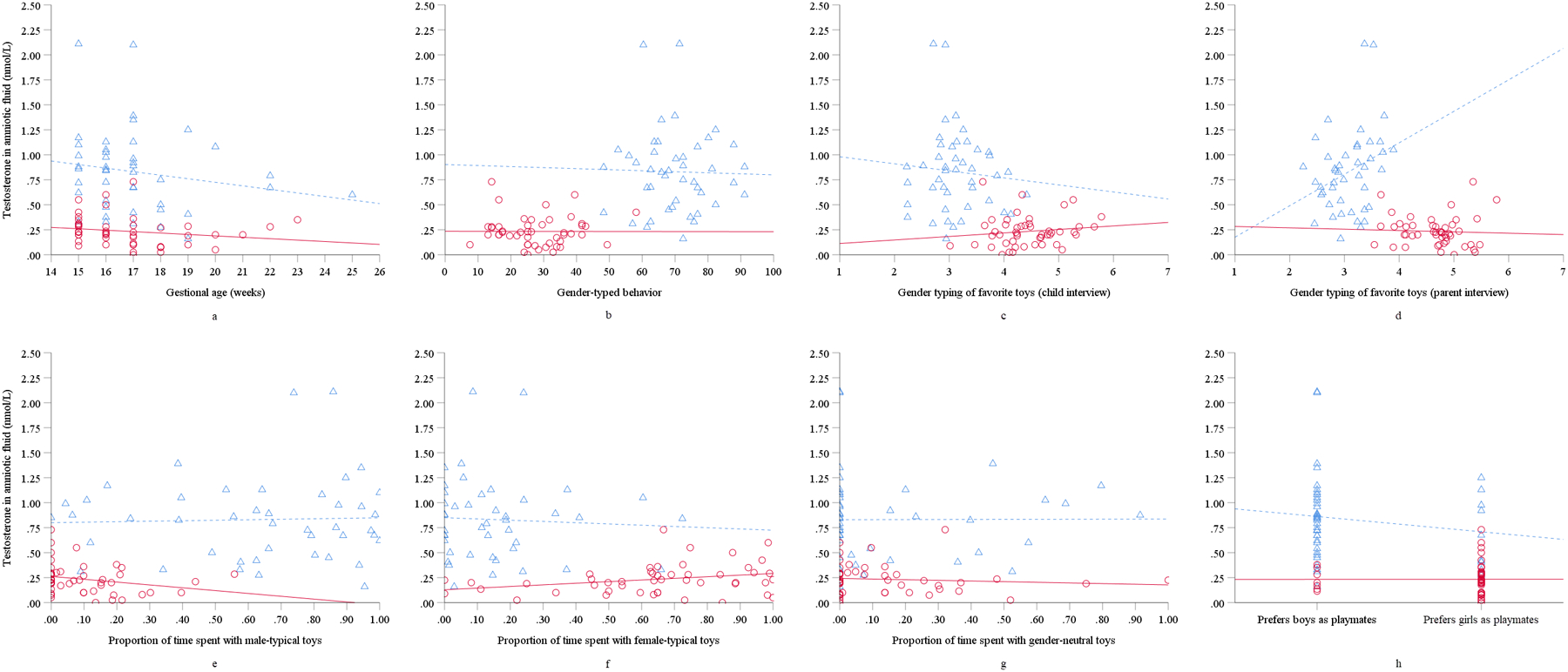
Scatter plots showing the relation between concentrations of amniotic fluid testosterone and gestational age at amniocentesis (Figure 1a), and between concentrations of amniotic fluid testosterone and the outcome variables (Figures 1b to 1h), for boys (triangles and dotted lines) and for girls (circles and solid lines).
We found the expected sex differences for the broad measure of children’s gender-typed behavior and for children’s toy and playmate preferences (Table 2). Boys scored higher (indicating more male-typical preferences) than girls on the broad measure of gender-typed behavior and spent more time playing with male-typical toys/less time playing with female-typical toys than girls. Girls scored higher than boys on the gender typing of favorite toys (child interview) and gender typing of favorite toys (parent interview) measures (higher scores, for both measures, indicate more female-typical/less male-typical preferences) and spent more time playing with female-typical toys/less time playing with male-typical toys than boys. Boys and girls spent similar amounts of time playing with gender-neutral toys. Regarding playmates, there was a sex difference in children’s preference for boys as playmates, χ2(1) = 39.05, p < .001, with 79.5% of boys compared to 14.6% of girls reporting a preference for boys as playmates.
Although we saw the hypothesized sex differences in amniotic fluid testosterone and in children’s gender-typed behavior and toy and playmate preferences scores, there were no significant relations, in the predicted direction, between amniotic fluid testosterone and any of the outcome measures (Table 3 and Figure 1). Two of the outcome measures related significantly to amniotic fluid testosterone, but both of these relations were in the direction opposite to that predicted and were no longer significant once the Bonferroni correction had been applied.
Table 3.
Within-sex correlations between amniotic fluid testosterone concentrations (nmol/L) and the outcome variables for typically developing children for whom testosterone had been measured in amniotic fluid.
| Boys n = 44 |
Girls n = 48 |
|
|---|---|---|
| Gender-typed behavior1 | −.03ns [−.29, .23] | .003ns [−.34, .33] |
| Gender typing of favorite toys (child interview)2 | −.09ns [−.33, .19] | .14ns, [−.21, .44] |
| Gender typing of favorite toys (parent interview)2 | .31* [.06, .51] | −.05ns, [−.50, .36] |
| Prefers boys as playmates | −.15ns [−.40, .13] | .002ns, [−.23, .19] |
| Proportion of time spent with male-typical toys | .04ns [−.21, .24] | −.24ns [−.42, −.05] |
| Proportion of time spent with female-typical toys | −.05ns [−.30, .20] | .29* [.06, .50] |
| Proportion of time spent with gender-neutral toys | .004ns [−.25, .30] | −.09ns [−.35, .15] |
Note.
= not significant (p > .05),
p ≤ .05.
Bias-corrected and accelerated (BCa) 95% confidence intervals (CIs), generated using 1,000 stratified bootstrap samples, are reported in square brackets.
Higher scores on this measure indicate more male-typical preferences.
Higher scores on this measure indicate more female-typical preferences.
Discussion
We conducted two studies to test the hypothesis that prenatal androgen exposure predicts children’s gender-typed behavior, including toy and playmate preferences. The first study, the CAH study, compared children with CAH to unaffected siblings and cousins. The second study, the amniotic testosterone study, related testosterone measured in amniotic fluid to gender-typed behavior and toy and playmate preferences in typically developing children. Importantly, particularly in light of issues regarding the replicability of research across the biological and social sciences (Ioannidis, 2005; Open Science Collaboration, 2015), our findings for the CAH study replicate and extend prior similar work. All outcome measures showed large and statistically significant sex differences in the expected direction. In addition, girls with CAH scored in a more male-typical direction on all of these measures, including measures based on self-report, parental reports, and behavioral observation. Also as expected, boys with and without CAH did not differ from one another on any of the measures. These findings strengthen prior conclusions that the increased early androgen exposure experienced by girls with CAH increases their male-typical, and decreases their female-typical, childhood gender-typed behavior, including their toy and playmate preferences (Berenbaum and Hines, 1992; Berenbaum and Snyder, 1995; Ehrhardt and Baker, 1974; Hines et al., 2004; Hines and Kaufman, 1994; Meyer-Bahlburg et al., 2004; Meyer-Bahlburg et al., 2006; Pasterski et al., 2011; Pasterski et al., 2015b; Servin et al., 2003; Slijper, 1984; Zucker et al., 1996; however, see Berenbaum and Snyder, 1995; Dittmann et al., 1990).
Furthermore, our findings appear to be uniform across the various informants and outcome measures employed. This suggests that researchers can select from among a range of measures and informants to suit their research situation. Initial reports of masculinized behavior in girls with CAH relied largely on parental reports (Ehrhardt and Baker, 1974; Money and Ehrhardt, 1973). Subsequently, it was suggested that parental reports might be unreliable, or influenced by parents’ awareness of their child’s condition and its physically masculinizing effects in girls (Fausto-Sterling, 1992; Quadagno et al., 1977). These suggestions made it important to observe the actual toy choices of girls with CAH in playrooms, and research that did so produced the same results as research based on parental reports (Berenbaum and Hines, 1992; Berenbaum and Snyder, 1995; Pasterski et al., 2005; Servin et al., 2003). The current results provide direct evidence that self-report, parental reports, and behavioral observation yield similar conclusions.
Our results also extend prior findings suggesting that girls with CAH show increased interest in boys as playmates. Although results of most prior studies have supported a similar conclusion (Ehrhardt and Baker, 1974; Hines and Kaufman, 1994; Meyer-Bahlburg et al., 2006; Pasterski et al., 2011; Servin et al., 2003), results of some studies did not (Berenbaum and Snyder, 1995; Dittmann et al., 1990). Thus, our findings, from a larger sample than has been studied before in regard to playmate preferences, strengthen the conclusion that girls with CAH do show increased male-typical playmate preferences as well as increased male-typical toy preferences.
Our findings for the amniotic testosterone study, like those for the CAH study, replicate previous reports of large and statistically significant sex differences on all of the outcome measures used. In addition, we saw the expected sex difference in testosterone, with concentrations of testosterone being significantly higher for males than females. In contrast to the results of the CAH study, however, the results of the amniotic testosterone study provide no support for a role of testosterone, at least when measured in amniotic fluid between 15 and 25 weeks’ gestation, in the development of children’s gender-typed behavior. Only 2 of the 14 within-sex correlations examined showed a significant relation to testosterone and both of these correlations were in the opposite direction to that predicted based on experimental research in non-human animals. In addition, all the within-sex correlations between amniotic fluid testosterone and later behavior that were in the predicted direction were small in magnitude (r < .10).
The lack of a predicted relation between amniotic fluid testosterone and any of our outcome measures may appear surprising, given other evidence that testosterone influences human behaviors that show sex differences. In addition, it contrasts with our findings in the CAH study for girls with CAH on the same outcome measures. Because amniotic fluid testosterone showed a sex difference similar in size to that seen by other researchers using a similar assay and because our behavioral measures showed large sex differences, these results are unlikely to be caused by inadequate measurement. The negative findings could be interpreted to suggest that the androgenic effects seen in CAH do not translate more broadly to human development or to less extreme variability in prenatal testosterone exposure. However, convergent evidence suggests that other causes of unusual prenatal androgen exposure also result in altered gender-typed behavior. For example, XY females who have been diagnosed with complete androgen insensitivity syndrome (CAIS; an X-linked, recessive condition characterized by impaired androgen receptor functioning) have been found to show increased female-typical and reduced male-typical play preferences (Hines et al., 2003; Jürgensen et al., 2007). In addition, a study of girls whose mothers, during pregnancy, were prescribed hormones that stimulated androgen receptors, found that these girls showed increased male-typical play (Ehrhardt and Money, 1967). Another study, this one of girls whose mothers, during pregnancy, were prescribed hormones that blocked androgen receptors, found that these girls showed reduced male-typical and increased female-typical play (Ehrhardt et al., 1977). Finally, anogenital distance at birth, which is larger in boys than in girls and which is influenced by prenatal androgen exposure, has been found to relate positively to male-typical gender role behavior, measured using the PSAI, in typically developing boys (Pasterski et al., 2015a).
Another possibility is that amniotic fluid testosterone may be a relatively insensitive measure of prenatal androgen exposure (Constantinescu and Hines, 2012). Over the past three decades, several research groups have related measures of amniotic fluid testosterone to children’s later gender-typed behaviors. Studies that have used samples of fewer than around 60 participants per group generally have not found significant correlations between amniotic fluid testosterone and the gender-typed behavior(s) under investigation, have found that the direction of one or more correlations was opposite to that predicted, or have found inconsistencies in the direction or strength of one or more correlations when comparing results for boys and girls (see e.g., Bergman et al., 2010; Grimshaw et al., 1995a; Grimshaw et al., 1995b; Knickmeyer et al., 2005a; Knickmeyer et al., 2005b; Kung et al., 2016; van de Beek et al., 2009). One research group has reported some significant within-sex relations between amniotic fluid testosterone and later gender-typed behaviors in samples similar in size to, or smaller than, ours, as well as in larger samples (around 100 participants per group). The studies using similarly-sized or smaller samples have found the predicted within-sex relations to amniotic fluid testosterone for autistic traits, attention to detail and empathy (Auyeung et al., 2012a; Auyeung et al., 2012b; Chapman et al., 2006). The studies of samples of over 100 participants of each sex have found the predicted within-sex relations for autistic traits and empathy, and for gender-typical childhood behavior (Auyeung et al., 2009a; Auyeung et al., 2009b; Chapman et al., 2006). Taken together, the evidence suggests that associations between amniotic fluid testosterone and human behavior, if they exist, may be small. Therefore, larger samples than have typically been used may be required to provide adequate statistical power to detect effects consistently.
Limitations
First, the use of amniotic fluid testosterone as a measure of normal variability in prenatal androgen exposure may not produce results that generalize to the wider population, because mothers who undergo amniocentesis are generally older than the average mother and may differ from other mothers in additional ways. Nevertheless, the resemblance of our basic findings (e.g., sex differences in our behavioral outcomes) to those reported by others provides some support for generalizability.
Second, the reliability of amniotic fluid testosterone as an index of prenatal androgen exposure may be limited. For instance, typically only a single amniotic fluid sample is collected, usually uncontrolled for time of day or gestational age, although in our study time of day was controlled to some extent by taking all amniotic fluid samples in the morning. The time during gestation when amniotic fluid samples are typically obtained also may not correspond precisely to the time when fetal testosterone is highest. Testosterone production in male fetuses peaks before gestational week 20 (Reyes et al., 1974; Reyes et al., 1973; Smail et al., 1981), and we obtained samples between weeks 15 and 25, with a mean of week 17. Although most prior studies obtained samples at similar gestational ages to the current study, one study focused exclusively on samples obtained prior to week 20 of gestation (van de Beek et al., 2009). That study, like the current study, did not find any significant relation between testosterone in amniotic fluid and children’s gender typed play behavior, however. Finally, while it has been assumed that testosterone concentrations in amniotic fluid are a proxy for testosterone concentrations in fetal blood (Baron-Cohen et al., 2004), the one study we are aware of that has investigated the relation reported no correlation between measures of testosterone in amniotic fluid and testosterone in fetal blood (Rodeck et al., 1985). Therefore, testosterone in amniotic fluid may not be a sufficiently powerful measure of prenatal androgen exposure to detect relations even to behaviors that show large sex differences, such as children’s gender-typed behavior and toy and playmate preferences, in samples similar in size to ours.
Third, there are limitations related to studying children with CAH. Although CAH influences androgen concentrations in girls beginning prenatally, it has additional consequences that also could potentially influence behavior. Notably, although postnatal hormone treatment is intended to normalize the hormone environment, this is not always successful. Therefore, children with CAH may experience higher or lower levels of glucocorticoids and/or androgens at one or more periods during postnatal life. These possible postnatal differences in hormones are unlikely to explain our results, however, because there is no evidence that either glucocorticoids or androgens after early infancy and before puberty influence gender-related play behavior in humans or other species. In addition, if consequences of CAH other than unusual androgen concentrations prenatally explained the behavioral changes seen in girls with CAH, similar effects would be expected in boys with CAH as well. This is because only girls with CAH experience unusually high androgen concentrations prenatally, whereas both boys and girls with CAH experience postnatal treatment and possible higher or lower levels of glucocorticoids or androgens postnatally.
Finally, we conducted two studies on relatively small groups of children. Nevertheless, we recruited a larger sample of children in our CAH study than has been recruited in most previous studies of play behavior in children with CAH, and the sample in our amniotic testosterone study is larger than that in the previous amniotic fluid testosterone studies showing the largest correlations between amniotic fluid testosterone and behavior (Auyeung et al., 2012a; Auyeung et al., 2012b; Grimshaw et al., 1995b). Importantly, both negative and positive results contribute to our understanding of the size, as well as the reliability, of relations between testosterone and gender-related behaviors, and our results are of interest not only on their own, but also in the context of prior findings (e.g., for meta-analytic studies).
Conclusions
Our primary goal was to examine the relation of prenatal androgen exposure to children’s gender-typed behavior and toy and playmate preferences. Consistent with prior research, we found that girls with CAH showed more male-typical behavior and preferences compared to unaffected girls. Our findings for gender-typed behavior and toy preferences are consistent with prior findings but add to understanding by showing that similar results are obtained across varied assessment methods and informants. In addition, prior studies have found some inconsistencies in outcomes for playmate preferences in girls with CAH. Our results accord with the majority, which have found that girls with CAH show increased interest in boys as playmates. Finally, we found no significant within-sex correlations, in the predicted direction, between amniotic fluid testosterone and any of our study measures, suggesting that amniotic fluid testosterone may be a relatively insensitive measure of prenatal androgen exposure. Research on typically developing children, using a more sensitive measure of early androgen exposure than that provided by measuring testosterone concentrations in amniotic fluid, would be useful.
Highlights.
Prenatal androgen exposure linked to gender-typed play behavior in girls with CAH
Girls with CAH showed increased preference for boys as playmates
Children without CAH showed large sex differences in gender-typed play behavior
Amniotic fluid testosterone did not relate to gender-typed play behavior
Amniotic fluid testosterone may not be a reliable measure of prenatal androgen
Acknowledgments
We would like to acknowledge the contributions of the following groups and individuals: Sue Elford and the Living with CAH support group; Kristin Bergman, Pampa Sarkar and Diana Adams; and all of the families whose participation made this study possible. This work was supported by the National Institute of Health Research (NIHR) Cambridge Biomedical Research Centre, United States Public Health Service National Institutes of Health grant numbers HD24542, MH073019 and MH073842, and the March of Dimes. Our funding sources had no involvement in study design; in the collection, analysis, and interpretation of the data; in the writing of the report; or in the decision to submit the article for publication.
Footnotes
Publisher's Disclaimer: This is a PDF file of an unedited manuscript that has been accepted for publication. As a service to our customers we are providing this early version of the manuscript. The manuscript will undergo copyediting, typesetting, and review of the resulting proof before it is published in its final form. Please note that during the production process errors may be discovered which could affect the content, and all legal disclaimers that apply to the journal pertain.
Declarations of interest: none.
References
- Arnold AP, 2009. The organizational-activational hypothesis as the foundation for a unified theory of sexual differentiation of all mammalian tissues. Hormones and Behavior 55, 570–578. [DOI] [PMC free article] [PubMed] [Google Scholar]
- Auyeung B, Ahluwalia J, Thomson L, Taylor K, Hackett G, O’Donnell KJ, Baron-Cohen S, 2012a. Prenatal versus postnatal sex steroid hormone effects on autistic traits in children at 18 to 24 months of age. Molecular Autism 3, 1–5. [DOI] [PMC free article] [PubMed] [Google Scholar]
- Auyeung B, Baron-Cohen S, Ashwin E, Knickmeyer R, Taylor K, Hackett G, 2009a. Fetal testosterone and autistic traits. British Journal of Psychology 100, 1–22. [DOI] [PubMed] [Google Scholar]
- Auyeung B, Baron-Cohen S, Ashwin E, Knickmeyer R, Taylor K, Hackett G, Hines M, 2009b. Fetal testosterone predicts sexually differentiated childhood behavior in girls and in boys. Psychological Science 20, 144–148. [DOI] [PMC free article] [PubMed] [Google Scholar]
- Auyeung B, Baron-Cohen S, Chapman E, Knickmeyer R, Taylor K, Hackett G, 2006. Foetal testosterone and the Child Systemizing Quotient. European Journal of Endocrinology 155, S123–S130. [Google Scholar]
- Auyeung B, Knickmeyer R, Ashwin E, Taylor K, Hackett G, Baron-Cohen S, 2012b. Effects of fetal testosterone on visuospatial ability. Archives of Sexual Behavior 41, 571–581. [DOI] [PubMed] [Google Scholar]
- Baron-Cohen S, Lutchmaya S, Knickmeyer R, 2004. Prenatal testosterone in mind: Amniotic fluid studies. MIT Press, Cambridge, MA. [Google Scholar]
- Berenbaum SA, Hines M, 1992. Early androgens are related to childhood sex-typed toy preferences. Psychological Science 3, 203–206. [Google Scholar]
- Berenbaum SA, Resnick SM, 1997. Early androgen effects on aggression in children and adults with congenital adrenal hyperplasia. Psychoneuroendocrinology 22, 505–515. [DOI] [PubMed] [Google Scholar]
- Berenbaum SA, Snyder E, 1995. Early hormonal influences on childhood sex-typed activity and playmate preferences: Implications for the development of sexual orientation. Developmental Psychology 31, 31–42. [Google Scholar]
- Berga SL, Nitsche JF, Braunstein GD, 2016. Endocrine changes in pregnancy, in: Melmed S, Polonsky KS, Larsen PR, Kronenberg HM (Eds.), Williams Textbook of Endocrinology, 13th ed. Elsevier, Philadelphia, pp. 831–848. [Google Scholar]
- Bergman K, Glover V, Sarkar P, Abbott DH, O’Connor TG, 2010. In utero cortisol and testosterone exposure and fear reactivity in infancy. Hormones and Behavior 57, 306–312. [DOI] [PMC free article] [PubMed] [Google Scholar]
- Brace RA, 1997. Physiology of amniotic fluid volume regulation. Clinical obstetrics and gynecology 40, 280–289. [DOI] [PubMed] [Google Scholar]
- Browne WV, Hindmarsh PC, Pasterski V, Hughes IA, Acerini CL, Spencer D, Neufeld S, Hines M, 2015. Working memory performance is reduced in children with congenital adrenal hyperplasia. Hormones and Behavior 67, 83–88. [DOI] [PMC free article] [PubMed] [Google Scholar]
- Carson DJ, Okuno A, Lee PA, Stetten G, Didolkar SM, Migeon CJ, 1982. Amniotic fluid steroid levels: Fetuses with adrenal hyperplasia, 46, XXY fetuses, and normal fetuses. American Journal of Diseases of Children 136, 218–222. [PubMed] [Google Scholar]
- Chapman E, Baron-Cohen S, Auyeung B, Knickmeyer R, Taylor K, Hackett G, 2006. Fetal testosterone and empathy: Evidence from the Empathy Quotient (EQ) and the “Reading the Mind in the Eyes” test. Social Neuroscience 1, 135–148. [DOI] [PubMed] [Google Scholar]
- Cherney ID, London K, 2006. Gender-linked differences in the toys, television shows, computer games, and outdoor activities of 5- to 13-year-old children. Sex Roles 54, 717–726. [Google Scholar]
- Cohen-Bendahan CCC, van de Beek C, Berenbaum SA, 2005. Prenatal sex hormone effects on child and adult sex-typed behavior: Methods and findings. Neuroscience & Biobehavioral Reviews 29, 353–384. [DOI] [PubMed] [Google Scholar]
- Cohen-Kettenis PT, 2010. Psychosocial and psychosexual aspects of disorders of sex development. Best Practice & Research: Clinical Endocrinology & Metabolism 24, 325–334. [DOI] [PubMed] [Google Scholar]
- Cohen J, 1988. Statistical power analysis for the behavioral sciences, 2nd ed. Lawrence Erlbaum Associates, Inc., Hillsdale, NJ. [Google Scholar]
- Constantinescu M, Hines M, 2012. Relating prenatal testosterone exposure to postnatal behavior in typically developing children: Methods and findings. Child Development Perspectives 6, 407–413. [Google Scholar]
- Dattani MT, Gevers EF, 2016. Endocrinology of fetal development, in: Melmed S, Polonsky KS, Larsen PR, Kronenberg HM (Eds.), Williams Textbook of Endocrinology, 13th ed. Elsevier, Philadelphia, pp. 849–892. [Google Scholar]
- Davis JTM, Hines M, 2020. How large are gender differences in toy preferences? A systematic review and meta-analysis of toy preference research. Archives of Sexual Behavior 49, 373–394. [DOI] [PMC free article] [PubMed] [Google Scholar]
- Dittmann RW, Kappes MH, Kappes ME, Börger D, Stegner H, Willig RH, Wallis H, 1990. Congenital adrenal hyperplasia I: Gender-related behavior and attitudes in female patients and sisters. Psychoneuroendocrinology 15, 401–420. [DOI] [PubMed] [Google Scholar]
- Ehrhardt AA, Baker SW, 1974. Fetal androgens, human central nervous system differentiation, and behavior sex differences, in: Friedman RC, Richart RM, van de Wiele RL, Stern LO (Eds.), Sex Differences in Behavior. John Wiley & Sons, Oxford, pp. 33–51. [Google Scholar]
- Ehrhardt AA, Epstein R, Money J, 1968. Fetal androgens and female gender identity in the early-treated adrenogenital syndrome. Johns Hopkins Medical Journal 122, 165–167. [PubMed] [Google Scholar]
- Ehrhardt AA, Grisanti GC, Meyer-Bahlburg HFL, 1977. Prenatal exposure to medroxyprogesterone acetate (MPA) in girls. Psychoneuroendocrinology 2, 391–398. [DOI] [PubMed] [Google Scholar]
- Ehrhardt AA, Money J, 1967. Progestin-induced hermaphroditism: IQ and psychosexual identity in a study of ten girls. Journal of Sex Research 3, 83–100. [Google Scholar]
- Fausto-Sterling A, 1992. Myths of gender: Biological theories about women and men, 2nd ed. Basic Books, New York. [Google Scholar]
- Field A, 2017. Discovering statistics using IBM SPSS Statistics, 5th ed. SAGE Publications, London. [Google Scholar]
- Forest MG, Bétuel H, Couillin P, Boué A, David M, Floret D, Francois R, Guibaud P, Plauchu H, Rappaport R, 1981. Prenatal diagnosis of congenital adrenal hyperplasia (CAH) due to 21-hydroxylase deficiency by steroid analysis in the amniotic fluid of mid-pregnancy: Comparison with HLA typing in 17 pregnancies at risk for CAH. Prenatal diagnosis 1, 197–207. [DOI] [PubMed] [Google Scholar]
- Frisén L, Nordenström A, Falhammar H, Filipsson H, Holmdahl G, Janson PO, Thorén M, Hagenfeldt K, Möller A, Nordenskjöld A, 2009. Gender role behavior, sexuality, and psychosocial adaptation in women with congenital adrenal hyperplasia due to CYP21A2 deficiency. Journal of Clinical Endocrinology & Metabolism 94, 3432–3439. [DOI] [PubMed] [Google Scholar]
- Golombok S, Rust J, 1993. The Pre-School Activities Inventory: A standardized assessment of gender role in children. Psychological Assessment 5, 131–136. [Google Scholar]
- Golombok S, Rust J, Zervoulis K, Croudace T, Golding J, Hines M, 2008. Developmental trajectories of sex-typed behavior in boys and girls: A longitudinal general population study of children aged 2.5 to 8 years. Child Development 79, 1583–1593. [DOI] [PubMed] [Google Scholar]
- Grimshaw GM, Bryden MP, Finegan J-AK, 1995a. Relations between prenatal testosterone and cerebral lateralization in children. Neuropsychology 9, 68–79. [Google Scholar]
- Grimshaw GM, Sitarenios G, Finegan J-AK, 1995b. Mental rotation at 7 years: Relations with prenatal testosterone levels and spatial play experiences. Brain and Cognition 29, 85–100. [DOI] [PubMed] [Google Scholar]
- Hall CM, Jones JA, Meyer-Bahlburg HFL, Dolezal C, Coleman M, Foster P, Price DA, Clayton PE, 2004. Behavioral and physical masculinization are related to genotype in girls with congenital adrenal hyperplasia. Journal of Clinical Endocrinology & Metabolism 89, 419–424. [DOI] [PubMed] [Google Scholar]
- Hines M, 2004. Brain Gender. Oxford University Press, New York. [Google Scholar]
- Hines M, 2015. Gendered Development, in: Lamb ME, Lerner RM (Eds.), Handbook of Child Psychology and Developmental Science, 7th ed. John Wiley & Sons, Inc., Hoboken, NJ, pp. 1–46. [Google Scholar]
- Hines M, Ahmed SF, Hughes IA, 2003. Psychological outcomes and gender-related development in complete androgen insensitivity syndrome. Archives of Sexual Behavior 32, 93–101. [DOI] [PubMed] [Google Scholar]
- Hines M, Brook C, Conway GS, 2004. Androgen and psychosexual development: Core gender identity, sexual orientation, and recalled childhood gender role behavior in women and men with congenital adrenal hyperplasia (CAH). Journal of Sex Research 41, 75–81. [DOI] [PubMed] [Google Scholar]
- Hines M, Davis J, 2018. Sex hormones and children’s gender-typed toy play, in: Weisgram ES, Dinella LM(Eds.), Gender typing of children’s toys: How early play experiences impact development. American Psychological Association, Washington, DC, pp. 97–120. [Google Scholar]
- Hines M, Kaufman FR, 1994. Androgen and the development of human sex-typical behavior: Rough-and-tumble play and sex of preferred playmates in children with congenital adrenal hyperplasia (CAH). Child Development 65, 1042–1053. [PubMed] [Google Scholar]
- Hines M, Pasterski V, Spencer D, Neufeld S, Patalay P, Hindmarsh PC, Hughes IA, Acerini CL, 2016. Prenatal androgen exposure alters girls’ responses to information indicating gender-appropriate behaviour. Philosophical Transactions of the Royal Society of London B: Biological Sciences 371, 20150125. [DOI] [PMC free article] [PubMed] [Google Scholar]
- IBM Corp, 2017. IBM SPSS Statistics for Windows 25. IBM Corp, Armonk, NY. [Google Scholar]
- Ioannidis JPA, 2005. Why most published research findings are false. PLoS Medicine 2, e124. [DOI] [PMC free article] [PubMed] [Google Scholar]
- Jürgensen M, Hiort O, Holterhus P-M, Thyen U, 2007. Gender role behavior in children with XY karyotype and disorders of sex development. Hormones and Behavior 51, 443–453. [DOI] [PubMed] [Google Scholar]
- Knickmeyer R, Baron-Cohen S, Raggatt P, Taylor K, 2005a. Foetal testosterone, social relationships, and restricted interests in children. Journal of Child Psychology and Psychiatry 46, 198–210. [DOI] [PubMed] [Google Scholar]
- Knickmeyer R, Wheelwright S, Taylor K, Raggatt P, Hackett G, Baron-Cohen S, 2005b. Gender-typed play and amniotic testosterone. Developmental Psychology 41, 517–528. [DOI] [PubMed] [Google Scholar]
- Kung KTF, Spencer D, Pasterski V, Neufeld S, Glover V, O’Connor TG, Hindmarsh PC, Hughes IA, Acerini CL, Hines M, 2016. No relationship between prenatal androgen exposure and autistic traits: Convergent evidence from studies of children with congenital adrenal hyperplasia and of amniotic testosterone concentrations in typically developing children. Journal of Child Psychology and Psychiatry 57, 1455–1462. [DOI] [PMC free article] [PubMed] [Google Scholar]
- Leaper C, 2013. Gender development during childhood, in: Zelazo PD (Ed.), The Oxford Handbook of Developmental Psychology, pp. 326–377. [Google Scholar]
- Maccoby EE, Jacklin CN, 1987. Gender Segregation in Childhood, in: Reese HW (Ed.), Advances in Child Development and Behavior. JAI, pp. 239–287. [DOI] [PubMed] [Google Scholar]
- Mair P, Wilcox RR, 2019. Robust statistical methods in R using the WRS2 package 1.0–0 [DOI] [PubMed]
- Mathews GA, Fane BA, Conway GS, Brook CGD, Hines M, 2009. Personality and congenital adrenal hyperplasia: Possible effects of prenatal androgen exposure. Hormones and Behavior 55, 285–291. [DOI] [PMC free article] [PubMed] [Google Scholar]
- McCarthy MM, DeVries GJ, Forger NG, 2009. Sexual differentiation of the brain: Mode, mechanisms, and meaning, in: Pfaff DW, Arnold AP, Etgen AM, Fahrbach SE, Rubin RT (Eds.), Hormones, brain and behavior. Academic Press, San Diego, CA, pp. 1707–1744. [Google Scholar]
- Meaney MJ, 1988. The sexual differentiation of social play. Trends in Neurosciences 11, 54–58. [DOI] [PubMed] [Google Scholar]
- Meyer-Bahlburg HFL, Dolezal C, Baker SW, Carlson AD, Obeid JS, New MI, 2004. Prenatal androgenization affects gender-related behavior but not gender identity in 5–12-year-old girls with congenital adrenal hyperplasia. Archives of Sexual Behavior 33, 97–104. [DOI] [PubMed] [Google Scholar]
- Meyer-Bahlburg HFL, Dolezal C, Baker SW, Ehrhardt AA, New MI, 2006. Gender development in women with congenital adrenal hyperplasia as a function of disorder severity. Archives of Sexual Behavior 35, 667–684. [DOI] [PubMed] [Google Scholar]
- Meyer-Bahlburg HFL, Dolezal C, Baker SW, New MI, 2008. Sexual orientation in women with classical or non-classical congenital adrenal hyperplasia as a function of degree of prenatal androgen excess. Archives of Sexual Behavior 37, 85–99. [DOI] [PubMed] [Google Scholar]
- Money J, Ehrhardt AA, 1973. Man and woman, boy and girl: Differentiation and dimorphism of gender identity from conception to maturity. Johns Hopkins University Press, Baltimore, MD. [Google Scholar]
- Nordenström A, Servin A, Bohlin G, Larsson A, Wedell A, 2002. Sex-typed toy play behavior correlates with the degree of prenatal androgen exposure assessed by CYP21 genotype in girls with congenital adrenal hyperplasia. Journal of Clinical Endocrinology & Metabolism 87, 5119–5124. [DOI] [PubMed] [Google Scholar]
- Open Science Collaboration, 2015. Estimating the reproducibility of psychological science. Science 349, aac4716. [DOI] [PubMed] [Google Scholar]
- Pang S, Levine LS, Cederqvist LL, Fuentes M, Riccardi VM, Holcombe JH, Nitowsky HM, Sachs G, Anderson CE, Duchon MA, Owens R, Merkatz I, New MI, 1980. Amniotic Fluid Concentrations of Δ5 and Δ4 Steroids in Fetuses with Congenital Adrenal Hyperplasia due to 21 Hydroxylase Deficiency and in Anencephalic Fetuses. The Journal of Clinical Endocrinology & Metabolism 51, 223–229. [DOI] [PubMed] [Google Scholar]
- Pasterski V, Acerini CL, Dunger DB, Ong KK, Hughes IA, Thankamony A, Hines M, 2015a. Postnatal penile growth concurrent with mini-puberty predicts later sex-typed play behavior: Evidence for neurobehavioral effects of the postnatal androgen surge in typically developing boys. Hormones and Behavior 69, 98–105. [DOI] [PubMed] [Google Scholar]
- Pasterski V, Geffner ME, Brain C, Hindmarsh P, Brook C, Hines M, 2005. Prenatal hormones and postnatal socialization by parents as determinants of male-typical toy play in girls with congenital adrenal hyperplasia. Child Development 76, 264–278. [DOI] [PubMed] [Google Scholar]
- Pasterski V, Geffner ME, Brain C, Hindmarsh P, Brook C, Hines M, 2011. Prenatal hormones and childhood sex segregation: Playmate and play style preferences in girls with congenital adrenal hyperplasia. Hormones and Behavior 59, 549–555. [DOI] [PMC free article] [PubMed] [Google Scholar]
- Pasterski V, Hindmarsh P, Geffner ME, Brook C, Brain C, Hines M, 2007. Increased aggression and activity level in 3- to 11-year-old girls with congenital adrenal hyperplasia (CAH). Hormones and Behavior 52, 368–374. [DOI] [PMC free article] [PubMed] [Google Scholar]
- Pasterski V, Zucker KJ, Hindmarsh PC, Hughes IA, Acerini C, Spencer D, Neufeld S, Hines M, 2015b. Increased cross-gender identification independent of gender role behavior in girls with congenital adrenal hyperplasia: Results from a standardized assessment of 4- to 11-year-old children. Archives of Sexual Behavior, 1–13. [DOI] [PubMed] [Google Scholar]
- Quadagno DM, Briscoe R, Quadagno JS, 1977. Effect of perinatal gonadal hormones on selected nonsexual behavior patterns: A critical assessment of the nonhuman and human literature. Psychological Bulletin 84, 62–80. [PubMed] [Google Scholar]
- R Core Team, 2019. R: A language and environment for statistical computing. R Foundation for Statistical Computing, Vienna, Austria. [Google Scholar]
- Reyes FI, Boroditsky RS, Winter JSD, Faiman C, 1974. Studies on human sexual development. II. Fetal and maternal serum gonadotropin and sex steroid concentrations. The Journal of Clinical Endocrinology & Metabolism 38, 612–617. [DOI] [PubMed] [Google Scholar]
- Reyes FI, Winter JSD, Faiman C, 1973. Studies on Human Sexual Development. I. Fetal Gonadal and Adrenal Sex Steroids1. The Journal of Clinical Endocrinology & Metabolism 37, 74–78. [DOI] [PubMed] [Google Scholar]
- Robinson JD, Judd HL, Young PE, Jones OW, Yen SSC, 1977. Amniotic fluid androgens and estrogens in mid-gestation. The Journal of Clinical Endocrinology & Metabolism 45, 755–761. [DOI] [PubMed] [Google Scholar]
- Rodeck CH, Gill D, Rosenberg DA, Collins WP, 1985. Testosterone levels in midtrimester maternal and fetal plasma and amniotic fluid. Prenatal diagnosis 5, 175–181. [DOI] [PubMed] [Google Scholar]
- Servin A, Nordenström A, Larsson A, Bohlin G, 2003. Prenatal androgens and gender-typed behavior: A study of girls with mild and severe forms of congenital adrenal hyperplasia. Developmental Psychology 39, 440–450. [DOI] [PubMed] [Google Scholar]
- Slijper FME, 1984. Androgens and gender role behaviour in girls with congenital adrenal hyperplasia (CAH), in: De Vries GJ, De Bruin JPC, Uylings HBM, Corner MA (Eds.), Progress in Brain Research. Elsevier, the Netherlands, pp. 417–422. [DOI] [PubMed] [Google Scholar]
- Smail PJ, Reyes FI, Winter JSD, Faiman C, 1981. The fetal hormonal environment and its effect on the morphogenesis of the genital system, in: Kogan SJ, Hafez ESE (Eds.), Pediatric Andrology. Martinus Nijhoff, The Hague, pp. 9–19. [Google Scholar]
- Speiser PW, Arlt W, Auchus RJ, Baskin LS, Conway GS, Merke DP, Meyer-Bahlburg HFL, Miller WL, Murad MH, Oberfield SE, White PC, 2018. Congenital adrenal hyperplasia due to steroid 21-hydroxylase deficiency: An Endocrine Society clinical practice guideline. Journal of Clinical Endocrinology & Metabolism 103, 4043–4088. [DOI] [PMC free article] [PubMed] [Google Scholar]
- Spencer D, Pasterski V, Neufeld S, Glover V, O’Connor TG, Hindmarsh PC, Hughes IA, Acerini CL, Hines M, 2017. Prenatal androgen exposure and children’s aggressive behavior and activity level. Hormones and Behavior 96, 156–165. [DOI] [PMC free article] [PubMed] [Google Scholar]
- Stewart PM, Newell-Price JDC, 2016. The adrenal cortex, in: Melmed S, Polonsky KS, Larsen PR, Kronenberg HM (Eds.), Williams Textbook of Endocrinology, 13th ed. Elsevier, Philadelphia, pp. 489–555. [Google Scholar]
- The SOCR Team, 2002, 2019. Statistics Online Computational Resource. University of California, Los Angeles, Los Angeles, CA. [Google Scholar]
- Todd BK, Fischer RA, Di Costa S, Roestorf A, Harbour K, Hardiman P, Barry JA, 2018. Sex differences in children’s toy preferences: A systematic review, meta-regression, and meta-analysis. Infant and Child Development 27, e2064. [Google Scholar]
- van de Beek C, van Goozen SHM, Buitelaar JK, Cohen-Kettenis PT, 2009. Prenatal sex hormones (maternal and amniotic fluid) and gender-related play behavior in 13-month-old infants. Archives of Sexual Behavior 38, 6–15. [DOI] [PubMed] [Google Scholar]
- Wechsler D, 1967/2002. Wechsler Primary and Preschool Scale of Intelligence - Third edition (WPPSI-III). Harcourt Assessment, San Antonio, TX. [Google Scholar]
- Wechsler D, 2003. Wechsler Intelligence Scale for Children - 4th Edition (WISC-IV). Harcourt Assessment, San Antonio, TX. [Google Scholar]
- Wilcox RR, Tian TS, 2011. Measuring effect size: a robust heteroscedastic approach for two or more groups. Journal of Applied Statistics 38, 1359–1368. [Google Scholar]
- Zucker KJ, Bradley SJ, Oliver G, Blake J, Fleming S, Hood J, 1996. Psychosexual Development of Women with Congenital Adrenal Hyperplasia. Hormones and Behavior 30, 300–318. [DOI] [PubMed] [Google Scholar]