



Abstract

We studied the binding energies of O species on face-centered-cubic Pt3M nanoparticles (NPs) with a Pt-skin layer using density functional theory calculations, where M is Co, Ni, or Cu. It is desirable to express the property by structural parameters rather than by calculated electronic structures such as the d-band center. A generalized coordination number (GCN) is an effective descriptor to predict atomic or molecular adsorption energy on Pt-NPs. The GCN was extended to the prediction of highly active sites for oxygen reduction reaction. However, it failed to explain the O binding energies on Pt-skin Pt150M51-NPs. In this study, we introduced an element-based GCN, denoted as GCNA–B, and considered it as a descriptor for supervised learning. The obtained regression coefficients of GCNPt–Pt were smaller than those of the other GCNA–B. With increasing M atoms in the subsurface layer, GCNPt–M, GCNM–Pt, and GCNM–M increased. These factors could reproduce the calculated result that the O binding energies of the Pt-skin Pt150M51-NPs were less negative than those of the Pt201-NPs. Thus, GCNA–B explains the ligand effect of the O binding energy on the Pt-skin Pt150M51-NPs.
Introduction
To date, the band center of d-orbitals (d-band center) estimated from the partial density states of a catalyst is regarded as a good descriptor of atomic or molecular adsorption in various catalytic reactions.1−8 There is a volcano-type relationship between oxygen reduction reaction (ORR) activity and oxygen binding energy.9−11 Tuning the adsorption energy or d-band center by alloying the catalyst is one of the important measures for enhancing the ORR activity of a catalyst. Recently, supervised learning (SL) studies using electronic structure descriptors, such as the d-band center, have been performed for predicting the atomic or molecular adsorption energy.12−15 To avoid the high computational cost required for density functional theory (DFT) calculations, simplified slab models are typically used to investigate the adsorption properties of small molecules on alloy catalysts. However, the calculation in the real-system nanoparticle (NP) models is important to analyze the heterogeneity of adsorption sites in nanoparticle catalysts. To date, although large and complicated systems, including NP models,16−31 have been investigated, to the best of our knowledge, a detailed analysis of the adsorption properties of alloy NPs with a few hundred atoms has not performed due to the requirement of large computational resources. Multinary alloys have a high degree of freedom in atomic configurations, compositions, sizes, and shapes, leading to different adsorption properties. Therefore, the development of a method for predicting the adsorption properties of alloy catalysts at a reasonable computational cost is important. A generalized coordination number (GCN) proposed by Calle-Vallejo et al. has been successfully used to estimate the adsorption energies of oxygen- and hydrogen-containing adsorbates instead of the d-band center.32−35 A coordination number (CN) is the number of the nearest neighbor atoms, whereas GCN includes information about the second nearest neighbor atoms to the atoms at the adsorption site. By expanding GCN, a clear and rapid analysis of adsorption and related properties can be realized. For example, GCN is applied to microkinetic models for analyzing the mass activity of Pt-NPs for the ORR.36 However, studies on the application of GCN are limited to monometallic systems. There are several types of adsorption sites for the constituent elements. For example, A–A, B–B, and A–B bridge sites are considered in A–B alloy. The prediction of the adsorption energy becomes difficult by alloying. As a first step, alloy NPs, in which the surface is composed of a single element, such as core–shell and skin layer configuration, are focused in this study.
Pt-skin alloy NPs have been widely studied as electrocatalysts for polymer electrolyte fuel cells9,10,37−39 to reduce the usage of Pt using alloying elements and enhance the ORR activity. Several attempts have been made for the development of better ORR catalysts. The alloy NPs prepared by size- and shape-controlled syntheses exhibited high ORR activity.17,40−43 Geometric and electronic structures of alloy NPs were examined by experimental44−46 and theoretical studies47−51 for understanding the ORR mechanism. Via computational screening of Pt-based core–shell NPs, 3d transition metals (TMs) favorable for alloying could be determined to enhance the stability and activity of catalysts.52 The GCN studies were extended to the prediction of the ORR activity of Pt-NPs and Pt-based alloy NPs.53−55 The coordination–activity relationship was analyzed based on the relationship between the experimental ORR activity and adsorption energy, suggesting an optimal GCN.53 However, the suggested GCN is mostly out of the range of that found for typical NPs and in the range of that obtained for unusual nanostructures including rod-like nanostructures.54,55 Therefore, alloying, which changes the electronic structure of the adsorption site from monometallic to bi- or multimetallic even if the GCN is the same, will be a practical and effective option to enhance the activity of the ORR catalysts. Strain and ligand effects influence the downshift of the d-band center in Pt-skin and core–shell alloy NPs. Alloying Pt with an element of smaller atomic radius leads to compressive strain. To consider this effect, the ratio of average interatomic distances between bulk and NP models is multiplied by the GCN as a strain effect.56 The compressive strain results in a modified GCN that is larger than the original GCN.57 On the other hand, the ligand effect has not been discussed in literature. During the study of core–shell NPs, preparing a few Pt layers near the surface of the NPs prevents the ligand effect on atomic or molecular adsorption. Investigation of the ligand effect may lead to further understanding of the adsorption properties of alloy NPs.
Herein, we studied the ligand effect in Pt-skin Pt3M-NPs, where M is Co, Ni, or Cu, on the O binding energies using DFT calculations. SL was performed to determine the descriptors that could explain the binding energy of O on the Pt3M-NPs with Pt-skin configuration.
Results and Discussion
Models
The TM-NP models were assumed to have truncated octahedral face-centered-cubic (fcc) structures, as shown in Figure 1a. In Pt3Ni-NPs, the activity of {111}-bound NPs was higher than that of {100}-bound NPs.41−43 Different facets should be considered during the analysis of the O binding energy. Examining the stability has revealed that the Pt surface is preferred in PtxM1–x-NPs.58,59 Pt-skin configurations of Pt3M-NPs have been found to be more stable than solid–solution configurations.60 The Pt-skin covered the core consisting of 79 atoms. We considered the random structure for the core. Warren–Cowley parameter,61 which represents the homogeneity of a random structure, was used. When this parameter is zero, the core shows the random structure. Detailed information on the construction of Pt-skin configurations is provided in ref (60). The vacuum space was set to >12 Å to avoid interactions with the neighboring NPs in an image cell.15 A cubic unit cell with a lattice parameter of 27.70 Å was used. Figure 1b,c,d shows the on-top, bridge, and hollow sites of a Pt201-NP model, respectively. Herein, six unique atoms in the surface layer of Pt201-NPs were identified by their symmetry, which defined all the unique adsorption sites. The total number of the on-top, bridge, three-fold hollow (fcc and hcp), and four-fold hollow sites was six, nine, six (three and three), and one, respectively. The characteristics, such as average CN and GCN, of each adsorption site are summarized in Table S1. The O binding energy on the NPs was calculated by
 |
1 |
where εNP–O, εNP, and εO represent the total energy of O-adsorbed NPs, isolated NPs, and a single O atom, respectively. The energy of the single O atom was calculated in a cubic unit cell with a lattice parameter of 8 Å. In most cases, the dissociative adsorption of O2 was involved.9−11,62 The heat of adsorption of O2 was calculated by subtracting half the dissociative energy of O2 from εbind.63,64 All the values are equally shifted with half the dissociative energy of O2. In the regression equation, the intercept is changed by the handling.
Figure 1.

(a) Pt-skin Pt150M51-NP model and (b) on-top, (c) bridge, and (d) hollow adsorption sites of TM201-NPs. The surface surrounded by cyan and green lines corresponds to {100} and {111} facets. Orange, cyan, and green symbols represent the adsorption sites on the ridge (T1x, B1x), in the {100} facet (T2x, B2x, H2x), and in the {111} facet (T3x, B3x, H3x), respectively.
O Binding Energy on Pt150M51-NPs
There are a total of 674 adsorption sites on TM201-NPs and herein, we have investigated 22 unique adsorption sites based on their symmetry, as shown in Figure 1. In some cases of Pt201-NPs, O migrated from the initial adsorption site to another adsorption site after geometry optimization. Especially, this tendency was significant for the bridge sites in the {111} facets, which was consistent with the results of a slab model study.64,65 In the Pt-skin configuration of Pt3M-NPs, the substitution of Pt in the subsurface layer by M broke the symmetry. However, calculating all sites of alloy NP is hardly realistic owing to limited computational resources. The Pt atoms in the surface layer showed a variety of coordination with Pt and M. Hereinafter, the CN by applying the subdivision of elements is denoted as CNA–B. For 22 adsorption sites of Pt150M51-NPs, there are many combinations of CNPt–Pt and CNPt–M. We selected 155 unique adsorption sites from the 674 sites in each Pt-skin Pt150M51-NP. In most cases, O migrated to other adsorption sites after geometry optimization. The cases, in which O migrated from the bridge site to the hollow site, were treated as the hollow site in the analysis. The migrated cases were regarded as the corresponding adsorption sites, where the overlapping adsorption sites were excluded. The characteristic of the bridge sites in the {111} facet was continuous even when the atoms in the subsurface layer were changed from Pt to M. We prepared a total of 138 bridge sites in the {111} facet. O remained at the initial adsorption sites only in four of the 138 cases investigated.
Figure 2 shows the O binding energies on the on-top, bridge, three-fold hollow, and four-fold hollow sites as a function of the GCN. The specific values of binding energies, GCN, and d-band centers are provided in Tables S3–S14. The strongest adsorption site of the Pt-NPs is the bridge site on the ridge (εbind = −4.558 eV), which is consistent with the results of a previously reported NP model study.65 The O binding energies on the on-top sites of Pt-NPs depend on the GCN; this finding is consistent with the results of GCN studies.32−35 On the other hand, the O binding energies on the bridge and hollow sites do not significantly depend on the GCN. The d-band center of the Pt150M51-NPs is downshifted as compared to that of the Pt201-NPs with some exceptions. In most cases, the O binding energies on the Pt150M51-NPs are less negative than those on the Pt201-NPs. With an increase in the GCN, the O binding energies on the Pt150M51-NPs upshift, which is similar to the case of the O binding energy on Pt201-NPs with exception of H33 sites. However, the O binding energies are distributed linearly for the same GCN. The distribution of the O binding energy depends on the base metal M.
Figure 2.

O binding energies on the on-top, bridge, and hollow sites of Pt201- and Pt-skin Pt150M51-NPs as a function of the generalized coordination number.
Simple Linear Regression by GCN
We conducted a simple linear regression analysis of the O binding energies on Pt150M51-NPs using GCN. To increase the number of samples, the data for the Pt-skin Pt150M51-NPs were combined with those for the Pt201-NPs. We separately considered the on-top, bridge, and three-fold hollow sites. The number of samples for the four-fold hollow site (= eight) were insufficient for dividing the data into test and training sets during the validation of SL. A study of the NO adsorption on TM405-NPs revealed that the second nearest neighbor TM atoms for NO directly affected the adsorption energy on the bridge sites in the {111} facet.15 In addition, the buckling parameters were large for the bridge sites in the {111} facet. We separately considered the O adsorption on the bridge sites in the {111} facet and on the other bridge sites. The number of samples for the bridge sites in the {111} facet (= four) were insufficient for the SL. We repeated the hold-out validation method five times. Figure 3 shows a representative comparison between the O binding energies predicted by GCN and those calculated by DFT for the Pt-skin Pt150Co51-NPs. The comparisons for the Pt-skin Pt150Ni51- and Pt150Cu51-NPs are shown in Figures S2 and S3, respectively. When the GCN is specified, the prediction leads to the same O binding energy. Table 1 shows the average values and standard deviations of predictive squared correlation coefficients (R2test) and mean absolute error (MAE) for the test set of the simple linear regression, and the coefficients of determination and MAE for the training set are shown in Table S15. The average values of R2test for the on-top and bridge sites were higher than 0.7, while those for the three-fold hollow sites were lower than 0.7 with an exception. Especially, R2test for the on-top sites was the highest in the considered adsorption sites. On the other hand, MAE for the on-top sites was the largest in the considered adsorption sites, which is opposite to the evaluation of R2test. The regression equation fitting was sensitive to the evaluation index.
Figure 3.

Comparison between the O binding energies predicted by simple linear regression and those calculated by DFT for Pt201+Pt150Co51.
Table 1. Predictive Squared Correlation Coefficients and Mean Absolute Error for the Test Set of Simple Linear Regression.
|
R2test | |||
|---|---|---|---|
| site | Pt+Pt3Co | Pt+Pt3Ni | Pt+Pt3Cu |
| on-top | 0.822 ± 0.080 | 0.826 ± 0.064 | 0.787 ± 0.093 |
| bridge | 0.844 ± 0.032 | 0.745 ± 0.114 | 0.749 ± 0.169 |
| three-fold fcc hollow | 0.790 ± 0.050 | 0.671 ± 0.188 | 0.601 ± 0.083 |
| three-fold hcp hollow | 0.646 ± 0.137 | 0.551 ± 0.137 | 0.674 ± 0.065 |
| MAE
(meV) | |||
|---|---|---|---|
| site | Pt+Pt3Co | Pt+Pt3Ni | Pt+Pt3Cu |
| on-top | 79.86 ± 15.83 | 60.22 ± 9.24 | 78.16 ± 15.73 |
| bridge | 35.77 ± 4.18 | 32.67 ± 13.51 | 46.79 ± 11.13 |
| three-fold fcc hollow | 35.06 ± 6.11 | 54.49 ± 12.21 | 36.18 ± 6.81 |
| three-fold hcp hollow | 51.98 ± 16.21 | 36.86 ± 7.38 | 37.04 ± 2.26 |
Element-Based Generalized Coordination Number
The CNA–B was divided into certain types, which were investigated by experimental methods including the extended X-ray absorption fine structure.66,67 The subdivision of elements was applied to determine element-based GCN (GCNA–B) as follows
 |
2 |
where CNmax represents the value reported in ref (32) and GCNA–B satisfies the following relationship
 |
3 |
Herein, A and B correspond to Pt or M. Four types of GCNA–B’s, such as GCNPt–Pt, GCNPt–M, GCNM–Pt, and GCNM–M, were generated. The specific values are shown in Tables S3–S14. The nearest neighbor atoms to the O-adsorbed Pt atoms are mainly Pt atoms because the skin layer consists of only Pt atoms. Eventually, the values of GCNPt–Pt are larger than those of the other GCNA–B. We performed multiple regression analyses of the O binding energies on Pt-skin Pt150M51-NPs using GCNA–B. Figure 4 shows a representative comparison between the O binding energies predicted by SL and those calculated by DFT for the Pt-skin Pt150M51-NPs. The O binding energies predicted by SL well matched those evaluated by DFT. Table 2 shows the values of R2test and MAE for the test set, and the coefficients of determination and MAE for the training set are presented in Table S17. Compared with the values of the simple linear regression (Table 1), the values of the multiple regression were better. The adjusted R2test values of the multiple regression were higher than those of the simple linear regression.
Figure 4.

Comparison between the O binding energies predicted by multiple regression and those calculated by DFT for (a) Pt201+Pt150Co51, (b) Pt201+Pt150Ni51, and (c) Pt201+Pt150Cu51.
Table 2. Predictive Squared Correlation Coefficients and Mean Absolute Error for the Test Set of Multiple Regression.
|
R2test | |||
|---|---|---|---|
| site | Pt+Pt3Co | Pt+Pt3Ni | Pt+Pt3Cu |
| on-top | 0.929 ± 0.039 | 0.950 ± 0.016 | 0.767 ± 0.078 |
| bridge | 0.887 ± 0.036 | 0.908 ± 0.027 | 0.920 ± 0.035 |
| three-fold fcc hollow | 0.864 ± 0.033 | 0.804 ± 0.082 | 0.852 ± 0.059 |
| three-fold hcp hollow | 0.928 ± 0.019 | 0.917 ± 0.035 | 0.900 ± 0.017 |
| MAE
(meV) | |||
|---|---|---|---|
| site | Pt+Pt3Co | Pt+Pt3Ni | Pt+Pt3Cu |
| on-top | 47.34 ± 10.28 | 41.19 ± 5.68 | 82.77 ± 16.37 |
| bridge | 28.60 ± 2.37 | 29.70 ± 7.37 | 43.85 ± 14.36 |
| three-fold fcc hollow | 28.74 ± 4.11 | 28.05 ± 5.07 | 22.12 ± 4.78 |
| three-fold hcp hollow | 25.40 ± 5.11 | 22.04 ± 4.21 | 22.14 ± 2.19 |
The hold-out method was employed as the validation for the obtained regression equation. The R2test and MAE were obtained from the test set that 1/4 of the whole configurations were randomly selected. The simple linear regression conducted by GCN showed that for the considered on-top sites, the R2test was close to unity, while MAE was largest. This trend was observed during the leave-one-out validation. The R2test depends on the difference from the average value of a response variable (y). If the difference between the maximum and minimum values of y, denoted as Δy, is substantial, the R2test is close to unity. Thus, the R2test depends on the randomly selected test set. We repeated the hold-out validation 107 times. The Δy value of 2–4 eV was frequently selected as the test set (Figure S5). We calculated the average values and standard deviations of R2test for Δy. Figure 5 shows the R2test as a function of the difference between the maximum and minimum O binding energies on the on-top, bridge, and three-fold hollow sites of Pt-skin Pt150Co51-NPs. When Δy was between 2 and 4 eV, the average values of R2test were high in the cases of GCN and GCNA–B. For GCN, a small or large Δy resulted in a low R2test because of the definition of R2test used herein and inappropriate extrapolation by GCN, respectively. The regression coefficients (β) varied depending on whether the maximum or minimum values were included. In contrast, the R2test of GCNA–B remained higher even at a large Δy. At any Δy, the R2test of GCNA–B was higher than those of GCN. The R2test of Pt-skin Pt150Ni51- and Pt150Cu51-NPs showed a trend similar to that of Pt150Co51-NPs (Figures S6 and S7). However, in some parts, the GCNA–B of Pt150Cu51-NPs does not work well. A Pt-based alloy with an element having 10 d electrons has been reported to show a different trend from that of other Pt-based alloys.68 The properties of the Pt150Cu51-NPs cannot be explained in a simple manner by either the d-band center or GCN. As shown in this study, GCNA–B, which is the structural parameter, could explain the O binding energy on the Pt-skin Pt150M51-NP. Although DFT calculation is still needed for learning, the adsorption properties of alloy NP are described without DFT calculation. GCNA–B may have a potential for expanding into various applications.
Figure 5.

Predictive squared correlation coefficients for the on-top, bridge, three-fold fcc, and hcp hollow sites of Pt201 + Pt150Co51 as a function of the difference between the maximum and minimum values of O binding energies in the test set.
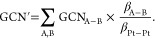
The ligand effect of the Pt-skin Pt150M51-NPs was examined based on β. We repeated the hold-out validation five times and determined the average values. Table 3 shows the average values of the β for the O binding energies on Pt-skin Pt3M-NPs. Mostly, the βPt–Pt was smaller than the other βA–B. With an increase in the GCNPt–M, GCNM–Pt, and GCNM–M, the O binding energy became less negative. Those play a role in the downshift of the d-band center in the Pt-skin configuration. Based on the relationship between the experimental activity and adsorption energy, the sites with 7.5 ≤ GCN ≤ 8.3 showed high ORR activity.53 The corresponding sites were few in the truncated octahedral NPs. Alloying may change the high ORR activity region. As shown in eq 3, the summation of GCNA–B is GCN. Furthermore, as the βPt–Pt was smaller than the other βA–B, the high ORR activity region might shift to the lower GCN side. Then, the effective region was roughly estimated. In monometallic NPs, atomic or molecular adsorption is linearly correlated with GCN. The multiple regression form was transformed into the simple regression form. We calculated the modified GCN (GCN′) as follows
 |
4 |
Table 3. Regression Coefficients of Multiple Regression Equations.
| Pt+Pt3Co | GCNPt–Pt | GCNPt–M | GCNM–Pt | GCNM–M | intercept |
|---|---|---|---|---|---|
| on-top | 0.323 | 0.416 | 0.166 | 0.692 | –5.239 |
| bridge | 0.358 | 0.399 | 0.364 | 0.547 | –6.047 |
| three-fold fcc hollow | 0.189 | 0.394 | 0.387 | 0.311 | –5.184 |
| three-fold hcp hollow | 0.187 | 0.361 | 0.298 | 0.413 | –5.157 |
| Pt+Pt3Ni | GCNPt–Pt | GCNPt–M | GCNM–Pt | GCNM–M | intercept |
|---|---|---|---|---|---|
| on-top | 0.317 | 0.314 | 0.043 | 0.900 | –5.198 |
| bridge | 0.324 | 0.352 | 0.367 | 0.443 | –5.940 |
| three-fold fcc hollow | 0.160 | 0.312 | 0.302 | 0.300 | –5.002 |
| three-fold hcp hollow | 0.197 | 0.305 | 0. 261 | 0.449 | –5.200 |
| Pt+Pt3Cu | GCNPt–Pt | GCNPt–M | GCNM–Pt | GCNM–M | intercept |
|---|---|---|---|---|---|
| on-top | 0.359 | 0.515 | 0.114 | 0.671 | –5.469 |
| bridge | 0.413 | 0.530 | 0.301 | 0.670 | –6.383 |
| three-fold fcc hollow | 0.116 | 0.227 | 0.222 | 0.311 | –4.812 |
| three-fold hcp hollow | 0.157 | 0.234 | 0.294 | 0.249 | –4.989 |
In ref (54), the on-top sites in Pt-NP were investigated as the active site. The on-top site of Pt3M-NP was compared with that of Pt-NP to reveal the influence of alloying on the active site. We considered the on-top site with 6.917 of GCN, and the GCNA–B for all corresponding sites was explored. The average GCNPt–Pt, GCNPt–M, GCNM–Pt, and GCNM–M in the considered NP models were 4.111, 1.139, 0.986, and 0.681, respectively. Using the β of the Pt-skin Pt150Co51-NPs, the GCN′ was estimated to be 7.544, which was in the high ORR activity region of Pt-NPs. In the Pt-skin Pt150M51-NPs, the high ORR activity region includes sites with GCN close to 7.0.
Larger NP models have numerous adsorption sites with unique GCNs. We investigated the size dependence of GCNA–B. In our previous study,60 the models consisting of 201, 405, and 711 atoms were analyzed. For Pt3M-NPs, the TM201- and TM405-NP models have only one Pt-skin layer, while the TM711-NP models have one or two Pt-skin layers. We considered four models for examining the size dependence of GCNA–B. Note that the SL of the Pt201-, Pt405-, Pt150Co51-, and Pt303Co102-NPs was successfully performed using the GCNA–B (Figures S9–S12). Figure 6 shows the GCNA–B of the on-top, bridge, and hollow sites as a function of GCN as well as the average values and standard deviations for each GCNA–B. The Pt3M-NP model with two Pt-skin configuration revealed that the second nearest neighbor atoms to the O-adsorbed Pt atoms were only Pt atoms. Thus, the GCNM–Pt and GCNM–M were 0. In the two Pt-skin configuration, the GCNPt–Pt and GCNPt–M affected the O binding energy. The standard deviation became small when compared with that of one Pt-skin configuration. βPt–M were close to βPt–Pt. Compared with the case of one Pt-skin configuration, the O binding energy could be finely tuned in the two Pt-skin configuration. With an increase in size, the surface area of the facet became larger. There are a few types of GCNs in the TM201-NP model. The atoms in the {111} facet are divided into the atoms adjacent to the ridge and atoms at the center of the facet. Larger NP models have atoms with an intermediate feature. Thus, new adsorption sites with unique GCNs appeared in the TM405- and TM711-NP models. In the {111} facet of the TM201-NP model, the atoms adjacent to the ridge and central atoms showed the GCNs of 6.917 and 7.500, respectively. New adsorption sites in the TM405- and TM711-NP models were concentrated near a GCN of 7.0, which meant that the effective sites for ORR activity were absent in small Pt-skin Pt3M-NPs. Small NPs have an advantage of a high specific surface area. However, significantly small Pt-skin Pt3M-NPs may not be promising materials to achieve high ORR activity. On the other hand, the location of M is an important factor in the design of promising materials with high ORR activity. When M is located near an adsorption site with a low GCN, the number of highly ORR active sites may increase. With a decrease in the GCN, the O binding energy on Pt-NPs becomes considerably negative. βM–M, which is larger than the other βA–B, weakens the O binding energy. The M atoms in the subsurface layer and the nearest neighbor M atoms result in a less negative O binding energy. If the location of M could be controlled in PtM-NPs, the ORR activity of the resulting catalyst would enhance.
Figure 6.

Element-based GCN (GCNA–B) for the on-top, bridge, three-fold fcc hollow, and three-fold hcp hollow sites of Pt150M51-NPs (one Pt-skin), Pt303M102-NPs (one Pt-skin), and Pt533M178-NPs (one or two Pt-skin) as a function of GCN. Symbols and error bars represent the average values and the standard deviation of GCNA–B, respectively.
The orders of β were determined by the values of the descriptors. The influences of β were directly compared. Standard partial regression coefficients, as shown in Table S18, are useful for comparing the influences of descriptors. The standard partial regression coefficients of GCNPt–Pt for the on-top and bridge sites showed higher values. In contrast, the standard partial regression coefficients of GCNPt–Pt for the hollow sites were close to those of the other GCNA–B. Escaño et al. showed that charge redistribution for a three-fold fcc hollow site on the (111) surface of a Pt-skin/Pt–Co slab model was different from that for a bridge site on the (100) surface of this model.69 For the bridge site, the charge along the bond between Co and O-adsorbed Pt atom changed, while those near other Co–Pt bonds remained unchanged. Charge redistribution in the region between Co and Pt was observed for the three-fold fcc hollow site. Compared to the cases of GCNPt–Pt and GCNM–M, the influences of GCNPt–M and GCNM–Pt on the hollow sites were larger than those on the bridge site. Therefore, the change of the interaction by O adsorption depends on the types of adsorption sites. The distribution of Pt and M around the adsorption site is an important factor to determine the O binding energy, as reflected in the descriptors of SL. These O adsorption properties could not be explained by only GCN. Thus, GCNA–B was generated based on the ligand effect in Pt-skin Pt3M-NP on the O binding energies.
Conclusions
Herein, we performed SL to predict the O binding energy on Pt-skin Pt3M-NPs (M = Co, Ni, or Cu) based on DFT calculations. Substitution of the inner Pt atoms by M led to the downshift of the d-band center of Pt atoms in the surface layer. The O binding energies on the Pt-skin Pt150M51-NPs were less negative than those on the Pt201-NPs. We aimed to predict the O binding energy by structural parameters instead of the d-band center. At first, GCN, which could explain the atomic or molecular adsorption energy on the Pt-NPs, was regarded as a descriptor. With an increase in GCN, the O bonding energies on the Pt-skin Pt150M51-NPs became less negative, similar to those on Pt201-NPs. SL by GCN showed good results numerically when R2test was used as an evaluation index. However, the O binding energies were widely distributed even when the GCN was the same. When Δy in the test set was large or small, SL by GCN did not work well. Therefore, we proposed a GCNA–B to improve the prediction of the O binding energies on Pt-skin Pt150M51-NPs. SL by GCNA–B could explain the O binding energy calculated by DFT. The obtained βPt–Pt was smaller than the other βA–B with some exceptions, which caused a shift of the high ORR activity region to the lower GCN side. Using β, GCN of the effective sites was estimated to be 6.917. We investigated the size dependence of GCNA–B distribution along with the number of Pt-skin layers. In the two Pt-skin configuration, the nearest neighbor atoms to the O-adsorbed Pt atoms comprised only Pt atoms, and fine-tuning of the O binding energy was realized. With an increase in the size of the alloy NPs, the effective sites with GCN close to 7.0 increased. In other words, the effective sites with high ORR activity may be absent in small alloy NPs. From the viewpoint of effective sites, extremely small Pt-skin Pt3M-NPs may not be promising materials for achieving high ORR activity.
Computational Methods
DFT Calculations
All the spin-polarized calculations were conducted using the Vienna ab initio simulation package (VASP) code70,71 under the generalized gradient approximation based on the Perdew–Burke–Ernzerhof exchange–correlation functional.72 A projector-augmented wave method was employed as the interaction between valence and core electrons.73,74 The plane-wave cutoff energy was 400 eV, and the k-point grid was 1 × 1 × 1. The self-consistent field convergence and geometry optimization convergence were 1.0 × 10⁻⁵ and 1.0 × 10⁻⁴ eV, respectively.
Supervised Learning
We performed multiple regression analyses in this study. The hold-out method was employed to validate the analyses, and 1/4 (Ntest) and 3/4 (Ntraining) of the whole configurations were randomly selected as test and training sets, respectively. We measured the R2test by the following equation
 |
5 |
where f and y represent the O binding energies predicted by SL and calculated by DFT, respectively. The bar of y denotes the average value of the O binding energy in the test. Moreover, MAE was calculated as follows
 |
6 |
Acknowledgments
This work was supported by ACCEL, JST (JPMJAC1501), and the computation was performed using MASAMUNE-IMR in Center for Computational Materials Science, Institute for Materials Research, Tohoku University (19S004).
Supporting Information Available
The Supporting Information is available free of charge at https://pubs.acs.org/doi/10.1021/acsomega.0c05649.
Information regarding NP models, such as O binding energy, d-band center, and generalized coordination number, are described (PDF)
The authors declare no competing financial interest.
Supplementary Material
References
- Hammer B.; Morikawa Y.; Nørskov J. K. CO Chemisorption at Metal Surfaces and Overlayers. Phys. Rev. Lett. 1996, 76, 2141–2144. 10.1103/PhysRevLett.76.2141. [DOI] [PubMed] [Google Scholar]
- Kitchin J. R.; Nørskov J. K.; Barteau M. A.; Chen J. G. Role of Strain and Ligand Effects in the Modification of the Electronic and Chemical Properties of Bimetallic Surfaces. Phys. Rev. Lett. 2004, 93, 156801. 10.1103/PhysRevLett.93.156801. [DOI] [PubMed] [Google Scholar]
- Liu P.; Nørskov J. K. Ligand and Ensemble Effects in Adsorption on Alloy Surfaces. Phys. Chem. Chem. Phys. 2001, 3, 3814–3818. 10.1039/b103525h. [DOI] [Google Scholar]
- Mpourmpakis G.; Stamatakis M.; Herrmann S.; Vlachos D. G.; Andriotis A. N. Predicting the Adsorption Behavior in Bulk from Metal Clusters. Chem. Phys. Lett. 2011, 518, 99–103. 10.1016/j.cplett.2011.11.004. [DOI] [Google Scholar]
- Greeley J.; Nørskov J. K. A General Scheme for the Estimation of Oxygen Binding Energies on Binary Transition Metal Surface Alloys. Surf. Sci. 2005, 592, 104–111. 10.1016/j.susc.2005.07.018. [DOI] [Google Scholar]
- Hyman M. P.; Medlin J. W. Effects of Electronic Structure Modifications on the Adsorption of Oxygen Reduction Reaction Intermediates on Model Pt(111)–Alloy Surfaces. J. Phys. Chem. C 2007, 111, 17052–17060. 10.1021/jp075108g. [DOI] [Google Scholar]
- Lischka M.; Mosch C.; Groβ A. Tuning Catalytic Properties of Bimetallic Surfaces: Oxygen Adsorption on Pseudomorphic Pt/Ru Overlayers. Electrochim. Acta 2007, 52, 2219–2228. 10.1016/j.electacta.2006.03.113. [DOI] [Google Scholar]
- Humbert M.; Chen J. Correlating Hydrogenation Activity with Binding Energies of Hydrogen and Cyclohexene on M/Pt(111) (M = Fe, Co, Ni, Cu) Bimetallic Surfaces. J. Catal. 2008, 257, 297–306. 10.1016/j.jcat.2008.05.013. [DOI] [Google Scholar]
- Stamenkovic V.; Mun B. S.; Mayrhofer K. J. J.; Ross P. N.; Markovic N. M.; Rossmeisl J.; Greeley J. R.; Nørskov J. K. Changing the Activity of Electrocatalysts for Oxygen Reduction by Tuning the Surface Electronic Structure. Angew. Chem., Int. Ed. 2006, 45, 2897–2901. 10.1002/anie.200504386. [DOI] [PubMed] [Google Scholar]
- Greeley J.; Stephens I. E. L.; Bondarenko A. S.; Johansson T. P.; Hansen H. A.; Jaramillo T. F.; Rossmeisl J.; Chorkendorff I.; Nørskov J. K. Alloys of Platinum and Early Transition Metals as Oxygen Reduction Electrocatalysts. Nat. Chem. 2009, 1, 552–556. 10.1038/nchem.367. [DOI] [PubMed] [Google Scholar]
- Nørskov J. K.; Rossmeisl J.; Logadottir A.; Lindqvist L.; Kitchin J. R.; Bligaard T.; Jónsson H. Origin of the Overpotential for Oxygen Reduction at a Fuel-Cell Cathode. J. Phys. Chem. B 2004, 108, 17886–17892. 10.1021/jp047349j. [DOI] [Google Scholar]
- Gasper R.; Shi H.; Ramasubramaniam A. Adsorption CO on Low-Energy, Low-Symmetry Pt Nanoparticles: Energy Decomposition Analysis and Prediction via Machine-Learning Models. J. Phys. Chem. C 2017, 121, 5612–5619. 10.1021/acs.jpcc.6b12800. [DOI] [Google Scholar]
- Li Z.; Wang S.; Chin W. S.; Achenie L. E.; Xin H. High-Throughput Screening of Bimetallic Catalysts Enabled by Machine Learning. J. Mater. Chem. A 2017, 5, 24131–24138. 10.1039/C7TA01812F. [DOI] [Google Scholar]
- Dean J.; Taylor M. G.; Mpourmpakis G. Unfolding Adsorption on Metal Nanoparticles: Connecting Stability with Catalysis. Sci. Adv. 2019, 5, eaax5101. 10.1126/sciadv.aax5101. [DOI] [PMC free article] [PubMed] [Google Scholar]
- Nanba Y.; Koyama M. NO Adsorption on 4d and 5d Transition-Metal (Rh, Pd, Ag, Ir, and Pt) Nanoparticles: Density Functional Theory Study and Supervised Learning. J. Phys. Chem. C 2019, 123, 28114–28122. 10.1021/acs.jpcc.9b05748. [DOI] [Google Scholar]
- Kent P. R. C. Computational Challenges of Large-Scale Long-Time First-Principles Molecular Dynamics. J. Phys.: Conf. Ser. 2008, 125, 012058 10.1088/1742-6596/125/1/012058. [DOI] [Google Scholar]
- Shao M.; Peles A.; Shoemaker K. Electrocatalysis on Platinum Nanoparticles: Particle Size Effect on Oxygen Reduction Reaction Activity. Nano Lett. 2011, 11, 3714–3719. 10.1021/nl2017459. [DOI] [PubMed] [Google Scholar]
- Ruiz-Serrano Á.; Skylaris C.-K. A Variational Method for Density Functional Theory Calculations on Metallic Systems with Thousands of Atoms. J. Chem. Phys. 2013, 139, 054107 10.1063/1.4817001. [DOI] [PubMed] [Google Scholar]
- Li L.; Larsen A. H.; Romero N. A.; Morozov V. A.; Glinsvad C.; Abild-Pedersen F.; Greeley J.; Jacobsen K. W.; Nørskov J. K. Investigation of Catalytic Finite-Size-Effects of Platinum Metal Clusters. J. Phys. Chem. Lett. 2013, 4, 222–226. 10.1021/jz3018286. [DOI] [PubMed] [Google Scholar]
- Laasonen K.; Panizon E.; Bochicchio D.; Ferrando R. Competition between Icosahedral Motifs in AgCu, AgNi, and AgCo Nanoalloys: A Combined Atomistic–DFT Study. J. Phys. Chem. C 2013, 117, 26405–26413. 10.1021/jp410379u. [DOI] [Google Scholar]
- Li L.; Abild-Pedersen F.; Greeley J.; Nørskov J. K. Surface Tension Effects on the Reactivity of Metal Nanoparticles. J. Phys. Chem. Lett. 2015, 6, 3797–3801. 10.1021/acs.jpclett.5b01746. [DOI] [PubMed] [Google Scholar]
- Back S.; Yeom M. S.; Jung Y. Active Sites of Au and Ag Nanoparticle Catalysts for CO2 Electroreduction to CO. ACS Catal. 2015, 5, 5089–5096. 10.1021/acscatal.5b00462. [DOI] [Google Scholar]
- Ishimoto T.; Koyama M. Electronic Structure and Phase Stability of PdPt Nanoparticles. J. Phys. Chem. Lett. 2016, 7, 736–740. 10.1021/acs.jpclett.5b02753. [DOI] [PubMed] [Google Scholar]
- Aarons J.; Jones L.; Varambhia A.; MacArthur K. E.; Ozkaya D.; Sarwar M.; Skylaris C.-K.; Nellist P. D. Predicting the Oxygen-Binding Properties of Platinum Nanoparticle Ensembles by Combining High-Precision Electron Microscopy and Density Functional Theory. Nano Lett. 2017, 17, 4003–4012. 10.1021/acs.nanolett.6b04799. [DOI] [PubMed] [Google Scholar]
- Nanba Y.; Ishimoto T.; Koyama M. Structural Stability of Ruthenium Nanoparticles: A Density Functional Theory Study. J. Phys. Chem. C 2017, 121, 27445–27452. 10.1021/acs.jpcc.7b08672. [DOI] [Google Scholar]
- Foster D. M.; Pavloudis T.; Kioseoglou J.; Palmer R. E. Atomic-Resolution Imaging of Surface and Core Melting in Individual Size-Selected Au Nanoclusters on Carbon. Nat. Commun. 2019, 10, 2583. 10.1038/s41467-019-10713-z. [DOI] [PMC free article] [PubMed] [Google Scholar]
- Liu S.; Huang S. Structure Engineering of Cu-Based Nanoparticles for Electrochemical Reduction of CO2. J. Catal. 2019, 375, 234–241. 10.1016/j.jcat.2019.05.035. [DOI] [Google Scholar]
- Aarons J.; Verga L. G.; Hine N. D. M.; Skylaris C.-K. Atom-Projected and Angular Momentum Resolved Density of States in the ONETEP Code. Electron. Struct. 2019, 1, 035002 10.1088/2516-1075/ab34f5. [DOI] [Google Scholar]
- Ellaby T.; Briquet L.; Sarwar M.; Thompsett D.; Skylaris C.-K. Modification of O and CO Binding on Pt Nanoparticles due to Electronic and Structural Effects of Titania Supports. J. Chem. Phys. 2019, 151, 114702. 10.1063/1.5120571. [DOI] [PubMed] [Google Scholar]
- Rocabado D. S. R.; Ishimoto T.; Koyama M. The Effect of SnO2(110) Supports on the Geometrical and Electronic Properties of Platinum Nanoparticles. SN Appl. Sci. 2019, 1, 1485. 10.1007/s42452-019-1478-0. [DOI] [Google Scholar]
- Farkaš B.; de Leeuw N. H. Towards a Morphology of Cobalt Nanoparticles: Size and Strain Effects. Nanotechnology 2020, 31, 195711. 10.1088/1361-6528/ab6fe0. [DOI] [PubMed] [Google Scholar]
- Calle-Vallejo F.; Martínez J. I.; García-Lastra J. M.; Sautet P.; Loffreda D. Fast Prediction of Adsorption Properties for Platinum Nanocatalysts with Generalized Coordination Numbers. Angew. Chem., Int. Ed. 2014, 53, 8316–8319. 10.1002/anie.201402958. [DOI] [PubMed] [Google Scholar]
- Calle-Vallejo F.; Sautet P.; Loffreda D. Understanding Adsorption-Induced Effects on Platinum Nanoparticles: An Energy-Decomposition Analysis. J. Phys. Chem. Lett. 2014, 5, 3120–3124. 10.1021/jz501263e. [DOI] [PubMed] [Google Scholar]
- Zhao Z.; Chen Z.; Zhang X.; Lu G. Generalized Surface Coordination Number as Activity Descriptors for CO2 Reduction on Cu Surfaces. J. Phys. Chem. C 2016, 120, 28125–28130. 10.1021/acs.jpcc.6b10155. [DOI] [Google Scholar]
- Bazhenov A. S.; Lefferts L.; Honkala K. Adsorption and Activation of Water on Cuboctahedral Rhodium and Platinum Nanoparticles. J. Phys. Chem. C 2017, 121, 4324–4331. 10.1021/acs.jpcc.6b11953. [DOI] [Google Scholar]
- Rück M.; Bandarenka A.; Calle-Vallejo F.; Gagliardi A. Oxygen Reduction Reaction: Rapid Prediction of Mass Activity of Nanostructured Platinum Electrocatalysts. J. Phys. Chem. Lett. 2018, 9, 4463–4468. 10.1021/acs.jpclett.8b01864. [DOI] [PubMed] [Google Scholar]
- Wakabayashi N.; Takeichi M.; Uchida H.; Watanabe M. Temperature Dependence of Oxygen Reduction Activity at Pt–Fe, Pt–Co, and Pt–Ni Alloy Electrodes. J. Phys. Chem. B 2005, 109, 5836–5841. 10.1021/jp046204+. [DOI] [PubMed] [Google Scholar]
- Wang C.; Chi M.; Li D.; Strmcnik D.; van der Vliet D.; Wang G.; Komanicky V.; Chang K.-C.; Paulikas A. P.; Tripkovic D.; et al. Design and Synthesis of Bimetallic Electrocatalyst with Multilayered Pt-Skin Surfaces. J. Am. Chem. Soc. 2011, 133, 14396–14403. 10.1021/ja2047655. [DOI] [PubMed] [Google Scholar]
- Watanabe M.; Yano H.; Tryk D. A.; Uchida H. Highly Durable and Active PtCo Alloy/Graphitized Carbon Black Cathode Catalysts by Controlled Deposition of Stabilized Pt Skin Layers. J. Electrochem. Soc. 2016, 163, F455–F463. 10.1149/2.0331606jes. [DOI] [Google Scholar]
- Wang C.; Daimon H.; Onodera T.; Koda T.; Sun S. A General Approach to the Size- and Shape-Controlled Synthesis of Platinum Nanoparticles and Their Catalytic Reduction of Oxygen. Angew. Chem., Int. Ed. 2008, 47, 3588–3591. 10.1002/anie.200800073. [DOI] [PubMed] [Google Scholar]
- Wu J.; Zhang J.; Peng Z.; Yang S.; Wagner F. T.; Yang H. Truncated Octahedral Pt3Ni Oxygen Reduction Reaction Electrocatalysts. J. Am. Chem. Soc. 2010, 132, 4984–4985. 10.1021/ja100571h. [DOI] [PubMed] [Google Scholar]
- Zhang J.; Yang H.; Fang J.; Zou S. Synthesis and Oxygen Reduction Activity of Shape-Controlled Pt3Ni Nanopolyhedra. Nano Lett. 2010, 10, 638–644. 10.1021/nl903717z. [DOI] [PubMed] [Google Scholar]
- Wu J.; Gross A.; Yang H. Shape and Composition-Controlled Platinum Alloy Nanocrystals Using Carbon Monoxide as Reducing Agent. Nano Lett. 2011, 11, 798–802. 10.1021/nl104094p. [DOI] [PubMed] [Google Scholar]
- Fowler B.; Lucas C. A.; Omer A.; Wang G.; Stamenković V. R.; Marković N. M. Segregation and Stability at Pt3Ni(111) Surfaces and Pt75Ni25 Nanoparticles. Electrochim. Acta 2008, 53, 6076–6080. 10.1016/j.electacta.2007.11.063. [DOI] [Google Scholar]
- Cui Y.-T.; Harada Y.; Niwa H.; Hatanaka T.; Nakamura N.; Ando M.; Yoshida T.; Ishii K.; Matsumura D.; Oji H.; et al. Wetting Induced Oxidation of Pt-Based Nano Catalysts Revealed by In Situ High Energy Resolution X-ray Absorption Spectroscopy. Sci. Rep. 2017, 7, 1482. 10.1038/s41598-017-00639-1. [DOI] [PMC free article] [PubMed] [Google Scholar]
- Dai S.; Hou Y.; Onoue M.; Zhang S.; Gao W.; Yan X.; Graham G. W.; Wu R.; Pan X. Revealing Surface Elemental Composition and Dynamic Processes Involved in Facet-Dependent Oxidation of Pt3Co Nanoparticles via in Situ Transmission Electron Microscopy. Nano Lett. 2017, 17, 4683–4688. 10.1021/acs.nanolett.7b01325. [DOI] [PubMed] [Google Scholar]
- Xu Y.; Ruban A. V.; Mavrikakis M. Adsorption and Dissociation of O2 on Pt–Co and Pt–Fe Alloys. J. Am. Chem. Soc. 2004, 126, 4717–4725. 10.1021/ja031701+. [DOI] [PubMed] [Google Scholar]
- Sha Y.; Yu T. H.; Merinov B. V.; Shirvanian P.; Goddard W. A. III Oxygen Hydration Mechanism for the Oxygen Reduction Reaction at Pt and Pd Fuel Cell Catalysts. J. Phys. Chem. Lett. 2011, 2, 572–576. 10.1021/jz101753e. [DOI] [Google Scholar]
- Duan Z.; Wang G. A First-Principles Study of Oxygen Reduction Reaction on a Pt(111) Surface Modified by a Subsurface Transition Metal M (M = Ni, Co, or Fe). Phys. Chem. Chem. Phys. 2011, 13, 20178–20187. 10.1039/c1cp21687b. [DOI] [PubMed] [Google Scholar]
- Ou L.; Chen S. Comparative Study of Oxygen Reduction Reaction Mechanisms on the Pd(111) and Pt(111) Surfaces in Acid Medium by DFT. J. Phys. Chem. C 2013, 117, 1342–1349. 10.1021/jp309094b. [DOI] [Google Scholar]
- Li K.; Li Y.; Wang Y.; He F.; Jiao M.; Tang H.; Wu Z. The Oxygen Reduction Reaction on Pt(111) and Pt(100) Surfaces Substituted by Subsurface Cu: A Theoretical Perspective. J. Mater. Chem. A 2015, 3, 11444. 10.1039/C5TA01017A. [DOI] [Google Scholar]
- Nair A. S.; Pathak B. Computational Screening for ORR Activity of 3d Transition Metal Based M@Pt Core–Shell Clusters. J. Phys. Chem. C 2019, 123, 3634–3644. 10.1021/acs.jpcc.8b11483. [DOI] [Google Scholar]
- Calle-Vallejo F.; Tymoczko J.; Colic V.; Vu Q. H.; Pohl M. D.; Morgenstern K.; Loffreda D.; Sautet P.; Schuhmann W.; Bandarenka A. S. Finding Optimal Surface Sites on Heterogeneous Catalysts by Counting Nearest Neighbors. Science 2015, 350, 185–189. 10.1126/science.aab3501. [DOI] [PubMed] [Google Scholar]
- Calle-Vallejo F.; Pohl M. D.; Reinisch D.; Loffreda D.; Sautet P.; Bandarenka A. S. Why Conclusions from Platinum Model Surfaces Do Not Necessarily Lead to Enhanced Nanoparticle Catalysts for the Oxygen Reduction Reaction. Chem. Sci. 2017, 8, 2283–2289. 10.1039/C6SC04788B. [DOI] [PMC free article] [PubMed] [Google Scholar]
- Rück M.; Bandarenka A. S.; Calle-Vallejo F.; Gagliardi A. Fast Identification of Optimal Pure Platinum Nanoparticles Shapes and Sizes for Efficient Oxygen Electroreduction. Nanoscale Adv. 2019, 1, 2901–2909. 10.1039/C9NA00252A. [DOI] [PMC free article] [PubMed] [Google Scholar]
- Calle-Vallejo F.; Bandarenka A. S. Enabling Generalized Coordination Numbers to Describe Strain Effects. ChemSusChem 2018, 11, 1824–1828. 10.1002/cssc.201800569. [DOI] [PubMed] [Google Scholar]
- Rück M.; Garlyyev B.; Mayr F.; Bandarenka A. S.; Gagliardi A. Oxygen Reduction Reaction Activities of Strained Platinum Core–Shell Electrocatalysts Predicted by Machine Learning. J. Phys. Chem. Lett. 2020, 11, 1773–1780. 10.1021/acs.jpclett.0c00214. [DOI] [PubMed] [Google Scholar]
- Piotrowski M. J.; Piquini P.; Da Silva J. L. F. Platinum-Based Nanoalloys PtnTM55–n (TM = Co, Rh, Au): A Density Functional Theory Investigation. J. Phys. Chem. C 2012, 116, 18432–18439. 10.1021/jp302844f. [DOI] [Google Scholar]
- Guedes-Sobrinho D.; Nomiyama R. K.; Chaves A. S.; Piotrowski M. J.; Da Silva J. L. F. Structure, Electronic and Magnetic Properties of Binary PtnTM55–n (TM = Fe, Co, Ni, Cu Zn) Nanoclusters: A Density Functional Theory Investigation. J. Phys. Chem. C 2015, 119, 15669–15679. 10.1021/acs.jpcc.5b02242. [DOI] [Google Scholar]
- Rocabado D. S. R.; Nanba Y.; Koyama M. Electronic Structure and Phase Stability of Pt3M (M = Co, Ni, or Cu) Bimetallic Nanoparticles. Comput. Mater. Sci. 2020, 184, 109874. 10.1016/j.commatsci.2020.109874. [DOI] [Google Scholar]
- Cowley J. M. An Approximate Theory of Order in Alloys. Phys. Rev. 1950, 77, 669–675. 10.1103/PhysRev.77.669. [DOI] [Google Scholar]
- Franceschetti A.; Pennycook S. J.; Pantelides S. T. Oxygen Chemisorption on Au Nanoparticles. Chem. Phys. Lett. 2003, 374, 471–475. 10.1016/S0009-2614(03)00725-5. [DOI] [Google Scholar]
- Ganduglia-Pirovano M. V.; Scheffler M. Structural and Electronic Properties of Chemisorbed Oxygen on Rh(111). Phys. Rev. B 1999, 59, 15533–15543. 10.1103/PhysRevB.59.15533. [DOI] [Google Scholar]
- Pang Q.; Zhang Y.; Zhang J.-M.; Xu K.-W. Structural and Electronic Properties of Atomic Oxygen Adsorption on Pt(111): A Density-Functional Theory Study. Appl. Surf. Sci. 2011, 257, 3047–3054. 10.1016/j.apsusc.2010.10.114. [DOI] [Google Scholar]
- Han B. C.; Miranda C. R.; Ceder G. Effect of Particle Size and Surface Structure on Adsorption of O and OH on Platinum Nanoparticles: A First-Principles Study. Phys. Rev. B 2008, 77, 075410 10.1103/PhysRevB.77.075410. [DOI] [Google Scholar]
- Hwang B. J.; Kumar S. M. S.; Chen C.-H.; Monalisa; Cheng M.-Y.; Liu D.-G.; Lee J.-F. An Investigation of Structure–Catalytic Activity Relationship for Pt–Co/C Bimetallic Nanoparticles toward the Oxygen Reduction Reaction. J. Phys. Chem. C 2007, 111, 15267–15276. 10.1021/jp072681r. [DOI] [Google Scholar]
- Alayoglu S.; Zavalij P.; Eichhorn B.; Wang Q.; Frenkel A. I.; Chupas P. Structural and Architectural Evaluation of Bimetallic Nanoparticles: A Case Study of Pt–Ru Core–Shell and Alloy Nanoparticles. ACS Nano 2009, 3, 3127–3137. 10.1021/nn900242v. [DOI] [PubMed] [Google Scholar]
- Ou L.; Chen S. DFT Calculation Analysis of Oxygen Reduction Reaction Activity and Stability of Bimetallic Catalysts with Pt-Segregated Surface. Sci. China: Chem. 2015, 58, 586–592. 10.1007/s11426-015-5324-y. [DOI] [Google Scholar]
- Escaño M. C. S.; Kasai H. First-Principles Study on Surface Structure, Thickness, and Composition Dependence of the Stability of Pt-Skin/Pt3Co Oxygen-Deduction Reaction Catalysts. J. Power Sources 2014, 247, 562–571. 10.1016/j.jpowsour.2013.09.013. [DOI] [Google Scholar]
- Kresse G.; Furthmüller J. Efficient Iterative Schemes for Ab Initio Total Energy Calculations Using a Plane-Wave Basis Set. Phys. Rev. B 1996, 54, 11169–11186. 10.1103/PhysRevB.54.11169. [DOI] [PubMed] [Google Scholar]
- Kresse G.; Furthmüller J. Efficiency of Ab Initio Total Energy Calculations for Metals and Semiconductors Using a Plane-Wave Basis Set. Comput. Mater. Sci. 1996, 6, 15–50. 10.1016/0927-0256(96)00008-0. [DOI] [PubMed] [Google Scholar]
- Perdew J. P.; Burke K.; Ernzerhof M. Generalized Gradient Approximation Made Simple. Phys. Rev. Lett. 1996, 77, 3865–3868. 10.1103/PhysRevLett.77.3865. [DOI] [PubMed] [Google Scholar]
- Blöchl P. E. Projector Augmented Wave Method. Phys. Rev. B 1994, 50, 17953–17979. 10.1103/PhysRevB.50.17953. [DOI] [PubMed] [Google Scholar]
- Kresse G.; Joubert D. From Ultrafast Pseudopotentials to the Projector Augmented Wave Method. Phys. Rev. B 1999, 59, 1758–1775. 10.1103/PhysRevB.59.1758. [DOI] [Google Scholar]
Associated Data
This section collects any data citations, data availability statements, or supplementary materials included in this article.