



Abstract
Aim:
In statin-treated persons with atherosclerotic cardiovascular disease (ASCVD) the further ASCVD risk that diabetes mellitus (DM) adds is not well-quantified. We examined this residual risk for initial and total recurrent ASCVD events.
Methods:
We studied 3271 patients with ASCVD on statin therapy in the AIM-HIGH clinical trial cohort. Cox regression and the Prentice, Williams, and Peterson model examined the excess risk of initial and total recurrent ASCVD events associated with DM over a 3- year mean follow-up. Predictors of first and total ASCVD events in those with and without DM were also examined.
Results:
Of our cohort with ASCVD on statin therapy 40% also had DM. Those with vs. without DM were older, were less likely to be male or white. They had higher systolic blood pressure, lower HDL-C, LDL-C, lipoprotein (a), but higher triglycerides and BMI (all p < 0.01). Adjusted HRs were 1.21 (95% CI; 1.01–1.46, p = 0.038) and 1.23 (95% CI: 1.05–1.44, p = 0.012) for first and total recurrent ASCVD events, respectively. Homocysteine and lipoprotein(a) most strongly predicted events in those with and without DM, respectively.
Conclusion:
In statin-treated patients with ASCVD, DM was associated with significantly greater residual risk over ASCVD alone for both first and total recurrent ASCVD events.
Keywords: Diabetes mellitus, Cardiovascular disease, Risk assessment, Statins
1. Introduction
Patients with diabetes mellitus (DM) are at increased risk of developing atherosclerotic cardiovascular disease (ASCVD).1,2 We have previously shown that US adults with DM have a wide distribution of risk; two-thirds of men and half of women either have pre-existing cardiovascular disease (CVD) or a >20% 10-year risk of CVD, with advancing age and insulin use status associated with a greater proportion of higher CVD risk DM patients.3 DM is, therefore, not a coronary risk equivalent but carries heterogeneous CVD risks.4,5
Moreover, more than a third of those with CVD have pre-existing DM,6 with the combination of DM and CVD identifying a very high-risk group associated with the highest mortality from coronary heart disease (CHD), CVD, and all causes in US adults.7 Recent US cholesterol management guidelines continue to recommend high-intensity statin with consideration of additional treatment non-statins in those at higher risk with DM and/or ASCVD.8,9 A recent analysis of Marketscan and Medicare databases showed persistence with statin therapy in 2014 to be only 79% following myocardial infarction and 67% in those with diabetes (but without CHD).10 A large Swedish diabetes registry noted adjusted prevalences of statin use in 2014 were 46% in primary prevention and 66% in secondary prevention DM patients.11 Our recently published data from the US National Health and Nutrition Examination surveys 2013–2016 note among adults with DM, 91% of those with known CVD and 86% of those without CVD to report taking lipid-lowering medication.12 The extent to which DM independently confers additional risk in those with ASCVD on statin therapy has not been well-quantified.
The Atherothrombosis Intervention in Metabolic Syndrome with Low HDL/High Triglycerides: Impact on Global Health Outcomes (AIM-HIGH) clinical trial13 provides a unique opportunity to examine this issue in a contemporary cohort of patients with known ASCVD with and without DM who were on intensive statin therapy. Given the many ASCVD patients with DM, a better understanding of the residual risk DM confers and what drives that risk is needed.
2. Methods
2.1. Study population
AIM-HIGH was a multi-center clinical trial of the effect of extended-release niacin added to simvastatin therapy on reducing the risk of cardiovascular events in patients with established ASCVD and atherogenic dyslipidemia. The study design of the trial has been published elsewhere.13 In brief, patients were recruited at 92 clinical centers in the United States and Canada. Eligible patients were 1) 45 years of age or older, 2) had established CVD (documented stable CHD, cerebrovascular or carotid disease, or peripheral arterial disease), 3) high density lipoprotein-cholesterol (HDL-C) <40 mg per deciliter [1.03 mmol per liter] for men or <50 mg per deciliter [1.29 mmol per liter] for women, 4) triglyceride levels of 150 to 400 mg per deciliter [1.69 to 4.52 mmol per liter], and 5) low density lipoprotein-cholesterol (LDL-C) levels lower than 180 mg per deciliter (4.65 mmol per liter) if they were not taking a statin at entry. Excluded were those who had a fasting glucose ≥180 mg/dL (10 mmol/L) or hemoglobin A1C ≥9.0%, or inability or refusal to use a glucometer for home glucose monitoring (DM patients). After further exclusion of 931 patients who could not tolerate at least 1500 mg of niacin, 3414 patients were randomly assigned, in a 1:1 ratio, to niacin or matching placebo in addition to 40 to 80 mg of simvastatin per day. After a mean follow-up of 3 years, the trial was stopped due to lack of efficacy to reduce the primary ASCVD composite endpoint. We included 3271 participants with complete baseline measurements of key risk factors. Patients were classified as DM if they had a documented history of DM, had fasting glucose ≥126 mg/dL, had HbA1c ≥6.5%, or took oral hypoglycemic medication or insulin at baseline. We utilized data from the AIM-HIGH cohort obtained with permission from the NIH Biologic Specimen and Data Repository Information Coordinating Center which was exempt from institutional review board review at UC Irvine.
2.2. Event ascertainment
After the first year, participants were seen every six months in the clinic. ECGs were obtained annually to assess for potential silent myocardial infarction (MI). A clinical events committee reviewed suspected primary endpoints (including silent MI) with supporting documentation that did not reveal the treatment assignments. Our composite ASCVD outcome for this analysis was the AIM-HIGH primary endpoint and included death from coronary heart disease, nonfatal MI, ischemic stroke, hospitalization (for >23 h) for an acute coronary syndrome, or symptom-driven coronary or cerebral revascularization. Both firsttime ASCVD and total recurrent ASCVD events were obtained during follow-up.
2.3. Statistical analysis
Baseline characteristics were compared between those with vs. without DM using t-tests for continuous variables or Chi-square tests of proportions for categorical variables. First recurrent ASCVD event rates and total ASCVD event rates were calculated per 1000 person-years stratified by DM status and sex. Hazard ratios (HRs) examining the relationship between DM and first of recurrent ASCVD events during follow-up were calculated from the Cox Proportional Hazards regression models, adjusted for age, sex, race, smoking status, alcohol consumption, systolic (SBP) and diastolic blood pressure (DBP), LDL-C, HDL-C, triglycerides, homocysteine, lipoprotein (a) [lp(a)], body mass index (BMI), family history of premature CVD and trial treatment. The Prentice, Williams and Peterson (PWP) model was used to calculate the hazard ratio (HR) of total ASCVD events as well as the HRs of the 2nd, 3rd, and 4th+ events.14 In subgroup analysis, we reexamined the above associations by sex. We also examined potential predictors (among the covariates listed above) for 1st and total ASCVD events separately among those with DM and no DM. In full Cox or PWP models with all above mentioned baseline variables, final predictors were remained in the model if its p value <0.15, with age, sex and race forced in the model. HRs were calculated in a final Cox or PWP models with the selected variables only. Further sensitivity analyses were done adding prior heart failure and number of antihypertensive medications to the model, as well as examining those with and without diagnosed DM separately. We further examined the possible interaction of DM with treatment arms in a sensitivity analysis. Two-sided p-values <0.05 (p < 0.1 for interaction test) were considered statistically significant. SAS 9.4 was used for all statistical analyses.
3. Results
3.1. Differences between DM and non-DM patients
Among 3271 patients with prior ASCVD (85.4% male, mean age 63.6 years), 40% had DM, and 60% did not. Compared to those without DM, those with DM were significantly older, had lower smoking rates and were less likely to be male or white. They also had higher SBP, triglycerides, BMI, and glycated hemoglobin (HbA1c), but a lower DBP, LDL-C, HDL-C, lp(a), but similar prior statin intensity and ezetimibe use (Table 1).
Table 1.
Baseline characteristics based on DM status (N = 3271).
| No DM (N = 1953,60%) | DM (N = 1318, 40%) | P value | |
|---|---|---|---|
| Age, years | 62.84 ± 8.97 | 64.80 ± 8.26 | <0.0001 |
| Male | 1697 (86.89%) | 1095 (83.08%) | 0.003 |
| White | 1840 (94.21%) | 1181 (89.61%) | <0.0001 |
| Current smokers | 393 (20.12%) | 209 (15.86%) | 0.014 |
| Alcohol consumption | 1084 (55.50%) | 581 (44.08%) | <0.0001 |
| Family history of CVD | 779 (39.89%) | 537 (40.74%) | 0.624 |
| SBP, mmHg | 127.11 ± 16.00 | 130.00 ± 16.64 | <0.0001 |
| DBP, mmHg | 75.12 ± 9.39 | 73.33 ± 10.29 | <0.0001 |
| Glucose, mg/dL | 99.86 ± 10.44 | 126.42 ± 25.81 | <0.0001 |
| HDL-C, mg/dL | 34.94 ± 5.64 | 34.37 ± 5.54 | 0.004 |
| LDL-C, mg/dL | 76.13 ± 23.13 | 70.90 ± 22.53 | <0.0001 |
| Lp(a), nmol/L | 79.64 ±91.16 | 72.01 ± 85.23 | 0.015 |
| Homocysteine, umol/L | 11.38 ± 6.38 | 11.57 ± 4.27 | 0.319 |
| Triglycerides, mg/dL | 176.74 ±63.38 | 190.93 ± 70.73 | <0.0001 |
| BMI, kg/m2 | 30.37 ± 4.91 | 32.56 ± 5.65 | <0.0001 |
| HbA1c, % | 5.55 ± 0.37 | 6.64 ± 4.27 | <0.0001 |
| HTN medication | |||
| ACEI | 1072 (54.89%) | 829 (62.90%) | <0.0001 |
| ARB | 299 (15.31%) | 300 (22.76%) | <0.0001 |
| Beta Blocker | 1523 (77.98%) | 1078 (81.79%) | 0.008 |
| CCB | 386 (19.76%) | 354 (26.86%) | <0.0001 |
| Diuretics | 545 (27.91%) | 595 (45.14%) | <0.0001 |
| Aspirin | 1812 (92.8%) | 1198 (90.9%) | 0.051 |
| Prior ezetimibe use | 149 (7.63%) | 115 (8.73%) | 0.224 |
| Prior statin use | |||
| Low intensity | 90 (4.61%) | 61 (4.63%) | 0.211 |
| Intermediate intensity | 1081 (55.35%) | 777 (58.95%) | |
| High intensity | 643 (32.93%) | 402 (30.50%) |
Continuous variables are presented as mean ± SD; categorical variables are presented as frequency (percentage).
3.2. Event rates in DM vs. non-DM patients
During the mean follow-up of 3.33 years, 531 first and 727 total recurrent ASCVD events occurred. 18.7% of DM patients had at least one recurrent ASCVD event during follow-up compared to 15.4% in those without DM (Chi2 p = 0.0014). There were 247 first recurrent events in those with DM compared to 284 in those without DM, and 352 total recurrent events in those with DM compared to 375 in those without DM. Fig. 1 shows the first and total recurrent ASCVD event rates by DM status overall and in males and females separately. First recurrent event rates were 47.5 per 1000 person-years for those without DM compared to 62.2 per 1000 person-years in those with DM; total recurrent event rates were 57.6 per 1000 person-years and 80.3 per 1000 person-years, respectively. In both males and females, patients with DM had higher first recurrent ASCVD rates as well as higher total recurrent ASCVD rates than their non-DM counterparts. Males with DM had the highest first recurrent ASCVD event rates of 64.5 per 1000 person-years and the highest total recurrent ASCVD event rates of 85.3 per 1000 person-years. Females with DM had first recurrent ASCVD event rates of 50.4 per 1000 person-years and total recurrent ASCVD event rates of 54.6 per 1000 person-years, both comparable to those in non-DM males.
Fig. 1.
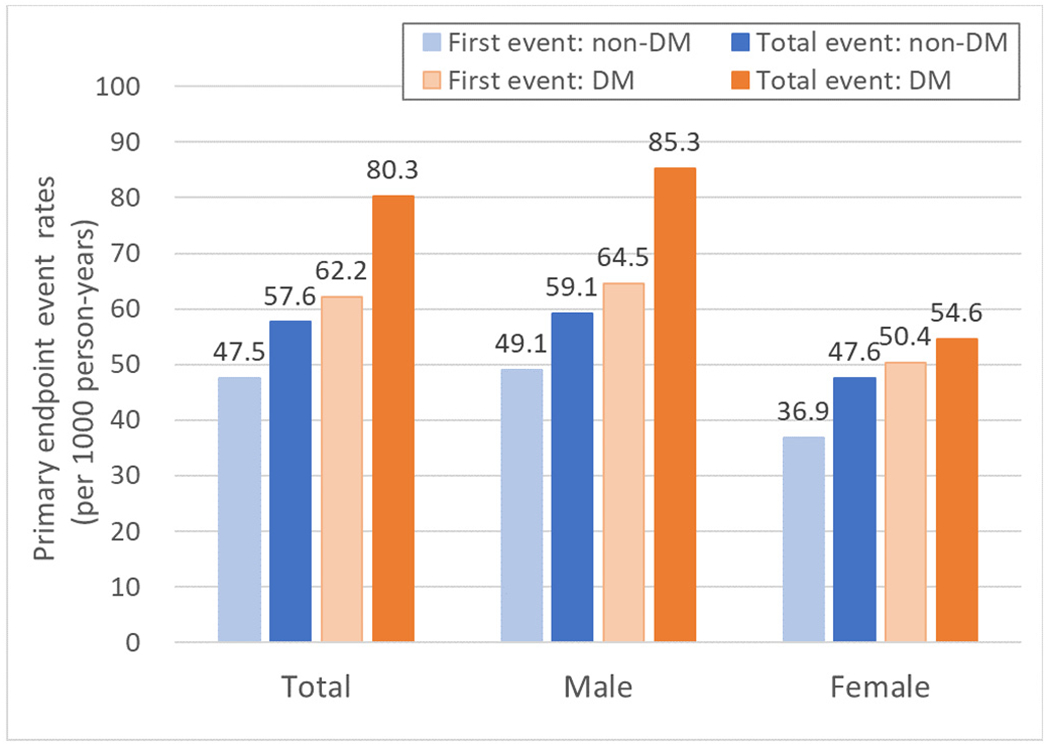
First and total recurrent ASCVD event rates by DM status and sex. Males with DM had the highest event rates for first and total ASCVD events (64.5 and 85.3 per 1000 person-years, respectively); females with DM had ASCVD event rates comparable to those in non-DM males (50.4 vs 49.1 per 1000 person-years for first event and 54.6 vs 59.1 per 1000 person-years for total event).
3.3. Adjusted models for first and total recurrent ASCVD events
In the Cox regression model, the unadjusted HR for first recurrent ASCVD events comparing DM vs. non-DM was 1.31 (95% CI; 1.101.55), and the age, sex, race adjusted HR was also 1.31 (95% CI; 1.091.54); in fully adjusted model, the HR was 1.21 (95% CI; 1.01–1.46) (Table 2). In the PWP model, the HR for total ASCVD events was 1.31 (95% CI: 1.13–1.51), 1.30 (95% CI: 1.12–1.51), and 1.23 (95% CI: 1.051.44) when unadjusted, adjusted for age, sex, and race, and fully adjusted, respectively. In sensitivity analysis, further adjustment of the number of hypertension medications and history of heart failure resulted in a DM vs. non-DM HR of 1.18 (95% CI: 0.98–1.42) for first events and 1.20 (95% CI: 1.02–1.41) for total events.
Table 2.
Hazard ratio of DM for the first and total recurrent ASCVD events overall and by sex.
| First recurrent ASCVD event | Total recurrent ASCVD events | |
|---|---|---|
| Events rates per 1000 person-years | 53.3 | 66.8 |
| Model 1 | 1.31 (1.10–1.55)** | 1.31 (1.13–1.51)*** |
| Model 2 | 1.30 (1.09–1.54)** | 1.30 (1.12–1.51)*** |
| Model 3 | 1.21 (1.01–1.46)* | 1.23 (1.05–1.44)* |
Models 1 were unadjusted.
Models 2 were adjusted for age, sex and race.
Models 3 were adjusted for age, sex, white race, SBP, DBP, BMI, LDL-C, HDL-C, triglycerides, Lp(a), smoking status, alcohol use, serum creatinine, homocysteine, history of CVD, HTN medication and randomized treatment.
CVD = cardiovascular disease, SBP = systolic blood pressure, DBP = diastolic blood pressure, HDL-C = high density lipoprotein-cholesterol, LDL-C = low density lipoprotein-cholesterol, Lp(a) = lipoprotein(a), BMI = body mass index, HTN = hypertension.
p < 0.05.
p <0.01.
p <0.001.
In the PWP model with non-common HR, i.e. separate HRs for the Nth events, the unadjusted HRs for the 2nd, 3rd, and 4th + ASCVD events were 1.50 (95% CI: 1.04–2.16), 1.41 (95% CI: 0.76–2.62) and 0.62 (95% Cl: 0.30–1.29), respectively. When adjusted for age, sex and other risk factors, the corresponding HRs for 2nd, 3rd, and 4th + ASCVD events were 1.54 (95%: 1.06–2.23), 1.64 (95%: 0.87–3.10) and 0.53 (95%: 0.25–1.03), respectively (Fig. 2).
Fig. 2.
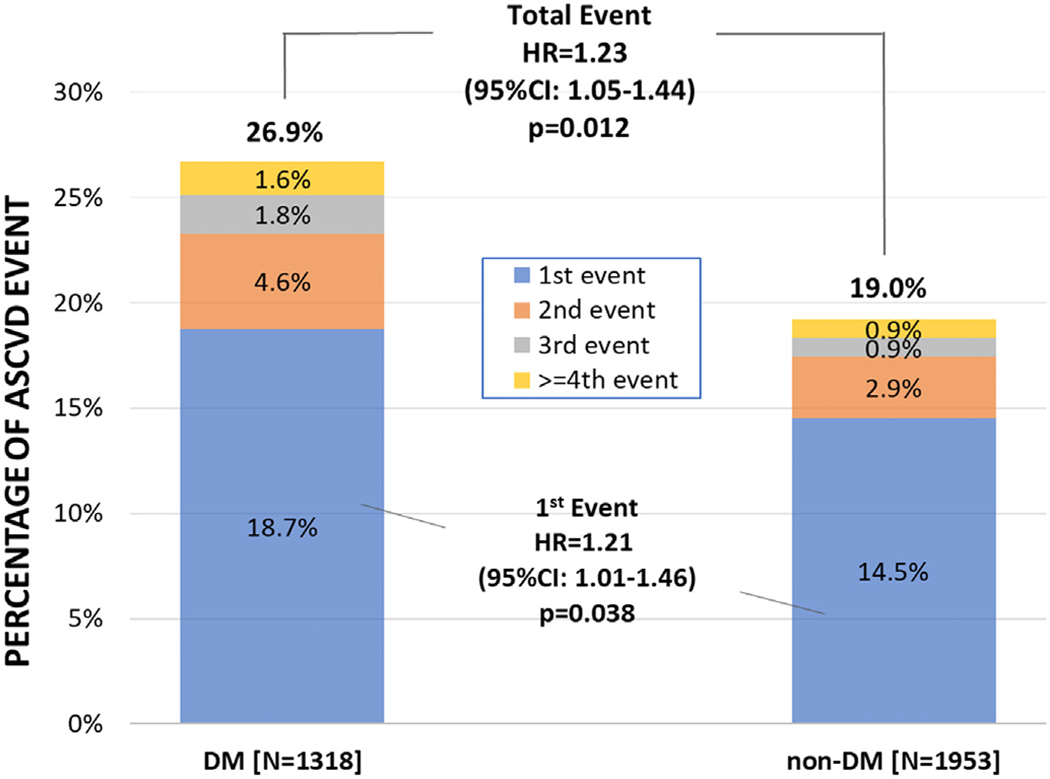
Distribution of first and total recurrent ASCVD events by DM status. DM was an independent predictor of first and total ASCVD events, associated with a >20% excess of both first and total ASCVD events. The above HRs were adjusted for age, sex, white race, SBP, DBP, BMI, LDL-C, HDL-C, triglycerides, lp(a), smoking status, alcohol use, serum creatinine, homocysteine, history of CVD, hypertension medication and randomized treatment.
3.4. Comparison of undiagnosed and diagnosed DM
We also investigated the potential impact of undiagnosed diagnosed DM by further classifying DM into diagnosed (DM history or taking DM medication) and undiagnosed (no DM history or medication use, but a fasting glucose ≥126 mg/dL, or HbA1c ≥6.5%). Among 1318 DM patients, only 173 had undiagnosed DM. The adjusted HRs of diagnosed DM vs. non-DM were 1.27 for both first and total ASCVD events (both p < 0.05); the corresponding HRs of undiagnosed DM vs. non-DM were 0.87 (95% CI: 0.57–1.33) and 0.95 (95% CI: 0.66–1.37), respectively. While statin use prior to baseline was similar in those with versus without DM (94.5% vs. 93.0%, p = 0.10), it was higher in those who were previously diagnosed versus not (95.2% vs. 89.6%, p = 0.003); while it is possible some persons were diagnosed with DM following the initiation of statin use, we did not have adequate information on timing of DM diagnosis and statin initiation to examine this.
3.5. Comparisons by sex
In subgroup analysis by sex, the HRs for first and total ASCVD events were 1.44 (95% CI: 0.83–2.50) and 1.31 (95% CI: 0.79–2.17) among females and were 1.22 (95% CI: 1.00–1.48) and 1.27 (95% CI:1.08–1.51) among males, respectively. Interaction tests of DM and sex were not significant for either the first or the total recurrent ASCVD events. In addition, there was no effect of treatment status (niacin vs. placebo) on initial or total recurrent events overall or within males or females (HRs ranged 1.00–1.05, all p > 0.2).
3.6. Independent predictors of ASCVD Events in patients with and without DM
In those with both DM and prior ASCVD, we identified family history of CVD, lp(a) and homocysteine as final predictors for both first and total recurrent ASCVD events, with male sex, family history, and alcohol use (inversely) additionally predictive of total recurrent ASCVD events and homocysteine levels being the strongest predictor (Table 3). For those with prior ASCVD but no DM, age, family history, alcohol use (inversely), BMI, lp(a), and creatinine were important predictors of first recurrent ASCVD events; except for age, these factors also predicted total recurrent ASCVD events, with lp(a) being the strongest predictor.
Table 3.
Predictors of first and total recurrent ASCVD events.
| DM (N = 1318,40%) |
No DM (N = 1953,60%) |
|||
|---|---|---|---|---|
| First ASCVD | Total ASCVD | First ASCVD | Total ASCVD | |
| Age, per 1 SD | 0.98 (0.85–1.12) | 1.03 (0.92–1.16) | 1.15 (1.01–1.31)* | 1.09 (0.97–1.22) |
| Male | 1.32 (0.91–1.9) | 1.49 (1.06–2.09)* | 1.33 (0.89–1.98) | 1.21 (0.86–1.71) |
| White race | 0.88 (0.59–1.31) | 0.93 (0.67–1.3) | 1.15 (0.67–1.98) | 1.12 (0.69–1.84) |
| Current Smoker | – | – | 1.33 (0.99–1.77) | 1.21 (0.93–1.56) |
| Alcohol use | – | 0.78 (0.62–0.97)* | 0.71 (0.56–0.9)** | 0.68 (0.55–0.84)*** |
| Family history of CVD | 1.24 (0.96–1.6) | 1.31 (1.05–1.62)* | 1.4 (1.11–1.77)** | 1.36 (1.1–1.67)** |
| Insulin use | – | 1.00 (1.00–1.01)* | – | – |
| HbA1c, per SD | – | – | 0.78 (0.6–1.02) | 0.82 (0.66–1.03) |
| BMI, per SD | – | – | 1.14(1.00–1.29)* | 1.13 (1.01–1.27)* |
| Lipoprotein a, per 1 SD | 1.1 (1.01–1.28)* | 1.12 (1.01–1.24)* | 1.2 (1.12–1.36)**** | 1.19 (1.09–1.3)**** |
| Serum creatinine, per 1 SD | – | – | 1.16 (1.02–1.32)* | 1.15 (1.03–1.29)* |
| Homocysteine, per 1 SD | 1.27 (1.11–1.44)*** | 1.32 (1.19–1.48)**** | – | – |
Among those without DM, Potential predictors were age, sex, White, current smoking, alcohol use, family history of CVD, SBP, DBP, LDL-C, HDL-C, triglycerides, BMI, HbA1c, Lp(a), serum creatine, homocysteine, history of Afib and trial treatment; For those with DM, DM duration and insulin use were additionally included in the list. CVD = cardiovascular disease, SBP = systolic blood pressure, DBP = diastolic blood pressure, HDL-C = high density lipoprotein-cholesterol, LDL-C = low density lipoprotein-cholesterol, Lp(a) = lipoprotein(a), BMI = body mass index, HbA1c = glycated hemoglobin, HTN = hypertension.
1 SD of age = 8.75 years; 1 SD of BMI = 5.33 kg/m2; 1 SD of HbA1C = 0.81%; 1 SD of serum creatinine = 0.24mg/dL; 1 SD of Lp(a) = 37.02 nmol/L; 1 SD of Homocysteine = 11.36 umol/L. Variables that did not enter model indicated by –.
p < 0.05.
p <0.01.
p < 0.001.
p <0.0001.
4. Discussion
We show that in persons with known ASCVD well-treated with statin therapy, DM was associated with over 20% higher risk to develop recurrent ASCVD events independent of other risk factors. The increased risk persisted with subsequent ASCVD events during follow-up, with a 23% higher risk for total recurrent ASCVD events. The excess risk that was related to DM was seen among both men and women. When accompanied by DM, women with ASCVD have as high subsequent ASCVD risk as men without DM. We show the excess risk of DM is present despite LDL-C being well-controlled, with risk being greater with older age, insulin use, family history, and increased levels of homocysteine and lipoprotein(a). Of note, we found that those with recently diagnosed DM had a similar risk as those without DM. This is not surprising given the shorter overall duration of DM, with prior investigators demonstrating DM is not a CHD risk equivalent unless DM duration is at least 10 years5; however, our study is unique in showing no excess risk in those undiagnosed DM over having ASCVD alone.
We also found homocysteine to be the most important predictor of recurrent events in those who had both DM and ASCVD; however, in those with ASCVD without DM, lipoprotein(a) was the strongest predictor of risk. Homocysteine has been previously shown to predict initial ASCVD events in those with DM15,16 although the effects of folic acid supplementation have been mixed with a modest effect limited to stroke (but not on CHD alone), and those without prior CVD.17 Lp (a) has been shown to predict future CVD events in statin-treated adults overall,18 as well as recently in those with DM and prior CVD.19
Few studies have examined predictors of subsequent ASCVD risk in those with both DM and CHD. In an analysis of 5483 T-SPARCLE multi-center registry of persons with CHD,20 among the 38.6% with DM, the risk of subsequent cardiac events was significantly increased with heart failure (HF), chronic kidney disease (CKD) stage 4–5 (vs. stage 1–2), without beta-blocker use, and higher non-HDL-C, after controlling for covariates including statin use and the intensity of therapy, whereas among those without DM, heart failure, chronic kidney disease stage 4–5, and history of myocardial infarction were the significant independent predictors of MACE. In a follow-up report from the BARI-2D trial21 among patients with DM and CHD, those who had 0–2 compared to all 6 risk factors at control (non-smoking, non-HDL-C <130 mg/dL, triglycerides <150 mg/dL, blood pressure <130/80 mmHg, and glycosylated hemoglobin <7%) had a 2-fold greater risk of mortality and 1.7-fold greater risk of cardiovascular events.
We have quantitated both first recurrent and total recurrent ASCVD event risk among DM and non-DM patients with prior ASCVD history demonstrating significant residual risk remains, with DM contributing further to this risk. Most recent guidelines have recommended more aggressive treatment for the secondary prevention population. The latest 2018 Multisociety Guideline on the Management of Blood Cholesterol recommended patients with prior ASCVD treated with high-intensity statin and possibly by ezetimibe and a PCSK9 inhibitor for those at very high-risk (such as those who also have diabetes and another high-risk condition)9 and the most recent 2017 ACC/AHA blood pressure guideline redefines HTN as ≥130/80 mmHg.22 The 2019 ESC/EAS Guidelines for the Management of Dyslipidemias have recently recommended an LDL-C reduction ≥50% from baseline and LDL-C target of 55 mg/dL23 for all with known ASCVD. The high risk of first and recurrent events that we have observed in those with known ASCVD, which is even greater in those with concurrent DM demonstrates a significant unmet need to better implement newer guidelines calling for more aggressive management of LDL-C and other risk factors in these high-risk populations. Future studies should explore the impact of reducing uncontrolled risk factors and continue to explore more novel predictors such as lp(a) in association with reducing residual ASCVD risk.
4.1. Strengths and limitations
AIM-HIGH had standardized assessment of risk factors and adjudication of ASCVD events which had made our results very reliable. However, the residual risks we observe and predictors of future ASCVD events are specific to the participants in AIM-HIGH who all had ASCVD and were generally well-controlled for LDL-C during follow-up and thus may not be generalized to the overall US population with ASCVD with or without DM on statin therapy who may not be as well treated. Importantly, while AIM-HIGH is widely representative of patients around the US and Canada from the large number of sites included, the inclusion criteria (focusing on those with low HDL-C and high triglycerides) preclude it from being fully representative of ASCVD patients in general. Further, given that LDL-C was titrated to within a certain range (e.g., 40–80 mg/dL), it is not surprising that LDL-C did not emerge as a predictor of subsequent events in our analysis. Finally, the AIM-HIGH patients were predominantly white and male so do not represent the diversity of the US or other populations. We adjusted for most conventional cardiovascular risk factors to investigate the independent association of DM and residual ASCVD risk, yet there could be potential unmeasured confounding factors that impacted both DM and ASCVD risk that limit our ability to imply causality.
4.2. Conclusions
We demonstrate DM carries more than a 20% excess risk of both initial and total recurrent ASCVD events among adults with prior ASCVD history, even after adjustment for other comorbidities and therapies and despite generally good LDL-C control on moderate-intensity statin therapy. This excess risk indicates the inadequacy of current therapies and possibly the need for greater use of newer evidence-based therapies shown to benefit persons with ASCVD and DM.
Acknowledgements
The authors thank the participants and investigators of the AIM-HIGH trial. This study was previously presented in part at the American Diabetes Association Scientific Sessions, June 2019. This study was supported by a contract from Amgen Pharmaceuticals to the University of California, Irvine. Dr. Wong reports research funding through the University of California, Irvine from Amgen, Amarin, and is on the speaker’s bureau for Amarin and Sanofi. Drs. Xiang, Crespo, and Lopez are employees and stockholders of Amgen Inc. AIM-HIGH was supported by the National Heart, Lung, and Blood Institute (U01-HL-081616 and U01-HL-081649) and by an unrestricted grant from Abbott Laboratories (now AbbVie), Chicago, IL. Abbott Laboratories donated the extended-release niacin, the matching placebo, and the ezetimibe; Merck donated the simvastatin. Neither of these companies had any role in the oversight or design of the study, or in the analysis or interpretation of the data.
Declaration of competing interest
This study was supported by a contract from Amgen Pharmaceuticals to the University of California, Irvine. Dr. Wong reports research funding through the University of California, Irvine from Amgen, Amarin, and is on the speaker’s bureau for Amarin and Sanofi. Drs. Xiang, Crespo, and Lopez are employees and stockholders of Amgen Inc.
References
- 1.Boulos N, Wong ND. Epidemiology of Diabetes and Cardiovascular Disease In: Wong ND, Malik S. Diabetes and Cardiovascular Disease: Evaluation, Prevention, and Management. Jaypee Brothers Medical Publishers, Ltd; New Delhi: 2015. [Google Scholar]
- 2.Pasternak RC, Grundy SM, Levy D, Thompson PD. 27th Bethesda conference: matching the intensity of risk factor management with the hazard for coronary disease events, task force 3: spectrum of risk factors for coronary heart disease. J Am Coll Cardiol 1996;27:978–90. [DOI] [PubMed] [Google Scholar]
- 3.Wong ND, Glovaci D, Wong K, Malik S, Franklin SS, Wygant G, et al. Global cardiovascular disease risk assessment in United States adults with diabetes. Diab Vasc Dis Res 2012;9:146–52. [DOI] [PubMed] [Google Scholar]
- 4.Bulugahapitiya U, Siyambalapitiya S, Sithole J, Idris I. Is diabetes a coronary risk equivalent? Systematic review and meta-analysis. Diabet Med 2009;26:142–8. [DOI] [PubMed] [Google Scholar]
- 5.Rana JS, Liu JY, Moffet HH, Jaffe M, Karter AJ. Diabetes and prior coronary heart disease are not necessarily risk equivalent for future coronary heart disease events. J Gen Intern Med 2016;31:387–93. [DOI] [PMC free article] [PubMed] [Google Scholar]
- 6.Anselmino M, Mellbin L, Wallander M, Ryden L. Early detection and integrated management of dysglycemia in cardiovascular disease: a key factor for decreasing the likelihood of future events. Rev Cardiovasc Med 2008;9:29–38. [PubMed] [Google Scholar]
- 7.Malik S, Wong ND, Franklin SS, Kamath TV, L’ltalien GJ, Pio JR, et al. Impact of the metabolic syndrome on mortality from coronary heart disease, cardiovascular disease, and all causes in United States adults. Circulation 2004;110:1245–50. [DOI] [PubMed] [Google Scholar]
- 8.Stone NJ, Robinson JG, Lichtenstein AH, Merz CN, Blum CB, Eckel RH, et al. 2013 ACC/AHA guideline on the treatment of blood cholesterol to reduce atherosclerotic cardiovascular risk in adults: a report of the American College of Cardiology/American Heart Association Task Force on Practice Guidelines. Journal of the American College of Cardiology 2014;63:2889–934. [DOI] [PubMed] [Google Scholar]
- 9.Grundy SM, Stone NJ, Bailey AL, Beam C, Birtcher KK, Blumenthal RS, et al. 2018 AHA/ACC/AACVPR/AAPA/ABC/ACPM/ADA/AGS/APhA/ASPC/NLA/PCNA guideline on the management of blood cholesterol: executive summary: a report of the American College of Cardiology/American Heart Association task force on clinical practice guidelines. J Am Coll Cardiol 2019;73:3168–209. [DOI] [PubMed] [Google Scholar]
- 10.Colantonio LD, Rosenson RS, Deng L, Monda KL, Dai Y, Farkouh ME, et al. Adherence to statin therapy among US adults between 2007 and 2014. J Am Heart Assoc 2019;8, e010376. [DOI] [PMC free article] [PubMed] [Google Scholar]
- 11.Karlsson SA, Franzén S, Svensson AM, Miftaraj M, Eliasson B, Andersson SK. Prescription of lipid-lowering medications for patients with type 2 diabetes mellitus and risk-associated LDL cholesterol: a nationwide study of guideline adherence from the Swedish National Diabetes Register. BMC Health Serv Res 2018;18:900. [DOI] [PMC free article] [PubMed] [Google Scholar]
- 12.Andary R, Fan W, Wong ND. Control of cardiovascular risk factors among US adults with type 2 diabetes with and without cardiovascular disease. Am J Cardiol 2019;124:522–7. [DOI] [PubMed] [Google Scholar]
- 13.The AIM-HIGH Investigators. Niacin in patients with low HDL-cholesterol levels receiving intensive statin therapy. N Engl J Med 2011;365:2255–67. [DOI] [PubMed] [Google Scholar]
- 14.Prentice RL, Williams BJ, Peterson AV. On the regression analysis of multivariate failure time data. Biometrika 1981;68:373–9. [Google Scholar]
- 15.Audelin MC, Genest J Jr. Homocysteine and cardiovascular disease in diabetes mellitus. Atherosclerosis 2001;159:497–511. [DOI] [PubMed] [Google Scholar]
- 16.Hoogeveen EK, Kostense PJ, Beks PJ, et al. Hyperhomocysteinemia is associated with an increased risk of cardiovascular disease, especially in non-insulin-dependent diabetes mellitus: a population-based study. Arterioscler Thromb Vasc Biol 1998;18: 133–8. [DOI] [PubMed] [Google Scholar]
- 17.Li Y, Huang T, Zheng Y, Muka T, Troup J, Hu FB. Folic acid supplementation and the risk of cardiovascular diseases: a meta-analysis of randomized controlled trials. J Am Heart Assoc 2016;5:e003768 Published 2016 August 15 10.1161/JAHA.116.003768. [DOI] [PMC free article] [PubMed] [Google Scholar]
- 18.Willeit P, Ridker PM, Nestel PJ, et al. Baseline and on-statin treatment lipoprotein(a) levels for prediction of cardiovascular events: individual patient-data meta-analysis of statin outcome trials. Lancet 2018;392:1311–20. [DOI] [PubMed] [Google Scholar]
- 19.Zhang Y, Jin JL, Cao YX, et al. Lipoprotein (a) predicts recurrent worse outcomes in type 2 diabetes mellitus patients with prior cardiovascular events: a prospective, observational cohort study. Cardiovasc Diabetol 2020;19:111 Published 2020 Jul 9. 10.1186/s12933-020-01083-8. [DOI] [PMC free article] [PubMed] [Google Scholar]
- 20.Lin FJ, Tseng WK, Yin WH, Yeh HI, Chen JW, Wu CC. Residual risk factors to predict major adverse cardiovascular events in atherosclerotic cardiovascular disease patients with and without diabetes mellitus. Sci Rep 2017;7:9179. [DOI] [PMC free article] [PubMed] [Google Scholar]
- 21.Bittner V, Bertolet M, Barraza Felix R, et al. Comprehensive cardiovascular risk factor control improves survival: the BARI 2D trial. J Am Coll Cardiol 2015;66:765–73. [DOI] [PMC free article] [PubMed] [Google Scholar]
- 22.Whelton PK, Carey RM, Aronow WS, Casey DE, Collins KJ, Himmelfarb CD, et al. 2017 ACC/AHA/AAPA/ABC/ACPM/AGS/APhA/ASH/ASPC/NMA/PCNA guideline for the prevention, detection, evaluation, and management of high blood pressure in adults: a report of the American College of Cardiology/American Heart Association Task Force on Clinical Practice Guidelines. J Am Coll Cardiol 2018;71:e127–248. [DOI] [PubMed] [Google Scholar]
- 23.Mach F, Baigent C, Catapano AL, Koskinas KC, Casula M, Badimon L, et al. ESC Scientific Document Group. 2019 ESC/EAS Guidelines for the management of dyslipidaemias: lipid modification to reduce cardiovascular risk. Eur Heart J 2020;41:111–88. [DOI] [PubMed] [Google Scholar]