



Abstract
Background
Teenage and late presentation of anorectal malformations are not uncommon in developing world. Some of the reasons for late presentation include but not limited to illiteracy, poverty, lack of awareness, and limited trained pediatric surgeons. In rural areas, neonates with ARMs are considered cursed and are marginalized.
Case
15-Year-old African girl (a munyankole by tribe in Uganda) from western Uganda presented at 15 years of life with colostomy and uncorrected anorectal malformation. Never went to school due to social stigma.
Conclusion
Due to limited number of trained pediatric surgeons in most of African Countries, many children in addition to living with a colostomy or untreated malformation, may also be undiagnosed with chronic constipation. Improved awareness and advocacy would promote early presentation and treatment.
Keywords: Anorectal malformation, Krickenbeck, Bowel function, Teenage presentation
Introduction
Anorectal malformations (ARMs) are common congenital anomalies with a reported incidence of approximately 1 in 5000 live births [1]. They have been classified according to Krickenbeck classification [2, 3]. The most common type in females is vestibular fistula [4–8]. Teenage and late presentation of anorectal malformations are not uncommon in the developing world. Some of the reasons for late presentation include lack of awareness, limited trained pediatric surgeons, illiteracy, poverty and child negligence. In some rural areas in Uganda, neonates with ARMs are considered cursed and are marginalized. These patients usually present because of marital reasons as the girl approaches puberty [8–12].
Case presentation
A 15-year-old African female (a munyankole by tribe in Uganda) presented with a sigmoid colostomy and an uncorrected ARM. Colostomy was placed when she was 2 months old. The operation was performed at what was then the only pediatric surgical unit in the country in Kampala, the capital city of Uganda. She shortly lost her parents to unknown illnesses, was moved to the village and has been raised by her maternal grandmother. Her grandmother thought the condition was unrepairable. She never went to school due to social stigma and has been marginalized in her village and considered cursed. A well-wisher who feared that she would not be considered suitable for marriage because of her colostomy brought her to our facility (Fig. 1).
Fig. 1.

Before posterior sagittal anorectoplasty
At the time of presentation, she was a well-nourished teenage girl with evident secondary female characteristics, weighing 53 kg, Abdominal examination was normal with a well-functioning double barrel sigmoid colostomy. Her blood work was normal. She was noted on perineal exam to have a vestibular fistula.
Posterior sagittal anorectoplasty (PSARP) was performed and the neoanus was calibrated to 17 mm at the end of repair. She underwent serial anal dilatation according our ward protocol, achieved anal size for age calibrated at 18 mm Hegar (Fig. 2). After 6 weeks colostomy was taken down. She is being followed in the clinic. Her short term follow-ups of three months so far revealed normal functional outcome.
Fig. 2.
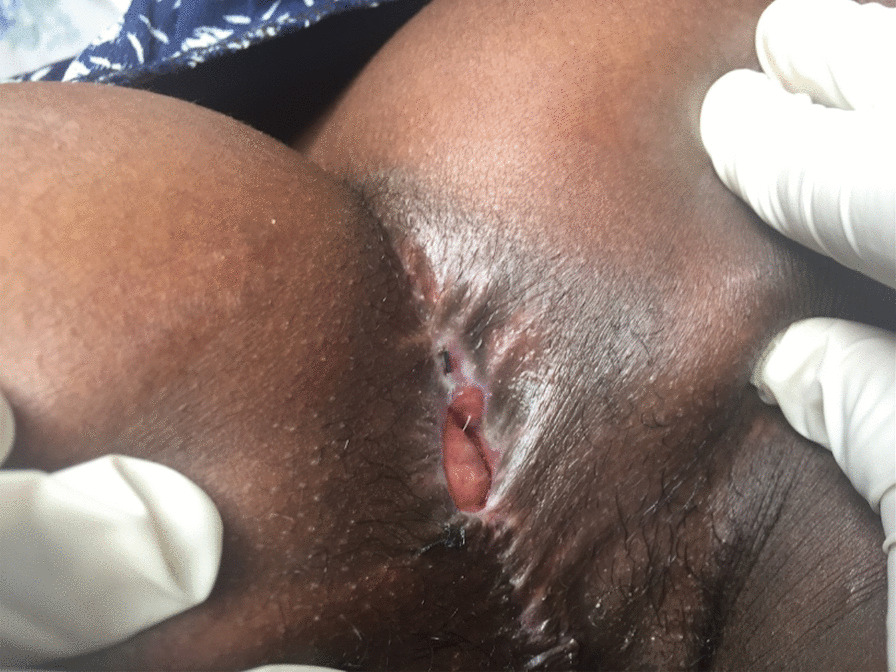
The Neoanus before colostomy closure
Ethical approval was obtained from Mbarara University research ethics committee #30/05-20. Written informed consent form was obtained from the legal guardian and assent from the child.
Discussion
Teenage and late presentation of anorectal malformations is not rare in developing world; however, they are correctable congenital malformations. Some of the reasons for late presentation include but not limited to illiteracy, poverty, lack of awareness, child negligence, lack of social support, and limited trained pediatric surgeons. In rural areas, neonates with ARMs are considered cursed and are marginalized [8–14. Our patient lived with colostomy because of lack of awareness of her grandmother when she lost her parents. Some patients usually present because of marital reasons as the girl approaches puberty their parents or guardians bring them to the hospital [8,15].
Impact of late presentation
Delayed presentation and diagnosis of ARMs may lead to complications such as constipation, delayed and altered surgical management, recurrent genital and urinary tract infections, infertility, inadequate weight gain, difficult toilet training increased parental anxiety, and functional and psychological problems for adult patients [16–18]. Other studies have reported complications of constipation, anal excoriation, occasional soiling, mucosal prolapse and sexual abnormalities [19, 20]. Often times there is significant dilation of rectum/colon due to distal obstruction from a small fistula opening, making repair more difficult and decreasing functionality of bowel.
Despite late presentation, patients with vestibular fistula after corrective surgery are able to conceive and carry the pregnancy to term, and deliver children through normal vaginal route [20, 21]. Therefore, community awareness through support groups and stoma care groups might help improve presentation, and as a result, the outcome.
Believing that community awareness could be increased in this fashion, we created community led support group for anorectal malformation in the Mbarara region of western Ugandan which was officially launched on June 12, 2019. This has substantially improved awareness in western Uganda with more patients presenting with colostomies for definitive repair.
Conclusion
Due to limited number of trained pediatric surgeons in most African countries, as well as low community awareness about the possibility of definitive repair, many children live with a colostomy or untreated malformation. As a result, they often have undiagnosed chronic constipation and fecal incontinence. These result in significant social ostracization and limited ability to go to school. Improved awareness and advocacy would promote early presentation and treatment.
Acknowledgements
Patient and her family, Doruk Ozgediz.
Abbreviations
- ARMs
Anorectal malformations
- PSARP
Posterior sagittal anorectoplasty
Authors' contributions
Conception and design—FO, MK, MS. Acquisition of data or analysis and interpretation of data—FO, MK, MS. Drafting the article or revising it critically for important intellectual content—FO, MK, MS. Final approval of the version published—FO, MK. Agreement to be accountable for the article and to ensure that all questions regarding the accuracy or integrity of the article are investigated and resolved—FO, MK. All authors read and approved the final manuscript.
Funding
No external funding.
Availability of data and materials
Supporting data is available upon request.
Ethics approval and consent to participate
Ethical approval was obtained from Mbarara University research ethics committee #30/05-20. Written informed consent form was obtained from parents of the child and assent from the child.
Consent for publication
Written informed consent was obtained from the patient’s legal guardian(s) for publication of this case report and any accompanying images. A copy of the written consent is available for review by the Editor-in-Chief of this journal.
Competing interests
All authors declared no conflict of interest.
Footnotes
Publisher's Note
Springer Nature remains neutral with regard to jurisdictional claims in published maps and institutional affiliations.
Contributor Information
Felix Oyania, Email: oyafel@icloud.com.
Meera Kotagal, Email: Meera.Kotagal@cchmc.org.
Martin Situma, Email: smssituma@gmail.com.
References
- 1.Rintala RJ. Congenital anorectal malformations: anything new? J Pediatr Gastroenterol Nutr. 2009 doi: 10.1097/MPG.0b013e3181a15b5e. [DOI] [PubMed] [Google Scholar]
- 2.Qazi SH, Faruque AV, Khan MAM, Saleem U. Functional outcome of anorectal malformations and associated anomalies in era of Krickenbeck classification. J Coll Phys Surg Pak. 2016;26(3):204–207. [PubMed] [Google Scholar]
- 3.Hohlschneider AM, Hustson JM. Incidence and frequency of different types, and classification of anorectal malformations. In: Holschneider AM, Hutson JM, editors. Anorectal malformations in children. Embryology, diagnosis, surgical treatment, follow-up. Berlin, Heidelberg: Springer; 2006. pp. 163–84. [Google Scholar]
- 4.Kayima P, Kitya D, Punchak M, Anderson GA, Situma M. Patterns and treatment outcomes of anorectal malformations in Mbarara Regional Referral Hospital, Uganda. J Pediatr Surg. 2019 doi: 10.1016/j.jpedsurg.2018.07.019. [DOI] [PubMed] [Google Scholar]
- 5.Holcomb GW, Murphy JP, Ostlie DJ (2014) Ashcraft’s Pediatric surgery e-book. Elsevier Health Sciences
- 6.Mattei P. Fundamentals of pediatric surgery. Fundam Pediatr Surg. 2011 doi: 10.1007/978-1-4419-6643-8. [DOI] [Google Scholar]
- 7.White RR. Atlas of pediatric surgery. New York: McGraw-Hill Companies; 1978. [Google Scholar]
- 8.Ameh EA, Bickler SW, Lakhoo K, Nwomeh B, Poenaru D. Paediatric surgery: a comprehensive text for Africa. Lymphangiomas. 2011;110:648–656. [Google Scholar]
- 9.Kumar V, Chattopdhay A, Vepakomma D, Shenoy D, Bhat P. Anovestibular fistula in adults: a rare presentation. Int Surg. 2005;90:27–29. [PubMed] [Google Scholar]
- 10.Bokhari I, Ali SU, Farooq AR, Khan A. Late presentation of a patient with an anorectal malformation (ARM) J Coll Phys Surg Pak. 2010;20:825–827. [PubMed] [Google Scholar]
- 11.Pandey A, Gupta V, Singh SP, Verma R. Female anorectal malformation in a woman. BMJ Case Rep. 2015 doi: 10.1136/bcr-2015-211456. [DOI] [PMC free article] [PubMed] [Google Scholar]
- 12.Albal M, Kundra D, Zaki BM. Anorectal malformation: presentation beyond adolescence. J Case Rep. 2015;4:196–198. doi: 10.17659/01.2014.0049. [DOI] [Google Scholar]
- 13.Sham M, Singh D, Phadke D. Anorectal malformations: definitive management during and beyond adolescence. J Indian Assoc Pediatr Surg. 2012;17:120. doi: 10.4103/0971-9261.98131. [DOI] [PMC free article] [PubMed] [Google Scholar]
- 14.Chakravartty S, Maity K, Ghosh D, Choudhury CR, Das S. Successful management in neglected cases of adult anorectal malformation. Singapore Med J. 2009;50:e280–e282. [PubMed] [Google Scholar]
- 15.Sinha SK, Kanojia RP, Wakhlu A, Rawat JD, Kureel SN, Tandon RK. Delayed presentation of anorectal malformations. J Indian Assoc Pediatr Surg. 2008;13:64. doi: 10.4103/0971-9261.43023. [DOI] [PMC free article] [PubMed] [Google Scholar]
- 16.Kim HLN, Gow KW, Penner JG, Blair GK, Murphy JJ, Webber EM. Presentation of low anorectal malformations beyond the neonatal period. Pediatrics. 2000;105:e68–e68. doi: 10.1542/peds.105.5.e68. [DOI] [PubMed] [Google Scholar]
- 17.Haider N, Fisher R. Mortality and morbidity associated with late diagnosis of anorectal malformations in children. Surgeon. 2007;5:327–330. doi: 10.1016/S1479-666X(07)80083-7. [DOI] [PubMed] [Google Scholar]
- 18.Eltayeb AA. Delayed presentation of anorectal malformations: the possible associated morbidity and mortality. Pediatr Surg Int. 2010 doi: 10.1007/s00383-010-2641-2. [DOI] [PubMed] [Google Scholar]
- 19.Thomas D. The embryology of persistent cloaca and urogenital sinus malformations. Asian J Androl. 2020 doi: 10.4103/aja.aja_72_19. [DOI] [PMC free article] [PubMed] [Google Scholar]
- 20.Iwai N, Deguchi E, Kimura O, Kubota Y, Ono S, Shimadera S. Social quality of life for adult patients with anorectal malformations. J Pediatr Surg. 2007;42:313–317. doi: 10.1016/j.jpedsurg.2006.10.004. [DOI] [PubMed] [Google Scholar]
- 21.Adejuyigbe O, Sowande OA, Olayinka OS, Fasubaa OB. Rectovestibular fistula with absent distal vagina in an adolescent Nigerian girl. J Pediatr Surg. 2002;37:1479–1480. doi: 10.1053/jpsu.2002.35419. [DOI] [PubMed] [Google Scholar]
Associated Data
This section collects any data citations, data availability statements, or supplementary materials included in this article.
Data Availability Statement
Supporting data is available upon request.