



Abstract
Emotion dysregulation and the experience of fatigue have both been linked to the maintenance of substance use. However, limited empirical data has evaluated individual differences in these constructs in terms of e-cigarette use expectancies. The present study examined a theoretically relevant model focused on whether the experience of more severe fatigue explains, in part, the relation between individual differences in emotion dysregulation and positive and negative e-cigarette expectancies among 525 adult e-cigarette users (50.9% female, Mage = 35.25 years, SD = 10.10). It was hypothesized that emotion dysregulation, via fatigue severity, would significantly predict greater positive and negative e-cigarette expectancies, which was examined in two separate mediation models. Fatigue severity significantly explained, in part, the relation between emotion dysregulation and positive (b = 0.02, CI [0.01, 0.02]) and negative expectancies of e-cigarette use (b = 0.02, 95% CI [0.02, 0.03]). The current findings suggest that the experience of fatigue helps explain the relation between emotion dysregulation and positive and negative e-cigarette expectancies among adult e-cigarette users. Future work is needed to explicate how reducing fatigue severity in the context of emotion dysregulation may change expectancies about e-cigarette expectancies.
Keywords: Emotion dysregulation, fatigue, electronic cigarettes, expectancies, dependence
Introduction
Recent years have been marked by a significant uptake in alternative nicotine delivery systems, such as electronic cigarettes (e-cigarettes; Glasser et al., 2017). Current prevalence rates are estimated at 3.2% of adults in the United States (Creamer et al., 2019), and rates of e-cigarette use double almost every year (Choi & Forster, 2013; Dockrell et al., 2013; King et al., 2013). Although relatively novel, there is a developing line of research that highlights the importance of examining cognitive factors as they relate to e-cigarette uptake and maintenance (Barker et al., 2019; Hartwell et al., 2020). This is a particularly important area of research given that one of the primary reasons adults report e-cigarette use is their perceived safety and ability to facilitate quitting combustible cigarettes (Etter & Bullen, 2011; Zhu et al., 2013). Thus, individual perceptions of use may contribute to uptake and, by extension, maintenance.
Of cognitive factors, outcome expectancies for substance use (i.e., beliefs about the expected consequences of drug use) have been among the most consistent and clinically-relevant predictors of maintained use across a broad range of drugs (Chassin et al., 1991; Doran et al., 2011; Garey et al., 2019; Gwaltney et al., 2005). Outcome expectancies for substance use reflect beliefs about the expected positive (e.g., use calms me down) and negative (e.g., use leads me to dependence) consequences of drug use (Brandon et al., 2004). In terms of e-cigarette expectancies, studies have found positive outcome expectancies (negative affect reduction, positive social effects and stimulation) are associated with greater use (Harrell et al., 2014; Pokhrel et al., 2014). Further, groups that evidence psychological or medical vulnerabilities perceive more positive benefits of their e-cigarette use (Hefner et al., 2016, 2017). Other research has found that positive expectancies for e-cigarette use may interact with individual differences in psychological vulnerability to confer more perceived benefits as well as more perceived risks of e-cigarette use and frequency of failed attempts to quit e-cigarettes (Garey et al., 2019; Zvolensky et al., 2018a). Work also has found that expectancies of e-cigarette use (whether positive or negative) are linked to both cognitive and affective factors (e.g. emotion dysregulation, fatigue, anxiety sensitivity; Manning et al., 2019; Zvolensky, Manning, et al., 2019).
One emerging e-cigarette research priority is to understand individual difference factors that may be related to e-cigarette outcome expectancies. One potentially important individual difference factor is emotion dysregulation, reflecting the process by which individual’s experience difficulty with monitoring, evaluating, modifying, or accomplishing their goals due to negative affect (Bloch et al., 2010). Research focused on combustible cigarette use has found that greater emotion dysregulation is associated with the expectation of negative affect reduction (Rogers et al., 2018; Zvolensky et al., 2019), attentional bias for smoking stimuli (Fucito et al., 2010), craving (Szasz et al., 2012), withdrawal (Rogers et al., 2019), and decreased quit success (Farris et al., 2016). Yet, past work has not explored whether emotion dysregulation is related to expectancies about e-cigarette use. Theoretically, greater emotion dysregulation may be linked to positive expectancies for e-cigarette use by virtue of expecting use to serve coping-oriented functions (e.g., e-cigarette use calms me down). At the same time, because emotion dysregulation is related to biased threat processing (Bardeen et al., 2017), greater emotion dysregulation could be related to greater perceived risk of e-cigarette use (e.g., e-cigarette use will cause physical health problems, addiction).
To the extent that emotion dysregulation exhausts psychological and physiological systems, it is possible that individual differences in the experience of fatigue may be important to understanding the effect of emotion dysregulation on e-cigarette outcome expectancies. Relative to general sleepiness, which reflects a difficulty or inability to maintain wakefulness, fatigue is a unique construct defined as an overwhelming sense of tiredness, exhaustion, and lack of energy (Chen, 1986; Shen et al., 2006). Fatigue has been identified as a risk factor for mental health problems (Friedberg et al., 2016), and conversely, psychiatric symptoms are associated with greater degrees of fatigue (De Venter et al., 2017). The combustible cigarette literature suggests that smokers may experience greater levels of fatigue compared to non-smokers (Corwin et al., 2002). In addition, there is evidence that fatigue symptoms may contribute to greater cigarette use, suggesting that nicotine may be used to combat feeling fatigued (Hamidovic & de Wit, 2009). This psychological effects is supported by biological evidence that nicotine acts as a stimulant on the central nervous system, thereby temporarily reducing fatigue related symptoms (Boutrel & Koob, 2004; Pomerleau, 1992). Further, fatigue has been shown to relate to both e-cigarette use beliefs (Zvolensky, Manning, et al., 2019) and emotion dysregulation (Manning et al., 2019). Moreover, previous work has linked mental health symptoms to e-cigarette use expectancies (Pham et al., 2020), in which e-cigarette use beliefs are underscored by an individual’s unique cognitive/affective characteristics (Zvolensky et al., 2018b). Yet, no work has explored this relation among e-cigarette users in terms of expectancies for use. Taken together, it is likely that emotion dysregulation exhausts cognitive and psychological systems, inducing greater fatigue symptoms. In an attempt to combat fatigue, an individual is likely to use and e-cigarette, reinforcing the expectation that it will improve fatigue symptoms, while also reinforcing the negative outcome expectancies (i.e. addictive potential).
Theoretically, a competing model in which fatigue severity, via emotion dysregulation predicts greater positive and negative e-cigarette outcome expectancies may exist. Indeed, greater fatigue may contribute to increased difficulty with emotion regulation, which may lead an individual to focus on the positive expectancies associated with e-cigarette use (e.g., coping potential) as well as the negative (e.g., addictive potential) functions as they may become more aware of their persistent need to use to cope. More work is needed to disentangle the relation between emotion dysregulation, fatigue, and e-cigarette outcome expectancies. Such scholarly efforts are necessary to inform evolving theoretical models of e-cigarette use and to guide the development of efficacious, tailored treatment for e-cigarette cessation, a clinically important topic that is severely under-developed (Rosen & Steinberg, 2020).
The present study sought to test competing models for the indirect effect of emotion dysregulation on e-cigarette (positive and negative) outcome expectancies through fatigue severity relative to the indirect effect of fatigue severity on e-cigarette (positive and negative) outcome expectancies through emotion dysregulation among adult e-cigarette users. This is the first study to examine emotion dysregulation and fatigue severity as explanatory factors underlying both positive and negative outcome expectancies for e-cigarette use. It was hypothesized that more robust evidence would emerge for the former model such that greater emotion dysregulation would be associated with higher positive and negative expectancies for e-cigarette use via fatigue severity.
Method
Participants
The present study consisted of 525 current e-cigarette using adults (50.9% female, Mage = 35.25 years, SD = 10.10). Participants were recruited via an online survey. Study eligibility criteria included being 18–65 years old, self-reported use of an e-cigarette at least 3 days out of the past 30 days and being able to provide informed consent. Exclusion criteria included being younger than 18 or older than 65, being a non-English speaker (to ensure comprehension of the study questions), and an inability to give informed and voluntary consent to participate.
Most of the sample was White/Caucasian (75.5%), with 16.7% identifying as Black/African American, 4.2% Asian, 1.6% Native American/Alaska Native, 0.4% Hawaiian, and 1.6% other. In terms of education, 2.7% of the sample reported less than a high school diploma, about a quarter of the sample (23.0%) reported attaining a high school diploma, 20.7% reported “some college,” and of the remaining sample, 24.4% indicated completing an associate degree or higher. The median income bracket fell within the range of $50,000 to $74,999. A moderate level of e-cigarette dependence was observed in the sample (M = 12.1, SD = 2.6; Foulds et al., 2015). E-cigarette users reported an average of 2.8 (SD = 3.1) serious lifetime attempts to quit e-cigarettes. Fifty-nine percent of the sample reported that their e-cigarette used a prefilled liquid cartridge, 21.9% reported that they manually added the liquid to their cartridge, and 18.3% reported that their e-cigarette used a tank feed system. Sixty-two percent of the sample reported that their e-cigarette was a similar length and width to a combustible cigarette, 47.6% reported that their preferred e-cigarette flavor was tobacco, and 62.3% reported that their e-cigarette used a single standard 3.7 volt battery. Approximately 79% of the sample reported concurrent combustible cigarette use. Among those who reported concurrent combustible cigarette use, participants reported smoking an average of 13.2 (SD = 17.3) cigarettes per day, 18.5 (SD = 5.5) years old when they started smoking cigarettes daily and being a daily cigarettes smoker for an average of 15.7 (SD = 10.6) years.
Measures
Demographics questionnaire
Participants provided data regarding sex (0 = Male, 1 = Female), race, marital status (1 = Married or Living with someone, 2 = Widowed, 3 = Separated, 4 = Divorced/Annulled, 5 = Never Married), age, occupation status (1 = Executive to 8 = Never Worked), education level (1 = Grade 6 or less to 8 = Graduate or professional degree), and annual income (1 = $0-$4,999 to 8 = $75,000 or higher).
Electronic cigarette smoking history questionnaire
The Electronic Cigarette Smoking History Questionnaire (EC-SHQ) is a 28-item self-report measure that has been successfully implemented in previous e-cigarette studies (Zvolensky et al., 2018a). The measure selected items from a large, national study on e-cigarette use (Wilson et al., 2015). This measure includes items evaluating frequency of e-cigarette use, age at onset, concurrent tobacco use (e.g., Do you currently use cigarettes? [1 = Yes, 2 = No]), and number of e-cigarette quit attempts (How many times in your life have you made a serious attempt to quit the e-cigarette?). The EC-SHQ was used to characterize the sample, assess frequency of e-cigarette use and concurrent combustible cigarette use.
Penn state electronic cigarette dependence index
The Penn State Electronic Cigarette Dependence Index is a 10-item self-report questionnaire used to assess e-cigarette dependence (Foulds et al., 2015). Participants are asked to provide information on the strength of urges to use (e.g., Do you ever have strong cravings to use your e-cigarette?), waking and night use (e.g., Do you sometimes awaken at night to have a e-cigarette?), number of times that an individual uses an e-cigarette (e.g., How many times a day do you usually use your e-cigarette?), difficulty quitting (e.g., Did you feel more irritable because you couldn’t use an e-cigarette?), and experience of craving and withdrawal symptoms (e.g., Is it hard to keep from using an e-cigarette?). Previous work supports the total score as a valid and reliable index of e-cigarette dependence (Foulds et al., 2015).
Smoking consequences for electronic cigarettes
The Smoking Consequences for Electronic Cigarettes (SCQ-EC; Harrell et al., 2015) is a 16-item self-report measure that examines both positive (e.g., E-cigarettes are satisfying) and negative (e.g., E-cigarettes are addictive) smoking expectancies on a scale from 1 (strongly disagree) to 7 (strongly agree). Consistent with other e-cigarette expectancies scales, items from each scale are combined to form the respective subscales (Brandon et al., 2019; Pokhrel et al., 2018). The present study included both subscales as criterion variables. The positive and negative outcome expectancy subscales demonstrated excellent internal consistency in the present sample (α = 0.92 and α = 0.87 respectively).
Fatigue severity scale
The Fatigue Severity Scale (FSS; Krupp et al., 1989) is a well-validated 9-item measure of fatigue severity. Items are rated on a 7-point Likert scale, ranging from 1 (no impairment) to 7 (severe impairment). Scores of 5 or higher indicate clinically significant levels of fatigue (Bakshi et al., 1999). The FSS in the current sample demonstrated excellent internal consistency (α = 0.95), which is consistent with past work (Krupp et al., 1989).
Difficulty in emotional regulation scale-16
The Difficulties in Emotion Regulation Scale-16 (DERS-16; Bjureberg et al., 2016) is a 16-item self-report measure, that assesses emotion dysregulation according to five domains including, lack of emotional clarity, difficulties engaging in goal-directed behavior, impulse control difficulties, limited access to effective emotion regulation strategies, and non-acceptance of emotional responses. Respondents are asked to indicate how often they experience each of the items (e.g., I am confused about how I feel) on a 5-point Likert scale 1 (almost never) to 5 (almost always). The DERS-16 includes a total score where higher values are indicative of greater emotion dysregulation. The DERS total score was used in the current study. As in past work (Bjureberg et al., 2016), the DERS-16 total score demonstrated excellent internal consistency (α = 0.97).
Procedure
Participants were recruited nationally via Qualtrics Inc. Through Qualtrics Inc., participants can obtain a Qualtrics Panels account to participate in research. From these accounts Qualtrics aims to generate a nationally representative sample for research studies based upon the most recent United States Census. Specifically, through their Qualtrics Panels account, individuals can see a list of studies in which they may qualify. Potentially eligible participants are shown the cover letter for each study in which a summary of the survey, eligibility criteria, and compensation are noted. Interested participants were able to click on the link to be screened for eligibility and directed to the online, anonymous survey. IP addresses were recorded to prevent duplicate responses. This survey method has been used successfully in past work (Mayorga et al., 2018; Rogers et al., 2019; Zvolensky, Bakhshaie, et al., 2019b). Participants were informed, via the cover letter, that pressing “next” to move forward from the cover letter implied that they provided informed consent. Participants were then compensated with $8.50 credit through their Qualtrics account commensurate to their participation. The study protocol was approved by the Institutional Review Board at the sponsoring institution. All data included in the current study were collected as part of a larger investigation that aimed to examine the relations between e-cigarette use, mental health, and health literacy. All data were collected between October and November of 2017.
Data analytic strategy
Analyses were conducted using SPSS version 24. First, bi-variate and point-biserial correlations among study variables were examined. Second, mediation analyses were conducted using the PROCESS macro (Hayes, 2013) for SPSS to compute the indirect associations of difficulties in emotion regulation (DERS, X) via fatigue severity (FSS, M) with the following criterion variables: positive expectancies (Y1) and negative expectancies (Y2; see Figure 1). In addition, competing models were run to test the indirect associations of fatigue severity (FSS, X) via difficulties in emotion regulation (DERS, M) with positive (Y1) and negative expectancies (Y2; see Figure 2). All models controlled for age, sex, education, income, dual cigarette use, and e-cigarette use frequency, as these variables have been shown relations to expectancies in past research (Harrell et al., 2014; Hendricks et al., 2015; Pokhrel et al., 2014; Zvolensky et al., 2019a; Zvolensky et al., 2018a). Both direct and total effects for each model were reported and b represents the unstandardized effect. To test the significance of the indirect effects, bootstrapping with 10,000 bootstrap re-samplings was conducted. Bootstrapping estimates the sampling distribution of an estimator based on re-sampling with replacement from the data set, which creates an empirically generated sampling distribution (Hayes, 2013). A bootstrapped 95% confidence interval that does not include zero indicates a statistically significant indirect effect (Preacher & Hayes, 2008). Effect sizes were calculated using completely standardized indirect effects represented as the indirect effect of a one-unit change in the standardized predictor (1 unit = 1 standard deviation) on the standardized outcome. ES is interpreted as small (0.14), medium (0.36), and large (0.51)
Figure 1.
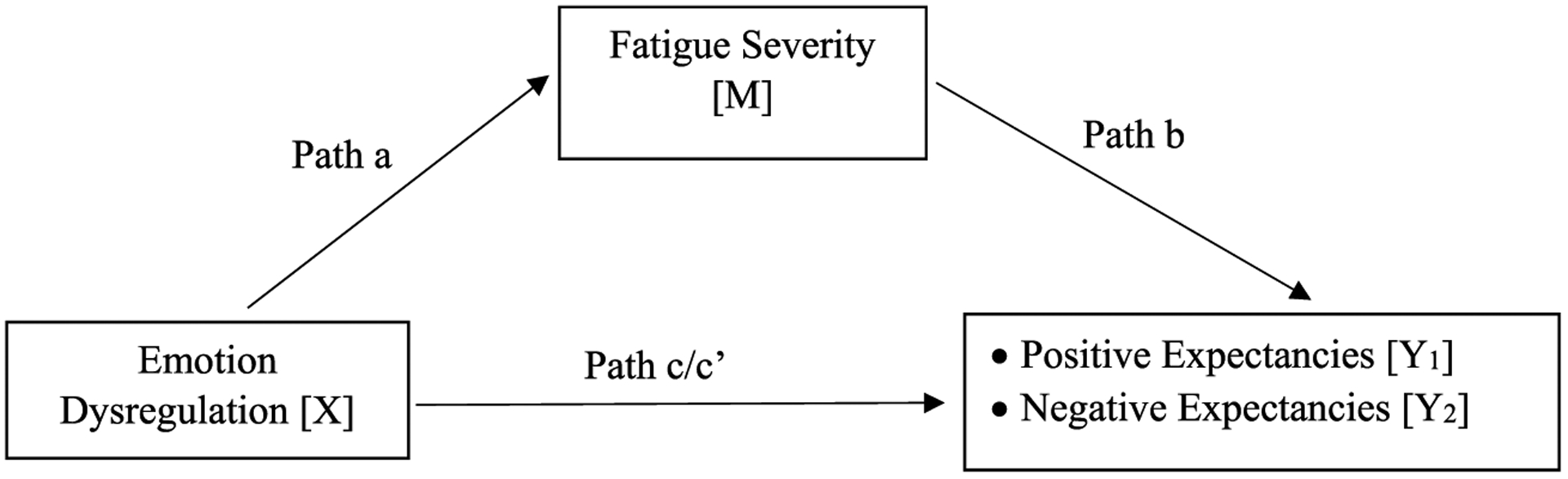
Emotion dysregulation predicting positive and negative expectancies of E-cigarette use via fatigue severity (Hypothesized Models).
Figure 2.

Fatigue severity predicting positive and negative expectancies of E-cigarette use via emotion dysregulation (Reverse Models).
Results
Bivariate correlations
Bivariate correlations are presented in Table 1. Emotion dysregulation was significantly correlated with fatigue severity (r = 0.50), positive expectancies (r = 0.28), and negative expectancies (r = 0.38). Fatigue severity was significantly correlated with positive expectancies (r = 0.41) and negative expectancies (r = 0.52).
Table 1.
Descriptive statistics and bivariate correlations.
| 1. | 2. | 3. | 4. | 5. | 6. | 7. | 8. | 9. | Mean (SD) or N [%] | |
|---|---|---|---|---|---|---|---|---|---|---|
| 1. Age | – | 35.25 (10.10) | ||||||||
| 2. Sex (Female) | 0.02 | – | 267 [50.9%] | |||||||
| 3. Education Level | −0.09* | −0.20** | – | 5.00 (1.8) | ||||||
| 4. Income | −0.06 | −0.17** | 0.53** | – | 6.09 (2.01) | |||||
| 5. E-Cigarette Use Frequency | −0.001 | 0.06 | 0.03 | 0.06 | – | 8.22 (9.89) | ||||
| 6. Current Cigarette Use (Yes) | −0.03 | −0.10* | 0.07 | 0.02 | −0.08 | – | 414 [78.9%] | |||
| 7. Fatigue Severity | −0.03 | 0.01 | 0.19** | 0.08 | 0.11* | 0.14** | – | 4.43 (1.60) | ||
| 8. Positive Expectancies | −0.03 | −0.10* | 0.30** | 0.29** | 0.08 | 0.10* | 0.41** | – | 5.05 (1.30) | |
| 9. Negative Expectancies | −0.13** | −0.10* | 0.29** | 028** | −0.02 | 0.15** | 0.52** | 0.73** | – | 4.74 (1.33) |
| 10. DERS | −0.20** | −0.10* | 0.23** | 0.14** | 0.04 | 0.06 | 0.50** | 0.28** | 0.38** | 43.19 (11.78) |
p < 0.05,
p < 0.01.
Sex coded 0 = Male and 1 = Female; Education level coded from 1 = Grade 6 or less to 8 = Graduate or professional degree; Income coded from 1 = $0-$4,999 to 8 = $75,000 or higher; E-Cigarette Use Frequency = average number of times e-cigarette used per day; Current Cigarette Use coded as 0 = does not currently smoke combustible cigarettes or 1 = currently smokes combustible cigarettes; Fatigue Severity = Fatigue Severity Scale (Krupp et al., 1989); Positive Expectancies = Smoking Consequences for Electronic Cigarettes-Positive Expectancies subscale (Harrell et al., 2015); Negative Expectancies = Smoking Consequences for Electronic Cigarettes-Negative Expectancies subscale (Harrell et al., 2015); DERS = Difficulty in Emotion Regulation Scale-short form (Kaufman et al., 2016).
Mediation models
In relation to positive expectancies, there was a significant total effect of emotion dysregulation (see Table 2; b = 0.03, 95%CI [0.02, 0.04]). In addition, there was a significant indirect effect of emotion dysregulation through fatigue severity, for positive expectancies (ab = 0.02, 95%CI [0.01, 0.02]), completely standardized indirect effect (β = 0.15). After accounting for indirect effects of the mediator, the direct effect of emotion dysregulation on positive expectancies remained significant (b = 0.01, 95%CI [0.0001, 0.02]). See Table 2.
Table 2.
Total, direct, and indirect effects of emotion dysregulation on positive and negative smoking expectancies via fatigue severity (Hypothesized Models).
| Y | Model | b | SE | t | p | LLCI | ULCI |
|---|---|---|---|---|---|---|---|
| 1 | DERS→FSS (a) | 0.07 | 0.06 | 11.86 | <0.001 | 0.05 | 0.08 |
| FSS→PE (b) | 0.25 | 0.04 | 6.79 | <0.001 | 0.17 | 0.32 | |
| DERS→PE (c) | 0.03 | 0.004 | 5.67 | <0.001 | 0.02 | 0.04 | |
| DERS→PE (c′) | 0.01 | 0.01 | 1.99 | <0.05 | 0.0001 | 0.02 | |
| DERS→PE (ab) | 0.02 | 0.004 | 0.01 | 0.02 | |||
| 2 | FSS→NE (b) | 0.33 | 0.04 | 9.43 | <0.001 | 0.26 | 0.40 |
| DERS→NE (c) | 0.04 | 0.005 | 7.81 | <0.001 | 0.03 | 0.05 | |
| DERS→NE (c′) | 0.01 | 0.01 | 2.98 | <0.01 | 0.01 | 0.02 | |
| DERS→NE (ab) | 0.02 | 0.004 | 0.02 | 0.03 |
a = Association of X with M; b = association of M with Y; c = Total association of X with Y; c′ = Direct association of X with Y controlling for M; ab = indirect effects of X on Y; Path a is equal in all models; therefore, it presented only in model 1. The standard error and 95% CI for ab are obtained by bootstrapping with 10,000 re-samples. FSS = Fatigue Severity Scale (Krupp et al., 1989); DERS = Difficulties in Emotion Regulation Scale (Gratz & Roemer, 2004); PE = Smoking Consequences for Electronic Cigarettes-Positive Expectancies (Harrell et al., 2015); NE = Smoking Consequences for Electronic Cigarettes-Negative Expectancies (Harrell et al., 2015); LLCI = lower bound of a 95% confidence interval; ULCI = upper bound;→ = association.
Regarding negative expectancies, there was a significant total effect of emotion dysregulation (See Table 2; b = 0.04, 95%CI [0.03, 0.05]). Also, there was a significant indirect effect of emotion dysregulation through fatigue severity, for negative expectancies (ab = 0.02, 95% CI [0.02, 0.03]), completely standardized indirect effect (β = 0.20). After accounting for indirect effects of the mediator, the direct effect of emotion dysregulation on negative expectancies remained significant (b = 0.02, 95%CI [0.01, 0.02]). See Table 2.
Reverse models
In relation to positive expectancies, there was a significant total effect of fatigue severity (b = 0.28, t = 8.76, p < 0.001, 95%CI [0.22, 0.34]). However, there was not a significant indirect effect of fatigue severity via emotion dysregulation for positive expectancies (ab = 0.03, SE = 0.02, 95% CI [−0.002, 0.06]). After accounting for indirect effects of the mediators, the direct effect of fatigue severity on positive expectancies remained significant (b = 0.25, t = 6.79, p < 0.001, 95%CI [0.17, 0.32]).
There was a significant total effect of fatigue severity for negative expectancies (b = 0.38, t = 12.24, p < 0.001, 95%CI [0.32, 0.44]). Also, there was a significant indirect effect of fatigue severity via emotion dysregulation for negative expectancies (ab = 0.05, SE = 0.02, 95% CI [0.01, 0.09]), completely standardized indirect effect (β = 0.06). After accounting for indirect effects of the mediators, the direct effect of fatigue severity on negative expectancies remained significant (b = 0.33, t = 9.43, p < 0.001, 95%CI [0.26, 0.40]).
Discussion
Overall, results were generally consistent with prediction. Specifically, more robust evidence emerged for fatigue as an explanatory factor between emotion dysregulation and positive and negative outcome expectancies for e-cigarette use relative to the competing models. The effect sizes for the primary models were small to moderate, and all observed effects were evident above and beyond the variance accounted for by age, sex, education, income, dual cigarette use, and e-cigarette use frequency. Such findings are in line with the theoretical perspective that the severity of fatigue may serve a mechanistic role in underlying the relation between emotion dysregulation and beliefs about the positive (e.g., calming effects of use) and negative (e.g., addictive qualities) functions of e-cigarette use relative to the opposite (i.e., emotion dysregulation mediates fatigue on outcomes). This conclusion is supported by the larger effect sizes in models examining fatigue severity as a mediating factor compared to emotion dysregulation and suggest that fatigue severity may possess relatively greater explanatory power. In addition, emotion dysregulation was not a significant mediator in the relation between fatigue severity and positive expectancies. In part, more robust evidence for fatigue as a mechanism may have emerged because of the psychological and physiological taxing consequence on persistent challenges with regulating emotions (Baumeister et al., 1998, 2000). Given the observed findings, there is a need to replicate and extend the current results using prospective research designs to help explicate the temporal ordering of the observed relations.
Across all models evaluated, there was evidence of the “dual endorsement” of both positive and negative expectancies for e-cigarette use. In addition, the correlation between positive and negative e-cigarette use expectancies was high (0.73), suggesting that as positive expectancies increase, so do negative expectancies, and vice versa. Thus, beliefs about e-cigarette use are not necessarily clustered in one domain (i.e., a person endorses only positive or negative expectancies about e-cigarette use). In the present study, there was clear empirical evidence that adult e-cigarette users with greater emotion dysregulation and severity of fatigue believed that e-cigarettes have both positive (e.g., help mood management) and negative (e.g., they are addictive) functions. These data highlight the complexity and importance of considering positive and negative expectancies about e-cigarette use in theoretical models as well as clinically oriented work on this population. For example, it is likely important to understand the unique and synergistic roles of expectancies for the initiation, maintenance, cessation, and relapse of e-cigarette use (Chaffee et al., 2018). Additionally, when advising persons trying to reduce or quit e-cigarette use, it is likely important to offer psychoeducation about positive and negative expectancies for use and how such beliefs are related to individual difference factors like emotion dysregulation and fatigue severity.
Although not the primary focus of the investigation, it is noteworthy that the observed average levels of emotion dysregulation (Bjureberg et al., 2016) and fatigue (Bakshi et al., 1999) were in the expected range of clinical populations using normative comparisons. Such findings highlight the clinical importance of these constructs among adult e-cigarette users and generally add to a growing literature that this population evinces high rates of psychological and medical dysfunction (Lorra Garey et al., 2019).
Clinically, the present findings suggest that intervention strategies or health promotion programs for adult e-cigarette users may benefit by considering emotion regulatory flexibility in the context of fatigue to more effectively address expectancies about use. For example, it may be useful to assess emotion dysregulation and fatigue to inform understanding about beliefs regarding the use of e-cigarettes among adults. Further, there are psychosocial interventions that can reduce emotion dysregulation (Clyne et al., 2010; Gratz, 2007; McMain et al., 2001). There may be merit to integrating such work with fatigue-based therapeutic interventions that have shown promise in controlled trials, such as graded exercise (Edmonds et al., 2004; Powell et al., 2001) or cognitive-behavioral therapy (Price & Couper, 2008) for adult e-cigarette users desiring to quit. In addition, a combination of mindfulness training and cognitive-behavioral therapy has shown promise in treating severe fatigue (van der Lee & Garssen, 2012). These strategies, such as identifying negative thoughts around fatigue symptoms and challenging them, could also serve to regulate emotional responses through increased self awareness, thereby, theoretically, reducing the need to use e-cigarettes as a method of coping. In terms of e-cigarette cessation, there is some initial work examining the benefits of computerized based treatments and texting programs (Graham et al., 2020; American Lung Association, 2020). However, there are no empirically supported treatments to date specifically aimed at reducing e-cigarette use. Collectively, the development and application of novel emotion dysregulation-fatigue interventions for e-cigarette users may have the potential to help address expectancies about use and thereby influence patterns of use.
There are several limitations of this study. First, the study design was cross-sectional in nature, limiting possible conclusions of the directionality of these findings. Future work would benefit from employing longitudinal research methodology to help explicate the nature of the interrelations between the studied variables. Second, e-cigarette dependence in the current sample was low. This characteristic may be in part due to the inclusion criteria for current e-cigarette use which allowed all participants that endorsed using an e-cigarette at least 3 days over the past 30 days to be included. Consequently, the current results may not necessarily generalize to e-cigarette users with higher e-cigarette dependence. Work may also benefit from examining dependence levels of nicotine, given the high rates of dual use among e-cigarette use samples. In addition, future work among e-cigarette users may benefit from examining specific types of fatigue (i.e. physical and mental) as research suggests that it is a multi-dimensional construct (Chen, 1986). Third, although most of the current adult sample reported daily e-cigarette use (67%), most of the sample (79%) were using combustible cigarettes. There is a need to continue to explore how exclusive e-cigarette and dual users (combustible and e-cigarette use) differ from one another. It may be that dual users represent a more severe type of user because they are addicted to or have more engrained patterns of two forms of nicotine products. The theoretical and clinical implications of exclusive versus dual use of e-cigarette and combustible cigarettes in terms of expectancies about use are not presently known. Fourth, the majority of the sample identified their race as White. Future work would benefit from employing the current model with more diverse samples to determine the generalizability of such findings. Fifth, the current investigation excluded participants younger than 18 and adults older than 65. This decision was made in an attempt to exclude adolescents (a unique developmental age group) who were not of legal smoking age and to exclude older adults who may be at greater risk for experiencing more physical or mental health problems and thus may endorse distinctive e-cigarette expectancies. Moving forward, the current model should be examined among these specific age groups to determine the replicability of the current findings. Sixth, current smoking status was determined via self-report and was not biochemically verified. This may lead to the inclusion of participants in the current data that would have otherwise been excluded based on biochemical verification. Seventh, the Smoking Consequences for Electronic Cigarettes Questionnaire was utilized to determine positive and negative expectancies for e-cigarette use. While this measure was the most empirically supported method of gathering data on e-cigarette expectancies at the time this study was conducted, recent work has published more relevant and more psychometrically sound questionnaires that better encapsulate e-cigarette expectancies. Future work would benefit from replicating the current model with a more updated measure of e-cigarette expectancies. In a similar vein, these results may not reflect the current state of the e-cigarette industry as research regarding health risks and social acceptability of e-cigarette is continuing to emerge. It is possible that expectancies regarding e-cigarette use are changing as more research develops. In addition, many other changes may have taken place since this data was collected, such as the advancement in e-cigarette products, and the patterns of use. Finally, because fatigue can co-occur with various physical and mental disorders (Hudson et al., 1993), there could be utility in future research exploring the present model among specific clinical populations (e.g., those with psychiatric disorders, chronic fatigue syndrome). This type of work would help identify the relative generalizability of the present model to specific healthcare populations.
Overall, the current study provides empirical support for the greater explanatory power of fatigue in the relation between emotion dysregulation and positive and negative e-cigarette expectancies relative to emotion dysregulation for fatigue on outcomes among adult e-cigarette users. Future work is needed to explicate how reducing fatigue severity in the context of emotion dysregulation may change expectancies about e-cigarette expectancies.
Footnotes
Disclosure of interest
The authors report no conflict of interest.
References
- American Lung Association. (2020). N-O-T: Not on tobacco – proven teen smoking and vaping cessation program. https://www.lung.org/stop-smoking/helping-teens-quit/not-on-tobacco.html
- Bakshi R, Miletich R, Henschel K, Shaikh Z, Janardhan V, Wasay M, Stengel L, Ekes R, & Kinkel P (1999). Fatigue in multiple sclerosis: Cross-sectional correlation with brain MRI findings in 71 patients. Neurology, 53(5), 1151–1152. 10.1212/WNL.53.5.1151 [DOI] [PubMed] [Google Scholar]
- Bardeen JR, Daniel TA, Hinnant JB, & Orcutt HK (2017). Emotion dysregulation and threat-related attention bias variability. Motivation and Emotion, 41(3), 402–409. 10.1007/s11031-017-9604-z [DOI] [Google Scholar]
- Barker JO, Kelley DE, Noar SM, Reboussin BA, Cornacchione Ross J, & Sutfin EL (2019). E-cigarette outcome expectancies among nationally representative samples of adolescents and young adults. Substance Use & Misuse, 54(12), 1970–1979. 10.1080/10826084.2019.1624773 [DOI] [PMC free article] [PubMed] [Google Scholar]
- Baumeister RF, Bratslavsky E, Muraven M, & Tice DM (1998). Ego depletion: Is the active self a limited resource? Journal of Personality and Social Psychology, 74(5), 1252. 10.1037/0022-3514.74.5.1252doi: [DOI] [PubMed] [Google Scholar]
- Baumeister RF, Muraven M, & Tice DM (2000). Ego depletion: A resource model of volition, self-regulation, and controlled processing. Social Cognition, 18(2), 130–150. 10.1521/soco.2000.18.2.130 [DOI] [Google Scholar]
- Bjureberg J, Ljótsson B, Tull MT, Hedman E, Sahlin H, Lundh L-G, Bjärehed J, DiLillo D, Messman-Moore T, Gumpert CH, & Gratz KL (2016). Development and validation of a brief version of the difficulties in emotion regulation scale: The DERS-16. Journal of Psychopathology and Behavioral Assessment, 38(2), 284–296. 10.1007/s10862-015-9514-x [DOI] [PMC free article] [PubMed] [Google Scholar]
- Bloch L, Moran EK, & Kring AM (2010). On the need for conceptual and definitional clarity in emotion regulation research on psychopathology. In Kring AM & Sloan DM (Eds.), Emotion regulation and psychopathology: A transdiagnostic approach to etiology and treatment (pp. 1–13). The Guilford Press. [Google Scholar]
- Boutrel B, & Koob GF (2004). What keeps us awake: The neuropharmacology of stimulants and wakefulness promoting medications. Sleep, 27(6), 1181–1194. 10.1093/sleep/27.6.1181 [DOI] [PubMed] [Google Scholar]
- Brandon KO, Simmons VN, Meltzer LR, Drobes DJ, Martínez Ú, Sutton SK, Palmer AM, Bullen CR, Harrell PT, & Brandon TH (2019). Vaping characteristics and expectancies are associated with smoking cessation propensity among dual users of combustible and electronic cigarettes. Addiction, 114(5), 896–906. 10.1111/add.14551 [DOI] [PMC free article] [PubMed] [Google Scholar]
- Brandon TH, Herzog TA, Irvin JE, & Gwaltney CJ (2004). Cognitive and social learning models of drug dependence: Implications for the assessment of tobacco dependence in adolescents. Addiction, 99(Supplement 1), 51–77. 10.1111/j.1360-0443.2004.00737.x [DOI] [PubMed] [Google Scholar]
- Chaffee BW, Watkins SL, & Glantz SA (2018). Electronic cigarette use and progression from experimentation to established smoking. Pediatrics, 141(4), e20173594. 10.1542/peds.2017-3594 [DOI] [PMC free article] [PubMed] [Google Scholar]
- Chassin L, Presson CC, Sherman SJ, & Edwards DA (1991). Four pathways to young-adult smoking status: Adolescent social-psychological antecedents in a midwestern community sample. Health Psychology, 10(6), 409. 10.1037/0278-6133.10.6.409 [DOI] [PubMed] [Google Scholar]
- Chen MK (1986). The epidemiology of self-perceived fatigue among adults. Preventive Medicine, 15(1), 74–81. 10.1016/0091-7435(86)90037-X [DOI] [PubMed] [Google Scholar]
- Choi K, & Forster J (2013). Characteristics associated with awareness, perceptions, and use of electronic nicotine delivery systems among young US Midwestern adults. American Journal of Public Health, 103(3), 556–561. 10.2105/AJPH.2012.300947doi: [DOI] [PMC free article] [PubMed] [Google Scholar]
- Clyne C, Latner JD, Gleaves DH, & Blampied NM (2010). Treatment of emotional dysregulation in full syndrome and subthreshold binge eating disorder. Eating Disorders, 18 (5), 408–424. 10.1080/10640266.2010.511930 [DOI] [PubMed] [Google Scholar]
- Corwin EJ, Klein LC, & Rickelman K (2002). Predictors of fatigue in healthy young adults: Moderating effects of cigarette smoking and gender. Biological Research for Nursing, 3(4), 222–233. 10.1177/109980040200300407 [DOI] [PubMed] [Google Scholar]
- Creamer MR, Wang TW, Babb S, Cullen KA, Day H, Willis G, Jamal A, & Neff L (2019). Tobacco Product Use and Cessation Indicators Among Adults — United States, 2018. Morbidity and Mortality Weekly Report, 68(45), 1013. 10.15585/mmwr.mm6845a2 [DOI] [PMC free article] [PubMed] [Google Scholar]
- De Venter M, Illegems J, Van Royen R, Moorkens G, Sabbe BG, & Van Den Eede F (2017). Differential effects of childhood trauma subtypes on fatigue and physical functioning in chronic fatigue syndrome. Comprehensive Psychiatry, 78, 76–82. 10.1016/j.comppsych.2017.07.006 [DOI] [PubMed] [Google Scholar]
- Dockrell M, Morrison R, Bauld L, & McNeill A (2013). E-cigarettes: Prevalence and attitudes in Great Britain. Nicotine & Tobacco Research, 15(10), 1737–1744. 10.1093/ntr/ntt057 [DOI] [PMC free article] [PubMed] [Google Scholar]
- Doran N, Schweizer CA, & Myers MG (2011). Do expectancies for reinforcement from smoking change after smoking initiation?. Psychology of Addictive Behaviors, 25(1), 101. 10.1037/a0020361 [DOI] [PMC free article] [PubMed] [Google Scholar]
- Edmonds M, McGuire H, & Price J (2004). Exercise therapy for chronic fatigue syndrome. The Cochrane Database of Systematic Reviews, (3), CD003200. 10.1002/14651858.CD003200.pub2 [DOI] [PubMed] [Google Scholar]
- Etter J-F, & Bullen C (2011). Electronic cigarette: Users profile, utilization, satisfaction and perceived efficacy. Addiction, 106(11), 2017–2028. 10.1111/j.1360-0443.2011.03505.x [DOI] [PubMed] [Google Scholar]
- Farris SG, Zvolensky MJ, & Schmidt NB (2016). Difficulties with emotion regulation and psychopathology interact to predict early smoking cessation lapse. Cognitive Therapy and Research, 40(3), 357–367. 10.1007/s10608-015-9705-5 [DOI] [PMC free article] [PubMed] [Google Scholar]
- Foulds J, Veldheer S, Yingst J, Hrabovsky S, Wilson SJ, Nichols TT, & Eissenberg T (2015). Development of a questionnaire for assessing dependence on electronic cigarettes among a large sample of ex-smoking E-cigarette users. Nicotine & Tobacco Research, 17(2), 186–192. 10.1093/ntr/ntu204 [DOI] [PMC free article] [PubMed] [Google Scholar]
- Friedberg F, Adamowicz JL, Caikauskaite I, Napoli A, Shapira O, Hobbs M, Bromet E, Kotov R, Gonzalez A, & Clouston S (2016). Fatigue severity in World Trade Center (9/11) responders: A preliminary study. Fatigue: Biomedicine, Health & Behavior, 4(2), 70–79. 10.1080/21641846.2016.1169726 [DOI] [Google Scholar]
- Fucito LM, Juliano LM, & Toll BA (2010). Cognitive reappraisal and expressive suppression emotion regulation strategies in cigarette smokers. Nicotine & Tobacco Research, 12(11), 1156–1161. 10.1093/ntr/ntq146 [DOI] [PMC free article] [PubMed] [Google Scholar]
- Garey L, Mayorga NA, Peraza N, Smit T, Nizio P, Otto MW, & Zvolensky MJ (2019). Distinguishing characteristics of E-cigarette users who attempt and fail to quit: Dependence, perceptions, and affective vulnerability. Journal of Studies on Alcohol and Drugs, 80(1), 134–140. 10.15288/jsad.2019.80.134 [DOI] [PubMed] [Google Scholar]
- Glasser AM, Collins L, Pearson JL, Abudayyeh H, Niaura RS, Abrams DB, & Villanti AC (2017). Overview of electronic nicotine delivery systems: A systematic review. American Journal of Preventive Medicine, 52(2), e33–e66. 10.1016/j.amepre.2016.10.036 [DOI] [PMC free article] [PubMed] [Google Scholar]
- Graham AL, Jacobs MA, & Amato MS (2020). Engagement and 3-month outcomes from a digital E-cigarette cessation program in a Cohort of 27 000 teens and young adults. Nicotine and Tobacco Research, 22(5), 859–860. 10.1093/ntr/ntz097doi: [DOI] [PMC free article] [PubMed] [Google Scholar]
- Gratz KL (2007). Targeting emotion dysregulation in the treatment of self-injury. Journal of Clinical Psychology, 63(11), 1091–1103. 10.1002/jclp.20417 [DOI] [PubMed] [Google Scholar]
- Gratz KL, & Roemer L (2004). Multidimensional assessment of emotion regulation and dysregulation: Development, factor structure, and initial validation of the difficulties in emotion regulation scale. Journal of Psychopathology and Behavioral Assessment, 26(1), 41–54. 10.1023/B:JOBA.0000007455.08539.94 [DOI] [Google Scholar]
- Gwaltney CJ, Shiffman S, Balabanis MH, & Paty JA (2005). Dynamic self-efficacy and outcome expectancies: prediction of smoking lapse and relapse. Journal of Abnormal Psychology, 114(4), 661. 10.1037/0021-843X.114.4.661 [DOI] [PubMed] [Google Scholar]
- Hamidovic A, & de Wit H (2009). Sleep deprivation increases cigarette smoking. Pharmacology, Biochemistry, and Behavior, 93(3), 263–269. 10.1016/j.pbb.2008.12.005 [DOI] [PMC free article] [PubMed] [Google Scholar]
- Harrell PT, Marquinez NS, Correa JB, Meltzer LR, Unrod M, Sutton SK, Simmons VN, & Brandon TH (2014). Expectancies for cigarettes, e-cigarettes, and nicotine replacement therapies among e-cigarette users (aka vapers). Nicotine & Tobacco Research, 17(2), 193–200. 10.1093/ntr/ntu149 [DOI] [PMC free article] [PubMed] [Google Scholar]
- Harrell PT, Simmons VN, Piñeiro B, Correa JB, Menzie NS, Meltzer LR, Unrod M, & Brandon TH (2015). E-cigarettes and expectancies: Why do some users keep smoking? Addiction, 110(11), 1833–1843. 10.1111/add.13043 [DOI] [PMC free article] [PubMed] [Google Scholar]
- Hartwell G, Egan M, & Petticrew M (2020). Understanding decisions to use e-cigarettes or behavioural support to quit tobacco: A qualitative study of current and ex-smokers and stop smoking service staff. Addiction, 115(3), 518–526. 10.1111/add.14844 [DOI] [PubMed] [Google Scholar]
- Hayes A (2013). Introduction to mediation, moderation, and conditional process analysis: A regression-based approach. Guilford Press. [Google Scholar]
- Hefner K, Rosenheck R, Merrel J, Coffman M, Valentine G, & Sofuoglu M (2016). E-cigarette use in veterans seeking mental health and/or substance use services. Journal of Dual Diagnosis, 12(2), 109–117. 10.1080/15504263.2016.1172895 [DOI] [PMC free article] [PubMed] [Google Scholar]
- Hefner K, Valentine G, & Sofuoglu M (2017). Electronic cigarettes and mental illness: Reviewing the evidence for help and harm among those with psychiatric and substance use disorders. The American Journal on Addictions, 26(4), 306–315. 10.1111/ajad.12504 [DOI] [PubMed] [Google Scholar]
- Hendricks PS, Cases MG, Thorne CB, Cheong J, Harrington KF, Kohler CL, & Bailey WC (2015). Hospitalized smokers’ expectancies for electronic cigarettes versus tobacco cigarettes. Addictive Behaviors, 41, 106–111. 10.1016/j.addbeh.2014.09.031 [DOI] [PMC free article] [PubMed] [Google Scholar]
- Hudson J, Goldenberg D, Pope H Jr, Keck P Jr, & Schlesinger L (1993). Comorbidity of fibromyalgia with medical and psychiatric disorders. Survey of Anesthesiology, 37(2), 93. 10.1097/00132586-199304000-00037 [DOI] [PubMed] [Google Scholar]
- Kaufman EA, Xia M, Fosco G, Yaptangco M, Skidmore CR, & Crowell SE (2016). The difficulties in emotion regulation scale short form (DERS-SF): Validation and replication in adolescent and adult samples. Journal of Psychopathology and Behavioral Assessment, 38(3), 443–455. 10.1007/s10862-015-9529-3 [DOI] [Google Scholar]
- King BA, Alam S, Promoff G, Arrazola R, & Dube SR (2013). Awareness and Ever-Use of Electronic Cigarettes Among U.S. Adults, 2010–2011. Nicotine & Tobacco Research, 15(9), 1623–1627. 10.1093/ntr/ntt013 [DOI] [PMC free article] [PubMed] [Google Scholar]
- Krupp LB, LaRocca NG, Muir-Nash J, & Steinberg AD (1989). The fatigue severity scale: Application to patients with multiple sclerosis and systemic lupus erythematosus. Archives of Neurology, 46(10), 1121–1123. 10.1001/archneur.1989.00520460115022 [DOI] [PubMed] [Google Scholar]
- Manning K, Garey L, Mayorga NA, Shepherd JM, & Zvolensky MJ (2019). The relation between fatigue severity and anxious arousal, negative affect, and emotion dysregulation among adult e-cigarette users. Fatigue: Biomedicine, Health & Behavior, 7(2), 92–101. 10.1080/21641846.2019.1626059 [DOI] [Google Scholar]
- Mayorga NA, Garey L, & Zvolensky MJ (2018). Differences in perceptions of e-cigarettes across daily and non-daily users. Addictive Behaviors, 90, 415–420. doi: 10.1016/j.addbeh.2018.12.004 [DOI] [PubMed] [Google Scholar]
- McMain S, Korman LM, & Dimeff L (2001). Dialectical behavior therapy and the treatment of emotion dysregulation. Journal of Clinical Psychology, 57(2), 183–196. 10.1002/1097-4679(200102)57:2<183::AID-JCLP5>3.0.CO;2-Y [DOI] [PubMed] [Google Scholar]
- Pham T, Williams JV, Bhattarai A, Dores AK, Isherwood LJ, & Patten SB (2020). Electronic cigarette use and mental health: A Canadian population-based study. Journal of Affective Disorders, 260, 646–652. 10.1016/j.jad.2019.09.026 [DOI] [PubMed] [Google Scholar]
- Pokhrel P, Lam TH, Pagano I, Kawamoto CT, & Herzog TA (2018). Young adult e-cigarette use outcome expectancies: Validity of a revised scale and a short scale. Addictive Behaviors, 78, 193–199. 10.1016/j.addbeh.2017.11.019 [DOI] [PMC free article] [PubMed] [Google Scholar]
- Pokhrel P, Little MA, Fagan P, Muranaka N, & Herzog TA (2014). Electronic cigarette use outcome expectancies among college students. Addictive Behaviors, 39(6), 1062–1065. 10.1016/j.addbeh.2014.02.014 [DOI] [PMC free article] [PubMed] [Google Scholar]
- Pomerleau OF (1992). Nicotine and the central nervous system: Biobehavioral effects of cigarette smoking. The American Journal of Medicine, 93(1), S2–S7. 10.1016/0002-9343(92)90619-Mdoi: [DOI] [PubMed] [Google Scholar]
- Powell P, Bentall RP, Nye FJ, & Edwards RH (2001). Randomised controlled trial of patient education to encourage graded exercise in chronic fatigue syndrome. Bmj, 322(7283), 387. 10.1136/bmj.322.7283.387 [DOI] [PMC free article] [PubMed] [Google Scholar]
- Preacher KJ, & Hayes AF (2008). Asymptotic and resampling strategies for assessing and comparing indirect effects in multiple mediator models. Behavior Research Methods, 40(3), 879–891. 10.3758/BRM.40.3.879 [DOI] [PubMed] [Google Scholar]
- Price JR, Mitchell E, Tidy E, & Hunot V (2008). Cognitive behaviour therapy for chronic fatigue syndrome in adults. Cochrane Database of Systematic Reviews, 2008(3), CD001027. 10.1002/14651858.CD001027.pub2 [DOI] [PMC free article] [PubMed] [Google Scholar]
- Rogers AH, Bakhshaie J, Garey L, Piasecki TM, Gallagher MW, Schmidt NB, & Zvolensky MJ (2019). Individual differences in emotion dysregulation and trajectory of withdrawal symptoms during a quit attempt among treatment-seeking smokers. Behaviour Research and Therapy, 115, 4–11. 10.1016/j.brat.2018.10.007 [DOI] [PMC free article] [PubMed] [Google Scholar]
- Rogers AH, Bakhshaie J, Viana AG, Manning K, Mayorga NA, Garey L, Raines AM, Schmidt NB, & Zvolensky MJ (2018). Emotion dysregulation and smoking among treatment-seeking smokers. Addictive Behaviors, 79, 124–130. 10.1016/j.addbeh.2017.12.025 [DOI] [PMC free article] [PubMed] [Google Scholar]
- Rogers AH, Kauffmann BY, Bakhshaie J, McHugh RK, Ditre JW, & Zvolensky MJ (2019). Anxiety sensitivity and opioid misuse among opioid-using adults with chronic pain. The American Journal of Drug and Alcohol Abuse, 45(5), 470–478. 10.1080/00952990.2019.1569670 [DOI] [PMC free article] [PubMed] [Google Scholar]
- Rosen RL, & Steinberg ML (2020). Interest in quitting E-cigarettes among adults in the United States. Nicotine and Tobacco Research, 22(5), 857–858. 10.1093/ntr/ntz062 [DOI] [PMC free article] [PubMed] [Google Scholar]
- Shen J, Barbera J, & Shapiro CM (2006). Distinguishing sleepiness and fatigue: Focus on definition and measurement. Sleep Medicine Reviews, 10(1), 63–76. 10.1016/j.smrv.2005.05.004 [DOI] [PubMed] [Google Scholar]
- Szasz PL, Szentagotai A, & Hofmann SG (2012). Effects of emotion regulation strategies on smoking craving, attentional bias, and task persistence. Behaviour Research and Therapy, 50(5), 333–340. 10.1016/j.brat.2012.02.010 [DOI] [PubMed] [Google Scholar]
- Truth Initiative. (2019, September 30). This is Quitting. https://truthinitiative.org/thisisquitting
- van der Lee ML, & Garssen B (2012). Mindfulness-based cognitive therapy reduces chronic cancer-related fatigue: A treatment study. Psycho-Oncology, 21(3), 264–272. 10.1002/pon.1890 [DOI] [PubMed] [Google Scholar]
- Wilson S, Foulds J, Berg A, & Chen G (2015). Examining the psychological and biological effects associated with the use of electronic cigarette devices. ETDA. https://etda.libraries.psu.edu/files/final_submissions/9660 [Google Scholar]
- Zhu S-H, Gamst A, Lee M, Cummins S, Yin L, & Zoref L (2013). The use and perception of electronic cigarettes and snus among the US population. PloS One, 8(10), e79332. 10.1371/journal.pone.0079332 [DOI] [PMC free article] [PubMed] [Google Scholar]
- Zvolensky M, Bakhshaie J, Shepherd J, Garey L, Peraza N, Viana A, Brown J, & Brown R (2019a). Anxiety sensitivity and smoking outcome expectancies among Spanish-speaking Latinx adult smokers. Experimental and Clinical Psychopharmacology, 27(6), 569–577. 10.1016/j.smrv.2005.05.004 [DOI] [PMC free article] [PubMed] [Google Scholar]
- Zvolensky MJ, Bakhshaie J, Shepherd JM, Peraza N, Garey L, Viana AG, Glover N, Brown JT, & Brown RA (2019b). Anxiety sensitivity and smoking among Spanish-speaking Latinx smokers. Addictive Behaviors, 90, 55–61. 10.1016/j.addbeh.2018.10.022 [DOI] [PMC free article] [PubMed] [Google Scholar]
- Zvolensky MJ, Manning K, Garey L, Mayorga NA, & Peraza N (2019). Fatigue severity and electronic cigarette beliefs and use behavior. Addictive Behaviors, 97, 1–6. 10.1016/j.addbeh.2019.05.014 [DOI] [PubMed] [Google Scholar]
- Zvolensky MJ, Mayorga NA, & Garey L (2018a). Positive expectancies for e-cigarette use and anxiety sensitivity among adults. Nicotine & Tobacco Research, 21(10), 1355–1362. 10.1093/ntr/nty106 [DOI] [PubMed] [Google Scholar]
- Zvolensky MJ, Mayorga NA, & Garey L (2018b). Worry, anxiety sensitivity, and electronic cigarettes among adults. Psychiatry Research, 269, 321–327. 10.1016/j.psychres.2018.08.087 [DOI] [PMC free article] [PubMed] [Google Scholar]
- Zvolensky MJ, Shepherd JM, Bakhshaie J, Garey L, Viana AG, & Peraza N (2019). Emotion dysregulation and smoking outcome expectancies among Spanish-speaking Latinx adult cigarette smokers in the United States. Psychology of Addictive Behaviors, 33(6), 574–579. 10.1037/adb0000481 [DOI] [PMC free article] [PubMed] [Google Scholar]