



Background:
Securing a plastic surgery position is a demanding task for students. Although many papers have been published internationally discussing the traits and features deemed important from the point of view of plastic surgery program directors, a gap exists in the literature where this aspect is not covered in Saudi Arabia. The aim of this study was to fill this gap.
Methods:
In this cross-sectional study, a survey was developed targeting all current and former Saudi plastic surgery training program directors. SPSS was used to calculate frequencies and present percentages; independent t-test was done to look for mean differences. Ethical approval was obtained from a local institution.
Results:
All current and former Saudi plastic surgery program directors participated (n = 17), including the 8 (47.1%) current directors. When asked to rank 7 items on a scale of importance, they scored a mean of 6.2, 5.8, 5.4, 4.88, 4.82, 4.6, and 3.7 for good impression on interviews, prior experience, research experience, the grade point average (GPA), oral or poster presentations on events, the Saudi Medical Licensing Examination (SMLE), and attaining a post-graduate degree, respectively. The majority [n = 7 (41%)] considers the mode of communication, such as phone calls, as the most important aspect in recommendations. They prefer candidates who took electives/rotations at their department [n = 12 (71%)] and give more value to high-quality publications [n = 9 (47%)]. Applicant’s gender was not important.
Conclusion:
With early planning, this article could serve as a guide for medical students interested in plastic surgery to build their assets toward a successful interview.
INTRODUCTION
The race toward securing a training position in plastic surgery is recognized as one of the most competitive endeavors in the medical field.1,2 In 2015, the Saudi Commission for Health Specialties reported that more than 60–70 medical graduates apply yearly to plastic surgery positions, and only 10–13 are matched.1
Given this competitive nature, training programs rank applicants based on different selection factors, including but not limited to academic achievement, medical licensing examination scores, letters of recommendation, personality traits, and impression made during rotations or interviews. According to the National Resident Match Program, plastic surgery applicants are expected to have above-average academic achievement, with a high number of publications and rich research experience.2 They conducted a survey in 2018 asking plastic surgery program directors to rank important factors on which they assess applicants.2 Similar studies were done by Liang et al,3 Janis and Hatef,4 Nguyen and Janis,5 and Drolet et al.6 These studies discussed the impact of recommendation letters, outstanding communication skills, grades, the graduating university reputation, and many others at the chances of being accepted for a plastic surgery training position. However, data are scarce with regard to this aspect in the local literature.
Henceforth, the purpose of this study was to identify the academic and subjective factors sought by program directors when ranking applicants to the Saudi plastic surgery training program centers. The findings would assist aspiring plastic surgeons and provide a clear guide for them.
METHODOLOGY
In this cross-sectional study, an electronic survey (See questionnaire, Supplemental Digital Content 1, which displays the list of questions used in the study. http://links.lww.com/PRSGO/B588.) was developed and sent to all current and former plastic surgery training program directors (who are not involved in the administrative process of the training anymore) in the Kingdom of Saudi Arabia (KSA). Directors of other specialties were excluded. Reminders were sent and all participants responded within a week. Respondents were asked for demographic data. Then, on a scale from 1 (least important) to 7 (most important), they had to rank 7 items pertinent to academic, clinical, and personal traits from their perspective, as program directors. These include the grade point average (GPA), Saudi Medical License Examination (SMLE) score, good impression on interview, work experience in plastic surgery, background in research, having a post-graduate degree, and poster and oral presentations. Other questions asked about which aspect of recommendations and research is the most important, details about the prior experience in plastic surgery, preference between fresh or older graduates, importance of gender in the selection process, role of the reputation of the applicant’s medical college, and the importance of prior knowledge in plastic surgery.
Participants consented to publishing their input; they were informed that participation is totally voluntary without positive or negative consequences should they fill in the questionnaire or refrain from contributing. Moreover, they were informed that no identifier data would be included in the article and data would not be shared with any third party. Institutional review board approval was obtained for this study and ethical principles stated in the Declaration of Helsiniki were followed. (See questionnaire, Supplemental Digital Content 1, which displays the list of questions used in the study. http://links.lww.com/PRSGO/B588.)
Data were first compiled in a Microsoft Excel format before exporting it to SPSS (23rd edition for Microsoft; Microsoft Corp, Redmond, Wash.). Frequencies and descriptive statistics were calculated as numbers and percentages. Weighted mean average of each item in the scale was calculated. Welch independent t-test was used to look for any significant differences in the mean between the current and former directors in the Likert-scale. A probability value of <0.5 was considered the cut-off for significance.
RESULTS
A total of 17 people participated in this survey (response rate: 100%), of which 8 (47.1%) actively work as a plastic surgery program director. The majority of the participants were men (82.4%) and directed programs of the central region of KSA (76.5%). In terms of work experience, the sample had a mean of 4.2 years of experience (SD = 3.4 years) as a plastic surgery program director. Please refer to Table 1 for further details about demographic data.
Table 1.
Demographic Data
| Parameter | No., % | Measures of Dispersion |
|---|---|---|
| Active appointment | Current PD: 8 (47.1%) Former PD: 9 (52.9%) | — |
| Gender | Men: 14 (82.4%) Women: 3 (17.6%) | — |
| Years of service as a PD | — | Mean: 4.2 y |
| SD: 3.4 y | ||
| Median: 4 y | ||
| Mode: 2 and 4 y | ||
| Minimum: 1 y | ||
| Maximum: 13 y | ||
| Region of service | Central: 13 (76.5%) | — |
| Western: 4 (23.5%) |
PD: Program director.
When asked to rank 7 items on a scale of importance, the program directors scored a mean of 6.2, 5.8, 5.4, 4.88, 4.82, 4.6, and 3.7 for good impression on interviews, prior experience, research experience, the GPA, oral or poster presentations on events, the Saudi Medical Licensing Examination, and attaining a post-graduate degree, respectively. Please refer to Table 2 for details. Most of the directors [n = 7 (41%)] considered mode of communicating the recommendation as the most important aspect of recommendation letters. Moreover, work history in the same institution where the candidate applied was considered the most important aspect of prior experience in plastic surgery by most of the participants [n = 12 (70.6%)]. Finally, the quality of the research was hinted as the most crucial when considering research and publications by the majority [n = 8 (47.1%)] (Figs. 1–3). Table 3 enlists the remainder of the survey’s questions to the directors. There was no significant difference in the responses between current and former program directors in all the parameters on Welch independent t-test and Fischer’s exact. The survey can be found in the appendix.
Table 2.
Ranking of Seven Personal Items based on the Importance from the Plastic Surgery Program Directors’ Point of View
| Item | Mean Score |
|---|---|
| Good impression on interviews | 6.2 (P > 1) |
| Background experience in plastic surgery such as electives | 5.8 (P = 0.16) |
| Experience in research in terms of courses or publications that show evidence of knowledge in basics of medical research | 5.4 (P = 0.20) |
| GPA* | 4.88 (P = 0.88) |
| Oral or poster presentations on events | 4.82 (P = 0.96) |
| SMLE score* | 4.6 (P = 0.42) |
| Holding a higher academic degree | 3.7 (P = 0.81) |
The table is organized in a descending order. All the insignificant probability values indicate that there is no significant difference in the mean between the current and former directors on independent t-test.
*With the assumption that the applicant has fulfilled the minimum requirement in this item for the institution where he applied to.
Fig. 1.
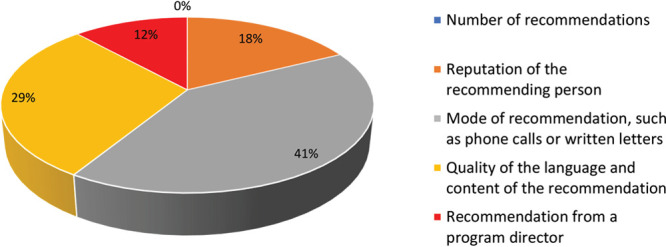
Which of the following regarding recommendations is the most important?
Fig. 3.

Which of the following is the most important regarding research?
Table 3.
Remainder of the Questions with Responses
| Item | The Prevalent Opinion, % |
|---|---|
| Is research experience in basic sciences more impressive than the clinical field? | No (76.5%) |
| Does passing other medical licensing examinations like the United States Medical Licensing Examination improve the chances of acceptance? | No (76.5%) |
| Are fresh graduates preferred over older graduates?* | Yes (76.5%) |
| Is the applicant’s gender important? | No (88.2%) |
| Is the applicant’s university reputation important? | Yes (58.8%) |
| Is the applicant’s personal reputation important? | Yes (100%) |
| Are honors or awards important? | Yes (70.6%) |
| Is background knowledge in plastic surgery important? | Yes (70.6%) |
*Fresh graduates were defined as those who graduated within the last 2 years.
Fig. 2.

Which of the following regarding previous background in plastic surgery is the most important?
DISCUSSION
All over the world, gaining entry into plastic surgery is extremely demanding. In the UK, a competition ratio of 3.92 was reported in 2019 when 149 people applied to 38 available plastic surgery positions.7 In KSA, there are 4 plastic surgery training programs across the central and western regions of the country, of which 2 are joint programs between multiple centers. To secure a position, a candidate has to go through a process that begins from a computerized central matching system run by the Saudi Commission for Health Specialties; applicants list their desired specialty along with the desired region of the country. Then, based on the highest composite score (which depends 30% on the GPA, 20% on elements of the circum vitae, and 50% on the SMLE score), the applicants are matched to their wanted future specialty according to the positions’ availability in the chosen region. The candidates who successfully match to plastic surgery then have to choose different training centers in the region where they got matched, to have appointments for interviews. This is the final stage where applicants are vetted and selected, and this phase is where this article becomes valuable.
Interview
From our assessment, a good impression on interviews could be the “make it or break it” factor during the selection process, where applicants can shine. It provides a window to display highly sought-after traits such as honesty, passion toward the specialty, hard-work, maturity, and intelligence.3 Oxley and Lotto regarded properly answering questions in the interview and making a good impression as the most important factor when selecting residents.8 On the other hand, a review of literature revealed that only 11 of 34 studies have found a positive correlation between interviews and performance during residency, in terms of clinical evaluations, in-training examinations, licensing board examinations, and a composite score or rank of residents’ performance. This disparity between interview expectations and future performance can be explained, in part, by lack of structure, inevitable subjectivity, and interpersonal and social skills. Given the weight interviews carry in the hiring process, its unreliability calls for a careful re-evaluation of its value.9
Recommendation Letters
Letters of recommendation are known to springboard the chances of acceptance to residency training.10 In this study, most of the directors deemed the mode of communicating the recommendation as the most important factor when considering recommendations. While each mode has its inherent advantages and disadvantages, we believe that in-person communication or phone calls are considered to be the strongest, followed by letters written particularly for the applicant and sent by the recommending person. Written and personal communication can present a biased image of the applicant when they opt to selectively provide letters or contact details of people with whom they hold warm relationships. However, stakeholders can engage in detailed conversations with the references, which helps acquiring a more robust impression of the applicant by exploring their weaknesses and strength points alike—an advantage that is lacking in the written recommendations. Direct communication could be impractical when directors are faced with a large pool of applicants,11 but this could be the optimal option in plastic surgery where the number of candidates is limited. Templates or letters imported from the internet that are given to whomever asks hold no weight. Notably, none of our cohort valued quantity of the recommendations. Please refer to graph 1 for more details.
Janis and Hatef suggested that the content of the recommendation letter and reputation of the recommending person are the most important factors when ranking applicants.4 Likewise, Liang et al reported that language of the recommendation does not compensate for the lack of the recommending person’s reputation, as they proposed that recommendations from known physicians is the most important factor, whereas strong letters from unknown physicians is the least important in plastic surgery residency selection.3 However, the results of our study indicated the opposite where the majority of our program directors valued the content and mode of communicating the recommendation more than the reputation of the recommending person. Similar findings were also reported by Nguyen and Janis.5 As a result, local applicants interested in pursuing a career as plastic surgeons are recommended to take note of this factor. As a result, students with limited opportunities to work with well-known plastic surgeons in KSA are not at an extreme disadvantage.
Previous Experience in Plastic Surgery
Second only to positive impression on interviews, work experience is imperative in boosting the chances of acceptance because it shows commitment and relationships could be fostered during rotations. All current Saudi plastic surgery residents, as reported by Shah Mardan et al, had some form of experience upon entry to residency training.12 More than two-thirds of the directors look for familiar aspiring residents, hence they prefer candidates who took electives/rotations at their institution.8 Contrary to common belief, most of the program directors in our cohort look for applicants with background knowledge in plastic surgery; this can be achieved especially in rotations and electives. Notwithstanding, it is a challenging step as most of the curricula in Saudi universities overlook plastic-surgery–related topics. Although none of the participants advocated for taking rotations in plastic surgery outside the KSA, it is absolutely necessary that students who do not have a plastic surgery program at their hometown attend away rotations in institutions with a residency program, by contacting the individual hospitals for arranging Summer electives or internship rotations. Drolet et al reported that 27% of the US postgraduate year-1 plastic surgery positions in 2014 were occupied by residents who took rotations at the institution where they got matched.6 Although working in a non-training plastic surgery position is a wise choice in case a candidate was unable to join the program, either did not match or was not accepted by a center, to improve their chance of gaining entry the next year, it should be noted that directors prefer fresh graduates (graduated within 2 years of application), as 76.5% (n = 13) of our sample indicated; this resembles the findings in other studies.13
Research and Presentations
Experience in research is one of the key differences between high-achieving graduates and others.10 It was ranked by the directors as the third most important factor, in our study. Moreover, half of the participants considered the quality of the publications as the most important factor when looking into research, meaning that research projects with more complex designs and bigger impact are optimal. However, research experience in basic sciences was not favorable over the clinical or academic field. It was reported that current Saudi plastic surgery residents published a mean of 1.4 articles during medical school, before internship.12 US applicants who successfully matched to plastic surgery from 2012 to 2017 published a mean of 4.1 articles before joining the residency,14 and research potential and productivity took middle-ground position in importance in the study by Liang et al.3 In the UK, a considerable emphasis was placed on research experience, as half of the applicants who were accepted into plastic surgery had published at least 5 articles in peer-review journals and two-thirds had presented in national or international events, as reported by Opel et al.15 The best approach to the students would be, considering time restriction and other academic priorities, to publish single articles in plastic surgery and then scavenge for high-quality projects, as the number of publications did not correlate with the number of interview invitation, and the only significant increase in the invitation was evident after 1 or 2 publications.16
Other Factors
Reputation of the medical college is significant in the opinion of half of our program directors. This proportion makes it mitigatable with other factors for applicants graduating from less-reputable universities. Indeed, minimal value is placed on university ranking in the United States, as reported by Liang et al.3 Although the reason may not be known yet locally, graduating from a top medical school in the United States could convey outstanding potential, involvement in higher quality research in plastic surgery, and networking with key figures in the field.17 Although university reputation could be debatable, all of the directors value reputable candidates. This parallels to the findings by Oxley and Lotto, where members of the Canadian Society of Plastic Surgeons labeled personal and professional reputation among other colleagues and peers as one of the most important factors when selecting potential residents.8
Although thereof factors are important during the selection process, few traits such as gender play no role locally, where close to 40% of current plastic surgery residents are women.12 Furthermore, passing other international medical licensing examinations, for instance the United States Medical Licensing Examination, adds no preference to the candidate. Whereas more than half of the respondents in Opel et al study reported undertaking a post-graduate degree, it ranked as the least important factor by our sample, indicating that students should prioritize other endeavors over it. A different study also suggested that holding additional degrees is insignificant during the selection process.8 With regard to the GPA and SMLE score, once the minimum requirement has been passed, it seems that most of the local plastic surgery directors overlook them, as they were placed in the middle- to lower ranking of importance. Nonetheless, almost all current residents in plastic surgery scored a GPA of 4–4.5 of 5 or 3.5–3.75 of 4 or higher, reflecting rich academic achievements.12 A number of features could deter the directors from a candidate, including dishonesty, evidence of laziness, arrogance, lack of teamwork skills, being overly money-oriented, lack of dependability, disinterest, and displaying sycophantic, narcissistic, or aggressive attitude.3,18 Although not necessarily deterrent, candidates with evidence of poor academic performance and extremely extrovert or introvert traits were criticized. Interestingly, artistic background was deemed less valuable by the surgeons in the survey by Liang et al.3 In a survey-based study, 54% of the plastic surgeons in the sample had regretted hiring a resident before: 36% due to poor relationship with other fellow surgeons, 31% due to creating administrative problems or complaints, 25% due to underdeveloped clinical judgment, and 8% due to poor relationships with other staff.8 Henceforth, candidates should be aware not to be victims of such pitfalls and risk losing potential positions.
Limitations and Strength Points
The main strength of this article is derived from its consensus population, as effort was made to include all current and former plastic surgery program directors in KSA, with the result of optimal internal validity. Furthermore, although matching conditions by the SCFHS are dynamic and subject to continuous refinement, the instructions in this article are likely valuable for rather a long time. The questionnaire was carefully designed with the help of field experts to cover the most important points and clear ambiguous aspects.
However, a few factors partook in limiting the strength of the study. Some may argue that the 7-point Likert-scale is less reliable compared with a narrower five-point scale. Although this can be true, the aim was to create a ranking order for 7 items and the participants were instructed not to repeat the same score for more than a single item. Thus, a 7-point scale was chosen to match the seven items to be ranked. Using a 5-point Likert-scale would have given an illusive impression of similar importance between different parameters. For example, the GPA (4.88 on the scale), presentations on events (4.82), and the Saudi licensing examination score (4.6) are already fairly close in importance using the current 7-point Likert scale; this may give a possibly false impression that GPA and licensing examination score hold similar value, while the GPA is roughly in the middle range compared with the examination score, which is the second least important point out of the other parameters. We imagine that this issue would be further aggravated when using a narrower scale by further clumping of the parameters and adding more to this “illusive zone.” A test-retest reliability test on a separate group showed satisfactory results (reliability coefficient: >0.7). We acknowledge the debate about the feasibility of handling Likert-scales as interval values in analyses, which was the case in our study, where we calculated a mean score for each item and compared the current and former directors mean using independent t-test. However, the meaning behind the average values was not as important as the goal of creating a rank order to guide the aspiring plastic surgeons, which was successfully done in our study.
CONCLUSIONS
Owing to many reasons, such as scarcity of positions, successfully gaining entry into a plastic surgery program could be recognized by some as a “Pyrrhic victory.” As a result, we conducted this study to help and encourage aspiring plastic surgeons in their endeavors; we instruct them to carefully consider the points in this article. The invaluable advice is to start and plan early because the preparation for a successful interview, the most important aspect in the point of view of directors, cannot be done overnight. Rather building the assets, either objective (such as publications) or subjective (such as maturity and work experience), early during medical school and before internship is the key to success.
ACKNOWLEDGMENTS
We thank the following plastic surgeons for their assistance in developing the questionnaire: Dr. Anas Alsaigh, plastic surgery assistant consultant; Dr. Atif Rafique, plastic surgery assistant consultant; Dr. Attiya Ijaz, MBBS, FCPS PLS; Dr. Emran Algadiem, MBBS, SB-Plast; Dr. Feras Basnawi, plastic surgery assistant consultant; Dr. Feras Alshomer, MBBS, MSc, SB-Plast; Dr. Khalid Arab, MD, FRCSC, MSc; Dr. Ovais Habib, MBBS, MCh; Dr. Shabeer Wani, plastic surgery assistant consultant.
Supplementary Material
Footnotes
Published online 18 February 2021.
Disclosure: The authors have no financial interest to declare in relation to the content of this article.
Related Digital Media are available in the full-text version of the article on www.PRSGlobalOpen.com.
REFERENCES
- 1.Alnamlah A, Aljaser A, Ibrahim A, et al. Plastic surgery. In: Medical Specialty Selection Guide for Medical Graduates. Riyadh, Saudi Arabia: Saudi Commission for Health Specialties; 2015:99–101. [Google Scholar]
- 2.Main Residency Match Data and Reports. The Match, National Resident Matching Program. June 2018. Available at https://www.nrmp.org/main-residency-match-data/. Accessed July 26, 2020.
- 3.Liang F, Rudnicki PA, Prince NH, et al. An evaluation of plastic surgery resident selection factors. J Surg Educ. 2015;72:8–15. [DOI] [PubMed] [Google Scholar]
- 4.Janis JE, Hatef DA. Resident selection protocols in plastic surgery: A national survey of plastic surgery program directors. Plast Reconstr Surg. 2008;122:1929–39; discussion 1940. [DOI] [PubMed] [Google Scholar]
- 5.Nguyen AT, Janis JE. Resident selection protocols in plastic surgery: A national survey of plastic surgery independent program directors. Plast Reconstr Surg. 2012;130:459–469. [DOI] [PubMed] [Google Scholar]
- 6.Drolet BC, Brower JP, Lifchez SD, et al. Away rotations and matching in integrated plastic surgery residency: Applicant and program director perspectives. Plast Reconstr Surg. 2016;137:1337–1343. [DOI] [PubMed] [Google Scholar]
- 7.Specialty Recruitment Competition Ratios 2019. 2019. Available at https://specialtytraining.hee.nhs.uk/Portals/1/Competition%20Ratios%202019_1.pdf. Accessed July 30, 2020.
- 8.Oxley PJ, Lotto JA. Factors influencing plastic surgeons when selecting new colleagues. Plast Surg (Oakv). 2019;27:112–117. [DOI] [PMC free article] [PubMed] [Google Scholar]
- 9.Stephenson-Famy A, Houmard BS, Oberoi S, et al. Use of the interview in resident candidate selection: A review of the literature. J Grad Med Educ. 2015;7:539–548. [DOI] [PMC free article] [PubMed] [Google Scholar]
- 10.Schultz KP, Shih L, Davis MJ, et al. Integrated plastic surgery applicant review: Important factors and selection criteria. Plast Reconstr Surg Glob Open. 2020;8:e2892. [DOI] [PMC free article] [PubMed] [Google Scholar]
- 11.Nehler M. Letters of recommendation: How do they fit into the modern application? J Grad Med Educ. 2018;10:267–268. [DOI] [PMC free article] [PubMed] [Google Scholar]
- 12.Shah Mardan QNM, Alharbi AB, Alzaidi SA, et al. Academic and clinical background of plastic surgery residents of the Saudi training program. Plast Reconstr Surg Glob Open. 2020;8:e2865. [DOI] [PMC free article] [PubMed] [Google Scholar]
- 13.Claiborne JR, Crantford JC, Swett KR, et al. The plastic surgery match: Predicting success and improving the process. Ann Plast Surg. 2013;70:698–703. [DOI] [PubMed] [Google Scholar]
- 14.Ngaage LM, Elegbede A, McGlone KL, et al. Integrated plastic surgery match: Trends in research productivity of successful candidates. Plast Reconstr Surg. 2020;146:193–201. [DOI] [PubMed] [Google Scholar]
- 15.Opel S, Ghani Y, Branford O. The insider’s guide to obtaining a national training number in plastic surgery. Bull R Coll Surg Engl. 2014;96:e1–e5. [Google Scholar]
- 16.Rogers CR, Gutowski KA, Munoz-Del Rio A, et al. Integrated plastic surgery residency applicant survey: Characteristics of successful applicants and feedback about the interview process. Plast Reconstr Surg. 2009;123:1607–1617. [DOI] [PubMed] [Google Scholar]
- 17.Tadisina KK, Orra S, Bassiri Gharb B, et al. Applying to integrated plastic surgery residency programs: Trends in the past 5 years of the match. Plast Reconstr Surg. 2016;137:1344–1353. [DOI] [PubMed] [Google Scholar]
- 18.Mankowski P, Demsey D, Brown E, et al. Resident behaviours to prioritize according to Canadian plastic surgeons. Plast Surg. 2020;28:148–155. [DOI] [PMC free article] [PubMed] [Google Scholar]
Associated Data
This section collects any data citations, data availability statements, or supplementary materials included in this article.