



Abstract
Saccharide production is critical to the development of biotechnology in the field of food and biofuel. The extraction of saccharide from biomass-based hydrolysate mixtures has become a trend due to low cost and abundant biomass reserves. Compared to conventional methods of fractionation and recovery of saccharides, nanofiltration (NF) has received considerable attention in recent decades because of its high selectivity and low energy consumption and environmental impact. In this review the advantages and challenges of NF based technology in the separation of saccharides are critically evaluated. Hybrid membrane processes, i.e., combining NF with ultrafiltration, can complement each other to provide an efficient approach for removal of unwanted solutes to obtain higher purity saccharides. However, use of NF membrane separation technology is limited due to irreversible membrane fouling that results in high capital and operating costs. Future development of NF membrane technology should therefore focus on improving material stability, antifouling ability and saccharide targeting selectivity, as well as on engineering aspects such as process optimisation and membrane module design.
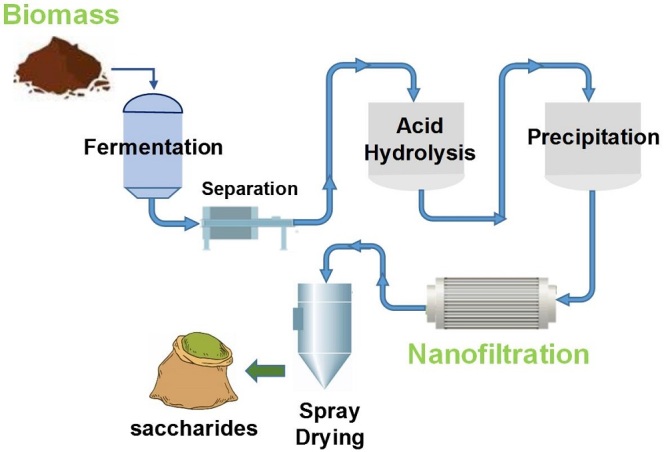
Keywords: saccharides, nanofiltration membrane, hybrid membrane process, biomas
Acknowledgements
Dr. X. Li thanks the European Union’s Horizon 2020 Research and Innovation Program for funding under Marie Sklodowska-Curie Grant Agreement No. 713683 (COFUNDfellowsDTU).
Contributor Information
Jianquan Luo, Email: jqluo@ipe.ac.cn.
Manuel Pinelo, Email: mp@kt.dtu.dk.
References
- 1.Moure A, Gullón P, Domínguez H, Parajó J C. Advances in the manufacture, purification and applications of xylo-oligosaccharides as food additives and nutraceuticals. Process Biochemistry. 2016;41(9):1913–1923. doi: 10.1016/j.procbio.2006.05.011. [DOI] [Google Scholar]
- 2.Peters D. Carbohydrates for fermentation. Biotechnology Journal. 2006;1(7–8):806–814. doi: 10.1002/biot.200600041. [DOI] [PubMed] [Google Scholar]
- 3.Isikgor F H, Remzi Becer C. Lignocellulosic biomass: a sustainable platform for production of bio-based chemicals and polymers. Polymer Chemistry. 2015;6(25):4497–4559. doi: 10.1039/C5PY00263J. [DOI] [Google Scholar]
- 4.Kamm B, Kamm M. Biorefinery-systems. Chemical and Biochemical Engineering Quarterly. 2004;18:1–7. [Google Scholar]
- 5.Roca C, Alves V D, Freitas F, Reis M A M. Exopolysaccharides enriched in rare sugars: bacterial sources, production, and applications. Frontiers in Microbiology. 2015;6:1–7. doi: 10.3389/fmicb.2015.00288. [DOI] [PMC free article] [PubMed] [Google Scholar]
- 6.Beerens K, Desmet T, Soetaert W. Enzymes for the biocatalytic production of rare sugars. Journal of Industrial Microbiology & Biotechnology. 2012;39(6):823–834. doi: 10.1007/s10295-012-1089-x. [DOI] [PubMed] [Google Scholar]
- 7.Carbohydrates in Human Nutrition: Report of a Joint FAO/WHO Expert Consultation. Rome, 1997 [PubMed]
- 8.Bandini S, Nataloni L. Nanofiltration for dextrose recovery from crystallization mother liquors: a feasibility study. Separation and Purification Technology. 2015;139:53–62. doi: 10.1016/j.seppur.2014.10.025. [DOI] [Google Scholar]
- 9.Salmi T, Holmbom B, Willf S, Murzin D Y. Synthesis of sugars by hydrolysis of hemicelluloses: a review. Chemical Reviews. 2011;111(9):5638–5666. doi: 10.1021/cr2000042. [DOI] [PubMed] [Google Scholar]
- 10.Pinelo M, Jonsson G, Meyer A S. Membrane technology for purification of enzymatically produced oligosaccharides: molecular and operational features affecting performance. Separation and Purification Technology. 2009;70(1):1–11. doi: 10.1016/j.seppur.2009.08.010. [DOI] [Google Scholar]
- 11.Pruksasri S, Nguyen T H, Haltrich D, Novalin S. Fractionation of a galacto-oligosaccharides solution at low and high temperature using nanofiltration. Separation and Purification Technology. 2015;151:124–130. doi: 10.1016/j.seppur.2015.07.015. [DOI] [PMC free article] [PubMed] [Google Scholar]
- 12.Sasaki K, Sasaki D, Sakihama Y, Teramura H, Yamada R, Hasunuma T, Ogino C, Kondo A. Ethanol fermentation by xylose-assimilating Saccharomyces cerevisiae using sugars in a rice straw liquid hydrolysate concentrated by nanofiltration. Bioresource Technology. 2013;147:84–88. doi: 10.1016/j.biortech.2013.07.091. [DOI] [PubMed] [Google Scholar]
- 13.Murthy G S, Sridhar S, Shyam Sunder M, Shankaraiah B, Ramakrishna M. Concentration of xylose reaction liquor by nanofiltration for the production of xylitol sugar alcohol. Separation and Purification Technology. 2005;44(3):221–228. doi: 10.1016/j.seppur.2005.01.009. [DOI] [Google Scholar]
- 14.Fornefett I, Rabet D, Buttersack C, Buchholz K. Adsorption of sucrose on zeolites. Green Chemistry. 2016;18(11):3378–3388. doi: 10.1039/C5GC02832A. [DOI] [Google Scholar]
- 15.Sen D, Gosling A, Stevens G W, Bhattacharya P K, Barber A R, Kentish S E, Bhattacharjee C, Gras S L. Galactosyl oligosaccharide purification by ethanol precipitation. Food Chemistry. 2011;128(3):773–777. doi: 10.1016/j.foodchem.2011.03.076. [DOI] [Google Scholar]
- 16.Saari P, Heikkila H, Hurme M. Adsorption equilibria of arabinose, fructose, galactose, glucose, mannose, rhamnose, sucrose, and xylose on ion-exchange resins. Journal of Chemical & Engineering Data. 2010;55(9):3462–3467. doi: 10.1021/je100165v. [DOI] [Google Scholar]
- 17.Bi W, Zhou J, Row K H. Separation of xylose and glucose on different silica-confined ionic liquid stationary phases. Analytica Chimica Acta. 2010;667(2):162–168. doi: 10.1016/j.aca.2010.08.004. [DOI] [PubMed] [Google Scholar]
- 18.Weng Y H, Wei H J, Tsai T Y, Lin T H, Wei T Y, Guo G L, Huang C P. Separation of furans and carboxylic acids from sugars in dilute acid rice straw hydrolyzates by nanofiltration. Bioresource Technology. 2010;101(13):4889–4894. doi: 10.1016/j.biortech.2009.11.090. [DOI] [PubMed] [Google Scholar]
- 19.Blanc C L, Lemaire J, Duval F, Théoleyre M A, Pareau D. Purification of pentoses from hemicellulosic hydrolysates without neutralization for sulfuric acid recovery. Separation and Purification Technology. 2017;174:513–519. doi: 10.1016/j.seppur.2016.10.042. [DOI] [Google Scholar]
- 20.Wei P, Cheng L H, Zhang L, Xu X H, Chen H L, Gao C J. A review of membrane technology for bioethanol production. Renewable & Sustainable Energy Reviews. 2014;30:388–400. doi: 10.1016/j.rser.2013.10.017. [DOI] [Google Scholar]
- 21.Goulas A K, Kapasakalidis P G, Sinclair H R, Rastall R A, Grandison A S. Purification of oligosaccharides by nanofiltration. Journal of Membrane Science. 2002;209(1):321–335. doi: 10.1016/S0376-7388(02)00362-9. [DOI] [Google Scholar]
- 22.Moulik S, Vadthya P, Kalipatnapu Y R, Chenna S, Sundergopal S. Production of fructose sugar from aqueous solutions: nanofiltration performance and hydrodynamic analysis. Journal of Cleaner Production. 2015;92:44–53. doi: 10.1016/j.jclepro.2014.12.092. [DOI] [Google Scholar]
- 23.Cheng H, Wang H, Lv J, Jiang M, Lin S, Deng Z. A novel method to prepare L-arabinose from xylose mother liquor by yeast-mediated biopurification. Microbial Cell Factories. 2011;10(1):1–11. doi: 10.1186/1475-2859-10-43. [DOI] [PMC free article] [PubMed] [Google Scholar]
- 24.Kobayashi H, Fukuoka A. Synthesis and utilisation of sugar compounds derived from lignocellulosic biomass. Green Chemistry. 2013;15(7):1740–1763. doi: 10.1039/c3gc00060e. [DOI] [Google Scholar]
- 25.Aguedo M, Vanderghem C, Goffin D, Richel A, Paquot M. Fast and high yield recovery of arabinose from destarched wheat bran. Industrial Crops and Products. 2013;43:318–325. doi: 10.1016/j.indcrop.2012.07.029. [DOI] [Google Scholar]
- 26.Granström T B, Takata G, Tokuda M, Izumori K. Izumoring: a novel and complete strategy for bioproduction of rare sugars. Journal of Bioscience and Bioengineering. 2004;97(2):89–94. doi: 10.1016/S1389-1723(04)70173-5. [DOI] [PubMed] [Google Scholar]
- 27.Kim J H, Na J G, Yang J W, Chang Y K. Separation of galactose, 5-hydroxymethylfurfural and levulinic acid in acid hydrolysate of agarose by nanofiltration and electrodialysis. Bioresource Technology. 2013;140:64–72. doi: 10.1016/j.biortech.2013.04.068. [DOI] [PubMed] [Google Scholar]
- 28.Kamm B, Patrick R, Michael K. Biorefineries—Industrial Processes and Products. Weinheim: Wiley-VCH; 2006. pp. 1–949. [Google Scholar]
- 29.Kuhn R C, Maugeri Filho F, Silva V, Palacio L, Hernández A, Prádanos P. Mass transfer and transport during purification of fructooligosaccharides by nanofiltration. Journal of Membrane Science. 2010;365(1–2):356–365. doi: 10.1016/j.memsci.2010.09.031. [DOI] [Google Scholar]
- 30.Mussatto S I, Mancilha I M. Non-digestible oligosaccharides: a review. Carbohydrate Polymers. 2007;68(3):587–597. doi: 10.1016/j.carbpol.2006.12.011. [DOI] [Google Scholar]
- 31.Zhao H, Hua X, Yang R, Zhao L, Zhao W, Zhang Z. Diafiltration process on xylo-oligosaccharides syrup using nanofiltration and its modelling. International Journal of Food Science & Technology. 2012;47(1):32–39. doi: 10.1111/j.1365-2621.2011.02803.x. [DOI] [Google Scholar]
- 32.Kumar A S, Mody K, Jha B. Bacterial exopolysaccharides—a perception. Journal of Basic Microbiology. 2007;47(2):103–117. doi: 10.1002/jobm.200610203. [DOI] [PubMed] [Google Scholar]
- 33.Bachelder E M, Beaudette T T, Broaders K E, Dashe J, Fréchet J M J. Acetal-derivatized dextran: an acid-responsive biodegradable material for therapeutic applications. Journal of the American Chemical Society. 2008;130(32):10494–10495. doi: 10.1021/ja803947s. [DOI] [PMC free article] [PubMed] [Google Scholar]
- 34.Mousavi S M, Moghadam M T. Separation of sugar from molasses by ultrafiltration and nanofiltration. World Applied Sciences Journal. 2009;7:632–636. [Google Scholar]
- 35.Christakopoulos P, Katapodis P, Kalogeris E, Kekos D, Macris B J, Stamatis H, Skaltsa H. Antimicrobial activity of acidic xylooligosaccharides produced by family 10 and 11 endoxylanases. International Journal of Biological Macromolecules. 2003;31(4–5):171–175. doi: 10.1016/S0141-8130(02)00079-X. [DOI] [PubMed] [Google Scholar]
- 36.Swennen K, Courtin C M, Van Der Bruggen B, Vandecasteele C, Delcour J A. Ultrafiltration and ethanol precipitation for isolation of arabinoxylooligosaccharides with different structures. Carbohydrate Polymers. 2005;62(3):283–292. doi: 10.1016/j.carbpol.2005.08.001. [DOI] [Google Scholar]
- 37.Vegas R, Alonso L, Domínguez H, Parajó J C. Processing of rice husk autohydrolysis liquors for obtaining food ingredients. Journal of Agricultural and Food Chemistry. 2004;52(24):7311–7317. doi: 10.1021/jf049142t. [DOI] [PubMed] [Google Scholar]
- 38.Nobre C, Teixeira J A, Rodrigues L R. New trends and technological challenges in the industrial production and purification of fructo-oligosaccharides. Critical Reviews in Food Science and Nutrition. 2013;55(10):1444–1455. doi: 10.1080/10408398.2012.697082. [DOI] [PubMed] [Google Scholar]
- 39.Meinita M D N, Hong Y K, Jeong G T. Detoxification of acidic catalyzed hydrolysate of Kappaphycus alvarezii (cottonii) Bioprocess and Biosystems Engineering. 2012;35(1–2):93–98. doi: 10.1007/s00449-011-0608-x. [DOI] [PubMed] [Google Scholar]
- 40.Xue J L, Zhao S, Liang R M, Yin X, Jiang S X, Su L H, Yang Q, Duan C J, Liu J L, Feng J X. A biotechnological process efficiently co-produces two high value-added products, glucose and xylooligosaccharides, from sugarcane bagasse. Bioresource Technology. 2016;204:130–138. doi: 10.1016/j.biortech.2015.12.082. [DOI] [PubMed] [Google Scholar]
- 41.Yapo B M, Robert C, Etienne I, Wathelet B, Paquot M. Effect of extraction conditions on the yield, purity and surface properties of sugar beet pulp pectin extracts. Food Chemistry. 2007;100(4):1356–1364. doi: 10.1016/j.foodchem.2005.12.012. [DOI] [Google Scholar]
- 42.Sharma M, Patel S N, Lata K, Singh U, Krishania M, Sangwan R S, Singh S P. A novel approach of integrated bioprocessing of cane molasses for production of prebiotic and functional bioproducts. Bioresource Technology. 2016;219:311–318. doi: 10.1016/j.biortech.2016.07.131. [DOI] [PubMed] [Google Scholar]
- 43.Sjöman E, Mänttäri M, Nyström M, Koivikko H, Heikkilä H. Separation of xylose from glucose by nanofiltration from concentrated monosaccharide solutions. Journal of Membrane Science. 2007;292(1–2):106–115. doi: 10.1016/j.memsci.2007.01.019. [DOI] [Google Scholar]
- 44.Alam M N H Z, Pinelo M, Samanta K, Jonsson G, Meyer A, Gernaey K V. A continuous membrane microbioreactor system for development of integrated pectin modification and separation processes. Chemical Engineering Journal. 2011;167(2–3):418–426. doi: 10.1016/j.cej.2010.09.082. [DOI] [Google Scholar]
- 45.Lyu H, Fang Y, Ren S, Chen K, Luo G, Zhang S, Chen J. Monophenols separation from monosaccharides and acids by two-stage nanofiltration and reverse osmosis in hydrothermal liquefaction hydrolysates. Journal of Membrane Science. 2016;504:141–152. doi: 10.1016/j.memsci.2015.12.048. [DOI] [Google Scholar]
- 46.Luo J, Zeuner B, Morthensen T, Meyer A S, Pinelo M. Separation of phenolic acids from monosaccharides by low-pressure nanofiltration integrated with laccase pre-treatments. Journal of Membrane Science. 2015;482:83–91. doi: 10.1016/j.memsci.2015.02.022. [DOI] [Google Scholar]
- 47.Kamada T, Nakajima M, Nabetani H, Saglam N, Iwamoto S. Availability of membrane technology for purifying and concentrating oligosaccharides. European Food Research and Technology. 2002;214(5):435–440. doi: 10.1007/s00217-001-0486-6. [DOI] [Google Scholar]
- 48.Sanz M L, Polemis N, Morales V, Corzo N, Drakoularakou A, Gibson G R, Rastall R A. In vitro investigation into the potential prebiotic activity of honey oligosaccharides. Journal of Agricultural and Food Chemistry. 2005;53(8):2914–2921. doi: 10.1021/jf0500684. [DOI] [PubMed] [Google Scholar]
- 49.Machado M T C, Trevisan S, Pimentel-Souza J D R, Pastore G M, Hubinger M D. Clarification and concentration of oligosaccharides from artichoke extract by a sequential process with microfiltration and nanofiltration membranes. Journal of Food Engineering. 2016;180:120–128. doi: 10.1016/j.jfoodeng.2016.02.018. [DOI] [Google Scholar]
- 50.Camelini C M, Rezzadori K, Benedetti S, Proner M C, Fogaça L, Azambuja A A, Giachini A J, Rossi M J, Petrus J C C. Nanofiltration of polysaccharides from Agaricus subrufescens. Applied Microbiology and Biotechnology. 2013;97(23):9993–10002. doi: 10.1007/s00253-013-5241-y. [DOI] [PubMed] [Google Scholar]
- 51.Giacobbo A, Bernardes A M, De Pinho M N. Nanofiltration for the recovery of low molecular weight polysaccharides and polyphenols from winery effluents. Separation Science and Technology. 2013;48(17):2524–2530. doi: 10.1080/01496395.2013.809762. [DOI] [Google Scholar]
- 52.Morthensen S T, Luo J, Meyer A S, Jørgensen H, Pinelo M. High performance separation of xylose and glucose by enzyme assisted nanofiltration. Journal of Membrane Science. 2015;492:107–115. doi: 10.1016/j.memsci.2015.05.025. [DOI] [Google Scholar]
- 53.Qi B, Luo J, Chen X, Hang X, Wan Y. Separation of furfural from monosaccharides by nanofiltration. Bioresource Technology. 2011;102(14):7111–7118. doi: 10.1016/j.biortech.2011.04.041. [DOI] [PubMed] [Google Scholar]
- 54.Li W, Li J, Chen T, Chen C. Study on nanofiltration for purifying fructo-oligosaccharides: I. Operation modes. Journal of Membrane Science. 2004;245(1–2):123–129. doi: 10.1016/j.memsci.2004.07.021. [DOI] [Google Scholar]
- 55.Himstedt H H, Du H, Marshall K M, Wickramasinghe S R, Qian X. pH responsive nanofiltration membranes for sugar separations. Industrial & Engineering Chemistry Research. 2013;52(26):9259–9269. doi: 10.1021/ie400982p. [DOI] [Google Scholar]
- 56.Luo J, Guo S, Wu Y, Wan Y. Separation of sucrose and reducing sugar in cane molasses by nanofiltration. Food and Bioprocess Technology. 2018;11(5):913–925. doi: 10.1007/s11947-018-2062-0. [DOI] [Google Scholar]
- 57.Faneer K A, Rohani R, Mohammad A W, Ba Abbad M M. Evaluation of the operating parameters for the separation of xylitol from a mixed sugar solution by using a polyethersulfone nanofiltration membrane. Korean Journal of Chemical Engineering. 2017;34(11):2944–2957. doi: 10.1007/s11814-017-0186-y. [DOI] [Google Scholar]
- 58.Akin O, Temelli F, Köseoğlu S. Membrane applications in functional foods and nutraceuticals. Critical Reviews in Food Science and Nutrition. 2012;52(4):347–371. doi: 10.1080/10408398.2010.500240. [DOI] [PubMed] [Google Scholar]
- 59.Grandison A S, Goulas A K, Rastall R A. The use of dead-end and cross-flow nanofiltration to purify prebiotic oligosaccharides from reaction mixtures. Songklanakarin Journal of Science and Technology. 2002;24:915–928. [Google Scholar]
- 60.Singh R D, Nadar C G, Muir J, Arora A. Green and clean process to obtain low degree of polymerisation xylooligosaccharides from almond shell. Journal of Cleaner Production. 2019;241:118237. doi: 10.1016/j.jclepro.2019.118237. [DOI] [Google Scholar]
- 61.Oliveira D L, Wilbey R A, Grandison A S, Duarte L C, Roseiro L B. Separation of oligosaccharides from caprine milk whey prior to prebiotic evaluation. International Dairy Journal. 2012;24(2):102–106. doi: 10.1016/j.idairyj.2011.12.012. [DOI] [Google Scholar]
- 62.Aguirre Montesdeoca V, van Der Padt A, Boom R M, Janssen A E M. Modelling of membrane cascades for the purification of oligosaccharides. Journal of Membrane Science. 2016;520:712–722. doi: 10.1016/j.memsci.2016.08.031. [DOI] [Google Scholar]
- 63.Sen D, Sarkar A, Das S, Chowdhury R, Bhattacharjee C. Batch hydrolysis and rotating disk membrane bioreactor for the production of galacto-oligosaccharides: a comparative study. Industrial & Engineering Chemistry Research. 2012;51(32):10671–10681. doi: 10.1021/ie3005786. [DOI] [Google Scholar]
- 64.Iwasaki K, Matsubara Y. Purification of pectate oligosaccharides showing root-growth promoting activity in lettuce using ultrafiltration and nanofiltration membranes. Journal of Bioscience and Bioengineering. 2000;89(5):495–497. doi: 10.1016/S1389-1723(00)89104-5. [DOI] [PubMed] [Google Scholar]
- 65.Sukhbaatar B, Hassan E B, Kim M, Steele P, Ingram L. Optimization of hot-compressed water pretreatment of bagasse and characterization of extracted hemicelluloses. Carbohydrate Polymers. 2014;101:196–202. doi: 10.1016/j.carbpol.2013.09.027. [DOI] [PubMed] [Google Scholar]
- 66.Karabelas A J, Karanasiou A, Sioutopoulos D C. Experimental study on the effect of polysaccharides on incipient membrane scaling during desalination. Desalination. 2017;416:106–121. doi: 10.1016/j.desal.2017.04.009. [DOI] [Google Scholar]
- 67.Fonseca A C, Summers R S, Greenberg A R, Hernandez M T. Extra-cellular polysaccharides, soluble microbial products, and natural organic matter impact on nanofiltration membranes flux decline. Environmental Science & Technology. 2007;41(7):2491–2497. doi: 10.1021/es060792i. [DOI] [PubMed] [Google Scholar]
- 68.Broeckmann A, Wintgens T, Schäfer A I. Removal and fouling mechanisms in nanofiltration of polysaccharide solutions. Desalination. 2005;178(1–3):149–159. doi: 10.1016/j.desal.2004.12.017. [DOI] [Google Scholar]
- 69.Zhang Y, Wang Y, Cao X, Xue J, Zhang Q, Tian J, Li X, Qiu X, Pan B, Gu A Z, Zheng X. Effect of carboxyl and hydroxyl groups on adsorptive polysaccharide fouling: a comparative study based on PVDF and graphene oxide (GO) modified PVDF surfaces. Journal of Membrane Science. 2020;595:117514. doi: 10.1016/j.memsci.2019.117514. [DOI] [Google Scholar]
- 70.Luo J, Hang X, Zhai W, Qi B, Song W, Chen X, Wan Y. Refining sugar cane juice by an integrated membrane process: filtration behavior of polymeric membrane at high temperature. Journal of Membrane Science. 2016;509:105–115. doi: 10.1016/j.memsci.2016.02.053. [DOI] [Google Scholar]
- 71.Guo S, Luo J, Wu Y, Qi B, Chen X, Wan Y. Decoloration of sugarcane molasses by tight ultrafiltration: filtration behavior and fouling control. Separation and Purification Technology. 2018;204:66–74. doi: 10.1016/j.seppur.2018.04.067. [DOI] [Google Scholar]
- 72.Guo S, Luo J, Yang Q, Qiang X, Feng S, Wan Y. Decoloration of molasses by ultrafiltration and nanofiltration: unraveling the mechanisms of high sucrose retention. Food and Bioprocess Technology. 2019;12(1):39–53. doi: 10.1007/s11947-018-2189-z. [DOI] [Google Scholar]
- 73.Luo J, Guo S, Qiang X, Hang X, Chen X, Wan Y. Sustainable utilization of cane molasses by an integrated separation process: interplay between adsorption and nanofiltration. Separation and Purification Technology. 2019;219:16–24. doi: 10.1016/j.seppur.2019.03.008. [DOI] [Google Scholar]
- 74.Qiang X, Luo J, Guo S, Cao W, Hang X, Liu J, Wan Y. A novel process for molasses utilization by membrane filtration and resin adsorption. Journal of Cleaner Production. 2019;207:432–443. doi: 10.1016/j.jclepro.2018.10.005. [DOI] [Google Scholar]
- 75.Gautam A, Menkhaus T J. Performance evaluation and fouling analysis for reverse osmosis and nanofiltration membranes during processing of lignocellulosic biomass hydrolysate. Journal of Membrane Science. 2014;451:252–265. doi: 10.1016/j.memsci.2013.09.042. [DOI] [Google Scholar]
- 76.Weng Y H, Wei H J, Tsai T Y, Chen W H, Wei T Y, Hwang W S, Wang C P, Huang C P. Separation of acetic acid from xylose by nanofiltration. Separation and Purification Technology. 2009;67(1):95–102. doi: 10.1016/j.seppur.2009.03.030. [DOI] [Google Scholar]
- 77.Love D J, Muzzell D J. Minimising sucrose loss in final molasses: the three laws of molasses loss. International Sugar Journal. 2009;111(1332):730–737. [Google Scholar]
- 78.Liu M, Zhu H, Dong B, Zheng Y, Yu S, Gao C. Submerged nanofiltration of biologically treated molasses fermentation waste-water for the removal of melanoidins. Chemical Engineering Journal. 2013;223:388–394. doi: 10.1016/j.cej.2013.02.107. [DOI] [Google Scholar]
- 79.Peshev D, Livingston A G. OSN Designer, a tool for predicting organic solvent nanofiltration technology performance using Aspen One, MATLAB and CAPE OPEN. Chemical Engineering Science. 2013;104:975–987. doi: 10.1016/j.ces.2013.10.033. [DOI] [Google Scholar]
- 80.Shi B, Marchetti P, Peshev D, Zhang S, Livingston A G. Performance of spiral-wound membrane modules in organic solvent nanofiltration—fluid dynamics and mass transfer characteristics. Journal of Membrane Science. 2015;494:8–24. doi: 10.1016/j.memsci.2015.07.044. [DOI] [Google Scholar]
- 81.Bargeman G, Vollenbroek J M, Straatsma J, Schroën C G P H, Boom R M. Nanofiltration of multi-component feeds. Interactions between neutral and charged components and their effect on retention. Journal of Membrane Science. 2005;247(1–2):11–20. doi: 10.1016/j.memsci.2004.05.022. [DOI] [Google Scholar]
- 82.Otero J A, Mazarrasa O, Villasante J, Silva V, Prádanos P, Calvo J I, Hernández A. Three independent ways to obtain information on pore size distributions of nanofiltration membranes. Journal of Membrane Science. 2008;309(1–2):17–27. doi: 10.1016/j.memsci.2007.09.065. [DOI] [Google Scholar]
- 83.Hilal N, Darwish N A, Mohammad A W, Arabi M A. A comprehensive review of nanofiltration membranes: treatment, pretreatment, modelling, and atomic force microscopy. Desalination. 2004;170(3):281–308. doi: 10.1016/j.desal.2004.01.007. [DOI] [Google Scholar]
- 84.Zhang Y, Zhang L, Hou L, Kuang S B, Yu A B. Modeling of the variations of permeate flux, concentration polarization, and solute rejection in nanofiltration system. AIChE Journal. American Institute of Chemical Engineers. 2019;65(3):1076–1087. doi: 10.1002/aic.16475. [DOI] [Google Scholar]
- 85.Li W, Li J, Chen T, Zhao Z, Chen C. Study on nanofiltration for purifying fructo-oligosaccharides: II. Extended pore model. Journal of Membrane Science. 2005;258(1–2):8–15. doi: 10.1016/j.memsci.2004.06.017. [DOI] [Google Scholar]
- 86.Agenson K O, Oh J I, Urase T. Retention of a wide variety of organic pollutants by different nanofiltration/reverse osmosis membranes: controlling parameters of process. Journal of Membrane Science. 2003;225(1–2):91–103. doi: 10.1016/j.memsci.2003.08.006. [DOI] [Google Scholar]
- 87.Kiso Y, Muroshige K, Oguchi T, Yamada T, Hhirose M, Ohara T, Shintani T. Effect of molecular shape on rejection of uncharged organic compounds by nanofiltration membranes and on calculated pore radii. Journal of Membrane Science. 2010;358(1–2):101–113. doi: 10.1016/j.memsci.2010.04.034. [DOI] [Google Scholar]
- 88.Kiso Y, Kon T, Kitao T, Nishimura K. Rejection properties of alkyl phthalates with nanofiltration membranes. Journal of Membrane Science. 2001;182(1–2):205–214. doi: 10.1016/S0376-7388(00)00567-6. [DOI] [Google Scholar]
- 89.Neuhaus W, Novalin S, Klimacek M, Splechtna B, Petzelbauer I, Szivak A, Kulbe K D. Optimization of an innovative hollow-fiber process to produce lactose-reduced skim milk. Applied Biochemistry and Biotechnology. 2006;134(1):1–14. doi: 10.1385/ABAB:134:1:1. [DOI] [PubMed] [Google Scholar]
- 90.Bandini S, Morelli V. Effect of temperature, pH and composition on nanofiltration of mono/disaccharides: experiments and modeling assessment. Journal of Membrane Science. 2017;533:57–74. doi: 10.1016/j.memsci.2017.03.021. [DOI] [Google Scholar]
- 91.Boy V, Roux de Balmann H, Galier S. Relationship between volumetric properties and mass transfer through NF membrane for saccharide/electrolyte systems. Journal of Membrane Science. 2012;390–391:254–262. doi: 10.1016/j.memsci.2011.11.046. [DOI] [Google Scholar]
- 92.Lipnizki F, Boelsmand J, Madsen R F. Concepts of industrial-scale diafiltration systems. Desalination. 2002;144(1–3):179–184. doi: 10.1016/S0011-9164(02)00309-0. [DOI] [Google Scholar]
- 93.Wang X L, Zhang C, Ouyang P. The possibility of separating saccharides from a NaCl solution by using nanofiltration in diafiltration mode. Journal of Membrane Science. 2002;204(1–2):271–281. doi: 10.1016/S0376-7388(02)00050-9. [DOI] [Google Scholar]
- 94.Ortiz Cerda I E, Bonnin J, Bostyn S, Ruiz Cabrera M A, Moscosa Santillán M. Experimental and CFD modeling study of inulin-type fructan purification from a model solution by diafiltration on a pilot-scale unit. Separation Science and Technology. 2014;49(8):1125–1134. doi: 10.1080/01496395.2014.880929. [DOI] [Google Scholar]
- 95.Dey P, Linnanen L, Pal P. Separation of lactic acid from fermentation broth by cross flow nanofiltration: membrane characterization and transport modelling. Desalination. 2012;288:47–57. doi: 10.1016/j.desal.2011.12.009. [DOI] [Google Scholar]
- 96.Caus A, Braeken L, Boussu K, Van der Bruggen B. The use of integrated countercurrent nanofiltration cascades for advanced separations. Journal of Chemical Technology and Biotechnology (Oxford, Oxfordshire) 2009;84(3):391–398. doi: 10.1002/jctb.2052. [DOI] [Google Scholar]
- 97.Patil N V, Janssen A E M, Boom R M. The potential impact of membrane cascading on downstream processing of oligosaccharides. Chemical Engineering Science. 2014;106:86–98. doi: 10.1016/j.ces.2013.11.007. [DOI] [Google Scholar]
- 98.Choudhury R R, Gohil J M, Mohanty S, Nayak S K. Antifouling, fouling release and antimicrobial materials for surface modification of reverse osmosis and nanofiltration membranes. Journal of Materials Chemistry. A, Materials for Energy and Sustainability. 2018;6(2):313–333. [Google Scholar]
- 99.Tang C Y, Chong T H, Fane A G. Colloidal interactions and fouling of NF and RO membranes: a review. Advances in Colloid and Interface Science. 2011;164(1–2):126–143. doi: 10.1016/j.cis.2010.10.007. [DOI] [PubMed] [Google Scholar]
- 100.Mondal S, De S. A fouling model for steady state crossflow membrane filtration considering sequential intermediate pore blocking and cake formation. Separation and Purification Technology. 2010;75(2):222–228. doi: 10.1016/j.seppur.2010.07.016. [DOI] [Google Scholar]
- 101.Saha N K, Balakrishnan M, Ulbricht M. Sugarcane juice ultrafiltration: FTIR and SEM analysis of polysaccharide fouling. Journal of Membrane Science. 2007;306(1–2):287–297. doi: 10.1016/j.memsci.2007.09.006. [DOI] [Google Scholar]
- 102.Almandoz C, Pagliero C, Ochoa A, Marchese J. Corn syrup clarification by microfiltration with ceramic membranes. Journal of Membrane Science. 2010;363(1–2):87–95. doi: 10.1016/j.memsci.2010.07.017. [DOI] [Google Scholar]
- 103.Gyura J, Šereš Z, Eszterle M. Influence of operating parameters on separation of green syrup colored matter from sugar beet by ultra-and nanofiltration. Journal of Food Engineering. 2005;66(1):89–96. doi: 10.1016/j.jfoodeng.2004.02.038. [DOI] [Google Scholar]
- 104.Balciolu G, Gönder Z B. Recovery of baker’s yeast wastewater with membrane processes for agricultural irrigation purpose: fouling characterization. Chemical Engineering Journal. 2014;255:630–640. doi: 10.1016/j.cej.2014.06.084. [DOI] [Google Scholar]
- 105.Meng S, Meng X, Fan W, Liang D, Wang L, Zhang W, Liu Y. The role of transparent exopolymer particles (TEP) in membrane fouling: a critical review. Water Research. 2020;181:115930. doi: 10.1016/j.watres.2020.115930. [DOI] [PubMed] [Google Scholar]
- 106.Fortunato L, Jeong S, Leiknes T O. Time-resolved monitoring of biofouling development on a flat sheet membrane using optical coherence tomography. Scientific Reports. 2017;7(1):15. doi: 10.1038/s41598-017-00051-9. [DOI] [PMC free article] [PubMed] [Google Scholar]
- 107.Mustafa G, Wyns K, Buekenhoudt A, Meynen V. New insights into the fouling mechanism of dissolved organic matter applying nanofiltration membranes with a variety of surface chemistries. Water Research. 2016;93:195–204. doi: 10.1016/j.watres.2016.02.030. [DOI] [PubMed] [Google Scholar]
- 108.Yu H Y, Hu M X, Xu Z K, Wang J L, Wang S Y. Surface modification of polypropylene microporous membranes to improve their antifouling property in MBR: NH3 plasma treatment. Separation and Purification Technology. 2005;45(1):8–15. doi: 10.1016/j.seppur.2005.01.012. [DOI] [Google Scholar]
- 109.Khammar M, Xu Y M. Continuous liquid extraction from saturated granular materials. Chemical Engineering Science. 2017;173:390–401. doi: 10.1016/j.ces.2017.07.047. [DOI] [Google Scholar]
- 110.Nath K, Patel T M. Mitigation of flux decline in the cross-flow nanofiltration of molasses wastewater under the effect of gas sparging. Separation Science and Technology. 2014;49(10):1479–1489. doi: 10.1080/01496395.2014.895766. [DOI] [Google Scholar]
- 111.Jones S A, Chew Y M J, Wilson D I, Bird M R. Fluid dynamic gauging of microfiltration membranes fouled with sugar beet molasses. Journal of Food Engineering. 2012;108(1):22–29. doi: 10.1016/j.jfoodeng.2011.08.001. [DOI] [Google Scholar]
- 112.Mänttäri M, Pihlajamäki A, Kaipainen E, Nyström M. Effect of temperature and membrane pre-treatment by pressure on the filtration properties of nanofiltration membranes. Desalination. 2002;145(1–3):81–86. doi: 10.1016/S0011-9164(02)00390-9. [DOI] [Google Scholar]
- 113.Shi J, Zhang W, Su Y, Jiang Z. Composite polyelectrolyte multilayer membranes for oligosaccharides nanofiltration separation. Carbohydrate Polymers. 2013;94(1):106–113. doi: 10.1016/j.carbpol.2013.01.044. [DOI] [PubMed] [Google Scholar]
- 114.Miller M D, Bruening M L. Controlling the nanofiltration properties of multilayer polyelectrolyte membranes through variation of film composition. Langmuir. 2004;20(26):11545–11551. doi: 10.1021/la0479859. [DOI] [PubMed] [Google Scholar]
- 115.Malmali M, Wickramasinghe S R, Tang J, Cong H. Sugar fractionation using surface-modified nanofiltration membranes. Separation and Purification Technology. 2016;166:187–195. doi: 10.1016/j.seppur.2016.04.025. [DOI] [Google Scholar]
- 116.Hong S U, Miller M D, Bruening M L. Removal of dyes, sugars, and amino acids from NaCl solutions using multilayer polyelectrolyte nanofiltration membranes. Industrial & Engineering Chemistry Research. 2006;45(18):6284–6288. doi: 10.1021/ie060239+. [DOI] [Google Scholar]
- 117.Gulec H A, Topacli A, Topacli C, Albayrak N, Mutlu M. Modification of cellulose acetate membrane via low-pressure plasma polymerization for sugar separation applications: Part I. Membrane development and characterization. Journal of Membrane Science. 2010;350(1–2):310–321. doi: 10.1016/j.memsci.2010.01.006. [DOI] [Google Scholar]
- 118.Malmali M, Wickramasinghe S R, Tang J, Cong H. Sugar fractionation using surface-modified nanofiltration membranes. Separation and Purification Technology. 2016;166:187–195. doi: 10.1016/j.seppur.2016.04.025. [DOI] [Google Scholar]
- 119.Lakra R, Saranya R, Lukka Thuyavan Y, Sugashini S, Begum K M M S, Arthanareeswaran G. Separation of acetic acid and reducing sugars from biomass derived hydrosylate using biopolymer blend polyethersulfone membrane. Separation and Purification Technology. 2013;118:853–861. doi: 10.1016/j.seppur.2013.08.023. [DOI] [Google Scholar]
- 120.Musale D A, Kumar A. Effects of surface crosslinking on sieving characteristics of chitosan/poly(acrylonitrile) composite nanofiltration membranes. Separation and Purification Technology. 2000;21(1–2):27–38. doi: 10.1016/S1383-5866(00)00188-X. [DOI] [Google Scholar]
- 121.Suwaileh W, Johnson D, Khodabakhshi S, Hilal N. Development of forward osmosis membranes modified by cross-linked layer by layer assembly for brackish water desalination. Journal of Membrane Science. 2019;583:267–277. doi: 10.1016/j.memsci.2019.04.052. [DOI] [Google Scholar]
- 122.Yang Z, Guo H, Yao Z K, Mei Y, Tang C Y. Hydrophilic silver nanoparticles induce selective nanochannels in thin film nanocomposite polyamide membranes. Environmental Science & Technology. 2019;53(9):5301–5308. doi: 10.1021/acs.est.9b00473. [DOI] [PubMed] [Google Scholar]
- 123.Li S, Luo J, Wan Y. Regenerable biocatalytic nanofiltration membrane for aquatic micropollutants removal. Journal of Membrane Science. 2018;549:120–128. doi: 10.1016/j.memsci.2017.11.075. [DOI] [Google Scholar]
- 124.Sen D, Sarkar A, Gosling A, Gras S L, Stevens G W, Kentish S E, Bhattacharya P K, Barber A R, Bhattacharjee C. Feasibility study of enzyme immobilization on polymeric membrane: a case study with enzymatically galacto-oligosaccharides production from lactose. Journal of Membrane Science. 2011;378(1–2):471–478. doi: 10.1016/j.memsci.2011.05.032. [DOI] [Google Scholar]
- 125.Abels C, Thimm K, Wulfhorst H, Spiess A C, Wessling M. Membrane-based recovery of glucose from enzymatic hydrolysis of ionic liquid pretreated cellulose. Bioresource Technology. 2013;149:58–64. doi: 10.1016/j.biortech.2013.09.012. [DOI] [PubMed] [Google Scholar]