



Abstract
Anaesthesiology is an ever-changing science and amongst its sub-specialities, the field of neuroanaesthesia is making rapid strides. The fragility of the brain and spinal cord and the multitude of complexities involved in neurosurgery and interventional neuroradiological procedures demand dedicated training in neuroanaesthesia. With rapid advancement in other neuroscience specialties, neuroanaesthesia too has made outstanding progress, owing to establishment of structured training, publication of high-quality scientific research, and invention of novel medications and monitoring modalities. The opportunities for training in India and abroad and resources to broaden knowledge in neuroanaesthesia have increased over the last two decades. A career in neuroanaesthesia offers a great future for budding anaesthesiologists.
Key words: Anaesthesiology, curriculum, neurosciences, neurosurgery
INTRODUCTION
Modern medicine has evolved tremendously from 'speciality' practice to 'subspeciality' practice. Anaesthesiology too has witnessed a similar paradigm shift. One such subspeciality of anaesthesiology is 'neuroanaesthesiology' which has progressed commensurate with its surgical counterpart. The delicate anatomical structures, complex physiology and variable pathology in the central nervous system demand comprehensive knowledge and meticulous understanding of the subject. In addition, the complexities involved in neurosurgery and interventional neuroradiological procedures necessitate dedicated and rigorous training in neuroanaesthesia. Over the last two decades, there has been a surge in the interest for neuroanaesthesia as a career option.[1] This, in turn, has led to tremendous improvement in clinical outcome of the patients. Moreover, the neurosurgeons have started to express their satisfaction over the contribution of neuroanaesthesiologists to the welfare of the patients. Nevertheless, this subspeciality still remains widely unexplored and opens the doors for young anaesthesiologists to reconnoitre the nuances of neuroanaesthesia. The aim of the current review is to provide insights into the existing scenario of neuroanaesthesia for those who are not practising neuroanaesthesia and to provide inputs to those students who consider taking up neuroanaesthesia as a career.
Neuroanaesthesiologists, indeed all anaesthesiologists, owe their gratitude to Harvey William Cushing, a student at Massachusetts General Hospital (1894). Cushing unfortunately, lost his patient during induction of anaesthesia with ether and was motivated to improve the practice of anaesthesia, and we owe monitoring charts to him.[2] Later, Cushing became a distinguished neurosurgeon. As a neurosurgeon, Cushing emphasised the importance of the anaesthesiologist, stating, 'Anaesthetisation by an expert is absolutely essential'. Dr. S. Griffith Davis was his full-time neuroanaesthesiologist. Cushing stated 'It is entirely due to [Davis'] skill that in over three hundred cranial operations, there has been a complete absence of calamities usually assigned to anaesthesia.'[3] The interdependence of surgeon and anaesthesiologist is more evident in neuroanaesthesia practice than in any other speciality, especially during the operative management of a complex neurosurgical patient. An insightful neurosurgeon understands that the successful outcome of a neurosurgical procedure is a true team effort while a discerning anaesthesiologist understands that it is not sufficient to be just technically proficient. It is both challenging and rewarding to understand the nuances of neuroanaesthesia.
The scope of Neuroanaesthesia
To a student contemplating a career in neuroanaesthesia, the opportunities that are presented are unlimited. The optimum management of neurologically ill patients requires a thorough understanding of the central nervous system (CNS) physiology and the effect of various medications and techniques on it. The determinants of cerebral physiology include cerebral metabolic rate (CMR), cerebral blood flow (CBF) and intracranial pressure (ICP). The concept of neuroprotection, control of intracranial pressure, and management of the tight brain are based on the changes in these determinants.[4]
The neurosurgical cases may be very challenging due to anticipated intraoperative massive blood loss, extremes of positions,[5] e.g., sitting position,[6] handling of vital centres of the brain sudden fluctuations in the heart rate and blood pressure[7] and challenging anaesthesia during awake neurosurgery.[8] Over years, awake surgeries have increased several folds with increasing indications in epilepsy surgery and deep brain stimulation.[9,10] The major challenge during awake craniotomy is to obtain an awake yet calm, comfortable and cooperative patient.[8] [Figure 1] Various neuroanaesthetic challenges include selection of appropriate patient, safe use of nerve blocks, judicious administration of sedatives and analgesics and facilitation of intraoperative language and motor mapping. Presently, functional neurosurgeries are performed to improve the quality of life and decrease the medication and the related side effects for various neurological conditions.
Figure 1.

Awake Craniotomy
Conventionally, neurosurgery is associated with long postoperative care. Implementation of multidisciplinary, preoperative, intraoperative and postoperative evidence-based intervention protocols [Enhanced Recovery after Surgery (ERAS) programme] is associated with significant reduction in postoperative length of stay (LOS) and enhanced functional recovery with comparable complication and reoperation rates as conventional neurosurgical perioperative care. Neuroanaesthesiologist has an important role in ERAS.[11,12] The concept of minimally invasive neurosurgery and keyhole techniques of neurosurgery are increasing owing to advances in imaging, computing and optics.[13] The lesions can be precisely targeted using stereotaxy and neuronavigation and special endoscopes. However, minimally invasive neurosurgical (MIN) procedures still have potential intra- and post-operative complications.[14] Same day discharge or outpatient surgery for intracranial and spine procedures has become possible with MIN.[15] The choice of anaesthetics has an important role in the outcome of these procedures.[16] Regional anaesthesia has become popular for procedures like percutaneous vertebroplasty.[17]
In neuroanaesthesia, the technique and choice of drugs directly influence the outcome of the patients. Administration of total intravenous anaesthesia (TIVA) using target-controlled infusion technique is emerging as a standard method to administer safe anaesthesia in neurosurgical patients. TIVA employs a sedative-hypnotic intravenous anaesthetic (usually propofol due to its favourable pharmacokinetic profile) combined with an analgesic agent (typically an opioid). In contrast to inhalational agents, intravenous anaesthetic agents facilitate intraoperative brain relaxation secondary to reduction in CBF and ICP without altering flow–metabolism coupling. TIVA also facilitates intraoperative evoked potentials monitoring which is otherwise susceptible to volatile anaesthetic agents.[18,19] TIVA is also associated with better recovery profile and reduced risk of postoperative nausea and vomiting as compared to inhalational anaesthetic agents.[20] Dexmedetomidine is being increasingly used for awake craniotomies, with or without propofol, benzodiazepines and/or opioids; the primary benefits of dexmedetomidine are that it causes conscious sedation without respiratory depression, and does not interfere with electrocorticography. The advanced neuromonitoring helps in protecting the neural tissue by detecting the harmful physiological events and guiding us in timely management of complications. The monitoring includes ICP (invasive, e.g., intraventricular or intraparenchymal/non-invasive, e.g., optic nerve sheath diameter, pupillometry, etc.), cerebral oxygenation (jugular venous oximetry, brain tissue oxygenation, near infrared oximetry), cerebral metabolism (microdialysis), CBF (direct/indirect, e.g., transcranial Doppler), and neurophysiology (spontaneous and evoked potentials). Intraoperative neuromonitoring (IONM) has now become the standard of care in neurosurgeries.[21] [Figure 2] Transcranial motor evoked potentials (TcMEPs) and somatosensory evoked potentials (SSEP) effectively monitor the integrity of the motor and sensory pathway respectively during spine surgery.[22] Likewise, intraoperative brain mapping (cortical and subcortical mapping) is an essential tool for neurosurgical procedures that involve lesions near functional or 'eloquent' cortex. Transcranial doppler (TCD), near infrared spectroscopy (NIRS), electroencephalography (EEG) and SSEP are used frequently to monitor intraoperative cerebral ischaemia particularly during carotid endarterectomy.[23] Intraoperative EEG and bispectral index (BIS) monitoring effectively guide the induction of burst suppression particularly during clipping of cerebral aneurysms.[24] Alternatives to invasive ICP monitoring are being explored these days. One technique that seems to be promising is optic nerve sheath diameter (ONSD).[25,26] It has been used in TBI as a substitute for ICP monitoring. The neuroanaesthesiologist has an important role in the monitoring and management of these challenging conditions. Advances such as intraoperative MRI have additional challenges right from avoidance of ferromagnetic substances to appropriate maintenance of anaesthesia.
Figure 2.
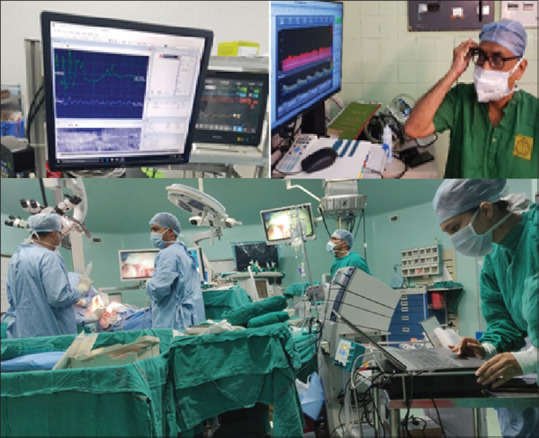
Intraoperative Neuromonitoring. Picture Courtesy AIIMS, PGIMER, SCTIMST
Training in neuroanaesthesia
There is a common belief that three years of rigorous post-graduation training in anaesthesiology involves training in advanced neuroanaesthesiology as well. Traditionally, postgraduate students in anaesthesia used to be trained in neuroanaesthesia for 1-3 months by rotation. Institutions where neurosciences departments did not exist used to send their students to centres with these facilities. However, post-graduation provides only a broad clinical orientation in neuroanaesthesia and it takes one step further to obtain the skills, knowledge and experience related to the sub-speciality of neuroanaesthesia. Sri Chitra Tirunal Institute for Medical Sciences and Technology (SCTIMST), Thiruvananthapuram was the first institute to start a one-year Postdoctoral Certificate Course (PDCC) in Cardiac and Neuroanaesthesia back in the early 1980s. In 1990s, many institutions started one-year training in neuroanaesthesia under the title of Postdoctoral Certificate Course (PDCC) in Neuroanaesthesia or Postdoctoral Fellowship (PDF, PDAF) in Neuroanaesthesia. All India Institute of Medical Sciences (AIIMS) New Delhi was the first institution to start a Doctor of Medicine (DM) course in Neuroanaesthesia in 2002. This was followed by a few more institutions starting a similar course. In 2015, National Board of Examinations approved a two year Diplomate of National Board course (DNB) in Neuroanaesthesia and later in 2018, a three year course, which is being currently run in a few institutions in the country [Table 1]. Various national and international neuroanaesthesia and neurocritical care societies are working actively for the growth and advancement of this speciality [Table 2].
Table 1.
Institutions and Hospitals in India providing Neuroanaesthesia Courses
| Courses | Institute |
|---|---|
| DM (3 years) | AIIMS, New Delhi |
| AIIMS, Bhubaneshwar | |
| AIIMS, Rishikesh | |
| AIIMS, Bhopal | |
| PGIMER, Chandigarh | |
| NIMHANS, Bangalore | |
| SCTIMST, Trivandrum | |
| JIPMER, Puducherry | |
| CMC, Vellore | |
| DNB (3 years) | Medanta - The Medicity, Gurgaon |
| Paras Hospitals, Gurgaon | |
| Indraprastha Apollo Hospitals, New Delhi | |
| GIPMER, New Delhi | |
| SKIMS, Srinagar | |
| Global Hospitals and Health City, Chennai | |
| Apollo Hospital, Telangana | |
| Institute of Neurosciences, Kolkata | |
| P.D. Hinduja National Hospital and Medical Research Centre, Mumbai | |
| KokilabenDhirubhai Ambani Hospital and Medical Research Institute, Mumbai | |
| Sahyadri Super Speciality Hospital, Pune | |
| PDAF (2 years) | SGPGIMS, Lucknow |
| PDCC/PDF (1 year) | IMS, BHU, Varanasi |
| AIIMS, Rishikesh | |
| SCTIMST, Trivandrum | |
| NIMHANS, Bangalore | |
| NIMS, Hyderabad | |
| CMC, Vellore | |
| PDF (1 year, ISNACC affiliated) | KokilabenDhirubhai Ambani Hospital and Medical Research Institute, Mumbai |
| Jaslok Hospital, Mumbai | |
| KIMS, Secunderabad | |
| Institute of Neurosciences, Kolkata | |
| Max Superspeciality Hospital, Saket, New Delhi | |
| Yashoda Hospitals, Hyderabad | |
| Artemis Hospital, Gurgaon | |
| Max Superspeciality Hospital, Dehradun | |
| Rahman Hospitals Pvt. Ltd., Guwahati | |
| FMRI, Gurgaon | |
| Vadodara Hospital | |
| MUHS PDF | KEM Hospital, Mumbai |
AIIMS: All India Institute of Medical Sciences; PGIMER: Postgraduate Institute of Medical Education & Research; NIMHANS: National Institute of Mental Health and Neurosciences; SCTIMST: Sree Chitra Tirunal Institute for Medical Sciences and Technology; JIPMER: Jawaharlal Institute of Postgraduate Medical Education & Research; CMC: Christian Medical College; GIPMER: Govind Ballabh Pant Institute of Postgraduate Medical Education and Research; SKIMS: Sher-I-Kashmir Institute of Medical Sciences; SGPGIMS: Sanjay Gandhi Post Graduate Institute of Medical Sciences; IMS, BHU: Institute of Medical Sciences, Banaras Hindu University; NIMS: Nizam’s Institute of Medical Sciences; KIMS: Krishna Institute of Medical Sciences; FMRI: Fortis Memorial Research Institute; ISNACC: Indian Society of Neuroanaesthesiology and Critical Care. (Disclaimer: This list is not comprehensive, some centres may have been added to the list)
Table 2.
National and International Neuroanaesthesia and Neurocritical Care Societies
| NATIONAL | INTERNATIONAL |
|---|---|
| Indian Society of Neuroanaesthesiology and Critical Care (ISNAAC) Neurocritical Care Society of India (NCSI) Society of Neurocritical Care (SNCC - INDIA) |
Society for Neuroscience in Anesthesiology and Critical Care (SNACC) Neuro Anaesthesia & Critical Care Society of Great Britain and Ireland (NACCS) Asian Society of Neuroanesthesia and Critical Care (ASNACC) Neurocritical Care Society (NCS) |
Though there is no regulatory board to design a standard curriculum of Neuroanaesthesia, all the institutes which run the Neuroanaesthesia course follow a more or less similar pattern of training. The training programme covers good hands-on clinical work, academic training and teaching in research methodology. Training in neuroanaesthesia starts with obtaining knowledge in basic neuroscience like cerebral and spinal cord anatomy, autonomic nervous system, neurophysiology, neural mechanisms of anaesthetics, neurotoxicity of general anaesthetics, neurobiology of acute and chronic pain, principles of neuroprotection, cognitive neuroscience, etc., In addition to training in management of neurosurgical, neurotrauma and neurocritical care patients, special emphasis is given on learning the art of intraoperative multimodal neuromonitoring (e.g., EEG, SSEP, TcMEP, ICP, NIRS, TCD, etc.), interpretation of neuroradiological scans and thrombolysing in acute ischaemic stroke (AIS). A substantial duration of training also involves engagement in research and publications. Once the candidate gets through the course, he should be able to provide clinical anaesthesia care to all neurosurgical patients, provide critical care to patients admitted to neurocritical care units, should be able to teach neuroanaesthesia and carry out neuroscience research. The use of advanced neuro-simulation training for critical incident scenarios should also contribute tremendously to teaching in neuroanaesthesia. Given the limited number of patients neuroanaesthesia trainees get to work with during early training, and the case scenarios that they would encounter during the training period, simulation-based training becomes more of a necessity than just a supplement to neuroanaesthesia.[27] Unfortunately in India right now there are few centres that offer this kind of training.[28]
The Emergency Neurological Life Support (ENLS) course is designed by Neurocritical Care Society to help healthcare professionals improve patient care and outcomes during the critical first hours of a patient's neurological emergency.[29] ENLS demonstrates a collaborative, multi-disciplinary approach and provides a consistent set of protocols, practical checklists, decision points and suggested communication to use during patient management. ENLS courses are being conducted in India more or less regularly once a year for the past four years.
Practice opportunities – Operating room and beyond
The opportunities for the neuroanaesthesiologists are diversifying with advancements in neurosciences. Neuroanaesthesiologists have evolved as perioperative physicians and neuroanaesthesia services have extended tremendously beyond the operating rooms [Figure 3]. With increasing neuroradiological interventions both in government and private sectors, neuroanaesthesiologists are required round the clock for safe and smooth conduction of such procedures under monitored anaesthesia care or general anaesthesia. Such interventions may be either diagnostic or therapeutic. An appreciation of the underlying pathology and multisystem effects of each disease is needed. At the same time, the hazards of remote site anaesthesia and ionising radiation need immense consideration.[30] Commonly performed complex therapeutic procedures include coiling of intracranial aneurysms, embolisation of arteriovenous malformations and vascular tumours, carotid artery stenting in carotid stenosis, mechanical thrombectomy in acute ischaemic stroke (AIS), etc. Anaesthesia for occlusion of Vein of Galen aneurysmal malformation (VAGM) in a neonate or infant is as challenging as any other complex neurosurgical procedure.[31] Many neuroanaesthesiologists are actively involved in thrombolysis for AIS in various centres. Recent developments such as mechanical thrombectomy in the management of AIS have the potential to significantly increase service delivery requirements in the future.
Figure 3.

Domains of Neuroanaesthesia
Neurocritical care has become an integral service of the neuroanaesthesiologists.[32] Many neurological insults such as meningitis, encephalitis, Guillain-Barré syndrome, myasthenia gravis, head and spine injury are being managed by neurointensivists in collaboration with other neuroscience disciplines. Multi-modal neuromonitoring is also integrated into the intraoperative and critical care unit practice of neuroanaesthesia. The advances in neuroimaging have also greatly enhanced the understanding and practice of neuroanaesthesia.
Neurotrauma forms a significant proportion of neuroanaesthetic work. Excellent active prehospital management by trained paramedics has converted the 'golden hour' of trauma into 'platinum minutes'.[33] However, large areas of the country, especially the rural areas do not have advanced care for head trauma. Head injury being one of the leading causes of death in young population, practice of neurotrauma care in these areas will fulfil our social responsibility. Surgical intervention and critical care management of traumatic brain injury in the presence of a trained neuroanaesthesiologist is likely to influence the clinical outcome of these cases.
Many institutions and hospitals currently lack the neuroscience units dedicated to the management of neurologically injured patients. Neuroanaesthesia and neurocritical care services are mainly confined to neuroscience units, which are primarily based in institutions or specialised centres. We are witnessing a gradual paradigm shift in the neurosurgical practice. What has been considered the domain of institutional practice restricted to big cities has moved to private practice and to the semi-urban areas. The increasing availability of neuroimaging techniques and operating facilities for neurosurgeons has enhanced the scope and demand of neuroanaesthesiologists as private practitioners in tier two cities. In India, there is still a paucity of adequately trained human resources in the field of neuroscience. The opportunities to broaden career and knowledge in neuroanaesthesia for anaesthesiologists have increased over the last 20 years. Regular programmed activities (conferences, workshops, CMEs) within this field are organised at national and international levels.
RESEARCH OPPORTUNITIES IN NEUROANAESTHESIA
Although the brain is the most critical organ and principle target of anaesthetic action, ironically, it is still the least understood and most difficult to monitor. However, it is in this irony that lies great research opportunity. High-quality research work helps in improving the patient's care. Multicentric and interdisciplinary research collaborations have shown significant progress. There is also a huge scope for translational studies to corroborate basic science research and clinical research. Clinical research helps in understanding whether experimental studies reflect the same results in the clinical scenarios also and whether the concerned intervention can be implemented in clinical practice or not. Different research funding agencies extend their support both for clinical and laboratory research particularly, involving molecular biology.? Neuroanaesthesiology is a great speciality for those who wish to incorporate the latest advances in biomedical engineering into their research and development of new tools for monitoring the brain. There are several potential areas for research and the opportunities for bench to bedside research are vast. Some research questions that can be explored are listed in Table 3. The publication of landmark trials and high-quality studies over the last few decades from across the world has changed the practice of neuroanaesthesia and neurocritical care from experience and eminence-based to evidence-based practice.
Table 3.
Potential areas for research
| Potential areas for research |
| Practical strategies for prevention of secondary brain injury |
| Simpler and reliable monitoring of the cerebral injury |
| Techniques of limiting the injury mediated by inflammation and apoptosis |
| Inflammatory, necrotic and apoptotic pathways in brain injury |
| Neuronal preconditioning |
| Non-invasive monitoring methods that can be used to screen patients for elevated ICP |
| Noninvasive Brain Physiology Monitoring |
| Monitoring of cerebral autoregulation |
| Cerebral Microdialysis |
| Biomarkers in cerebral injury |
| Delayed cerebral ischemic injury following subarachnoid haemorrhage |
| Cerebral tissue oxygen monitoring in patients with acute brain injury |
| Multimodal Invasive Monitoring in Acute Traumatic Brain Injury |
| Prophylaxis for venous thrombo-embolism in neurocritical care |
| Informatics for neurocritical care |
ICP-Intracranial pressure
Contribution of Neuroanaesthesia research to the neuroscience literature
Neuroanaesthesiologists have contributed significantly for the overall growth and progression of neuroscience. Some of these include studying the effect of anaesthetic exposure on neurodevelopmental outcomes in infants and children[34]; choice of anaesthetics affecting outcome after mechanical thrombectomy in acute ischaemic stroke,[35,36] understanding the influence of anaesthesia on neurocognitive outcomes in elderly patients,[37] evaluating the impact of therapeutic hypothermia after cardiac arrest,[38] application of anaesthetics for refractory and super-refractory status epilepticus[39] and refractory intracranial hypertension.[40]
A few landmark researches are mentioned here. A large prospective, multicentric trial, 'Intraoperative Hypothermia for Aneurysm Surgery Trial (IHAST)', concluded that intraoperative hypothermia did not improve the outcome in patients with good-grade subarachnoid haemorrhage.[41] These findings were in contrast to the experimental (animal) studies showing benefits of hypothermia in the acutely insulted brain.[42]
Over the past several years, there is a concern raised from animal studies regarding neuroapoptosis and neurodegenerative changes caused by the use of sedatives and hypnotics in the developing mammalian brain.[41,43] There are a few large clinical studies; one of those is GAS Study (General anaesthesia vs. Spinal anaesthesia) where 722 infants with postconceptional age <60 weeks were enrolled in 28 centres.[44] The authors did not find altered neurodevelopmental outcome in the children who were subjected to general anaesthesia at the age of five years compared with those who were subjected to awake-regional anaesthesia. This clinical trial was consistent with the results of two other recent human studies, Pediatric Anesthesia Neurodevelopment Assessment (PANDA) and Mayo Anesthesia Safety in Kids (MASK), providing strong evidence that a short exposure to general anaesthesia at a young age does not result in detectable alterations in neurodevelopmental outcome.[45,46]
The research in basic sciences also helps us in understanding the effect of anaesthesia on the disease course of the patients. There is an upcoming debate on effect of anaesthetic agents on cancer progression.[47] Exact answer is still awaited for the best anaesthetic agent in malignancies. A study conducted by Hurmath et al. found that sevoflurane and thiopentone can inhibit the tumour cells migration in glial cell line.[48]
FUTURE OF NEUROANAESTHESIOLOGY
As the neurosurgical procedures are becoming less and less invasive, anaesthesiologists must adapt their anaesthetic techniques to suit the procedures. Emphasis will be more on efficient monitoring. They will have a major role to play in the diagnostic procedures, not only providing anaesthetic services for these procedures, but also providing monitoring and resuscitative services during these procedures. Anaesthesiologists will play a major role in the neurointensive care units. They will play the role of a physician in the intensive care units. Their contribution to research will find answers to the pathomechanisms of some of the disease processes in neurosciences.
CONCLUSION
The scope for neuroanaesthesiology is rapidly expanding. The advances in our understanding of neurophysiology, pharmacology, pathology and molecular processes that underlie the nervous system's response to injury and ischaemia drive the process of anaesthesia for neurosurgical procedures. Advances in neuroprotective and neuromonitoring techniques have made it possible to target anaesthetic-related interventions to specific patient needs. The sub-speciality of neuroanaesthesia and critical care is making huge strides and marching towards a brighter future. Many academic institutions and private hospitals have now started creating specialised posts for neuroanaesthesiologists and neurointensivists. The structured neuroanaesthesia and neurocritical care training programs have expanded to meet the increasing need for anaesthesiologists to pursue a career in neuroanaesthesia. The future is promising for neuroanaesthesiologists, as clinicians contributing to the better outcomes of the neurological patients and as researchers finding solutions for the problems faced by the field of neurosciences at present.
Financial support and sponsorship
Nil.
Conflicts of interest
There are no conflicts of interest.
REFERENCES
- 1.Rajan S, Theard MA, Easdown J, Goyal K, Pasternak JJ. Perceived benefits and barriers to a career in neuroanesthesiology: A pilot survey of anesthesiology clinicians. J Neurosurg Anesthesiol. 2019 doi: 10.1097/ANA.0000000000000655. doi: 10.1097/ANA.0000000000000655. [DOI] [PubMed] [Google Scholar]
- 2.Sundararaman LV, Desai SP. The anesthesia records of Harvey Cushing and Ernest Codman. Anesth Analg. 2018;126:322–9. doi: 10.1213/ANE.0000000000002576. [DOI] [PubMed] [Google Scholar]
- 3.Bingham WF. The early history of neurosurgical anesthesia. J Neurosurg. 1973;39:568–84. doi: 10.3171/jns.1973.39.5.0568. [DOI] [PubMed] [Google Scholar]
- 4.Li J, Gelb AW, Flexman AM, Ji F, Meng L. Definition, evaluation, and management of brain relaxation during craniotomy. Br J Anaesth. 2016;116:759–69. doi: 10.1093/bja/aew096. [DOI] [PubMed] [Google Scholar]
- 5.Voorhees JR, Cohen-Gadol AA, Spencer DD. Early evolution of neurological surgery: Conquering increased intracranial pressure, infection, and blood loss. Neurosurg Focus. 2005;18:e2. doi: 10.3171/foc.2005.18.4.3. [DOI] [PubMed] [Google Scholar]
- 6.Gupta P, Rath GP, Prabhakar H, Bithal PK. Complications related to sitting position during pediatric neurosurgery: An institutional experience and review of literature. Neurol India. 2018;66:217–22. doi: 10.4103/0028-3886.222852. [DOI] [PubMed] [Google Scholar]
- 7.Endo T, Sato K, Takahashi T, Kato M. Acute hypotension and bradycardia by medulla oblongata compression in spinal surgery. J Neurosurg Anesthesiol. 2001;13:310–3. doi: 10.1097/00008506-200110000-00005. [DOI] [PubMed] [Google Scholar]
- 8.Stevanovic A, Rossaint R, Veldeman M, Bilotta F, Coburn M. Anaesthesia management for awake craniotomy: Systematic review and meta-analysis. PLoS One. 2016;11:e0156448. doi: 10.1371/journal.pone.0156448. [DOI] [PMC free article] [PubMed] [Google Scholar]
- 9.Meng L, Berger MS, Gelb AW. The potential benefits of awake craniotomy for brain tumor resection: An Anesthesiologist's perspective. J Neurosurg Anesthesiol. 2015;27:310–7. doi: 10.1097/ANA.0000000000000179. [DOI] [PubMed] [Google Scholar]
- 10.Venkatraghavan L, Luciano M, Manninen P. Review article: Anesthetic management of patients undergoing deep brain stimulator insertion. Anesth Analg. 2010;110:1138–45. doi: 10.1213/ANE.0b013e3181d2a782. [DOI] [PubMed] [Google Scholar]
- 11.Mishra RK KI, Mahajan C, Prabhakar H. Enhanced recovery after surgery: Neuroanaesthetic perspective. J Neuroanaesthesiol Crit Care. 2017;4:5. [Google Scholar]
- 12.Ali ZS, Flanders TM, Ozturk AK, Malhotra NR, Leszinsky L, McShane BJ, et al. Enhanced recovery after elective spinal and peripheral nerve surgery: Pilot study from a single institution. J Neurosurg Spine. 2019:1–9. doi: 10.3171/2018.9.SPINE18681. doi: 10.3171/2018.9.SPINE18681. [DOI] [PubMed] [Google Scholar]
- 13.Labib MA, Abou-Al-Shaar H, Cavallo C. Minimally invasive cranial neurosurgery in the 21st century. J Neurosurg Sci. 2018;62:615–6. doi: 10.23736/S0390-5616.18.04600-3. [DOI] [PubMed] [Google Scholar]
- 14.Guan J, Bisson EF, Dailey AT, Hood RS, Schmidt MH. Comparison of clinical outcomes in the national neurosurgery quality and outcomes database for open versus minimally invasive transforaminal lumbar interbody fusion. Spine (Phila Pa 1976) 2016;41:E416–21. doi: 10.1097/BRS.0000000000001259. [DOI] [PubMed] [Google Scholar]
- 15.Sheshadri V, Venkatraghavan L, Manninen P, Bernstein M. Anesthesia for same day discharge after craniotomy: Review of a single center experience. J Neurosurg Anesthesiol. 2018;30:299–304. doi: 10.1097/ANA.0000000000000483. [DOI] [PubMed] [Google Scholar]
- 16.Prabhakar H, Mahajan C, Kapoor I. Anesthesia for minimally invasive neurosurgery. Curr Opin Anaesthesiol. 2017;30:546–50. doi: 10.1097/ACO.0000000000000499. [DOI] [PubMed] [Google Scholar]
- 17.Balkarli H, Kilic M, Ozturk I. Neuraxial anesthesia after local anesthesia for management of percutaneous vertebroplasty complication during vertebroplasty. Braz J Anesthesiol. 2017;67:205–9. doi: 10.1016/j.bjane.2014.07.007. [DOI] [PubMed] [Google Scholar]
- 18.Lauta E, Abbinante C, Del Gaudio A, Aloj F, Fanelli M, de Vivo P, et al. Emergence times are similar with sevoflurane and total intravenous anesthesia: Results of a multicenter RCT of patients scheduled for elective supratentorial craniotomy. J Neurosurg Anesthesiol. 2010;22:110–8. doi: 10.1097/ANA.0b013e3181c959da. [DOI] [PubMed] [Google Scholar]
- 19.Martorano PP, Aloj F, Baietta S, Fiorelli A, Munari M, Paccagnella F, et al. Sufentanil-propofol vs remifentanil-propofol during total intravenous anesthesia for neurosurgery. A multicentre study. Minerva Anestesiol. 2008;74:233–43. [PubMed] [Google Scholar]
- 20.Cole CD, Gottfried ON, Gupta DK, Couldwell WT. Total intravenous anesthesia: Advantages for intracranial surgery. Neurosurgery. 2007;61(5 Suppl 2):369. doi: 10.1227/01.neu.0000303996.74526.30. [DOI] [PubMed] [Google Scholar]
- 21.Mahajan C, Rath GP, Bithal PK. Advances in neuro-monitoring. Anesth Essays Res. 2013;7:312–8. doi: 10.4103/0259-1162.123216. [DOI] [PMC free article] [PubMed] [Google Scholar]
- 22.Biscevic M, Sehic A, Krupic F. Intraoperative neuromonitoring in spine deformity surgery: Modalities, advantages, limitations, medicolegal issues-surgeons' views. EFORT Open Rev. 2020;5:9–16. doi: 10.1302/2058-5241.5.180032. [DOI] [PMC free article] [PubMed] [Google Scholar]
- 23.Sef D, Skopljanac-Macina A, Milosevic M, Skrtic A, Vidjak V. Cerebral Neuromonitoring during Carotid Endarterectomy and Impact of Contralateral Internal Carotid Occlusion. J Stroke Cerebrovasc Dis. 2018;27:1395–402. doi: 10.1016/j.jstrokecerebrovasdis.2017.12.030. [DOI] [PubMed] [Google Scholar]
- 24.Spina A, Mortini P. Intraoperative Neuromonitoring Strategies for Temporary Clipping in Aneurysm Surgery. World Neurosurg. 2017;101:773–5. doi: 10.1016/j.wneu.2017.02.005. [DOI] [PubMed] [Google Scholar]
- 25.Balakrishnan S, Naik S, Chakrabarti D, Konar S, Sriganesh K. Effect of respiratory physiological changes on optic nerve sheath diameter and cerebral oxygen saturation in patients with acute traumatic brain injury. J Neurosurg Anesthesiol. 2020 doi: 10.1097/ANA.0000000000000706. doi: 10.1097/ANA.0000000000000706. [DOI] [PubMed] [Google Scholar]
- 26.Lee SH, Kim HS, Yun SJ. Optic nerve sheath diameter measurement for predicting raised intracranial pressure in adult patients with severe traumatic brain injury: A meta-analysis. J Crit Care. 2020;56:182–7. doi: 10.1016/j.jcrc.2020.01.006. [DOI] [PubMed] [Google Scholar]
- 27.Builes-Aguilar A, Diaz-Gomez JL, Bilotta F. Education in neuroanesthesia and neurocritical care: Trends, challenges and advancements. Curr Opin Anaesthesiol. 2018;31:520–5. doi: 10.1097/ACO.0000000000000628. [DOI] [PubMed] [Google Scholar]
- 28.Khanna RBP. Simulation in neuroanesthesia: How much to learn? J Neuroanaesthesiol Crit Care. 2018;5:4. [Google Scholar]
- 29.Miller CM, Pineda J, Corry M, Brophy G, Smith WS. Emergency Neurologic Life Support (ENLS): Evolution of management in the first hour of a neurological emergency. Neurocrit Care. 2015;23(Suppl 2):S1–4. doi: 10.1007/s12028-015-0170-5. [DOI] [PubMed] [Google Scholar]
- 30.Schulenburg E, Matta B. Anaesthesia for interventional neuroradiology. Curr Opin Anaesthesiol. 2011;24:426–32. doi: 10.1097/ACO.0b013e328347ca12. [DOI] [PubMed] [Google Scholar]
- 31.Hrishi AP, Lionel KR. Periprocedural management of vein of Galen aneurysmal malformation patients: An 11-year experience. Anesth Essays Res. 2017;11:630–5. doi: 10.4103/aer.AER_252_16. [DOI] [PMC free article] [PubMed] [Google Scholar]
- 32.Markandaya M, Thomas KP, Jahromi B, Koenig M, Lockwood AH, Nyquist PA, et al. The role of neurocritical care: A brief report on the survey results of neurosciences and critical care specialists. Neurocrit Care. 2012;16:72–81. doi: 10.1007/s12028-011-9628-2. [DOI] [PubMed] [Google Scholar]
- 33.Calland V. Extrication of the seriously injured road crash victim. Emerg Med J. 2005;22:817–21. doi: 10.1136/emj.2004.022616. [DOI] [PMC free article] [PubMed] [Google Scholar]
- 34.Vutskits L, Culley DJ. GAS, PANDA, and MASK: No evidence of clinical anesthetic neurotoxicity! Anesthesiology. 2019;131:762–4. doi: 10.1097/ALN.0000000000002863. [DOI] [PubMed] [Google Scholar]
- 35.Zhang Y, Jia L, Fang F, Ma L, Cai B, Faramand A. General anesthesia versus conscious sedation for intracranial mechanical thrombectomy: A systematic review and meta-analysis of randomized clinical trials. J Am Heart Assoc. 2019;8:e011754. doi: 10.1161/JAHA.118.011754. [DOI] [PMC free article] [PubMed] [Google Scholar]
- 36.Brinjikji W, Murad MH, Rabinstein AA, Cloft HJ, Lanzino G, Kallmes DF. Conscious sedation versus general anesthesia during endovascular acute ischemic stroke treatment: A systematic review and meta-analysis. AJNR Am J Neuroradiol. 2015;36:525–9. doi: 10.3174/ajnr.A4159. [DOI] [PMC free article] [PubMed] [Google Scholar]
- 37.Cottrell JE, Hartung J. Anesthesia and cognitive outcome in elderly patients: A narrative viewpoint. J Neurosurg Anesthesiol. 2020;32:9–17. doi: 10.1097/ANA.0000000000000640. [DOI] [PMC free article] [PubMed] [Google Scholar]
- 38.Schenone AL, Cohen A, Patarroyo G, Harper L, Wang X, Shishehbor MH, et al. Therapeutic hypothermia after cardiac arrest: A systematic review/meta-analysis exploring the impact of expanded criteria and targeted temperature. Resuscitation. 2016;108:102–10. doi: 10.1016/j.resuscitation.2016.07.238. [DOI] [PubMed] [Google Scholar]
- 39.Zhang Q, Yu Y, Lu Y, Yue H. Systematic review and meta-analysis of propofol versus barbiturates for controlling refractory status epilepticus. BMC Neurol. 2019;19:55. doi: 10.1186/s12883-019-1281-y. [DOI] [PMC free article] [PubMed] [Google Scholar]
- 40.Carney N, Totten AM, O'Reilly C, Ullman JS, Hawryluk GW, Bell MJ, et al. Guidelines for the management of severe traumatic brain injury, fourth edition. Neurosurgery. 2017;80:6–15. doi: 10.1227/NEU.0000000000001432. [DOI] [PubMed] [Google Scholar]
- 41.Todd MM, Hindman BJ, Clarke WR, Torner JC. Intraoperative Hypothermia for Aneurysm Surgery Trial I: Mild intraoperative hypothermia during surgery for intracranial aneurysm. N Engl J Med. 2005;352:135–45. doi: 10.1056/NEJMoa040975. [DOI] [PubMed] [Google Scholar]
- 42.Nagel S, Papadakis M, Hoyte L, Buchan AM. Therapeutic hypothermia in experimental models of focal and global cerebral ischemia and intracerebral hemorrhage. Expert Rev Neurother. 2008;8:1255–68. doi: 10.1586/14737175.8.8.1255. [DOI] [PubMed] [Google Scholar]
- 43.Jevtovic-Todorovic V, Hartman RE, Izumi Y, Benshoff ND, Dikranian K, Zorumski CF, et al. Early exposure to common anesthetic agents causes widespread neurodegeneration in the developing rat brain and persistent learning deficits. J Neurosci. 2003;23:876–82. doi: 10.1523/JNEUROSCI.23-03-00876.2003. [DOI] [PMC free article] [PubMed] [Google Scholar]
- 44.McCann ME, de Graaff JC, Dorris L, Disma N, Withington D, Bell G, et al. Neurodevelopmental outcome at 5 years of age after general anaesthesia or awake-regional anaesthesia in infancy (GAS): An international, multicentre, randomised, controlled equivalence trial. Lancet. 2019;393:664–77. doi: 10.1016/S0140-6736(18)32485-1. [DOI] [PMC free article] [PubMed] [Google Scholar]
- 45.Sun LS, Li G, Miller TL, Salorio C, Byrne MW, Bellinger DC, et al. Association between a single general anesthesia exposure before age 36 months and neurocognitive outcomes in later childhood. JAMA. 2016;315:2312–20. doi: 10.1001/jama.2016.6967. [DOI] [PMC free article] [PubMed] [Google Scholar]
- 46.Warner DO, Zaccariello MJ, Katusic SK, Schroeder DR, Hanson AC, Schulte PJ, et al. Neuropsychological and behavioral outcomes after exposure of young children to procedures requiring general anesthesia: The Mayo Anesthesia Safety in Kids (MASK) study. Anesthesiology. 2018;129:89–105. doi: 10.1097/ALN.0000000000002232. [DOI] [PMC free article] [PubMed] [Google Scholar]
- 47.Xie Z. Cancer prognosis: Can anesthesia play a role? Anesthesiology. 2013;119:501–3. doi: 10.1097/ALN.0b013e31829e4819. [DOI] [PMC free article] [PubMed] [Google Scholar]
- 48.Hurmath FK, Mittal M, Ramaswamy P, Umamaheswara Rao GS, Dalavaikodihalli Nanjaiah N. Sevoflurane and thiopental preconditioning attenuates the migration and activity of MMP-2 in U87MG glioma cells. Neurochem Int. 2016;94:32–8. doi: 10.1016/j.neuint.2016.02.003. [DOI] [PubMed] [Google Scholar]