



Abstract
Sulfur‐containing molecules are of utmost topical importance towards the effective development of pharmaceuticals and functional materials. Herein, we present an efficient and mild electrochemical thiolation by cross‐electrophile coupling of alkyl bromides with functionalized bench‐stable thiosulfonates to access alkyl sulfides with excellent efficacy and broad functional group tolerance. Cyclic voltammetry and potentiostatic analysis were performed to elucidate mechanistic insights into this electrocatalytic thiolation reaction.
Keywords: cross-electrophile coupling, electrosynthesis, nickel, reductive, thiolation
Nickela‐electrothiolation: A nascent co‐operation between nickel catalysis and electrochemical synthesis to bring forth cross‐electrophile thiolation of alkyl bromides.

The vast amount of resources that has been directed to researches on nascent approaches for the formation of C−S bonds is caused by the influx of extensively useful sulfur‐containing drug scaffolds. [1] Alkyl sulfides have been recognized for their unique importance in pharmaceuticals and organic syntheses. [2] Traditionally, the formation of alkyl sulfides largely required strong alkaline conditions that could hinder its use with limited substrate scope and low yielding products. [3] Thus, it is desirable to develop facile and yet efficient methods for the C−S formation. Transition‐metal‐catalyzed C−S formations have undoubtedly eased the syntheses of alkyl sulfides dominated by precious metals, such as palladium, rhodium and gold. [4] However, recently, 3d‐transition metals have gained major attention and are well‐sought after due to their low toxicities and earth‐abundant nature.[ 2c , 4c , 4f , 5 ] Thiols and their oxidized derivatives are predominantly used as the coupling partner. However, they are known to be highly toxic with foul‐smelling odor and this impedes its functionality. In stark contrast, the use of simple, bench‐stable and odorless electrophilic thiosulfonates for the formation of C−S bonds continues to be underdeveloped.[ 5a , 5b , 5c , 5e , 5g , 6 ] Cross‐electrophile couplings have surfaced as an impressive alternative to conventional cross‐couplings with preformed nucleophiles, providing an advantage in terms of step‐economy. [7] Notable examples for reductive cross‐electrophile thiolation include defluorinative reductive cross‐coupling of gem‐difluoroalkenes with thiosulfonates and reductive thiolation of bromides (Scheme 1 a)[ 5c , 5e ] by using super‐stoichiometric amounts of manganese as the chemical reductant. Recently, electrocatalysis combined with 3d‐metal catalysis [8] has emerged as a powerful tool for sustainable molecular syntheses. [9] Pioneering studies for electrochemical thiolation feature independent reports from Mei and Wang/Pan on redox‐neutral nickel‐catalyzed electrochemical C−S bond formation with substituted thiols as coupling partners (Scheme 1 b). [10] In addition to the impressive usage of electrosynthesis for the formation of C−S bonds, it is intriguing to unravel potent syntheses for thiolations that are mild and environmentally friendly. Herein, we report on a nickel‐catalyzed cross‐electrophile thiolation of alkyl bromides, featuring electricity as a mediator to access alkyl sulfides, which are common structural motifs in numerous drug scaffolds (Scheme 1 c). [11]
Scheme 1.

Electrochemical nickel‐catalyzed cross‐electrophile thiolation.
We initiated our studies by optimizing the reaction conditions (Table 1) for the envisioned electro‐thiolation of alkyl halides with benzenethiosulfonates. Bidentate nitrogen‐containing ligands such as bathocuproine and neocuproine failed to give satisfactory yields (entries 2–3). Instead, the relatively inexpensive bipyridine outperformed them. Polar aprotic solvents, such as DMF and DMA, performed decently for the electro‐thiolation (Table S‐2). [12] Various anode and cathode materials were tested for their efficacies (entries 5–8) but to no avail, these includes platinum cathode which provided the desired product with a lower yield. Control experiments (entries 9 and 10) substantiated the importance of electricity, and the essential role of the nickel catalyst for this cross‐electrophile electro‐thiolation (Table S‐3). [12] The use of electrolytes did not improve the yield as the potential of the optimized reaction remained stable throughout the entire course of electrolysis (entry 11). Notably, the commercially available IKA ElectraSyn 2.0 was used to exhibit the simplicity of the transformation, furnishing product 3 aa in comparable yield (entry 12). The use of diphenyl disulfide 4 a did not lead to product formation (entry 13).
Table 1.
Optimization of nickel‐catalyzed electro‐reductive thiolation.[a]
|
| ||
|---|---|---|
|
Entry |
Deviation from standard conditions |
Yield[b] |
|
1 |
– |
86 % |
|
2 |
bathocuproine instead of 2,2’‐bipyridine |
82 % |
|
3 |
neocuproine instead of 2,2’‐bipyridine |
67 % |
|
4 |
NiCl2 (5.0 mol %) |
47 %[c] |
|
5 |
Fe anode |
– |
|
6 |
Zn anode |
– |
|
7 |
Cu anode |
– |
|
8 |
Pt cathode |
70 % |
|
9 |
without catalyst |
37 %[d] |
|
10 |
no electricity |
– |
|
11 |
Et4NOTs (0.5 equiv) as electrolyte |
51 % |
|
12 |
with IKA ElectraSyn 2.0 |
79 % |
|
13 |
PhS‐SPh (4 a) instead of 2 a |
– |

[a] Undivided cell, 1 a (0.250 mmol), 2 a (0.275 mmol), NiBr2⋅diglyme (5.0 mol %), 2,2’‐bipyridine (7.5 mol %), solvent (5.0 mL), 25 °C, 3 h, Mg foil electrode (3.0 mm × 15 mm × 0.2 mm), Ni foam electrode (10 mm × 15 mm × 1.0 mm), constant current electrolysis (CCE) at 5 mA with an overall cell potential of 0.70–0.95 V. [b] Isolated yield. [c] 6 h reaction time. [d] High potential was observed.
With the optimized reaction conditions in hand, we were keen on exploring the substrate scope of the nickelaelectro‐reductive thiolation reaction. We embarked on testing the robustness with various substituted bench‐stable thiosulfonates (Scheme 2). Electron‐donating groups such as para‐substituted methyl 2 b, methoxy 2 c, provided the product with great efficacy. Halogen‐containing substrates (2 d–e) resulted in excellent yield of the thiolated products (3 ad and 3 ae) without byproduct formation from C−X cross‐couplings. In addition, alkyl thiosulfonates, such as benzyl 2 f and cyclohexyl 2 g, delivered the desired products 3 af and 3 ag in very good yields. Moreover, heterocyclic thiosulfonates (2 h–j) were well tolerated and furnished the thiolation products with high yield. The mild reaction conditions were highly versatile as various thiosulfonates were efficiently converted to the desired alkyl sulfide product 3. Hence, we were intrigued to evaluate the performance of the electro‐catalysis on differently substituted bromides (Scheme 3). To our delight, para‐substituted electron‐donating groups, such as methyl 1 b, methoxy 1 c, both gave the desired alkyl sulfide products with excellent yield. Electron‐withdrawing trifluoromethyl arene 1 d also furnished the thiolated product with great yield, displaying no obvious preferences in terms of electronic influences. Various halogen‐containing substrates (1 e–f) gave the desired products (3 ea–3 ef) in a highly chemoselective fashion. Synthetically useful cyclic 1,3‐dioxolane substituted bromide 1 g also underwent facile thiolation to give excellent yield of the desired product. In addition, ester‐containing substrate 1 h provided the desired alkyl sulfide product (3 ha) with good yield. Various functional groups such as terminal alkene (1 i), sterically crowded 2‐cyclohexyl (1 j), alkyl chloride (1 k), and cyano (1 l) were efficiently transformed to products 3. The otherwise highly labile boronic ester 1 m remained intact in the electro‐thiolation regime to deliver the product (3 ma). In addition, unprotected indole 1 n provided the desired product as well. Secondary bromides (1 o–p) were also successfully thiolated, albeit lower yields were obtained.
Scheme 2.
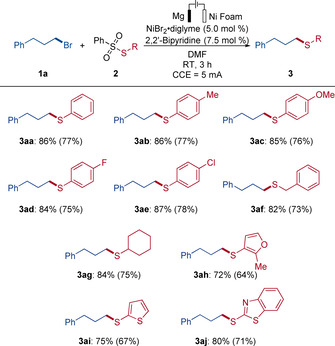
Nickel‐catalyzed electro‐reductive thiolation of alkylbromide 1 a with substituted thiosulfonates 2. Faradaic yield given in parentheses.
Scheme 3.
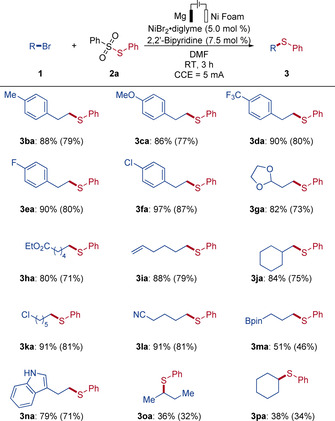
Nickel‐catalyzed electro‐reductive thiolation with bromides 1. Faradaic yield given in parentheses.
In order to understand the mode of action for the nickelaelectro‐catalyzed thiolation reaction with alkyl bromides 1, we sought to investigate the mechanism in detail. First, radical clock experiments also were performed with 6‐bromo‐1‐hexene to illustrate the formation of primary alkyl radical (Table 2).
Table 2.
Radical Clock Experiment.
|
| ||||
|---|---|---|---|---|
|
Entry |
[Ni] (X mol %) |
Ligand (Y mol %) |
Yield[a] |
3 ia:3 ia’ [a] |
|
1 |
2.50 |
3.75 |
69 % |
14:1 |
|
2 |
5.00 |
7.50 |
96 % |
>20:1 |

[a] Yield and ratio determined by 1H NMR spectroscopy with 1,3,5‐trimethoxybenzene as internal standard.
Second, we elucidated various reduction potentials of the substrates and catalyst by means of cyclic voltammetry (CV) as disulfides were frequently present as by‐product of the reaction. The cathodic reduction of thiosulfonates was important to determine the presence of an off‐cycle pathway of this electro‐catalysis. Cyclic voltammetry revealed that the reduction of the bipyridine ligated nickel pre‐catalyst is more facile than the two‐electron reduction of S‐phenyl benzenethiosulfonate 2 a to the thiolate anion (Figure 1). The first reduction potential of thiosulfonate 2 a was shown to be irreversible at E p=−0.91 V vs. Ag/AgCl and this could plausibly be assigned to the formation of the thiyl radical. Thiyl radicals are known to recombine systematically to disulfide due to their relative stability. [13] In addition, a second reduction potential was found to be reversible at E p=−1.62 V vs. Ag/AgCl and this would then be assigned to the thiolate anion after a two‐electrons transfer process. [14] The nickel pre‐catalyst exhibits an irreversible reduction potential at E p=−1.27 V vs. Ag/AgCl, which is lowered further to a reversible reduction potential of E p=−1.10 V vs. Ag/AgCl by the ligation of the bipyridine ligand [12] for the reduction of nickel(II) to nickel(I) analogous to previously reported observations. [15] Additional observations postulate that the ligated nickel catalyst is found to undergo facile two electron reduction synergistically with the reduction of thiosulfonate. Further mechanistic studies by means of potentiostatic reactions were performed to illustrate the generation of thiyl radicals and the subsequent disulfide formation through radical recombination (Scheme 4). Potentiostatic reactions were conducted under the otherwise standard reaction conditions. [16] As hypothesized, the desired product was not formed at CPE=−0.70 V vs. Ag/AgCl, but radical rebounded disulfide 4 a was formed with 18 % yield, likely due to an early first onset potential of the thiosulfonate 2 a at E onset=−0.60 V vs. Ag/AgCl. In contrast, the thiolated product 3 aa was formed at CPE=−1.00 V vs. Ag/AgCl, albeit with a considerable amount of by‐product 4 a, plausibly by radical recombination. This observation is in good agreement with our CV studies indicating possible formation of thiyl radicals by initial reduction of substrate 2 a. When the potential was higher than the second reduction potential of substrate 2 a at CPE=−1.80 V vs. Ag/AgCl, the desired thiolated product 3 aa was obtained with 53 % yield, while by‐product 4 a was formed with 44 % yield.
Figure 1.

Cyclic voltammetry (DMF, 0.1 m nBu4NPF6, 100 mVs−1) with glassy carbon as the working electrode. Cyclic voltammograms of different reaction components.
Scheme 4.

Potentiostatic studies.
A plausible catalytic cycle is proposed based on the obtained results (Scheme 5).[ 5e , 5f , 17 ] Initially, oxidative addition of 2 onto the active nickel(0) catalyst I occurs.[ 8b , 18 ] This formed intermediate II then combines with an alkyl radical formed in situ to give a nickel(III) complex. The complex III undergoes reductive elimination to provide the thiolation product 3 through a C−S bond formation. Nickel(I) complex IV would subsequently react with another molecule of alkyl bromide regenerating the alkyl radical and form nickel(II) intermediate V. This then undergoes cathodic reduction to reform the active catalyst. [19]
Scheme 5.

Plausible catalytic cycle.
In summary, we have developed an efficient and robust nickelaelectro‐catalyzed strategy for the cross‐electrophile electro‐coupling of alkyl bromides and thiosulfonates to access alkyl sulfides through C−S bond formation under ambient conditions, devoid of harsh chemical reductants. The mild electro‐thiolation provided a broad and versatile substrate scope with excellent yields. Cyclic voltammetry and potentiostatic investigations provided detailed mechanistic insights into the reaction mechanism.
Conflict of interest
The authors declare no conflict of interest.
Supporting information
As a service to our authors and readers, this journal provides supporting information supplied by the authors. Such materials are peer reviewed and may be re‐organized for online delivery, but are not copy‐edited or typeset. Technical support issues arising from supporting information (other than missing files) should be addressed to the authors.
Supplementary
Acknowledgements
Generous support by the DFG (Gottfried‐Wilhelm‐Leibniz award to LA) is gratefully acknowledged. Open access funding enabled and organized by Projekt DEAL.
N. W. J. Ang, L. Ackermann, Chem. Eur. J. 2021, 27, 4883.
Contributor Information
Nate W. J. Ang, http://www.ackermann.chemie.uni‐goettingen.de/.
Prof. Dr. Lutz Ackermann, Email: Lutz.Ackermann@chemie.uni-goettingen.de.
References
- 1.
- 1a. Wang J.-M., Ding G.-Z., Fang L., Dai J.-G., Yu S.-S., Wang Y.-H., Chen X.-G., Ma S.-G., Qu J., Xu S., Du D., J. Nat. Prod. 2010, 73, 1240–1249; [DOI] [PubMed] [Google Scholar]
- 1b. Guo H., Sun B., Gao H., Chen X., Liu S., Yao X., Liu X., Che Y., J. Nat. Prod. 2009, 72, 2115–2119; [DOI] [PubMed] [Google Scholar]
- 1c. Thase M. E., Macfadden W., Weisler R. H., Chang W., Paulsson B., Khan A., Calabrese J. R., J. Clin. Psychopharmacol. 2006, 26, 600–609; [DOI] [PubMed] [Google Scholar]
- 1d. Piscitelli S. C., Goss T. F., Wilton J. H., D′Andrea D. T., Goldstein H., Schentag J. J., Antimicrob. Agents Chemother. 1991, 35, 1765–1771; [DOI] [PMC free article] [PubMed] [Google Scholar]
- 1e. Garrod L. P., Br. Med. J. 1960, 2, 1695–1696; [DOI] [PMC free article] [PubMed] [Google Scholar]
- 1f. Garrod L. P., Br. Med. J. 1960, 1, 527–529. [DOI] [PMC free article] [PubMed] [Google Scholar]
- 2.
- 2a. Wang N., Saidhareddy P., Jiang X., Nat. Prod. Rep. 2020, 37, 246–275; [DOI] [PubMed] [Google Scholar]
- 2b. Dunbar K. L., Scharf D. H., Litomska A., Hertweck C., Chem. Rev. 2017, 117, 5521–5577; [DOI] [PubMed] [Google Scholar]
- 2c. Liu H., Jiang X., Chem. Asian J. 2013, 8, 2546–2563; [DOI] [PubMed] [Google Scholar]
- 2d. Wang F.-Z., Huang Z., Shi X.-F., Chen Y.-C., Zhang W.-M., Tian X.-P., Li J., Zhang S., Bioorg. Med. Chem. Lett. 2012, 22, 7265–7267; [DOI] [PubMed] [Google Scholar]
- 2e. Jiang C.-S., Müller W. E. G., Schröder H. C., Guo Y.-W., Chem. Rev. 2012, 112, 2179–2207; [DOI] [PubMed] [Google Scholar]
- 2f. Odds F. C., Webster C. E., Abbott A. B., J. Antimicrob. Chemother. 1984, 14, 105–114. [DOI] [PubMed] [Google Scholar]
- 3. Gilman H., Beaber N. J., J. Am. Chem. Soc. 1925, 47, 1449–1451. [Google Scholar]
- 4.
- 4a. Lian Z., Bhawal B. N., Yu P., Morandi B., Science 2017, 356, 1059–1063; [DOI] [PubMed] [Google Scholar]
- 4b. Timpa S. D., Pell C. J., Ozerov O. V., J. Am. Chem. Soc. 2014, 136, 14772–14779; [DOI] [PubMed] [Google Scholar]
- 4c. Lee C.-F., Liu Y.-C., Badsara S. S., Chem. Asian J. 2014, 9, 706–722; [DOI] [PubMed] [Google Scholar]
- 4d. Lai C.-S., Kao H.-L., Wang Y.-J., Lee C.-F., Tetrahedron Lett. 2012, 53, 4365–4367; [Google Scholar]
- 4e. Sayah M., Organ M. G., Chem. Eur. J. 2011, 17, 11719–11722; [DOI] [PubMed] [Google Scholar]
- 4f. Beletskaya I. P., Ananikov V. P., Chem. Rev. 2011, 111, 1596–1636; [DOI] [PubMed] [Google Scholar]
- 4g. Jean M., Renault J., van de Weghe P., Asao N., Tetrahedron Lett. 2010, 51, 378–381; [Google Scholar]
- 4h. Arisawa M., Suzuki T., Ishikawa T., Yamaguchi M., J. Am. Chem. Soc. 2008, 130, 12214–12215; [DOI] [PubMed] [Google Scholar]
- 4i. Morita N., Krause N., Angew. Chem. Int. Ed. 2006, 45, 1897–1899; [DOI] [PubMed] [Google Scholar]; Angew. Chem. 2006, 118, 1930–1933; [Google Scholar]
- 4j. Fernández-Rodríguez M. A., Shen Q., Hartwig J. F., J. Am. Chem. Soc. 2006, 128, 2180–2181; [DOI] [PubMed] [Google Scholar]
- 4k. Kondo T., Mitsudo T.-A., Chem. Rev. 2000, 100, 3205–3220. [DOI] [PubMed] [Google Scholar]
- 5.
- 5a. Xu P., Zhu Y.-M., Li X.-J., Wang F., Wang S.-Y., Ji S.-J., Adv. Synth. Catal. 2019, 361, 4909–4913; [Google Scholar]
- 5b. Li J., Wang S.-Y., Ji S.-J., J. Org. Chem. 2019, 84, 16147–16156; [DOI] [PubMed] [Google Scholar]
- 5c. Li J., Rao W., Wang S.-Y., Ji S.-J., J. Org. Chem. 2019, 84, 11542–11552; [DOI] [PubMed] [Google Scholar]
- 5d. Kibriya G., Mondal S., Hajra A., Org. Lett. 2018, 20, 7740–7743; [DOI] [PubMed] [Google Scholar]
- 5e. Fang Y., Rogge T., Ackermann L., Wang S.-Y., Ji S.-J., Nat. Commun. 2018, 9, 2240; [DOI] [PMC free article] [PubMed] [Google Scholar]
- 5f. Oderinde M. S., Frenette M., Robbins D. W., Aquila B., Johannes J. W., J. Am. Chem. Soc. 2016, 138, 1760–1763; [DOI] [PubMed] [Google Scholar]
- 5g. Mampuys P., Zhu Y., Vlaar T., Ruijter E., Orru R. V. A., Maes B. U. W., Angew. Chem. Int. Ed. 2014, 53, 12849–12854; [DOI] [PubMed] [Google Scholar]; Angew. Chem. 2014, 126, 13063–13068; [Google Scholar]
- 5h. Liu T.-J., Yi C.-L., Chan C.-C., Lee C.-F., Chem. Asian J. 2013, 8, 1029–1034; [DOI] [PubMed] [Google Scholar]
- 5i. Lan M.-T., Wu W.-Y., Huang S.-H., Luo K.-L., Tsai F.-Y., RSC Adv. 2011, 1, 1751–1755; [Google Scholar]
- 5j. Wu J.-R., Lin C.-H., Lee C.-F., Chem. Commun. 2009, 4450–4452; [DOI] [PubMed] [Google Scholar]
- 5k. Correa A., Carril M., Bolm C., Angew. Chem. Int. Ed. 2008, 47, 2880–2883; [DOI] [PubMed] [Google Scholar]; Angew. Chem. 2008, 120, 2922–2925; [Google Scholar]
- 5l. Wong Y.-C., Jayanth T. T., Cheng C.-H., Org. Lett. 2006, 8, 5613–5616; [DOI] [PubMed] [Google Scholar]
- 5m. Baldovino-Pantaleón O., Hernández-Ortega S., Morales-Morales D., Adv. Synth. Catal. 2006, 348, 236–242; [Google Scholar]
- 5n. Taniguchi N., J. Org. Chem. 2004, 69, 6904–6906; [DOI] [PubMed] [Google Scholar]
- 5o. Kwong F. Y., Buchwald S. L., Org. Lett. 2002, 4, 3517–3520. [DOI] [PubMed] [Google Scholar]
- 6.
- 6a. Wang W., Peng X., Wei F., Tung C.-H., Xu Z., Angew. Chem. Int. Ed. 2016, 55, 649–653; [DOI] [PubMed] [Google Scholar]; Angew. Chem. 2016, 128, 659–663; [Google Scholar]
- 6b. Fleming F. F., Gudipati S., Vu V. A., Mycka R. J., Knochel P., Org. Lett. 2007, 9, 4507–4509; [DOI] [PubMed] [Google Scholar]
- 6c. Stoll A. H., Krasovskiy A., Knochel P., Angew. Chem. Int. Ed. 2006, 45, 606–609; [DOI] [PubMed] [Google Scholar]; Angew. Chem. 2006, 118, 621–623; [Google Scholar]
- 6d. Palumbo G., Ferreri C., D′Ambrosio C., Caputo R., Phosphorus Sulfur 1984, 19, 235–238. [Google Scholar]
- 7.
- 7a. Truesdell B. L., Hamby T. B., Sevov C. S., J. Am. Chem. Soc. 2020, 142, 5884–5893; [DOI] [PubMed] [Google Scholar]
- 7b. Kumar G. S., Peshkov A., Brzozowska A., Nikolaienko P., Zhu C., Rueping M., Angew. Chem. Int. Ed. 2020, 59, 6513–6519; [DOI] [PubMed] [Google Scholar]; Angew. Chem. 2020, 132, 6575–6581; [Google Scholar]
- 7c. Jiao K.-J., Liu D., Ma H.-X., Qiu H., Fang P., Mei T.-S., Angew. Chem. Int. Ed. 2020, 59, 6520–6524; [DOI] [PubMed] [Google Scholar]; Angew. Chem. 2020, 132, 6582–6586; [Google Scholar]
- 7d. Ang N. W. J., Oliveira J. C. A., Ackermann L., Angew. Chem. Int. Ed. 2020, 59, 12842–12847; [DOI] [PMC free article] [PubMed] [Google Scholar]; Angew. Chem. 2020, 132, 12942–12947; [Google Scholar]
- 7e. Lucas E. L., Jarvo E. R., Nat. Rev. Chem. 2017, 1, 0065; [Google Scholar]
- 7f. Weix D. J., Acc. Chem. Res. 2015, 48, 1767–1775; [DOI] [PMC free article] [PubMed] [Google Scholar]
- 7g. Moragas T., Correa A., Martin R., Chem. Eur. J. 2014, 20, 8242–8258; [DOI] [PubMed] [Google Scholar]
- 7h. Knappke C. E. I., Grupe S., Gärtner D., Corpet M., Gosmini C., Jacobi von Wangelin A., Chem. Eur. J. 2014, 20, 6828–6842. [DOI] [PubMed] [Google Scholar]
- 8.
- 8a. Zhang S.-K., Struwe J., Hu L., Ackermann L., Angew. Chem. Int. Ed. 2020, 59, 3178–3183; [DOI] [PMC free article] [PubMed] [Google Scholar]; Angew. Chem. 2020, 132, 3204–3209; [Google Scholar]
- 8b. Zhang S.-K., Samanta R. C., Del Vecchio A., Ackermann L., Chem. Eur. J. 2020, 26, 10936–10947; [DOI] [PMC free article] [PubMed] [Google Scholar]
- 8c. Siu J. C., Fu N., Lin S., Acc. Chem. Res. 2020, 53, 547–560; [DOI] [PMC free article] [PubMed] [Google Scholar]
- 8d. Samanta R. C., Meyer T. H., Siewert I., Ackermann L., Chem. Sci. 2020, 11, 8657–8670; [DOI] [PMC free article] [PubMed] [Google Scholar]
- 8e. Jiao K.-J., Xing Y.-K., Yang Q.-L., Qiu H., Mei T.-S., Acc. Chem. Res. 2020, 53, 300–310; [DOI] [PubMed] [Google Scholar]
- 8f. Zhu C., Stangier M., Oliveira J. C. A., Massignan L., Ackermann L., Chem. Eur. J. 2019, 25, 16382–16389; [DOI] [PMC free article] [PubMed] [Google Scholar]
- 8g. Meyer T. H., Oliveira J. C. A., Sau S. C., Ang N. W. J., Ackermann L., ACS Catal. 2018, 8, 9140–9147. [Google Scholar]
- 9.
- 9a. Röckl J. L., Pollok D., Franke R., Waldvogel S. R., Acc. Chem. Res. 2020, 53, 45–61; [DOI] [PubMed] [Google Scholar]
- 9b. Minteer S. D., Baran P., Acc. Chem. Res. 2020, 53, 545–546; [DOI] [PubMed] [Google Scholar]
- 9c. Ackermann L., Acc. Chem. Res. 2020, 53, 84–104; [DOI] [PubMed] [Google Scholar]
- 9d. Wang H., Gao X., Lv Z., Abdelilah T., Lei A., Chem. Rev. 2019, 119, 6769–6787; [DOI] [PubMed] [Google Scholar]
- 9e. Shida N., Zhou Y., Inagi S., Acc. Chem. Res. 2019, 52, 2598–2608; [DOI] [PubMed] [Google Scholar]
- 9f. Elsherbini M., Wirth T., Acc. Chem. Res. 2019, 52, 3287–3296; [DOI] [PubMed] [Google Scholar]
- 9g. Sauermann N., Meyer T. H., Qiu Y., Ackermann L., ACS Catal. 2018, 8, 7086–7103; [Google Scholar]
- 9h. Sauermann N., Meyer T. H., Ackermann L., Chem. Eur. J. 2018, 24, 16209–16217; [DOI] [PubMed] [Google Scholar]
- 9i. Moeller K. D., Chem. Rev. 2018, 118, 4817–4833; [DOI] [PubMed] [Google Scholar]
- 9j. Jiang Y., Xu K., Zeng C., Chem. Rev. 2018, 118, 4485–4540; [DOI] [PubMed] [Google Scholar]
- 9k. Fu N., Sauer G. S., Lin S., Nat. Protoc. 2018, 13, 1725–1743; [DOI] [PubMed] [Google Scholar]
- 9l. Yan M., Kawamata Y., Baran P. S., Chem. Rev. 2017, 117, 13230–13319; [DOI] [PMC free article] [PubMed] [Google Scholar]
- 9m. Horn E. J., Rosen B. R., Baran P. S., ACS Cent. Sci. 2016, 2, 302–308; [DOI] [PMC free article] [PubMed] [Google Scholar]
- 9n. Francke R., Little R. D., Chem. Soc. Rev. 2014, 43, 2492–2521; [DOI] [PubMed] [Google Scholar]
- 9o. Sperry J. B., Wright D. L., Chem. Soc. Rev. 2006, 35, 605–621; [DOI] [PubMed] [Google Scholar]
- 9p. Shono T., Tetrahedron 1984, 40, 811–850. [Google Scholar]
- 10.
- 10a. Wang Y., Deng L., Wang X., Wu Z., Wang Y., Pan Y., ACS Catal. 2019, 9, 1630–1634; [Google Scholar]
- 10b. Liu D., Ma H.-X., Fang P., Mei T.-S., Angew. Chem. Int. Ed. 2019, 58, 5033–5037; [DOI] [PubMed] [Google Scholar]; Angew. Chem. 2019, 131, 5087–5091. [Google Scholar]
- 11.
- 11a. Surur A. S., Schulig L., Link A., Arch. Pharm. Chem. Life Sci. 2019, 352, e1800248; [DOI] [PubMed] [Google Scholar]
- 11b. Feng M., Tang B., Liang S. H., Jiang X., Curr. Top. Med. Chem. 2016, 16, 1200–1216; [DOI] [PMC free article] [PubMed] [Google Scholar]
- 11c. Bogolubsky A. V., Moroz Y. S., Mykhailiuk P. K., Ostapchuk E. N., Rudnichenko A. V., Dmytriv Y. V., Bondar A. N., Zaporozhets O. A., Pipko S. E., Doroschuk R. A., Babichenko L. N., Konovets A. I., Tolmachev A., ACS Comb. Sci. 2015, 17, 348–354; [DOI] [PubMed] [Google Scholar]
- 11d. Holland H. L., Nat. Prod. Rep. 2001, 18, 171–181. [DOI] [PubMed] [Google Scholar]
- 12. Davies D. L., Macgregor S. A., Poblador-Bahamonde A. I., Dalton Trans. 2010, 39, 10520–10527. [DOI] [PubMed] [Google Scholar]
- 13.
- 13a. Schöneich C., Molecules 2019, 24, 4357; [DOI] [PMC free article] [PubMed] [Google Scholar]
- 13b. Dénès F., Pichowicz M., Povie G., Renaud P., Chem. Rev. 2014, 114, 2587–2693; [DOI] [PubMed] [Google Scholar]
- 13c. Steer R. P., Kalra B. L., Knight A. R., J. Phys. Chem. 1967, 71, 783–784. [Google Scholar]
- 14.
- 14a. Roos G., De Proft F., Geerlings P., Chem. Eur. J. 2013, 19, 5050–5060; [DOI] [PubMed] [Google Scholar]
- 14b. Armstrong D. A., Sun Q., Schuler R. H., J. Phys. Chem. 1996, 100, 9892–9899; [Google Scholar]
- 14c. Surdhar P. S., Armstrong D. A., J. Phys. Chem. 1987, 91, 6532–6537; [Google Scholar]
- 14d. Surdhar P., Armstrong D. A., J. Phys. Chem. 1986, 90, 5915–5917. [Google Scholar]
- 15.
- 15a. Kawamata Y., Vantourout J. C., Hickey D. P., Bai P., Chen L., Hou Q., Qiao W., Barman K., Edwards M. A., Garrido-Castro A. F., deGruyter J. N., Nakamura H., Knouse K., Qin C., Clay K. J., Bao D., Li C., Starr J. T., Garcia-Irizarry C., Sach N., White H. S., Neurock M., Minteer S. D., Baran P. S., J. Am. Chem. Soc. 2019, 141, 6392–6402; [DOI] [PMC free article] [PubMed] [Google Scholar]
- 15b. Durandetti M., Maddaluno J., in Encyclopedia of Reagents for Organic Synthesis, Wiley, 2014, pp. 1–6; [Google Scholar]
- 15c. Zilbermann I., Maimon E., Cohen H., Meyerstein D., Chem. Rev. 2005, 105, 2609–2626; [DOI] [PubMed] [Google Scholar]
- 15d. Lappin A. G., McAuley A., Adv. Inorg. Chem. 1988, 32, 241–295. [Google Scholar]
- 16.
- 16a. Muchez L., De Vos D. E., Kim M., ACS Sustainable Chem. Eng. 2019, 7, 15860–15864; [Google Scholar]
- 16b. Li C., Tong X., Yu P., Du W., Wu J., Rao H., Wang Z. M., J. Mater. Chem. A 2019, 7, 16622–16642; [Google Scholar]
- 16c. Shan B., Schmehl R., J. Phys. Chem. A 2014, 118, 10400–10406; [DOI] [PubMed] [Google Scholar]
- 16d. Maity S., Zheng N., Synlett 2012, 23, 1851–1856; [DOI] [PMC free article] [PubMed] [Google Scholar]
- 16e. Richardson R. D., Holland E. J., Carpenter B. K., Nat. Chem. 2011, 3, 301–303; [DOI] [PubMed] [Google Scholar]
- 16f. Prasad D. R., Hoffman M. Z., J. Phys. Chem. 1984, 88, 5660–5665. [Google Scholar]
- 17.
- 17a. Venkanna G. T., Arman H. D., Tonzetich Z. J., ACS Catal. 2014, 4, 2941–2950; [Google Scholar]
- 17b. Biswas S., Weix D. J., J. Am. Chem. Soc. 2013, 135, 16192–16197. [DOI] [PMC free article] [PubMed] [Google Scholar]
- 18. Vasudevan D., Russ. J. Electrochem. 2005, 41, 310–314. [Google Scholar]
- 19.
- 19a. Mostardeiro V. B., Dilelio M. C., Kaufman T. S., Silveira C. C., RSC Adv. 2020, 10, 482–491; [DOI] [PMC free article] [PubMed] [Google Scholar]
- 19b. Dmitrieva E., Yu X., Hartmann H., Electrochem. Commun. 2020, 114, 106706; [Google Scholar]
- 19c. Janhsen B., Daniliuc C. G., Studer A., Chem. Sci. 2017, 8, 3547–3553. [DOI] [PMC free article] [PubMed] [Google Scholar]
Associated Data
This section collects any data citations, data availability statements, or supplementary materials included in this article.
Supplementary Materials
As a service to our authors and readers, this journal provides supporting information supplied by the authors. Such materials are peer reviewed and may be re‐organized for online delivery, but are not copy‐edited or typeset. Technical support issues arising from supporting information (other than missing files) should be addressed to the authors.
Supplementary