



Abstract
Human herpes virus-6 (HHV-6) infection is a common infection in the paediatric population and is increasingly reported in immunosuppressed adult patients. It has been reported as the causative agent of disease in few case reports in immunocompetent adults. We report herein an unusual case of HHV-6-associated viraemia, pneumonitis and meningitis in a patient who presented with dyspnoea, hypoxia, dry cough and headache. She was treated for atypical pneumonia with no improvement. Meningitis was suspected as headache kept worsening. HHV-6B was detected by PCR in the cerebrospinal fluid, and subsequently, in the bronchoalveolar lavage and serum samples. Studies were negative for the most common primary and secondary immunodeficiency syndromes, and serology could not be performed to differentiate virus reactivation from a primary infection. The patient was successfully treated with ganciclovir and had no residual sequelae.
Keywords: infectious diseases, meningitis, pneumonia (infectious disease)
Background
Human herpes virus-6 (HHV-6) infects 90%–100% of individuals during early childhood.1 HHV-6A and HHV-6B differ in their genomes, biological and immunological characteristics, epidemiology and association with diseases.2 Infection or reactivation is well described in the immunocompromised host population.3 Reactivation occurs in up to 50% of allogeneic haematopoietic stem cell transplant (HSCT) recipients and causes a broad spectrum of clinical manifestations including meningoencephalitis, bone marrow suppression, graft-versus-host disease, hepatitis and pneumonitis.4 5 It is also associated with cytomegalovirus (CMV) reactivation and increased mortality.6
A mononucleosis-like syndrome of varying severity with prolonged lymphadenopathy has been described in association with HHV-6 seroconversion in adults.7 There are few cases in the literature reporting HHV-6 infections in otherwise not known immunosuppressed patients including cases of myocarditis and hepatitis,8 9 with only 18 cases of meningoencephalitis,10 11 and 2 cases of pneumonitis described.12 13
We aim to report an unusual case of HHV-6 infection in an immunocompetent woman presenting with meningitis and pneumonitis who was found to have HHV-6 type B viraemia.
Case presentation
A 45-year-old woman presented to the emergency department (ED) at the American University of Beirut Medical Center for dyspnoea of 6 days duration, associated with dry cough, chills, headache and one episode of vomiting. The review of system was negative otherwise. The patient was maintained on propranolol for migraine and had received an electrical cardioversion for atrial fibrillation 1 year prior to presentation. She denied any sick contacts. In the ED, vital signs were all normal except for mild tachypnoea. The oxygen saturation (SaO2) was at 100% on room air. Lung examination was normal. Mild right lower quadrant tenderness was noted.
Her complete blood count showed a white cell count (WCC) of 5.9x10⁹/L with 65% polymorphonuclear (PMN) cells and 17% lymphocytes. C reactive protein (CRP) level was 116.2 mg/L (normal is below 2.5 mg/L) and procalcitonin level at 0.02 ng/mL (normal is below 0.05 ng/mL). Chest X-ray showed bilateral infiltrates, predominantly in the lower and central lung fields. A viral syndrome and an atypical bacterial pneumonia were considered in the differential diagnosis. Influenza A and B antigens, Mycoplasma IgM and Legionella-1 urine antigen assays were negative. The patient was admitted to the regular ward.
The next day, she developed a progressive drop in SaO2 that reached 93%, necessitating oxygen supplementation by nasal cannula. She was started on levofloxacin treating an atypical pneumonia. SaO2 stabilised at 93% on room air at day 3 of hospitalisation and clinical improvement was noted. Repeat CRP level showed a significant drop to 59.9 mg/L. She was discharged home on levofloxacin to complete a 5-day treatment course.
The patient presented back to the ED within less than 24 hours complaining of severe headache, chills, photophobia, vomiting and dyspnoea. She described her headache as having a different nature and a worse severity than her prior migraine episodes. She was afebrile, normotensive with an SaO2 of 93% on room air. Physical examination was relevant for bilateral mild expiratory wheezes.
Investigations
A nasal swab for respiratory pathogens tested by multiplex real-time PCR (RT-PCR) was negative. CT angiography of the chest was negative for pulmonary embolism and it showed extensive bilateral air space disease and ground glass opacities, more prominent in the perihilar areas (figure 1). Brain CT was performed to investigate the patient’s headache and was normal. To rule out meningitis, a lumbar puncture was performed and cerebrospinal fluid (CSF) studies showed: glucose 61 mg/dL (50–80 mg/dL), protein 26 mg/dL (15–60 mg/dL), WCC 0.003 x10⁹/L (0–0.005x10⁹/L) and red blood cell count 0.005 x10⁹/L. The cytospin preparation yielded 1 PMN and 28 lymphocytes. Gram stain showed rare white blood cells and no micro-organisms.
Figure 1.
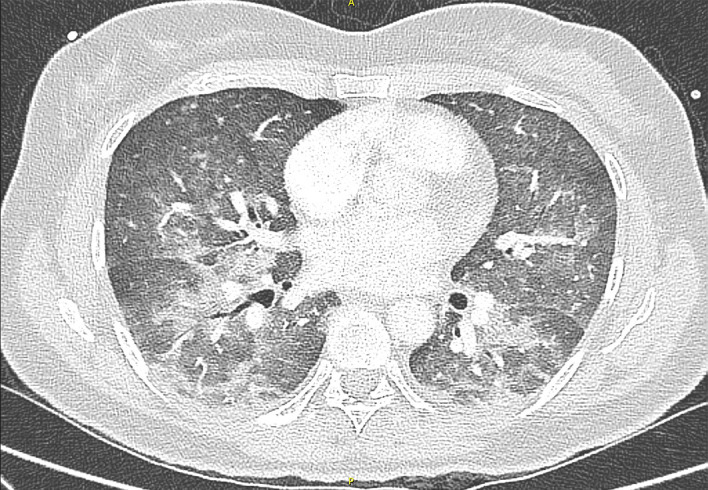
CT chest cut showing scattered airway disease and ground grass opacities, mainly, in the perihilar lung fields.
Meropenem and vancomycin were started for a possible partially treated bacterial meningitis, awaiting completion of the workup. Blood and CSF cultures returned negative.
Differential diagnosis
The patient failed to improve on empiric antibiotic therapy. A serum ACE level was done to rule out sarcoidosis and was normal (31.7 U/L, N=12–68 U/L). Multiplex RT-PCR conducted on the CSF specimen detected HHV-6 DNA. HHV-6 PCR on a serum specimen detected 13 710 copies/mL of HHV-6, type B.
Since the patient’s respiratory status did not improve either, atypical etiologies of pneumonia were considered, with the differential including HHV-6, CMV and Pneumocystis jirovecii. Empiric antibiotics were stopped. Bronchoscopy was performed on the sixth day of admission and the bronchoalveolar lavage (BAL) tested negative by multiplex RT-PCR for the usually tested respiratory pathogens. CMV PCR and P. jirovecii stain were negative. HHV-6 type B was detected at a viral load of 66 600 copies/mL.
Given the unusual presentation of HHV-6 viraemia, pneumonitis and meningitis in the adult immunocompetent patient population, workup for an underlying immunosuppressive state was pursued and the patient tested negative for the HIV 1 and 2 antibodies and the p24 antigen. Quantitative immunoglobulins yielded borderline levels illustrated by the following: IgG 6.22 g/L (7–16 g/L), IgA 0.97 g/L (0.70–4.00 g/L), IgM 0.44 g/L (0.40–2.30 g/L).
Treatment
When HHV-6 was detected in both the CSF and serum, the diagnosis of disseminated HHV-6 was entertained, and the patient was started on ganciclovir 5 mg/kg intravenously every 12 hours treating for a probable HHV-6 meningitis. The same treatment was continued to treat the concomitant HHV-6 pneumonitis.
The patient showed very slow improvement in clinical symptoms, with daily headaches of decreasing intensity. She also remained oxygen dependent by nasal cannula; however, subtle clinical improvement was noticed at day 7 of ganciclovir, and she was weaned off oxygen by day 9. She completed a 10 days course of IV ganciclovir then was discharged home on oral valganciclovir 900 mg orally two times per day to complete a total of 2 weeks induction therapy, followed by valganciclovir 900 mg orally daily as a maintenance therapy for 1 week.
Outcome and follow-up
At follow-up clinic evaluation 10 days after discharge, the patient reported complete resolution of her symptoms and her lung exam was normal. Until the date of this report (2 years after presentation), the patient remains free of symptoms and of sequelae.
Discussion
HHV-6 infection in immunocompetent adults is a rare entity and its occurrence has been described in few case reports in the literature. Only 18 cases of HHV-6-associated meningoencephalitis in immunocompetent adults have been reported.10 11 The clinical presentation is non-specific and varies from altered level of consciousness, personality changes, speech difficulties, memory loss, seizures, acute cerebellar ataxia, tremor and focal neurological deficit. Neurological outcomes have varied from full recovery to death.14–16 Most cases are believed to represent reactivation.15 16
HHV-6 pneumonitis on the other hand is mostly described in HSCT recipients and HIV patients.12 17–20 The clinical spectrum of HHV-6-associated pneumonia includes mild and severe cases.17 Radiologic features include non-specific and diverse CT findings similar to the findings of Pneumocystis jirovecii pneumonia and CMV pneumonitis: reticular infiltrates with peripheral sparing, ground glass opacity, consolidation, centrilobular nodules and pleural effusions.18 19
Only two cases of HHV-6 pneumonitis in immunocompetent patients are reported in the literature. A 19-year-old woman with respiratory failure requiring extracorporeal membrane oxygenation and leading to death on day 12 had HHV-6 as the only organism detected in BAL, which was later confirmed on autopsy.13 Another case caused by coinfection with HHV-6 and Legionella has been reported in an immunocompetent adult.12 Despite appropriate treatment, the clinical picture progressed to multiorgan failure, requiring mechanical ventilation and haemodialysis, and to subsequent chronic bone marrow suppression.20 We tested our patient for 33 respiratory pathogens by RT-PCR as well as both P. jirovecii and CMV in BAL and no coinfection was identified.
HHV-6 can be found in normal lung tissues, therefore quantitative viral loads are needed to differentiate between pathogenic and ‘normal’ levels of HHV-6 replication. Furthermore, HHV-6 may be amplified by a PCR assay on a BAL sample in the setting of viraemia.17 20
Although our patient could possibly have had HHV-6 viraemia and viral seeding into the CSF, it is far more likely that she had HHV-6 meningitis. She presented with chills but no fever, which was probably masked by acetaminophen that she was taking for her headache. She also reported photophobia, and the nature of the pain was different that her prior migraine attacks. She reported that this headache was one the most severe headaches of her life. On physical examination, no neck stiffness was noted, but this finding is absent from 30% of patients presenting with aseptic meningitis.21 This clinical picture and the CSF lymphocytosis were suggestive of viral meningitis. Additionally, a correlation has been established between HHV-6 serum levels and central nervous system (CNS) disease with an incidence of encephalitis of 8.1% for a serum viral load above 10 000 copies/mL in HSCT recipients.22 Our patient had a serum HHV-6 viral load of 13 710 copies/mL which is concordant with a high incidence of CNS disease.
Given that HHV-6 infection in immunocompetent adults is very rare, and in the absence of clear guidelines for treatment even in immunosuppressed patients,23 24 we decided to treat the patient according to clinical response and based on shared decision making with the patient herself. Expert opinion advises a 3-week (grade CIII by the European Conference on Infections in Leukaemia) course of therapy with either foscarnet or ganciclovir in immunocompromised patients.24 The patient received intravenous therapy as long as she was hospitalised (10 days), and continued the remaining of the 3-week course by oral therapy, available as valganciclovir in our country. She refused to have a repeat CSF analysis since she was back to normal as of day 10 of therapy and she remains symptoms-free since.
HHV-6 has occasionally been associated with cases of interstitial pneumonitis,25 mainly in individuals with impaired cellular immunity. Susceptibility to severe herpes simplex recurrence and severe CMV infection has been reported in hypogammaglobulinaemia patients with concomitant impairment in cellular immunity.25 26 We tested our patient for hypogammaglobulinaemia and HIV infection. However, cellular proliferation responses of lymphocytes were not recorded. IgG levels were lower than the normal limit for the age, IgA and IgM levels within the limits of normal. In severe community-acquired pneumonia, Ig levels (IgG1, IgG2, IgG3, IgG4, IgA and IgM) are proven to decrease.27 We intended to repeat the levels after recovery, however, the patient refused.
Also, we discussed with our patient the need to take a hair follicle specimen to rule out HHV-6 chromosomal integration which she refused. However, with chromosomal integration, HHV-6 levels typically exceed 5.5 log10 copies/mL, whereas, in HHV-6 reactivation and children with primary HHV-6B infection, the viral DNA loads are typically between 1.5 and 5.0 log10 copies/mL in blood samples.28 In the case of our patient, 13 710 copies/mL of HHV-6B were detected in the serum sample which makes the possibility of chromosomal integration less likely.
It is worth noting that we cannot determine whether we were dealing with a reactivation or a primary infection as serological tests were not conducted.
Given the fact that our patient had respiratory and meningeal symptoms with detection of HHV-6 in CSF, BAL and serum and in view of the remarkable response to ganciclovir, it is far more likely that HHV-6 was the culprit behind the clinical presentation. To our knowledge, this is the first case of pneumonitis, meningitis and viraemia associated with HHV-6 infection in an immunocompetent patient. It may be plausible to think about this rare entity in patients presenting with a picture consistent with atypical pneumonia, meningoencephalitis with no identifiable alternate microbiological diagnosis and no improvement with conventional therapy.
Learning points.
Human herpes virus-6 (HHV-6) can be a rare cause of severe infections in immunocompetent adults.
This is the first case of pneumonitis, meningitis and viraemia associated with HHV-6 infection in an immunocompetent patient successfully treated with ganciclovir.
Our case illustrates that HHV-6 can be a causative agent of atypical pneumonia and meningoencephalitis in a patient with no identifiable alternate microbiological diagnosis.
A low clinical threshold for HHV-6 infection should be maintained in order to initiate early antiviral therapy.
Footnotes
Twitter: @Maria Alkozah, @RamiHallak7
Contributors: MA, RH, IBA and AEZ participated in planning this case report. MA and RH participated in data acquisition. MA, RH, IBA and AEZ participated in manuscript writing. MA, RH, IBA and AEZ have all approved the final version of this manuscript.
Funding: The authors have not declared a specific grant for this research from any funding agency in the public, commercial or not-for-profit sectors.
Competing interests: None declared.
Patient consent for publication: Not required.
Provenance and peer review: Not commissioned; externally peer reviewed.
References
- 1.Okuno T, Takahashi K, Balachandra K, et al. Seroepidemiology of human herpesvirus 6 infection in normal children and adults. J Clin Microbiol 1989;27:651–3. 10.1128/JCM.27.4.651-653.1989 [DOI] [PMC free article] [PubMed] [Google Scholar]
- 2.Braun DK, Dominguez G, Pellett PE. Human herpesvirus 6. Clin Microbiol Rev 1997;10:521–67. 10.1128/CMR.10.3.521 [DOI] [PMC free article] [PubMed] [Google Scholar]
- 3.Imbert-Marcille BM, Tang XW, Lepelletier D, et al. Human herpesvirus 6 infection after autologous or allogeneic stem cell transplantation: a single-center prospective longitudinal study of 92 patients. Clin Infect Dis 2000;31:881–6. 10.1086/318142 [DOI] [PubMed] [Google Scholar]
- 4.Dockrell DH, Paya CV. Human herpesvirus-6 and -7 in transplantation. Rev Med Virol 2001;11:23–36. 10.1002/rmv.299 [DOI] [PubMed] [Google Scholar]
- 5.Zerr DM. Human herpesvirus 6 (HHV-6) disease in the setting of transplantation. Curr Opin Infect Dis 2012;25:438–44. 10.1097/QCO.0b013e3283553362 [DOI] [PubMed] [Google Scholar]
- 6.Volin L, Lautenschlager I, Juvonen E, et al. Human herpesvirus 6 antigenaemia in allogeneic stem cell transplant recipients: impact on clinical course and association with other beta-herpesviruses. Br J Haematol 2004;126:690–6. 10.1111/j.1365-2141.2004.05101.x [DOI] [PubMed] [Google Scholar]
- 7.Niederman JC, Liu CR, Kaplan MH, et al. Clinical and serological features of human herpesvirus-6 infection in three adults. Lancet 1988;2:817–9. 10.1016/S0140-6736(88)92783-3 [DOI] [PubMed] [Google Scholar]
- 8.Leveque N, Boulagnon C, Brasselet C, et al. A fatal case of human herpesvirus 6 chronic myocarditis in an immunocompetent adult. J Clin Virol 2011;52:142–5. 10.1016/j.jcv.2011.06.017 [DOI] [PubMed] [Google Scholar]
- 9.Arribas Anta J, Zaera de la Fuente C, Graus Morales J, et al. [Fulminant hepatitis caused by herpes virus 6 in immunocompetent adults]. Gastroenterol Hepatol 2016;39:533–4. 10.1016/j.gastrohep.2015.09.003 [DOI] [PubMed] [Google Scholar]
- 10.De Simone M, Muccio CF, Megna AS, et al. Human herpes virus 6 encephalitis in immunocompetent patient: an unusual neuroradiological presentation. Clin Neurol Neurosurg 2013;115:2219–22. 10.1016/j.clineuro.2013.06.015 [DOI] [PubMed] [Google Scholar]
- 11.Yilmaz M, Yasar C, Aydin S, et al. Human herpesvirus 6 encephalitis in an immunocompetent pregnant patient and review of the literature. Clin Neurol Neurosurg 2018;171:106–8. 10.1016/j.clineuro.2018.05.026 [DOI] [PubMed] [Google Scholar]
- 12.Russler SK, Tapper MA, Knox KK, et al. Pneumonitis associated with coinfection by human herpesvirus 6 and Legionella in an immunocompetent adult. Am J Pathol 1991;138:1405–11. [PMC free article] [PubMed] [Google Scholar]
- 13.Merk J, Schmid FX, Fleck M, et al. Fatal pulmonary failure attributable to viral pneumonia with human herpes virus 6 (HHV6) in a young immunocompetent woman. J Intensive Care Med 2005;20:302–6. 10.1177/0885066605279068 [DOI] [PubMed] [Google Scholar]
- 14.Fujimaki K, Mori T, Kida A, et al. Human herpesvirus 6 meningoencephalitis in allogeneic hematopoietic stem cell transplant recipients. Int J Hematol 2006;84:432–7. 10.1532/IJH97.06072 [DOI] [PubMed] [Google Scholar]
- 15.Isaacson E, Glaser CA, Forghani B, et al. Evidence of human herpesvirus 6 infection in 4 immunocompetent patients with encephalitis. Clin Infect Dis 2005;40:890–3. 10.1086/427944 [DOI] [PubMed] [Google Scholar]
- 16.McCullers JA, Lakeman FD, Whitley RJ. Human herpesvirus 6 is associated with focal encephalitis. Clin Infect Dis 1995;21:571–6. 10.1093/clinids/21.3.571 [DOI] [PubMed] [Google Scholar]
- 17.Cone RW, Huang ML, Hackman RC. Human herpesvirus 6 and pneumonia. Leuk Lymphoma 1994;15:235–41. 10.3109/10428199409049719 [DOI] [PubMed] [Google Scholar]
- 18.Ishio T, Endo T, Okada K, et al. Human herpesvirus-6 pneumonitis around the engraftment of cord blood transplantation following foscarnet prophylaxis in a patient with acute leukemia. Case Rep Hematol 2015;2015:1–5. 10.1155/2015/949265 [DOI] [PMC free article] [PubMed] [Google Scholar]
- 19.Nakayama T, Okada F, Ando Y, et al. A case of pneumonitis and encephalitis associated with human herpesvirus 6 (HHV-6) infection after bone marrow transplantation. Br J Radiol 2010;83:e255–8. 10.1259/bjr/19375793 [DOI] [PMC free article] [PubMed] [Google Scholar]
- 20.Gompels UA, Luxton J, Knox KK, et al. Chronic bone marrow suppression in immunocompetent adult by human herpesvirus 6. Lancet 1994;343:735–6. 10.1016/S0140-6736(94)91619-5 [DOI] [PubMed] [Google Scholar]
- 21.Wright WF, Pinto CN, Palisoc K, et al. Viral (aseptic) meningitis: a review. J Neurol Sci 2019;398:176–83. 10.1016/j.jns.2019.01.050 [DOI] [PubMed] [Google Scholar]
- 22.Ogata M, Satou T, Kadota J-ichi, et al. Human herpesvirus 6 (HHV-6) reactivation and HHV-6 encephalitis after allogeneic hematopoietic cell transplantation: a multicenter, prospective study. Clin Infect Dis 2013;57:671–81. 10.1093/cid/cit358 [DOI] [PubMed] [Google Scholar]
- 23.El Zakhem A, Shah DP, Mori N, et al. The clinical significance of human herpes virus 6 (HHV-6) DNAemia in 68 hematopoietic cell transplant recipients (HSCT). Biology of Blood and Marrow Transplantation 2014;20:S219. 10.1016/j.bbmt.2013.12.370 [DOI] [Google Scholar]
- 24.Ward KN, Hill JA, Hubacek P, et al. Guidelines from the 2017 European conference on infections in leukaemia for management of HHV-6 infection in patients with hematologic malignancies and after hematopoietic stem cell transplantation. Haematologica 2019;104:2155–63. 10.3324/haematol.2019.223073 [DOI] [PMC free article] [PubMed] [Google Scholar]
- 25.Vuorinen T, Kotilainen P, Lautenschlager I, et al. Interstitial pneumonitis and coinfection of human herpesvirus 6 and Pneumocystis carinii in a patient with hypogammaglobulinemia. J Clin Microbiol 2004;42:5415–8. 10.1128/JCM.42.11.5415-5418.2004 [DOI] [PMC free article] [PubMed] [Google Scholar]
- 26.Freeman HJ, Shnitka TK, Piercey JR, et al. Cytomegalovirus infection of the gastrointestinal tract in a patient with late onset immunodeficiency syndrome. Gastroenterology 1977;73:1397–403. 10.1016/S0016-5085(19)31521-5 [DOI] [PubMed] [Google Scholar]
- 27.de la Torre MC, Torán P, Serra-Prat M, et al. Serum levels of immunoglobulins and severity of community-acquired pneumonia. BMJ Open Respir Res 2016;3:e000152. 10.1136/bmjresp-2016-000152 [DOI] [PMC free article] [PubMed] [Google Scholar]
- 28.Pellett PE, Ablashi DV, Ambros PF, et al. Chromosomally integrated human herpesvirus 6: questions and answers. Rev Med Virol 2012;22:144–55. 10.1002/rmv.715 [DOI] [PMC free article] [PubMed] [Google Scholar]