



Dear Editor,
The current pandemic of SARS-CoV-2 has posed many challenges in the delivery of eye care. Tele-ophthalmology along with the existing technology has to be put to its best use in providing continuity in eye care delivery to tide over this crisis. Our study looked at the role of mobile application-based teleophthalmology services in providing primary eye care during the COVID-19 pandemic.
The data of 2452 patients who consulted an app based or through a web app using a browser on a dedicated telemedicine platform mFineCare using a mobile phone, desktop or a tablet for ophthalmic problems over a 15-week period between May 1 and August 22, 2020 was analyzed for the reasons for consultation, diagnosis offered, number of patients advised follow up on the mobile app and patient feedback in rating the teleconsultation.
Data are de-identified to maintain patient privacy.[1] The consultations were on demand from the patients, where they select their consultant from the list of doctors from different hospitals across the country that are enrolled with the Telemedicine application based on doctor‘s experience and proximity. All patients were triaged by the service provider, and patients with noncritical problems were furthered for ophthalmologist‘s consultation. All consultations were first consultation in nature. This study excluded data from the follow-up consultations. The mobile application required two calls to complete a typical teleconsultation cycle. Utilizing the hybrid of store and forward teleconsultation with history of present complaint, medical history, treatment history, and patient-generated images of external eye, being obtained at the time of initial screening by the organization‘s team of resident doctors who meticulously collected patient‘s history by a chatbot that was combined with a real-time audio or video consultation between patient and the ophthalmologist.[2] A provisional diagnosis was made based on symptoms and signs. Treatment options and follow-up plan were discussed during the teleconsultation and the e-prescription given as per the telemedicine practice guidelines of India.[3] Descriptive analysis of the data was done using Microsoft Excel 2019.
Among the 2452 patients, the mean age of the patients was 30.72 ± 17.29 years; the median age was 29 years with interquartile range of 17 and the range was 0 and 93 years. There were 1392 male patients; 1058 were female and 2 patients were transgenders. In total, 74% of patients consulted through audio call and 26% by video call. Approximately 90% of patients could upload external photograph of the eye. The common causes for consultation are given in Graph 1. Few edited patient generated images is shown in Fig. 1.
Graph 1.
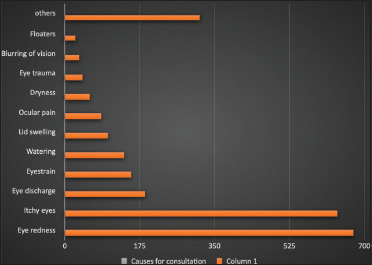
Common causes for consultation
Figure 1.
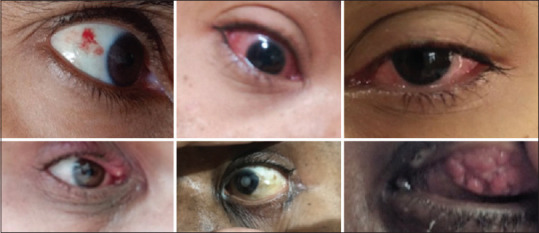
Few edited patient-generated images
The top 15 most common diagnosis offered across the subspecialities is shown in Table 1. Diagnosis of anterior segment disease was made in about 1892 (77.16%) individuals, with ocular allergy being the commonest diagnosis made in 949 (38.67%) individuals. A diagnosis of corneal ulcer was made in 12 patients. Ocular trauma was the second most common subspecialty diagnoses made in 109 (4.4%). In 39 individuals blunt trauma was diagnosed that presented with a subconjunctival hemorrhage in 22, retained foreign body in conjunctiva and cornea in 34 individuals. A presumed change in refractive status was diagnosed in 92 patients (3.75%). Diagnosis of orbit and oculoplasty disorders was made in 47 patients that included conditions like preseptal cellulitis in 14, myokymia of lids, blepharo-ptosis, blepharospasm, thyroid eye disease, senile and cicatricial ectropion. Retinal problems were presumed based on the symptoms of distorted vision, sudden loss of vision, and association with diabetes mellitus. 44 patients (1.79%) were diagnosed with a possible retinal problem. Posterior vitreous detachment was the most common retinal diagnosis made in about 18 patients. Ophthalmic emergency was diagnosed in 26 patients (1.06%) with sudden onset of drop in vision, redness of eyes associated with fever, toxicity to antiglaucoma medication, angioedema due to insect bite, macular edema, blunt trauma causing hyphema and possible vitreous hemorrhage, and Herpes zoster ophthalmicus. A need for follow-up on the mobile application within 5 days was flagged in 125 patients (5.0%). 55% of patients rated the conversation of their teleconsultation as 5 stars on a scale of five and 22% did not give their feedback.
Table 1.
The Top 15 most common diagnosis offered across the subspecialities
| Diagnosis | n (%) |
|---|---|
| Ocular allergy | 949 (38.7%) |
| Dry eyes | 360 (14.7%) |
| Hordeolum | 247 (10.1%) |
| Change in refractive error | 92 (3.75%) |
| Viral conjunctivitis | 90 (3.67%) |
| Chalazion | 68 (2.77%) |
| Headache and periocular pain | 55 (2.24%) |
| Subconjunctival hemorrhage | 49 (1.99%) |
| Episcleritis and Scleritis | 46 (1.87%) |
| Foreign body of Conjunctiva/Cornea/lids | 34 (1.38%) |
| Cataract | 32 (1.30%) |
| Chemical injury | 28 (1.14%) |
| Dacryocystitis | 21 (0.85%) |
| Posterior vitreous detachment | 18 (0.73%) |
| Iridocyclitis | 14 (0.57%) |
Features that promoted easy consultation are convenience of filling pre denoted forms in the chatbot by the patient for uploading history and symptoms, convenient scheduling of appointments, ease of uploading images, user-friendly interface of the platform for patient and consultant.
Advantages of teleophthalmology include rapid access to healthcare, catering to people under various circumstances like in a pandemic, remote patient location, lack of transport, individuals with restricted mobility. Being time saving and cost effective, it serves as an important infection control tool at the same time.[4] The utility of teleophthalmology will keep expanding with advances in technology for safer patient outcomes during the current pandemic and beyond.
Financial support and sponsorship
Nil.
Conflicts of interest
There are no conflicts of interest.
References
- 1.Krishna R, Kelleher K, Stahlberg E. Patient confidentiality in the research use of clinical medical databases. Am J Public Health. 2007;97:654–8. doi: 10.2105/AJPH.2006.090902. [DOI] [PMC free article] [PubMed] [Google Scholar]
- 2.Caffrey LJ, Taylor M, Gole G. Smith ACModels of care in tele-ophthalmology: A scoping review. J Telemed Telecare. 2019;25:106–22. doi: 10.1177/1357633X17742182. [DOI] [PubMed] [Google Scholar]
- 3.Ministry of Health and Family Welfare, Government of India. Telemedicine Practice Guidelines. c2020. [Last accessed on 2020 Nov 03]. Available from: https://www.mohfw.gov.in/pdf/Telemedicine.pdf .
- 4.Ting DS, Gunasekaran DV, Wicken L, Wong TY. Next generation telemedicine platforms to screen and triage. Br J Ophthalmol. 2020;104:299–300. doi: 10.1136/bjophthalmol-2019-315066. [DOI] [PubMed] [Google Scholar]