



A 2016 AHA scientific statement identified short sleep as an emerging risk factor for hypertension.1 Observational studies generally demonstrate that short sleep duration (<7h) is associated with greater hypertension risk and elevated systolic and diastolic blood pressure (SBP and DBP), with stronger relations observed among women and younger adults.1,2 Intervention studies are limited, particularly among women, who may be more prone to adverse cardiovascular consequences of short sleep.2 Further, existing clinical trials have focused primarily on the short-term effects (≤3 weeks) of severe sleep restriction (SR)(≤4 h). Thus, the impact of sustained mild SR, resembling the widely prevalent short sleep observed in >35% of US women, on BP profiles is not well characterized.1 Moreover, existing studies focus narrowly on clinic BP assessments, rather than measures of the circadian pattern of BP from 24-h ambulatory BP monitoring (ABPM), which are more strongly related to cardiovascular disease (CVD) morbidity and mortality.3
We recently provided the earliest evidence that, compared with maintenance of adequate habitual sleep (HS), prolonged mild SR leads to poorer clinic and 24-h BP in pre-menopausal women.4 The current study provides updated results from the AHA Go Red for Women Strategically Focused Research Network, highlighted by novel investigation that includes post-menopausal women.
Participants in this randomized crossover trial were metabolically healthy pre-menopausal (n=26) and post-menopausal (n=10) women, with BMI of 25–29.9kg/m2 or BMI of 20–24.9kg/m2 and at least one first degree family member with obesity, type 2 diabetes, CVD, or another CVD risk factor, who had adequate habitual sleep duration (7–9h average total sleep time (TST)) verified from 2 weeks of screening with actigraphy (GT3X+, Actigraph Corp, Pensacola, FL) and nightly sleep diaries. Detailed description of study inclusion/exclusion criteria and procedures have been previously published.4 Women underwent 6 weeks of HS, with bed and wake times based on screening values, and 6 weeks of SR, with habitual bedtime delayed by 1.5 h/night and wake time unchanged. These sleep conditions were separated by a 6-week washout period. Sleep was assessed nightly throughout both phases with actigraphy and sleep diaries. Weekly resting clinic BP was measured in duplicate on the left arm while seated with legs uncrossed using an automated BP monitor (Medline MDS3001 Adult Automatic Digital Blood Pressure Monitor, Medline Industries Inc., Northfield, IL) and the readings were averaged. During week 6 of each phase, women (n=29) completed ABPM (OnTrak, Spacelabs Healthcare, Snoqualmie, WA) with readings obtained every 30 minutes. Study procedures were approved by the Columbia University Institutional Review Board and pre-registered on ClinicalTrials.gov (NCT02835261). Participants provided written informed consent.
Linear mixed models were used to test whether sleep condition influenced the change in weekly SBP and DBP over time (sleep condition (SR vs. HS) × time interaction) or impacted ABPM values at week 6. Analyses were conducted as intent-to-treat using SAS v9.4 (Cary, NC) and R v4.0.2. Socio-demographic covariates, menopausal status, phase, and carryover effects were included in initial models and dropped if non-significant. Analyses were conducted for the overall sample and stratified a priori by menopausal status. Results are reported as mean±SEM and considered significant at p<0.05.
Average age of participants was 37±14y (pre-menopausal women: 30.0±6.5y, range: 21–46y; postmenopausal women: 56±9.5y, range: 35–65y), BMI was 25.4±3.5kg/m2 (38% and 11% had a BMI in the overweight and obese categories, respectively), and nightly TST at screening was 458±25min. Overall, 28% were post-menopausal, and 53% reported being a racial/ethnic minority. There was a significant influence of sleep condition on change in weekly clinic SBP (difference in slope of change in SBP for SR vs. HS: 0.66±0.32mmHg, p=0.042; Figure Panel A). In the SR condition, SBP slope was −0.27±0.23, with a decrease from week 0 to 6 of 1.60mmHg; whereas in HS, the SBP slope was −0.93±0.51, showing a reduction of 5.57mmHg from week 0 to week 6. No sleep condition × time interaction was observed for clinic DBP (0.32±0.26, p=0.228). Differences in ABPM measures during the last week of SR vs. HS are shown in Figure Panel C. Compared with HS, SR led to higher 24-h SBP (2.95±1.20mmHg, p=0.024) and mean arterial pressure (MAP)(2.22±0.97mmHg, p=0.035). Further, trends for an effect of SR on 24-h DBP (1.59±0.88mmHg, p=0.085), wake SBP (2.42±1.39mmHg, p=0.098), and MAP (2.18±1.09mmHg, p=0.060) were observed.
Figure Legend:
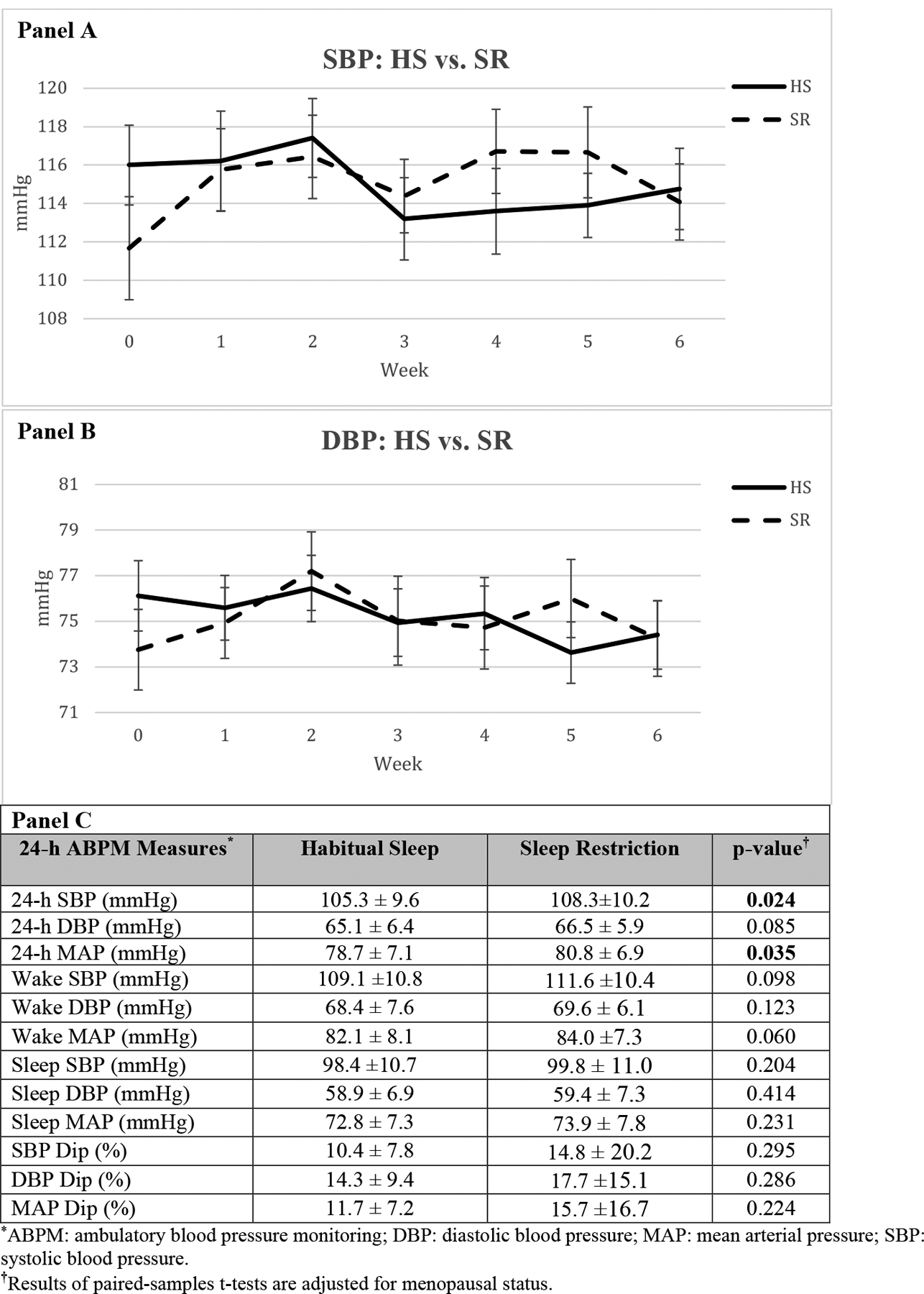
Change in systolic blood pressure (panel A) and diastolic blood pressure (panel B) over 6 weeks of habitual sleep (solid line) and sleep restriction (hatched line) in 36 pre-and post-menopausal women. Panel C displays mean ± SD differences in 24-h ambulatory blood pressure measures at week 6 of habitual sleep and sleep restriction in 29 women.
In stratified analyses, the slope of change in office-measured SBP was 1.01±0.39mmHg higher in SR relative to HS in pre-menopausal women (p=0.010). Compared to HS, SR led to higher ABPM 24-h (2.79±1.25mmHg, p=0.044) and wake MAP (3.17±1.40mmHg, p=0.041), and trends for an effect of SR on 24-h SBP (3.24±1.59mmHg, p=0.060), 24-h DBP (2.20±1.14mmHg, p=0.075), and wake DBP (2.54±1.35mmHg, p=0.081) were observed. In postmenopausal women, SR led to higher ABMP-measured sleep SBP (6.27±2.04mmHg, p=0.037), and a trend for an effect on sleep MAP (3.90±1.57mmHg, p=0.068) was detected, relative to HS.
This update provides causal evidence that sustained mild SR, mimicking prevalent real-life insufficient sleep observed in women, adversely affects clinic SBP relative to HS, particularly among pre-menopausal women, and leads to diurnal BP profiles associated with increased CVD risk. Notably, weekly clinic SBP declined in both sleep conditions, but to a greater extent in HS, suggesting that SR may have prevented a potential protective effect of stabilizing sleep schedules on SBP that was observed in HS, as emerging evidence suggests that regularity of sleep-wake patterns may be related to favorable BP profiles.5 On the other hand, the magnitude of differences in ambulatory BP measures between HS vs. SR reported herein has been linked to significant decreases in CVD outcomes at the population level3, thereby justifying screening for and targeting short sleep in the clinic and public health setting as part of a comprehensive lifestyle approach for CVD prevention in women. Chronic short sleep may increase BP through mechanisms including disturbed autonomic balance, increased risk for adiposity and metabolic dysfunction, and circadian misalignment, which disrupt the circadian rhythmicity of physiological processes and shift the daily BP profile to higher values.2 Finally, our sample of postmenopausal women was limited because few met the inclusion criterion of adequate sleep duration upon screening, which may have led to an underestimation of the impact of mild SR on BP in this population group. Thus, additional clinical trials to examine the effect of SR on BP profiles in postmenopausal women are warranted, given the greater risk for both sleep disturbances and hypertension in this life stage and the greater difficulty in achieving BP control with aging, particularly in women.2
Acknowledgements:
The authors would like to thank the women who participated in this research and the graduate students who have contributed to the implementation of this study.
Sources of Funding: This research was funded by an American Heart Association Strategically Focused Research Network Award (#16SFRN27950012) and NIH R01 grants HL128226 and HL142648 awarded to MPSO. NM is supported by a NIH K99/R00 Award (K99-HL148511). FMZ is supported by a Berrie Diabetes Foundation Fellowship Award and NIH T32 (HL007343).
Footnotes
Disclosures: None.
References:
- 1.St-Onge M, Grandner MA, Brown D, Conroy MB, Jean-Louis G, Coons M, Bhatt DL. Sleep duration and quality: Impact on lifestyle behaviors and cardiometabolic health: A scientific statement from the American Heart Association. Circulation. 2016;134(18):e367–e386. [DOI] [PMC free article] [PubMed] [Google Scholar]
- 2.Makarem N, Shechter A, Carnethon MR, Mullington JM, Hall MH, Abdalla M. Sleep duration and blood pressure: Recent advances and future directions. Curr Hypertens Rep. 2019;21(5):33. [DOI] [PMC free article] [PubMed] [Google Scholar]
- 3.Whelton PK, Carey RM, Aronow WS, Casey DE, Collins KJ, Himmelfarb CD, DePalma SM, Gidding S, Jamerson KA, Jones DW, MacLaughlin EJ. 2017 ACC/AHA/AAPA/ABC/ACPM/AGS/APhA/ASH/ASPC/NMA/PCNA guideline for the prevention, detection, evaluation, and management of high blood pressure in adults: A report of the American College of Cardiology/American Heart Association task force on clinical practice guidelines. J Am Coll Cardiol. 2017:24430. [DOI] [PubMed] [Google Scholar]
- 4.St-Onge M, Campbell A, Aggarwal B, Taylor JL, Spruill TM, RoyChoudhury A. Mild sleep restriction increases 24-hour ambulatory blood pressure in premenopausal women with no indication of mediation by psychological effects. Am Heart J. 2020;223:12–22. [DOI] [PMC free article] [PubMed] [Google Scholar]
- 5.Makarem N, Zuraikat FM, Aggarwal B, Jelic S, St-Onge M. Variability in sleep patterns: An emerging risk factor for hypertension. Curr Hypertens Rep. 2020;22(2):1–10. [DOI] [PMC free article] [PubMed] [Google Scholar]