



Abstract
The present study investigated effects of phonological and orthographic neighborhood density on event-related potentials, with an aim to better specify the factors that determine N400 amplitude in single word reading paradigms. We orthogonally manipulated the number of orthographic and phonological neighbors of words using the Levenshtein Distance metric (OLD20 and PLD20, respectively). The results showed opposite effects of phonological neighborhood density (PND) as a function of orthographic neighborhood density (OND). Larger N400 amplitudes were elicited by words with high PND compared with low PND when OND was high, and smaller N400 amplitudes were observed with high PND compared with low PND words when OND was low. We interpret these findings using the notion of cross-code consistency, according to which the compatibility of orthographic and phonological representations activated by a given word influences the process of recognizing that word. Words with similar numbers of orthographic and phonological neighbors have more consistent spellings and pronunciations across the neighborhood, and generate larger N400 amplitudes.
Keywords: Visual word recognition, Phonological neighbors, Orthographic neighbors, ERPs
1. Introduction
Research on silent reading suggests that phonological codes are rapidly and automatically activated during visual word recognition (Ferrand & Grainger, 1992, 1993, 1994; Grainger & Ferrand, 1994; Grainger, Kiyonaga & Holcomb, 2006; Okano, Grainger, & Holcomb, 2016; Ziegler, Ferrand, Jacobs, Rey, & Grainger, 2000; see Rastle & Brysbaert, 2006; for a review). Part of the evidence in support of a role for phonology during silent reading comes from studies examining the influence of phonologically similar words (“phonological neighbors”) during the processing of written words by skilled readers (Chen, Vaid, Boas, & Bortfeld, 2011; Grainger, Muneaux, Farioli, & Ziegler, 2005; Yates, Locker, & Simpson, 2004). In a lexical decision task, Chen et al. (2011) showed that English words with many phonological neighbors were recognized more slowly than words with few phonological neighbors. However, these findings stand in contrast with facilitative effects reported in other studies (Yates, 2005; Yates et al., 2004) where visually presented words with a large number of phonological neighbors were processed faster than those with a small number of phonological neighbors. One possibility for these contradictory findings could be due to differences in the number of orthographically similar words for the high and low phonological neighborhood words in these previous studies (Grainger et al., 2005). Grainger et al. showed that the effect of phonological neighborhood size on visual word recognition was modulated by the number of orthographic neighbors, where orthographic neighbors were defined as words that can be generated by replacing one letter of a target word while preserving letter positions (Coltheart, Davelaar, Jonasson, & Besner, 1977). Grainger et al. (2005) showed that increasing phonological neighborhood size resulted in inhibitory effects for visual words with sparse orthographic neighborhoods, but had facilitative effects for words with dense orthographic neighborhoods. These authors argued for a cross-code consistency account to explain this pattern of phonological neighborhood effects. Consistency refers to the degree to which a certain number of words are spelled and pronounced similarly. That is, a word that shares both the orthographic and phonological codes with most of its neighbors is more consistent than a word that shares the orthographic codes with its neighbors but has a different pronunciation. Accordingly, words with similar phonological and orthographic neighborhood densities tend to have orthographic and phonological neighbors with similar spellings and pronunciations, whereas different levels of neighborhood densities lead to more divergent spellings and pronunciations in the neighborhood. Thus, a word like type that has many phonological neighbors (e.g., wipe, ripe, pipe, tap, tape, tide, tied, time, tip, and top) and relatively few orthographic neighbors (e.g., tape, typo, tyre, hype, and tope) is harder to recognize given the inconsistent sound-spelling mappings across neighbors.
The notion of cross-code consistency has been previously suggested to play in important role within models of visual word recognition, such as the triangle model (Seidenberg & McClelland, 1989) and the bimodal interactive-activation model (Diependaele, Ziegler, & Grainger, 2010; Grainger & Ziegler, 2008). According to the latter model described in Fig. 1, visual word recognition involves the activation of sublexical orthographic units (O-units) that include information about letters or letter clusters. A central interface (O⇔P) receives activation from sublexical orthographic units and allows the mapping onto their corresponding phonological units (P-units). These orthography-to-phonology mappings send activation to whole-word orthographic (O-word) and phonological (P-word) representations. This central interface between orthography and phonology can account for the mechanisms that are responsible for the cross-code consistency effects. The level of consistency across all phonological and orthographic units activated by a word target and its neighbors is thus thought to affect the processes by which the word is recognized.
Fig. 1.

Architecture of the bimodal interactive activation model of word recognition (the details of the inhibitory within-level and excitatory between-level connections are not provided).
Following the bimodal interactive-activation framework, a printed word stimulus is assumed to activate a set of orthographic, phonological and semantic units of the target word itself, and those of other words that are orthographically and phonologically similar to the target word (its orthographic and phonological neighbors). Accordingly, consistency of the spelling-to-sound mappings across all co-activated orthographic and phonological representations will influence the course of word recognition (Grainger & Ziegler, 2008). For instance, recognition of a word like “wave” can be affected by the knowledge of other similarly spelled words whose eave ending is pronounced differently as in “have”. Moreover, consistency of phonology-to-spelling mappings has also been found to influence visual word recognition (Stone, Vanhoy, & Orden, 1997; Ziegler, Montant, & Jacobs, 1997; Ziegler, Petrova, & Ferrand, 2008). This occurs when words with inconsistent sound-to-spelling mappings like “heap” whose/ip/pronunciation has more than one spelling as in “deep” are recognized more slowly in lexical decision tasks than words with phonological units like/uk/that can only be spelled one way as in words like “duck” and “luck”.
The goal of the present study was to investigate the effects of interactions between orthographic and phonological neighborhood density on event-related brain potentials (ERPs). Of particular interest to the present study is one ERP component, the N400, a negative deflection that reaches its maximal amplitude around 400 ms after stimulus onset. The N400 has been shown to be sensitive to lexical and semantic aspects of word processing (Kutas & Hillyard, 1980, 1984) and its amplitude can be modulated by processing costs associated with the retrieval of semantic properties of a word form stored in memory (Holcomb, Grainger, & O’Rourke, 2002; Kutas & Federmeier, 2000). Prior studies have reported evidence for ERP effects that vary as a function of orthographic neighborhood density. Word stimuli with larger neighborhoods generate larger N400 amplitudes relative to those with small neighborhoods (Holcomb et al., 2002; Laszlo & Federmeier, 2009; Midgley, Holcomb, van Heuven, & Grainger, 2008; Müller, Duñabeitia, & Carreiras, 2010; Vergara-Martínez & Swaab, 2012). It has been argued that this is because word stimuli not only activate their own lexical and semantic representations but also at least partially activate representations for their orthographic neighbors as well (Holcomb et al., 2002). The size of the N400 is thought to reflect the total semantic activation of the word itself and its neighbors, thus more activation is associated with larger N400s.
However, it is also possible that increased N400 amplitudes for words with more neighbors could be driven by an increased difficulty in recognizing these words due to competition from the neighbors. Indeed, lateral inhibition between co-activated lexical representations is a key ingredient of interactive-activation models of word recognition (McClelland & Rumelhart, 1981), and has been used to explain inhibitory effects of orthographic neighborhood found in behavioral studies (Grainger & Jacobs, 1996; Jacobs & Grainger, 1992). Inhibitory connections between whole-word representations slow down the processing of a given target word when words other than the target are simultaneously activated. An increased difficulty in target word processing would lead to increased difficulty in mapping form onto meaning, hence causing an increase in N400 amplitude, in the same way as low-frequency words generate greater N400 amplitudes than high-frequency words (Smith & Halgren, 1987; Van Petten & Kutas, 1990).
By manipulating phonological neighborhood density in words with high and low orthographic neighborhood densities in the present study, we aim to tease apart the contribution of possible interfering effects of neighbors and the overall strength of lexical activity generated by a word and its neighbors in determining N400 amplitude. If difficulty in processing the target word is the primary factor causing an increase in N400 amplitude, then N400 amplitude should be greatest in the conditions where there is a mismatch between orthographic and phonological density. It is in these conditions that word recognition was found to be the hardest in the Grainger et al. (2005) study. If, on the other hand, it is strength of lexical activity, determined by the level of compatibility of spellings and pronunciations in co-activated orthographic and phonological representations, that causes an increase in N400 amplitude, then N400 amplitude should be greatest in the conditions where there is match in orthographic and phonological neighborhood density.
We also manipulated task demands (lexical decision vs. semantic categorization) in order to further evaluate the extent to which the effects of neighborhood density are specific to a given task. Contrary to previous behavioral studies where effects of orthographic neighborhood have been found to be modulated by task demands (Carreiras, Perea, & Grainger, 1997; Forster & Shen, 1996; Sears, Lupker, & Hino, 1999), we expected the N400 amplitude to be impervious to strategic factors implemented by a different type of task, as reported in Holcomb et al.’s study (2002). Indeed, Holcomb et al. (2002) found the N400 effect in response to orthographic neighborhood density to be consistent across lexical decision and semantic categorization tasks, which suggests that the N400 amplitude can reflect processes that are independent of task requirements.
2. Methods and materials
2.1. Participants
A total of fifty Tufts University undergraduate students (34 females) were recruited and participated for monetary compensation. All participants were right-handed native speakers of English. The age range was 18–23 (mean age = 20.34, SD = 1.58). They had normal or corrected-to-normal vision with no history of neurological language impairments.
2.2. Materials
A total of 192 English words between four (N = 89) and five letters (N = 103) were selected from a large database of approximately one thousand words generated for the KiloWord Project (Dufau, Grainger, Midgley, & Holcomb, 2015). Stimulus words were subdivided into four conditions in a 2 (Orthographic Neighborhood density: low versus high) by 2 (Phonological Neighborhood density: low versus high) experimental design. Each condition contained 48 words. Orthographic neighborhood (ON) and phonological neighborhood (PN) density was operationalized using the Levenshtein Distance 20 (LD20) measure (Yarkoni, Balota, & Yap, 2008). Orthographic (OLD20) and phonological (PLD20) measures were computed based on the mean number of substitution, insertions, or deletion operations needed to turn a word into 20 of its closest orthographic and phonological neighbors. Median OLD20 and PLD20 values across all stimulus words were used to split words into low and high neighborhood conditions. OLD20 values were smaller than 1.65 for words in the high orthographic condition (mean = 1.51, SD = 0.13) and higher than 1.65 for words in the low orthographic condition (mean = 1.79, SD = 0.08). Moreover, PLD20 values were smaller than 1.45 for words in the high phonological condition (mean = 1.20, SD = 0.17) and higher than 1.45 for words in the low phonological condition (mean = 1.60, SD = 0.10). and low Differences between high neighborhood conditions were confirmed by analyses of variance (ANOVA) for OLD20 (F (3,188) = 104.839, p < 0.001) and PLD20 (F (3,188) = 132.04, p < 0.001). In terms of N-metric (Coltheart et al., 1977), words with low OLD20 values have a higher number of orthographic neighbors (mean = 8.10, SD = 2.95), whereas words with high OLD20 values have a smaller number of orthographic neighbors (mean = 3.36, SD = 1.97). Similarly, words with low PLD20 values have a higher number of phonological neighbors (mean = 21.46, SD = 11.07), whereas words with high PLD20 values have a smaller number of phonological neighbors (mean = 10.08, SD = 6.22). For example, a word with a low OLD20 value (park, OLD20 = 1.2) will have a large number of ON according to Coltheart’s N-metric (ON = 11). Inversely, a word with a high OLD20 value (city, OLD20 = 1.9) will have a small number of ON (ON = 2). Differences between high and low neighborhood conditions in terms of N-metric were similarly confirmed by analyses of variance (ANOVA) for ON (F (3,188) = 57.76, p < 0.001) and PN (F (3,188) = 26.7, p < 0.001). As shown in Table 1, stimulus words were matched for length (number of letters), concreteness, bigram frequency (summed bigram by position) and log frequency according to CELEX (1993) database. ANOVAs run for all these lexical properties revealed no significant differences across all four experimental conditions (all p values > 0.10). All experimental stimuli were counterbalanced across four presentation blocks such that half of the stimuli were presented in a lexical decision task (LDT) and the other half in a semantic categorization task (SCT). A total of 140 non-words and 140 animal names (13% of trials) served as probe items in LDT blocks and SCT blocks, respectively.
Table 1.
Stimulus materials and their lexical properties for phonological neighborhood (PN) and orthographic neighborhood (ON) density conditions (standard deviations in parentheses).
| PN | ON | OLD20 | PLD20 | ON N-metric | PN N-metric | Letters | Frequency | BG Frequency | Concreteness |
|---|---|---|---|---|---|---|---|---|---|
| CELEX | |||||||||
| High | High | 1.49 (±0.49) | 1.19 (±0.14) | 8.45 (±2.79) | 19.97 (±9.35) | 4.41 (±0.49) | 1.74 (±0.48) | 7427.97 (±2837.24) | 4.70 (±1.25) |
| Low | 1.78 (±0.08) | 1.21 (±0.19) | 3.39 (±2.14) | 22.95 (±12.49) | 4.62 (±0.48) | 1.56 (±0.73) | 6142.12 (±2894.85) | 4.20 (±1.16) | |
| Low | High | 1.53 (±0.13) | 1.59 (±0.10) | 7.75 (±3.09) | 10.35 (±6.94) | 4.43 (±0.50) | 1.42 (±0.73) | 6644.37 (±3458.62) | 4.79 (±1.19) |
| Low | 1.80 (±0.09) | 1.61 (±0.09) | 3.33 (±1.80) | 9.81 (±5.48) | 4.66 (±0.47) | 1.58 (±0.70) | 6658.45 (±3558.55) | 4.52 (±1.21) |
2.3. Procedure
Participants were seated comfortably in a sound-attenuated room. Word stimuli were displayed visually in white lowercase letters against a black background on a computer screen that was positioned at approximately 1.5 m from the participant. Experimental stimuli were presented in four different blocks with a short break between blocks. Two of these four blocks required a LDT and the other two a SCT. Participants were instructed to read the words for meaning and to press a button as soon as they saw a non-word in blocks requiring a lexical decision, or an animal name in blocks requiring a semantic categorization. Critical words did not require any overt behavioral response from participants. Order of the blocks and tasks was counterbalanced across participants such that for 25 participants the order was LDT-SCT-LDT-SCT while the reverse order was used for the remaining 25 participants (SCT-LDT-SCT-LDT). Stimuli were presented for 400 ms and were followed by a 600 ms black screen. Each trial was preceded by a 500 m s fixation cross (+) that was followed by 500 ms of black screen. After every 8 to 12 trials, a blink sign [ (−) ] appeared on the screen for 4 s indicating that blinking was allowed. Participants were asked to refrain from blinking and making eye movements during the remainder of the task.
The experiment started with a short practice list (10 trials) before the presentation of each LDT and SCT block. Also written and oral instructions/reminders were given prior to each block (e.g., “This is an animal name block. Press to any animal name”). There was a pause after completion of each block, the length of which was determined by the participant.
2.4. EEG recording
Scalp voltages were collected from 29 tin electrodes attached to an elastic cap (Electro-cap International, Eaton, OH). The electrode montage in Fig. 2 shows the placement of electrodes, with five sites along the midline (FPz, Fz, Cz, Pz, and Oz), three sites along the column 1 on the left (FC1, C3, and CP1) and the right (FC2, C4, and CP2) hemispheres, four sites on the left (F3, FC5, P5, and P3) and right (F4, FC6, CP6, and P4) hemispheres along the column 2, and five sites along the left (FP1, F7, T3, T5, and O1) and right (FP2, F8, T4, T6, and O2) hemispheres of column 3. Eye blinks and movements were monitored via two additional electrodes placed below the left eye and at the outer canthus of the right eye. Impedances were kept below 5 kΩ for all electrodes. The continuous EEG was referenced to an electrode placed over the left mastoid bone and activity from the right mastoid was recorded as another channel. After the study was completed we inspected the activity at the right mastoid and did not detect any effects due to the variables manipulated. We therefore did not re-reference to the average of mastoid. EEG signals were amplified using an SA Instruments Bio-amplifier system with 6 db cutoffs set at 0.01 and 40 Hz. The signals were digitally sampled at 250 Hz throughout the experiment. Averaging began 100 ms prior to stimulus onset and continued 920 ms thereafter.
Fig. 2.
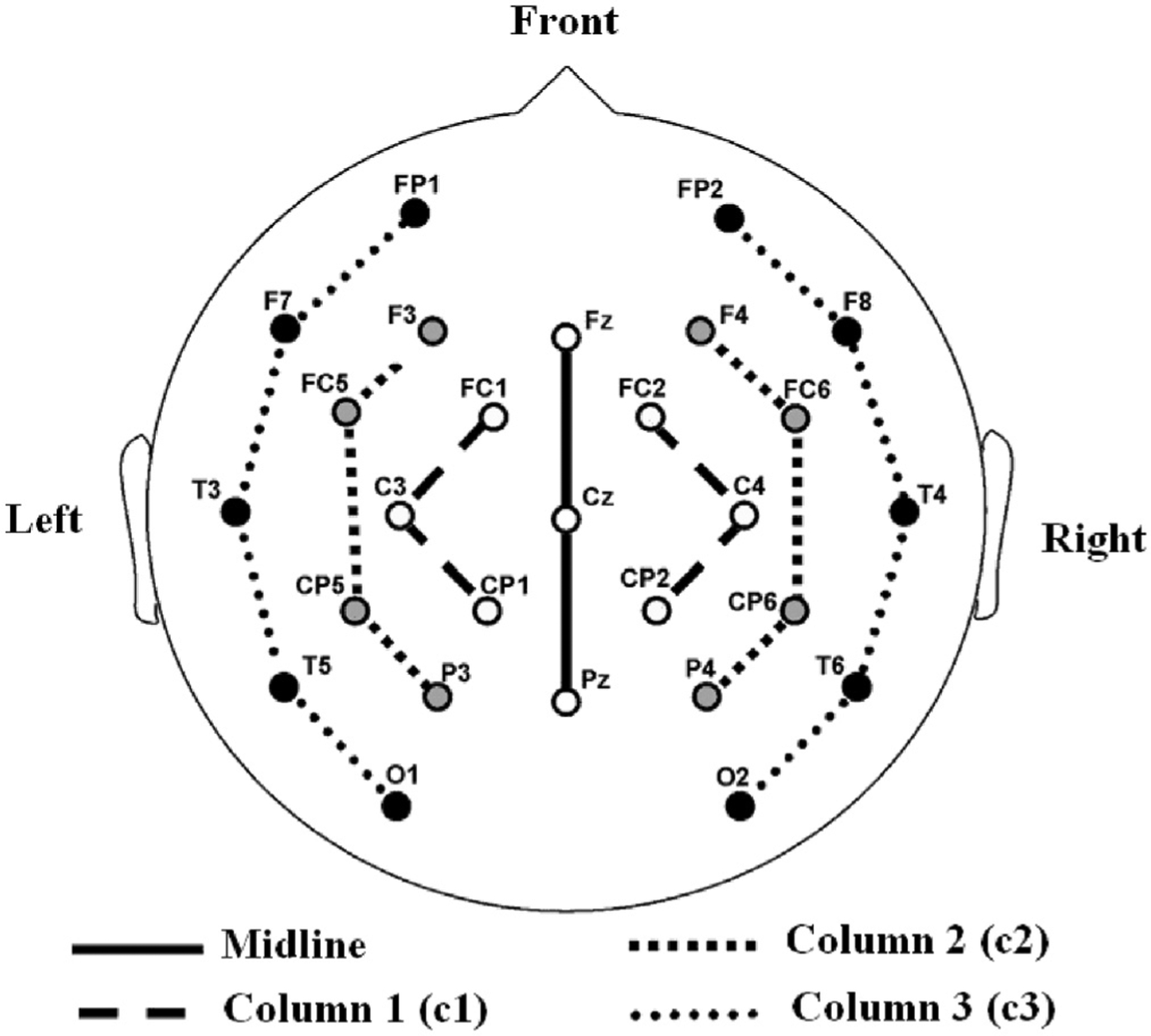
Electrode montage and analysis sites.
2.5. EEG analyses
Separate ERPs were obtained averaging critical trials for each experimental condition. Trials contaminated by muscular and/or ocular artifacts were not included in the average ERPs (9% of critical trials were rejected overall, with no statistical differences in the number of rejections across experimental conditions, F < 1). Average ERPs were then quantified by calculating the mean amplitude values in two time windows: 180–300 ms to capture pre-N400 activity, and 300–500 ms to capture the N400 itself.
Analyses of variance (ANOVAs) on the mean amplitudes were conducted for each time window on midline electrodes and on three sets of lateral columns (see Fig. 1). This columnar analysis has been successfully applied in previous language studies (Carrasco-Ortiz, Midgley, & Frenck-Mestre, 2012; Holcomb & Grainger, 2006; Midgley, Holcomb, & Grainger, 2011). Main analyses included Task (SCT vs. LDT) as a between-subject factor, and ON (low vs. high), PN (low vs. high) and electrode variables as within-subject factors. Significant interactions between ON and PN were followed up with planned contrasts of the PN variable at each level of the ON factor. For electrode variables there were three levels of anterior-posterior extent for midline site analyses (Fz vs. Cz vs. Pz) and for the three lateral columnar analyses there were either three levels (column 1 - c1: FC1/FC2 vs. C2/C4 vs. CP1/CP2); four levels (column 2 – c2: F3/F4 vs. FC5/FC6 vs. CP5/CP6 vs. P3/P4) or five levels (column 3 – c3: (Fp1/Fp2 vs. F7/F8 vs. T3/T4 vs. T5/T6 vs. O1/O2). For the latter three analyses there was also a within-subject factor of Hemisphere (left vs. right). Where appropriate, p values were adjusted using the Greenhouse-Geisser correction (Greenhouse & Geisser, 1959).
3. Results
3.1. Behavioral results
The analysis of behavioral data showed that participants correctly categorized 83% of the non-words in the lexical decision task and 81% of the animal target words in the semantic categorization task.
3.2. Visual inspection of ERPs
ERP grand mean waveforms for word targets are presented as a function of task in Fig. 3 and as a function of ON and PN comparisons in Figs. 4 and 5. Visual inspection for all ERPs revealed a negative-going deflection occurring between 100 and 150 ms (N100) followed by a positive deflection that peaked at approximately 200 ms (P200) after stimulus onset. Following these early deflections, an N400-like negativity peaking around 400 ms post-stimulus onset is observed to be modulated by task (Fig. 3) and by ON and PN density (Figs. 4 and 5).
Fig. 3.

ERP waveforms as a function of task – lexical decision (LDT) compared with semantic categorization (SCT).
Fig. 4.
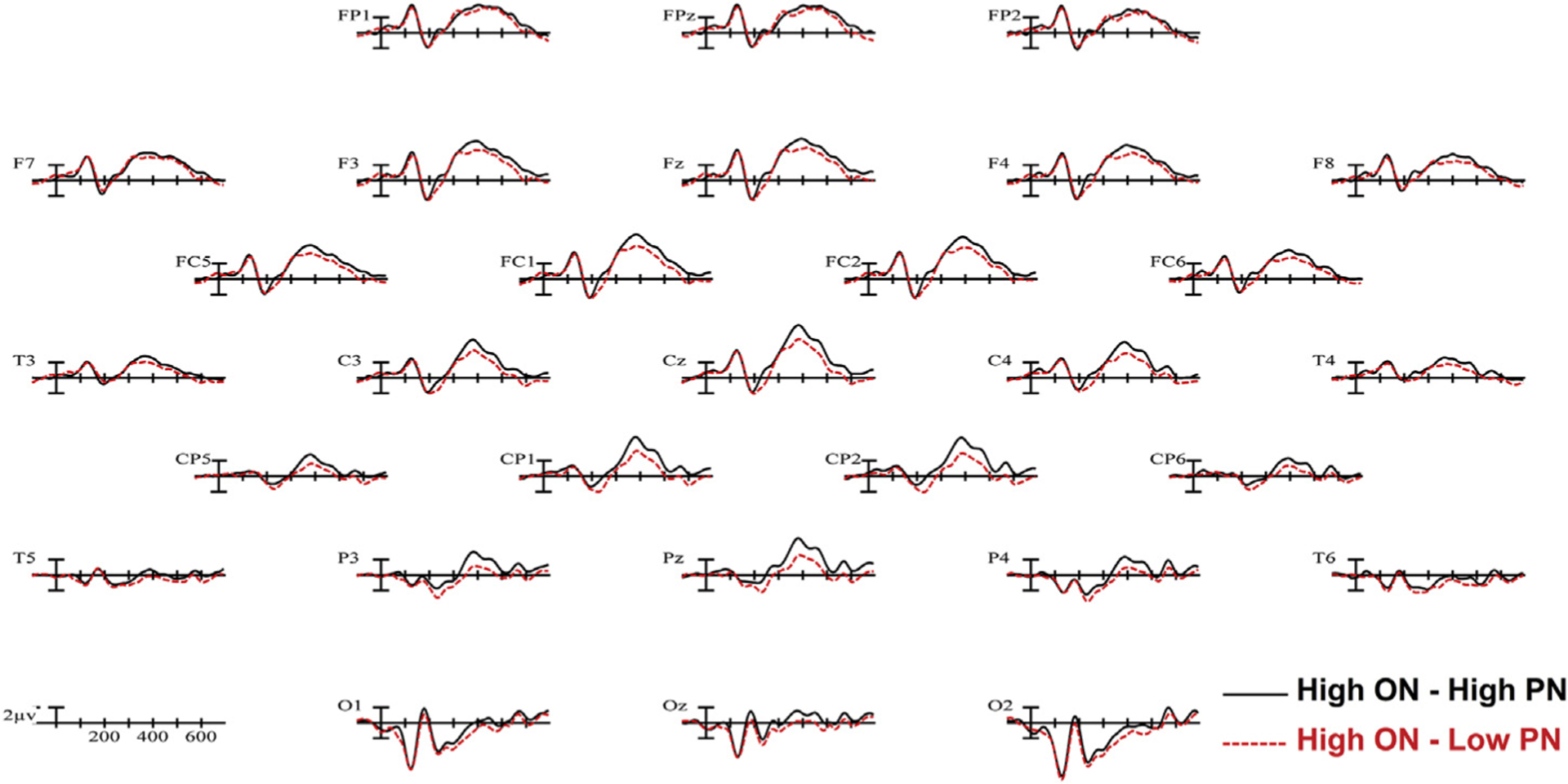
The effect of phonological neighborhood density (PN: high vs. low) on words with a high orthographic neighborhood density (high ON).
Fig. 5.

The effect of phonological neighborhood density (PN: high vs. low) on words with a low orthographic neighborhood density (low ON).
3.3. Analyses of ERP data
3.3.1. 180–300 ms epoch
Analyses between 180 and 300 ms from stimulus onset revealed differences as a function of task. Greater negativity was observed in response to words presented in the SCT compared to the same words presented in the LDT. These differences were confirmed by a significant effect of Task across much of the scalp [midline: (F (1,198) = 4.44, p < 0.03); c1: (F (1,198) = 4.97, p < 0.02); c2: (F (1,198) = 4.41, p < 0.03)]. However, the effect of Task did not interact with PN or ON density (all p values > 0.23).
The main effects of ON and PN were not significant in any of the columnar analyses (all p values > 0.26). However, there was a significant interaction between PN and ON in all four columns [midline: (F (1,198) = 11.66, p < 0.001); c1: (F (1,198) = 12.15, p < 0.001); c2: (F (1,198) = 10.9, p < 0.001); c3: (F (1,198) = 7.78, p < 0.01)]. To better characterize the source of this interaction, planned follow-up analyses contrasting high and low PN items were conducted at each level of ON density. For high ON density words, the effect of PN was significant across the scalp [midline: (F (1,199) = 9.75, p < 0.01); c1: (F (1,199) = 10.92, p < 0.01); c2: (F (1,199) = 9.00, p < 0.01); c3: (F (1,199) = 5.69, p < 0.03)] indicating that words with many phonological neighbors elicited a larger negativity compared to that elicited by words with fewer phonological neighbors. For low ON density words, the effect of PN was the inverse of that observed for high ON density words (i.e., words with many phonological neighbors elicited a smaller negativity than words with few phonological neighbors), although these effects only approached statistical significance [midline: (F (1,199) = 3.42, p < 0.06); c1: (F (1,199) = 3.04, p < 0.08); c2: (F (1,199) = 3.60, p < 0.06); c3: (F (1,199) = 3.70, p < 0.06)].
3.3.2. 300–500 ms epoch
The analyses of the mean amplitudes values corresponding to the typical time window of the N400 revealed a main effect of Task [midline: (F (1,198) = 5.65, p < 0.01); c1: (F (1,198) = 5.32, p < 0.02); c2: (F (1,198) = 6.84, p < 0.01); c3: (F (1,198) = 8.85, p < 0.01)]. Words in the SCT produced greater negativity than words in the LDT. However, the effect of Task did not significantly interact with any other experimental factor (all p values > 0.10).
The main effects of ON and PN were not significant at any electrode site (all p values > 0.16), although a significant interaction between PN and ON was observed across the scalp [midline: (F (1,198) = 15.58, p < 0.001); c1: (F (1,198) = 14.66, p < 0.001); c2: (F (1,198) = 12.8, p < 0.001); c3: (F (1,198) = 7.63, p < 0.01)]. Follow-up analyses were performed at each level of ON density. For high ON density words, the effect of PN was significant in all four electrode columnar analyses [midline: (F (1,199) = 9.28, p < 0.01); c1: (F (1,199) = 10.07, p < 0.01); c2: (F (1,199) = 7.95, p < 0.01); c3: (F (1,199) = 4.23, p < 0.04)] and indicated that words with many phonological neighbors produced larger negativities than words with few phonological neighbors. For low ON density words, the opposite pattern of PN was observed [midline: (F (1,199) = 5.87, p < 0.01); c1: (F (1,199) = 4.42, p < 0.03); and c2: (F (1,199) = 4.76, p < 0.03; c3: (F (1,199) = 3.45, p < 0.06) indicating that words with many phonological neighbors elicited smaller negativities compared to words with few phonological neighbors.
4. Discussion
In the present study we examined the effects of phonological and orthographic neighborhood density on visual word recognition, with an aim to better specify the neural underpinnings of the interactive effects of these two variables seen in prior behavioral research (Grainger et al., 2005). In line with the behavioral results we found a significant interaction between orthographic and phonological neighborhood density. When words had a large number of orthographic neighbors then increasing the size of their phonological neighborhood caused an increase in N400 amplitude. On the other hand, when words had few orthographic neighbors then the largest N400 amplitude was found on words with a low phonological neighborhood density. In line with Grainger et al.’s (2005) cross-code consistency account of interactions between orthographic and phonological neighborhood, the present results suggest that it is not the overall number of neighbors that determines N400 amplitude, but rather the consistency in the spellings and the pronunciations across these neighbors. N400 amplitude is greater with a higher level of cross-code consistency in the orthographic and phonological neighborhood.
This pattern of results therefore suggests that it is not difficulty in processing words due to competition from co-activated neighbors that is the primary factor determining neighborhood effects on N400 amplitude, but rather the overall strength of lexical and semantic activity generated during processing of the target word. Here we suggest that strength of lexical and semantic activity is determined by cross-code consistency, with greater levels of resonant activity arising when the consistency is high. Words with similar numbers of orthographic and phonological neighbors have more consistent spellings and pronunciations across the neighborhood, and therefore generate greater resonance across simultaneously activated orthographic and phonological representations. Words with differing numbers of orthographic and phonological neighbors (i.e., high orthographic & low phonological, or low orthographic & high phonological) have less consistent spellings and pronunciations across the neighborhood, and therefore generate more dissonant activity in orthographic and phonological representations. We therefore propose that it is the amount of resonant activity across co-activated orthographic and phonological representations that is one main factor determining N400 amplitude in the present study. This extends our previous proposal that it is resonant feedback across different levels of representation, rather than feed-forward activity alone, that determines the amplitude of the ERP components modulated by masked priming (Grainger & Holcomb, 2009; Holcomb & Grainger, 2006). Furthermore, there is converging evidence from other paradigms that N400 amplitude does not necessarily reflect processing difficulty. Using the masked priming paradigm, Massol, Grainger, Dufau, and Holcomb (2010) showed that although high-frequency neighbor primes did interfere with behavioral responses in a lexical decision task, they did not cause an increase in N400 amplitude relative to unrelated primes. In this light, the fact that high-frequency words generate reduced N400 amplitudes compared with low-frequency words (Smith & Halgren, 1987; Van Petten & Kutas, 1990) could be interpreted as reflecting a reduced amount of lexical activity in high-frequency words due to more efficient processing of these words. In line with this tentative account, Midgley, Holcomb, and Grainger (2009) found that words in a bilingual’s first language (L1) generated greater N400 amplitude than words in the second language (L2). This pattern can be explained by the greater lexical and semantic activity generated by L1 words compared with L2 words, arising as a result of the richer connectivity of the L1 network.
The pattern of neighborhood effects observed in the present study did not interact with task. There was, however, a main effect of task (see Fig. 3), with the semantic categorization task generating larger N400 amplitudes than the lexical decision task. This is further evidence that the N400 reflects semantic-level processing, as well as processing at the level of whole-word orthographic and phonological forms. We would argue that in single word reading paradigms, as used in the present study, N400 amplitude is determined by the overall resonant activity between whole-word orthographic and phonological forms and their corresponding semantic representations. However, the same pattern of neighborhood effects was also seen in a relatively early (180–300 ms) time-window. The relatively early onset of these effects therefore points to a role for both sublexical and lexical representations, as hypothesized in the cross-code consistency account of the effects. Consistency of spellings and pronunciations also influences processing at the level of sublexical orthographic and phonological representations in the bi-modal interactive-activation model. Our At least some prior research using masked priming has suggested that such processing occurs predominantly in a time-window that roughly spans 200–300 ms (the N250) post-target onset (see Grainger & Holcomb, 2009; Holcomb & Grainger, 2006), which is in line with the early effects seen in the present study. However, whether the current early neighborhood effects are on the N250 or instead reflect activity on the rising edge of the N400 is not entirely clear. The only solid evidence for separate N250 and N400 effects has come from studies using masked priming where it has been argued that this effect appears because of the use of short interval masked priming (Grainger & Holcomb, 2009). Few single word studies without a short priming manipulation have reported clear N250 effects, so it seems prudent to remain cautious in concluding the exact component labeling of the early effects in the current study.
The present findings are in line with previous studies demonstrating that consistency between spellings and pronunciations modulates N400 amplitudes during word recognition in different languages other than English (Lee et al., 2007; Pattamadilok, Perre, & Ziegler, 2011). In a spoken word recognition study, Pattamadilok et al. (2011) found that words that have a consistent spelling-sound mapping (i.e., words composed of sounds that have only one possible spelling in French) elicited larger negativities than inconsistent words with more than one possible spelling for their constituent sounds (e.g., in English, the word “know” contains the rime “ow” that can be spelled differently in different words). These results were interpreted as reflecting the stronger activation of words with consistent sound-spelling mappings due to stronger connections between sublexical phonological and orthographic representations compared with inconsistent words. Similarly, Lee et al. (2007) reported an effect of the consistency of Chinese characters on N400 amplitude. Consistency was manipulated in terms of the pronunciation of all other characters sharing the same phonetic radical as the target word. In line with the present findings, high-consistency characters generated larger N400 amplitudes than low-consistency characters. The present results are also consistent with the fast-acting cross-modal repetition priming effects seen in prior ERP studies, whereby processing of auditorily presented target words is modulated by the prior brief presentation of visual primes (Kiyonaga, Grainger, Midgley, & Holcomb, 2007; Okano et al., 2016).
Finally, we would note that our proposal that N400 amplitude in single word reading paradigms reflects resonant activity across different types of representation (orthographic, phonological, and semantic) provides a possible solution to apparently contradictory findings. That is the fact that high-frequency words generate smaller N400 amplitudes than low-frequency words (Smith & Halgren, 1987; Van Petten & Kutas, 1990), whereas words in the first language of beginning bilinguals generate larger N400 amplitudes than words in the second language (Midgley et al., 2009). This pattern can be explained by assuming 1) that processing of high-frequency words involves fast feed-forward mechanisms that lead to word identification before feedback has had time to develop, and 2) that during language learning, feedback processes and cross-code interactions take longer to be automatized than feed-forward processes.
Acknowledgment
This research was supported by grant number HD25889 awarded to PJH. JG was supported by ERC grant 230313.
References
- Carrasco-Ortiz H, Midgley KJ, & Frenck-Mestre C (2012). Are phonological representations in bilinguals language specific? an ERP study on interlingual homophones. Psychophysiology, 49(4), 531–543. 10.1111/j.1469-8986.2011.01333.x. [DOI] [PubMed] [Google Scholar]
- Carreiras M, Perea M, & Grainger J (1997). Effects of the orthographic neighborhood in visual word recognition: Cross-task comparisons. Journal of Experimental Psychology: Learning, Memory, and Cognition, 23(4), 857–871. 10.1037/0278-7393.23.4.857. [DOI] [PubMed] [Google Scholar]
- CELEX. (1993). English database (Release E25). Available from: http://www.mpi.nl/world/celex.
- Chen H-C, Vaid J, Boas DA, & Bortfeld H (2011). Examining the phonological neighborhood density effect using near infrared spectroscopy. Human brain mapping, 32(9), 1363–1370. 10.1002/hbm.21115. [DOI] [PMC free article] [PubMed] [Google Scholar]
- Coltheart M, Davelaar E, Jonasson J, & Besner D (1977). Access to the internal lexicon. In Dornic En S. (Ed.), Attention and performance VI (pp. 535–555). Hillsdale, NJ: Lawrence Erlbaum Associates. Recuperado a partir de. http://www.maccs.mq.edu.au/~max/cv/#four. [Google Scholar]
- Diependaele K, Ziegler JC, & Grainger J (2010). Fast phonology and the bimodal interactive activation model. European Journal of Cognitive Psychology, 22(5), 764–778. 10.1080/09541440902834782. [DOI] [Google Scholar]
- Dufau S, Grainger J, Midgley KJ, & Holcomb PJ (2015). A thousand words are worth a picture snapshots of printed-word processing in an event-related potential megastudy. Psychological Science, 26(12), 1887–1897, 0956797615603934 10.1177/0956797615603934. [DOI] [PMC free article] [PubMed] [Google Scholar]
- Ferrand L, & Grainger J (1992). Phonology and orthography in visual word recognition: Evidence from masked non-word priming. The Quarterly Journal of Experimental Psychology. A, Human Experimental Psychology, 45(3), 353–372. [DOI] [PubMed] [Google Scholar]
- Ferrand L, & Grainger J (1993). The time-course of orthographic and phonological code activation in the early phases of visual word recognition. Bulletin of the Psychonomic Society, 31(2), 119–122. [Google Scholar]
- Ferrand L, & Grainger J (1994). Effects of orthography are independent of phonology in masked form priming. The Quarterly Journal of Experimental Psychology. A, Human Experimental Psychology, 47(2), 365–382. [DOI] [PubMed] [Google Scholar]
- Forster KI, & Shen D (1996). No enemies in the neighborhood: Absence of inhibitory neighborhood effects in lexical decision and semantic categorization. Journal of Experimental Psychology: Learning, Memory, and Cognition, 22(3), 696–713. 10.1037/0278-7393.22.3.696. [DOI] [PubMed] [Google Scholar]
- Grainger, & Ferrand L(1994). Phonology and orthography in visual word Recognition: Effects of masked homophone primes. Journal of Memory and Language, 33(2), 218–233. 10.1006/jmla.1994.1011. [DOI] [Google Scholar]
- Grainger J, & Holcomb PJ (2009). Watching the word go by: On the time-course of component processes in visual word recognition. Language and Linguistics Compass, 3(1), 128–156. 10.1111/j.1749-818X.2008.00121.x. [DOI] [PMC free article] [PubMed] [Google Scholar]
- Grainger J, & Jacobs AM (1996). Orthographic processing in visual word recognition: A multiple read-out model. Psychological Review, 103(3), 518–565. [DOI] [PubMed] [Google Scholar]
- Grainger, Kiyonaga K, & Holcomb PJ (2006). The time course of orthographic and phonological code activation. Psychological science, 17(12), 1021–1026. 10.1111/j.1467-9280.2006.01821.x. [DOI] [PMC free article] [PubMed] [Google Scholar]
- Grainger J, Muneaux M, Farioli F, & Ziegler JC (2005). Effects of phonological and orthographic neighborhood density interact in visual word recognition. The Quarterly Journal of Experimental Psychology, 58A(6), 981–998. [DOI] [PubMed] [Google Scholar]
- Grainger J, & Ziegler JC (2008). Cross-code consistency in a functional architecture for word recognition. In Grigorenko En E. L., & Naples AJ(Eds.), Single-word Reading: Behavioral and biological perspectives (pp. 129–157). Mahwah, NJ: Lawrence Erlbaum Associates. [Google Scholar]
- Greenhouse SW, & Geisser S (1959). On methods in the analysis of profile data. Psychometrika, 24(2), 95–112. 10.1007/BF02289823. [DOI] [Google Scholar]
- Holcomb PJ, & Grainger J (2006). On the time course of visual word Recognition: An event-related potential investigation using masked repetition priming. Journal of cognitive neuroscience, 18(10), 1631–1643. 10.1162/jocn.2006.18.10.1631. [DOI] [PMC free article] [PubMed] [Google Scholar]
- Holcomb PJ, Grainger J, & O’Rourke T (2002). An electrophysiological study of the effects of orthographic neighborhood size on printed word perception. Journal of Cognitive Neuroscience, 14(6), 938–950. 10.1162/089892902760191153. [DOI] [PubMed] [Google Scholar]
- Jacobs AM, & Grainger J (1992). Testing a semistochastic variant of the interactive activation model in different word recognition experiments. Journal of Experimental Psychology: Human Perception and Performance, 18(4), 1174–1188. 10.1037/0096-1523.18.4.1174. [DOI] [PubMed] [Google Scholar]
- Kiyonaga K, Grainger J, Midgley K, & Holcomb PJ (2007). Masked cross-modal repetition Priming: An event-related potential investigation. Language and cognitive processes, 22(3), 337–376. 10.1080/01690960600652471. [DOI] [PMC free article] [PubMed] [Google Scholar]
- Kutas M, & Federmeier KD (2000). Electrophysiology reveals semantic memory use in language comprehension. Trends in Cognitive Sciences, 4(12), 463–470. 10.1016/S1364-6613(00)01560-6. [DOI] [PubMed] [Google Scholar]
- Kutas M, & Hillyard SA (1980). Reading between the lines: Event-related brain potentials during natural sentence processing. Brain and Language, 11(2), 354–373. [DOI] [PubMed] [Google Scholar]
- Kutas M, & Hillyard SA (1984). Brain potentials during reading reflect word expectancy and semantic association. Nature, 307(5947), 161–163. [DOI] [PubMed] [Google Scholar]
- Laszlo S, & Federmeier KD (2009). A beautiful day in the Neighborhood: An event-related potential study of lexical relationships and prediction in context. Journal of memory and language, 61(3), 326–338. 10.1016/j.jml.2009.06.004. [DOI] [PMC free article] [PubMed] [Google Scholar]
- Lee C-Y, Tsai J-L, Chan W-H, Hsu C-H, Hung DL, & Tzeng OJL (2007). Temporal dynamics of the consistency effect in reading chinese: An event-related potentials study. Neuroreport, 18(2), 147–151. 10.1097/WNR.0b013e328010d4e4. [DOI] [PubMed] [Google Scholar]
- Massol S, Grainger J, Dufau S, & Holcomb P (2010). Masked priming from orthographic Neighbors: An ERP investigation. Journal of Experimental Psychology: Human Perception and Performance, 36(1), 162–174. 10.1037/a0017614. [DOI] [PubMed] [Google Scholar]
- McClelland JL, & Rumelhart DE (1981). An interactive activation model of context effects in letter perception: Part 1. An account of basic findings. Psychological Review, 88(5), 375–407. [PubMed] [Google Scholar]
- Midgley KJ, Holcomb PJ, & Grainger J (2009). Language effects in second language learners and proficient bilinguals investigated with event-related potentials. Journal of Neurolinguistics, 22, 281–300. [DOI] [PMC free article] [PubMed] [Google Scholar]
- Midgley KJ, Holcomb PJ, & Grainger J (2011). Effects of cognate status on word comprehension in second language Learners: An ERP investigation. Journal of Cognitive Neuroscience, 23(7), 1634–1647. 10.1162/jocn.2010.21463. [DOI] [PMC free article] [PubMed] [Google Scholar]
- Midgley KJ, Holcomb PJ, van Heuven WJB, & Grainger J (2008). An electrophysiological investigation of cross-language effects of orthographic neighborhood. Brain Research, 1246, 123–135. 10.1016/j.brainres.2008.09.078. [DOI] [PMC free article] [PubMed] [Google Scholar]
- Müller O, Duñabeitia JA, & Carreiras M (2010). Orthographic and associative neighborhood density effects: What is shared, what is different? Psychophysiology, 47(3), 455–466. 10.1111/j.1469-8986.2009.00960.x. [DOI] [PubMed] [Google Scholar]
- Okano K, Grainger J, & Holcomb PJ (2016). Rapid modulation of spoken word recognition by visual primes. Journal of Neurolinguistics, 37, 58–67. 10.1016/j.jneuroling.2015.09.002. [DOI] [PMC free article] [PubMed] [Google Scholar]
- Pattamadilok C, Perre L, & Ziegler JC (2011). Beyond rhyme or reason: ERPs reveal task-specific activation of orthography on spoken language. Brain and Language, 116(3), 116–124. 10.1016/j.bandl.2010.12.002. [DOI] [PubMed] [Google Scholar]
- Rastle K, & Brysbaert M (2006). Masked Phonological Priming Effects in English: Are They Real? Do They Matter? Cognitive Psychology, 53(2), 97–145. 10.1016/j.cogpsych.2006.01.002. [DOI] [PubMed] [Google Scholar]
- Sears CR, Lupker SJ, & Hino Y (1999). Orthographic neighborhood effects in perceptual identification and semantic categorization tasks: A test of the multiple read-out model. Perception & Psychophysics, 61(8), 1537–1554. 10.3758/BF03213116. [DOI] [PubMed] [Google Scholar]
- Seidenberg MS, & McClelland JL (1989). A distributed, developmental model of word recognition and naming. Psychological Review, 96(4), 523–568. [DOI] [PubMed] [Google Scholar]
- Smith ME, & Halgren E (1987). Event-related potentials during lexical decision: Effects of repetition, word frequency, pronounce-ability, and concreteness. Electroencephalography and clinical neurophysiology, 40, 417–421. [PubMed] [Google Scholar]
- Stone GO, Vanhoy M, & Orden GCV (1997). Perception is a two-way Street: Feedforward and feedback phonology in visual word recognition. Journal of Memory and Language, 36(3), 337–359. 10.1006/jmla.1996.2487. [DOI] [Google Scholar]
- Van Petten C, & Kutas M (1990). Interactions between sentence context and word frequency in event-related brain potentials. Memory & Cognition, 18(4), 380–393. [DOI] [PubMed] [Google Scholar]
- Vergara-Martínez M, & Swaab TY (2012). Orthographic neighborhood effects as a function of word frequency: An event-related potential study. Psychophysiology, 49(9), 1277–1289. 10.1111/j.1469-8986.2012.01410.x. [DOI] [PMC free article] [PubMed] [Google Scholar]
- Yarkoni T, Balota D, & Yap M (2008). Moving beyond Coltheart’s N: A new measure of orthographic similarity. Psychonomic Bulletin & Review, 15(5), 971–979. 10.3758/PBR.15.5.971. [DOI] [PubMed] [Google Scholar]
- Yates M (2005). Phonological neighbors speed visual word processing: Evidence from multiple tasks. Journal of Experimental Psychology. Learning, Memory, and Cognition, 31(6), 1385–1397. 10.1037/0278-7393.31.6.1385. [DOI] [PubMed] [Google Scholar]
- Yates M, Locker L, & Simpson GB (2004). The influence of phonological neighborhood on visual word perception. Psychonomic Bulletin & Review, 11(3), 452–457. [DOI] [PubMed] [Google Scholar]
- Ziegler JC, Ferrand L, Jacobs AM, Rey A, & Grainger J (2000). Visual and phonological codes in letter and word recognition: Evidence from incremental priming. The Quarterly Journal Of Experimental Psychology. A Human Experimental Psychology, 53(3), 671–692. 10.1080/713755906. [DOI] [PubMed] [Google Scholar]
- Ziegler JC, Montant M, & Jacobs AM (1997). The feedback consistency effect in lexical decision and naming. Journal of Memory and Language, 37(4), 533–554. 10.1006/jmla.1997.2525. [DOI] [Google Scholar]
- Ziegler JC, Petrova A, & Ferrand L (2008). Feedback consistency effects in visual and auditory word recognition: Where do we stand after more than a decade? Journal of Experimental Psychology. Learning, Memory, and Cognition, 34(3), 643–661. 10.1037/0278-7393.34.3.643. [DOI] [PubMed] [Google Scholar]