



Summary
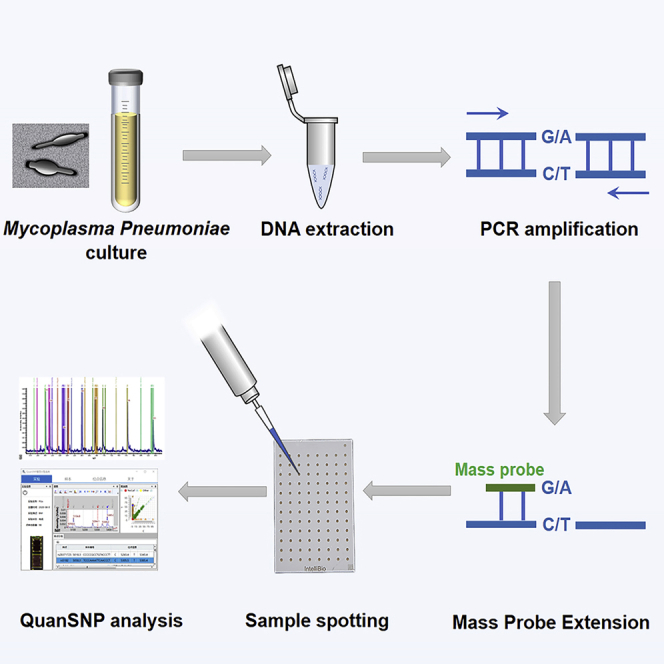
In this study, a multisite SNP genotyping and macrolide (ML) susceptibility gene test method for Mycoplasma pneumoniae (M. pneumoniae) was developed based on matrix-assisted laser desorption/ionization time-of-flight mass spectrometry (MALDI-TOF MS). The detection limit of this method for nucleic acids was 102 -103 copies/reaction. Six SNP site-based genotyping and 3 ML susceptibility sites could be detected simultaneously based on multiplex PCR and mass probe. Using the method constructed in this study, 141 Chinese clinical isolates were divided into 8 SNP types. All the SNP test results for the ML susceptibility gene were in line with those of the 23S rRNA sequencing results. With this method, the multisite SNP genotyping and ML susceptibility determination of M. pneumoniae can be completed simultaneously in one test, which greatly reduces the workload and cost, improves the genotyping ability of M. pneumoniae and deserves clinical application.
Subject areas: Microbiology, Microbial Genetics, Biotechnology
Graphical abstract
Highlights
-
•
An all-in-one genotyping and macrolide resistance testing method for M. pneumoniae
-
•
Multisite SNP detection technology was used for genotyping and resistance testing
-
•
The cost of M. pneumoniae genotyping and macrolide resistance detection was reduced
Microbiology;Microbial Genetics; Biotechnology
Introduction
Mycoplasma pneumoniae (M. pneumoniae), an important pathogenic bacterium of respiratory tract infection in children and adults, is responsible for approximately 10%–30% of community-acquired pneumonia (Jacobs et al., 2015; Loens et al., 2010). There has been epidemic spread of M. pneumoniae in many European and Asian countries since 2010 (Blystad et al., 2012; Chalker et al., 2011; Gadsby et al., 2012; Lenglet et al., 2012; Linde et al., 2012; Uldum et al., 2012). Generally, the prognosis of M. pneumoniae is good, with only a few pediatric cases progressing to refractory Mycoplasma pneumoniae pneumonia (RMPP) or severe Mycoplasma pneumoniae pneumonia (SMPP), resulting in severe complications and poor prognosis (Liu et al., 2018; Okumura et al., 2019). To date, macrolides (MLs) have been recommended as the first-line agent for treating clinical infection of M. pneumoniae infections, especially in children (Waites et al., 2009, 2017).
In the past two decades, the proportion of ML susceptibility in M. pneumoniae (MRMP) has shown an increasing trend, especially in Japan and the Republic of Korea (Hong et al., 2013; Kawai et al., 2013). In mainland China, the ML susceptibility ratio of M. pneumoniae is still high to some extent (Cao et al., 2010; Liu et al., 2009; Qu et al., 2013; Xin et al., 2009;Zhao et al., 2012).Studies have shown that the ML resistance mechanism of M. pneumoniae is very fixed and only closely related to 23S rRNA point mutations. The ML susceptibility of M. pneumoniae is closely related to the 23S rRNA mutation, among which the mutations at the 2063 and 2064 positions are correlated with high ML susceptibility (>64 μg/mL for erythromycin) and the mutation at the 2617 position is correlated with low ML susceptibility (Pereyre et al., 2016). Therefore, gene detection based on these mutation sites may serve as an alternative to antimicrobial susceptibility testing of M. pneumonia in vitro. To date, the most common methods of detecting ML resistant of M. pneumoniae strains include real-time PCR-HRM, PCR-RFLP, and pyrosequencing assays (Liu et al., 2014; Matsuoka et al., 2004; Nummi et al., 2015; Peuchant et al., 2009; Spuesens et al., 2010; Wolff et al., 2008).
Genotyping is an important method for studying the molecular biology and epidemiologic features of M. pneumoniae. There may be a close relationship between the transformation of M. pneumoniae genotypes in the population and the epidemics of M. pneumoniae, and genotyping is also an important technique for tracing the origin of M. pneumoniae local outbreaks. The M. pneumoniae genome is highly conserved, with a sequence similarity of up to 99% among strains. Based on single nucleotide polymorphisms (SNPs) and indels, two main subgroups of M. pneumoniae, genotype I and genotype II, can be clearly differentiated (Lluch-Senar et al., 2015; Xiao et al., 2015). Currently, the most common genotyping techniques for these two genotypes are based mainly on PCR-RFLP genotyping of the p1 gene (Dorigo-Zetsma et al., 2000), VNTR of the pl gene, and real-time PCR of the MPN459/MPNA5864 gene (Zhao et al., 2015). These techniques are easy to perform, but the discrimination ability is not adequate due to the presence of a single target site. Specifically, multiple-locus variable-number tandem-repeat analysis (MLVA) (Degrange et al., 2009) and multilocus sequence typing (MLST) (Brown et al., 2015) contribute to the genotyping of M. pneumoniae. However, these genotyping procedures are time-consuming and technically demanding, which hampers their applications. Both genotyping analysis and ML susceptibility nucleic acid testing for M. pneumoniae involve complicated procedures, and it is necessary to develop new methods that are rapid and inexpensive.
Matrix-assisted laser desorption/ionization time-of-flight mass spectrometry (MALDI-TOF MS) has been utilized for detecting SNPs in recent decades. Multiplex PCR is used to amplify the genes containing the targets of SNPs. Subsequently, an extension mass probe has been utilized for the extension of SNP sites. Finally, MALDI-TOF MS is performed to identify the mass-to-charge ratio (m/z) of extended mass probes. Recently, MALDI-TOF MS has been commonly used in microbiological detection and analysis, and is considered a new gold standard for the identification of many kinds of microorganisms (Jang and Kim, 2018;Kostrzewa, 2018;Rahi et al., 2016). To date, SNP genotyping based on MALDI-TOF MS has been frequently conducted for the screening of hand-foot-and-mouth disease virus, hepatitis B virus (HBV) detection, and the human papillomavirus (HPV) genotyping and serves as an effective alternative to conventional techniques (Peng et al., 2013a, 2013b;Sjoholm et al., 2008). SNP analysis based on MALDI-TOF MS features high throughput, rapid detection, and simultaneous detection of multiple targets. Therefore, it is one of the most promising biomolecular techniques.
In this study, multiplex PCR coupled with MALDI-TOF MS (PCR-MALDI-TOF MS) was used to genotype and detect the antimicrobial susceptibility of M. pneumoniae.
Results
MALDI-TOF MS-based method establishment and optimization
Multiplex PCR coupled with MALDI-TOF MS assay was utilized to automate the detection of the nine SNPs and avoid sequencing the gene fragments. To avoid the formation of a dimer between the probes at the 23S rRNA2063 and 23S rRNA2064 sites, the quality probe at the 2064 site was designed at the reverse complementary strand. Therefore, the SNP of this site was the basis of the complementary strand (Table 1, Figure 1). MALDI-TOF MS-based amplification and identification were performed on 10 epidemiologically unrelated M. pneumoniae strains. Six SNP genotyping sites and three ML susceptibility gene sites were detected, and no MS peak was observed in the blank control. There was complete consistency between the MS SNP results of three ML susceptibility sites and the sequencing results of the strains. Among the 10 strains, there were 6 SNP types (0, 1, 3, 11, 15 and 32). Six odd number SNP types were classified into genotype I, and 4 even number SNP types were classified into genotype II (Table 2) . For example, there were 9 MS peaks for M129 in Figure 1A, representing 6 SNP typing mass probes and 3 ML susceptibility mass probes. The dotted line of the same color represents the mass spectrum peak for various mass probes extending the same base pairs in the SNP sites. The peak value represents the m/z of the MPE after extension. After multiplex PCR amplification and MPE probes extension for M129, the peak of the spectrum is shown in Figure 1B. The red arrow represents the quality value of the nine MPE probes after SNP site extension. The optimized concentration of each extension primer in the primer mixture was 6.9 μM (MPN1141461), 7.1μM (MPN3721112), 7.7μM (23S rRNA2063), 8.0μM (MPN21347), 8.6μM (MPN2801641), 9.2μM (23S rRNA2617), 9.5μM (MPN126470), 10.4μM (MPN262192), and 11.2μM (23S rRNA2064).
Table 1.
Primer sequences for M. pneumoniae SNP typing and susceptibility target site amplification and MPE probes for SNP detection
| Target gene | SNP | Multiple-PCR |
Mass probe extension |
|||||||||||
|---|---|---|---|---|---|---|---|---|---|---|---|---|---|---|
| Forward primer sequence | Reverse primer sequence | Mass probe sequence | Mass probe mass (Da) | Extension call | Extended mass (Da) | Extension call | Extended mass (Da) | Extension call | Extended mass (Da) | Extension call | Extended mass (Da) | |||
| GENOTYPING | MPN1141461 | C/T | acgttggatgCA CCGAGTGTC TTCGTCCTT |
acgttggatgG GTTGACCCC ACTACCCTTT |
CCCTTTTGC GCTAACCG |
5097.4 | C | 5410.4 | T | 5394.4 | ||||
| MPN126470 | C/T | acgttggatgAA ATTCCCCGT AATCCGAGA |
acgttggatgGC CTTCTGCTTGT TAGGTAGATG |
AGTGATTT AACGTTCC ATTTTC |
6690.4 | C | 6963.4 | T | 7032.4 | |||||
| MPN21347 | G/T | acgttggatgA TCAGTCGCT GGTACTGTGG |
acgttggatgGC TGTGCTTTTG GCAACTTA |
TACTACCACC GCAGTTGTT |
5738.8 | G | 6011.8 | T | 6035.8 | |||||
| MPN262192 | C/T | acgttggatgAC CACTTAGAG CCGGAACAA |
acgttggatgTT GCTGAAACTG ACCATCCA |
GCCCAATT TAGTCTTAT TTTGGAT |
7323.8 | C | 7636.8 | T | 7620.8 | |||||
| MPN2801641 | G/T | acgttggatgCTC AATTAAACGCG GTTTGG |
acgttggatgC GGTTGAAATC AACGGGTTA |
TTCCAAAT GAAGTAAG ACAC |
6118.0 | G | 6391.0 | T | 6415.0 | |||||
| MPN3721112 | G/T | acgttggatgAGTG TTAGCGCGGTT AATGC |
acgttggatgTC GTGTTGTGAA CCACCACT |
AATGACAC CGCAAGACA |
5181.4 | T | 5523.4 | G | 5494.4 | |||||
| ML DETECTION | 23S rRNA2063 | A/T/C/G | acgttggatgCCA GGTACGGGTG AAGACAC |
acgttggatgA TTCCACCTTT CGCATCAAC |
TTAGGCGCA ACGGGACGG |
5589.6 | G | 5902.6 | A | 5886.6 | C | 5862.6 | T | 5931.6 |
| a23S rRNA2064 | A/T/C/G | acgttggatgCC AGGTACGGGTG AAGACAC |
acgttggatgA TTCCACCTTTC GCATCAAC |
AGCTACAGT AAAGCTTCA CGGGGTCT |
7995.2 | T | 8337.2 | C | 8268.2 | G | 8308.2 | A | 8292.2 | |
| 23S rRNA2617 | A/T/C/G | acgttggatgGC TGTTCGCCGA TTAAAGAG |
acgttggatgG CGCTACAACT GGAGCATAA |
CCGTCGT GAGACAGG TTGGTC |
6478.2 | C | 6751.2 | G | 6791.2 | A | 6775.2 | T | 6820.2 | |
The MPE extension probe for the SNP of 23S rRNA2064 was the reverse complementary strand, which detected the complementary bases for the SNP.
Figure 1.

MS peak of the MPE probes
(A) MS peaks of 9 MPE probes without extension;
(B) SNP peak of the 9 MPE probes extended with M. pneumoniae M129.
Table 2.
Characteristics of the ten M. pneumoniae clinical isolates and strains selected for method establishment
| Strain/Isolate | Year of isolation | Susceptibility to macrolides | Sequence 23S rRNA mutation | P1 gene type | MLVA | Geographical origin | SNP typing | ML SNP 23S rRNA mutation | Reference |
|---|---|---|---|---|---|---|---|---|---|
| M129(ATCC29342) | 1969 | S | None | 1 | 4572 | USA | SNP1 | None | Himmelreich et al. (1996) |
| FH(ATCC15531) | 1954 | S | None | 2 | 3562 | Boston, USA | SNP0 | None | Xiao et al. (2015) |
| ICDC SY15-11 | 2012 | S | None | 1 | 4572 | Beijng, China | SNP11 | None | Zhao et al., 2013b |
| ICDC P028 | 2008 | S | None | 2 | 3562 | Beijng, China | SNP32 | None | Zhao et al., 2013b |
| ICDC 21075 | 2016 | S | None | 2 | 3572 | Beijng, China | SNP0 | None | Zhao et al. (2019a) |
| ICDC AH-012 | 2017 | R | A2063G | 1 | 4572 | Fuyang, China | SNP11 | A2063G | Zhao et al. (2019b) |
| ICDC SD14-08 | 2017 | R | A2063G | 2 | 3562 | Jinan, China | SNP0 | A2063G | Zhao et al. (2019b) |
| ICDC SL066 | 2018 | R | A2064G | 1 | 4572 | Jilin, China | SNP3 | A2064G | Zhao et al. (2019b) |
| ICDC JSSZ031 | 2018 | R | A2063G | 1 | 4573 | Soochow, China | SNP15 | A2063G | Zhao et al. (2019b) |
| ICDC W081 | 2019 | R | A2063T | 1 | 4573 | Weihai, China | SNP15 | A2063T | This study |
Specificity and detection limit of PCR-MALDI-TOF MS
There was no extension signal on the quality probe for the nucleic acids from the 20 non-M. pneumoniae pathogens, yielding a specificity of 100%. In addition, the nucleic acids of M. pneumoniae M129 strains subjected to 10-fold dilution (100-105copies/μl) were utilized for the validation of LDL, using 1 μL template. In the presence of an M. pneumoniae load of 103-105copies/reaction, all the nine SNP sites could be accurately identified after two tests. In the presence of a load of 102 copies/reaction, 23S rRNA2617 site could be accurately examined only once, while there was no MS peak in the other test. For MPN262, there was no MS peak after two tests, and no signals were noticed in the MS peak in the blank control (Figure 2). The detection limit of the nucleic acid derived from the M. pneumoniae strains was in the range of 102-103copies/reaction.
Figure 2.

Detection of 9 SNP sites in the presence of different nucleic acid from M. pneumoniae based on the PCR-MALDI-TOF MS method
The test was performed twice for each concentration. a-g: of a concentration range of 105-100copies/μL and the blank control.
Nucleic acid detection of M. pneumoniae isolates
The genotyping and ML susceptibility of the nucleic acids from 141 M. pneumoniae isolates were evaluated using this method. The genotyping and ML susceptibility results are shown in Table 3. For the ML susceptibility sites, 106 were confirmed with the A2063G mutation, 3 with the A2064T mutation, 1 with the A2063T mutation, and 31 with no mutations. The MS findings were consistent with previous sequencing results and drug sensitivity tests. SNP genotyping indicated that there were eight genotypes for the 141 isolates, namely, SNP0, 1, 3, 11, 15, 26, 32, and 27. The 109 strains of genotype I showed an odd number SNP genotype (1, 3, 11, 15, 17), among which SNP 11, 15, and 27 were the major types. Thirty-two genotype II strains showed an even number SNP genotype (0, 26, 32), among which SNP32 was the major type. There were large variations in the number and proportion of the SNP genotypes in the M. pneumoniae isolates (Table 4).
Table 3.
Genotyping and macrolide susceptibility results of M. pneumoniae strains used in this study
| Isolates name | City | year of isolation | MLVA type | Genotype | Nucleotide of SNP |
SNP1-6 to digital string | SNP type | SNP (odd/even) | 23S rRNA SNP |
|||||||
|---|---|---|---|---|---|---|---|---|---|---|---|---|---|---|---|---|
| SNP1 |
SNP2 |
SNP3 |
SNP4 |
SNP5 |
SNP6 |
2063 |
2064 |
2617 |
||||||||
| aMPN1141461 | MPN126470 | MPN21347 | MPN262192 | MPN2801641 | MPN3721112 | 23S rRNA2063 | 23S rRNA2064 | 23S rRNA2617 | ||||||||
| ICDC SD14-02 | Jinan | 2017 | 3562 | II | C | C | G | C | G | G | 000000 | 0 | even | A | A | C |
| ICDC SD14-07 | Jinan | 2017 | 3562 | II | C | C | G | C | G | G | 000000 | 0 | even | A | A | C |
| ICDC SD14-09 | Jinan | 2017 | 3562 | II | C | C | G | C | G | G | 000000 | 0 | even | A | A | C |
| ICDC SD14-26 | Jinan | 2017 | 3562 | II | C | C | G | C | G | G | 000000 | 0 | even | A | A | C |
| ICDC SD14-50 | Jinan | 2018 | 3662 | II | C | C | G | C | G | G | 000000 | 0 | even | G | A | C |
| ICDC SD14-58 | Jinan | 2018 | 3562 | II | C | C | G | C | G | G | 000000 | 0 | even | A | A | C |
| ICDC SD14-61 | Jinan | 2018 | 3562 | II | C | C | G | C | G | G | 000000 | 0 | even | G | A | C |
| ICDC SD14-69 | Jinan | 2018 | 3562 | II | C | C | G | C | G | G | 000000 | 0 | even | A | A | C |
| ICDC SD14-77 | Jinan | 2018 | 3562 | II | C | C | G | C | G | G | 000000 | 0 | even | A | A | C |
| ICDC SD14-13 | Jinan | 2017 | 3562 | II | C | T | T | C | T | G | 011010 | 26 | even | A | A | C |
| ICDC SD14-91 | Jinan | 2018 | 3562 | II | C | T | T | C | T | G | 011010 | 26 | even | A | A | C |
| ICDC SD14-03 | Jinan | 2017 | 4572 | I | C | C | G | C | T | T | 000011 | 3 | odd | A | G | C |
| ICDC SD14-01 | Jinan | 2017 | 4572 | I | C | C | T | C | T | T | 001011 | 11 | odd | G | A | C |
| ICDC SD14-06 | Jinan | 2017 | 4572 | I | C | C | T | C | T | T | 001011 | 11 | odd | G | A | C |
| ICDC SD14-22 | Jinan | 2017 | 4572 | I | C | C | T | C | T | T | 001011 | 11 | odd | G | A | C |
| ICDC SD14-23 | Jinan | 2017 | 4572 | I | C | C | T | C | T | T | 001011 | 11 | odd | G | A | C |
| ICDC SD14-37 | Jinan | 2018 | 4572 | I | C | C | T | C | T | T | 001011 | 11 | odd | G | A | C |
| ICDC SD14-88 | Jinan | 2018 | 4572 | I | C | C | T | C | T | T | 001011 | 11 | odd | A | A | C |
| ICDC SD14-45 | Jinan | 2018 | 4572 | I | C | C | T | T | T | T | 001111 | 15 | odd | G | A | C |
| ICDC SD14-14 | Jinan | 2017 | 4572 | I | C | T | T | C | T | T | 011011 | 27 | odd | G | A | C |
| ICDC SD14-25 | Jinan | 2017 | 4572 | I | C | T | T | C | T | T | 011011 | 27 | odd | G | A | C |
| ICDC SL002 | Jilin | 2017 | 4572 | I | C | T | T | C | T | T | 011011 | 27 | odd | G | A | C |
| ICDC SL008 | Jilin | 2017 | 4572 | I | C | T | T | C | T | T | 011011 | 27 | odd | G | A | C |
| ICDC SL011 | Jilin | 2017 | 4572 | I | C | T | T | C | T | T | 011011 | 27 | odd | G | A | C |
| ICDC SL019 | Jilin | 2017 | 4572 | I | C | T | T | C | T | T | 011011 | 27 | odd | G | A | C |
| ICDC SL033 | Jilin | 2018 | 4572 | I | C | C | G | C | T | T | 000011 | 3 | odd | G | A | C |
| ICDC SL037 | Jilin | 2018 | 4572 | I | C | T | T | C | T | T | 011011 | 27 | odd | G | A | C |
| ICDC SL044 | Jilin | 2018 | 4572 | I | C | T | T | C | T | T | 011011 | 27 | odd | G | A | C |
| ICDC SL061 | Jilin | 2018 | 4573 | I | C | T | T | C | T | T | 011011 | 27 | odd | G | A | C |
| ICDC SL066 | Jilin | 2018 | 4572 | I | C | T | T | C | T | T | 011011 | 27 | odd | G | A | C |
| ICDC SL069 | Jilin | 2018 | 4572 | I | C | T | T | C | T | T | 011011 | 27 | odd | G | A | C |
| ICDC SL075 | Jilin | 2018 | 4572 | I | C | C | T | T | T | T | 001111 | 15 | odd | G | A | C |
| ICDC SL083 | Jilin | 2018 | 4572 | I | C | C | T | T | T | T | 001111 | 15 | odd | G | A | C |
| ICDC SL087 | Jilin | 2018 | 4572 | I | C | T | T | C | T | T | 011011 | 27 | odd | G | A | C |
| ICDC SL091 | Jilin | 2018 | 4572 | I | C | T | T | C | T | T | 011011 | 27 | odd | G | A | C |
| ICDC SL093 | Jilin | 2018 | 4572 | I | C | T | T | C | T | T | 011011 | 27 | odd | G | A | C |
| ICDC SL121 | Jilin | 2018 | 4572 | I | C | T | T | C | T | T | 011011 | 27 | odd | G | A | C |
| ICDC SL134 | Jilin | 2018 | 4572 | I | C | T | T | C | T | T | 011011 | 27 | odd | G | A | C |
| ICDC SL144 | Jilin | 2018 | 4572 | I | C | T | T | C | T | T | 011011 | 27 | odd | G | A | C |
| ICDC SL145 | Jilin | 2018 | 4572 | I | C | C | T | C | T | T | 001011 | 11 | odd | G | A | C |
| ICDC SL181 | Jilin | 2018 | 4572 | I | C | T | T | C | T | T | 011011 | 27 | odd | G | A | C |
| ICDC SL182 | Jilin | 2018 | 4572 | I | C | T | T | C | T | T | 011011 | 27 | odd | G | A | C |
| ICDC SL199 | Jilin | 2018 | 4572 | I | C | C | T | T | T | T | 001111 | 15 | odd | G | A | C |
| ICDC SL200 | Jilin | 2018 | 4572 | I | C | T | T | C | T | T | 011011 | 27 | odd | G | A | C |
| ICDC SL251 | Jilin | 2018 | 4572 | I | C | C | T | T | T | T | 001111 | 15 | odd | G | A | C |
| ICDC SL266 | Jilin | 2018 | 4572 | I | C | C | T | C | T | T | 001011 | 11 | odd | G | A | C |
| ICDC SL277 | Jilin | 2018 | 4472 | I | C | T | T | C | T | T | 011011 | 27 | odd | G | A | C |
| ICDC SL281 | Jilin | 2018 | 4572 | I | C | C | T | T | T | T | 001111 | 15 | odd | G | A | C |
| ICDC SL288 | Jilin | 2018 | 4572 | I | C | C | T | C | T | T | 001011 | 11 | odd | G | A | C |
| ICDC SL309 | Jilin | 2018 | 4572 | I | C | C | T | T | T | T | 001111 | 15 | odd | G | A | C |
| ICDC SL331 | Jilin | 2018 | 4572 | I | C | C | T | T | T | T | 001111 | 15 | odd | G | A | C |
| ICDC BCH001 | Beijing | 2017 | 3562 | II | C | C | G | C | G | G | 000000 | 0 | even | A | A | C |
| ICDC BCH077 | Beijing | 2017 | 3562 | II | C | C | G | C | G | G | 000000 | 0 | even | A | A | C |
| ICDC BCH336 | Beijing | 2018 | 3562 | II | C | C | G | C | G | G | 000000 | 0 | even | G | A | C |
| ICDC BCH423 | Beijing | 2018 | 3562 | II | C | C | G | C | G | G | 000000 | 0 | even | A | A | C |
| ICDC BCH437 | Beijing | 2018 | 3562 | II | C | C | G | C | G | G | 000000 | 0 | even | A | A | C |
| ICDC BCH443 | Beijing | 2018 | 3562 | II | C | C | G | C | G | G | 000000 | 0 | even | A | A | C |
| ICDC BCH118 | Beijing | 2017 | 3562 | II | C | T | T | C | T | G | 011010 | 26 | even | A | A | C |
| ICDC BCH023 | Beijing | 2017 | 4572 | I | C | C | T | C | T | T | 001011 | 11 | odd | G | A | C |
| ICDC BCH031 | Beijing | 2017 | 4572 | I | C | C | T | C | T | T | 001011 | 11 | odd | G | A | C |
| ICDC BCH039 | Beijing | 2017 | 4572 | I | C | C | T | C | T | T | 001011 | 11 | odd | G | A | C |
| ICDC BCH145 | Beijing | 2018 | 4572 | I | C | C | T | C | T | T | 001011 | 11 | odd | G | A | C |
| ICDC BCH331 | Beijing | 2018 | 4572 | I | C | C | T | T | T | T | 001111 | 15 | odd | G | A | C |
| ICDC BCH012 | Beijing | 2017 | 4572 | I | C | C | T | T | T | T | 001111 | 15 | odd | G | A | C |
| ICDC BCH057 | Beijing | 2017 | 4572 | I | C | C | T | T | T | T | 001111 | 15 | odd | G | A | C |
| ICDC BCH112 | Beijing | 2017 | 4572 | I | C | C | T | T | T | T | 001111 | 15 | odd | G | A | C |
| ICDC BCH120 | Beijing | 2017 | 4573 | I | C | C | T | T | T | T | 001111 | 15 | odd | G | A | C |
| ICDC BCH133 | Beijing | 2018 | 4572 | I | C | C | T | T | T | T | 001111 | 15 | odd | G | A | C |
| ICDC BCH178 | Beijing | 2018 | 4572 | I | C | C | T | T | T | T | 001111 | 15 | odd | G | A | C |
| ICDC BCH215 | Beijing | 2018 | 4572 | I | C | C | T | T | T | T | 001111 | 15 | odd | G | A | C |
| ICDC BCH281 | Beijing | 2018 | 4472 | I | C | C | T | T | T | T | 001111 | 15 | odd | G | A | C |
| ICDC BCH399 | Beijing | 2018 | 4572 | I | C | C | T | T | T | T | 001111 | 15 | odd | G | A | C |
| ICDC BCH451 | Beijing | 2018 | 4572 | I | C | C | T | T | T | T | 001111 | 15 | odd | G | A | C |
| ICDC BCH008 | Beijing | 2017 | 4572 | I | C | T | T | C | T | T | 011011 | 27 | odd | G | A | C |
| ICDC BCH016 | Beijing | 2017 | 4572 | I | C | T | T | C | T | T | 011011 | 27 | odd | G | A | C |
| ICDC BCH019 | Beijing | 2017 | 4572 | I | C | T | T | C | T | T | 011011 | 27 | odd | G | A | C |
| ICDC BCH022 | Beijing | 2017 | 4572 | I | C | T | T | C | T | T | 011011 | 27 | odd | A | A | C |
| ICDC BCH090 | Beijing | 2017 | 4572 | I | C | T | T | C | T | T | 011011 | 27 | odd | G | A | C |
| ICDC BCH264 | Beijing | 2018 | 4572 | I | C | T | T | C | T | T | 011011 | 27 | odd | G | A | C |
| ICDC BCH271 | Beijing | 2018 | 4572 | I | C | T | T | C | T | T | 011011 | 27 | odd | G | A | C |
| ICDC BCH412 | Beijing | 2018 | 4572 | I | C | T | T | C | T | T | 011011 | 27 | odd | G | A | C |
| ICDC U016 | Beijing | 2008 | 3562 | II | C | C | G | C | G | G | 000000 | 0 | even | A | A | C |
| ICDC U098 | Beijing | 2008 | 3562 | II | C | C | G | C | G | G | 000000 | 0 | even | A | A | C |
| ICDC 12013 | Beijing | 2012 | 3562 | II | C | C | G | C | G | G | 000000 | 0 | even | A | A | C |
| ICDC 21055 | Beijing | 2012 | 3562 | II | C | C | G | C | G | G | 000000 | 0 | even | A | A | C |
| ICDC 21077 | Beijing | 2012 | 3562 | II | C | C | G | C | G | G | 000000 | 0 | even | A | A | C |
| ICDC 21109 | Beijing | 2013 | 3562 | II | C | C | G | C | G | G | 000000 | 0 | even | A | G | C |
| ICDC B117 | Beijing | 2013 | 3562 | II | C | C | G | C | G | G | 000000 | 0 | even | G | A | C |
| ICDC P0118 | Beijing | 2008 | 3562 | II | T | C | G | C | G | G | 100000 | 32 | even | A | A | C |
| ICDC P033 | Beijing | 2008 | 3562 | II | T | C | G | C | G | G | 100000 | 32 | even | A | A | C |
| ICDC P054 | Beijing | 2008 | 3562 | II | T | C | G | C | G | G | 100000 | 32 | even | A | A | C |
| ICDC 21010 | Beijing | 2012 | 4572 | I | C | C | G | C | G | T | 000001 | 1 | odd | G | A | C |
| ICDC SR15-22 | Beijing | 2015 | 4472 | I | C | C | G | C | G | T | 000001 | 1 | odd | G | A | C |
| ICDC U014 | Beijing | 2008 | 4572 | I | C | C | G | C | T | T | 000011 | 3 | odd | G | A | C |
| ICDC P396 | Beijing | 2009 | 4572 | I | C | C | G | C | T | T | 000011 | 3 | odd | G | A | C |
| ICDC 21001 | Beijing | 2012 | 4572 | I | C | C | T | C | T | T | 001011 | 11 | odd | G | A | C |
| ICDC 12066 | Beijing | 2013 | 4572 | I | C | C | T | C | T | T | 001011 | 11 | odd | T | A | C |
| ICDC B271 | Beijing | 2013 | 4572 | I | C | C | T | C | T | T | 001011 | 11 | odd | G | A | C |
| ICDC SY15-77 | Beijing | 2015 | 4572 | I | C | C | T | T | T | T | 001111 | 15 | odd | A | G | C |
| ICDC P005 | Beijing | 2008 | 4572 | I | C | C | T | T | T | T | 001111 | 15 | odd | A | A | C |
| ICDC 12075 | Beijing | 2013 | 4572 | I | C | C | T | T | T | T | 001111 | 15 | odd | A | A | C |
| ICDC B023 | Beijing | 2013 | 4572 | I | C | C | T | T | T | T | 001111 | 15 | odd | G | A | C |
| ICDC B370 | Beijing | 2013 | 4572 | I | C | C | T | T | T | T | 001111 | 15 | odd | G | A | C |
| ICDC B385 | Beijing | 2014 | 4572 | I | C | C | T | T | T | T | 001111 | 15 | odd | G | A | C |
| ICDC P135 | Beijing | 2008 | 4573 | I | C | T | T | C | T | T | 011011 | 27 | odd | G | A | C |
| ICDC 10577 | Beijing | 2012 | 4572 | I | C | T | T | C | T | T | 011011 | 27 | odd | G | A | C |
| ICDC 12038 | Beijing | 2012 | 4572 | I | C | T | T | C | T | T | 011011 | 27 | odd | G | A | C |
| ICDC 21000 | Beijing | 2012 | 4573 | I | C | T | T | C | T | T | 011011 | 27 | odd | G | A | C |
| ICDC 21114 | Beijing | 2013 | 4572 | I | C | T | T | C | T | T | 011011 | 27 | odd | G | A | C |
| ICDC B429 | Beijing | 2014 | 4572 | I | C | T | T | C | T | T | 011011 | 27 | odd | G | A | C |
| ICDC B434 | Beijing | 2014 | 4572 | I | C | T | T | C | T | T | 011011 | 27 | odd | G | A | C |
| ICDC JSSZ002 | Soochow | 2017 | 3562 | II | C | C | G | C | G | G | 000000 | 0 | even | A | A | C |
| ICDC JSSZ012 | Soochow | 2017 | 3562 | II | C | C | G | C | G | G | 000000 | 0 | even | A | A | C |
| ICDC JSSZ023 | Soochow | 2017 | 4572 | I | C | C | G | C | T | T | 000011 | 3 | odd | G | A | C |
| ICDC JSSZ038 | Soochow | 2017 | 4572 | I | C | C | G | C | T | T | 000011 | 3 | odd | G | A | C |
| ICDC JSSZ007 | Soochow | 2017 | 4572 | I | C | C | T | C | T | T | 001011 | 11 | odd | G | A | C |
| ICDC JSSZ010 | Soochow | 2017 | 4572 | I | C | C | T | C | T | T | 001011 | 11 | odd | G | A | C |
| ICDC JSSZ024 | Soochow | 2017 | 4572 | I | C | C | T | C | T | T | 001011 | 11 | odd | G | A | C |
| ICDC JSSZ028 | Soochow | 2017 | 4572 | I | C | C | T | C | T | T | 001011 | 11 | odd | G | A | C |
| ICDC JSSZ037 | Soochow | 2017 | 4572 | I | C | C | T | C | T | T | 001011 | 11 | odd | G | A | C |
| ICDC JSSZ041 | Soochow | 2017 | 4572 | I | C | C | T | C | T | T | 001011 | 11 | odd | G | A | C |
| ICDC JSSZ046 | Soochow | 2017 | 4572 | I | C | C | T | C | T | T | 001011 | 11 | odd | G | A | C |
| ICDC JSSZ047 | Soochow | 2017 | 4572 | I | C | C | T | C | T | T | 001011 | 11 | odd | G | A | C |
| ICDC JSSZ048 | Soochow | 2017 | 4572 | I | C | C | T | C | T | T | 001011 | 11 | odd | G | A | C |
| ICDC JSSZ051 | Soochow | 2017 | 4572 | I | C | C | T | C | T | T | 001011 | 11 | odd | G | A | C |
| ICDC JSSZ055 | Soochow | 2017 | 4573 | I | C | C | T | C | T | T | 001011 | 11 | odd | G | A | C |
| ICDC JSSZ064 | Soochow | 2017 | 4572 | I | C | C | T | C | T | T | 001011 | 11 | odd | G | A | C |
| ICDC JSSZ072 | Soochow | 2018 | 4572 | I | C | C | T | C | T | T | 001011 | 11 | odd | G | A | C |
| ICDC JSSZ078 | Soochow | 2018 | 4572 | I | C | C | T | C | T | T | 001011 | 11 | odd | G | A | C |
| ICDC JSSZ033 | Soochow | 2017 | 4572 | I | C | C | T | T | T | T | 001111 | 15 | odd | G | A | C |
| ICDC JSSZ067 | Soochow | 2018 | 4572 | I | C | C | T | T | T | T | 001111 | 15 | odd | G | A | C |
| ICDC JSSZ071 | Soochow | 2018 | 4572 | I | C | C | T | T | T | T | 001111 | 15 | odd | G | A | C |
| ICDC JSSZ073 | Soochow | 2018 | 4572 | I | C | C | T | T | T | T | 001111 | 15 | odd | G | A | C |
| ICDC JSSZ077 | Soochow | 2018 | 4572 | I | C | C | T | T | T | T | 001111 | 15 | odd | G | A | C |
| ICDC AH-001 | Fuyang | 2018 | 3562 | II | C | C | G | C | G | G | 000000 | 0 | even | A | A | C |
| ICDC AH-014 | Fuyang | 2018 | 3562 | II | C | C | G | C | G | G | 000000 | 0 | even | A | A | C |
| ICDC AH-007 | Fuyang | 2018 | 4572 | I | C | C | G | C | T | T | 000011 | 3 | odd | G | A | C |
| ICDC AH-004 | Fuyang | 2018 | 4572 | I | C | C | T | C | T | T | 001011 | 11 | odd | G | A | C |
| ICDC AH-006 | Fuyang | 2018 | 4572 | I | C | C | T | C | T | T | 001011 | 11 | odd | G | A | C |
| ICDC AH-008 | Fuyang | 2018 | 4472 | I | C | C | T | C | T | T | 001011 | 11 | odd | G | A | C |
| ICDC AH-010 | Fuyang | 2018 | 4572 | I | C | C | T | C | T | T | 001011 | 11 | odd | G | A | C |
The result information for columns 1–5 in the table comes from reference Zhao et al. (2013a), 2013b, Zhao et al. (2019b).
ATCC29342 (GenBank: U00089.2) was used as reference. The number after MPN is the gene number, and the superscript number indicates the position of SNP in the gene.
Table 4.
SNP genotyping of 141 Chinese M. pneumoniae isolates, macrolide susceptibility test results, and mimic genotyping of 79 international M. pneumoniae
| Year | No | Genotype 1 |
Genotype 2 |
23S rRNA |
||||||||||
|---|---|---|---|---|---|---|---|---|---|---|---|---|---|---|
| SNP1 | SNP3 | SNP11 | SNP15 | SNP27 | SNP0 | SNP26 | SNP32 | A2063G | A3064G | A2063T | None | |||
| Beijing, China | 2008–2012 | 30 | 2 | 2 | 3 | 6 | 7 | 7 | 0 | 3 | 17 | 2 | 1 | 10 |
| Beijing, China | 2017–2018 | 30 | 0 | 0 | 4 | 11 | 8 | 6 | 1 | 0 | 23 | 0 | 0 | 7 |
| Soochow, China | 2017–2018 | 23 | 0 | 2 | 14 | 5 | 0 | 2 | 0 | 0 | 21 | 0 | 0 | 2 |
| Jinan, China | 2017–2018 | 21 | 0 | 1 | 6 | 1 | 2 | 9 | 2 | 0 | 10 | 1 | 0 | 10 |
| Jilin, China | 2017–2018 | 30 | 0 | 1 | 3 | 7 | 19 | 0 | 0 | 0 | 30 | 0 | 0 | 0 |
| Fuyang, China | 2017–2018 | 7 | 0 | 1 | 4 | 0 | 0 | 2 | 0 | 0 | 5 | 0 | 0 | 2 |
| Total | 2008–2018 | 141 | 2 | 7 | 34 | 30 | 36 | 26 | 3 | 3 | 106 | 3 | 1 | 31 |
| International strains | – | 79 | 14 | 17 | 4 | 7 | 7 | 30 | 0 | 0 | – | – | – | – |
Detailed information on each M. pneumoniae strain is shown inTable 3.
Mimic SNP genotyping of international M. pneumoniae strains
There were 6 genotypes, namely, SNP 0,1,3,11,15 and 27, among the genomes of 79 international M. pneumoniae strains with sequences in the NCBI databases. There were 30 strains with SNP 0 genotypes, including AP012303.1, AP017318.1, AP017319.1, CP002077.1, CP010539.1, CP010540.1, CP010546.1, CP010547.1, CP010548.1, CP010549.1, CP010550.1, CP010551.1, CP017327.1, CP017329.1, CP017334.1, CP017335.1, CP017336.1, CP017337.1, CP017338.1, CP017339.1, CP017340.1, CP017341.1, CP017342.1, CP039761.1, CP039772.1, CP039775.1, CP039777.1, CP039781.1, CP039784.1, and LR214945.1. There were 14 SNP 1 genotype including CP003913.2, CP017330.1, CP017343.1, CP020689.1, CP020690.1, CP020691.1, CP020692.1, CP020693.1, CP020710.1, CP020711.1, CP020712.1, CP039787.1, CP039790.1, and U00089.2. There were 17 SNP 3 genotype including CP008895.1, CP010538.1, CP010541.1, CP010542.1, CP010543.1, CP010544.1, CP010545.1, CP017328.1, CP017331.1, CP017332.1, CP017333.1, CP039776.1, CP039779.1, CP039782.1, CP039783.1, CP039785.1, and CP039788.1. There were 4 SNP11 genotypes (i.e. CP013829.1, CP014267.1, CP039773.1, and CP039780.1). There were 7 SNP16 genotypes (CP039762.1, CP039763.1, CP039764.1, CP039765.1, CP039766.1, CP039767.1, and CP039769.1) and 7 SNP27 genotype (CP039768.1, CP039770.1, CP039771.1, CP039774.1, CP039778.1, CP039786.1, and CP039789.1). Among these genotypes, all the odd number SNP genotypes were genotype I, with SNP1 and SNP3 as the major types, and all the even number SNP genotypes were genotype II. Compared with the Chinese strains, the international strains lacked the genotypes SNP26 and SNP32 (Table 4).
Detection results for the nucleic acid positive clinical specimens of M. pneumoniae
Our assay was performed directly on clinical specimens using an increase in the template volume (5 μL) and PCR volume (20 μL). Among the 30 M. pneumoniae nucleic acid positive clinical specimens, 9 SNP sites were detected in 25 isolates (83.3%). The detection limit of the clinical specimens was 5.2×10² copies/reaction. In addition, the genotype and ML susceptibility results in the 25 isolates were consistent with the detection of M. pneumoniae. For the remaining 5 specimens, incomplete SNP profiles were obtained. On this basis, complete data interpretation could not be given.
Discussion
With the increased accessibility to markers through high-throughput whole-genome sequencing (WGS), SNP analysis is increasingly useful for evaluating drug susceptibility, evolution, and molecular epidemiology (Kuglik et al., 2014; Lipworth et al., 2019). To date, the single or small proportion of SNP site detection mainly relies on the first-generation sequencing technique or TaqMAN probe-based real-time PCR detection. For the analysis of multiple SNP sites that are extensively distributed, the WGS technique is the preferred option. However, these techniques are not adequate in the detection of more than tens or dozens of SNP sites. The MS technique facilitates these two SNP-based techniques. Multiplex PCR and the single base pair extension technique have proven to be superior in detecting more than ten SNP sites and are extensively utilized in the genotyping and identification of multiple microorganisms(Jang and Kim, 2018; Kostrzewa, 2018; Peng et al., 2013a, 2013b;Rahi et al., 2016;Sjoholm et al., 2008).
To date, there is still a lack of efficiency regarding genotyping techniques for M. pneumoniae compared with other pathogens. Currently, the most commonly utilized methods are based on the genotyping technique for the two genotypes. These methods are easy to perform, but their application in tracing pathogenic bacteria is hampered due to insufficient discriminatory capacity. In 2009, Degrange et al. established an MLVA genotyping technique using 5 VNTR sites, which divided M. pneumoniae into dozens of MLVA genotypes. However, the classification ability of this method is still limited in practical applications (Benitez et al., 2012;Degrange et al., 2009;Dumke and Jacobs, 2011;Kubota et al., 2015;Pereyre et al., 2013;Qu et al., 2013; Waller et al., 2014;Xue et al., 2014;Yan et al., 2014;Zhao et al., 2013a, 2013b). In 2015, Brown et al. (Brown et al., 2015) established a genotyping technique of MLST. MLST improves the typing ability to a certain extent, but such a technique is not extensively utilized, as it is technically demanding and expensive. In addition, there is a necessity for data uploading. In the same year, Touati et al. developed SNaPshot minisequencing technology based on the single base extension of a specially designed minisequencing primer, which promoted the discrimination of M. pneumoniae. However, the cost was still high, even though it was less than that presented in a previous study (4.2 Euro) (Touati et al., 2015). In this study, 6 SNP genotyping sites, which were derived from 1434 SNPs (Table S1) screened from 20 M. pneumoniae clinical isolates, were utilized as the targets. In addition, all three sites associated with ML susceptibility were included, and then MS-based amplification was established that could simultaneously accomplish M. pneumoniae genotyping of multiple sites and ML susceptibility analysis, which could test 96 samples simultaneously within 6 hr based on PCR amplification and extension (4.5 hr) and MS analysis (0.5 hr). The cost for MS was only 1.0 RMB (approximately 0.1 Euro), which was far less than that reported by Touati (Touati et al., 2015) Meanwhile, our method could provide more data on the ML susceptibility gene based on genotyping. To the best of our knowledge, this method provides the highest throughput for the M. pneumoniae genotyping and ML susceptibility gene testing and involves less time and expenditure than the current methods.
The selected SNP site, MPN3721112 (G1112T), was closely related to the two genotypes of M. pneumoniae, with T and G for genotype I and genotype II, respectively. According to the data interpretation standard, stains with an even number SNP genotype were classified into genotype II, while those with an odd number SNP genotype were classified into genotype I (Table S2). The SNP genotyping of the 141 Chinese isolates showed complete consistency, among which 109 genotype I strains showed an odd number SNP genotype and the 32 genotype II strains showed an even number SNP genotype. Moreover, for the 79 international strains, genome sequencing was consistent with the above rules (Table 3). This indicated that our method could improve the discriminatory capacity and present the genotyping traits of the two conventional genotypes of M. pneumoniae. For the detection of ML susceptibility sites of 23S rRNA2063, 23S rRNA2064 and 23S rRNA20617, 106 isolates showed A2063G, 3 showed A2064G, 1 showenA2063T, and 31 showed no mutations at the 2063/2064 sites. SNP ML susceptibility findings were consistent with the strain sequencing and ML sensitivity test findings (Table 3). The SNP genotyping results indicated that there were 4–7 SNP genotypes in the five selected cities (Table 4). There were differences in the SNP genotypes in different regions between 2017 and 2018. Specifically, SNP27 was the predominant type in Jilin City in northern China, while SNP14 was found in Suzhou in southern China, SNP15 in Beijing in central China, and SNP0 in Jinan in the mid-eastern part of China. The differences in SNP types for the same region in different years were relatively small. For instance, the genotype I M. pneumoniae strains between 2008 and 2012 as well as 2017 and 2018 in Beijing were predominantly of the SNP15 and SNP27 types, while for genotype II, SNP0 was the predominant type. For the 79 international strains, there were 6 SNP genotypes, among which 49 genotype I M. pneumoniae strains showed an odd number SNP type and 30 genotype II M. pneumoniae strains showed an even number SNP type. The international strains with an odd number SNP type were predominantly SNP1 and SNP3, while those of the Chinese strains were SNP11, SNP15, and SNP27, yielding a large variance. This further confirmed the discriminatory capacity of our method.
In addition to genotyping and the ML susceptibility test with pure culture M. pneumoniae nucleic acids, our method could be utilized for the analysis of nucleic acids derived from clinical specimens. The detection limit of the clinical specimens was 5.2×10² copies/reaction, which was relatively consistent with that of nucleic acids isolated from the purified M. pneumoniae strains (102-103copies/reaction). The detection limit was on the same order of magnitude (102 copies/reaction), which was similar to that of the multiplex PCR. The genotyping and ML susceptibility positive rate of the 30 clinical isolates with nucleic acid load after real-time PCR was 83.3%. This implied that our method contributed to the genotyping of the clinical isolates and the ML susceptibility test, which was appropriate for the rapid genotyping of M. pneumoniae with a slow growth and rapid detection of ML susceptibility.
In this study, we developed a multiplex PCR coupled with the MALDI-TOF MS method for the multisite genotyping and ML susceptibility gene testing of M. pneumoniae. The method was easy to perform with a high specificity and a low cost as well as a high throughput. Multisite genotyping and ML susceptibility gene testing could be accomplished simultaneously, with a strong discriminatory capacity for strains of genotype I and genotype II. The analysis of the ML susceptibility site was comprehensive and accurate and deserves clinical application. Meanwhile, the PCR-MALDI-TOF MS technique could meet the demands of various regimens, which may contribute to the microbial identification, genotyping, and drug susceptibility testing.
Limitations of the study
The sensitivity of the method constructed in this study is limited by the detection limit of multiplex PCR technology.
Resource availability
Lead contact
Further information and requests for resources should be directed to and will be fulfilled by the Lead Contact, Prof. Di Xiao, xiaodi@icdc.cn.
Material availability
This study did not generate nor use any new or unique reagents.
Data and code availability
The raw data of MALDI-TOF MS of all the samples used in this study are available on the project homepage at https://dx.doi.org/10.17632/b8pnzp2y6c.1.
Methods
All methods can be found in the accompanying Transparent methods supplemental file.
Acknowledgments
This study was funded by the National Natural Science Foundation of China (Grant No. 81772154), and The Major Infectious Diseases Such as AIDS and Viral Hepatitis Prevention and Control Technology Major Projects (Grant No. 2018ZX10712001&2018ZX10733402).
Author contributions
Z.F. and X.D. conceived and managed the project, analyzed the data, and wrote the manuscript. Z.J.Z searched the literature. W.X.M. acquired the MS data. L.L.Y. and G.J. operated the experiments. Z.Z.X. helped design the primers. H.L.H. and M.F.L. cultured the bacteria.
Declaration of interests
The authors declare no conflicts of interests.
Published: May 21, 2021
Footnotes
Supplemental information can be found online at https://doi.org/10.1016/j.isci.2021.102447.
Supplemental information
References
- Benitez A.J., Diaz M.H., Wolff B.J., Pimentel G., Njenga M.K., Estevez A., Winchell J.M. Multilocus variable-number tandem-repeat analysis of Mycoplasma pneumoniae clinical isolates from 1962 to the present: a retrospective study. J. Clin. Microbiol. 2012;50:3620–3626. doi: 10.1128/JCM.01755-12. [DOI] [PMC free article] [PubMed] [Google Scholar]
- Blystad H., Anestad G., Vestrheim D.F., Madsen S., Ronning K. Increased incidence of Mycoplasma pneumoniae infection in Norway 2011. Euro Surveill. 2012;17:20074. doi: 10.2807/ese.17.05.20074-en. [DOI] [PubMed] [Google Scholar]
- Brown R.J., Holden M.T., Spiller O.B., Chalker V.J. Development of a multilocus sequence typing scheme for molecular typing of mycoplasma pneumoniae. J. Clin. Microbiol. 2015;53:3195–3203. doi: 10.1128/JCM.01301-15. [DOI] [PMC free article] [PubMed] [Google Scholar]
- Cao B., Zhao C.J., Yin Y.D., Zhao F., Song S.F., Bai L., Zhang J.Z., Liu Y.M., Zhang Y.Y., Wang H., Wang C. High prevalence of macrolide resistance in Mycoplasma pneumoniae isolates from adult and adolescent patients with respiratory tract infection in China. Clin.Infect. Dis. 2010;51:189–194. doi: 10.1086/653535. [DOI] [PubMed] [Google Scholar]
- Chalker V., Stocki T., Mentasti M., Fleming D., Harrison T. Increased incidence of Mycoplasma pneumoniae infection in England and Wales in 2010: multiocus variable number tandem repeat analysis typing and macrolide susceptibility. Euro Surveill. 2011;16:19865. [PubMed] [Google Scholar]
- Degrange S., Cazanave C., Charron A., Renaudin H., Bebear C., Bebear C.M. Development of multiple-locus variable-number tandem-repeat analysis for molecular typing of Mycoplasma pneumoniae. J. Clin. Microbiol. 2009;47:914–923. doi: 10.1128/JCM.01935-08. [DOI] [PMC free article] [PubMed] [Google Scholar]
- Dorigo-Zetsma J.W., Dankert J., Zaat S.A. Genotyping of Mycoplasma pneumoniae clinical isolates reveals eight P1 subtypes within two genomic groups. J. Clin. Microbiol. 2000;38:965–970. doi: 10.1128/jcm.38.3.965-970.2000. [DOI] [PMC free article] [PubMed] [Google Scholar]
- Dumke R., Jacobs E. Culture-independent multi-locus variable-number tandem-repeat analysis (MLVA) of Mycoplasma pneumoniae. J. Microbiol.Methods. 2011;86:393–396. doi: 10.1016/j.mimet.2011.06.008. [DOI] [PubMed] [Google Scholar]
- Gadsby N.J., Reynolds A.J., McMenamin J., Gunson R.N., McDonagh S., Molyneaux P.J., Yirrell D.L., Templeton K.E. Increased reports of Mycoplasma pneumoniae from laboratories in Scotland in 2010 and 2011 - impact of the epidemic in infants. Euro Surveill. 2012;17:20110. [PubMed] [Google Scholar]
- Himmelreich R., Hilbert H., Plagens H., Pirkl E., Li B.C., Herrmann R. Complete sequence analysis of the genome of the bacterium Mycoplasma pneumoniae. Nucleic Acids Res. 1996;24:4420–4449. doi: 10.1093/nar/24.22.4420. [DOI] [PMC free article] [PubMed] [Google Scholar]
- Hong K.B., Choi E.H., Lee H.J., Lee S.Y., Cho E.Y., Choi J.H., Kang H.M., Lee J., Ahn Y.M., Kang Y.H., Lee J.H. Macrolide resistance of Mycoplasma pneumoniae, South Korea, 2000-2011. Emerg.Infect. Dis. 2013;19:1281–1284. doi: 10.3201/eid1908.121455. [DOI] [PMC free article] [PubMed] [Google Scholar]
- Jacobs E., Ehrhardt I., Dumke R. New insights in the outbreak pattern of Mycoplasma pneumoniae. Int. J. Med. Microbiol. 2015;305:705–708. doi: 10.1016/j.ijmm.2015.08.021. [DOI] [PubMed] [Google Scholar]
- Jang K.S., Kim Y.H. Rapid and robust MALDI-TOF MS techniques for microbial identification: a brief overview of their diverse applications. J. Microbiol. 2018;56:209–216. doi: 10.1007/s12275-018-7457-0. [DOI] [PubMed] [Google Scholar]
- Kawai Y., Miyashita N., Kubo M., Akaike H., Kato A., Nishizawa Y., Saito A., Kondo E., Teranishi H., Wakabayashi T. Nationwide surveillance of macrolide-resistant Mycoplasma pneumoniae infection in pediatric patients. Antimicrob. Agents Chemother. 2013;57:4046–4049. doi: 10.1128/AAC.00663-13. [DOI] [PMC free article] [PubMed] [Google Scholar]
- Kostrzewa M. Application of the MALDI Biotyper to clinical microbiology: progress and potential. Expert Rev. Proteomics. 2018;15:193–202. doi: 10.1080/14789450.2018.1438193. [DOI] [PubMed] [Google Scholar]
- Kubota H., Okuno R., Hatakeyama K., Uchitani Y., Sadamasu K., Hirai A., Kai A. Molecular typing of Mycoplasma pneumoniae isolated from pediatric patients in Tokyo, Japan. Jpn. J.Infect. Dis. 2015;68:76–78. doi: 10.7883/yoken.JJID.2014.336. [DOI] [PubMed] [Google Scholar]
- Kuglik P., Smetana J., Vallova V., Moukova L., Kasikova K., Cvanova M., Brozova L. Genome-wide screening of DNA copy number alterations in cervical carcinoma patients with CGH+SNP microarrays and HPV-FISH. Int. J. Clin. Exp. Pathol. 2014;7:5071–5082. [PMC free article] [PubMed] [Google Scholar]
- Lenglet A., Herrador Z., Magiorakos A.P., Leitmeyer K., Coulombier D., European Working Group on Mycoplasma pneumoniae S. Surveillance status and recent data for mycoplasma pneumoniae infections in the European union and European economic area, January 2012. Euro Surveill. 2012;17:20075. doi: 10.2807/ese.17.05.20075-en. [DOI] [PubMed] [Google Scholar]
- Linde A., Ternhag A., Torner A., Claesson B. Antibiotic prescriptions and laboratory-confirmed cases of Mycoplasma pneumoniae during the epidemic in Sweden in 2011. Euro Surveill. 2012;17:20082. [PubMed] [Google Scholar]
- Lipworth S., Jajou R., de Neeling A., Bradley P., van der Hoek W., Maphalala G., Bonnet M., Sanchez-Padilla E., Diel R., Niemann S. SNP-IT tool for identifying subspecies and associated lineages of Mycobacterium tuberculosis complex. Emerg.Infect. Dis. 2019;25:482–488. doi: 10.3201/eid2503.180894. [DOI] [PMC free article] [PubMed] [Google Scholar]
- Liu Y., Ye X., Zhang H., Xu X., Li W., Zhu D., Wang M. Antimicrobial susceptibility of Mycoplasma pneumoniae isolates and molecular analysis of macrolide-resistant strains from Shanghai, China. Antimicrob. Agents Chemother. 2009;53:2160–2162. doi: 10.1128/AAC.01684-08. [DOI] [PMC free article] [PubMed] [Google Scholar]
- Liu Y., Ye X., Zhang H., Wu Z., Xu X. Rapid detection of Mycoplasma pneumoniae and its macrolide-resistance mutation by Cycleave PCR. Diagn. Microbiol. Infect. Dis. 2014;78:333–337. doi: 10.1016/j.diagmicrobio.2013.12.002. [DOI] [PubMed] [Google Scholar]
- Liu T.Y., Lee W.J., Tsai C.M., Kuo K.C., Lee C.H., Hsieh K.S., Chang C.H., Su Y.T., Niu C.K., Yu H.R. Serum lactate dehydrogenase isoenzymes 4 plus 5 is a better biomarker than total lactate dehydrogenase for refractory Mycoplasma pneumoniae pneumonia in children. Pediatr.Neonatol. 2018;59:501–506. doi: 10.1016/j.pedneo.2017.12.008. [DOI] [PubMed] [Google Scholar]
- Lluch-Senar M., Cozzuto L., Cano J., Delgado J., Llorens-Rico V., Pereyre S., Bebear C., Serrano L. Comparative "-omics" in mycoplasma pneumoniae clinical isolates reveals key virulence factors. PLoS One. 2015;10:e0137354. doi: 10.1371/journal.pone.0137354. [DOI] [PMC free article] [PubMed] [Google Scholar]
- Loens K., Goossens H., Ieven M. Acute respiratory infection due to Mycoplasma pneumoniae: current status of diagnostic methods. Eur. J. Clin. Microbiol. Infect. Dis. 2010;29:1055–1069. doi: 10.1007/s10096-010-0975-2. [DOI] [PMC free article] [PubMed] [Google Scholar]
- Matsuoka M., Narita M., Okazaki N., Ohya H., Yamazaki T., Ouchi K., Suzuki I., Andoh T., Kenri T., Sasaki Y. Characterization and molecular analysis of macrolide-resistant Mycoplasma pneumoniae clinical isolates obtained in Japan. Antimicrob. Agents Chemother. 2004;48:4624–4630. doi: 10.1128/AAC.48.12.4624-4630.2004. [DOI] [PMC free article] [PubMed] [Google Scholar]
- Nummi M., Mannonen L., Puolakkainen M. Development of a multiplex real-time PCR assay for detection of Mycoplasma pneumoniae, Chlamydia pneumoniae and mutations associated with macrolide resistance in Mycoplasma pneumoniae from respiratory clinical specimens. Springerplus. 2015;4:684. doi: 10.1186/s40064-015-1457-x. [DOI] [PMC free article] [PubMed] [Google Scholar]
- Okumura T., Kawada J.I., Tanaka M., Narita K., Ishiguro T., Hirayama Y., Narahara S., Tsuji G., Sugiyama Y., Suzuki M. Comparison of high-dose and low-dose corticosteroid therapy for refractory Mycoplasma pneumoniae pneumonia in children. J.Infect. Chemother. 2019;25:346–350. doi: 10.1016/j.jiac.2019.01.003. [DOI] [PubMed] [Google Scholar]
- Peng J., Gao L., Guo J., Wang T., Wang L., Yao Q., Zhu H., Jin Q. Type-specific detection of 30 oncogenic human papillomaviruses by genotyping both E6 and L1 genes. J. Clin. Microbiol. 2013;51:402–408. doi: 10.1128/JCM.01170-12. [DOI] [PMC free article] [PubMed] [Google Scholar]
- Peng J., Yang F., Xiong Z., Guo J., Du J., Hu Y., Jin Q. Sensitive and rapid detection of viruses associated with hand foot and mouth disease using multiplexed MALDI-TOF analysis. J. Clin. Virol. 2013;56:170–174. doi: 10.1016/j.jcv.2012.10.020. [DOI] [PubMed] [Google Scholar]
- Pereyre S., Touati A., Petitjean-Lecherbonnier J., Charron A., Vabret A., Bebear C. The increased incidence of Mycoplasma pneumoniae in France in 2011 was polyclonal, mainly involving M. pneumoniae type 1 strains. Clin. Microbiol. Infect. 2013;19:E212–E217. doi: 10.1111/1469-0691.12107. [DOI] [PubMed] [Google Scholar]
- Pereyre S., Goret J., Bebear C. Mycoplasma pneumoniae: current knowledge on macrolide resistance and treatment. Front. Microbiol. 2016;7:974. doi: 10.3389/fmicb.2016.00974. [DOI] [PMC free article] [PubMed] [Google Scholar]
- Peuchant O., Menard A., Renaudin H., Morozumi M., Ubukata K., Bebear C.M., Pereyre S. Increased macrolide resistance of Mycoplasma pneumoniae in France directly detected in clinical specimens by real-time PCR and melting curve analysis. J. Antimicrob. Chemother. 2009;64:52–58. doi: 10.1093/jac/dkp160. [DOI] [PubMed] [Google Scholar]
- Qu J., Yu X., Liu Y., Yin Y., Gu L., Cao B., Wang C. Specific multilocus variable-number tandem-repeat analysis genotypes of Mycoplasma pneumoniae are associated with diseases severity and macrolide susceptibility. PLoS One. 2013;8:e82174. doi: 10.1371/journal.pone.0082174. [DOI] [PMC free article] [PubMed] [Google Scholar]
- Rahi P., Prakash O., Shouche Y.S. Matrix-assisted laser desorption/ionization time-of-flight mass-spectrometry (MALDI-TOF MS) based microbial identifications: challenges and scopes for microbial ecologists. Front. Microbiol. 2016;7:1359. doi: 10.3389/fmicb.2016.01359. [DOI] [PMC free article] [PubMed] [Google Scholar]
- Sjoholm M.I., Dillner J., Carlson J. Multiplex detection of human herpesviruses from archival specimens by using matrix-assisted laser desorption ionization-time of flight mass spectrometry. J. Clin. Microbiol. 2008;46:540–545. doi: 10.1128/JCM.01565-07. [DOI] [PMC free article] [PubMed] [Google Scholar]
- Spuesens E.B., Hoogenboezem T., Sluijter M., Hartwig N.G., van Rossum A.M., Vink C. Macrolide resistance determination and molecular typing of Mycoplasma pneumoniae by pyrosequencing. J. Microbiol.Methods. 2010;82:214–222. doi: 10.1016/j.mimet.2010.06.004. [DOI] [PubMed] [Google Scholar]
- Touati A., Blouin Y., Sirand-Pugnet P., Renaudin H., Oishi T., Vergnaud G., Bebear C., Pereyre S. Molecular epidemiology of mycoplasma pneumoniae: genotyping using single nucleotide polymorphisms and SNaPshot technology. J. Clin. Microbiol. 2015;53:3182–3194. doi: 10.1128/JCM.01156-15. [DOI] [PMC free article] [PubMed] [Google Scholar]
- Uldum S.A., Bangsborg J.M., Gahrn-Hansen B., Ljung R., Molvadgaard M., Fons Petersen R., Wiid Svarrer C. Epidemic of Mycoplasma pneumoniae infection in Denmark, 2010 and 2011. Euro Surveill. 2012;17:20073. doi: 10.2807/ese.17.05.20073-en. [DOI] [PubMed] [Google Scholar]
- Waites K.B., Crabb D.M., Duffy L.B. Comparative in vitro susceptibilities of human mycoplasmas and ureaplasmas to a new investigational ketolide, CEM-101. Antimicrob. Agents Chemother. 2009;53:2139–2141. doi: 10.1128/AAC.00090-09. [DOI] [PMC free article] [PubMed] [Google Scholar]
- Waites K.B., Xiao L., Liu Y., Balish M.F., Atkinson T.P. Mycoplasma pneumoniae from the respiratory tract and beyond. Clin.Microbiol. Rev. 2017;30:747–809. doi: 10.1128/CMR.00114-16. [DOI] [PMC free article] [PubMed] [Google Scholar]
- Waller J.L., Diaz M.H., Petrone B.L., Benitez A.J., Wolff B.J., Edison L., Tobin-D'Angelo M., Moore A., Martyn A., Dishman H. Detection and characterization of Mycoplasma pneumoniae during an outbreak of respiratory illness at a university. J. Clin. Microbiol. 2014;52:849–853. doi: 10.1128/JCM.02810-13. [DOI] [PMC free article] [PubMed] [Google Scholar]
- Wolff B.J., Thacker W.L., Schwartz S.B., Winchell J.M. Detection of macrolide resistance in Mycoplasma pneumoniae by real-time PCR and high-resolution melt analysis. Antimicrob. Agents Chemother. 2008;52:3542–3549. doi: 10.1128/AAC.00582-08. [DOI] [PMC free article] [PubMed] [Google Scholar]
- Xiao L., Ptacek T., Osborne J.D., Crabb D.M., Simmons W.L., Lefkowitz E.J., Waites K.B., Atkinson T.P., Dybvig K. Comparative genome analysis of Mycoplasma pneumoniae. BMC Genomics. 2015;16:610. doi: 10.1186/s12864-015-1801-0. [DOI] [PMC free article] [PubMed] [Google Scholar]
- Xin D., Mi Z., Han X., Qin L., Li J., Wei T., Chen X., Ma S., Hou A., Li G., Shi D. Molecular mechanisms of macrolide resistance in clinical isolates of Mycoplasma pneumoniae from China. Antimicrob. Agents Chemother. 2009;53:2158–2159. doi: 10.1128/AAC.01563-08. [DOI] [PMC free article] [PubMed] [Google Scholar]
- Xue G., Wang Q., Yan C., Jeoffreys N., Wang L., Li S., Gilbert G.L., Sun H. Molecular characterizations of PCR-positive Mycoplasma pneumoniae specimens collected from Australia and China. J. Clin. Microbiol. 2014;52:1478–1482. doi: 10.1128/JCM.03366-13. [DOI] [PMC free article] [PubMed] [Google Scholar]
- Yan C., Sun H., Xue G., Zhao H., Wang L., Feng Y., Li S. A single-tube multiple-locus variable-number tandem-repeat analysis of Mycoplasma pneumoniae clinical specimens by use of multiplex PCR-capillary electrophoresis. J. Clin. Microbiol. 2014;52:4168–4171. doi: 10.1128/JCM.02178-14. [DOI] [PMC free article] [PubMed] [Google Scholar]
- Zhao F., Lv M., Tao X., Huang H., Zhang B., Zhang Z., Zhang J. Antibiotic sensitivity of 40 Mycoplasma pneumoniae isolates and molecular analysis of macrolide-resistant isolates from Beijing, China. Antimicrob. Agents Chemother. 2012;56:1108–1109. doi: 10.1128/AAC.05627-11. [DOI] [PMC free article] [PubMed] [Google Scholar]
- Zhao F., Liu G., Cao B., Wu J., Gu Y., He L., Meng F., Zhu L., Yin Y., Lv M., Zhang J. Multiple-locus variable-number tandem-repeat analysis of 201 Mycoplasma pneumoniae isolates from Beijing, China, from 2008 to 2011. J. Clin. Microbiol. 2013;51:636–639. doi: 10.1128/JCM.02567-12. [DOI] [PMC free article] [PubMed] [Google Scholar]
- Zhao F., Liu G., Wu J., Cao B., Tao X., He L., Meng F., Zhu L., Lv M., Yin Y., Zhang J. Surveillance of macrolide-resistant mycoplasma pneumoniae in Beijing, China, from 2008 to 2012. Antimicrob. Agents Chemother. 2013;57:1521–1523. doi: 10.1128/AAC.02060-12. [DOI] [PMC free article] [PubMed] [Google Scholar]
- Zhao F., Liu L., Tao X., He L., Meng F., Zhang J. Culture-Independent detection and genotyping of mycoplasma pneumoniae in clinical specimens from Beijing, China. PLoS One. 2015;10:e0141702. doi: 10.1371/journal.pone.0141702. [DOI] [PMC free article] [PubMed] [Google Scholar]
- Zhao F., Liu J., Shi W., Huang F., Liu L., Zhao S., Zhang J. Antimicrobial susceptibility and genotyping of Mycoplasma pneumoniae isolates in Beijing, China, from 2014 to 2016. Antimicrob. Resist. Infect. Control. 2019;8:18. doi: 10.1186/s13756-019-0469-7. [DOI] [PMC free article] [PubMed] [Google Scholar]
- Zhao F., Li J., Liu J., Guan X., Gong J., Liu L., He L., Meng F., Zhang J. Antimicrobial susceptibility and molecular characteristics of Mycoplasma pneumoniae isolates across different regions of China. Antimicrob. Resist. Infect. Control. 2019;8:143. doi: 10.1186/s13756-019-0576-5. [DOI] [PMC free article] [PubMed] [Google Scholar]
Associated Data
This section collects any data citations, data availability statements, or supplementary materials included in this article.
Supplementary Materials
Data Availability Statement
The raw data of MALDI-TOF MS of all the samples used in this study are available on the project homepage at https://dx.doi.org/10.17632/b8pnzp2y6c.1.