


Abstract
Aims
Functional decline is associated with worse outcomes in patients with elderly heart failure (HF), but little is known about the prognostic impact of hospital‐acquired disability (HAD) during hospital stay after acute HF. The present study examines the prognostic significance of HAD in the prediction of all‐cause mortality in elderly patients who admitted for acute HF.
Methods and results
This retrospective study was performed in 1941 elderly patients aged ≥65 years or older from the cardiovascular physiotherapy for acute HF patients in the Tokyo metropolitan area registry and excluded those who died in hospital. HAD was defined as any decline in the Barthel index (BI) before discharge compared with the BI within 1 month before hospital admission. The primary outcome of this study was all‐cause death and HF readmission. A total of 565 (29%) deaths and 789 (41%) HF readmission occurred over a median follow‐up period of 1.7 years. A total of 476 patients (25%) had HAD during hospital stay after acute HF. In multivariable analysis, HAD predicted all‐cause death [hazard ratio (HR): 1.772; 95% confidence interval (CI): 1.450–2.167; P < 60; 0.001] and with risk of HF readmission (HR: 1.193; 95% CI: 1.005–1.416; P = 0.043) after adjusting for the Meta‐analysis Global Group in Chronic Heart Failure risk score.
Conclusions
Hospital‐acquired disability is associated with an increased risk of all‐cause death and readmission for HF in elderly patients with acute HF.
Keywords: Heart failure, Elderly, Hospital‐acquired disability, Prognosis
Introduction
Currently, heart failure (HF) is a primary reason for hospitalization and is associated with high medical costs in the elderly population. 1 , 2 The dramatic increase in the number of elderly patients with HF is of concern 3 as it presents a major challenge for the health and social care systems; HF among elderly patients increases vulnerability to functional decline, thereby resulting in a dependent lifestyle. 4 Particularly, the number of very elderly patients with HF is increasing. However, very elderly patients with HF are often underrepresented in several clinical studies. 5
Hospital‐acquired disability (HAD), which refers to either a new or worsened disability in activities of daily living (ADLs) during hospitalization that was not present before hospitalization, develops in 25–50% of hospitalized elderly patients. 6 , 7 HAD requires reconsideration of healthcare or rehabilitation service after hospital discharge. Moreover, HAD is a powerful predictor of mortality after hospitalization in the older population. 8 Functional status trajectory during hospitalization was recently recognized as an essential outcome in the older population.
In‐hospital complications or comorbidities could lead to a longer hospitalization and higher medical expenditures in elderly patients with HF and are strong predictors of poor clinical outcomes in advanced aged patients with HF. 2 Elderly patients with HF are at increased risk of in‐hospital complications or comorbidities, including HAD. The impact of HAD may be strong among elderly patients with HF. However, there is little evidence on the prognostic significance of HAD in elderly patients with HF. Exploration of the characteristics of HAD in elderly patients with HF may facilitate the development of a specific strategy to avoid worsening of ADLs and reduce healthcare expenditures.
Hence, this study aimed to analyse retrospectively the prevalence of HAD and its independent impact on prognosis after hospitalization in elderly patients with HF.
Methods
Study design and population
The Cardiovascular physiotherapy for acute heart failure patients in the Tokyo metropolitan (CRAFTSMAN) studies the characteristics, acute phase of cardiac rehabilitation, and outcomes including death and rehospitalization among patients with worsening HF in Tokyo Metropolitan area. The CRAFTSMAN collected data of acute phase of index hospitalization of the patients admitted with worsening HF at four participating hospitals from 1 April 2015 to 30 December 2018, and retrospectively obtained follow‐up data of clinical outcomes including death and rehospitalization after hospital discharge from 1 April 2019 and 30 September 2019. Information on the objectives of the present study and an abstract were provided for clinical trial registration with the University Hospital Medical Information Network (000036818).
The present study collected data of acute phase of index and clinical outcomes in detail of 2106 elderly patients aged ≥65 years or older selected from a total of 2517 patients registered in CRAFTSMAN. The physiotherapists of each hospitals were encouraged to register the patients as consecutively as possible. For each patient, baseline data included, demography, aetiology of HF, comorbidities, clinical status, laboratory data, and treatment including discharge meditation.
Of 2106 patients, 15 were excluded for missing data regarding ADLs, 88 died during hospitalization, and 62 failed to follow‐up after discharge. Using the database of 1941 patients registered in CRAFTSMAN, the present study analysed the data of (i) characteristics (age, sex, body mass index, aetiology of HF, and comorbidities), (ii) vital signs and laboratory data on admission [New York Heart Association (NYHA) functional class, clinical scenario, blood chemistry, and echocardiographic parameters], (iii) acute phase of cardiac rehabilitation and physical function at discharge (short physical performance battery and gait speed), (iv) clinical status during index hospitalization (early ambulation and length of stay), and (v) discharge medication [angiotensin‐converting enzyme (ACE) inhibitor or angiotensin II receptor blocker (ARB), b‐blocker, and diuretics].
This study was conducted based on the Helsinki Declaration and the Japanese Ethical Guidelines for Clinical Studies. The study protocol was approved by the local ethics committee at each institute (ID: 11‐042). Informed consent was obtained in the form of opt‐out on the website of each hospital.
Data collection
Information on all variables, including demographic information, biochemical data, echocardiographic results, and clinical outcomes following hospitalization, was obtained from electronic medical records. Either brain natriuretic peptide (BNP) or N‐terminal pro‐BNP was measured depending on the research site.
Definition of hospital‐acquired disability
Hospital‐acquired disability was defined by a decrease in at least 5‐point on the Barthel index (BI) at the day before discharge to home, nursing care facility, or other hospital compared with the preadmission BI. The subanalyses were performed using no HAD, mild HAD as 5‐point BI score decline, and severe HAD as a ≥10‐point BI score decline.
The baseline BI was evaluate on the basis of an interview with patients or family according to patient's cognitive function, approximately 1‐month before hospital admission, as in a previous study. 9 , 10 BI was evaluated by trained physiotherapist at each hospital. BI is a simple 10‐item instrument that measures functional independence in ADLs. 11 Total scores range from 0 to 100 points, with higher scores indicating independence in performing basic ADLs. In this study, the ADLs before admission were classified into three categories according to BI score: independent, BI score ≥ 95; moderately dependent ADLs, BI score ≥ 60 to < 95; and highly dependent ADLs, BI score < 60. Based on previous reports, a BI score of 60 and 95 was used as the cut‐off scores. 12 , 13
Outcomes
The primary outcome was all‐cause death, and the secondary outcome was the rate of readmission for HF. The time to the primary and secondary outcome was calculated as the number of days from the date of hospital discharge to the date of the event. All events information was retrospectively obtained from local hospital medical records at each research site.
In‐hospital cardiac rehabilitation and mobility
A physiotherapist carefully assisted patients with compensated HF without cardiogenic shock, moderate‐to‐severe congestion, and HF symptoms in performing early mobilization or exercise. Based on functional status and haemodynamics, the physiotherapist applied the optimal programme, which included getting out of bed (Step 1), standing at the bed side (Step 2), and walking a corridor as well as callisthenics exercise to improve standing balance, strength, and mobility, in the intensive care unit or general ward (Step 3), according to the Japanese Circulation Society cardiac rehabilitation guidelines. 14 In addition, endurance exercise using a cycle ergometer or moderate‐intensity resistance exercise using weight machine was also performed according to the patient's functional status and haemodynamics. Moreover, we investigated the proportion of patients who could complete a 100‐m corridor walk without assistance at their comfortable pace within 3 days after hospital admission; early ambulation is one of the important indicators of recovery of mobility or physical activity during hospitalization.
Statistical analysis
Continuous variables were expressed as median (interquartile range) and categorical variables as number and percentage. The two groups were compared using χ 2 test for categorical covariates or Mann–Whitney U test. A two‐sided P value < 0.05 was considered statistically significant. Kaplan–Meier and Cox proportional hazard analyses were used to estimate the associations of HAD with outcomes. Multivariate Cox regression analysis was conducted, and the adjustment variables were HAD and prognostic variables included in the Meta‐analysis Global Group in Chronic Heart Failure (MAGGIC) risk score related to the all‐cause mortality at P < 0.10 in univariate analysis. In addition, the association of HAD with death and HF‐readmission risk were examined using a Cox regression model adjusted for the MAGGIC risk score and prognostic variables excluding individual MAGGIC risk scores. The MAGGIC risk score, which included 13 clinical variables: age, ejection fraction, NYHA functional class, serum creatinine, diabetes, systolic blood pressure, body mass index, time since diagnosis, current smoker, chronic obstructive pulmonary disease, male sex, non‐prescription of angiotensin‐converting enzyme inhibitor or angiotensin receptor blockers (ACEI/ARB), and non‐prescription of beta‐blocker, was calculated for each patient, as described previously. 15 The discrimination and calibration of the MAGGIC risk score has been well validated in patients with HF both HF with reduced ejection fraction and HF with preserved ejection fraction (HFpEF). 16 Dose–response relationship between a decline in BI score and outcomes was evaluated. To examine the potential effect modification on the association of HAD with all cause‐mortality, subgroup analyses of baseline ADLs level were performed in three‐subgroup using baseline BI score ≥ 95, ≥ 60 to < 95, and < 60. All analyses were performed using SPSS Version 23.0 for Windows (IBM Corp., Armonk, New York).
Results
Baseline characteristics
Baseline demographics and characteristics are shown in Table 1 . A total of 476 of 1941 patients (25%) in the elderly patients with HF had HAD.
Table 1.
Baseline characteristics
| Total (n = 1941) | HAD (n = 476) | Non‐HAD (n = 1465) | P value | ||||
|---|---|---|---|---|---|---|---|
| Age (years) | 81 | (75, 86) | 83 | (78, 88) | 81 | (75, 86) | <0.001 |
| Female, n (%) | 916 | (47) | 237 | (50) | 679 | (46) | 0.125 |
| BMI (kg/m2) | 22.3 | (20.0, 25.0) | 21.9 | (19.6, 24.6) | 22.4 | (20.2, 25.0) | 0.018 |
| Aetiology, n (%) | 0.391 | ||||||
| Ischaemic | 638 | (33) | 166 | (35) | 472 | (32) | |
| HHD | 192 | (10) | 50 | (11) | 142 | (10) | |
| Valvular | 602 | (31) | 148 | (31) | 454 | (31) | |
| Myopathy | 202 | (10) | 37 | (8) | 165 | (11) | |
| Others | 307 | (16) | 73 | (15) | 234 | (16) | |
| NYHA class ≥III, n (%) | 1342 | (69) | 353 | (74) | 989 | (68) | 0.006 |
| sBP (mmHg) | 136 | (114, 160) | 138 | (114, 160) | 136 | (115, 160) | 0.517 |
| CS, n (%) | 0.264 | ||||||
| 1 | 920 | (47) | 237 | (50) | 683 | (47) | |
| 2 | 832 | (43) | 189 | (40) | 643 | (44) | |
| 3 | 188 | (10) | 50 | (10) | 138 | (9) | |
| LVEF | 44 | (30, 59) | 45 | (31, 58) | 43 | (30, 59) | 0.961 |
| HF class, n (%) | 0.711 | ||||||
| HFrEF | 826 | (43) | 196 | (41) | 630 | (43) | |
| HFmrEF | 297 | (15) | 79 | (17) | 218 | (15) | |
| HFpEF | 818 | (42) | 201 | (42) | 617 | (42) | |
| LAD (mm) | 43 | (39, 47) | 43 | (37, 47) | 43 | (39, 48) | 0.278 |
| E/A | 1.20 | (0.77, 1.86) | 1.30 | (0.83, 1.90) | 1.10 | (0.75, 1.86) | 0.196 |
| E/e' | 21.5 | (16.1, 29.6) | 23.2 | (16.5, 30.4) | 21.0 | (16.0, 29.2) | 0.153 |
| Hypertension, n (%) | 1,257 | (65) | 311 | (65) | 946 | (65) | 0.783 |
| Dyslipidaemia, n (%) | 582 | (30) | 148 | (31) | 434 | (30) | 0.565 |
| Diabetes mellitus, n (%) | 591 | (30) | 134 | (28) | 457 | (31) | 0.229 |
| CKD, n (%) | 572 | (29) | 143 | (30) | 429 | (29) | 0.772 |
| COPD, n (%) | 157 | (8) | 40 | (8) | 117 | (8) | 0.771 |
| CVD, n (%) | 270 | (14) | 72 | (15) | 198 | (14) | 0.402 |
| Current smoking, n (%) | 247 | (13) | 70 | (15) | 177 | (12) | 0.133 |
| Alb (g/dL) | 3.6 | (3.2, 3.9) | 3.5 | (3.1, 3.8) | 3.6 | (3.3, 3.9) | 0.001 |
| GNRI | 95 | (88, 103) | 93 | (85, 100) | 96 | (89, 103) | <0.001 |
| Hb (g/dL) | 11.5 | (10.0, 12.9) | 11.2 | (9.9, 12.7) | 11.6 | (10.1, 13.0) | 0.063 |
| BUN (g/dL) | 24.2 | (18.1, 33.9) | 25.7 | (18.4, 37.3) | 23.6 | (18.0, 32.7) | 0.003 |
| sCr (mg/dL) | 1.12 | (0.86, 1.57) | 1.15 | (0.84, 1.72) | 1.12 | (0.86, 1.52) | 0.179 |
| BNP (pg/dL) | 663 | (351, 1145) | 681 | (327, 1330) | 652 | (360, 1070) | 0.185 |
| NT‐pro BNP (pg/dL) | 4622 | (2431, 9342) | 6,276 | (2681, 15 565) | 4,219 | (2319, 8655) | <0.001 |
| CRP (mg/dL) | 0.62 | (0.19, 2.04) | 0.91 | (0.25, 3.02) | 0.50 | (0.17, 1.66) | <0.001 |
| MAGGIC risk score, point | 27 | (23–31) | 28 | (24‐32) | 27 | (23‐31) | <0.001 |
| Early ambulation, n (%) | 966 | (50) | 161 | (34) | 805 | (55) | <0.001 |
| ADLs before admission, point | 100 | (85, 100) | 95 | (85, 100) | 100 | (90, 100) | <0.001 |
| ADLs at hospital discharge, point | 95 | (80, 100) | 80 | (50, 90) | 100 | (90, 100) | <0.001 |
| Gait speed, m/s at hospital discharge | 0.76 | (0.56, 0.95) | 0.56 | (0.43, 0.74) | 0.80 | (0.50, 0.97) | <0.001 |
| SPPB score, point at hospital discharge | 9 | (6, 11) | 6 | (3, 8) | 10 | (7, 12) | <0.001 |
| ACEI/ARB, n (%) | 812 | (42) | 174 | (37) | 638 | (44) | 0.026 |
| Beta‐blocker, n (%) | 1195 | (62) | 263 | (55) | 932 | (64) | 0.015 |
| Diuretics, n (%) | 1643 | (85) | 388 | (82) | 1,255 | (86) | 0.074 |
| Place of residence, n (%) | 0.267 | ||||||
| Home | 1814 | (93) | 444 | (93) | 1,370 | (94) | |
| Nursing care | 108 | (6) | 30 | (6) | 78 | (5) | |
| Other hospital | 19 | (1) | 2 | (1) | 17 | (1) | |
| Living alone, n (%) | 409 | (21) | 117 | (25) | 292 | (20) | 0.305 |
| Return to home, n (%) | 1671 | (86) | 326 | (68) | 1345 | (92) | <0.001 |
| Hospital stay (days) | 16 | (11, 24) | 18 | (12, 29) | 16 | (11, 22) | <0.001 |
Data are median (interquartile range).
A, late (atrial) diastolic transmitral flow velocity; ACEI, angiotensin‐converting enzyme inhibitor; ADLs, activities of daily living; Alb, albumin; ARB, angiotensin II receptor block; BMI, body mass index; BNP, brain natriuretic peptide; BNU, blood urea nitrogen; CKD, chronic kidney disease; COPD, chronic obstructive pulmonary disease; CRP, C‐reactive protein; CS, clinical scenario; CVD, cerebrovascular disease; E, early diastolic transmitral flow velocity; e', early diastolic mitral annular velocity; GNRI, geriatric nutritional risk index; Hb, haemoglobin; HF, heart failure; HFmrEF, heart failure with mid‐range ejection fraction; HFpEF, heart failure with preserved ejection fraction; HFrEF, heart failure with reduced ejection fraction; LAD, left atrial diameter; LVEF, left ventricular ejection fraction; NT‐pro BNP, N‐terminal pro‐brain natriuretic peptide; NYHA, New York Heart Association; sBP, systolic blood pressure; sCr, serum creatinine; SPPB, short physical performance battery.
Patients with HAD were significantly older; had higher blood urine nitrogen, NT‐pro BNP and C‐reactive protein levels, and proportion of NYHA class ≥III; had longer hospital stay; and had lower body mass index, albumin level, geriatric nutritional risk index, BI score before admission and BI score, gait speed, and short physical performance battery score at discharge, and return to home rate than those without HAD. In addition, the median (interquartile range) time of initiation of acute phase of physiotherapy progression; Steps 1 and 2 (2–4) vs. 2 (1–3); Step 2 and 3 (2–5) vs. 2 (1–4); Steps 3 and 5 (3–8) vs. 3 (1–5): P < 0.001, respectively, was well as lower prevalence of early ambulation were related to the HAD. Patients with HAD had also a significantly higher MAGGIC risk score than those without HAD. The frequency of ACE‐inhibitor or ARB‐antagonist (37% vs. 44%, P = 0.026) and beta‐blocker (55% vs. 64%, P = 0.015) administration at hospital discharge was lower in patients with HAD; however, no difference in the prescription of diuretics was found between the groups. Moreover, no significant difference in chronic comorbidities, aetiology of HF, clinical scenario, and HF classification based on EF was observed between the patients with and without HAD.
Supporting Information, Table S1 shows the baseline characteristics of the patients in the study compared with those excluded from the study. Patients included in the analysis had higher body mass index, systolic blood pressure, geriatric nutritional risk index, Hb, ADLs before admission, hospital stay, and lower Alb, BUN, sCr, NT‐pro BNP, CRP, as well as lower prevalence of CS3, CKD.
Hospital‐acquired disability and clinical outcome
The median (interquartile range) and mean follow‐up were 1.7 years (0.7–2.0 years) and 1.6 ± 1.2 years. During the follow‐up period, 565 deaths and 789 HF‐readmission occurred. During the follow‐up period, 104 deaths in patients with HAD and 258 deaths in patients without HAD occurred (39% vs. 26%, P < 0.001). The Kaplan–Meier survival curves indicated significant associations of HAD with both higher all‐cause mortality and HF‐readmission rates (log‐rank: P < 0.001 and P = 0.031) (Figure 1 A,B ). Both HAD and MAGGIC risk score alone were associated with clinical outcomes in elderly HF patients (Table 2 ). In addition, HAD was independent predictor of all‐cause mortality [hazard ratio (HR): 1.772; 95% confidence interval (CI): 1.450–2.167; P < 0.001] and HF readmission (HR: 1.193; 95% CI: 1.005–1.416; P = 0.043), if combined with the MAGGIC risk score.
Figure 1.
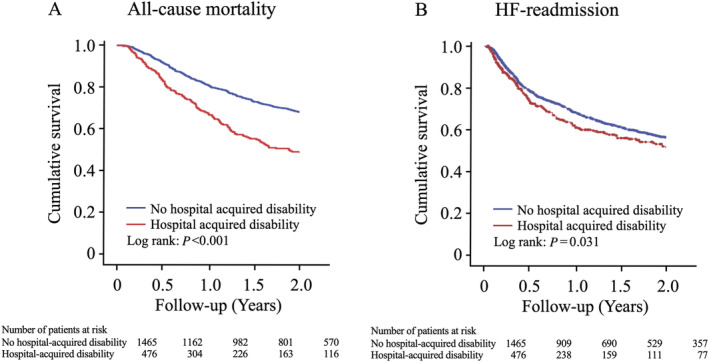
(A) Kaplan–Meier curve showing all‐cause death among elderly patients with HF with and without hospital‐acquired disability. (B) Kaplan–Meier curve showing HF readmission among elderly patients with HF with and without hospital‐acquired disability. HF, heart failure.
Table 2.
The prognostic impact of addition of HAD to MAGGIC risk score in Cox regression analyses
| Predictor | All‐cause death | HF readmission | ||||
|---|---|---|---|---|---|---|
| HR | 95% CI | P value | HR | 95% CI | P value | |
| Risk score | ||||||
| HAD | ||||||
| Linear (every 5‐point BI score decline) | 1.019 | 1.014–1.024 | <0.001 | 1.004 | 0.998–1.009 | 0.193 |
| Dichotomized (HAD vs. no HAD) | 1.887 | 1.546–2.305 | <0.001 | 1.203 | 1.022–1.416 | 0.027 |
| 3‐category | ||||||
| No HAD | 1 | 1 | ||||
| Mild HAD | 1.551 | 1.229–1.957 | <0.001 | 1.151 | 0.935–1.418 | 0.185 |
| Sever HD | 2.243 | 1.768–2.847 | <0.001 | 1.289 | 1.029–1.616 | 0.027 |
| MAGGIC risk score | ||||||
| Linear (every 1‐point decrease) | 1.051 | 1.035–1.066 | <0.001 | 1.018 | 1.006–1.030 | 0.003 |
| Combination of HAD and MAGGIC risk score | ||||||
| Model1 | ||||||
| HAD linear | 1.016 | 10.11–1.021 | <0.001 | 1.003 | 0.997–1.008 | 0.304 |
| MAGGIC risk score | 1.061 | 1.047–1.076 | <0.001 | 1.024 | 1.012–1.035 | <0.001 |
| Model 2 | ||||||
| HAD dichotomized | 1.772 | 1.450–2.167 | <0.001 | 1.193 | 1.005–1.416 | 0.043 |
| MAGGIC risk score | 1.051 | 1.035–1.066 | <0.001 | 1.016 | 1.004–1.028 | 0.009 |
| Model 3 | ||||||
| 3‐category | ||||||
| No HAD | 1 | 1 | ||||
| Mild HAD | 1.515 | 1.200–1.914 | 0.001 | 1.118 | 0.908–1.378 | 0.294 |
| Sever HAD | 1.964 | 1.546–2.496 | <0.001 | 1.227 | 0.978–1.540 | 0.077 |
| MAGGIC risk score | 1.058 | 1.044–1.073 | <0.001 | 1.023 | 1.011–1.034 | 1.023 |
CI, confidence interval; HAD, hospital‐acquired disability; HR, hazard ratio; MAGGIC, the Meta‐analysis Global Group in Chronic Heart Failure
Moreover, on the basis of the three categories of HAD, death occurred in 26%, 35%, and 37% of those with no HAD, mild HAD, and severe HAD, respectively (χ 2 P < 0.001 and P for linear trend < 0.001). The three subgroup of HAD was significantly associated with all‐cause mortality after adjusting for the MAGGIC risk score (mild HAD, HR: 1.515, 95% CI: 1.200–1.914, P = 0.001; severe HAD, HR: 1.964, 95% CI: 1.546–2.496, P < 0.001). The association between three categories of HAD and HF readmission showed a similar tendency, but the association was not statistically significant when combined with the MAGGIC risk score. In addition, HAD showed a significant association with all‐cause mortality in the three categories of preadmission BI score: independent (HR: 1.615, 95% CI: 1.242–2.099, P < 0.001), moderately dependent (HR: 1.595, 95% CI: 1.191–2.137, P = 0.002), and highly dependent (HR: 1.790, 95% CI: 1.051–3.051, P = 0.032) after adjusting for the MAGGIC risk score.
Discussion
This study has several strengths. To the best of our knowledge, our study is the first to report that HAD occurs in a significant proportion of elderly patients with HF, even during the standard acute phase of cardiac rehabilitation. Moreover, HAD was associated with worse clinical outcomes after adjusting for the MAGGIC risk score. These findings suggest that assessment of functional status trajectory during hospitalization is important for risk stratification in elderly patients with HF. 17
Elderly patients with HF show a different clinical profile compared with younger patients. 18 Generally, elderly patients with HF are more likely to be female and have HFpEF with a more complex pattern. 19 Our results revealed that an increasing number of proportions of female, HFpEF pattern and comorbidities. The available evidence for beta‐blockers and ACEI/ARB is limited in HFpEF patients. However, a high proportion of the HFpEF patients received beta‐blockers ACEI/ARB, explained by an assumption that they are efficacious for treating comorbidity including hypertension, coronary artery disease, and atrial fibrillation. 20 In addition, beta blockers or ACEI/ARB are not well tolerated in older frail or vulnerable patients, including potential harms such as orthostatic hypotension, fatigue, and depression, which can negatively affect physical activity, functional status, and clinical outcomes. The characteristics of our study subjects are consistent with those in previous reports, 18 and such heterogeneities in elderly patients with HF limit the use of various risk models. Therefore, we examined specific risk models including this clinical dilemma of standard HF treatment among elderly patients with HF.
Furthermore, our findings showed that incidence of HAD was equivalent or less compared with prior studies in patients with HF, 9 , 10 and which could be attributed to the worse baseline condition, impaired functional status, and higher susceptibility to various hospital‐induced stresses in the former. 21 HAD showed significant correlation with increased risk of all‐cause death and HF readmission after adjusting for the standard HF risk score. In addition, the association between HAD and all‐cause mortality was similar among patients with independent ADLs, moderately dependent ADLs, and highly dependent ADLs. With regard to the prognosis and risk stratification in elderly patients with HF, the importance of conditions that are not strictly related to HF or comorbidities, which may reflect greater impaired baseline functional decline and HAD, should be considered. 18 Prior study confirmed an excellent inter‐rater reliability between trained medical stuff in the total BI (Spearman; r = 0.98) or in individual activities (Cohen's kappa higher to 0.89 in all activities). However, nontrained medical staff observed low inter‐rater reliability in the BI, thus suggesting that medical stuff need training to evaluate the change in BI during hospitalization in elderly patients with HF.
Nonetheless, the potential mechanism underlying the relationship between HAD and prognosis in elderly patients with HF remains unclear. Several researches suggested that gait speed is a predictor of mortality and should be used as a vital sign for the care of older patients. 22 Currently, the International Academy on Nutrition and Aging expert panel proposed gait speed below 0.8 m/s as predictive values for risk of further functional decline and adverse outcomes. 23 In our population, HAD was associated low gait speed at discharge. We speculate that short‐term functional decline or disability might indicate a subclinical impairment in health status.
Preventing HAD is possible only if modifiable risk factors are identified. Zisberg et al. 24 suggested that physical activity‐related factors (i.e. mobility status or continence care) and baseline ADL level are associated with HAD in elderly subjects. Physical inactivity is the strongest direct correlate of HAD; thus, early ambulation or stepwise increased physical activity plays a crucial role in HAD prevention. 21 , 25 In our study, early ambulation was significantly associated with HAD. Nonetheless, severe HF patients or patients with worse functional status would have less tolerance to guideline‐directed acute phase of cardiac rehabilitation programme. In addition, several prior studies reported that at least 50% of hospitalized elderly patients do not walk outside their room except during rehabilitation or medical examinations, 26 , 27 particularly the patients with physical restraints or in‐dwelling urinary catheters. 28 Thus, optimal exercise progression and physical activity management may be also required to prevent a HAD, particularly elderly HF patients with prolonged hospital stay. Further research is needed to determine whether an integrated acute phase of cardiac rehabilitation could help elderly patients with HF return to their baseline ADL level.
Study limitations
This study has several limitations, including the small size in the subgroup multivariate analysis. A substantial number of patients could not complete the ADLs assessment or follow‐up and died during hospitalization, and they were excluded from the analysis. The patients excluded from the study had greater severity of HF or comorbidities compared with those included in the analysis, which may have introduced bias. In addition, unmeasured and unadjusted factors, such as malnutrition, cachexia, other complication, in‐hospital physical activity, hospital environment, depressive symptom or vitality, and in‐hospital nutrition intake, 29 may have an effect on HAD or clinical outcome. 24 Performance‐based functional assessment at hospital admission could not be performed in patients with symptomatic acute decompensated HF. Nonetheless, BI, which is a self‐report assessment and a widely accepted tool and feasible approach, could be used to assess ADLs, 30 , 31 even in elderly patients with HF. 32 Moreover, no prior study has assessed the minimal clinically important difference for BI score in patients with acute HF. However, loss of at least five points during hospitalization may be useful as a simple risk stratification in elderly patients with HF. Finally, hospital cost is important as healthcare outcome in older patients with HF. Further research is required to assess the impact on hospital cost and cost‐effective means for preventing HAD in elderly patients with HF.
Conclusions
Hospital‐acquired disability is associated with an increased risk of all‐cause death and HF readmission in elderly patients with HF. A comprehensive management of physical activity and hospital care, which focuses on functional trajectory, is an essential prerequisite to preventing HAD in elderly patients with HF.
Conflict of interest
None declared.
Funding
This work was supported by a Sakakibara Heart Institute (Tokyo, Japan) research grant.
Supporting information
Table S1. Baseline characteristics of the patients included vs. those excluded from the study.
Acknowledgements
The authors thank all the members of the Department of Rehabilitation, Sakakibara Heart Institute; Department of Rehabilitation, St Luke's International Hospital; Department of Rehabilitation, Mitsui Memorial Hospital; and Department of Rehabilitation, Ayase Heart Hospital.
Saitoh, M. , Takahashi, Y. , Okamura, D. , Akiho, M. , Suzuki, H. , Noguchi, N. , Yamaguchi, Y. , Hori, K. , Adachi, Y. , and Takahashi, T. (2021) Prognostic impact of hospital‐acquired disability in elderly patients with heart failure. ESC Heart Failure, 8: 1767–1774. 10.1002/ehf2.13356
References
- 1. Sasaki N, Kunisawa S, Ikai H, Imanaka Y. Differences between determinants of in‐hospital mortality and hospitalisation costs for patients with acute heart failure: a nationwide observational study from Japan. BMJ Open 2017; 7: e013753. [DOI] [PMC free article] [PubMed] [Google Scholar]
- 2. Kanaoka K, Okayama S, Nakai M, Sumita Y, Nishimura K, Kawakami R, Okura H, Miyamoto Y, Yasuda S, Tsutsui H, Komuro I, Ogawa H, Saito Y. Hospitalization costs for patients with acute congestive heart failure in Japan. Circ J 2019; 83: 1025–1031. [DOI] [PubMed] [Google Scholar]
- 3. Okura Y, Ramadan MM, Ohno Y, Mitsuma W, Tanaka K, Ito M, Suzuki K, Tanabe N, Kodama M, Aizawa Y. Impending epidemic: future projection of heart failure in Japan to the year 2055. Circ J 2008; 72: 489–491. [DOI] [PubMed] [Google Scholar]
- 4. Pandey A, Kitzman D, Reeves G. Frailty is intertwined with heart failure: mechanisms, prevalence, prognosis, assessment, and management. JACC Heart Fail 2019; 7: 1001–1011. [DOI] [PMC free article] [PubMed] [Google Scholar]
- 5. Matsushita K, Harada K, Miyazaki T, Miyamoto T, Kohsaka S, Iida K, Yamamoto Y, Nagatomo Y, Yoshino H, Yamamoto T, Nagao K, Takayama M. Younger‐ vs older‐old patients with heart failure with preserved ejection fraction. J Am Geriatr Soc 2019; 67: 2123–2128. [DOI] [PubMed] [Google Scholar]
- 6. Hirsch CH, Sommers L, Olsen A, Mullen L, Winograd CH. The natural history of functional morbidity in hospitalized older patients. J Am Geriatr Soc 1990; 38: 1296–1303. [DOI] [PubMed] [Google Scholar]
- 7. Saitoh M, Saji M, Kozono‐Ikeya A, Arimitsu T, Sakuyama A, Ueki H, Nagayama M, Isobe M. Hospital‐acquired functional decline and clinical outcomes in older patients undergoing transcatheter aortic valve implantation. Circ J 2020; 84: 1083–1089. [DOI] [PubMed] [Google Scholar]
- 8. Boyd CM, Landefeld CS, Counsell SR, Palmer RM, Fortinsky RH, Kresevic D, Burant C, Covinsky KE. Recovery of activities of daily living in older adults after hospitalization for acute medical illness. J Am Geriatr Soc 2008; 56: 2171–2179. [DOI] [PMC free article] [PubMed] [Google Scholar]
- 9. Delgado Parada E, Suárez García FM, López Gaona V, Gutiérrez Vara S, Solano Jaurrieta JJ. Mortality and functional evolution at one year after hospital admission due to heart failure (HF) in elderly patients. Arch Gerontol Geriatr 2012; 54: 261–265. [DOI] [PubMed] [Google Scholar]
- 10. Uemura Y, Shibata R, Takemoto K, Koyasu M, Ishikawa S, Murohara T, Watarai M. Prognostic impact of the preservation of activities of daily living on post‐discharge outcomes in patients with acute heart failure. Circ J 2018; 82: 2793–2799. [DOI] [PubMed] [Google Scholar]
- 11. Mahoney FI, Barthel DW. Functional evaluation: the barthel index. Md State Med J 1965; 14: 61–65. [PubMed] [Google Scholar]
- 12. Balu S. Differences in psychometric properties, cut‐off scores, and outcomes between the Barthel Index and Modified Rankin Scale in pharmacotherapy‐based stroke trials: systematic literature review. Curr Med Res Opin 2009; 25: 1329–1341. [DOI] [PubMed] [Google Scholar]
- 13. Balasch i Bernat M, Balasch i Parisi S, Sebastián EN, Moscardó LD, Ferri Campos J, López BL. Determining cut‐off points in functional assessment scales in stroke. NeuroRehabilitation 2015; 37: 165–172. [DOI] [PubMed] [Google Scholar]
- 14. Guidelines for rehabilitation in patients with cardiovascular disease (JCS 2012). Circ J 2014; 78: 2022–2093. [DOI] [PubMed] [Google Scholar]
- 15. Pocock SJ, Ariti CA, McMurray JJ, Maggioni A, Køber L, Squire IB, Swedberg K, Dobson J, Poppe KK, Whalley GA, Doughty RN, Meta‐Analysis Global Group in Chronic Heart Failure . Predicting survival in heart failure: a risk score based on 39 372 patients from 30 studies. Eur Heart J 2013; 34: 1404–1413. [DOI] [PubMed] [Google Scholar]
- 16. Rich JD, Burns J, Freed BH, Maurer MS, Burkhoff D, Shah SJ. Meta‐Analysis Global Group in Chronic (MAGGIC) heart failure risk score: validation of a simple tool for the prediction of morbidity and mortality in heart failure with preserved ejection fraction. J Am Heart Assoc 2018; 7: e009594. [DOI] [PMC free article] [PubMed] [Google Scholar]
- 17. Gohbara MN, Nakai M, Sumita Y, Endo T, Matsuzawa Y, Konishi M, Kosuge M, Ebina T, Tamura T, Kimura K. Low activities of daily living associated with increased cardiovascular disease mortality in Japan—analysis of health records from a Nationwide Claim‐Based Database, JROAD‐DPC. Circ Rep 2019; 1: 20–28. [DOI] [PMC free article] [PubMed] [Google Scholar]
- 18. Lazzarini V, Mentz RJ, Fiuzat M, Metra M, O'Connor CM. Heart failure in elderly patients: distinctive features and unresolved issues. Eur J Heart Fail 2013; 15: 717–723. [DOI] [PMC free article] [PubMed] [Google Scholar]
- 19. Coats AJS. Heart failure management of the elderly patient: focus on frailty, sarcopaenia, cachexia, and dementia: conclusions. Eur Heart J Suppl 2019; 21: L36–l38. [DOI] [PMC free article] [PubMed] [Google Scholar]
- 20. Silverman DN, Plante TB, Infeld M, Callas PW, Juraschek SP, Dougherty GB, Meyer M. Association of β‐blocker use with heart failure hospitalizations and cardiovascular disease mortality among patients with heart failure with a preserved ejection fraction: a secondary analysis of the TOPCAT trial. JAMA Netw Open 2019; 2: e1916598. [DOI] [PMC free article] [PubMed] [Google Scholar]
- 21. Covinsky KE, Pierluissi E, Johnston CB. Hospitalization‐associated disability: “She was probably able to ambulate, but I'm not sure”. JAMA 2011; 306: 1782–1793. [DOI] [PubMed] [Google Scholar]
- 22. Kuys SS, Peel NM, Klein K, Slater A, Hubbard RE. Gait speed in ambulant older people in long term care: a systematic review and meta‐analysis. J Am Med Dir Assoc 2014; 15: 194–200. [DOI] [PubMed] [Google Scholar]
- 23. Abellan van Kan G, Rolland Y, Andrieu S, Bauer J, Beauchet O, Bonnefoy M, Cesari M, Donini LM, Gillette‐Guyonnet S, Inzitari M, Nourhashemi F, onder G, Ritz P, Salva A, Visser M, Vellas B. Gait speed at usual pace as a predictor of adverse outcomes in community‐dwelling older people an International Academy on Nutrition and Aging (IANA) Task Force. J Nutr Health Aging 2009; 13: 881–889. [DOI] [PubMed] [Google Scholar]
- 24. Zisberg A, Shadmi E, Gur‐Yaish N, Tonkikh O, Sinoff G. Hospital‐associated functional decline: the role of hospitalization processes beyond individual risk factors. J Am Geriatr Soc 2015; 63: 55–62. [DOI] [PubMed] [Google Scholar]
- 25. Fleming LM, Zhao X, DeVore AD, Heidenreich PA, Yancy CW, Fonarow GC, Hernandez AF, Kociol RD. Early ambulation among hospitalized heart failure patients is associated with reduced length of stay and 30‐day readmissions. Circ Heart Fail 2018; 11: e004634. [DOI] [PubMed] [Google Scholar]
- 26. Callen BL, Mahoney JE, Grieves CB, Wells TJ, Enloe M. Frequency of hallway ambulation by hospitalized older adults on medical units of an academic hospital. Geriatr Nurs 2004; 25: 212–217. [DOI] [PubMed] [Google Scholar]
- 27. Brown CJ, Friedkin RJ, Inouye SK. Prevalence and outcomes of low mobility in hospitalized older patients. J Am Geriatr Soc 2004; 52: 1263–1270. [DOI] [PubMed] [Google Scholar]
- 28. Van Grootven B, Jeuris A, Jonckers M, Devriendt E, Dierckx de Casterlé B, Dubois C, Fagard K, Herregods M‐C, Hornikx M, Meuris B, Rex S, Tournoy J, Milisen K, Flamaing J, Deschodt M. Predicting hospitalisation‐associated functional decline in older patients admitted to a cardiac care unit with cardiovascular disease: a prospective cohort study. BMC Geriatr 2020; 20: 112. [DOI] [PMC free article] [PubMed] [Google Scholar]
- 29. Sullivan DH, Sun S, Walls RC. Protein‐energy undernutrition among elderly hospitalized patients: a prospective study. JAMA 1999; 281: 2013–2019. [DOI] [PubMed] [Google Scholar]
- 30. Covinsky KE, Palmer RM, Counsell SR, Pine ZM, Walter LC, Chren MM. Functional status before hospitalization in acutely ill older adults: validity and clinical importance of retrospective reports. J Am Geriatr Soc 2000; 48: 164–169. [DOI] [PubMed] [Google Scholar]
- 31. Bowling CB, Fonarow GC, Patel K, Zhang Y, Feller MA, Sui X, Blair SN, Alagiakrishnan K, Aban IB, Love TE, Allman RM, Ahmed A. Impairment of activities of daily living and incident heart failure in community‐dwelling older adults. Eur J Heart Fail 2012; 14: 581–587. [DOI] [PMC free article] [PubMed] [Google Scholar]
- 32. Takabayashi K, Ikuta A, Okazaki Y, Ogami M, Iwatsu K, Matsumura K, Ikeda T, Ichinohe T, Morikami Y, Yamamoto T, Fujita R, Takenaka K, Takenaka H, Haruna Y, Muranaka H, Ozaki M, Kitamura T, Kitaguchi S, Nohara R. Clinical characteristics and social frailty of super‐elderly patients with heart failure—the Kitakawachi clinical background and outcome of heart failure registry. Circ J 2016; 81: 69–76. [DOI] [PubMed] [Google Scholar]
Associated Data
This section collects any data citations, data availability statements, or supplementary materials included in this article.
Supplementary Materials
Table S1. Baseline characteristics of the patients included vs. those excluded from the study.