



Abstract
o-Carboryne (1,2-dehydro-o-carborane) is a very useful synthon for the synthesis of a variety of carborane-functionalized molecules. With 1-Li-2-OTf-o-C2B10H10 as the precursor, o-carboryne undergoes an efficient [4 + 2] cycloaddition with various conjugated enynes, followed by a subsequent [2 + 2] cycloaddition at room temperature, generating a series of carborane-fused tricyclo[6.4.0.02,7]dodeca-2,12-dienes in moderate to high isolated yields. This reaction is compatible with many functional groups and has a broad substrate scope. A reactive carborane-fused 1,2-cyclohexadiene intermediate is involved, which is supported by experimental results and DFT calculations. This protocol offers a convenient strategy for the construction of complex carborane-functionalized tricyclics.
An unprecedented tandem [4 + 2]/[2 + 2] cycloaddition of o-carboryne with enynes has been disclosed for the efficient synthesis of various carborane-fused tricyclics, in which a reactive carborane-fused 1,2-cyclohexadiene intermediate is involved.
Introduction
Strained cyclic organic molecules, such as arynes, cyclic alkynes and cyclic allenes, have intrigued chemists for more than a century with their unusual structures and high chemical reactivity (Scheme 1a).1 The considerable ring strain (30–50 kilocalories per mole)2,3 that characterizes these transient intermediates imparts high reactivity in many reactions, including cycloadditions and nucleophilic trappings, often generating structurally complex products.4 Cyclic allenes are a relatively less studied class of highly strained intermediate as compared with benzynes and cyclic alkynes. The generation and reactivity of 6-membered cyclic allenes such as the parent 1,2-cyclohexadiene have attracted much research interest in recent years.5 Strained six-membered-ring allenes are also found as common intermediates in the [4 + 2] cycloaddition of conjugated enynes with unsaturated molecules, including alkenes and alkynes.6,7 Aryne, a very reactive archetypal two-electron component in [4 + 2] cycloadditions, can react with conjugated enynes to generate isoaromatic cyclic allenes, which undergo isoaromatization to afford the polycyclic aromatics (Scheme 1b).8
Scheme 1. Reactions involving the enynes, aryne and carboryne: (a) strained cyclic intermediates. (b) Reactions of enyne with aryne and 1,3-o-carboryne. (c) This work.

On the other hand, carborane (o-C2B10H12), a three-dimensional relative of benzene, is a molecular boron–carbon cluster.9 Owing to their unique properties, functionalized carboranes are now finding a broad range of applications encompassing organic synthesis, drug design, polymers, cancer therapy, catalysis, metal–organic frameworks, electronic devices, and more.9–11 Similarly, 1,2-dehydro-o-carborane (o-carboryne) can be viewed as a three-dimensional relative of benzyne, which has been widely employed as a useful synthon for generating a wide range of functional carboranes over the past two decades.12 It can undergo cycloadditions,13–15 the ene reaction16 and the C–H bond insertion reaction,17 with a variety of organic molecules to afford a large class of functionalized carboranes. Cycloadditions involving an o-carboryne intermediate have been developed to enable the synthesis of various carbocyclic carborane derivatives.12 In our recently reported work, the ene reaction was observed between 1,3-dehydro-o-carboryne and a conjugated enyne due probably to the polarized “C B” multiple bond (Scheme 1b).18 Surprisingly, 1,2-dehydro-o-carboryne (o-carboryne) reacted with conjugated enynes in an unprecedented tandem [4 + 2]/[2 + 2] cycloaddition manner, generating a new class of rigid carborane-fused tricyclo[6.4.0.02,7]dodeca-2,12-dienes (Scheme 1c). Herein, we reported a general method for the construction of such carborane-fused tricyclics.
Results and discussion
In our initial study, the reaction of o-carboryne, generated in situ by treatment of 1-OTf-o-C2B10H11 (1) with LiHMDS (lithium bis(trimethylsilyl)amide), with 1.2 equiv. of 2-methyl-1-hexen-3-yne (2a) in cyclohexane at room temperature afforded carborane-fused tricyclo[6.4.0.02,7]dodeca-2,12-diene 3a in 84% GC yield (Table 1, entry 1). Several common bases, such as organic lithium reagents and Grignard reagents, were screened (Table 1, entries 2–5), and the results suggested that LiHMDS was the best choice (Table 1, entry 1).
Optimization of reaction conditionsa.
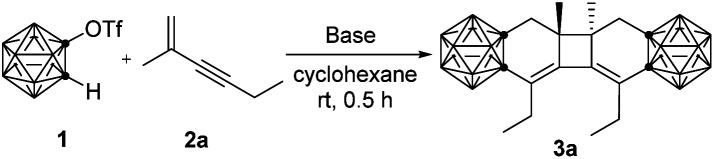
Reactions conditions: 1 (0.1 mmol), 2a (0.12 mmol), base (0.105 mmol) in cyclohexane (2 mL), rt, 0.5 h.
Determined by GC.
Isolated yield.
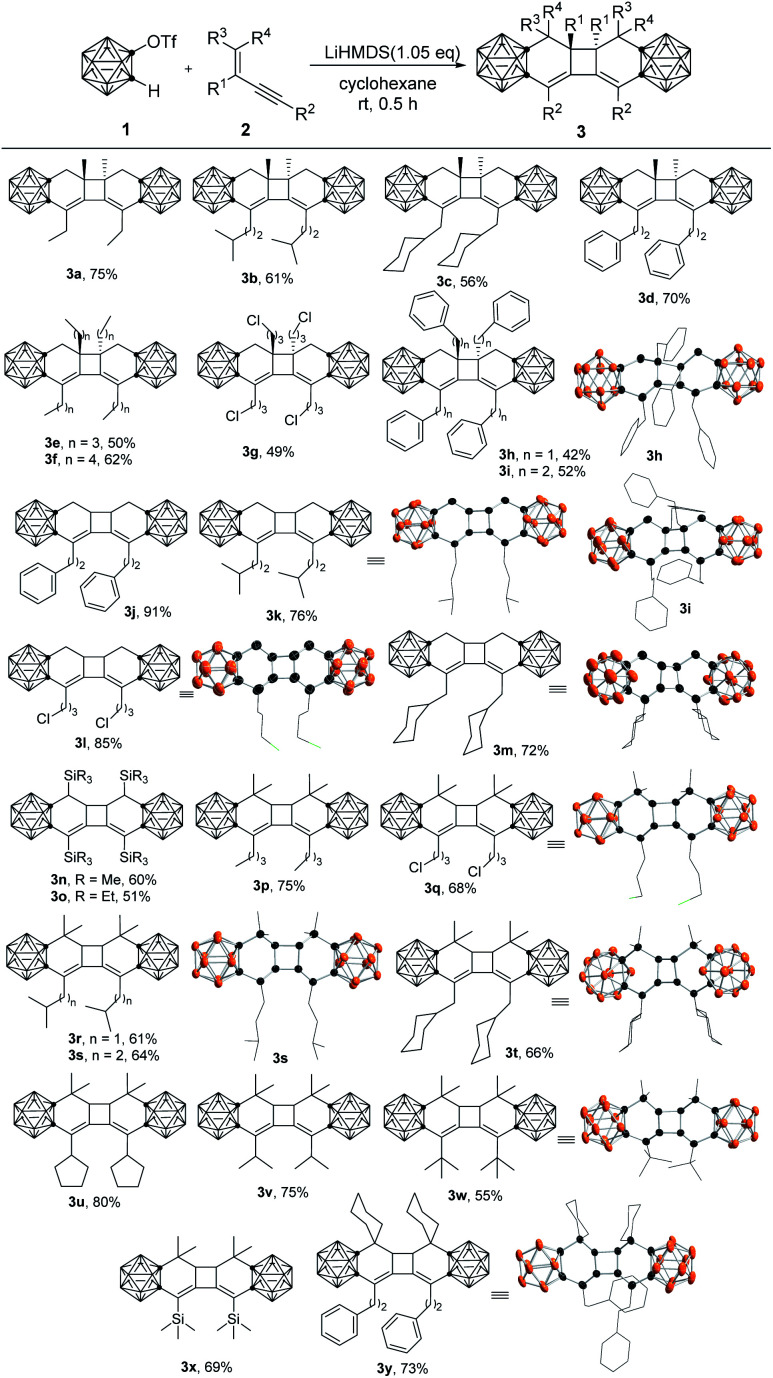
With the optimal reaction conditions in hand, the scope of this tandem [4 + 2]/[2 + 2] cycloaddition of o-carboryne with a series of conjugated enynes was examined and the desired carborane-fused tricyclic compounds were obtained in moderate to high yields (Table 2). Various substituents, including linear, branched and cyclic alkyl groups, silyl groups, and distal chloro and phenyl groups, were compatible with this reaction. It was noted that the reaction of the ornamented conjugated enynes directly with the phenyl group led to very complicated results due to the side reactions of the styrene14i,l or phenylacetylene15b moiety with o-carboryne. It was found that the steric hindrance of the substituents may play a role in the reaction, especially for the ones (R1) attached to the internal alkenyl carbon atom (3a–3ivs.3j–3m). For instance, the reaction of 2j or 2l proceeded smoothly to generate cycloadducts 3j and 3l in >85% yields, whereas 3d, 3g and 3i were isolated in <70% yields. When the two terminal alkenyl C–H groups were replaced by methyl groups, the yield of the desired products decreased slightly (3qvs.3l, 3svs.3k, 3tvs.3m, and 3yvs.3j). Moreover, the substituents (R2) at the terminal alkynyl carbon atom showed no obvious effect on the yields of 3.
[4 + 2]/[2 + 2] Cycloadditions of o-carboryne with enynesa,b.
|
Reactions conditions: 1 (0.1 mmol), 2 (0.12 mmol), LiHMDS (0.105 mmol) in cyclohexane (2 mL), rt, 0.5 h.
Isolated yields.
Compounds 3 were fully characterized by 1H, 13C, and 11B NMR spectroscopy as well as by HRMS. The 11B{1H} NMR spectra exhibited a 4 : 2 : 12 : 2 pattern for 3a and 3d, a 6 : 14 pattern for 3c, 3e–j, 3n, and 3o, and a 4 : 16 pattern for 3p–u and 3y, spanning the range δ = −2 to −14 ppm. The molecular structures of 3h–3i, 3k–3m, 3q, 3s–3t, 3w and 3y were further confirmed by single-crystal X-ray analyses.19
To gain some insight into the reaction mechanism, several control experiments were conducted (Scheme 2). Under standard reaction conditions, o-carboryne was treated with a mixture (1 : 1 molar ratio) of 2j and 2m, yielding three products 3j, 3jm, and 3m in a molar ratio of around 1 : 2 : 1. The isolation of the crossover product 3jm suggested that this is a stepwise process and the [2 + 2] cycloaddition step is an intermolecular reaction (Scheme 2a). On the other hand, 1,4-bis(triisopropylsilyl)-1-buten-3-yne 4, providing two highly sterically demanding silyl groups at the terminals of 1-buten-3-yne, reacted smoothly with o-carboryne to afford 5 in 30% yield (Scheme 2b). In this reaction, the in situ generated carborane-fused 1,2-cyclohexadiene intermediate was trapped preferentially by less hindered o-carboryne, which can be ascribed to the fact that the resultant sterically demanding cyclic allene intermediate prevents its dimerization.
Scheme 2. Control experiments: (a) crossover reaction. (b) Reactions with sterically hindered enynes.

Furthermore, the treatment of 2,4-bis(tert-butyl)-1-buten-3-yne 6 with o-carboryne gave benzo-o-carborane 7 in 80% yield, which might result from the 1,3-H-migration of the extremely sterically demanding carborane-fused 1,3-di(tert-butyl)-1,2-cyclohexadiene intermediate (Scheme 2b). These results further supported that this reaction proceeded via a carborane-fused 1,2-cyclohexadiene intermediate. The molecular structures of 3jm, 5 and 7 were further confirmed by single-crystal X-ray analyses.19
Based on the above experimental results, a plausible reaction mechanism is proposed in Scheme 3. At first, in situ generated o-carboryne A by reaction of 1 with LiHMDS, reacts with conjugated enyne 2 to form highly reactive carborane-fused 1,2-cyclohexadiene Bvia [4 + 2] cycloaddition.20 Two molecules of cyclic allenes B undergo a stepwise [2 + 2] cycloaddition via a singlet bis-allyl diradical C intermediate,21 affording the desired carborane-fused tricyclo[6.4.0.02,7]dodeca-2,12-diene 3. This proposed mechanism is supported by DFT calculations (see ESI† for details).
Scheme 3. Proposed reaction mechanism.

Conclusions
Using 1-OTf-o-C2B10H10 (1) as an o-carboryne precursor, an unprecedented tandem [4 + 2]/[2 + 2] cycloaddition reaction of o-carboryne with conjugated enynes was developed with a broad substrate scope, affording a series of carborane-fused tricyclo[6.4.0.02,7]dodeca-2,12-dienes in moderate to high yields. In this reaction, a reactive carborane-fused 1,2-cyclohexadiene intermediate was formed, followed by a stepwise [2 + 2] cycloaddition via a diallyl diradical to give the final product. This protocol provided a feasible strategy for the synthesis of complex carborane-fused tricyclic compounds in a single process, which is otherwise inaccessible by other means.
Conflicts of interest
There are no conflicts to declare.
Supplementary Material
Acknowledgments
This work was supported by grants from the Research Grants Council of HKSAR (Project No. 14306519) and NSFC/RGC Joint Research Scheme (Project No. N_CUHK402/18), as well as by the CUHK Impact Postdoctoral Fellowship Scheme (IPDFS to Z.J.).
Electronic supplementary information (ESI) available. CCDC [2052100–2052112]. For ESI and crystallographic data in CIF or other electronic format see DOI: 10.1039/d0sc07047e
Notes and references
- Wenk H. H. Winkler M. Sander W. Angew. Chem., Int. Ed. 2003;42:502–528. doi: 10.1002/anie.200390151. [DOI] [PubMed] [Google Scholar]
- Liebman J. F. Greenberg A. A. Chem. Rev. 1976;76:311–365. [Google Scholar]
- Angus R. O. Schmidt Jr M. W. Johnson R. P. J. Am. Chem. Soc. 1985;107:532–537. [Google Scholar]
- Pellissier H. Santelli M. Tetrahedron. 2003;59:701–730. [Google Scholar]
- (a) Quintana I. Peña D. Pérez D. Guitián E. Eur. J. Org. Chem. 2009;2009:5519–5524. [Google Scholar]; (b) Barber J. S. Styduhar E. D. Pham H. V. McMahon T. C. Houk K. N. Garg N. K. J. Am. Chem. Soc. 2016;138:2512–2515. doi: 10.1021/jacs.5b13304. [DOI] [PMC free article] [PubMed] [Google Scholar]; (c) Lofstrand V. A. West F. G. Chem.−Eur. J. 2016;22:10763–10767. doi: 10.1002/chem.201602201. [DOI] [PubMed] [Google Scholar]; (d) Barber J. S. Yamano M. M. Ramirez M. Darzi E. R. Knapp R. R. Liu F. Houk K. N. Garg N. K. Nat. Chem. 2018;10:953–960. doi: 10.1038/s41557-018-0080-1. [DOI] [PMC free article] [PubMed] [Google Scholar]; (e) Lofstrand V. A. McIntosh K. C. Almehmadi Y. A. West F. G. Org. Lett. 2019;21:6231–6234. doi: 10.1021/acs.orglett.9b02085. [DOI] [PubMed] [Google Scholar]; (f) Yamano M. Knapp R. Ngamnithiporn A. Ramirez M. Houk K. Stoltz B. Garg N. K. Angew. Chem., Int. Ed. 2019;58:5653–5657. doi: 10.1002/anie.201900503. [DOI] [PMC free article] [PubMed] [Google Scholar]; (g) Almehmadi Y. A. West F. G. Org. Lett. 2020;22:6091–6095. doi: 10.1021/acs.orglett.0c02172. [DOI] [PubMed] [Google Scholar]; (h) Yamano M. M. Kelleghan A. V. Shao Q. Giroud M. Simmons B. J. Li B. Chen S. Houk K. N. Garg N. K. Nature. 2020;586:242–247. doi: 10.1038/s41586-020-2701-2. [DOI] [PMC free article] [PubMed] [Google Scholar]
- (a) Wessig P. Muller G. Chem. Rev. 2008;108:2051–2063. doi: 10.1021/cr0783986. [DOI] [PubMed] [Google Scholar]; (b) Gevorgyan V. and Zatolochnaya O. V., [4 + 2] Benzannulation of enynes with alkynes, in Transition-Metal-Mediated Aromatic Ring Construction, ed. K. Tanaka, 2013, pp. 355–377 [Google Scholar]
- (a) Danheiser R. L. Brisbois R. G. Kowalczyk J. J. Miller R. F. J. Am. Chem. Soc. 1990;112:3093–3100. [Google Scholar]; (b) Dunetz J. R. Danheiser R. L. J. Am. Chem. Soc. 2005;127:5776–5777. doi: 10.1021/ja051180l. [DOI] [PMC free article] [PubMed] [Google Scholar]; (c) Saito S. Salter M. M. Gevorgyan V. Tsuboya N. Tando K. Yamamoto Y. J. Am. Chem. Soc. 1996;118:3970–3971. [Google Scholar]; (d) Gevorgyan V. Takeda A. Yamamoto Y. J. Am. Chem. Soc. 1997;119:11313–11314. [Google Scholar]; (e) Gevorgyan V. Takeda A. Homma M. Sadayori N. Radhakrishnan U. Yamamoto Y. J. Am. Chem. Soc. 1999;121:6391–6402. [Google Scholar]; (f) Rubina M. Conley M. Gevorgyan V. J. Am. Chem. Soc. 2006;128:5818–5827. doi: 10.1021/ja060085p. [DOI] [PubMed] [Google Scholar]; (g) Nakao Y. Hirata Y. Ishihara S. Oda S. Yukawa T. Shirakawa E. Hiyama T. J. Am. Chem. Soc. 2004;126:15650–15651. doi: 10.1021/ja044429s. [DOI] [PubMed] [Google Scholar]; (h) Punner F. Hilt G. Chem. Commun. 2012;48:3617–3619. doi: 10.1039/c2cc30777d. [DOI] [PubMed] [Google Scholar]
- (a) Hayes M. E. Shinokubo H. Danheiser R. L. Org. Lett. 2005;7:3917–3920. doi: 10.1021/ol051372l. [DOI] [PMC free article] [PubMed] [Google Scholar]; (b) Yoshida S. Shimizu K. Uchida K. Hazama Y. Igawa K. Tomooka K. Hosoya T. Chem.–Eur. J. 2017;23:15332–15335. doi: 10.1002/chem.201704345. [DOI] [PubMed] [Google Scholar]
- (a) Grimes R. N., Carboranes, Academic Press, Amsterdam, 3rd edn, 2016 [Google Scholar]; (b) Hosmane N. S., Boron Science: New Technologies and Applications, CRC Press, Boca Raton, FL, 2011 [Google Scholar]; (c) Xie Z. Jin G. X. Carborane Themed Issue. Dalton Trans. 2014;43:4911–5232. [Google Scholar]; (d) Bregadze V. I. Xie Z. Boron Chemistry Themed Issue. Eur. J. Inorg. Chem. 2017:4344–4692. [Google Scholar]
- For reviews, see:; (a) Núñez R. Tarrés M. Ferrer-Ugalde A. F de Biani F. Teixidor F. Chem. Rev. 2016;116:14307–14378. doi: 10.1021/acs.chemrev.6b00198. [DOI] [PubMed] [Google Scholar]; (b) Mukherjee S. Thilagar P. Chem. Commun. 2016;52:1070–1093. doi: 10.1039/c5cc08213g. [DOI] [PubMed] [Google Scholar]; (c) Li X. Yan H. Zhao Q. Chem.−Eur. J. 2016;22:1888–1898. doi: 10.1002/chem.201503456. [DOI] [PubMed] [Google Scholar]; (d) Xie Z. Acc. Chem. Res. 2003;36:66–77. doi: 10.1021/ar020094c. [DOI] [PubMed] [Google Scholar]; (e) Yu W.-B. Cui P.-F. Gao W.-X. Jin G.-X. Coord. Chem. Rev. 2017;350:300–319. [Google Scholar]; (f) Qiu Z. Ren S. Xie Z. Acc. Chem. Res. 2011;44:299–309. doi: 10.1021/ar100156f. [DOI] [PubMed] [Google Scholar]; (g) Fisher S. P. Tomich A. W. Lovera S. O. Kleinsasser J. F. Guo J. Asay M. J. Nelson H. M. Lavallo V. Chem. Rev. 2019;119:8262–8290. doi: 10.1021/acs.chemrev.8b00551. [DOI] [PubMed] [Google Scholar]; (h) Zhang J. Xie Z. Acc. Chem. Res. 2014;47:1623–1633. doi: 10.1021/ar500091h. [DOI] [PubMed] [Google Scholar]; (i) Hawthorne M. F. Angew. Chem., Int. Ed. Engl. 1993;32:950–984. [Google Scholar]; (j) Hawthorne M. F. Maderna A. Chem. Rev. 1999;99:3421–3434. doi: 10.1021/cr000001+. [DOI] [PubMed] [Google Scholar]; (k) Armstrong A. F. Valliant J. F. Dalton Trans. 2007:4240–4251. doi: 10.1039/b709843j. [DOI] [PubMed] [Google Scholar]; (l) Issa F. Kassiou M. Rendina L. M. Chem. Rev. 2011;111:5701–5722. doi: 10.1021/cr2000866. [DOI] [PubMed] [Google Scholar]; (m) Scholz M. Hey-Hawkins E. Chem. Rev. 2011;111:7035–7062. doi: 10.1021/cr200038x. [DOI] [PubMed] [Google Scholar]; (n) Núñez R. Romero I. Teixidor F. Viñas C. Chem. Soc. Rev. 2016;45:5147–5173. doi: 10.1039/c6cs00159a. [DOI] [PubMed] [Google Scholar]; (o) Quan Y. Xie Z. Chem. Soc. Rev. 2019;48:3660–3673. doi: 10.1039/c9cs00169g. [DOI] [PubMed] [Google Scholar]; (p) Au Y. K. Xie Z. Bull. Chem. Soc. Jpn. 2021 doi: 10.1246/bcsj.20200366R. [DOI] [Google Scholar]; (q) Grimes N. Dalton Trans. 2015;44:5939–5956. doi: 10.1039/c5dt00231a. [DOI] [PubMed] [Google Scholar]; (r) Stockmann P. Gozzi M. Kuhnert R. Sárosi M. B. Hey-Hawkins E. Chem. Soc. Rev. 2019;48:3497–3512. doi: 10.1039/c9cs00197b. [DOI] [PubMed] [Google Scholar]
- For selected examples, see:; (a) Jude H. Disteldorf H. Fischer S. Wedge T. Hawkridge A. M. Arif A. M. Hawthorne M. F. Muddiman D. C. Stang P. J. J. Am. Chem. Soc. 2005;127:12131–12139. doi: 10.1021/ja053050i. [DOI] [PubMed] [Google Scholar]; (b) Northrop B. H. Yang H.-B. Stang P. J. Chem. Commun. 2008:5896–5908. doi: 10.1039/b811712h. [DOI] [PMC free article] [PubMed] [Google Scholar]; (c) Ludlow III J. M. Tominaga M. Chujo Y. Schultz A. Lu X. Xie T. Guo K. Moorefield C. N. Wesdemiotis C. Newkome G. R. Dalton Trans. 2014;43:9604–9611. doi: 10.1039/c4dt00989d. [DOI] [PubMed] [Google Scholar]; (d) Jung D. Saleh L. M. A. Berkson Z. J. El-Kady M. F. Hwang J. Y. Mohamed N. Wixtrom A. I. Titarenko E. Shao Y. McCarthy K. Guo J. Martini I. B. Kraemer S. Wegener E. C. Saint-Cricq P. Ruehle B. Langeslay R. R. Delferro M. Brosmer J. L. Hendon C. H. Gallagher-Jones M. Rodriguez J. Chapman K. W. Miller J. T. Duan X. Kaner R. B. Zink J. I. Chmelka B. F. Spokoyny A. M. Nat. Mater. 2018;17:341–348. doi: 10.1038/s41563-018-0021-9. [DOI] [PubMed] [Google Scholar]; (e) Guo J. Liu D. Zhang J. Zhang J. Miao Q. Xie Z. Chem. Commun. 2015;51:12004–12007. doi: 10.1039/c5cc03608a. [DOI] [PubMed] [Google Scholar]; (f) Dash B. P. Satapathy R. Gaillard E. R. Maguire J. A. Hosmane N. S. J. Am. Chem. Soc. 2010;132:6578–6587. doi: 10.1021/ja101845m. [DOI] [PubMed] [Google Scholar]; (g) Koshino M. Tanaka T. Solin N. Suenaga K. Isobe H. Nakamura E. Science. 2007;316:853. doi: 10.1126/science.1138690. [DOI] [PubMed] [Google Scholar]; (h) Brusselle D. Bauduin P. Girard L. Zaulet A. Viñas C. Teixidor F. Ly I. Diat O. Angew. Chem., Int. Ed. 2013;52:12114–12118. doi: 10.1002/anie.201307357. [DOI] [PubMed] [Google Scholar]; (i) Farha O. K. Spokoyny A. M. Mulfort K. L. Hawthorne M. F. Mirkin C. A. Hupp J. T. J. Am. Chem. Soc. 2007;129:12680–12681. doi: 10.1021/ja076167a. [DOI] [PubMed] [Google Scholar]; (j) Schwartz J. J. Mendoza A. M. Wattanatorn N. Zhao Y. Nguyen V. T. Spokoyny A. M. Mirkin C. A. Baše T. Weiss P. S. J. Am. Chem. Soc. 2016;138:5957–5967. doi: 10.1021/jacs.6b02026. [DOI] [PubMed] [Google Scholar]; (k) McArthur S. G. Geng L. Guo J. Lavallo V. Inorg. Chem. Front. 2015;2:1101–1104. [Google Scholar]; (l) Clingerman D. J. Morris W. Mondloch J. E. Kennedy R. D. Sarjeant A. A. Stern C. Hupp J. T. Farha O. K. Mirkin C. A. Chem. Commun. 2015;51:6521–6523. doi: 10.1039/c4cc09212k. [DOI] [PubMed] [Google Scholar]; (m) Spokoyny A. M. Machan C. W. Clingerman D. J. Rosen M. S. Wiester M. J. Kennedy R. D. Stern C. L. Sarjeant A. A. Mirkin C. A. Nat. Chem. 2011;3:590–596. doi: 10.1038/nchem.1088. [DOI] [PubMed] [Google Scholar]; (n) Lugo C. A. Moore C. E. Rheingold A. L. Lavallo V. Inorg. Chem. 2015;54:2094–2096. doi: 10.1021/ic5030636. [DOI] [PubMed] [Google Scholar]; (o) Saleh L. M. A. Dziedzic R. M. Khan S. I. Spokoyny A. M. Chem.–Eur. J. 2016;22:8466–8470. doi: 10.1002/chem.201601292. [DOI] [PubMed] [Google Scholar]; (p) Wei X. Zhu M.-J. Cheng Z. Lee M. Yan H. Lu C. Xu J.-J. Angew. Chem., Int. Ed. 2019;58:3162–3166. doi: 10.1002/anie.201900283. [DOI] [PubMed] [Google Scholar]
- For reviews on carboryne chemistry, see:; (a) Qiu Z. Xie Z. Dalton Trans. 2014;43:4925–4934. doi: 10.1039/c3dt52711e. [DOI] [PubMed] [Google Scholar]; (b) Zhao D. Xie Z. Coord. Chem. Rev. 2016;314:14–33. [Google Scholar]
- Example for [5 + 2]/[3 + 2] cycloaddition of o-carboryne: ; Zhao D. Zhang J. Xie Z. J. Am. Chem. Soc. 2015;137:13938–13942. doi: 10.1021/jacs.5b09074. [DOI] [PubMed] [Google Scholar]
- Select examples for [4 + 2] cycloaddition of o-carboryne:; (a) Gingrich H. L. Ghosh T. Huang Q. Jones Jr M. J. Am. Chem. Soc. 1990;112:4082–4083. [Google Scholar]; (b) Jeon J. Kitamura T. Yoo B.-W. Kang S. O. Ko J. Chem. Commun. 2001:2110–2111. doi: 10.1039/b107343e. [DOI] [PubMed] [Google Scholar]; (c) Ghosh T. Gingrich H. L. Kam C. K. Mobraaten E. C. M. Jones Jr M. J. Am. Chem. Soc. 1991;113:1313–1318. [Google Scholar]; (d) Barnett-Thamattoor L. Zheng G.-X. Ho D. M. Jones Jr M. Jackson J. E. Inorg. Chem. 1996;35:7311–7315. doi: 10.1021/ic960284h. [DOI] [PubMed] [Google Scholar]; (e) Atkins J. H. Ho D. M. Jones Jr M. Tetrahedron Lett. 1996;37:7217–7220. [Google Scholar]; (f) Wang S. R. Xie Z. Organometallics. 2012;31:3316–3323. [Google Scholar]; (g) Kahlert J. U. Rawal A. Hook J. M. Rendina L. M. Choucair M. Chem. Commun. 2014;50:11332–11334. doi: 10.1039/c4cc04521a. [DOI] [PubMed] [Google Scholar]; (h) Zhang J. Qiu Z. Xu P.-F. Xie Z. ChemPlusChem. 2014;79:1044–1052. [Google Scholar]; (i) Wang S. R. Xie Z. Tetrahedron. 2012;68:5269–5278. [Google Scholar]; (j) Zhang J. Qiu Z. Xie Z. Organometallics. 2017;36:3806–3811. [Google Scholar]; (k) Zhao D. Zhang J. Xie Z. Angew. Chem., Int. Ed. 2014;53:8488–8491. doi: 10.1002/anie.201405023. [DOI] [PubMed] [Google Scholar]; (l) Zhang J. Xie Z. Chin. J. Chem. 2018;36:1041–1046. [Google Scholar]
- Select examples for [2 + 2] cycloaddition of o-carboryne:; (a) Lee T. Jeon J. Song K. H. Jung I. Baik C. Park K.-M. Lee S. S. Kang S. O. Ko J. Dalton Trans. 2004:933–937. doi: 10.1039/b315205g. [DOI] [PubMed] [Google Scholar]; (b) Cunningham R. J. Bian N. Jones Jr M. Inorg. Chem. 1994;33:4811–4812. [Google Scholar]; (c) Ho D. M. Cunningham R. J. Brewer J. A. Bian N. Jones Jr M. Inorg. Chem. 1995;34:5274–5278. [Google Scholar]; (d) Wang S. R. Qiu Z. Xie Z. J. Am. Chem. Soc. 2010;132:9988–9989. doi: 10.1021/ja1044488. [DOI] [PubMed] [Google Scholar]; (e) Zhao D. J. Am. Chem. Soc. 2015;137:9423–9428. doi: 10.1021/jacs.5b05426. [DOI] [PubMed] [Google Scholar]; (f) Zhang J. Xie Z. Organometallics. 2020;39:4214–4220. [Google Scholar]
- Select examples for ene reactions of o-carboryne:; (a) Huang Q. Gingrich H. L. Jones Jr M. Inorg. Chem. 1991;30:3254–3257. [Google Scholar]; (b) Gingrich H. L. Huang Q. Morales A. L. Jones Jr M. J. Org. Chem. 1992;57:3803–3806. [Google Scholar]; (c) Zhao D. Zhang J. Xie Z. Chem.–Eur. J. 2015;21:10334–10337. doi: 10.1002/chem.201501911. [DOI] [PubMed] [Google Scholar]
- Select examples for C−H insertion reactions of o-carboryne:; (a) Wang S. R. Qiu Z. Xie Z. J. Am. Chem. Soc. 2011;133:5760–5763. doi: 10.1021/ja201126h. [DOI] [PubMed] [Google Scholar]; (b) Zhao D. Zhang J. Xie Z. Angew. Chem., Int. Ed. 2014;53:12902–12906. doi: 10.1002/anie.201409141. [DOI] [PubMed] [Google Scholar]; (c) Wang S. R. Xie Z. Organometallics. 2012;31:4544–4550. [Google Scholar]; (d) Cheng R. Zhang J. Zhang J. Qiu Z. Xie Z. Angew. Chem., Int. Ed. 2016;55:1751–1754. doi: 10.1002/anie.201507952. [DOI] [PubMed] [Google Scholar]
- Zhao D. Zhang J. Xie Z. Chem.−Eur. J. 2015;21:10334–10337. doi: 10.1002/chem.201501911. [DOI] [PubMed] [Google Scholar]
- CCDC 2052100 (3h), CCDC 2052101 (3i), CCDC 2052102 (3k), CCDC 2052103 (3l), CCDC 2052104 (3m), CCDC 2052105 (3q), CCDC 2052106 (3s), CCDC 2052107 (3t), CCDC 2052108 (3w), CCDC 2052109 (3y), CCDC 2052110 (3jm), CCDC 2052111 (5) and CCDC 2052112 (7) contain the supplementary crystallographic data for this paper
- (a) Ajaz A. Bradley A. Z. Burrell R. C. Li W. H. H. Daoust K. J. Bovee L. B. DiRico K. J. Johnson R. P. J. Org. Chem. 2011;76:9320–9328. doi: 10.1021/jo201567d. [DOI] [PubMed] [Google Scholar]; (b) Ananikov V. P. J. Phys. Org. Chem. 2001;14:109–121. [Google Scholar]; (c) Ananikov V. P. Gordeev E. G. Chem. Sci. 2011;2:2332–2341. [Google Scholar]
- (a) Johnson R. P. Chem. Rev. 1989;89:1111–1124. [Google Scholar]; (b) Skraba S. L. Johnson R. P. J. Org. Chem. 2012;77:11096–11100. doi: 10.1021/jo302176k. [DOI] [PubMed] [Google Scholar]; (c) Jacobs T. L. McClenon J. R. Muscio Jr O. J. J. Am. Chem. Soc. 1969;91:6038–6041. [Google Scholar]
Associated Data
This section collects any data citations, data availability statements, or supplementary materials included in this article.