



Abstract
Virtual copresence, or the sense of being with others in an online space, is a feeling induced on many apps and websites through user avatars and browsable profile pages. Despite the small/modest effect sizes observed in popular web-based personalized normative feedback (PNF) alcohol interventions for college students, previous research has yet to consider how copresence might boost efficacy. This study builds on previous PNF gamification work to investigate whether specific copresence features (visual and text-based information about peers) increase PNF’s ability to reduce alcohol use relative to a standard PNF condition and a gamified PNF condition. Copresence and perceptions of drinking norms (average drinks, peak drinks, and binge episodes) were assessed during a 3-week period following random assignment of college students (N=235) to 1 of the 4 web-based PNF conditions (Standard PNF, Gamified PNF Only, Gamified PNF+Visual Copresence, and Gamified PNF+Maximum Copresence). These conditions asked the same questions about drinking and delivered identical PNF on alcohol use, but differed in the level of visual and text-based information about peers. Overall, only the gamified condition that featured maximum copresence significantly reduced drinking outcomes relative to standard PNF. However, conditional effects were moderated by pre-intervention drinking. Among heavier pre-intervention drinkers, both gamified conditions that featured copresence significantly improved upon Standard PNF in reducing alcohol use at follow-up. Findings suggest that including social media-like copresence features to visually represent and provide basic information about the peers contributing to the norms can enhance the efficacy of gamified PNF interventions, especially among high-risk heavy drinkers.
Keywords: Alcohol, College students, Copresence, Gamification, Interventions, Social media
1. Introduction
Researchers and university administrators continue to search for strategies to reduce risky college drinking (Dawson, Grant, Stinson, & Chou, 2004; Merrill & Carey, 2016; Schulenberg et al., 2017; White & Hingson, 2013) in order to protect students from serious consequences including alcohol related injuries (Caamaño-Isorna et al., 2017), sexual assault (Foster, Caravelis, & Kopak, 2013), blackouts, missed classes and work, and illness (Hingson, Zha, Simons-Morton, & White, 2016). Personalized normative feedback (PNF), which uses feedback to correct students’ misperceived peer drinking norms and subsequently reduce drinking behavior, is one of the most researched and empirically-validated interventions to reduce risky college student drinking (Dotson, Dunn, & Bowers, 2015; Lewis & Neighbors, 2006; Miller et al., 2013). Nearly all successful college alcohol interventions now include components designed to correct misperceived peer drinking norms (Cronce & Larimer, 2011; Larimer & Cronce, 2002). However, the effect sizes for PNF interventions are generally small/modest (Dotson et al., 2015; Riper et al., 2009; Walters & Neighbors, 2005). Efforts to increase PNF efficacy have typically centered on improving attention by changing mode of delivery (online versus in-person; LaBrie, Hummer, Huchting, & Neighbors, 2009; LaBrie, Hummer, Neighbors, & Pedersen, 2008) and increasing credibility of the feedback by increasing the level of specificity of reference group used for the feedback (LaBrie et al., 2013; Larimer et al., 2011).
Recently, there has been growing interest in the ability of gamified features (e.g., points, levels, avatars, chance-based uncertainty) to increase the effectiveness of online behavior change interventions (Breuer & Bente, 2010; Brown et al., 2016; Comello et al., 2016; Girard, Ecalle, & Magnan, 2013; Wouters, van Nimwegen, van Oostendorp, & van der Spek, 2013). Though many types of features have been tested, no studies have investigated whether features associated with the concept of virtual copresence, or “being there” together in an online space (Schroeder, 2002), might influence gamified intervention efficacy. Because our pilot work, both in live groups (LaBrie et al., 2009, 2008) and in gamified online interventions (Boyle, Earle, LaBrie, & Smith, 2017; Boyle, Earle, McCabe, & LaBrie, 2018; Earle, LaBrie, Boyle, & Smith, 2018), suggests copresence might be beneficial—specifically in the area of college alcohol feedback interventions—the current study sought to experimentally isolate the effect of copresence on behavior change following a brief gamified college alcohol PNF intervention.
1.1. The evolution of virtual copresence
The concept of copresence was originally referred to in the writings of Goffman (1963), who used the term to denote a psychological connection with another human. In the decades since, as computer-mediated communication has become increasingly prominent, the concept of virtual copresence has been used to encompass the feeling of being together with others in an online space (Schroeder, 2002). Previous research examining the effects of copresence in various online environments (e.g., e-commerce, online classrooms, and consumer opinion websites) suggests that copresence is positively related to feelings of trust (Aljukhadar, Senecal, & Ouellette, 2010; Gefen & Straub, 2004; Hassanein & Head, 2007), satisfaction (Bulu, 2012; Holzwarth, Janiszewski, & Neumann, 2006), and increased affective learning (Russo & Benson, 2005). Following from this work, several studies have attempted to use copresence to improve mobile and computer-based health behavior interventions. However, these studies have narrowly focused on copresence in the contexts of interactivity and social support. For instance, interventions featuring peer forums (Barrera, Glasgow, McKay, Boles, & Feil, 2002), Facebook support groups (Ramo, Thrul, Chavez, Delucchi, & Prochaska, 2015) and virtual communities (Eysenbach, Powell, Englesakis, Rizo, & Stern, 2004) include copresence features which allow participants to interact and support one another. Indeed, findings suggest that participant interactivity afforded by copresence features can increase social support (Barrera et al., 2002), and, in turn, improve intervention efficacy (Anderson-Bill, Winett, & Wojcik, 2011). To date, however, intervention research has yet to examine copresence features outside of the support and interactivity context. Thus, it remains unclear whether copresence features that induce the feeling of being online with others but do not allow for interactivity or communication between individuals can increase the efficacy of health behavior interventions.
1.2. Copresence in the context of social norms alcohol interventions
Social norms-based alcohol interventions present a unique context wherein the simple representation of peers alone might improve intervention efficacy by increasing the believability of normative statistics. Research has established that college students are likely to reject (Granfield, 2005), doubt (Polonec, Major, & Atwood, 2006), and question (Miller et al., 2013) the credibility of normative drinking statistics from national and campus-wide surveys. Additionally, student drinkers react defensively to, and are more critical of, alcohol risk messaging compared to non-drinkers (Leffingwell, Neumann, Leedy, & Babitzke, 2007). The popularity and widespread use of social media sites on college campuses may offer a potential remedy to PNF credibility issues. Today, roughly 98% of 18 to 24 year-olds use social media sites regularly (Villanti et al., 2017) and on average, college students spend more than 3 h per day accessing social media sites from their smartphones (David, Roberts, & Christenson, 2018). A key feature common across the social media sites popular among college students (e.g., Facebook, Instagram, Twitter, etc.) is the visual representation of users via avatar images and personal profiles. Just as these copresence features work to virtually represent users within the social media sphere, these same features could be leveraged in a PNF intervention to represent the group of college students who have contributed to drinking norms by responding to alcohol questions, potentially making PNF more believable, engaging, and effective.
Media richness theory, proposed by Daft and Lengel (1986), contends that the ability of a medium to effectively convey a message is rooted in the richness of the medium. Providing additional support for the notion that copresence features may increase PNF intervention efficacy, this theory contends that increasing the media richness of information presented can reduce uncertainty and ambiguity among recipients. Characteristics of rich media include a capacity for personalizing information, providing immediate feedback, as well as providing multiple cues, and a variety of languages to communicate information (e.g. body language and tone of voice; Daft & Lengel, 1986). Based on these criteria, Daft and Lengel identify face-to-face communication to be the richest media. In contrast, traditional web-based PNF interventions, which only include text and charts, would be rated low in media richness. However, if features were added to increase richness, this theory suggests that PNF may be communicated more effectively and understood more clearly by students. A simple way to increase the richness of this intervention approach is to add a visual representation of peers contributing to the norms. In addition, increasing the media richness of the specific copresence features leveraged in the intervention by moving from just avatars (visual cue only) to both avatars and browsable personal profiles (visual + textual cues) may further benefit feedback comprehension and believability.
1.3. The current study
Previous studies have attempted to increase the media richness of normative feedback through in-person, interactive group sessions (LaBrie et al., 2009, 2008). In these studies, students used wireless keypads to answer questions about their own drinking and their perceptions of their peers’ drinking during an interactive group session. After questions were answered, an immediate display of real-time normative data contrasted group members’ perceptions of peers’ drinking with the actual consumption data collected from the group just moments before. Since participants received feedback immediately and could associate the normative information with the other students present in the room, this allowed for high media richness in the normative context. However, this group-based interactive approach is expensive, requires significant resources, and is time consuming.
Traditional web-based PNF formats are cost and time efficient and easily disseminated but lack the media richness of in-person approaches. Our previous gamified PNF interventions for college students leveraged copresence to increase media richness by displaying the avatars of the students on whom normative statistics are based (Boyle et al., 2017; Boyle, Earle, et al., 2018; Earle et al., 2018). When copresence and other gamification features (chance and points) were added to the PNF interventions, they significantly increased intervention efficacy (Boyle et al., 2017; Boyle, Earle, et al., 2018; Earle et al., 2018). However, the unique effects of copresence features were not specifically tested. The current study builds on this work by isolating and manipulating the media richness of copresence features and examining whether richer copresence increases gamified PNF intervention efficacy.
2. Method
2.1. Participants
Participants were 235 undergraduate student drinkers recruited via the psychology department’s human subject pool (n=87) and referred from the campus Judicial Affairs Office for alcohol-related policy violations (n=148) at a private mid-sized university in the United States. Students recruited through subject pool received partial course credit for participation, while adjudicated students voluntarily participated in the study in lieu of a different judicial sanction from the university. All participants reported demographic characteristics and only drinkers (those who reported at least one alcoholic beverage during the previous 2 weeks) were invited to participate further. A total of 235 participants completed the baseline assessment (T1), with 227 (97%) also completing the 3-week (T2) follow-up. Of these 226 participants, 48.1% were in their first year of college, 51% were female, 57% were Caucasian, 13% were Hispanic, 11% were Asian, 5% were African American, 11% multiracial, and 3% other. All study procedures and measures were approved by the university’s Institutional Review Board.
2.2. Procedure
After screening into the study and providing consent, participants were randomly assigned to one of four conditions: (0) Standard PNF, (1) Gamified PNF, (2) Gamified PNF+Visual Copresence, and (3) Gamified PNF+Maximum Copresence. Participants assigned to the Standard PNF condition were directed to an online survey where they answered questions about their perceptions and behaviors related to college student drinking and then received traditional PNF. Participants in the three gamified copresence conditions were informed they were about to play in a competition to make accurate guesses about other university students. The same gamification features (i.e., spinners and points) were used in all three gamified conditions; however, the level of copresence was manipulated across the three conditions. The copresence manipulation began with all three conditions’ participants being told that 136 of their peers from other universities in southern California had also recently played the game. Each gamified condition included a spinner that chose 3 topics (out of 10). While this appeared to be random to participants, the spinner always chose the same three topics (TV watching, social media, and alcohol). Participants in the Gamified PNF Only condition progressed immediately on to the next task, while participants in the Gamified PNF+Visual Copresence were instructed to upload a photo (i.e., avatar) to represent themselves in the game. In the final condition, Gamified PNF+Maximum Copresence, participants were prompted to upload a photo and build a brief ‘profile’ including a 140 character bio, their hometown, major, and university (See Fig. 1 for example profile).
Fig. 1.
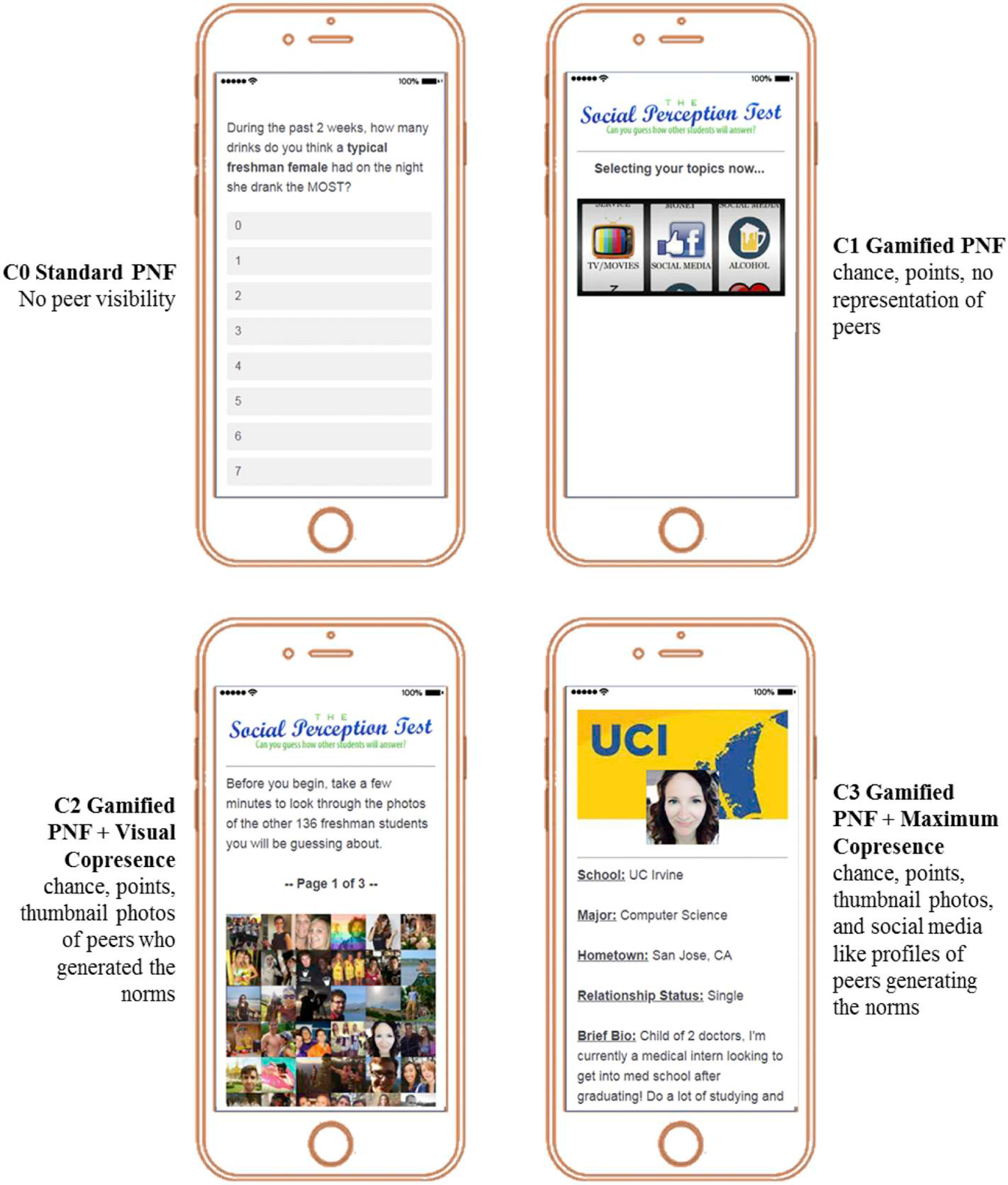
Screenshots of the study conditions showing varying levels of peer visibility.
Note: The class year and gender changed to match the reported gender and class year for each participant.
Next, participants in the latter two conditions were prompted to browse the thumbnail sized avatar images of the 136 other students who ostensibly played during the previous week. The photos were divided up among three pages. To avoid potential confounds to study condition, all participants were presented the same set of 136 stock photos of college students. The sets of stock images selected were those rated by our undergraduate research assistants to look most like the avatars typical college students would select to represent them on their Facebook profiles. The avatar photos were also selected to correspond to the racial/ethnic composition of the university. The participants in the Gamified PNF+Visual Copresence condition simply browsed the three pages of user avatars for as long as they wanted (see Fig. 1 for a screenshot) before advancing to the next task. Participants in the Gamified PNF+Maximum Copresence condition were required to choose 3 student profiles to view from each of the 3 pages of avatars (9 profiles total). Touching or clicking on an avatar opened a view of that user’s profile. These ‘profiles’ were developed by undergraduate research assistants and consisted of a simple banner denoting the university that the student attends, their avatar photo, hometown, major, and bio. The bios, majors, and hometowns varied in order to represent a broad range of students. Majors and hometowns matched with popular majors and hometowns of students at the university and the short bios varied in terms of interests and writing/communication style. To ensure consistency throughout the condition, the textual profile content was held constant. Thus, all participants in this condition saw the same nine profiles in the same order. In order to create the feeling that participants were freely selecting which profile to view, a software program automatically superimposed the avatar photo selected onto the next profile, keeping all other information constant. To facilitate this, all profiles did not refer to the sex or appearance of the individual in the bio so that every photo would pair naturally with every profile. In order to hold exposure to profiles constant, all participants were required to view nine profiles before moving on to the next task.
Immediately after the copresence manipulation, but before answering any perception questions, all participants responded to survey questions about their feelings of copresence, to serve as a manipulation check. Next, all four conditions prompted participants to answer the same questions about their perceptions of their peers’ alcohol use as well as their own corresponding alcohol use. Participants in the three gamified conditions also answered questions about the two “randomly selected” categories (TV watching and social media) in addition to the alcohol questions. Participants in the gamified conditions then viewed another spinner that selected the feedback topic (apparently at random). However, the spinner always chose alcohol. Participants in all conditions then received PNF on alcohol use. Feedback for each question consisted of a screen revealing graphs comparing participants’ perceptions to the actual average (ostensibly calculated from the 136 students but, in reality, taken from existing survey data in our lab) and participants’ own self-reported behavior to the actual average. Participants in the three gamified conditions also viewed a screen revealing the number of ‘points won’ based on the accuracy of their guesses.
Finally, a link to complete the follow-up survey was emailed to participants 3 weeks post-intervention. After completing the final follow-up, participants were debriefed regarding the study’s research questions and deceptive elements (i.e., avatar photos, profiles, nonrandom spinners).
2.3. Measures
At the start of the survey/game, participants answered items assessing their sex, class year, race, and ethnicity.
2.3.1. Copresence
Four items assessed participants’ experience of copresence. This measure prompted participants to think about the 136 other students apparently taking the Social Perception Test and to indicate on a scale of 1 (strongly disagree) to 7 (strongly agree) how much they agreed with the following statements: “I feel like these students are similar to me”, “I feel like I understand the lives of these students”, “I feel like these students and I are part of the same group”, and “The other students and I probably experienced similar feelings about participating in this study.” The items were averaged for the final copresence measure used in the study (α=0.80).
2.3.2. Perceptions of drinking norms
Participants answered questions about their perceptions of past two-week drinking behaviors of university students of their same sex and class year. The following items measured average, peak, and binge norms respectively: “How many drinks do you think a typical [female/male] [freshman/sophomore/junior/senior] student had, on average, each time [he/she] drank during the past two weeks?”; “How many drinks do you think a typical [female/male] [freshman/sophomore/junior/senior] student had on the night [he/she] drank the MOST during the past two weeks?”; and “How many times in the past two weeks do you think a typical [female/male] [freshman/sophomore/junior/senior] student drank [4+/5+] drinks within a few hours?”. The response options ranged from 0 to 10+ for average drinks, 0–12+ for peak, and 0–7+ for binge occasions.
2.3.3. Alcohol consumption
Participants reported their own alcohol consumption during the previous 2 weeks using three items that paralleled the norms items (e.g., average, peak, and binge). For example, the following item assessed average drinks: “How many drinks did you have each time you drank, on average, in the past two weeks?” The response options were the same for participants reporting their own alcohol consumption.
2.4. Analysis plan
All analyses were conducted using SPSS version 24 and included participant source (i.e., subject pool versus judicial), sex, and class-year standing as covariates. An ANOVA was used to conduct the manipulation check, with simple contrasts used to compare copresence ratings between the Standard PNF condition and each of the three gamified PNF conditions. Linear regression was used to assess the main effect of condition on each of the three drinking outcomes at T2 while controlling for the corresponding baseline drinking outcome. Model 1 of Hayes’ (2017) PROCESS macro 3.0 was used to assess whether providing the avatar photos and/or text-based profile information about the other students was especially effective in reducing alcohol use among students who were heavier drinkers at baseline. The 95% confidence intervals were generated using 10,000 bootstrap samples.
3. Results
3.1. Preliminary results & manipulation check
Accounting for covariates, there was a statistically significant omnibus effect of condition on copresence, F(3, 228)=3.411, p=.018, η2=0.042. Probing this effect using simple contrasts, there was no significant difference between the Standard PNF and Gamified PNF conditions, p=.180. There were, however, significant differences between the Standard PNF condition and the Gamified PNF+Visual Copresence condition, p=.031, and the Gamified PNF+Maximum Copresence condition, p=.002 (see Table 1 for means and standard deviations).
Table 1.
Descriptive statistics for demographics, attrition, alcohol use and copresence overall and by study condition.
| Overall | C0 standard PNF | C1 gamified PNF | C2 gamified PNF+visual copresence | C3 gamified PNF+maximum copresence | |
|---|---|---|---|---|---|
| N=235 | n=58 | n=59 | n=58 | n=60 | |
| % (n) | % (n) | % (n) | % (n) | % (n) | |
| Sex female | 52.34 (123) | 51.72 (30) | 52.54 (31) | 60.34 (35) | 45.00 (27) |
| Class freshman | 48.09 (113) | 44.83 (26) | 44.07 (26) | 46.55 (27) | 56.67 (34) |
| Source subject pool | 62.98 (148) | 62.07 (36) | 66.10 (39) | 63.79 (37) | 60.00 (36) |
| Attrition T1 to T2 | 0.04 (9) | 0.05 (3) | 0.03 (2) | 0.05 (3) | 0.02 (1) |
| M (SD) | M (SD) | M (SD) | M (SD) | M (SD) | |
| T1 average drinks | 4.07 (2.43) | 4.12 (2.68) | 4.36 (2.19) | 3.69 (2.47) | 4.12 (2.35) |
| T1 peak drinks | 5.92 (3.22) | 6.12 (3.51) | 6.27 (3.11) | 5.26 (3.12) | 6.01 (3.13) |
| T1 binge episodes | 1.72 (1.17) | 1.60 (1.64) | 1.88 (1.56) | 1.59 (1.76) | 1.80 (1.61) |
| T1 copresence rating | 4.00 (1.06) | 3.68 (1.28)<C2, <C3 | 3.96 (0.97) | 4.11 (1.02) >C0 | 4.27 (0.85) >C0 |
| T2 average drinks | 3.26 (2.21) | 3.72 (2.79)< C3 | 3.39 (2.03) | 3.14 (2.18) | 2.82 (1.66) >C0 |
| T2 peak drinks | 4.79 (3.32) | 5.38 (4.17) <C3 | 5.08 (2.91) | 4.53 (3.27) | 4.18(2.71) >C0 |
| T2 binge episodes | 1.50 (1.18) | 1.69 (1.44) <C3 | 1.73 (1.11) <C3 | 1.36 (1.12) | 1.23 (0.96) >C0, >C1 |
Notes. Superscripts in condition-specific columns denote significant differences, p < .05, between unadjusted conditional means or percentages in that condition versus the condition in superscript; The > and < symbols denote whether the value was significantly greater than or less than (respectively) the condition noted in the superscript.
3.2. Main effects of condition
After controlling for covariates, there was not a statistically significant difference in the average number of drinks between the Standard PNF condition and the Gamified PNF condition, t(227)=−1.276, p=.203, or the Gamified PNF+Visual Copresence condition, t(227)=−1.185, p=.237. There was, however, a significantly greater decrease in average number of drinks in the Gamified PNF+Maximum Copresence condition compared to the Standard PNF condition, t(227)=−2.455, p=.015 (see Table 2).
Table 2.
Regression models testing the effects of study condition on peak drinks, average drinks and binge episodes at follow-up among college drinkers (N=227).
| Step | Predictors | T2 average drinks | T2 peak drinks | T2 binge episodes |
|---|---|---|---|---|
| B (SE) | B (SE) | B (SE) | ||
| 1 | Judicial origin | −0.35 (0.27) | −0.15 (0.37) | −0.16 (0.13) |
| Class year | −0.03 (0.16) | −0.13 (0.21) | 0.01 (0.08) | |
| Female sex | 0.32 (0.26) | 0.16 (0.35) | 0.04 (0.13) | |
| T1 alcohol outcome | 0.45 (0.05)*** | 0.64 (0.06)*** | 0.41 (0.04)*** | |
| C1 (relative to C0) | −0.46 (0.36) | −0.40 (0.49) | −0.08 (0.18) | |
| C2 (relative to C0) | −0.43 (0.36) | −0.31 (0.49) | −0.33 (0.18) | |
| C3 (relative to C0) | −0.88 (0.36)* | −1.14 (0.48)* | −0.53 (0.18)** | |
| 2 | C1*T1 alcohol outcome | −0.24 (0.14) | −0.22 (0.14) | −0.13 (0.11) |
| C2*T1 alcohol outcome | −0.59 (0.13)*** | −0.56 (0.14)*** | −0.33 (0.10)** | |
| C3*T1 alcohol outcome | −0.61 (0.14)*** | −0.54 (0.14)*** | −0.34 (0.11)** | |
| Total | Model | R2 = 0.34 | R2 = 0.45 | R2 = 0.39 |
| F(10, 224) = 11.46*** | F(10, 224) = 18.23*** | F(10, 224) = 14.09*** | ||
Notes: C0: Standard PNF; C1: Gamified PNF; C2: Gamified PNF+Visual Copresence; C3: Gamified PNF+Maximum Copresence. Judicial Origin refers to students recruited from the Judicial Affairs Office.
p < .05.
p < .01.
p < .001.
A similar pattern occurred when looking at peak number of drinks, with no statistically significant differences between the Standard PNF and the Gamified PNF conditions, t(227)=−0.831, p=.407, or the Gamified PNF+Visual Copresence condition, t(227)=−0.633, p=.527, However, there was a significantly greater decrease in peak number of drinks in the Gamified PNF+Maximum Copresence condition compared to the Standard PNF condition, t(227)=−2.363, p=.019.
When looking at binge drinking, there was not a significant difference between the Standard PNF condition and the Gamified PNF condition, t(227)=−0.451, p=.653 nor the Gamified PNF+Visual Copresence condition, t(227)=−1.805, p=.072, and the Gamified PNF+Maximum Copresence condition led to a significantly greater decrease in binge drinking, t(227)=−2.945, p=.004, when compared to the Standard PNF condition.
3.3. Moderation
The Standard PNF condition was used as the reference group for all moderation analyses. Interactions were probed with conditional effects using +/− 1 SD from the mean of T1 drinking (i.e., average, peak, binge).
3.3.1. Average number of drinks
There was no statistically significant interaction between the Gamified PNF condition and average drinks at T1, t(224)=−1.677, p=.095, 95% CI[−0.521, 0.042]. There was, however, a significant interaction between the Gamified PNF+Visual Copresence condition and average drinks at T1, t(224)=−4.403, p < .001, 95% CI [−0.855, −0.326]. Looking at the conditional effects, the Gamified PNF+Visual Copresence condition led to a greater decrease in average number of drinks compared to the Standard PNF condition for those who started as heavier drinkers, t(224)=−3.949, p < .001, 95% CI [−2.906, −0.971], but not those who started as average drinkers, t (224)=−1.458, p=.146, 95% CI[−1.182, 0.177]. The regression model predicted a higher average number of drinks in the Gamified PNF+Visual Copresence condition compared to the Standard PNF condition for lighter drinkers t(224)=2.041, p=.042, 95% CI[0.032, 1.835].
There was a significant interaction between the Gamified PNF+Maximum Copresence condition and average drinks at T1, t (224)=−4.444, p < .001, 95% CI[−0.874, −0.337]. Looking at the conditional effects, the Gamified PNF+Maximum Copresence condition led to a greater decrease in average number of drinks relative to Standard PNF for those who started as average, t(224)=−2.525, p = .012, 95% CI[−1.531, −0.189], or heavier drinkers, t (224)=−4.952, p < .001, 95% CI[−3.262, −1.405], but not those who started as lighter drinkers t(224)=1.280, p=.202, 95% CI [−0.331, 1.558].
3.3.2. Peak number of drinks
There was no statistically significant interaction between the Gamified PNF condition and peak drinks at T1, t(224)=−1.524, p=.129, 95% CI[−0.500, 0.064]. There was, however, a significant interaction between the Gamified PNF+Visual Copresence condition and peak drinks at T1, t(224)=−3.872, p <. 001, 95% CI[−0.838, −0.273]. Looking at the conditional effects, the Gamified PNF+Visual Copresence condition led to a greater decrease in peak number of drinks compared to the Standard PNF condition for those who started as heavier drinkers, t(224)=−3.176, p=.002, 95% CI[−3.550, −0.832], but not those who started as average drinkers, t (224)=−0.845, p=.399, 95% CI[−1.338, 0.535]. The regression model predicted greater peak drinking in the Gamified PNF+Visual Copresence condition compared to the Standard PNF condition for lighter drinkers t(224)=2.187, p=.030, 95% CI[0.137, 2.639].
There was a significant interaction between the Gamified PNF+Maximum Copresence condition and peak drinks at T1, t (224)=−3.848, p < .001, 95% CI[−0.828, −0.267]. Looking at the conditional effects, the Gamified PNF+Maximum Copresence condition led to a greater decrease in peak number of drinks compared to the Standard PNF condition for those who started as average, t (224)=−2.309, p=.022, 95% CI[−1.998, −0.158], or heavier drinkers, t(224)=−4.424, p < .001, 95% CI[−4.109, −1.577], but not those who started as lighter drinkers t(224)=1.031, p=.304, 95% CI[−0.626, 1.999].
3.3.3. Binge drinking
There was no statistically significant interaction between the Gamified PNF condition and binge drinking at T1, t(224)=−1.198, p=.232, 95% CI[−0.351, 0.085]. There was, however, a significant interaction between the Gamified PNF+Visual Copresence condition and binge drinking at T1, t(224)=−3.207, p=.002, 95% CI[−0.542, −0.129]. Looking at the conditional effects, the Gamified PNF+Visual Copresence condition led to a greater decrease in binge drinking compared to the Standard PNF condition for those who started as average, t (224)=−2.080, p=.039, 95% CI[−0.715, −0.019], or heavier drinkers, t(224)=−3.594, p < .001, 95% CI[−1.421, −0.415], but not those who started as lighter drinkers, t(224)=−0.774, p=.440, 95% CI[−0.284, 0.650].
There was also significant interaction between the Gamified PNF+Maximum Copresence condition and binge drinking at T1, t (224)=−3.186, p=.002, 95% CI[−0.557, −0.131]. Looking at the conditional effects, the Gamified PNF+Maximum Copresence condition led to a greater decrease in peak number of drinks compared to the Standard PNF condition for those who started as average, t (224)=−3.085, p=.002, 95% CI[−0.886, −0.195], or heavier drinkers, t(224)=−4.417, p < .001, 95% CI[−1.599, −0.612], but not those who started as lighter drinkers t(224)=0.098, p=.922, 95% CI[−0.465, 0.514].
4. Discussion
Virtual copresence, or the sensation of ‘being there’ with others in an online space, is a feeling conjured by popular social media platforms, smartphone games, and websites through user avatars and profiles. Employing these same features in the current study, we experimentally manipulated the level of copresence in a brief gamified PNF alcohol intervention. Results revealed that this manipulation was impactful, as participants reported increasingly greater levels of copresence in conditions with profile pictures and profile information. Further, the Gamified PNF Maximum Copresence condition, which included thumbnail photos of other users and the ability to browse profiles of other students, demonstrated significantly greater reductions in alcohol use at the 3-week follow-up relative to Standard PNF, especially among heavy drinkers. These results suggest that copresence is an important aspect of successful gamified PNF interventions and incorporating user avatars and social media-like profiles into gamified interventions can increase efficacy, even in the absence of user interaction and social support.
Analyses revealed that, for all three alcohol use variables assessed, the effect of condition on drinking was moderated by participants’ baseline level of alcohol consumption, with the strongest effects among heavier drinkers. Using the coefficients in the respective PROCESS models, students who reported a peak consumption of 10.0 drinks on a single occasion (the definition of extreme drinking) at baseline, on average reduced their peak by 4.5 drinks at follow-up in the Gamified PNF Maximum Copresence condition, compared to an average reduction of only one drink in the Standard PNF condition. Similarly, among the heaviest drinking participants, average drinks per occasion dropped by 3.75 drinks in the Gamified PNF Maximum Copresence condition compared to just 1 drink in the Standard PNF group. Finally, predicted average number of binge drinking episodes dropped an episode and a half (from 3.0 to 1.5) in the Gamified PNF Maximum Copresence condition while only decreasing half an episode among Standard PNF participants (from 3.0 to 2.5; see Fig. 2). Taken together, these findings suggest copresence features may be especially beneficial for the heaviest drinking students and those who engage in extreme drinking. These students may be more likely to question the norms (i.e., the norms’ source) in standard PNF interventions, and thus benefit most from the copresence enhancement.
Fig. 2.
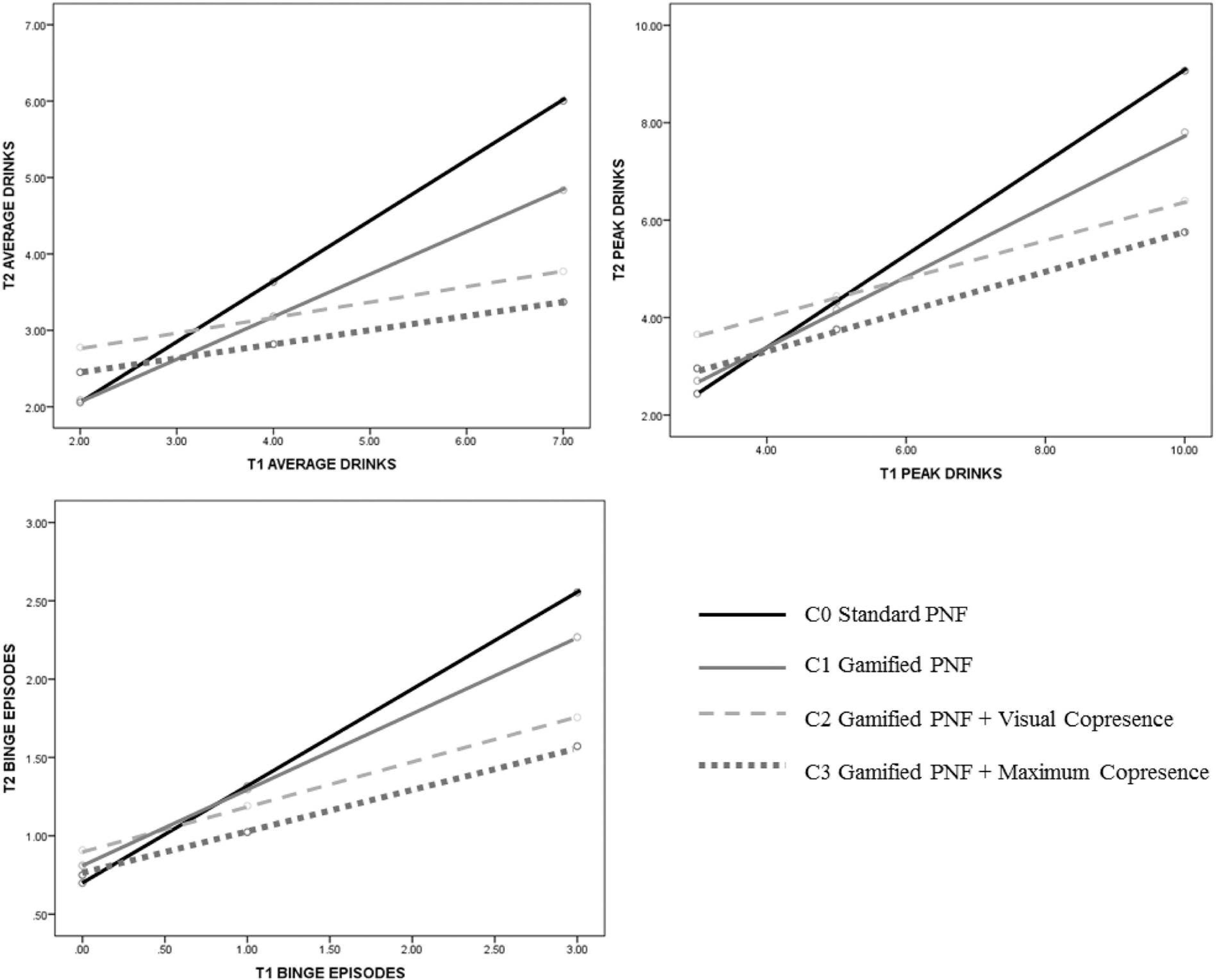
Models of interactions between condition and T1 alcohol outcomes on T2 alcohol outcomes.
4.1. Implications
In combination with our previous paper (Boyle, Earle, et al., 2018), which isolated the effects of varying levels of chance-based uncertainty on a gamified PNF intervention, these results continue to illuminate and extend our pilot work on a fully-gamified PNF alcohol intervention for college students (Boyle et al., 2017; Earle et al., 2018). Specifically, the current paper’s findings suggest that including copresence features beyond the traditional approach of presenting students with data taken from “a recent survey of students on your campus” or from “a nation-wide study of college students” may be particularly helpful. It appears that for heavier drinking students these types of survey data traditionally used in Standard PNF might not be as impactful as having a visual and biographical sense of the group of students from whom the norms are derived. Finding ways to make participants feel more connected to the specific peer group from which the norms have been derived may increase believability, attention, impact, and intervention efficacy.
Given that copresence features are commonly integrated on many social media sites (via profile pictures, bios, live chats), interventionists may benefit from utilizing social media-like features to enhance their interventions. While previous research has used social media as platforms to deliver health behavior interventions (Ramo et al., 2018; Ridout & Campbell, 2014), comprehensive reviews generally find small or non-significant effects for these types of interventions (Welch, Petkovic, Pardo, Rader, & Tugwell, 2016) and encourage a more targeted theory-based approach when using social media for interventions (Maher et al., 2014). Thus, using copresence features (i.e., user avatars and profiles) to represent the sources of the norms may be a particularly effective, theory-driven method of improving social norms-based interventions.
4.2. Limitations and directions for future research
Findings from the current study are specific to college students from a single west coast university; thus, further studies with larger and more diverse cohorts of students from multiple universities are necessary. Additionally, given the study’s short follow-up period of 3 weeks, future research should include longer follow-up periods (e.g., 6 months, 1 year). The current study is also limited by its sample size, which makes it difficult to discern smaller effects and precludes us from assessing pairwise comparisons between individual conditions. Though the predicted trend was clearly visible among heavy drinkers for every outcome, with each successive condition outperforming the last in terms of the magnitude of drinking reductions, this difference was only significant when the Gamified PNF+Maximum Copresence condition was compared to the Standard PNF condition. Using thumbnail photos as the only copresence feature did not significantly improve the PNF intervention after controlling for baseline drinking. Similarly, the small sample size also prevented us from including a condition in which participants made text-based profiles but did not submit photos, which would have completed the 2×2+1 design.
An unexpected finding emerged among light drinking students randomized to the Gamified PNF+Visual Copresence condition. Specifically, lighter drinkers reported greater average and peaks drinks at follow-up than did lighter drinkers in the Standard PNF condition. Oddly, this suggests that the Gamified PNF+Visual Copresence condition had an iatrogenic effect on these drinking outcomes among lighter drinking participants while the Gamified PNF+Maximum Copresence condition, which included more copresence features, did not. Inspecting alcohol consumption by study condition at baseline (Table 1) however, average and peak drinks trended lower in the Gamified + Visual Copresence condition compared to the other conditions, suggesting that these effects may be spurious. A replication study will be needed to determine whether the iatrogenic effect or error explanation for this study’s pattern of results among low-risk drinkers is correct. If the iatrogenic explanation holds, it will be critical to identify the psychological mechanisms that explain why some co-presence features but not others diminish PNF’s impact among lighter drinkers. Further, as the current study only included alcohol experienced students, it remains unknown whether the copresence features investigated in this study would be similarly beneficial for non-drinking students. Future research should examine the impact of adding copresence features to a gamified PNF intervention for students with no alcohol experience.
In addition, the Gamified PNF+Maximum Copresence condition in the current study required participants not only to view more information about other students contributing to the norms, but also spend time constructing a profile of their own. Thus, not only did the copresence conditions increase the level of peer visibility, but they also increased the participants’ level of interaction with the intervention. It is possible that this process contributed to the increased feelings of copresence. Future research should attempt to isolate the effects of creating profiles and viewing profiles on feelings of copresence. Additionally, the current study examined copresence only in conditions with gamified PNF in order to build upon our previous gamification work (Boyle et al., 2017; Boyle, Earle, et al., 2018; Earle et al., 2018). However, this study did not examine the effects of copresence features in a Standard PNF intervention. In order to separate the effects of copresence from the effects of a gamified intervention, future research may wish to consider how the addition of user avatars and profiles to a Standard PNF intervention influences feelings of copresence and drinking outcomes. Additionally, while our theoretical rationale to include copresence in this intervention was that it would increase the credibility and believability of the feedback, this was not directly tested in the present study. Future research is needed to identify the psychological mechanisms by which copresence features impact PNF interventions.
A final avenue for future research is to investigate the hypothesis that inducing copresence in PNF interventions may be particularly impactful among heavy social media users. It is possible that the reason students today respond well to copresence features is because they are conditioned to accept these features as “normal” as a result of their regular social media use. This suggests that more frequent social media users, who are exposed to copresence features more often, may benefit most strongly from the inclusion of such features within an intervention. Features that improve intervention efficacy among this heavy social media using cohort are important to discover, as mounting evidence suggests alcohol-related content on social media may be influencing students to participate more frequently in heavy drinking (Boyle, LaBrie, Froidevaux, & Witkovic, 2016; Erevik, Pallesen, Vedaa, Andreassen, & Torsheim, 2017; Steers, Moreno, & Neighbors, 2016).
4.3. Conclusion
This study isolated the game mechanic of virtual copresence, or “being there” with others in an online space. A PNF intervention for college students was significantly more effective at reducing risky drinking behavior in heavy drinking college students when the intervention enhanced gamified elements designed to create a feeling of virtual copresence. Further, the enhancing effects of copresence were concentrated among the students with the heaviest pre-intervention levels of alcohol consumption, the highest-risk cohort of drinkers. The findings suggest the addition of both copresence elements (profiles and thumbnail images) to represent other users from whom the norms used in the feedback are derived can enhance the effects of gamified feedback interventions, especially among high-risk heavy drinkers.
HIGHLIGHTS.
Visual and textual information about peers induce feelings of copresence.
This study isolated the effect of copresence in a gamified alcohol intervention.
The condition with the highest level of copresence significantly reduced drinking.
Effects were concentrated among the heaviest drinking students.
Funding
This work was supported by the National Institute on Alcohol Abuse and Alcoholism [grant number R21AA024853].
Footnotes
Declaration of Competing interest
All authors declare they have no conflicts of interest.
References
- Aljukhadar M, Senecal S, & Ouellette D (2010). Can the media richness of a privacy disclosure enhance outcome? A multifaceted view of trust in rich media environments. International Journal of Electronic Commerce, 14(4), 103–126. 10.2753/JEC1086-4415140404. [DOI] [Google Scholar]
- Anderson-Bill ES, Winett RA, & Wojcik JR (2011). Social cognitive determinants of nutrition and physical activity among web-health users enrolling in an online intervention: The influence of social support, self efficacy, outcomes expectations, and self-regulation. Journal of Medical Internet Research, 13(1), 147–162. 10.2196/jmir.1551. [DOI] [PMC free article] [PubMed] [Google Scholar]
- Barrera M, Glasgow RE, McKay HG, Boles SM, & Feil EG (2002). Do internet-based support interventions change perceptions of social support?: An experimental trial of approaches for supporting diabetes self-management. American Journal of Community Psychology, 30(5), 637–654. 10.1023/A:1016369114780. [DOI] [PubMed] [Google Scholar]
- Boyle SC, Earle AM, LaBrie JW, & Smith DJ (2017). PNF 2.0? Initial evidence that gamification can increase the efficacy of brief, web-based personalized normative feedback alcohol interventions. Addictive Behaviors, 67, 8–17. 10.1016/j.addbeh.2016.11.024. [DOI] [PMC free article] [PubMed] [Google Scholar]
- Boyle SC, Earle AM, McCabe N, & LaBrie JW (2018). Increasing chance-based uncertainty reduces heavy drinkers’ cognitive reactance to web-based personalized normative feedback. Journal of Studies on Alcohol and Drugs, 79(4), 601–610. 10.15288/jsad.2018.79.601. [DOI] [PMC free article] [PubMed] [Google Scholar]
- Boyle SC, LaBrie JW, Froidevaux NM, & Witkovic YD (2016). Different digital paths to the keg? How exposure to peers’ alcohol-related social media content influences drinking among male and female first-year college students. Addictive Behaviors, 57, 21–29. 10.1016/j.addbeh.2016.01.011. [DOI] [PMC free article] [PubMed] [Google Scholar]
- Breuer J, & Bente G (2010). Why so serious? On the relation of serious games and learning. Journal for Computer Game Culture, 4(1), 7–24. [Google Scholar]
- Brown M, O’Neill N, van Woerden H, Eslambolchilar P, Jones M, & John A (2016). Gamification and adherence to web-based mental health interventions: A systematic review. JMIR Mental Health, 3(3), 10.2196/mental.5710. [DOI] [PMC free article] [PubMed] [Google Scholar]
- Bulu ST (2012). Place presence, social presence, co-presence, and satisfaction in virtual worlds. Computers & Education, 58(1), 154–161. 10.1016/j.compedu.2011.08.024. [DOI] [Google Scholar]
- Caamaño-Isorna F, Moure-Rodríguez L, Doallo S, Corral M, Rodriguez Holguín S, & Cadaveira F (2017). Heavy episodic drinking and alcohol-related injuries: An open cohort study among college students. Accident Analysis & Prevention, 100, 23–29. 10.1016/j.aap.2016.12.012. [DOI] [PubMed] [Google Scholar]
- Comello MLG, Qian X, Deal AM, Ribisl KM, Linnan LA, & Tate DF (2016). Impact of game-inspired infographics on user engagement and information processing in an eHealth program. Journal of Medical Internet Research, 18(9), e237. 10.2196/jmir.5976. [DOI] [PMC free article] [PubMed] [Google Scholar]
- Cronce JM, & Larimer ME (2011). Individual-focused approaches to the prevention of college student drinking. Alcohol Research and Health, 34(2), 210–221. Retrieved from http://electra.lmu.edu:2048/login?url=https://search.proquest.com/docview/912154914?accountid=7418. [PMC free article] [PubMed] [Google Scholar]
- Daft RL, & Lengel RH (1986). Organizational information requirements, media richness and structural design. Management Science, 32(5), 554–571. 10.1287/mnsc.32.5.554. [DOI] [Google Scholar]
- David ME, Roberts JA, & Christenson B (2018). Too much of a good thing: Investigating the association between actual smartphone use and individual well-being. International Journal of Human–Computer Interaction, 34(3), 265–275. 10.1080/10447318.2017.1349250. [DOI] [Google Scholar]
- Dawson DA, Grant BF, Stinson FS, & Chou PS (2004). Another look at heavy episodic drinking and alcohol use disorders among college and noncollege youth. Journal of Studies on Alcohol, 65(4), 477–488. 10.15288/jsa.2004.65.477. [DOI] [PubMed] [Google Scholar]
- Dotson KB, Dunn ME, & Bowers CA (2015). Stand-alone personalized normative feedback for college student drinkers: A meta-analytic review, 2004 to 2014. PLoS One, 10(10), e0139518. 10.1371/journal.pone.0139518. [DOI] [PMC free article] [PubMed] [Google Scholar]
- Earle AM, LaBrie JW, Boyle SC, & Smith D (2018). In pursuit of a self-sustaining college alcohol intervention: Deploying gamified PNF in the real world. Addictive Behaviors, 80, 71–81. 10.1016/j.addbeh.2018.01.005. [DOI] [PMC free article] [PubMed] [Google Scholar]
- Erevik EK, Pallesen S, Vedaa Ø, Andreassen CS, & Torsheim T (2017). Alcohol use among Norwegian students: Demographics, personality and psychological health correlates of drinking patterns. Nordic Studies on Alcohol and Drugs, 34(5), 415–429. 10.1177/1455072517709918. [DOI] [PMC free article] [PubMed] [Google Scholar]
- Eysenbach G, Powell J, Englesakis M, Rizo C, & Stern A (2004). Health related virtual communities and electronic support groups: Systematic review of the effects of online peer to peer interactions. BMJ, 328(7449), 1166. 10.1136/bmj.328.7449.1166. [DOI] [PMC free article] [PubMed] [Google Scholar]
- Foster C, Caravelis C, & Kopak A (2013). National College Health Assessment measuring negative alcohol-related consequences among college students. American Journal of Public Health Research, 2(1), 1–5. 10.12691/ajphr-2-1-1. [DOI] [Google Scholar]
- Gefen D, & Straub DW (2004). Consumer trust in B2C e-commerce and the importance of social presence: Experiments in e-products and e-services. Omega, 32(6), 407–424. 10.1016/j.omega.2004.01.006. [DOI] [Google Scholar]
- Girard C, Ecalle J, & Magnan A (2013). Serious games as new educational tools: How effective are they? A meta-analysis of recent studies: Serious games as educational tools. Journal of Computer Assisted Learning, 29(3), 207–219. 10.1111/j.1365-2729.2012.00489.x. [DOI] [Google Scholar]
- Goffman E (1963). Behavior in public places. New York: Free Press. [Google Scholar]
- Granfield R (2005). Alcohol use in college: Limitations on the transformation of social norms. Addiction Research & Theory, 13(3), 281–292. 10.1080/16066350500053620. [DOI] [Google Scholar]
- Hassanein K, & Head M (2007). Manipulating perceived social presence through the web interface and its impact on attitude towards online shopping. International Journal of Human-Computer Studies, 65(8), 689–708. 10.1016/j.ijhcs.2006.11.018. [DOI] [Google Scholar]
- Hayes AF (2017). Introduction to mediation, moderation, and conditional process analysis: A regression-based approach. New York, NY: Guilford Publications. [Google Scholar]
- Hingson R, Zha W, Simons-Morton B, & White A (2016). Alcohol-induced blackouts as predictors of other drinking related harms among emerging young adults. Alcoholism, Clinical and Experimental Research, 40(4), 776–784. 10.1111/acer.13010. [DOI] [PMC free article] [PubMed] [Google Scholar]
- Holzwarth M, Janiszewski C, & Neumann MM (2006). The influence of Avatars on online consumer shopping behavior. Journal of Marketing, 70(4), 19–36. Retrieved from http://electra.lmu.edu:2048/login?url=https://search.ebscohost.com/login.aspx?direct=true&db=bth&AN=22285162&site=eds-live&scope=site. [Google Scholar]
- LaBrie JW, Hummer JF, Huchting KK, & Neighbors C (2009). A brief live interactive normative group intervention using wireless keypads to reduce drinking and alcohol consequences in college student athletes. Drug and Alcohol Review, 28(1), 40–47. 10.1111/j.1465-3362.2008.00012.x. [DOI] [PMC free article] [PubMed] [Google Scholar]
- LaBrie JW, Hummer JF, Neighbors C, & Pedersen ER (2008). Live interactive group-specific normative feedback reduces misperceptions and drinking in college students: A randomized cluster trial. Psychology of Addictive Behaviors: Journal of the Society of Psychologists in Addictive Behaviors, 22(1), 141–148. 10.1037/0893-164X.22.1.141. [DOI] [PMC free article] [PubMed] [Google Scholar]
- LaBrie JW, Lewis MA, Atkins DC, Neighbors C, Zheng C, Kenney SR, & Larimer ME (2013). RCT of web-based personalized normative feedback for college drinking prevention: Are typical student norms good enough? Journal of Consulting and Clinical Psychology, 81(6), 1074–1086. 10.1037/a0034087. [DOI] [PMC free article] [PubMed] [Google Scholar]
- Larimer ME, & Cronce JM (2002). Identification, prevention and treatment: A review of individual-focused strategies to reduce problematic alcohol consumption by college students. Journal of Studies on Alcohol, Supplement, (s14), 148–163. 10.15288/jsas.2002.s14.148. [DOI] [PubMed] [Google Scholar]
- Larimer ME, Neighbors C, LaBrie JW, Atkins DC, Lewis MA, Lee CM, … Walter T (2011). Descriptive drinking norms: For whom does reference group matter? Journal of Studies on Alcohol and Drugs, 72(5), 833–843. 10.15288/jsad.2011.72.833. [DOI] [PMC free article] [PubMed] [Google Scholar]
- Leffingwell TR, Neumann C, Leedy MJ, & Babitzke AC (2007). Defensively biased responding to risk information among alcohol-using college students. Addictive Behaviors, 32(1), 158–165. 10.1016/j.addbeh.2006.03.009. [DOI] [PubMed] [Google Scholar]
- Lewis MA, & Neighbors C (2006). Social norms approaches using descriptive drinking norms education: A review of the research on personalized normative feedback. Journal of American College Health : J of ACH, 54(4), 213–218. 10.3200/JACH.54.4.213-218. [DOI] [PMC free article] [PubMed] [Google Scholar]
- Maher CA, Lewis LK, Ferrar K, Marshall S, De Bourdeaudhuij I, & Vandelanotte C (2014). Are health behavior change interventions that use online social networks effective? A systematic review. Journal of Medical Internet Research, 16(2), 10.2196/jmir.2952. [DOI] [PMC free article] [PubMed] [Google Scholar]
- Merrill JE, & Carey KB (2016). Drinking over the lifespan: Focus on college ages. Alcohol Research : Current Reviews, 38(1), 103–114. Retrieved from https://www.ncbi.nlm.nih.gov/pubmed/27159817. [DOI] [PMC free article] [PubMed] [Google Scholar]
- Miller MB, Leffingwell T, Claborn K, Meier E, Walters S, & Neighbors C (2013). Personalized feedback interventions for college alcohol misuse: An update of Walters & Neighbors (2005). Psychology of Addictive Behaviors : Journal of the Society of Psychologists in Addictive Behaviors, 27(4), 909–920. 10.1037/a0031174. [DOI] [PMC free article] [PubMed] [Google Scholar]
- Polonec LD, Major AM, & Atwood LE (2006). Evaluating the believability and effectiveness of the social norms message “Most students drink 0 to 4 drinks when they party”. Health Communication, 20(1), 23–34. 10.1207/s15327027hc2001_3. [DOI] [PubMed] [Google Scholar]
- Ramo DE, Thrul J, Chavez K, Delucchi KL, & Prochaska JJ (2015). Feasibility and quit rates of the Tobacco Status Project: A Facebook smoking cessation intervention for young adults. Journal of Medical Internet Research, 17(12), 10.2196/jmir.5209. [DOI] [PMC free article] [PubMed] [Google Scholar]
- Ramo DE, Thrul J, Delucchi KL, Hall S, Ling PM, Belohlavek A, & Prochaska JJ (2018). A randomized controlled evaluation of the tobacco status project, a Facebook intervention for young adults. Addiction, 113(9), 1683–1695. 10.1111/add.14245. [DOI] [PMC free article] [PubMed] [Google Scholar]
- Ridout B, & Campbell A (2014). Using Facebook to deliver a social norm intervention to reduce problem drinking at university. Drug and Alcohol Review, 33(6), 667–673. 10.1111/dar.12141. [DOI] [PubMed] [Google Scholar]
- Riper H, van Straten A, Keuken M, Smit F, Schippers G, & Cuijpers P (2009). Curbing problem drinking with personalized-feedback interventions: A meta-analysis. American Journal of Preventive Medicine, 36(3), 247–255. 10.1016/j.amepre.2008.10.016. [DOI] [PubMed] [Google Scholar]
- Russo T, & Benson S (2005). Learning with invisible others: Perceptions of online presence and their relationship to cognitive and affective learning. Journal of Educational Technology & Society, 8(1), 54–62. Retrieved from http://electra.lmu.edu:2048/login?url=https://search.ebscohost.com/login.aspx?direct=true&db=a9h&AN=85866338&site=eds-live&scope=site. [Google Scholar]
- Schroeder R (2002). Copresence and interaction in virtual environments: An overview of the range of issues. 25. [Google Scholar]
- Schulenberg JE, Johnston LD, O’Malley PM, Bachman JG, Miech RA, Patrick ME, & University of Michigan, I. for S. R (2017). Monitoring the future national survey results on drug use, 1975–2016. Volume II, college students & adults ages 19–55. Institute for Social Research. Retrieved from http://electra.lmu.edu:2048/login?url=https://search.ebscohost.com/login.aspx?direct=true&db=eric&AN=ED578605&site=eds-live&scope=site. [Google Scholar]
- Steers M-LN, Moreno MA, & Neighbors C (2016). The influence of social media on addictive behaviors in college students. Current Addiction Reports, 3(4), 343–348. 10.1007/s40429-016-0123-x. [DOI] [PMC free article] [PubMed] [Google Scholar]
- Villanti AC, Johnson AL, Ilakkuvan V, Jacobs MA, Graham AL, & Rath JM (2017). Social media use and access to digital technology in US young adults in 2016. Journal of Medical Internet Research, 19(6), 383–396. 10.2196/jmir.7303. [DOI] [PMC free article] [PubMed] [Google Scholar]
- Walters ST, & Neighbors C (2005). Feedback interventions for college alcohol misuse: What, why and for whom? Addictive Behaviors, 30(6), 1168–1182. 10.1016/j.addbeh.2004.12.005. [DOI] [PMC free article] [PubMed] [Google Scholar]
- Welch V, Petkovic J, Pardo JP, Rader T, & Tugwell P (2016). Interactive social media interventions to promote health equity: An overview of reviews. Health Promotion and Chronic Disease Prevention in Canada : Research, Policy and Practice, 36(4), 63–75. Retrieved from https://www.ncbi.nlm.nih.gov/pmc/articles/PMC4964231/. [DOI] [PMC free article] [PubMed] [Google Scholar]
- White A, & Hingson R (2013). The burden of alcohol use: Excessive alcohol consumption and related consequences among college students. Alcohol Research: Current Reviews, 35(2), 201–218. [DOI] [PMC free article] [PubMed] [Google Scholar]
- Wouters P, van Nimwegen C, van Oostendorp H, & van der Spek ED (2013). A meta-analysis of the cognitive and motivational effects of serious games. Journal of Educational Psychology, 105(2), 249–265. 10.1037/a0031311. [DOI] [Google Scholar]