



Abstract
Aims
Diabetes is emerging as a risk factor for coronavirus disease (COVID)‐19 prognosis. However, contradictory findings have been reported regarding the impact of glycaemic control on COVID‐19 outcome. The aim of this meta‐analysis was to explore the impact of hospital pre‐admission or at‐admission values of HbA1c on COVID‐19 mortality or worsening in patients with diabetes.
Materials and Methods
We searched PubMed, Embase and Scopus up to 30th December 2020. Eligibility criteria for study selection were the following: (1)enrolling patients with any form of diabetes mellitus and hospitalized for COVID‐19 and (2) reporting data regarding HbA1c values before infection or at hospital admission in relation to COVID‐19 mortality or worsening. Descriptive statistics, HbA1c values, odds ratios (ORs) and hazard ratios were extracted from seven observational studies and generic inverse variance (random effects) of OR was used to estimate the effect of HbA1c on COVID‐19 outcome.
Results
HbA1c was linearly associated with an increased COVID‐19 mortality or worsening when considered as a continuous variable (OR 1.01 [1.01, 1.01]; p < 0.00001). Similarly, when analysing studies providing the number of events according to the degree of glycaemic control among various strata, a significantly increased risk was observed with poor glycaemic control (OR 1.15 [1.11, 1.19]; p < 0.00001), a result corroborated by sensitivity analysis.
Conclusions
Notwithstanding the large heterogeneity in study design and patients' characteristics in the few available studies, data suggest that patients with diabetes and poor glycaemic control before infection might have an increased risk of COVID‐19 related mortality.
Keywords: COVID‐19, COVID‐19 prognosis, glycaemic control, HbA1c, mortality, outcomes, SARS‐CoV‐2, type 1 diabetes mellitus, type 2 diabetes mellitus
1. INTRODUCTION
Diabetes mellitus (DM) is emerging as a critical risk factor for coronavirus diseases (COVID)‐19 poor prognosis, with a recent meta‐analysis reporting that COVID‐19 patients with pre‐existing DM have a threefold increased risk of in‐hospital mortality. 1 , 2 A number of hypotheses has been proposed to explain the observed increased risk among patients with DM, and multiple variables explored as intermediate risk factors. 3 , 4 Among others, blood glucose levels are emerging as a critical prognostic factor for COVID‐19 mortality in both patients with and without DM. 4 , 5 , 6 On the other hand, conflicting data have been reported regarding hospital pre‐admission or at‐admission assessment of glycaemic control in relation to COVID‐19 related mortality in patients with DM. 7 , 8 The objective of this study was to explore whether glycaemic control, as measured by HbA1c, is a relevant prognostic factor for acute COVID‐19 mortality or worsening of symptoms in patients with DM.
2. MATERIALS AND METHODS
2.1. Data source and study selection
We searched for studies through PubMed, Embase and Scopus up to 30th December 2020, collecting only articles in English. The strings used for the PubMed search can be found in the Data S1. Twenty‐four abstracts were identified. Two investigators (F.P. and P.d.C.) independently reviewed the selected abstracts to determine the eligibility of the studies for the meta‐analysis according to two inclusion criteria: (1) enrolling patients with any form of pre‐existing DM and hospitalized for COVID‐19 (laboratory confirmed or clinically assigned) and (2) reporting data regarding HbA1c values at hospital admission or before infection in relation to COVID‐19 mortality or a composite outcome including mortality with any follow‐up duration, including studies not having this outcome as the primary endpoint. Exclusion criteria were the following: (1)‐ populations composed of COVID‐19 patients without pre‐existing DM and (2)‐ manuscripts not reporting HbA1c among the variables analysed. The primary outcome of our analysis was mortality or the composite of mortality and disease worsening/progression, with no restriction to the definition of worsening. No secondary outcome was collected. The protocol was registered in OSF and it is accessible at https://osf.io/8h9yn. The MOOSE checklist 9 is available as Data S1.
2.2. Data extraction and quality assessment
Two authors (F.P. and P.d.C.) used a standardized collection form to extract summary estimates data of selected studies. Included information were study design, sample size, primary outcome, sex, age, diabetes duration, BMI, HbA1c, reported hazard ratios (HRs) or odds ratios (ORs) for HbA1c, and the relative statistic approach, including the adjustments applied. Data were checked for accuracy by two additional investigators (A.C. and A.N.). F.P. and P.d.C. independently used the Newcastle–Ottawa Scale (NOS) for non‐randomized cohort studies 10 to perform quality assessment of included manuscripts.
2.3. Data synthesis and statistical analysis
We used the generic inverse variance method to estimate the effect of HbA1c on COVID‐19 mortality starting from collected OR with the relative confidence intervals (CI)s. As the statistical methods were different in the collected studies, we separately analysed studies analysing HbA1c measurements as a continuous variable and studies instead providing risk estimates according to the degree of glycaemic control, categorizing HbA1c as a dichotomous variable. For those studies reporting HR for multiple HbA1c strata, 8 , 11 we calculated the relative crude OR with 95% CIs by extracting the number of events and the number of patients for two groups, split according to an HbA1c value of either < or >7.5% (good vs. poor glycaemic control, respectively). This cut‐off was selected in order to use all the collected studies and minimize the risk of bias since one study only allowed this extraction, 11 albeit current guidelines recommend an HbA1c target of 7% for most patients with DM. 12 Statistical heterogeneity between studies was evaluated by I 2 statistic and the significance for heterogeneity was set at I 2 >50% or p < 0.1, using the fixed effect model to estimate summary below this limit and the random effects model above the same threshold. For the sensitivity analysis, we performed an alternative calculation for studies reporting HR for multiple HbA1c strata, using HR as OR (given the short time of follow‐ups, i.e., COVID‐19 mortality or worsening is observed in 7–30 days) and pooling them through the generic inverse variance method (fixed effect) to obtain one OR value against the reference group. 8 , 13 All analyses were performed using review manager 5.4 (Cochrane Collaboration). 14
3. RESULTS
3.1. Study selection
Inclusion flow of studies is presented in Figure S1. Of the 26 abstracts identified, 16 manuscripts reported only data regarding blood glucose levels or range in relation to the observed outcome and not HbA1c values, 4 , 15 , 16 , 17 , 18 , 19 , 20 , 21 , 22 , 23 , 24 , 25 , 26 , 27 , 28 , 29 , 30 one study has only intubation as reported outcome, 31 another one included patients without DM in the group with good glycaemic control, 32 while the remaining one was focused on the comparison between pre‐existing and new‐onset diabetes. 33
3.2. Study characteristics
The characteristics of the included seven manuscripts 7 , 8 , 11 , 13 , 34 , 35 , 36 are presented in Table 1. They were all observational studies and there was only one prospective cohort, the CORONADO study, which provided separate data for type 1 DM (T1DM) and DM overall in two different manuscripts, 13 , 34 while another large study provided separate data for T1DM and T2DM in the same manuscript, 8 thus yielding an overall of eight study groups for the meta‐analysis. The quality assessment of included studies is reported in Figure S2. Overall, the analysis involved 4,985,063 patients, 298,850 with T1DM and 1,533,579 with a non‐specified form of DM. As evidenced in Table 1, there was a large heterogeneity in terms of study design, patients' characteristics and the approach adopted to both report descriptive statistics and calculate OR for the selected clinical variables. Thus, we analysed data treating HbA1c as a continuous variable separated from those allowing to treat glycaemic control as a dichotomous variable. For the same reasons, it was not possible to calculate the mean values of the extracted variables. As two manuscripts might have enrolled the same populations 8 , 13 albeit using different databases, we considered these studies one at a time.
TABLE 1.
Characteristics, extracted clinical variables and calculated OR of included studies
| Study | Population features | Sample size (total and groups, according to study design) | Primary Outcome | Length of follow‐up | Male sex % | Age mean (± SD or IQR) | Diabetes duration [CI] | BMI [CI] | HbA1c % | Statistical method | Reported OR or HR | Adjustment | Recalculated, unadjusted OR for meta‐analysis* | Alternative OR for sensitivity analysis+ | ||
|---|---|---|---|---|---|---|---|---|---|---|---|---|---|---|---|---|
| Agarwal et al. (2020) | Patients with diabetes and COVID‐19 | Total 1279 for HbA1c OR 1126 | Mortality | Clinical records from 11th Mar to 7th May | 49.3 | 67.9 ± 13.7 | NP | 30.1 ± 7.5 | NP | NP | Logistic regression | 1.01 (0.94, 1.09) | Multiple | \ | \ | |
| Coronado study (T1DM) | Type 1 diabetes and COVID‐19 | 56 (43 mild and 13 severe) | Mortality or tracheal intubation within 7 days | 7 days | 55.4 | 56.0 ± 16.4 | 26.0 [15.0; 39.5] | 25.8 (22.5; 29.8) | Alive/Mild 8.8 (7.9; 9.7) | Severe/Dead 8.1 (7.0; 8.4) | Logistic regression | 0.46 (0.17–1.21) | Age | \ | \ | |
| Coronado study | People with diabetes hospitalised for COVID‐19 | 1317 | Tracheal intubation and/or mortality within 7 days | 7 days | 64.9 | 69.8 ± 13.0 | 13.6 ± 10.9 | 28.4 (25.0–32.7) | Alive/Mild 8.2 ± 1.9 | Severe/Dead 8.1 ± 1.9 | Logistic regression | Composite primary 0.94 (0.86, 1.03) only death 1.02 (0.87, 1.19) | Multiple | \ | For death 1.16 [0.78, 1.74] | |
| McGurnaghan et al. (2020) | Patients with diabetes registered in the Scottish general practice electronic database | 319, 349 | Fatal or critical care unit‐treated COVID‐19 | Clinical records from 1st Mar 2020 to 31th Jul 2020 | NP | 66.7 (56.3–75.8) | 10.5 (5.7–16.6) | 30 (27–35) | Alive/Mild 7.37 (6.63; 8.55) | Severe/Dead 7.46 (6.45; 8.65) | Logistic regression | 1.010 (1.006–1.014) | Multiple | \ | \ | |
| Bhandari et al., 2020 | COVID‐19 patients with T2DM | 80 | Mortality (extracted from descriptive statistics) | Hospitalization time (date NP) | 57.5 | 61.45 ± 5.08 | NP | NP | 58 with HbA1c < 8%; 22 with HbA1c > 8% | Only tests for comparison among groups | Only p values provided | None | 2.64 (0.84–8.38) | \ | ||
| Holman et al. (2020) | Patients with diabetes registered in the English general practice electronic database | Type 1 diabetes (n = 264,390) | COVID‐19 related mortality (as registered in the database) | Clinical records from 16th Feb to 11th May | 56.6 | Data provided for different strata | HbA1c strata: <6.5% 17,950; 6.5%–7.0% 21,550; 7.1%–7.5% 25,200; 7.6%–8.9% 77,380; 9.0%–9.9% 30,150; ≥10.0% 31 280 | Cox | 1.37 (0.89–2.09); 1.00 (ref group); 0.78 (0.48–1.25); 1.16 (0.81–1.67); 1.37 (0.90–2.07); 2.23 (1.50–3.3) | Multiple | 1.03 (0.83–1.28) | 1.19 (0.99–1.43) | ||||
| ‐ | ‐ | Type 2 diabetes (n = 2,874,020) | As above | As above | 55.9 | Data provided for different strata | HbA1c strata: <6.5% 721,950; 6.5%–7.0% 591,815; 7.1%–7.5% 365,955; 7.6%–8.9% 551,530; 9.0%–9.9% 157,030; ≥10.0% 174,835 | Cox | 1.11 (1.05–1.18); 1.00 (ref); 1.05 (0.97–1.13); 1.22 (1.15–1.30); 1.36 (1.24–1.50); 1.61 (1.47–1.77) | Multiple | 1.07 (1.03–1.12) | 1.15 (1.11–1.19) | ||||
| OpenSafely | All patients registered in the English general practice electronic database | Total (n = 17,278,392) DM = 1,524,573 with available HbA1c data | COVID‐19 related mortality (as registered in the database) | Clinical records from 1st Feb to 6th May | NP specifically for patients with DM | HbA1c strata: With HbA1c < 7.5% 1,038,082; With HbA1c ≥ 7,5% 486,491 | Cox | With HbA1c < 7.5% 1.31 (1.24–1.37); with HbA1c ≥ 7.5% 1.95 (1.83–2.08) both versus non diabetes | Multiple | 1.12 (1.05–1.20) | \ | |||||
Abbreviations: DM, diabetes mellitus; T1DM, type 1 DM; T2DM, type 2 DM.
*By setting a cut‐off of 7.5% for HbA1c and use the number of events in each group (< and >7.5%) to calculate crude OR from Holman et al. (2020) and Open Safely and 8% for Bhandari et al. (2020).
+By pooling adjusted OR through generic inverse variance, fixed effect, against the reference group.
3.3. Meta‐analysis
When considering HbA1c as a continuous variable, the results of the meta‐analysis showed that higher HbA1c values were associated with an increased COVID‐19 related mortality or worsening (OR 1.01 [1.01, 1.01]; p < 0.00001; Figure 1A). Restricting the outcome of interest to mortality alone did not yield significant results (OR 1.01 [0.95, 1.08]; p = 0.73) (Figure 1B). There was a small statistical heterogeneity across studies in the first case (I 2 = 39%; p = 0.18) and no heterogeneity in the latter (I 2 = 0%; p = 0.91; Figure 1).
FIGURE 1.
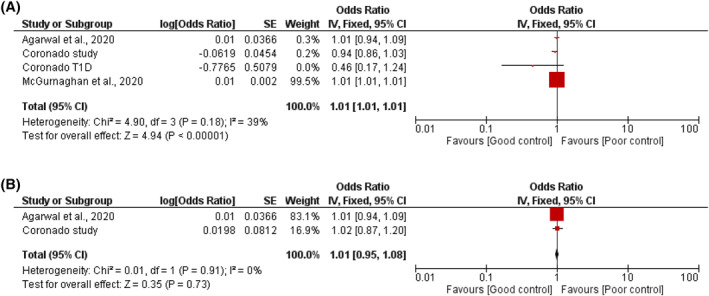
(A) Forest plot showing the association between HbA1c as continuous variable and COVID‐19 worsening or mortality. (B) Forest plot showing the association between HbA1c as continuous variable and COVID‐19 mortality which excluded two manuscripts not providing data for mortality alone
When considering glycaemic control as a dichotomous variable, a significantly increased risk for poor glycaemic control was observed when considering either Holman 8 (OR 1.07 [1.03, 1.12]; p = 0.0006; I 2 = 19%; p = 0.29; Figure 2A) or Open Safely 13 (OR 1.08 [1.03, 1.12]; p < 0.00001; I 2 = 57%; p = 0.13; Figure 2B). Then, we performed an additional sensitivity analysis, by calculating OR for two studies 8 , 13 with a different approach, which allowed to include additional mortality data from the Coronado study, 13 providing also OR according to different HbA1c categories, and obtained similar results when considering either Holman et al., (OR 1.15 [1.11, 1.19]; p < 0.00001; I 2 = 0%; p = 0.55; Figure 2C) or Open Safely (OR 1.12 [1.05, 1.20]; p < 0.0003; I 2 = 6%; p = 0.35; Figure 2D).
FIGURE 2.
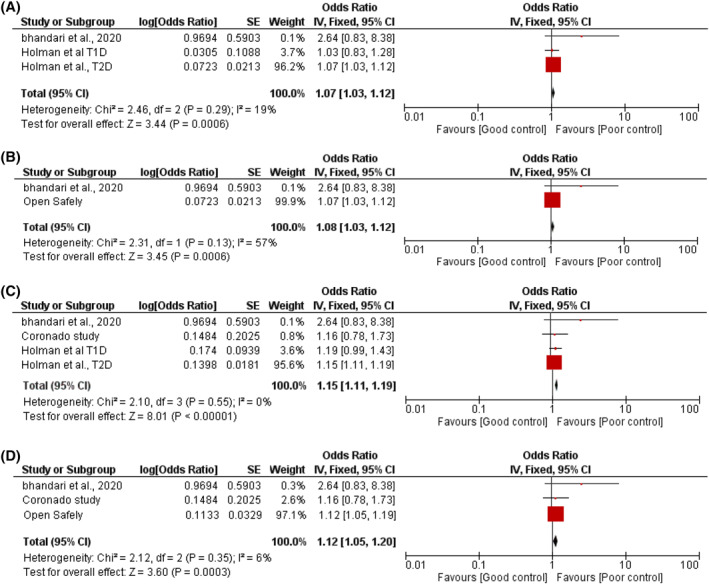
Forest plot showing the association between the degree of glycaemic control, categorized as a dichotomous variable, and COVID‐19 mortality considering the manuscripts by either Holman et al. (A) or Open Safely (B). Sensitivity analysis performed by calculating OR with a different approach considering either Holman et al. (C) or Open Safely (D). Data for mortality alone were extracted from the Coronado study
Finally, when including only studies measuring HbA1c at hospital admission, we did not obtain a significant result (Figure S3).
4. DISCUSSION
COVID‐19 pandemic is affecting an ever‐increasing number of people worldwide. Patients with DM are among those mostly suffering the consequences of the infection, with an increased risk of mortality compared to the general population. 2 An ongoing effort is being undertaken to explore the intermediate risk factors explaining the higher mortality burden among DM patients with COVID‐19. While blood glucose levels are emerging as associated with a poor prognosis, 5 the prognostic value of glycaemic control is uncertain. In this meta‐analysis, we showed that HbA1c values measured prior to or at‐hospital admission are linearly associated with an increased risk of COVID‐19 mortality or worsening. In addition, comparing patients with different degree of glycaemic control suggested that subjects with a poor glycaemic control might have an increased risk of COVID‐19 related mortality.
These findings must be interpreted with caution for a variety of reasons. There was a large heterogeneity in study design, patients' characteristics and reporting of descriptive statistics. As a result, we had to recalculate OR from large studies 8 , 11 by selecting a cut‐off for HbA1c (7,5%) that allowed the inclusion of all studies. We are not able to exclude the possibility that setting a lower cut‐off would have yielded different results, but extracted data did not allow a different analysis. In addition, the remaining study, 35 reported data only setting a cut‐off for glycaemic control at HbA1c < or >8%. However, the sensitivity analysis, performed by calculating OR for these studies with an alternative approach taking advantage of adjusted HR, provided similar results. On the other hand, the degree of glycaemic control for the reference group was not homogenous even in this case. 8 , 13 Furthermore, the two larger studies, which clearly influenced the results, derived both from English electronic health records. 8 , 11 Albeit their relative source databases were different, 8 , 11 it cannot be excluded that some patients might have been included in both studies. Thus, we pooled the relative results in separate scenarios to avoid duplication bias. Finally, the magnitude of the observed effect is small if compared with other clinical variables such as age, gender, BMI and the presence of multiple comorbidities such as hypertension and vascular diseases, at least considering data emerged so far. 28 , 37 , 38 To this respect, it was not possible to use adjusted OR for the presented scenarios since: (1)‐ some manuscripts do not provide adjusted OR and (2)‐ the collected studies were not coherent for the variables used to perform adjustments. This aspect may have affected the results since patients with poor glycaemic control are more commonly characterized by a higher burden of vascular complications, which themselves can represent a risk factor for COVID‐19 outcomes. 23 , 39 In addition, the analyses did not take in account the different classes of glucose‐lowering agents used before infection, an aspect that is also emerging as a possible determinant of COVID‐19 prognosis. 23 , 28
An additional factor that might have influenced the results is the length of follow‐up. Indeed, the only prospective study 13 , 34 established 7 days as the follow‐up period, while all the other studies followed patients until outcome adjudication (the majority of them retrospectively used electronic clinical records). Considering that COVID‐19 patients might deteriorate also later in the course of the disease, 40 the Coronado study might have missed a not negligible number of events, at least those related to overall mortality.
Given the small number of available manuscripts and the design of most studies, another limitation of this meta‐analysis is that used data from patients with both T1DM and T2DM. Beyond their substantially different etiopathogenesis, a number of additional alterations often characterize T2DM, for example, obesity, older age, hypertension and dyslipidaemia, 41 which might explain why HbA1c has only a small, albeit significant, linear association with COVID‐19 prognosis when performing multiple adjustments. As also suggested by others, 7 considering that HbA1c has been associated with a higher basal state of low‐grade inflammation 42 and a dysregulated immune cell function, 43 , 44 it is reasonable to expect a higher risk of complicated prognosis in DM patients with a poor glycaemic control. However, low‐grade inflammation and immune cell function in turn depend on a plethora of variables, including all those mentioned above. 45 , 46 Thus, the effect of glycaemic control on these two phenomena, clearly emerging as major determinants of COVID‐19 prognosis, might be overwhelmed by more relevant triggers of inflammation and immune system dysfunction, for example, age, male sex and obesity. 47 This framework is also compatible with emerging observations regarding: (1) the divergent COVID‐19 outcomes in patients with high versus normal fasting blood glucose 5 ; (2) the diverse outcomes observed according to the different glucose‐lowering therapies 28 , 38 and (3) the possible higher risk of patients with T2DM compared with T1DM. 2 , 34 Indeed: (1) glucose spikes are known to promote the secretion of soluble inflammatory mediators, while inhibiting immune cell function 44 , 48 ; (2) selected glucose‐lowering drugs are accompanied by pleiotropic anti‐inflammatory effects while others are not 49 , 50 and (3) T2DM is known to be accompanied by a large pro‐inflammatory/immune remodelling at both the tissue and the systemic level, 45 while T1DM generates from a specific, localized autoimmune response. The hypothesis that multiple variables determine background inflammation and immune function in patients with DM prior to COVID‐19 must be tested by future studies. Finally, as elegantly shown in one of the included manuscripts, 8 the association between glycaemic control and COVID‐19 prognosis might be U‐shaped, with patients with both low and high HbA1c values being at higher risk of COVID‐19 related death.
5. CONCLUSIONS
The small number and the large heterogeneity of collected studies do not allow a definitive conclusion regarding the role of glycaemic control in determining COVID‐19 prognosis or mortality in patients with DM. Available data suggest a linear relationship of HbA1c with COVID‐19 prognosis and an increased COVID‐19 related mortality in DM patients with poor glycaemic control before infection. While additional, prospective studies are needed to fully establish a correlation between glycaemic control and COVID‐19 prognosis in T1DM and T2DM, existing evidence suggests that it is worth testing the hypothesis that the harmful effect of COVID‐19 in patients with DM may be reduced also by improving long‐term glycaemic control.
CONFLICT OF INTEREST
All the authors declared that they have no conflict of interest.
ETHICAL APPROVAL
The protocol was registered in OSF and it is accessible at https://osf.io/8h9yn. The MOOSE checklist is attached in the Data S1.
AUTHOR CONTRIBUTIONS
Francesco Prattichizzo and Antonio Ceriello conceived the idea, contributed to study design, data collection, statistical analysis, data interpretation and drafting of the manuscript. Paola de Candia and Antonio Nicolucci contributed to study design, data collection, data interpretation and critical review of the manuscript. All authors approved the final version and agree to be accountable for all aspects of the work. Francesco Prattichizzo is the guarantor of this work and, as such, had full access to all the data in the study and takes responsibility for the integrity of the data and the accuracy of the data analysis.
PEER REVIEW
The peer review history for this article is available at https://publons.com/publon/10.1002/dmrr.3476.
Supporting information
Supporting Information 1
ACKNOWLEDGMENTS
This work has been supported by the Italian Ministry of Health—Ricerca Corrente to IRCCS MultiMedica.
Prattichizzo F, de Candia P, Nicolucci A, Ceriello A. Elevated HbA1c levels in pre‐Covid‐19 infection increases the risk of mortality: a systematic review and meta‐analysis. Diabetes Metab Res Rev. 2022;38(1):e3476. 10.1002/dmrr.3476
Contributor Information
Francesco Prattichizzo, Email: francesco.prattichizzo@multimedica.it.
Antonio Ceriello, Email: antonio.ceriello@multimedica.it.
DATA AVAILABILITY STATEMENT
This is a systematic review and meta‐analysis, and as such, no raw data were generated.
REFERENCES
- 1. Guo W, Li M, Dong Y, et al. Diabetes is a risk factor for the progression and prognosis of COVID‐19. Diabetes Metab Res Rev. 2020;36:e3319. [DOI] [PMC free article] [PubMed] [Google Scholar]
- 2. Mantovani A, Byrne CD, Zheng M‐H, Targher G. Diabetes as a risk factor for greater COVID‐19 severity and in‐hospital death: a meta‐analysis of observational studies. Nutr Metabol Cardiovasc Dis. 2020;30(8):1236‐1248. [DOI] [PMC free article] [PubMed] [Google Scholar]
- 3. Palaiodimos L, Kokkinidis DG, Li W, et al. Severe obesity, increasing age and male sex are independently associated with worse in‐hospital outcomes, and higher in‐hospital mortality, in a cohort of patients with COVID‐19 in the Bronx, New York. Metabolism. 2020;108:154262. [DOI] [PMC free article] [PubMed] [Google Scholar]
- 4. Fadini GP, Morieri ML, Boscari F, et al. Newly‐diagnosed diabetes and admission hyperglycemia predict COVID‐19 severity by aggravating respiratory deterioration. Diabetes Res Clin Pract. 2020;168:108374. [DOI] [PMC free article] [PubMed] [Google Scholar]
- 5. Lee MH, Wong C, Ng CH, Yuen DCW, Lim AYL, Khoo CM. Effects of hyperglycaemia on complications of COVID ‐19: a meta‐analysis of observational studies. Diabetes Obes Metab. 2020;23:287‐289. 10.1111/dom.14184 [DOI] [PubMed] [Google Scholar]
- 6. Ceriello A, De Nigris V, Prattichizzo F. Why is hyperglycaemia worsening COVID ‐19 and its prognosis? Diabetes Obes Metab. 2020;22(10):1951‐1952. [DOI] [PMC free article] [PubMed] [Google Scholar]
- 7. Agarwal S, Schechter C, Southern W, Crandall JP, Tomer Y. Preadmission diabetes‐specific risk factors for mortality in hospitalized patients with diabetes and coronavirus disease 2019. Dia Care. 2020;43:2339‐2344. 10.2337/dc20-1543 [DOI] [PMC free article] [PubMed] [Google Scholar]
- 8. Holman N, Knighton P, Kar P, et al. Risk factors for COVID‐19‐related mortality in people with type 1 and type 2 diabetes in England: a population‐based cohort study. Lancet Diabetes Endocrinol. 2020;8(10):823‐833. [DOI] [PMC free article] [PubMed] [Google Scholar]
- 9. Stroup DF, Berlin JA, Morton SC, et al. Meta‐analysis of observational studies in EpidemiologyA proposal for reporting. J Am Med Assoc. 2000;283(15):2008‐2012. [DOI] [PubMed] [Google Scholar]
- 10. http://www.ohri.ca/programs/clinical_epidemiology/oxford.asp
- 11. Williamson EJ, Walker AJ, Bhaskaran K, et al. Factors associated with COVID‐19‐related death using OpenSAFELY. Nature. 2020;584:430‐436. [DOI] [PMC free article] [PubMed] [Google Scholar]
- 12. American Diabetes Association. Glycemic targets: standards of medical care in diabetes‐2020. Diabetes Care. 2020;43(Suppl. 1):S66‐S76, 10.2337/dc20-S006 [DOI] [PubMed] [Google Scholar]
- 13. Cariou B, Hadjadj S, Hadjadj S, et al. Phenotypic characteristics and prognosis of inpatients with COVID‐19 and diabetes: the CORONADO study. Diabetologia. 2020;63:1500‐1515. [DOI] [PMC free article] [PubMed] [Google Scholar]
- 14. https://training.cochrane.org/online‐learning/core‐software‐cochrane‐reviews/revman
- 15. Coppelli A, Giannarelli R, Aragona M, et al. Hyperglycemia at hospital admission is associated with severity of the prognosis in patients hospitalized for COVID‐19: the Pisa COVID‐19 study. Dia Care. 2020;43(10):2345‐2348. 10.2337/dc20-1380 [DOI] [PubMed] [Google Scholar]
- 16. Wu J, Huang J, Zhu G, et al. Elevation of blood glucose level predicts worse outcomes in hospitalized patients with COVID‐19: a retrospective cohort study. BMJ Open Diabetes Res Care. 2020;8:e001476. [DOI] [PMC free article] [PubMed] [Google Scholar]
- 17. Bode B, Garrett V, Messler J, et al. Glycemic characteristics and clinical outcomes of COVID‐19 patients hospitalized in the United States. J Diabetes Sci Technol. 2020;14(4):813‐821. [DOI] [PMC free article] [PubMed] [Google Scholar]
- 18. Sardu C, D’Onofrio N, Balestrieri ML, et al. Hyperglycaemia on admission to hospital and COVID‐19. Diabetologia. 2020;63(11):2486‐2487. [DOI] [PMC free article] [PubMed] [Google Scholar]
- 19. Wang S, Ma P, Zhang S, et al. Fasting blood glucose at admission is an independent predictor for 28‐day mortality in patients with COVID‐19 without previous diagnosis of diabetes: a multi‐centre retrospective study. Diabetologia. 2020;63:2102‐2111. [DOI] [PMC free article] [PubMed] [Google Scholar]
- 20. Xu Z, Wang Z, Wang S, et al. The impact of type 2 diabetes and its management on the prognosis of patients with severe COVID ‐19. J Diabetes. 2020;12:909‐918. 10.1111/1753-0407.13084 [DOI] [PMC free article] [PubMed] [Google Scholar]
- 21. Zhang J, Kong W, Xia P, et al. Impaired fasting glucose and diabetes are related to higher risks of complications and mortality among patients with coronavirus disease 2019. Front Endocrinol. 2020;11:525. 10.3389/fendo.2020.00525 [DOI] [PMC free article] [PubMed] [Google Scholar]
- 22. Li H, Tian S, Chen T, et al. Newly diagnosed diabetes is associated with a higher risk of mortality than known diabetes in hospitalized patients with COVID ‐19. Diabetes Obes Metab. 2020;22:1897‐1906. 10.1111/dom.14099 [DOI] [PMC free article] [PubMed] [Google Scholar]
- 23. Yehya A, Carbone S. Managing type 2 diabetes mellitus during COVID‐19 pandemic: the bittersweet. Diabetes Metab Res Rev. 2021;37(1):e3360. [DOI] [PMC free article] [PubMed] [Google Scholar]
- 24. Li Y, Han X, Alwalid O, et al. Baseline characteristics and risk factors for short‐term outcomes in 132 COVID‐19 patients with diabetes in Wuhan China: a retrospective study. Diabetes Res Clin Pract. 2020;166:108299. [DOI] [PMC free article] [PubMed] [Google Scholar]
- 25. Zhang Q, Wei Y, Chen M, Wan Q, Chen X. Clinical analysis of risk factors for severe COVID‐19 patients with type 2 diabetes. J Diabetes its Complicat. 2020;34(10):107666. [DOI] [PMC free article] [PubMed] [Google Scholar]
- 26. Liu S‐p, Zhang Q, Wang W, et al. Hyperglycemia is a strong predictor of poor prognosis in COVID‐19. Diabetes Res Clin Pract. 2020;167:108338. [DOI] [PMC free article] [PubMed] [Google Scholar]
- 27. Zhu L, She Z‐G, Cheng X, et al. Association of blood glucose control and outcomes in patients with COVID‐19 and pre‐existing type 2 diabetes. Cell Metab 2020;31(6):1068‐1077. [DOI] [PMC free article] [PubMed] [Google Scholar]
- 28. Chen Y, Yang D, Cheng B, et al. Clinical characteristics and outcomes of patients with diabetes and COVID‐19 in association with glucose‐lowering medication. Dia Care. 2020;43(7):1399‐1407. [DOI] [PubMed] [Google Scholar]
- 29. Zhang Y, Cui Y, Shen M, et al. Association of diabetes mellitus with disease severity and prognosis in COVID‐19: a retrospective cohort study. Diabetes Res Clin Pract. 2020;165:108227. [DOI] [PMC free article] [PubMed] [Google Scholar]
- 30. Wu J, Zhang J, Sun X, et al. Influence of diabetes mellitus on the severity and fatality of SARS‐CoV‐2 (COVID‐19) infection. Diabetes Obes Metab. 2020;22:1907‐1914. 10.1111/dom.1410510.1111/dom.14105 [DOI] [PMC free article] [PubMed] [Google Scholar]
- 31. Smith SM, Boppana A, Traupman JA, et al. Impaired glucose metabolism in patients with diabetes, prediabetes, and obesity is associated with severe COVID‐19. J Med Virol. 2020;1:7. [DOI] [PMC free article] [PubMed] [Google Scholar]
- 32. Liu L, Wei W, Yang K, et al. Glycemic control before admission is an important determinant of prognosis in patients with coronavirus disease 2019. J Diabetes Investig. 2020;106:2067–2072. 10.1111/jdi.13431 [DOI] [PMC free article] [PubMed] [Google Scholar]
- 33. Zhang Y, Li H, Zhang J, et al. The clinical characteristics and outcomes of patients with diabetes and secondary hyperglycaemia with coronavirus disease 2019: a single‐centre, retrospective, observational study in Wuhan. Diabetes Obes Metab. 2020;22(8):1443‐1454. [DOI] [PMC free article] [PubMed] [Google Scholar]
- 34. Wargny M, Gourdy P, Ludwig L, et al. Type 1 diabetes in people hospitalized for COVID‐19: new insights from the CORONADO study. Dia Care. 2020;43:e174‐e177. 10.2337/dc20-1217 [DOI] [PMC free article] [PubMed] [Google Scholar]
- 35. Bhandari S, Rankawat G, Singh A, Gupta V, Kakkar S. Impact of glycemic control in diabetes mellitus on management of COVID‐19 infection. Int J Diabetes Dev Ctries. 2020;40:340‐345. [DOI] [PMC free article] [PubMed] [Google Scholar]
- 36. McGurnaghan SJ, Weir A, Bishop J, et al. Risks of and risk factors for COVID‐19 disease in people with diabetes: a cohort study of the total population of Scotland. Lancet Diabetes Endocrinol. 2021;9(2):82‐93. 10.1016/S2213-8587(20)30405-8 [DOI] [PMC free article] [PubMed] [Google Scholar]
- 37. Zheng Z, Peng F, Xu B, et al. Risk factors of critical & mortal COVID‐19 cases: a systematic literature review and meta‐analysis. J Infect. 2020;81(2):e16‐e25. [DOI] [PMC free article] [PubMed] [Google Scholar]
- 38. Mirani M, Favacchio G, Carrone F, et al. Impact of comorbidities and glycemia at admission and dipeptidyl peptidase 4 inhibitors in patients with type 2 diabetes with COVID‐19: a case series from an academic hospital in Lombardy, Italy. Dia Care. 2020;43:3042‐3049. 10.2337/dc20-1340 [DOI] [PubMed] [Google Scholar]
- 39. Maddaloni E, D’Onofrio L, Alessandri F, et al. Cardiometabolic multimorbidity is associated with a worse Covid‐19 prognosis than individual cardiometabolic risk factors: a multicentre retrospective study (CoViDiab II). Cardiovasc Diabetol. 2020;19:164. [DOI] [PMC free article] [PubMed] [Google Scholar]
- 40. https://www.cdc.gov/coronavirus/2019‐ncov/hcp/clinical‐guidance‐management‐patients.html
- 41. Ferrannini E. Physiological and metabolic consequences of obesity. Metabolism. 1995;44(9 Suppl 3):15‐17. [DOI] [PubMed] [Google Scholar]
- 42. Elimam H, Abdulla AM, Taha IM. Inflammatory markers and control of type 2 diabetes mellitus. Diabetes Metab Syndr. 2019;13(1):800‐804. [DOI] [PubMed] [Google Scholar]
- 43. Kulcsar KA, Coleman CM, Beck SE, Frieman MB. Comorbid diabetes results in immune dysregulation and enhanced disease severity following MERS‐CoV infection. JCI Insight. 2019;4:e131774. [DOI] [PMC free article] [PubMed] [Google Scholar]
- 44. Lecube A, Pachón G, Petriz J, Hernández C, Simó R. Phagocytic activity is impaired in type 2 diabetes mellitus and increases after metabolic improvement. PLoS One. 2011;6(8):e23366. 10.1371/journal.pone.0023366 [DOI] [PMC free article] [PubMed] [Google Scholar]
- 45. Prattichizzo F, Giuliani A, Sabbatinelli J, et al. Prevalence of residual inflammatory risk and associated clinical variables in patients with type 2 diabetes. Diabetes Obes Metab. 2020;22(9):1696‐1700. 10.1111/dom.14081 [DOI] [PubMed] [Google Scholar]
- 46. Prattichizzo F, De Nigris V, Sabbatinelli J, et al. CD31+ extracellular vesicles from patients with type 2 diabetes shuttle a miRNA signature associated with cardiovascular complications. Diabetes. 2021;70(1):240‐254. 10.2337/db20-0199 [DOI] [PubMed] [Google Scholar]
- 47. Bonafè M, Prattichizzo F, Giuliani A, Storci G, Sabbatinelli J, Olivieri F. Inflamm‐aging: why older men are the most susceptible to SARS‐CoV‐2 complicated outcomes. Cytokine Growth Factor Rev. 2020;53:33‐37. 10.1016/j.cytogfr.2020.04.005 [DOI] [PMC free article] [PubMed] [Google Scholar]
- 48. Esposito K, Nappo F, Marfella R, et al. Inflammatory cytokine concentrations are acutely increased by hyperglycemia in humans. Circulation. 2002;106(16):2067‐2072. 10.1161/01.cir.0000034509.14906.ae [DOI] [PubMed] [Google Scholar]
- 49. Scheen AJ. Cardiovascular effects of gliptins. Nat Rev Cardiol. 2013;10:73‐84. [DOI] [PubMed] [Google Scholar]
- 50. Pradhan AD, Everett BM, Cook NR, Rifai N, Ridker PM. Effects of initiating insulin and metformin on glycemic control and inflammatory biomarkers among patients with type 2 diabetes. J Am Med Assoc. 2009;302(11):1186‐1194. 10.1001/jama.2009.1347 [DOI] [PubMed] [Google Scholar]
Associated Data
This section collects any data citations, data availability statements, or supplementary materials included in this article.
Supplementary Materials
Supporting Information 1
Data Availability Statement
This is a systematic review and meta‐analysis, and as such, no raw data were generated.