



Abstract
The recent outbreak of Zika virus infection increased the incidence of Guillain–Barré syndrome (GBS). Following the first reported case of GBS after Zika virus infection in 2013, there has been a considerable increase in the incidence of GBS in endemic countries, such as French Polynesia and Latin American countries. The association between coronavirus disease 2019 (COVID‐19), caused by the novel severe acute respiratory syndrome coronavirus 2 (SARS‐CoV‐2), and GBS is another emerging research hotspot. Electrophysiological studies have suggested that GBS patients associated with Zika virus infection or COVID‐19 tend to manifest acute inflammatory demyelinating polyneuropathy, rather than acute motor axonal neuropathy (AMAN). Causative autoantibodies, such as anti‐ganglioside antibodies in AMAN associated with Campylobacter jejuni infection, have not been identified in GBS associated with these emerging infectious diseases. Nevertheless, recent studies suggested molecular mimicry between these viruses and human proteins related to GBS. Recent studies have shown the efficacy of new vaccines, containing artificial messenger RNA encoding the spike protein of SARS‐CoV‐2, against COVID‐19. These vaccines are now available in many countries and massive vaccination campaigns are currently ongoing. Although there are long‐standing concerns about the increased risk of GBS after inoculation of conventional vaccines, the risk of GBS is not considered a legitimate reason to limit administration of currently available vaccines, because the benefits outweigh the risks.
Keywords: acute inflammatory demyelinating polyneuropathy, acute motor axonal neuropathy, antecedent infection, Guillain–Barré syndrome, vaccine
In this article, we review the evidence regarding the relationship between emerging infectious diseases (such as Zika virus infection and coronavirus disease 2019) and Guillain–Barré syndrome. The contemporary knowledge about post‐vaccination Guillain–Barré syndrome is also summarized.

1. INTRODUCTION
Guillain–Barré syndrome (GBS) is an immune‐mediated acute polyradiculoneuropathy that typically occurs after infectious diseases. 1 Studies carried out in North America and Europe suggest that the incidence of this disease ranges from 0.84 to 1.91/100 000 per year. 2 GBS was initially considered as demyelinating neuropathy referred to as acute inflammatory demyelinating polyneuropathy (AIDP); however, subsequent studies identified an axonal form of GBS called acute motor axonal neuropathy (AMAN) or acute motor sensory axonal neuropathy, based on the absence or presence of sensory involvement. 3 , 4 Studies have suggested the association of GBS with several pathogens, including Campylobacter jejuni, Haemophilus influenzae, Mycoplasma pneumoniae, cytomegalovirus, Epstein–Barr virus, hepatitis E virus and influenza A virus. 1 Production of autoantibodies directed against the peripheral nerve components (particularly gangliosides and their complexes) induced by infection of these pathogens is believed to play an important role in the pathogenesis of GBS and its variant, Miller Fisher syndrome, characterized by acute ophthalmoplegia, gait ataxia and areflexia. 5 , 6 , 7 , 8 The recent outbreak of Zika virus infection led to increased incidence of GBS. 9 , 10 Furthermore, the association between coronavirus disease 2019 (COVID‐19) and GBS has also been investigated. 11 , 12 , 13
In this article, we review the evidence regarding the relationship between emerging infectious diseases (such as Zika virus infection and COVID‐19) and GBS. The contemporary knowledge about post‐vaccination GBS is also summarized.
1.1. Zika virus infection and GBS
Zika virus is a single‐strand RNA virus of the Fraviviridae family transmitted to humans by mosquitoes, such as Aedes aegypti and Aedes albopictus. 14 Human‐to‐human transmission also occurs through sexual contact, blood infusion or organ transplantation. 15 , 16 , 17 Most people infected with Zika virus are asymptomatic, whereas approximately 20% people experience symptoms (referred to as Zika fever), such as fever, headache, posterior orbital pain, conjunctival hyperemia, arthralgia, myalgia and skin rash. 14 , 18 The incubation period of the disease ranges from 2 to 7 days. 18 Zika virus was first isolated from Macaca mulatta monkeys residing in the Zika forest of Uganda in 1947. Sporadic cases of Zika virus infection have been reported in tropical and subtropical regions of Africa and Asia. 14 The first large outbreak occurred in Yap Island, Federated States of Micronesia, in 2007, 19 and another outbreak occurred in French Polynesia in 2013. 14 In 2015, an epidemic occurred in northeastern Brazil, which spread to North America by the end of 2016. 20 During this epidemic, a variety of neurological manifestations, including GBS, myelitis, meningoencephalitis and microcephaly, were recognized to be associated with Zika virus infection. 9 , 18 , 21 , 22
The first reported case of GBS associated with Zika virus infection was a middle‐aged woman in French Polynesia. 23 The patient manifested rapidly developing sensorimotor neuropathy 1 week after the onset of Zika fever in November 2013 and recovered after intravenous immunoglobulin therapy. 23 A subsequent study of 42 GBS patients in French Polynesia from 2013 to 2014 demonstrated serum antibodies to Zika virus in all patients. 9 In particular, 39 of these patients had immunoglobulin M antibodies suggestive of a recent Zika virus infection. 9 An increase in GBS patients associated with Zika virus infection was also reported from South American countries. 10 In a study of GBS patients in Colombia from 2015 to 2016, 66 of the 68 patients manifested symptoms suggestive of Zika virus infection before the onset of GBS. 21 Reverse transcription polymerase chain reaction test in 17 of the 42 patients in this study showed the presence of Zika virus in blood. 21 As compared with the pre‐Zika era, the incidence of GBS increased 5.1‐fold in Rio de Janeiro, Brazil; 2.7‐fold in Bahia state, Brazil; 3.1‐fold in Colombia; 2.5‐fold in the Dominican Republic; 2.0‐fold in El Salvador; 2.4‐fold in Honduras; 5.0‐fold in Suriname; and 9.8‐fold in Venezuela. 10 , 24
Electrophysiological features of GBS associated with Zika virus infection are usually consistent with those of AIDP, such as slowing of conduction velocity and prolongation of distal motor latency. 25 According to representative studies carried out in French Polynesia, Colombia and Brazil, the median duration from the onset of Zika fever to that of GBS was 6, 7 and 10 days, respectively. 9 , 21 , 24 Clinical features are characterized by predominant lower‐limb weakness and frequent facial nerve palsy accompanied by sensory and autonomic disturbances. 9 , 21 , 24 Bulbar palsy and respiratory muscle paralysis were also frequently seen, necessitating care in the intensive care unit. 26 Magnetic resonance imaging showed gadolinium enhancement of facial nerves, spinal nerve roots and the dorsal root ganglia. 24 , 27 Increased protein level in the cerebrospinal fluid with normal cell count was observed in most patients. 9 , 21
Plasma exchange and intravenous immunoglobulin are effective treatment modalities for GBS. 1 The therapeutic strategy for GBS associated with Zika virus infection is currently based on evidence pertaining to ordinary GBS patients. 9 , 24 , 25 According to studies carried out in French Polynesia, Colombia and Brazil, intensive care unit admission was required in 38%, 59% and 15% of patients, and mechanical ventilation was required in 29%, 31% and 7% of patients, respectively. 9 , 21 , 24 The mortality rate in these studies was 0%, 4% and 4%, respectively. 9 , 21 , 24 The prognosis seems to be similar to that of ordinary GBS patients. 28
1.2. COVID‐19 and GBS
COVID‐19 is an infectious disease caused by the novel severe acute respiratory syndrome coronavirus 2 (SARS‐CoV‐2). SARS‐CoV‐2 is also a single‐strand RNA virus of the Coronaviridae family. 29 Person‐to‐person transmission of SARS‐CoV‐2 mainly occurs through respiratory droplets. 29 SARS‐CoV‐2 infection might be asymptomatic or it might cause a wide spectrum of symptoms, ranging from mild symptoms of upper respiratory tract infection to life‐threatening acute respiratory distress syndrome. 30 This virus was first detected in Wuhan, China, in December 2019, and rapidly spread throughout the world. 31 During this pandemic, several neurological manifestations, such as stroke, olfactory–gustatory dysfunction (i.e. anosmia and aguesia), encephalitis, myelitis and GBS, were suggested to be associated with SARS‐CoV‐2 infection. 32
The first reported case of GBS associated with SARS‐CoV‐2 infection was a 61‐year‐old woman who had a travel history to Wuhan. 33 The patient manifested rapidly developing weakness on 23 January 2020 and recovered after intravenous immunoglobulin therapy. Chest computed tomography on day 8 showed pneumonia and reverse transcription polymerase chain reaction of oropharyngeal swabs showed SARS‐CoV‐2 infection. 33 However, the causal relationship between GBS and SARS‐CoV‐2 infection is widely contested because of the low incidence of GBS in COVID‐19 patients. 32 According to a study of GBS patients using data from the UK National Immunoglobulin Database, the number of GBS patients treated in UK hospitals rather fell between March and May 2020 compared with the corresponding period of 2016–2019; this was probably due to the influence of lockdown measures that helped reduce the transmission of conventional GBS‐inducing pathogens. 12 In another cohort study of GBS patients in the UK (independent of the UK National Immunoglobulin Database) between March and May 2020, 25 of the 47 patients were suspected to be associated with COVID‐19. 12 In contrast, a study of patients treated at the emergency departments in Spain during the peak pandemic period (March to April 2020) showed a higher frequency of GBS among COVID‐19 patients (0.15%) than in non‐COVID‐19 patients (0.02%). 11 Another study in Northern Italy suggested an increased incidence of GBS from 0.077/1 000 000/month in the pre‐COVID‐19 era of March and April 2019 to 0.202/1 000 000/month during the corresponding period of 2020. 13
As in GBS associated with Zika virus infection, electrophysiological features of GBS associated with COVID‐19 are usually suggestive of demyelination compatible with those of AIDP. 34 , 35 , 36 However, some patients with AMAN or acute motor sensory axonal neuropathy have also been reported. 13 , 34 , 36 , 37 According to a systematic literature review from January to June 2020, the mean interval between the onset of COVID‐19 and GBS symptoms was 11.5 days. 35 An Italian study compared the clinical features of 30 COVID‐19 GBS patients with those of 17 non‐COVID‐19 GBS patients. COVID‐19 GBS patients tended to manifest AIDP, more severe weakness necessitating intensive care unit admission and hypotension. 13 Cerebrospinal fluid parameters were similar in the two groups. 13 Magnetic resonance imaging showed gadolinium enhancement of facial nerves or spinal nerve roots in some of the patients. 38 , 39
The treatment strategy for COVID‐19 GBS patients is not different from that for non‐COVID‐19 GBS patients. 13 However, it should be noted that COVID‐19 GBS patients tend to be complicated by pneumonia. Even in a study that found no association between GBS and COVID‐19, intubation was more frequent in COVID‐19 GBS patients (54%) than in non‐COVID‐19 GBS patients (23%). 12
1.3. Immunopathogenesis of GBS associated with emerging infections
Although many reports have documented GBS patients associated with Zika virus or SARS‐CoV‐2 infection, the pathological basis of neuropathy induced by these viruses is not well characterized. The concept of molecular mimicry between pathogens and human peripheral nerve components was established through studies of AMAN‐type of GBS following detection of anti‐ganglioside GM1 antibodies after Campylobacter jejuni infection. 8 According to this concept, immunoglobulin G autoantibodies directed against surface epitopes of Campylobacter jejuni also react to ganglioside GM1 localized in the axolemma of motor fibers. 8 Consistent with this view, a previous study demonstrated the deposition of immunoglobulin G and complements in the axolemma of motor fibers from AMAN patients. 40 Hence, membrane attack complexes formed by activation of complement cascades resulting from the attachment of autoantibodies cause axonal damage in AMAN. 8 , 41
Compared with AMAN, a clear relationship between specific autoantibodies and the occurrence of AIDP, which accounts for most GBS patients associated with Zika virus and SARS‐CoV‐2 infection, has not yet been shown. 41 The most characteristic pathological feature in AIDP patients is the demyelination resulting from phagocytosis of myelin by macrophages (Figure 1). 42 Demyelination in a sural nerve biopsy specimen has also been reported in a patient with Zika virus‐associated GBS. 28 A recent study using longitudinal sections of sural nerve biopsy specimens from AIDP patients demonstrated deposition of complement at the sites of macrophage‐induced demyelination. 42 A study of autopsy specimens also showed similar findings. 43 These findings indicate that immunological processes mediated by autoantibodies similar to AMAN also play a role in the pathogenetic mechanism of demyelination in AIDP.
FIGURE 1.
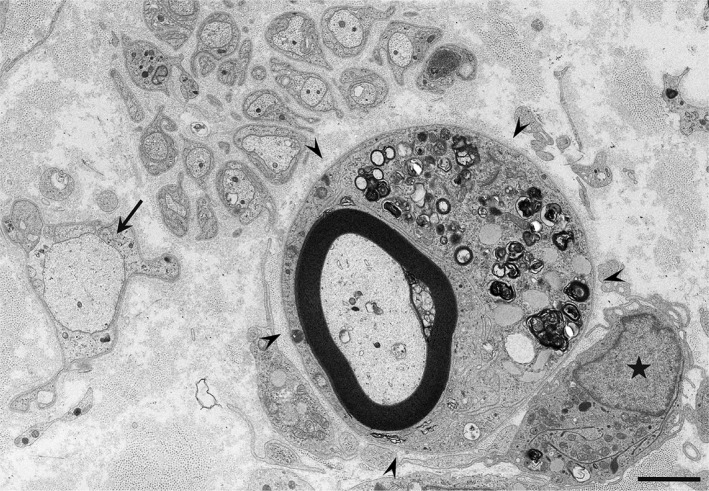
Typical pathological findings of acute inflammatory demyelinating polyneuropathy. A cross‐section of a sural nerve biopsy specimen. The cytoplasm of a macrophage invading the basement membrane surrounding a myelinated fiber (arrowheads) contains myelin debris resulting from phagocytosis. The arrow indicates a demyelinated axon. A macrophage located outside of the basement membrane tube of a myelinated fiber is indicated by an asterisk. Uranyl acetate and lead citrate staining. Scale bar, 2 μm.
According to a study of Zika virus‐associated GBS in French Polynesia from 2013 to 2014, serum antibodies against glycolipids, including gangliosides, were positive in 13 of 42 patients. 9 In contrast, a more recent extensive investigation of anti‐glycolipid antibodies found no specific antibody signature in sera obtained from patients with GBS during the outbreak of Zika virus infection in Northeast Brazil. 44 Nevertheless, mimicry between Zika virus polyproteins and human proteins related to GBS has been reported, 45 suggesting that the peripheral nervous system components other than glycolipids/gangliosides are potential targets of autoantibodies in Zika virus‐associated GBS. Molecular mimicry between SARS‐CoV‐2 and human proteins related to GBS has also been suggested. 46
1.4. Vaccination and GBS
Recent studies have shown the protective efficacy of new vaccines, containing artificial messenger RNA encoding the spike protein of SARS‐CoV‐2, against COVID‐19. 47 , 48 These vaccines are now available in many countries and massive vaccination drives are currently ongoing in these countries. Conventional vaccines contain antigens based on either attenuated or inactive forms of viruses or bacteria, whereas messenger RNA vaccines induce the synthesis of specific viral proteins by host cells after inoculation. 49 Inoculation of vaccines can decrease the risk of infection by stimulating the immune system; however, there have long‐standing concerns about the increased risk of autoimmune diseases, such as GBS. For example, studies have found an association between GBS and older versions of rabies vaccine prepared from suckling mouse brain and mature sheep brain. 50 , 51 However, an extensive review of published literature found only a trivial or no association between currently available vaccines and GBS. 52 Previously suggested links between the oral polio vaccine and diphtheria, tetanus toxoid, and pertussis vaccine have now been excluded, because the risk of development of GBS after inoculation of these vaccines has not been substantiated. 53 , 54 In contrast, there are still some concerns pertaining to measles, mumps, and rubella, human papillomavirus, quadrivalent conjugate meningococcal, and influenza vaccines. 55 However, the risk of GBS is not considered a legitimate reason to limit administration of these vaccines, because the benefits far outweigh the risks. 55
Among the vaccines that are reportedly associated with the occurrence of GBS, influenza vaccine is probably the most extensively investigated. Initial reports suggesting the relationship between influenza vaccination and GBS were based on the experience with swine influenza vaccine, which increased the incidence by up to eightfold in 1976 in the USA. 56 In the subsequent studies carried out in Canada between 1992 and 2004, and in the USA between 1992 and 1994, the relative risk of GBS in the 6‐week period after vaccination was 1.45 (95% confidence interval [CI] 1.05–1.99; P = .02) and 1.7 (95% CI 1.0–2.8; P = .04), respectively. 57 , 58 Additionally, in a meta‐analysis of data pertaining to 23 million individuals, the vaccine prepared for the 2009 influenza A (H1N1) pandemic strain was associated with a relative risk of GBS of 2.35 (95% CI 1.4–4.0; P = .0003) and caused 1.6 additional GBS patients per million vaccinated individuals in the USA, where non‐adjuvanted vaccines were used. 59 A similar increase was reported in other countries where adjuvanted vaccines were also inoculated. 60 , 61 However, after adjusting for potential confounding factors, such as influenza‐like illness and upper respiratory tract infection, no association between administration of vaccine for 2009 pandemic influenza A (H1N1) and GBS was found (adjusted odds ratio 1.0, 95% CI 0.3–2.7). 62 This finding indicates that contracting influenza might also result in a risk of GBS. For example, in a study of surveillance data of GBS covering a population of 45 million in the USA during the 2009 influenza A (H1N1) pandemic, the vaccinated population had a lower average risk (incidence density ratio 0.83, 95% CI 0.63‐1.08) and a lower cumulative risk (6.6 vs 9.2 cases per million persons, P = 0.012) of GBS than the unvaccinated population. 63 Another study of over 13 million individuals in Canada between 1993 and 2011 provided comprehensive data from this viewpoint. 64 According to that study, the risk of GBS within 6 weeks of influenza vaccination was 52% higher than in the control interval of 9–42 weeks (relative incidence 1.52, 95% CI 1.17–1.99), with the greatest risk during weeks 2‐4 after vaccination. 64 In contrast, the risk of GBS within 6 weeks after suffering from influenza was much greater than that associated with influenza vaccination (15.81, 95% CI 10.28–24.32). 64 Additionally, the risk of hospitalization resulting from GBS was 1.03 per million vaccinations, compared with 17.2 per million influenza episodes. 64
An important issue when considering vaccination is whether the overall benefit outweighs the overall risk or not. For example, findings obtained from studies of influenza vaccines indicate that even if they can cause GBS, the risk is very low and suffering from influenza itself seems to increase the risk of GBS among unvaccinated individuals. Therefore, influenza vaccines can help reduce the overall risk of developing GBS. As influenza vaccines effectively prevent influenza and its complications, the benefits of influenza vaccines greatly outweigh the risks. 55
DISCLOSURE
Conflict of interest: The authors declare no conflict of interest.
ACKNOWLEDGMENT
This work was supported in part by the Health and Labor Sciences Research Grant on Intractable Diseases (Neuroimmunological Diseases) from the Ministry of Health, Labor and Welfare of Japan (20FC1030).
Koike H, Katsuno M. Emerging infectious diseases, vaccines and Guillain–Barré syndrome. Clin Exp Neuroimmunol. 2021;12:165–170. 10.1111/cen3.12644
[Correction added on 19 July 2021, after first online publication: In Abstract, the word “COVID‐19” has been inserted at the end of this sentence “…encoding the spike protein of SARS‐CoV‐2, against.” so it should read as “…encoding the spike protein of SARS‐CoV‐2, against COVID‐19.”]
REFERENCES
- 1. Shahrizaila N, Lehmann HC, Kuwabara S. Guillain‐Barré syndrome. Lancet. 2021;397(10280):1214–28. [DOI] [PubMed] [Google Scholar]
- 2. McGrogan A, Madle GC, Seaman HE, de Vries CS. The epidemiology of Guillain‐Barré syndrome worldwide. A systematic literature review. Neuroepidemiology. 2009;32(2):150–63. [DOI] [PubMed] [Google Scholar]
- 3. Prineas JW. Acute idiopathic polyneuritis. An electron microscope study. Lab Invest. 1972;26(2):133–47. [PubMed] [Google Scholar]
- 4. Griffin JW, Li CY, Ho TW, Xue P, Macko C, Gao CY, et al Guillain‐Barré syndrome in northern China. the spectrum of neuropathological changes in clinically defined cases. Brain. 1995;118(Pt 3):577–95. [DOI] [PubMed] [Google Scholar]
- 5. Chiba A, Kusunoki S, Shimizu T, Kanazawa I. Serum IgG antibody to ganglioside GQ1b is a possible marker of miller fisher syndrome. Ann Neurol. 1992;31(6):677–9. [DOI] [PubMed] [Google Scholar]
- 6. Kusunoki S, Chiba A, Kon K, Ando S, Arisawa K, Tate A, et al N‐acetylgalactosaminyl GD1a is a target molecule for serum antibody in Guillain‐Barré syndrome. Ann Neurol. 1994;35(5):570–6. [DOI] [PubMed] [Google Scholar]
- 7. Kaida K, Morita D, Kanzaki M, Kamakura K, Motoyoshi K, Hirakawa M, et al Ganglioside complexes as new target antigens in Guillain‐Barré syndrome. Ann Neurol. 2004;56(4):567–71. [DOI] [PubMed] [Google Scholar]
- 8. Yuki N, Hartung HP. Guillain‐Barré syndrome. N Engl J Med. 2012;366(24):2294–304. [DOI] [PubMed] [Google Scholar]
- 9. Cao‐Lormeau VM, Blake A, Mons S, Lastère S, Roche C, Vanhomwegen J, et al Guillain‐Barré Syndrome outbreak associated with Zika virus infection in French Polynesia: a case‐control study. Lancet. 2016;387(10027):1531–9. [DOI] [PMC free article] [PubMed] [Google Scholar]
- 10. Dos Santos T, Rodriguez A, Almiron M, Sanhueza A, Ramon P, de Oliveira WK, et al Zika Virus and the Guillain‐Barré syndrome ‐ case series from seven countries. N Engl J Med. 2016;375(16):1598–601. [DOI] [PubMed] [Google Scholar]
- 11. Fragiel M, Miró Ò, Llorens P, Jiménez S, Piñera P, Burillo G, et al SIESTA (Spanish Investigators in Emergency Situations Team) network . Incidence, clinical, risk factors and outcomes of Guillain‐Barré in Covid‐19. Ann Neurol. 2021;89(3):598–603. [DOI] [PubMed] [Google Scholar]
- 12. Keddie S, Pakpoor J, Mousele C, Pipis M, Machado PM, Foster M, et al Epidemiological and cohort study finds no association between COVID‐19 and Guillain‐Barré syndrome. Brain. 2021;144(2):682–93. [DOI] [PMC free article] [PubMed] [Google Scholar]
- 13. Filosto M, Cotti Piccinelli S, Gazzina S, Foresti C, Frigeni B, Servalli MC, et al Guillain‐Barré syndrome and COVID‐19: an observational multicentre study from two Italian hotspot regions. J Neurol Neurosurg Psychiatry. in press. [DOI] [PubMed] [Google Scholar]
- 14. Petersen LR, Jamieson DJ, Powers AM, Honein MA. Zika virus. N Engl J Med. 2016;374(16):1552–63. [DOI] [PubMed] [Google Scholar]
- 15. Foy BD, Kobylinski KC, Chilson Foy JL, Blitvich BJ, Travassos da Rosa A, Haddow AD, et al Probable non‐vector‐borne transmission of Zika virus, Colorado, USA. Emerg Infect Dis. 2011;17(5):880–2. [DOI] [PMC free article] [PubMed] [Google Scholar]
- 16. Motta IJ, Spencer BR, Cordeiro da Silva SG, Arruda MB, Dobbin JA, Gonzaga YB, et al Evidence for transmission of Zika virus by platelet transfusion. N Engl J Med. 2016;375(11):1101–3. [DOI] [PubMed] [Google Scholar]
- 17. Nogueira ML, Estofolete CF, Terzian ACB, Mascarin do Vale EPB, da Silva R, da Silva RF, et al Zika virus infection and solid organ transplantation: a new challenge. Am J Transplant. 2017;17(3):791–5. [DOI] [PubMed] [Google Scholar]
- 18. Kutsuna S. Zika virus infection: clinical overview with a summary of Japanese cases. Clin Exp Neuroimmunol. 2017;8(3):192–8. [Google Scholar]
- 19. Duffy MR, Chen TH, Hancock WT, Powers AM, Kool JL, Lanciotti RS, et al Zika virus outbreak on Yap Island, federated states of Micronesia. N Engl J Med. 2009;360(24):2536–43. [DOI] [PubMed] [Google Scholar]
- 20. Zhang Q, Sun K, Chinazzi M, Pastore y Piontti A, Dean NE, Rojas DP, et al Spread of Zika virus in the Americas. Proc Natl Acad Sci U S A. 2017;114(22):E4334–E4343. [DOI] [PMC free article] [PubMed] [Google Scholar]
- 21. Parra B, Lizarazo J, Jiménez‐Arango JA, Zea‐Vera AF, González‐Manrique G, Vargas J, et al Guillain‐Barré syndrome associated with Zika virus infection in Colombia. N Engl J Med. 2016;375(16):1513–23. [DOI] [PubMed] [Google Scholar]
- 22. Mlakar J, Korva M, Tul N, Popović M, Poljšak‐Prijatelj M, Mraz J, et al Zika virus associated with microcephaly. N Engl J Med. 2016;374(10):951–8. [DOI] [PubMed] [Google Scholar]
- 23. Oehler E, Watrin L, Larre P, Leparc‐Goffart I, Lastere S, Valour F, et al Zika virus infection complicated by Guillain‐Barre syndrome–case report, French Polynesia, december 2013. Euro Surveill. 2014;19(9):20720. [DOI] [PubMed] [Google Scholar]
- 24. da Silva IRF, Frontera JA, Bispo de Filippis AM, Nascimento OJMD. RIO‐GBS‐ZIKV research group . Neurologic complications associated with the Zika virus in Brazilian adults. JAMA Neurol. 2017;74(10):1190–8. [DOI] [PMC free article] [PubMed] [Google Scholar]
- 25. Uncini A, Shahrizaila N, Kuwabara S. Zika virus infection and Guillain‐Barré syndrome: a review focused on clinical and electrophysiological subtypes. J Neurol Neurosurg Psychiatry. 2017;88(3):266–71. [DOI] [PubMed] [Google Scholar]
- 26. Arias A, Torres‐Tobar L, Hernández G, Paipilla D, Palacios E, Torres Y, et al Guillain‐Barré syndrome in patients with a recent history of Zika in Cúcuta, Colombia: a descriptive case series of 19 patients from December 2015 to March 2016. J Crit Care. 2017;37:19–23. [DOI] [PubMed] [Google Scholar]
- 27. Fontes CA, Dos Santos AA, Marchiori E. Magnetic resonance imaging findings in Guillain‐Barré syndrome caused by Zika virus infection. Neuroradiology. 2016;58(8):837–8. [DOI] [PubMed] [Google Scholar]
- 28. Nascimento OJM, da Silva IRF. Guillain‐Barré syndrome and Zika virus outbreaks. Curr Opin Neurol. 2017;30(5):500–7. [DOI] [PubMed] [Google Scholar]
- 29. Wiersinga WJ, Rhodes A, Cheng AC, Peacock SJ, Prescott HC. Pathophysiology, transmission, diagnosis, and treatment of coronavirus disease 2019 (COVID‐19): a review. JAMA. 2020;324(8):782–93. [DOI] [PubMed] [Google Scholar]
- 30. Huang C, Wang Y, Li X, Ren L, Zhao J, Hu Y, et al Clinical features of patients infected with 2019 novel coronavirus in Wuhan. China. Lancet. 2020;395(10223):497–506. [DOI] [PMC free article] [PubMed] [Google Scholar]
- 31. Chan JF, Yuan S, Kok KH, To KK, Chu H, Yang J, et al A familial cluster of pneumonia associated with the 2019 novel coronavirus indicating person‐to‐person transmission: a study of a family cluster. Lancet. 2020;395(10223):514–23. [DOI] [PMC free article] [PubMed] [Google Scholar]
- 32. Ellul MA, Benjamin L, Singh B, Lant S, Michael BD, Easton A, et al Neurological associations of COVID‐19. Lancet Neurol. 2020;19(9):767–83. [DOI] [PMC free article] [PubMed] [Google Scholar]
- 33. Zhao H, Shen D, Zhou H, Liu J, Chen S. Guillain‐Barré syndrome associated with SARS‐CoV‐2 infection: causality or coincidence? Lancet Neurol. 2020;19(5):383–4. [DOI] [PMC free article] [PubMed] [Google Scholar]
- 34. Caress JB, Castoro RJ, Simmons Z, Scelsa SN, Lewis RA, Ahlawat A, et al COVID‐19‐associated Guillain‐Barré syndrome: the early pandemic experience. Muscle Nerve. 2020;62(4):485–91. [DOI] [PMC free article] [PubMed] [Google Scholar]
- 35. Uncini A, Vallat JM, Jacobs BC. Guillain‐Barré syndrome in SARS‐CoV‐2 infection: an instant systematic review of the first six months of pandemic. J Neurol Neurosurg Psychiatry. 2020;91(10):1105–10. [DOI] [PubMed] [Google Scholar]
- 36. Sriwastava S, Kataria S, Tandon M, Patel J, Patel R, Jowkar A, et al Guillain Barré syndrome and its variants as a manifestation of COVID‐19: a systematic review of case reports and case series. J Neurol Sci. 2021;420:117263. [DOI] [PMC free article] [PubMed] [Google Scholar]
- 37. Hirayama T, Hongo Y, Kaida K, Kano O. Guillain‐Barré syndrome after COVID‐19 in Japan. BMJ Case Rep. 2020;13(10):e239218. [DOI] [PMC free article] [PubMed] [Google Scholar]
- 38. Toscano G, Palmerini F, Ravaglia S, Ruiz L, Invernizzi P, Cuzzoni MG, et al Guillain‐Barré syndrome associated with SARS‐CoV‐2. N Engl J Med. 2020;382(26):2574–6. [DOI] [PMC free article] [PubMed] [Google Scholar]
- 39. Bigaut K, Mallaret M, Baloglu S, Nemoz B, Morand P, Baicry F, et al Guillain‐Barré syndrome related to SARS‐CoV‐2 infection. Neurol Neuroimmunol Neuroinflamm. 2020;7(5):e785. [DOI] [PMC free article] [PubMed] [Google Scholar]
- 40. Hafer‐Macko C, Hsieh ST, Li CY, Ho TW, Sheikh K, Cornblath DR, et al Acute motor axonal neuropathy: an antibody‐mediated attack on axolemma. Ann Neurol. 1996;40(4):635–44. [DOI] [PubMed] [Google Scholar]
- 41. Koike H, Katsuno M. The role of macrophages in Guillain‐Barré syndrome and chronic inflammatory demyelinating polyneuropathy. Neurol Clin Neurosci. 2020;9(3):203–10. [Google Scholar]
- 42. Koike H, Fukami Y, Nishi R, Kawagashira Y, Iijima M, Katsuno M, et al Ultrastructural mechanisms of macrophage‐induced demyelination in Guillain‐Barré syndrome. J Neurol Neurosurg Psychiatry. 2020;91(6):650–9. [DOI] [PubMed] [Google Scholar]
- 43. Hafer‐Macko CE, Sheikh KA, Li CY, Ho TW, Cornblath DR, McKhann GM, et al Immune attack on the Schwann cell surface in acute inflammatory demyelinating polyneuropathy. Ann Neurol. 1996;39(5):625–35. [DOI] [PubMed] [Google Scholar]
- 44. Leonhard SE, Halstead S, Lant SB, Militão de Albuquerque MFP, de Brito CAA, de Albuquerque LBB, et al Guillain‐Barré syndrome during the Zika virus outbreak in Northeast Brazil: an observational cohort study. J Neurol Sci. 2021;420:117272. [DOI] [PubMed] [Google Scholar]
- 45. Lucchese G, Kanduc D. Zika virus and autoimmunity: from microcephaly to Guillain‐Barré syndrome, and beyond. Autoimmun Rev. 2016;15(8):801–8. [DOI] [PubMed] [Google Scholar]
- 46. Lucchese G, Flöel A. SARS‐CoV‐2 and Guillain‐Barré syndrome: molecular mimicry with human heat shock proteins as potential pathogenic mechanism. Cell Stress Chaperones. 2020;25(5):731–5. [DOI] [PMC free article] [PubMed] [Google Scholar]
- 47. Polack FP, Thomas SJ, Kitchin N, Absalon J, Gurtman A, Lockhart S, et al C4591001 clinical trial group . Safety and efficacy of the BNT162b2 mRNA Covid‐19 vaccine. N Engl J Med. 2020;383(27):2603–15. [DOI] [PMC free article] [PubMed] [Google Scholar]
- 48. Baden LR, El Sahly HM, Essink B, Kotloff K, Frey S, Novak R, et al Study group . Efficacy and Safety of the mRNA‐1273 SARS‐CoV‐2 vaccine. N Engl J Med. 2021;384(5):403–16. [DOI] [PMC free article] [PubMed] [Google Scholar]
- 49. Shin MD, Shukla S, Chung YH, Beiss V, Chan SK, Ortega‐Rivera OA, et al COVID‐19 vaccine development and a potential nanomaterial path forward. Nat Nanotechnol. 2020;15(8):646–55. [DOI] [PubMed] [Google Scholar]
- 50. Toro G, Vergara I, Román G. Neuroparalytic accidents of antirabies vaccination with suckling mouse brain vaccine. Clinical and pathologic study of 21 cases. Arch Neurol. 1977;34(11):694–700. [DOI] [PubMed] [Google Scholar]
- 51. Hemachudha T, Griffin DE, Chen WW, Johnson RT. Immunologic studies of rabies vaccination‐induced Guillain‐Barré syndrome. Neurology. 1988;38(3):375–8. [DOI] [PubMed] [Google Scholar]
- 52. Haber P, Sejvar J, Mikaeloff Y, DeStefano F. Vaccines and Guillain‐Barré syndrome. Drug Saf. 2009;32(4):309–23. [DOI] [PubMed] [Google Scholar]
- 53. Tuttle J, Chen RT, Rantala H, Cherry JD, Rhodes PH, Hadler S. The risk of Guillain‐Barré syndrome after tetanus‐toxoid‐containing vaccines in adults and children in the United States. Am J Public Health. 1997;87(12):2045–8. [DOI] [PMC free article] [PubMed] [Google Scholar]
- 54. Salisbury DM. Association between oral poliovaccine and Guillain‐Barré syndrome? Lancet. 1998;351(9096):79–80. [DOI] [PubMed] [Google Scholar]
- 55. Principi N, Esposito S. Vaccine‐preventable diseases, vaccines and Guillain‐Barre' syndrome. Vaccine. 2019;37(37):5544–50. [DOI] [PubMed] [Google Scholar]
- 56. Schonberger LB, Bregman DJ, Sullivan‐Bolyai JZ, Keenlyside RA, Ziegler DW, Retailliau HF, et al Guillain‐Barre syndrome following vaccination in the national influenza immunization program, United States, 1976–1977. Am J Epidemiol. 1979;110(2):105–23. [DOI] [PubMed] [Google Scholar]
- 57. Lasky T, Terracciano GJ, Magder L, Koski CL, Ballesteros M, Nash D, et al The Guillain‐Barré syndrome and the 1992–1993 and 1993–1994 influenza vaccines. N Engl J Med. 1998;339(25):1797–802. [DOI] [PubMed] [Google Scholar]
- 58. Juurlink DN, Stukel TA, Kwong J, Kopp A, McGeer A, Upshur RE, et al Guillain‐Barré syndrome after influenza vaccination in adults: a population‐based study. Arch Intern Med. 2006;166(20):2217–21. [DOI] [PubMed] [Google Scholar]
- 59. Salmon DA, Proschan M, Forshee R, Gargiullo P, Bleser W, Burwen DR, et al H1N1 GBS Meta‐Analysis working group. Association between Guillain‐Barré syndrome and influenza A (H1N1) 2009 monovalent inactivated vaccines in the USA: a meta‐analysis. Lancet. 2013;381(9876):1461–8. [DOI] [PubMed] [Google Scholar]
- 60. De Wals P, Deceuninck G, Toth E, Boulianne N, Brunet D, Boucher RM, et al Risk of Guillain‐Barré syndrome following H1N1 influenza vaccination in Quebec. JAMA. 2012;308(2):175–81. [DOI] [PubMed] [Google Scholar]
- 61. Dodd CN, Romio SA, Black S, Vellozzi C, Andrews N, Sturkenboom M, et al Global H1N1 GBS Consortium. International collaboration to assess the risk of Guillain Barré syndrome following influenza A (H1N1) 2009 monovalent vaccines. Vaccine. 2013;31(40):4448–58. [DOI] [PubMed] [Google Scholar]
- 62. Dieleman J, Romio S, Johansen K, Weibel D, Bonhoeffer J, Sturkenboom M, et al Guillain‐Barre syndrome and adjuvanted pandemic influenza a (H1N1) 2009 vaccine: multinational case‐control study in Europe. BMJ. 2011;343:d3908. [DOI] [PMC free article] [PubMed] [Google Scholar]
- 63. Vellozzi C, Iqbal S, Stewart B, Tokars J, DeStefano F. Cumulative risk of Guillain‐Barré syndrome among vaccinated and unvaccinated populations during the 2009 H1N1 influenza pandemic. Am J Public Health. 2014;104(4):696–701. [DOI] [PMC free article] [PubMed] [Google Scholar]
- 64. Kwong JC, Vasa PP, Campitelli MA, Hawken S, Wilson K, Rosella LC, et al Risk of Guillain‐Barré syndrome after seasonal influenza vaccination and influenza health‐care encounters: a self‐controlled study. Lancet Infect Dis. 2013;13(9):769–76. [DOI] [PubMed] [Google Scholar]