



Abstract
Calciphylaxis is a small vessel vasculopathy causing subcutaneous ischemic necrosis. This condition is a recognized complication of end stage renal disease and is associated with severe pain. The mechanism of the pain generated by calciphylaxis is thought to be partly related to tissue ischemia, with a significant neuropathic component associated with neuronal hypoxic injury. The pain can be further exacerbated by the inflammatory process ensuing as a result of calciphylactic lesion infections which are commonly associated with this condition. Obtaining adequate pain relief is a challenging aspect of symptom control in calciphylaxis, and historically, patients suffering from calciphylaxis required high dose opioid medications to achieve satisfactory analgesia.
This case report presents a multimodal pain management approach utilizing low dose ketamine infusion in an opioid-tolerant patient suffering from severe calciphylaxis-related pain. Ketamine is an anesthetic agent well established for its efficacy in the management of neuropathic pain in opioid-tolerant patients, and has been shown to prevent opioid-induced hyperalgesia and decrease opioid requirements. Prior published data studying pain control in calciphylaxis have mainly focused on subcutaneous ketamine administration which as noted in the literature, can be associated with infusion site complications. To the best of our knowledge, this report is first of its kind to describe successful use of ketamine infusion in treatment of acute calciphylaxis-related pain.
Dose modification of ketamine is not required for patients with impaired renal function, and low dose intravenous ketamine infusion was associated with no reported adverse effects in our patient.
Keywords: Calciphylaxis, End stage renal disease, Ketamine
Introduction
Calciphylaxis is a small vessel vasculopathy causing subcutaneous (SC) ischemic necrosis [1, 2]. Severe pain and hyperesthesia are predominant features of this condition. Although rare, calciphylaxis is a recognized complication of end stage renal disease (ESRD). Calciphylaxis lesion infections are often a complicating factor in treatment of this condition and contribute negatively to patients’ pain. Adequate pain relief is reported as one of the most challenging aspects of symptom control in calciphylaxis [3]. This encounter presents successful use of low dose intravenous (IV) ketamine infusion as an adjunct to a multimodal pain therapy in an ESRD patient suffering from excruciating pain associated with calciphylaxis.
Consent
Informed written consent was obtained from the patient for the publication of this case report.
Case presentation
A 38-year-old male with past medical history significant for diabetes type Ι, ESRD on hemodialysis (HD), chronic pain related to calciphylaxis on long term opioid therapy was admitted for severe acute pain exacerbation secondary to calciphylaxis. The patient was diagnosed with calciphylaxis one year prior to the current presentation. On admission, the physical exam was notable for multiple calciphylaxis lesions involving digits of hands and feet, legs, groins [Figure 1] and the sacrum. The patient had presented with a history of Pseudomonas aeruginosa superinfection of the calciphylaxis groin lesions three weeks prior to the current presentation, for which he had completed appropriate antibiotic course. No signs or symptoms of infection were noted on current admission. The patient reported that despite improvement of infection, his groin and lower extremity calciphylaxis related pain had significantly progressed in the last four weeks, necessitating increased utilization of opioid medications beyond the recommended total daily dose. He reported the pain as 10 out of 10 (10/10) on the numerical rating scale (NRS; 0 was defined as no pain and 10 as worst imaginable pain). During the first 24 h after admission, the patient required total of 12 mg (mg) IV hydromorphone in addition to 70 mg (20 + 30 + 20 mg) maintenance home oxycodone dose and scheduled acetaminophen with minimal to no pain relief. Two days following the admission, 0.1 mg/kg/h; 117.6 mg/24 h IV ketamine infusion was started. On the following day, the patient reported improved analgesia with the NRS pain scores decrease by three points (from 10/10 to 7/10), and 50% reduced hydromorphone requirement. In an attempt to further progress patient’s analgesic outcomes and reduce risks associated with high dose opioids in an ESRD patient, ketamine infusion rate was increased to 0.15 mg/kg/h; 176.4 mg/24 h. As a result, the patient reported further decrease in pain severity to 5/10, and did not require any additional opioids besides his maintenance dose of oxycodone. The patient denied any ketamine related side effects including psychoactive phenomena, and was satisfied with the pain relief. Ketamine was subsequently discontinued after 4 days of infusion with smooth transition to his home opioid medication regimen, acetaminophen and pregabalin 25 mg daily. On the day of ketamine infusion discontinuation, the patient required additional dose of 20 mg of oxycodone solely for the purpose of participation in wound dressing changes and physical therapy. The patient was then discharged home reporting satisfactory pain control on acetaminophen, pregabalin and baseline oxycodone regimen. To address his further pain management needs, the patient was scheduled for a follow up at an outpatient chronic pain clinic.
Fig. 1.
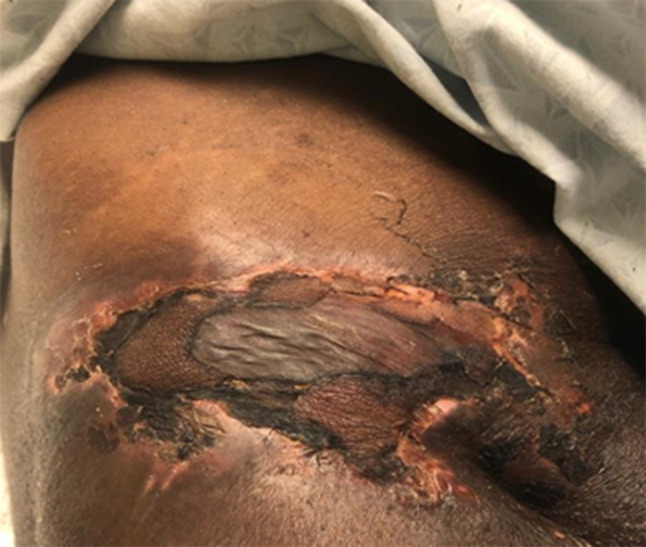
Right groin calciphylaxis and prior infection site.
Discussion
Adequate pain control in patients with calciphylaxis remains a challenge in clinical practice. With no reported randomized controlled trials to offer practice guide recommendations, the current evidence for appropriate pain management approach for this condition is largely based on case studies and expert opinions. The present case report demonstrates the role of a low dose IV ketamine infusion as an adjunct to a multimodal pain in treatment of severe pain associated with calciphylaxis.
The mechanism of the pain generated by calciphylaxis is not well understood, and is thought to be partly related to tissue ischemia, with a significant neuropathic component associated with nerve hypoxemia and inflammation [3]. As described in the literature, calciphylaxis lesions are frequently infected [4] which might contribute to worsening of pain associated with this condition. The pain associated with calciphylaxis is described as refractory to opioids, and a multimodal approach to the pain management is suggested [3].
Due to severity of our patient’s chronic pain prior to hospital admission, he was utilizing oxycodone in excess of 70 mg daily which was his maintenance dose. Taking under consideration the severity of patient’s renal impairment and HD requirement, high dose opioid use may lead to inadvertent overdose resulting in respiratory depression and even death. Although short acting opioids such as oxycodone, are certainly safer than time-release opioid formulations, they should be used with restraint in ESRD and HD patients. Many opioids, such as oxycodone and hydromorphone, require adequate renal function for proper metabolite excretion, thus their administration must be closely monitored [5]. Due to decreased reliance on renal excretion, some opioids such as buprenorphine, tend to be safer when administered to ESRD patients [6].Unfortunately, buprenorphine lacks the analgesic efficacy required for adequate analgesia in treatment of high level acute pain in an opioid tolerant patient. Fentanyl, although a potent opioid, may also be safely administered to the ESRD patients due to its limited dependence on renal excretion [6]. Our patient reported intolerance to fentanyl and required an alternative opioid therapy. This was accomplished in the form of oxycodone and hydromorphone. Unfortunately, despite the high dose opioid therapy, the patient did not obtain desired pain relief. His poor responsiveness to opioids was thought to be secondary to development of opioid tolerance and the neuropathic nature of his pain condition. Therefore multimodal therapy was implemented. With the goal of improving pain, functional status, participation in physical therapy, and to decrease total daily opioid requirement, we initiated a multimodal pain management regimen including renally dosed pregabalin, acetaminophen, oxycodone, as needed hydromorphone and IV low dose ketamine infusion.
Ketamine is known to modulate central sensitization by antagonizing N-methyl-d-aspartate (NMDA) receptors [7]. Additionally, both nociceptive and neuropathic pain is mediated through NMDA receptors [8]. Ketamine is reported to be effective in opioid tolerant patients by preventing opioid induced hyperalgesia and decreasing opioid requirements [7, 9–11].
Ketamine has been safely used in patients with ESRD, and most providers believe that dose modification of ketamine is not required for patients with impaired renal function [12, 13].
A potentially disconcerting side effect of ketamine may be its psychotomimetic properties, however, this side effect is uncommon on low sub-anesthetic ketamine doses [14, 15] and if needed, can be treated with benzodiazepines, dexmedetomidine [16, 17] or simply ketamine discontinuation. Caution should be taken when using ketamine in patients with history of significant liver impairment, severe heart disease, increased intracranial or intraocular pressure, as ketamine has sympathetic activation properties [17].
Prior published data studying pain control in calciphylaxis have mainly focused on administration of SC ketamine [3, 13, 18]. Only one prior case describes the effect of IV ketamine infusion in calciphylaxis. However, in that report, the originally initiated SC ketamine was transitioned to IV administration due to complications of SC administration at the infusion site [18]. The authors report pain relief with IV and SC ketamine administration [18]. Although literature pertaining to the use of ketamine for calciphylaxis related pain is limited, there are multitude of studies suggesting analgesic benefits of IV ketamine in treatment of acute and chronic pain, in particular neuropathic pain [19–22]. In line with the published data, we report that opioid requirements in the setting of severe calciphylaxis pain significantly declined during ketamine administration and even post its discontinuation.
Present case report demonstrates a multimodal approach with adjunct of IV ketamine in treatment of severe calciphylaxis related pain. Our pain regimen consisted of low dose IV ketamine infusion as an adjunct to administration of maintenance home opioids, acetaminophen and pregabalin. To our knowledge, the present report is the first to describe management of severe pain associated with calciphylaxis with administration of low dose IV ketamine infusion. We hope that this study encourages further exploration of the role of IV ketamine infusion in symptom management of patients with this debilitating condition.
Author’s contribution
Research idea and study design: SG, DLJ, JSS. Data acquisition: SG. Data analysis/interpretation: SG, DLJ, JSS. Supervision: DLJ, JSS. Each author contributed important intellectual content during manuscript drafting and revision, accepts personal accountability for the author’s own contributions, and agrees to ensure that questions pertaining to the accuracy or integrity of any portion of the work are appropriately investigated and resolved. This manuscript has been read and approved by all co-authors.
Funding
None. No support or funding was received.
Compliance with ethical standards
Conflict of interest
None.
Footnotes
Publisher's Note
Springer Nature remains neutral with regard to jurisdictional claims in published maps and institutional affiliations.
Contributor Information
Shirin Ghanavatian, Email: Shirin_Ghanavatian@med.unc.edu.
Dominika Lipowska James, Email: Dominika_James@med.unc.edu.
Joshua Simon Sadolf, Email: Joshua_sadolf@med.unc.edu.
References
- 1.Gipstein RM, et al. Calciphylaxis in man. A syndrome of tissue necrosis and vascular calcification in 11 patients with chronic renal failure. Arch Intern Med. 1976;136(11):1273–1280. doi: 10.1001/archinte.1976.03630110043012. [DOI] [PubMed] [Google Scholar]
- 2.Oh DH, et al. Five cases of calciphylaxis and a review of the literature. J Am Acad Dermatol. 1999;40(6 Pt 1):979–987. doi: 10.1016/S0190-9622(99)70087-3. [DOI] [PubMed] [Google Scholar]
- 3.Polizzotto MN, et al. Symptomatic management of calciphylaxis: a case series and review of the literature. J Pain Symptom Manage. 2006;32(2):186–190. doi: 10.1016/j.jpainsymman.2006.03.009. [DOI] [PubMed] [Google Scholar]
- 4.Udomkarnjananun S, et al. Treatment of calciphylaxis in CKD: a systematic review and meta-analysis. Kidney Int Rep. 2019;4(2):231–244. doi: 10.1016/j.ekir.2018.10.002. [DOI] [PMC free article] [PubMed] [Google Scholar]
- 5.King S, et al. A systematic review of the use of opioid medication for those with moderate to severe cancer pain and renal impairment: a European Palliative Care Research Collaborative opioid guidelines project. Palliat Med. 2011;25(5):525–552. doi: 10.1177/0269216311406313. [DOI] [PubMed] [Google Scholar]
- 6.Raina R, Krishnappa V, Gupta M. Management of pain in end-stage renal disease patients: short review. Hemodial Int. 2018;22(3):290–296. doi: 10.1111/hdi.12622. [DOI] [PubMed] [Google Scholar]
- 7.Trujillo KA, Akil H. Inhibition of morphine tolerance and dependence by the NMDA receptor antagonist MK-801. Science. 1991;251(4989):85–87. doi: 10.1126/science.1824728. [DOI] [PubMed] [Google Scholar]
- 8.Zhou HY, Chen SR, Pan HL. Targeting N-methyl-d-aspartate receptors for treatment of neuropathic pain. Expert Rev Clin Pharmacol. 2011;4(3):379–388. doi: 10.1586/ecp.11.17. [DOI] [PMC free article] [PubMed] [Google Scholar]
- 9.Clark JL, Kalan GE. Effective treatment of severe cancer pain of the head using low-dose ketamine in an opioid-tolerant patient. J Pain Symptom Manage. 1995;10(4):310–314. doi: 10.1016/0885-3924(95)00010-V. [DOI] [PubMed] [Google Scholar]
- 10.Mitra S, Sinatra RS. Perioperative management of acute pain in the opioid-dependent patient. Anesthesiology. 2004;101(1):212–227. doi: 10.1097/00000542-200407000-00032. [DOI] [PubMed] [Google Scholar]
- 11.Mitra S. Opioid-induced hyperalgesia: pathophysiology and clinical implications. J Opioid Manag. 2008;4(3):123–130. doi: 10.5055/jom.2008.0017. [DOI] [PubMed] [Google Scholar]
- 12.Aroni F, et al. Pharmacological aspects and potential new clinical applications of ketamine: reevaluation of an old drug. J Clin Pharmacol. 2009;49(8):957–964. doi: 10.1177/0091270009337941. [DOI] [PubMed] [Google Scholar]
- 13.Capel MM, et al. Use of ketamine for ischemic pain in end-stage renal failure. J Pain Symptom Manage. 2009;35:232–234. doi: 10.1016/j.jpainsymman.2007.10.002. [DOI] [PubMed] [Google Scholar]
- 14.Kudoh A, et al. Small-dose ketamine improves the postoperative state of depressed patients. Anesth Analg. 2002;95(1):114–118. doi: 10.1097/00000539-200207000-00020. [DOI] [PubMed] [Google Scholar]
- 15.Javery KB, et al. Comparison of morphine and morphine with ketamine for postoperative analgesia. Can J Anaesth. 1996;43(3):212–215. doi: 10.1007/BF03011736. [DOI] [PubMed] [Google Scholar]
- 16.Trivedi S, et al. A comparative study of dexmedetomidine and midazolam in reducing delirium caused by ketamine. J Clin Diagn Res. 2016;10(8):UC01–4. doi: 10.7860/JCDR/2016/18397.8225. [DOI] [PMC free article] [PubMed] [Google Scholar]
- 17.Orhurhu, VJ., et al. Ketamine Toxicity, in StatPearls. 2020: Treasure Island (FL).
- 18.Fitzgibbon EJ, et al. Low dose ketamine as an analgesic adjuvant in difficult pain syndromes: a strategy for conversion from parenteral to oral ketamine. J Pain Symptom Manage. 2002;23(2):165–170. doi: 10.1016/S0885-3924(01)00393-1. [DOI] [PubMed] [Google Scholar]
- 19.Elia N, Tramer MR. Ketamine and postoperative pain–a quantitative systematic review of randomised trials. Pain. 2005;113(1–2):61–70. doi: 10.1016/j.pain.2004.09.036. [DOI] [PubMed] [Google Scholar]
- 20.Honarmand A, Safavi M, Karaky H. Preincisional administration of intravenous or subcutaneous infiltration of low-dose ketamine suppresses postoperative pain after appendectomy. J Pain Res. 2012;5:1–6. doi: 10.2147/JPR.S26476. [DOI] [PMC free article] [PubMed] [Google Scholar]
- 21.Maher J, et al. Balloon cell melanoma: a case report with polarized and non-polarized dermatoscopy and dermatopathology. Dermatol Pract Concept. 2014;4(1):69–73. doi: 10.5826/dpc.0401a11. [DOI] [PMC free article] [PubMed] [Google Scholar]
- 22.Mitchell AC, Fallon MT. A single infusion of intravenous ketamine improves pain relief in patients with critical limb ischaemia: results of a double blind randomised controlled trial. Pain. 2002;97(3):275–281. doi: 10.1016/S0304-3959(02)00033-7. [DOI] [PubMed] [Google Scholar]