



Abstract
A 47-year-old Caucasian man on long-standing antifungal therapy for chronic necrotising aspergillosis and a history of recurrent pseudomonas pneumonias presented to the outpatient pulmonary clinic with dyspnoea and chest discomfort for 3 days. A CT angiography of the chest demonstrated angioinvasion from the previously noted left upper lobe cavitary lesion into the left main pulmonary artery, along with new consolidating lesions. Due to the high risk for massive haemoptysis, he was evaluated by thoracic surgery and underwent a successful left pneumonectomy. As invasive pulmonary aspergillosis is associated with high mortality, surgical intervention should always be considered, especially in those who develop extensive disease, despite being on aggressive antifungal therapy. Though minimally described in literature, invasive pulmonary pseudomonas also carries a high mortality risk. In our patient, cultures from the resected lung only demonstrated Pseudomonas aeruginosa.
Keywords: pneumonia (infectious disease), TB and other respiratory infections
Background
I am pleased to submit an article entitled, ‘Invasive Pulmonary Aspergillosis/Pseudomonas’ for consideration for publication in BMJ Case Reports. We encountered a case of chronic aspergillosis with angioinvasion into the pulmonary artery, and this article includes unique imaging we feel clinicians will find both useful and interesting.
We believe that this manuscript is appropriate for publication by BMJ Case Reports because it provides an interesting image of invasive aspergillosis, a rare, yet potentially life-threatening complication of this infection. This article also highlights possible angioinvasive bacterial infections, which are even rarer in most clinical settings and have not been well described in the current literature. We hope this case may lead to further research regarding management options and the development of standardised treatment guidelines for these aggressive infections.
Invasive pulmonary aspergillosis is a rare, yet deadly type of severe fungal infection. Most invasive infections are caused by Aspergillus fumigatus, with the remainder being due to Aspergillus flavus, Aspergillus niger and Aspergillus terreus. Risk factors most commonly associated with invasive aspergillosis include haematological malignancies, solid organ transplants, chronic steroid use and severe neutropenia. Patients may present with the classic triad of fever, chest pain and haemoptysis, but symptoms can often be subtle and indolent. A high index of suspicion is needed to identify these patients early to avoid potentially deadly consequences. Here, we present a patient with chronic cavitary aspergillosis, who was later found to have advanced, invasive disease.
Case presentation
A47-year-old Caucasian man presented to the outpatient pulmonary clinic with dyspnoea and chest discomfort for 3 days. He denied cough or haemoptysis. He had a 20 pack-year history of cigarette smoking, chronic obstructive pulmonary disease and an area of chronic necrotising, cavitary aspergillosis (previously diagnosed by bronchoalveolar lavage culture) with an aspergilloma. Figure 1 demonstrates the cavitary lesion and aspergilloma noted at diagnosis. He had been on chronic daily antifungal treatment with voriconazole for 6 years. Physical examination revealed a thin man in no distress with bilateral equal breath sounds. A CT angiography of the chest demonstrated angioinvasion from the previously noted left upper lobe cavitary lesion into the left main pulmonary artery, resulting in downstream seeding and development of new consolidating lesions (figures 2 and 3, respectively). Cardiac MRI showed similar findings and no intraluminal masses. He was admitted to the hospital and underwent bronchoscopy with bronchoalveolar lavage. Bacterial cultures grew Pseudomonas aeruginosa, while fungal cultures were negative. Our patient was evaluated by the cardiothoracic service and underwent a successful left pneumonectomy. Pathology (including the 3×2 cm portion of the left mainstem bronchus) showed evidence of chronic inflammation. Bacterial cultures from the left excised lung grew P. aeruginosa, while fungal cultures were negative. The patient received antibiotics and was eventually discharged home.
Figure 1.
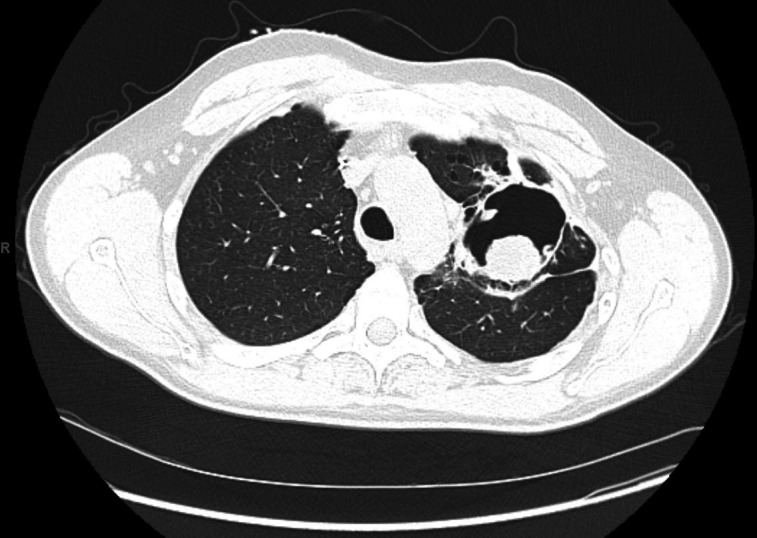
Axial view of CT scan of the chest demonstrating left upper lobe cavitary lesion containing aspergilloma and surrounding area of chronic necrotising infection.
Figure 2.
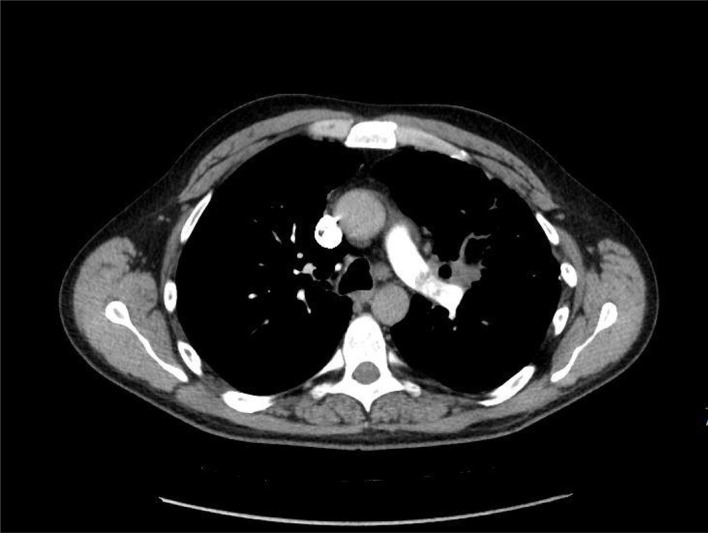
Axial view of CT scan of the chest demonstrating angioinvasion from the chronic necrotising lesion into the left main pulmonary artery.
Figure 3.
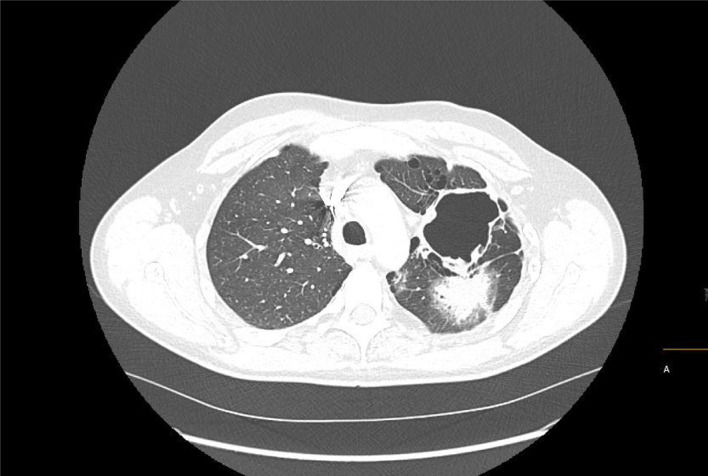
Axial view of CT scan of the chest demonstrating chronic left upper lobe cavitary lesion and evolving necrotising lesion.
Differential diagnosis
The chest imaging in this case prompted a number of potential diagnoses. Given the patient’s history of a chronic necrotising aspergillosis and the proximity of this cavity to the pulmonary artery, invasive aspergillosis was a top consideration. The intraluminal appearance also raised the possibility of a pulmonary embolism. Another possible explanation was necrotising bacterial infections. Malignancy was also considered.
Treatment
Given the degree of angioinvasion and potential for life-threatening haemorrhage, this patient underwent left pneumonectomy per cardiothoracic surgery. Bacterial cultures from the tissue grew P. aeruginosa, for which the patient was treated with a 2-week course of piperacillin–tazobactam. Surprisingly, the fungal cultures did not grow any organisms.
Outcome and follow-up
The patient was seen in the general pulmonary clinic 6 weeks postoperatively and reported no respiratory issues. The patient continues to do well.
Discussion
Invasive pulmonary aspergillosis continues to be one of the most severe causes of fungal infections associated with high morbidity and mortality rates.1 Aspergillus species have been identified in a variety of patients, ranging from those with chronic obstructive pulmonary disease to solid organ transplant recipients.2 The most current guidelines for invasive pulmonary aspergillosis, based on the European Organisation for the Research and Treatment of Cancer/Mycosis, require microbiological or histopathological diagnosis.3 Though this patient was previously known to have chronic cavitary aspergillosis and an aspergilloma, aspergillosis was not demonstrated in the cultures from the surgically resected specimen. Some prior studies have shown that 48%–70% of tissues with evidence of invasive septate hyphae fail to grow in culture.4 Though the majority of invasive aspergillosis cases tend to occur in patients with malignancies or previous transplants, it is possible to develop angioinvasion in non-neutropaenic patients, as we believe to be the case with our patient.5
Positive culture results for P. aeruginosa raise the question of whether the imaging findings in our patient were due to invasive spread from this organism. A prior review demonstrated coinfection with aspergillus and parasites, but there are limited reports similar to ours.6 In general, the majority of cavitary pneumonias in hospitalised or immunocompromised patients are due to P. aeruginosa. Pseudomonal pneumonias are rarely angioinvasive. When angioinvasion occurs, it is primarily in patients who received haematopoietic stem cell transplantation.7 As there are no clear guidelines for treatment of these specific invasive infections, most patients are treated with an extended course of antibiotics.
The decision to pursue surgical intervention is most often considered in instances of life-threatening haemoptysis or the potential for life-threatening haemoptysis. Whether our patient’s findings may have been related to an aggressive gram negative infection is unknown. However, as there have been several reported cases of aspergillosis (and at least a few cases of pseudomonas) involving invasion into the chest wall, heart or great vessels that have resulted in death, we are confident that surgical management of our patient resulted in the optimal outcome. Early surgical intervention should be considered in patients with extensive disease, despite being on appropriate antibiotic and antifungal therapy.
Learning points.
Invasive pulmonary aspergillosis may develop in non-neutropaenic patients on chronic antifungal therapy without any history of prior malignancy or transplantation.
Though minimally described in literature, angioinvasive invasive pulmonary pseudomonas carries a high mortality risk in patients.
Early surgical intervention should be considered in all patients with evidence of angioinvasive infections.
Footnotes
Contributors: This manuscript has not been published and is not under consideration for publication elsewhere. We have no conflicts of interest to disclose. This manuscript was prepared in equal parts by both listed authors: MM and DU.
Funding: The authors have not declared a specific grant for this research from any funding agency in the public, commercial or not-for-profit sectors.
Competing interests: None declared.
Provenance and peer review: Not commissioned; externally peer reviewed.
Ethics statements
Patient consent for publication
Obtained.
References
- 1.Broaddus VC, Mason RJ, Ernst JD. Aspergillosis. Murray & Nadel’s Textbook of Respiratory Medicine 2016:670–4. [Google Scholar]
- 2.Shahi M, Ayatollahi Mousavi SA, Nabili M, et al. Aspergillus colonization in patients with chronic obstructive pulmonary disease. Curr Med Mycol 2015;1:45–51. 10.18869/acadpub.cmm.1.3.45 [DOI] [PMC free article] [PubMed] [Google Scholar]
- 3.Patterson TF, Thompson GR, Denning DW, et al. Practice guidelines for the diagnosis and management of aspergillosis: 2016 update by the infectious diseases Society of America. Clin Infect Dis 2016;63:e1–60. 10.1093/cid/ciw326 [DOI] [PMC free article] [PubMed] [Google Scholar]
- 4.Tarrand JJ, Lichterfeld M, Warraich I, et al. Diagnosis of invasive septate mold infections. Am J Clin Pathol 2003;119:854–8. 10.1309/EXBVYAUPENBM285Y [DOI] [PubMed] [Google Scholar]
- 5.Kung VL, Chernock RD, Burnham C-AD. Diagnostic accuracy of fungal identification in histopathology and cytopathology specimens. Eur J Clin Microbiol Infect Dis 2018;37:157–65. 10.1007/s10096-017-3116-3 [DOI] [PubMed] [Google Scholar]
- 6.Aliyali M, Badali H, Shokohi T, et al. Coinfection of pulmonary hydatid cyst and aspergilloma: case report and systematic review. Mycopathologia 2016;181:255–65. 10.1007/s11046-015-9974-2 [DOI] [PubMed] [Google Scholar]
- 7.Hakki M, Limaye AP, Kim HW, et al. Invasive Pseudomonas aeruginosa infections: high rate of recurrence and mortality after hematopoietic cell transplantation. Bone Marrow Transplant 2007;39:687–93. 10.1038/sj.bmt.1705653 [DOI] [PubMed] [Google Scholar]