



Ana Paula Alonso received her B.Sc. in Biochemistry in 1998 and M.Sc. in Biological and Medical Sciences in 2000 from the Université Victor Segalen in Bordeaux, France. Her spark for plant science, more specifically plant biochemistry and metabolism, started during her Ph.D. research at the Institut National de la Recherche Agronomique, Villenave d'Ornon, France, where she discovered a new substrate cycle in plants. After four years of postdoctoral training in seed metabolism (Michigan State University, USA), and microbial metabolism (Institut National des Sciences Appliquées, Toulouse, France), Ana joined the Great Lakes Bioenergy Research Center, USA, in 2008 as a Visiting Assistant Professor to work in the exciting field of biofuel research. In 2010, Ana started her independent research group at The Ohio State University and subsequently moved to the BioDiscovery Institute at the University of North Texas in 2018; she is currently an Associate Professor at the Department of Biological Sciences and serves as the Director of the BioAnalytical Facility. Ana’s unique expertise in mass spectrometry-based metabolomics and 13C-fluxomics has provided novel contributions in the fields of plant physiology and biochemistry, seed metabolism (Cocuron et al. 2019) and plant response to stresses (De Souza et al. 2015).
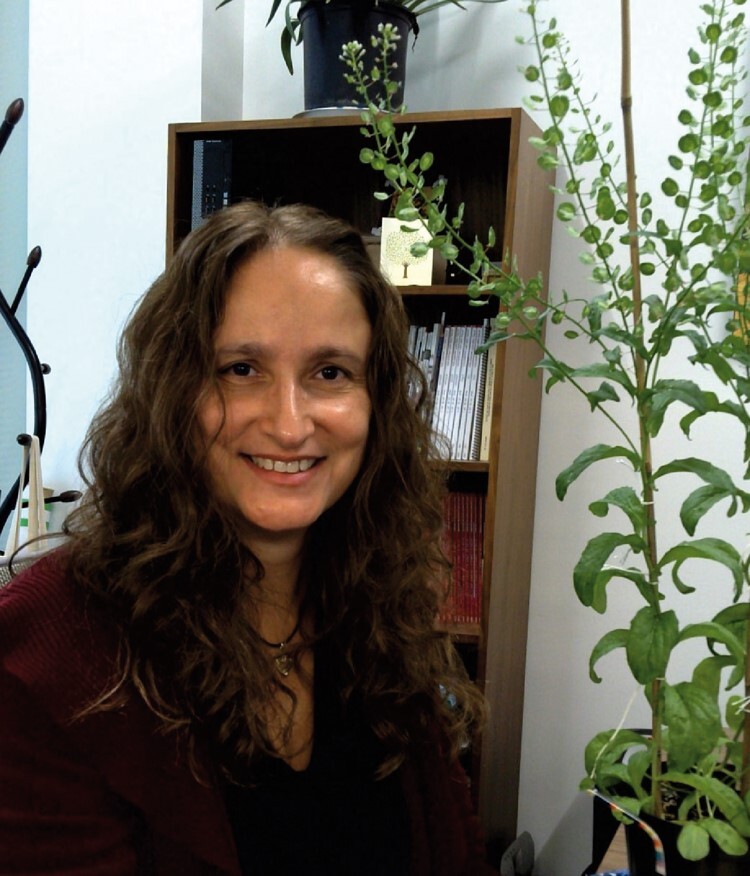
Photo: Ana Paula Alonso, Editor, Plant and Cell Physiology. Ana has served on the editorial board since 2019 and mostly handles papers related to seed metabolism and plant biochemistry.
What is your favorite plant and why?
Thlaspi arvense L. (aka field pennycress) is my favorite plant (see photo). Pennycress belongs to the Brassicaceae family and produces pods whose shape and size is similar to those of a penny, hence its nickname. As a side note, it is also called ‘stinkweed’ because of its unpleasant smell, or ‘Frenchweed’—though no real explanation for the latter! Knowing that a lot of goodies contain ‘French’ in their names, such as French fries, French toasts and French kiss, I thought that this plant must be hiding something worthy. Indeed, although considered as a weed for a long time, pennycress is gaining interest because its seeds produce speciality oil that is suitable for aviation fuel. Pennycress is a winter annual that requires low agricultural inputs and can be grown in a summer/winter rotation cycle with other conventional commodity crops such as maize and soybean (Phippen and Phippen 2012). The US Department of Agriculture and Department of Energy have funded several projects aimed at improving the qualities of pennycress to advance toward its establishment as a dedicated bioenergy crop. Half of my research team members are currently involved in such pennycress projects… and have become accustomed to its scent!
What was the first paper you published?
My first scientific achievement was the discovery of a new substrate cycle between glucose-6-phosphate and glucose in plants (Alonso et al. 2005). Substrate cycles involve the simultaneous synthesis and degradation of a metabolite, resulting in ATP consumption. They are often called ‘futile cycles’ because they burn substantial proportions of cell energy—up to 90% of total ATP in some plant organs—without any evident physiological role. This result has implications for the actual metabolic efficiency of plants and opens new avenues for improving the energetic balance: reducing substrate cycles would save energy that the cell may redirect to increase yield, the production of a compound of interest, etc. I was very excited when this work was finally accepted for publication. Indeed, the first version of the manuscript was ‘badly flawed’, the ‘English expression was very poor’, etc., which motivated me to work hard on my writing skills. I have kept the comments of the editor and reviewers all these years, and I humbly share them with my junior lab members—and now, with you all—to emphasize the importance of gaining good presentation and writing skills.
How does your research impact society?
I use innovative systems level approaches, such as metabolomics and fluxomics, to address global challenges related to food and energy security. My research group directly studies food crops (maize, soybean) and alternative crops with bioenergy/industrial applications (Physaria fendleri L., T. arvense L.). My major interests and accomplishments are in understanding carbon partitioning through central metabolism, which is the resultant of overall gene expression, protein biosynthesis and posttranslational regulation. In plants, central metabolism provides carbon, energy and reducing equivalents necessary for the production of storage oils, proteins and carbohydrates. Understanding carbon partitioning is, therefore, of fundamental relevance to plant fitness, fruit quality, seed yield and germination and to designing novel approaches for the breeding and genetic engineering of crops.
What is your favorite PCP paper(s)?
One of my major research interests lies in storage lipids, i.e. the production of (un)usual fatty acids in seeds. Naturally, the Special Focus Issue ‘Lipid Metabolism in Plants and Algae’, edited by Yonghua Li-Beisson and Hajime Wada in 2019, is my favorite issue in PCP. It features four reviews on the lipid composition in the moss model organism Physcomitrella patens (Resemann et al. 2019), subcellular organization and regulation of plant glycerolipid metabolism (Lavell and Benning 2019), molecular genetic strategies to increase oil synthesis in microalgae (Kong et al. 2019) and engineering efforts to improve fatty acid composition in Brassica oilseed species (Zhou et al. 2019). This Spotlight Issue underlines the structural and functional diversity of lipids and gives an overview of the current status quo in plant and algae lipid research.
What tips would you give to early-career scientists?
We are living in some perplexing times where misinformation and politics hinder scientific progress to address global challenges related to health, food security, energy security and the environment. As a junior researcher, you are gaining the knowledge and skills to help address some of these grave problems, but also the opportunity to raise public awareness, and confidence in science. Here, are a couple of tips for budding researchers: (i) Be proud to be a scientist! Talk to your neighbors, your community, share your findings and success stories on social media. (ii) Develop good communication/writing skills. Take the opportunity to present your work at scientific meetings, which is important to make new connections too. Get involved in drafting reviews, research papers, reports as much as possible; writing is crucial to publish your work in a timely fashion and, later, to obtain funding for your research. (iii) Collaborate. Collaborations and interdisciplinary teams assemble different sets of expertise to tackle more intricate projects, which allow reaching a higher level of understanding, and result in impactful findings. (iv) Be creative. Do not be afraid to voice and follow your ideas, learn and try new approaches. Attending workshops, for instance, is a way to learn and get hands-on experience on a new methodology. (v) Once you become an established researcher, do not forget to give back. Get involved in teaching, mentoring students, inspire and help train the next generation of scientists.
References
- Alonso A.P., Vigeolas H., Raymond P., Rolin D., Dieuaide-Noubhani M. (2005) A new substrate cycle in plants. evidence for a high glucose-phosphate-to-glucose turnover from in vivo steady-state and pulse-labeling experiments with [(13)C] glucose and [(14)C] glucose. Plant Physiol. 138: 2220–2232. [DOI] [PMC free article] [PubMed] [Google Scholar]
- Cocuron J.C., Koubaa M., Kimmelfield R., Ross Z., Alonso A.P. (2019) A combined metabolomics and fluxomics analysis identifies steps limiting synthesis in maize embryos. Plant Physiol. 181: 961–975. [DOI] [PMC free article] [PubMed] [Google Scholar]
- De Souza A.P., Cocuron J.C., Garcia A.C., Alonso A.P., Buckeridge M.S. (2015) Changes in whole-plant metabolism during the grain-filling stage in sorghum grown under elevated CO2 and drought. Plant Physiol. 169: 1755–1765. [DOI] [PMC free article] [PubMed] [Google Scholar]
- Kong F.T., Yamaoka Y., Ohama T., Lee Y., Li-Beisson Y. (2019) Molecular genetic tools and emerging synthetic biology strategies to increase cellular oil content in Chlamydomonas reinhardtii. Plant Cell Physiol. 60: 1184–1196. [DOI] [PubMed] [Google Scholar]
- Lavell A.A., Benning C. (2019) Cellular organization and regulation of plant glycerolipid metabolism. Plant Cell Physiol. 60: 1176–1183. [DOI] [PMC free article] [PubMed] [Google Scholar]
- Phippen W.B., Phippen M.E. (2012) Soybean seed yield and quality as a response to field pennycress residue. Crop Sci. 52: 2767–2773. [Google Scholar]
- Resemann H.C., Lewandowska M., Gömann, J., Feussner I. (2019) Membrane lipids, waxes and oxylipins in the moss model organism Physcomitrella patens. Plant Cell Physiol. 60: 1166–1175. [DOI] [PMC free article] [PubMed] [Google Scholar]
- Zhou X.R., Li J., Wan X., Hua W., Singh S. (2019) Harnessing biotechnology for the development of new seed lipid traits in Brassica. Plant Cell Physiol. 60: 1197–1204. [DOI] [PubMed] [Google Scholar]