



Abstract
Logarithmic finite-size scaling of the O(n) universality class at the upper critical dimensionality (dc = 4) has a fundamental role in statistical and condensed-matter physics and important applications in various experimental systems. Here, we address this long-standing problem in the context of the n-vector model (n = 1, 2, 3) on periodic four-dimensional hypercubic lattices. We establish an explicit scaling form for the free-energy density, which simultaneously consists of a scaling term for the Gaussian fixed point and another term with multiplicative logarithmic corrections. In particular, we conjecture that the critical two-point correlation g(r, L), with L the linear size, exhibits a two-length behavior: follows  governed by the Gaussian fixed point at shorter distances and enters a plateau at larger distances whose height decays as
 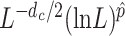 with
with  a logarithmic correction exponent. Using extensive Monte Carlo simulations, we provide complementary evidence for the predictions through the finite-size scaling of observables, including the two-point correlation, the magnetic fluctuations at zero and nonzero Fourier modes and the Binder cumulant. Our work sheds light on the formulation of logarithmic finite-size scaling and has practical applications in experimental systems.
Keywords: critical phenomena, universality class, O(n) vector model, finite-size scaling
INTRODUCTION
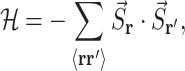
The O(n) model of interacting vector spins is a much-applied model in condensed-matter physics and one of the most significant classes of lattice models in equilibrium statistical mechanics [1,2]. The Hamiltonian of the O(n) vector model is written as
 |
(1) |
where  is an n-component isotropic spin with unit length and the summation runs over nearest neighbors. Prominent examples include the Ising (n = 1), XY (n = 2) and Heisenberg (n = 3) models of ferromagnetism, as well as the self-avoiding random walk (n → 0) in polymer physics. Its experimental realization is now available for various n values in magnetic materials [3–7], superconducting arrays [8,9] and ultracold atomic systems [10,11].
Finite-size scaling (FSS) is an extensively utilized method for studying systems of continuous phase transitions [12], including the O(n) vector model (1). Near criticality, these systems are characterized by a diverging correlation length ξ ∝ t−ν, where the parameter t measures the deviation from the critical point and ν is a critical exponent. For a finite box with linear size L, the standard FSS hypothesis assumes that ξ is bounded by the linear size L, and thus predicts that the singular part f(t, h) of the free-energy density scales as
 |
(2) |
where  is a universal scaling function, t and h represent the thermal and magnetic scaling fields, and yt = 1/ν and yh are the corresponding thermal and magnetic renormalization exponents, respectively. Furthermore, the standard FSS theory hypothesizes that, at criticality, the spin-spin correlation function
 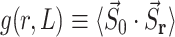 of distance r decays as
 |
(3) |
where η relates to yh by the scaling relation η = 2 + d − 2yh. From (2) and (3), the FSS of various macroscopic physical quantities can be obtained. For instance, from the second derivative of f(t, h) with respect to t or h, it follows that, at criticality, the specific heat behaves as  and the magnetic susceptibility diverges as
 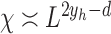 . The FSS of χ can also be calculated by summing g(r, L) over the system. Furthermore, the thermodynamic critical exponents can be obtained by the (hyper-)scaling relations. For instance, in the thermodynamic limit (L → ∞), the specific heat and the magnetic susceptibility scale as C ∝ t−α and χ ∝ t−γ, where the critical exponents are α = 2 − d/yt and γ = (2yh − d)/yt.
The O(n) model exhibits an upper critical dimensionality dc = 4 such that the thermodynamic scaling in higher dimensions d > dc are governed by the Gaussian fixed point, which has the critical exponents α = 0 and γ = 1, etc. In the framework of the renormalization group, the renormalization exponents near the Gaussian fixed point are
 |
(4) |
for d > dc.
Accordingly, the standard FSS formulae (2) and (3) predict that the critical susceptibility diverges as 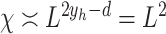 for d > dc. However, for the Ising model on 5D periodic hypercubes, χ was numerically observed to scale as L ≍ L5/2 instead of L2 [13–18]. The FSS for d ≥ dc turns out to be surprisingly subtle and remains a topic of extensive controversy [13–21].
It was realized that, for d > dc, the Gaussian exponents yt and yh in (4) can be renormalized by the leading irrelevant thermal field with exponent yu = 4 − d as [22–25]
 |
(5) |
and the FSS of the free-energy density f(t, h) becomes
 |
(6) |
In this scenario of the dangerously irrelevant field, the FSS of the critical susceptibility becomes  , consistent with the numerical results [13–15,17,18]. It was further assumed that the scaling behavior of g(r, L) is modified as [16]
 |
(7) |
with ηQ = 2 − d/2, such that the decay of g(r, L) is no longer Gaussian-like. In the study of the 5D Ising model [13], a more subtle scenario was proposed that g(r, L) decays as r−3 at short distances, gradually becomes r−5/2 for large distances and has a crossover behavior in between. The introduction of ηQ was refuted by Wittmann and Young [15] as the magnetic fluctuations at nonzero Fourier mode k ≠ 0 scale as χk ≍ L2 and underlined in [17], which revealed that the nonzero Fourier moments are governed by the Gaussian fixed point instead of being contaminated by the dangerously irrelevant field.
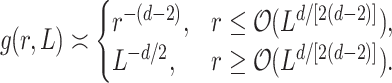
Using random-current and random-path representations [26–28], Papathanakos [19] conjectured that the scaling behavior of g(r, L) has a two-length form as
 |
(8) |
According to (8), the critical correlation function still exhibits a Gaussian-like decay, g(r, L) ≍ r−(d − 2), up to a length scale ξ1 = Ld/[2(d − 2)], and then enters an r-independent plateau whose height vanishes as L−d/2. Since the length ξ1 is vanishingly small compared to the linear size, ξ1/L → 0, the plateau effectively dominates the scaling behavior of g(r, L) and the FSS of χ. The two-length scaling form (8) has been numerically confirmed for the 5D Ising model and self-avoiding random walk, with a geometric explanation based on the introduction of an unwrapped length on the torus [18]. It is also consistent with the rigorous calculations for the so-called random-length random-walk model [20]. It is noteworthy that the two-length scaling is able to explain both the FSS χ0 ≡ χ ≍ L5/2 for the susceptibility (the magnetic fluctuations at the zero Fourier mode) [14] and the FSS χk ≍ L2 for the magnetic fluctuations at nonzero modes [15,17].
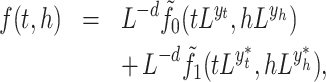
Combining all the existing numerical and (semi-)analytical insights [13–20], Y.D. and coworkers extended the scaling form (6) for the free energy to be [21]
 |
(9) |
where (yt, yh) are the Gaussian exponents (4) and  are still given by (5). Conceptually, scaling formula (9) explicitly points out the coexistence of two sets of exponents (yt, yh) and
  , which was implied in previous studies [15,17,18,20]. Moreover, a simple perspective of understanding was provided [21] that the scaling term with
  can be regarded as corresponding to the FSS of the critical O(n) model on a finite complete graph with V = Ld vertices. As a consequence, the exponents
  can be directly obtained from exact calculations of the complete-graph O(n) vector model, which also gives
  and
and  . From this correspondence, the plateau of g(r, L) in (8) is in line with the FSS of the complete-graph correlation function
 , which also decays as V−1/2 = L−d/2. Note that, as a counterpart of the complete-graph scaling function, the term with
  should not describe the FSS of quantities merely associated with r-dependent behaviors, including magnetic/energylike fluctuations at nonzero Fourier modes. Therefore, in comparison with (6), scaling formula (9) can give the FSS of a more exhaustive list of physical quantities. The following gives some examples at criticality.
Let
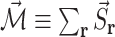 specify the total magnetization of a spin configuration, and measure its ℓ moment as
  . Equation (9) predicts that
  , with q a nonuniversal constant. In particular, the magnetic susceptibility
  , where the FSS from the Gaussian term
  is effectively a finite-size correction, but its existence is important in analyzing numerical data [21].
Let
 specify the Fourier mode of magnetization with momentum k ≠ 0, and measure its ℓ moment as
  . The magnetic fluctuations at k ≠ 0 behave as
  . The behaviors of χ0 and χk have been confirmed for the 5D Ising model [15,17,18,20].
The Binder cumulant
 should take the complete-graph value, as expected from the correspondence between the term with
  in (9) and the complete-graph FSS. For the Ising model, the complete-graph calculations give Q = 4[Γ(3/4)/Γ(1/4)]2 ≈ 0.456 947, consistent with the 5D result in [13].
Analogously, the FSS behaviors of the energy density, its higher-order fluctuations and the ℓ-moment Fourier modes at k ≠ 0 can be derived from (9).
We expect that the FSS formulae (8) and (9) are valid not only for the O(n) vector model but also for generic systems of continuous phase transitions at d > dc. An example is given for percolation that has dc = 6. It was observed [29] that, at criticality, the probability distributions of the largest-cluster size follow the same scaling function for 7D periodic hypercubes and on the complete graph.
In this work, we focus on the FSS for the O(n) vector model at the upper critical dimensionality d = dc. In this marginal case, it is known that multiplicative and additive logarithmic corrections would appear in the FSS. However, exploring these logarithmic corrections turns out to be notoriously hard. The challenge comes from the lack of analytical insights, the existence of slow finite-size corrections, as well as the unavailability of very large system sizes in simulations of high-dimensional systems.
For the O(n) vector model, establishing the precise FSS form at d = dc is not only of fundamental importance in statistical mechanics and condensed-matter physics, but also of practical relevance due to the direct experimental realizations of the model, particularly in three-dimensional quantum critical systems [3–6,10,11]. For instance, to explore the stability of Anderson–Higgs excitation modes in systems with continuous symmetry breaking (n ≥ 2), a crucial theoretical question is whether or not the Gaussian r-dependent behavior g(r) ≍ r−2 is modified by some multiplicative logarithmic corrections.
SUMMARY OF THE MAIN FINDINGS
At the upper critical dimensionality (dc = 4) of the O(n) model, state-of-the-art applications of FSS are mostly restricted to a phenomenological scaling form proposed by Kenna [30] for the singular part of the free-energy density, which was extended from Aktekin’s formula for the Ising model [31],
 |
(10) |
for n ≥ 0 and n ≠ 4, where the renormalization exponents yt = 2 and yh = 3 are given by (4). Furthermore, the renormalization-group calculations predicted the logarithmic-correction exponents as  and
and  [32,33]. The leading FSS of χ0 is hence given by χ0 ≍ L2(lnL)1/2, independent of n.
Motivated by recent progress in O(n) models for d > dc [15–21], we hereby propose that, at d = dc, the scaling form (10) for the free energy should be revised as
 |
(11) |
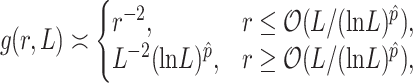
and the critical two-point correlation g(r, L) behaves as
 |
(12) |
with 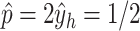 . By (12), we explicitly point out that no multiplicative logarithmic correction appears in the r dependence of g(r, L) ≍ r−2, which is still Gaussian-like. By contrast, the plateau for
  is modified as
  . In other words, along any direction of the periodic hypercube, we have
  , with
  a nonuniversal constant. The r−2 decay at shorter distances in (12) is consistent with analytical calculations for the 4D weakly self-avoiding random walk and the O(n) φ4 model directly in the thermodynamic limit (L → ∞) [34], which predict
  .
.
The roles of terms with  and
and  in (11) are analogous to those in (9). The former arises from the Gaussian fixed point, and the latter describes the ‘background’ contributions (k = 0) for the FSS of macroscopic quantities. However, note that the term with
  can no longer be regarded as an exact counterpart of the FSS of the complete graph, due to the existence of multiplicative logarithmic corrections. By contrast, the exact complete-graph mechanism applies to the
  term in (9), where the logarithmic correction is absent and
  corresponds to the free energy of the standard complete-graph model. According to (11), the FSS of various macroscopic quantities at d = dc can be obtained as follows.
The magnetization density
 .
.The magnetic susceptibility
 .
.The magnetic fluctuations at k ≠ 0 Fourier modes χk ≍ L2.
The Binder cumulant Q may not take the exact complete-graph value, due to the multiplicative logarithmic correction. Some evidence was observed in a recent study by Y.D. and his coworkers for the self-avoiding random walk (n = 0) on 4D periodic hypercubes, in which the maximum system size is up to L = 700.
The FSS of the energy density, its higher-order fluctuations and the ℓ-moment Fourier modes at k ≠ 0 can be obtained.
In quantities like m and χ0, the FSS from the Gaussian fixed point effectively plays the role of finite-size corrections. Nevertheless, we note that in the analysis of numerical data, it is important to include such scaling terms.
We remark that the FSS formulae (11) and (12) for d = dc are less generic than (8) and (9) for d > dc. For the O(n) models, a multiplicative logarithmic correction is absent in the Gaussian r dependence of g(r, L) in (12). Although the two length scales are possibly generic features of models with logarithmic finite-size corrections at upper critical dimensionality, multiplicative logarithmic corrections to the r dependence of g(r, L) require case-by-case analyses. Equation (11) can be modified in some of these models, which include the percolation and spin-glass models in six dimensions.
We proceed to verify (11) and (12) using extensive Monte Carlo (MC) simulations of the O(n) vector model. Before giving the technical details, in Fig. 1 we present complementary evidence for (11) and (12) in the case of the critical 4D XY model. In Fig. 1(a) we show the extensive data of g(r, L) for 16 ≤ L ≤ 80, of which the largest system contains about 4 × 10⁷ lattice sites. To demonstrate the multiplicative logarithmic correction in the large-distance plateau indicated by (12), we plot g(L/2, L)L2 versus lnL on a log-log scale in Fig. 1(b). The excellent agreement between the MC data and the formula  1(lnL)1/2 +
  2 provides a first piece of evidence for the presence of the logarithmic correction with exponent
  . The second piece of evidence comes from Fig. 1(c), which suggests that the χ0L−2 data can be well described by the formula q1(lnL)1/2 + q2. Finally, in Fig. 1(d) we plot the k ≠ 0 magnetic fluctuations χ1 and χ2 with k1 = (2π/L, 0, 0, 0) and k2 = (2π/L, 2π/L, 0, 0), respectively, which suppress the L-dependent plateau and show the r-dependent behavior of g(r, L). Indeed, the χ1L−2 and χ2L−2 data converge rapidly to constants as L increases.
Figure 1.

Evidence for conjectured formulae (11) and (12) in the example of the critical four-dimensional (4D) XY model. (a) Correlation function g(r, L) on a log-log scale. The solid line denotes r−2 behavior. (b) Scaled correlation g(r, L)L2 with r = L/2 versus lnL on a log-log scale. Thus, the horizontal axis is effectively on a double logarithmic scale of L. The solid line represents logarithmic divergence with  . (c) Scaled magnetic susceptibility χ0L−2 versus lnL on a log-log scale. The solid line accounts for logarithmic divergence with
  . (d) Scaled k ≠ 0 magnetic fluctuations χ1L−2 and χ2L−2, with k1 = (2π/L, 0, 0, 0) and k2 = (2π/L, 2π/L, 0, 0), respectively. The horizontal lines strongly indicate the absence of logarithmic corrections in the scaling of χk.
NUMERICAL RESULTS AND FINITE-SIZE SCALING ANALYSES
Using a cluster MC algorithm [35], we simulate Hamiltonian (1) on 4D hypercubic lattices up to Lmax = 96 (Ising, XY) and 56 (Heisenberg), and measure a variety of macroscopic quantities, including the magnetization density m, the susceptibility χ0, the magnetic fluctuations χ1 and χ2 and the Binder cumulant Q. Moreover, we compute the two-point correlation function g(r, L) for the XY model up to Lmax = 80 by means of a state-of-the-art worm MC algorithm [36].
Estimates of critical temperatures
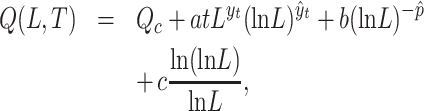
In order to locate the critical temperatures Tc, we perform least-squares fits for the finite-size MC data of the Binder cumulant to
 |
(13) |
where t is explicitly defined as Tc − T, Qc is a universal ratio, and a, b, c are nonuniversal parameters. In addition to the leading additive logarithmic correction, we include c(ln(lnL))/lnL proposed by Kenna [30] as a high-order correction, ensuring the stability of fits. In all fits, we justify the confidence in a standard manner: the fits with Chi squared (χ2) per degree of freedom (DF) is  and remains stable as the cutoff size Lmin increases. The latter is a caution against possible high-order corrections not included. The details of the fits are presented in the online supplementary material.
By analyzing the finite-size correction Q(L, Tc) − Qc, we find that the leading correction is nearly proportional to (lnL)−1/2, consistent with the prediction of (11) and (12). We let Qc be free in the fits and have Qc = 0.45(1), close to the complete-graph result Qc = 0.456 947. Besides, we perform simulations for the XY and Heisenberg models on the complete graph and obtain Qc ≈ 0.635 and 0.728, respectively, also close to the fitting results of the 4D Q data. We obtain Tc(XY) = 3.314 437(6), and in Fig. 2(a) we illustrate the location of Tc by Q.
Figure 2.

Locating Tc for the 4D XY model. (a) The Binder cumulant Q with finite-size corrections being subtracted, namely, Q*(L, T) = Q(L, T) − b(lnL)−1/2, with b ≈ 0.1069 according to a preferred least-squares fit. The shadow marks Tc and its error margin. (b) The magnetization density m rescaled by L−1 versus lnL around Tc = 3.314 44 on a log-log scale.
We further examine the estimate of Tc by the FSS of other quantities, such as the magnetization density m. For the XY model, in Fig. 2(b) we give a log-log plot of the mL data versus lnL for T = Tc, as well as for Tlow = 3.314 40 and Tabove = 3.314 50. The significant bending-up and bending-down features clearly suggest that Tlow < Tc and Tabove > Tc, providing confidence for the finally quoted error margin of Tc.
The final estimates of Tc are summarized in Table 1. For n = 1, we have Tc = 6.680 300(10), which is consonant with and improves over Tc = 6.680 263(23) [37] and marginally agrees with Tc = 6.679 63(36) [38] and 6.680 339(14) [13]. For n = 2, our determination Tc = 3.314 437(6) significantly improves over Tc = 3.31 [39,40] and 3.314 [41]. For n = 3, our result Tc = 2.198 79(2) rules out Tc = 2.192(1) from a high-temperature expansion [42].
Table 1.
Estimates of Tc for the 4D O(n) vector models.
Finite-size scaling of the two-point correlation
We then fit the critical two-point correlation g(L/2, L) to
 |
(14) |
where the first term comes from the large-distance plateau and the second term comes from the r-dependent behavior of g(r, L). With  being fixed, the estimate of the leading scaling term L−1.98(4) agrees well with the exact L−2. With the exponent −2 in L−2 being fixed, the result
  is also well consistent with the prediction
  . These results are elaborated in the online supplementary material.
We remark that FSS analyses for g(L/2, L) have already been performed in [16] with the formula g(L/2, L) = AL−2[ln(L/2 + B)]1/2 (A and B are constants) and in [13] with a similar formula. These FSSs in the literature correspond to the first scaling term in (14). Hence, (14) serves as a forward step for complete FSS by involving the scaling term  2L−2, which arises from the Gaussian fixed point.
Finite-size scaling of the magnetic susceptibility
According to (11) and (12), we fit the critical susceptibility χ0 to
 |
(15) |
with q1 and q2 nonuniversal constants. For  being fixed, we obtain fitting results with χ2/DF ≲ 1 for each n = 1, 2, 3, and correctly produce the leading scaling form L2. The scaled susceptibility χ0L−2 versus lnL is shown in Fig. 1(c) for the XY model and in Fig. 3(a) for the Ising and Heisenberg models.
Figure 3.

The magnetic fluctuations (a) χ0 and (b) χ1 rescaled by L2 versus lnL on a log-log scale for the critical Ising and Heisenberg models. The black lines in (a) represent the least-squares fits, and the red line in (b) denotes a constant.
We note that previous studies based on a FSS without high-order corrections produced estimates of 
 , considered to be consistent with
  [38,43–45]. The maximum lattice size therein was Lmax = 24, four times smaller than Lmax = 96 of the present study. In particular, it was reported [43] that
  and
and 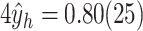 . Nevertheless, we find that the fit
  by dropping the correction term q2L2 would yield
 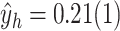 (Ising), 0.20(1) (XY), and 0.19(1) (Heisenberg), which are smaller than and inconsistent with the predicted value
  . This suggests the significance of q2L2 in the susceptibility χ0, which arises from the r dependence of g(r, L).
Finite-size scaling of the magnetic fluctuations at nonzero Fourier modes
We consider the magnetic fluctuations χ1 with |k1| = 2π/L and χ2 with 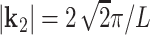 . We have compared the FSSs of χ0, χ1 and χ2 in Fig. 1(c) and (d) for the critical 4D XY model. As L increases, χ1L−2 and χ2L−2 converge rapidly, suggesting the absence of a multiplicative logarithmic correction. This is in sharp contrast to the behavior of χ0L−2, which diverges logarithmically. For the Ising and Heisenberg models, the FSS of the fluctuations at nonzero modes is also free of a multiplicative logarithmic correction (Fig. 3(b)).
Surprisingly, we find that the scaled fluctuations χ1L−2 ≈ 0.15 are equal within error bars for the Ising, XY and Heisenberg models.
Furthermore, we show in Fig. 4 χ1 and χ2 versus T for the 4D XY model. We observe that the magnetic fluctuations at nonzero Fourier modes reach maximum at Tc and that the χ1L−2 (χ2L−2) data for different Ls collapse well not only at Tc but also for a wide range of 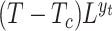 with yt = 2.
Figure 4.

Data collapses for the magnetic fluctuations (a) χ1 and (b) χ2 rescaled by  and
and  (yh = 3, yt = 2, d = 4) for the 4D XY model. The insets show the scaled fluctuations versus T, and the dashed lines denote Tc.
DISCUSSIONS
We propose formulae (11) and (12) for the FSS of the O(n) universality class at the upper critical dimensionality, which are tested against extensive MC simulations with n = 1, 2, 3. From the FSS of the magnetic fluctuations at zero and nonzero Fourier modes, the two-point correlation function and the Binder cumulant, we obtain complementary and solid evidence supporting (11) and (12). As byproducts, the critical temperatures for n = 1, 2, 3 are all located up to an unprecedented precision.
An immediate application of (12) is to the massive amplitude excitation mode (often called the Anderson–Higgs boson) due to the spontaneous breaking of the continuous O(n) symmetry [46], which is at the frontier of condensed matter research. At the pressure-induced quantum critical point (QCP) in the dimerized quantum antiferromagnet TlCuCl3, the 3D O(3) amplitude mode was probed by neutron spectroscopy and a rather narrow peak width of about 15% of the excitation energy was revealed, giving no evidence for the logarithmic reduction of the width-mass ratio [3]. This was later confirmed by a quantum MC study of a 3D model Hamiltonian of O(3) symmetry [5,6]. Indeed, (12) provides an explanation why the logarithmic-correction reduction in the Higgs resonance was not observed at the 3D QCP. In numerical studies of the Higgs excitation mode at the 3D QCP, the correlation function g(τ ≡ |τ1 − τ2|) is measured along the imaginary-time axis β, and numerical analytical continuation is used to deal with the g(τ) data. In practice, simulations are carried out at very low temperature β → ∞, and it is expected that g(τ) ≍ τ−2 for a significantly wide range of τ. Furthermore, it is the τ-dependent behavior of g(τ), instead of the L dependence, that plays a decisive role in numerical analytical continuation.
In the thermodynamic limit, the two-point correlation function decays as 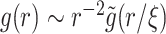 , where the scaling function
  quickly drops to zero as r/ξ ≫ 1. It can be seen that no multiplicative logarithmic correction exists in the algebraic decaying behavior. On the other hand, as the criticality is approached (t → 0), the correlation length diverges as
 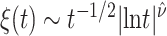 , and
, and  implies that ξ diverges faster than t−1/2 [30,33]. Since the susceptibility can be calculated by summing the correlation as
  , we have
 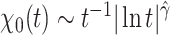 with
with  . The thermodynamic scaling of χ0(t) can also be obtained from the FSS formula (10) or (11), which gives
  . By fixing
  at some constant, we obtain the relation
  . Substituting this into the FSS of χ0(t, L) yields
 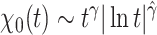 with γ = (2yh − 4)/yt and
  . With
  , we have γ = 1 and
  . The thermodynamic scaling with logarithmic corrections has been demonstrated in [4] in terms of the magnetization m of an O(3) Hamiltonian.
For the critical Ising model in five dimensions, an unwrapped distance ru was introduced to account for the winding numbers across a finite torus [18]. The unwrapped correlation was shown to behave as  , where the unwrapped correlation length diverges as ξu ∼ Ld/4. This differs from typical correlation functions that are cut off by a linear system size of approximately L. We expect that at dc = 4 the unwrapped correlation length diverges as
 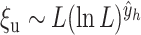 , which gives the critical susceptibility as
  .
.
Besides, (12) is useful for predicting various critical behaviors. As an instance, it was observed that an impurity immersed in a 2D O(2) quantum critical environment can evolve into a quasiparticle of fractionalized charge, as the impurity-environment interaction is tuned to a boundary critical point [47–49]. Equation (12) precludes the emergence of such a quantum-fluctuation-induced quasiparticle at the 3D O(2) QCP.
We mention an open question about the specific heat of the 4D Ising model. The FSS formula (10) predicts that the critical specific heat diverges as C ≍ (ln L)1/3. By contrast, an MC study demonstrated that the critical specific heat is bounded [37]. The complete scaling form (11) is potentially useful for reconciling the inconsistency.
Finally, it would be possible to extend the present scheme to other systems of critical phenomena, as the existence of upper critical dimensionality is a common feature therein. These systems include the percolation and spin-glass models at their upper critical dimensionality dc = 6. We leave this for a future study.
METHODS
Throughout the paper, the raw data for any temperature T and linear size L are obtained by means of MC simulations, for which the Wolff cluster algorithm [35] and the Prokof’ev–Svistunov worm algorithm [36] are employed complementarily. Both algorithms are state-of-the-art tools in their own territories.
The O(n) vector model (1) in its original spin representation is efficiently sampled by the Wolff cluster algorithm, which is the single-cluster version of the widely utilized nonlocal cluster algorithms. The present study uses the standard procedure of the algorithm, as in the original paper [35] where the algorithm was invented. In some situations, we also use the conventional Metropolis algorithm [50] for benchmarks. The macroscopic physical quantities of interest have been introduced in aforementioned sections for the spin representation.
The two-point correlation function for the XY model (n = 2) is sampled by means of the Prokof’ev–Svistunov worm algorithm, which was invented for a variety of classical statistical models [36]. By means of a high-temperature expansion, we perform an exact transformation for the original XY spin model to a graphic model in directed-flow representation. We then introduce two defects for enlarging the state space of directed flows. The Markov chain process of evolution is built upon biased random walks of defects, which satisfy the detailed balance condition. It is defined that the evolution hits the original directed-flow state space when the two defects meet at a site. The details for the exact transformation and a step-by-step procedure for the algorithm have been presented in [51].
Supplementary Material
Acknowledgements
Y.D. is indebted to valuable discussions with Timothy Garoni, Jens Grimm and Zongzheng Zhou.
Contributor Information
Jian-Ping Lv, Department of Physics, Anhui Key Laboratory of Optoelectric Materials Science and Technology, Key Laboratory of Functional Molecular Solids, Ministry of Education, Anhui Normal University, Wuhu 241000, China.
Wanwan Xu, Department of Physics, Anhui Key Laboratory of Optoelectric Materials Science and Technology, Key Laboratory of Functional Molecular Solids, Ministry of Education, Anhui Normal University, Wuhu 241000, China.
Yanan Sun, Department of Physics, Anhui Key Laboratory of Optoelectric Materials Science and Technology, Key Laboratory of Functional Molecular Solids, Ministry of Education, Anhui Normal University, Wuhu 241000, China.
Kun Chen, Department of Physics and Astronomy, Rutgers, The State University of New Jersey, Piscataway, NJ 08854-8019, USA; Department of Physics, Anhui Key Laboratory of Optoelectric Materials Science and Technology, Key Laboratory of Functional Molecular Solids, Ministry of Education, Anhui Normal University, Wuhu 241000, China.
Youjin Deng, National Laboratory for Physical Sciences at Microscale and Department of Modern Physics, University of Science and Technology of China, Hefei 230026, China; Department of Physics and Electronic Information Engineering, Minjiang University, Fuzhou 350108, China.
FUNDING
This work was supported by the National Natural Science Foundation of China (11774002, 11625522 and 11975024), the National Key R&D Program of China (2016YFA0301604 and 2018YFA0306501), and the Department of Education in Anhui Province.
AUTHOR CONTRIBUTIONS
J.-P.L., K.C. and Y.D. designed the research and established the formulae for finite-size scaling. J.-P.L., W.X. and Y.S. performed the simulations. J.-P.L., W.X., Y.S. and Y. D. analyzed the results. J.-P.L. and Y.D. wrote the manuscript. All the authors participated in the revisions of the manuscript.
Conflict of interest statement. None declared.
REFERENCES
- 1. Fernández R, Fröhlich J, Sokal AD.. Random Walks, Critical Phenomena, and Triviality in Quantum Field Theory. Berlin: Springer, 2013. [Google Scholar]
- 2. Svistunov BV, Babaev ES, Prokof’ev NV. Superfluid States of Matter. London: CRC Press, 2015. [Google Scholar]
- 3. Merchant P, Normand B, Krämer KWet al. Quantum and classical criticality in a dimerized quantum antiferromagnet. Nat Phys 2014; 10: 373–9. [Google Scholar]
- 4. Qin YQ, Normand B, Sandvik AWet al. Multiplicative logarithmic corrections to quantum criticality in three-dimensional dimerized antiferromagnets. Phys Rev B 2015; 92: 214401. 10.1103/PhysRevB.92.214401 [DOI] [Google Scholar]
- 5. Lohöfer M, Wessel S.. Excitation-gap scaling near quantum critical three-dimensional antiferromagnets. Phys Rev Lett 2017; 118: 147206. 10.1103/PhysRevLett.118.147206 [DOI] [PubMed] [Google Scholar]
- 6. Qin YQ, Normand B, Sandvik AWet al. Amplitude mode in three-dimensional dimerized antiferromagnets. Phys Rev Lett 2017; 118: 147207. 10.1103/PhysRevLett.118.147207 [DOI] [PubMed] [Google Scholar]
- 7. Cui Y, Zou H, Xi Net al. Quantum criticality of the Ising-like screw chain antiferromagnet SrCo2V2O8 in a Transverse magnetic field. Phys Rev Lett 2019; 123: 067203. 10.1103/PhysRevLett.123.067203 [DOI] [PubMed] [Google Scholar]
- 8. Resnick DJ, Garland JC, Boyd JTet al. Kosterlitz-Thouless transition in proximity-coupled superconducting arrays. Phys Rev Lett 1981; 47: 1542–5. 10.1103/PhysRevLett.47.1542 [DOI] [Google Scholar]
- 9. Goldman A. Percolation, Localization, and Superconductivity, Vol. 109. Boston: Springer, 2013. [Google Scholar]
- 10. Greiner M, Mandel O, Esslinger Tet al. Quantum phase transition from a superfluid to a Mott insulator in a gas of ultracold atoms. Nature 2002; 415: 39–44. 10.1038/415039a [DOI] [PubMed] [Google Scholar]
- 11. Capogrosso-Sansone B, Prokof’ev NV, Svistunov BV.. Phase diagram and thermodynamics of the three-dimensional Bose-Hubbard model. Phys Rev B 2007; 75: 134302. 10.1103/PhysRevB.75.134302 [DOI] [Google Scholar]
- 12. Cardy J. Finite-Size Scaling, Vol. 2. Amsterdam: Elsevier, 2012. [Google Scholar]
- 13. Luijten E. Interaction Range, Universality and the Upper Critical Dimension. Delft: Delft University Press, 1997. [Google Scholar]
- 14. Luijten E, Binder K, Blöte HWJ.. Finite-size scaling above the upper critical dimension revisited: the case of the five-dimensional Ising model. Euro Phys J B 1999; 9: 289–97. 10.1007/s100510050768 [DOI] [Google Scholar]
- 15. Wittmann M, Young AP.. Finite-size scaling above the upper critical dimension. Phys Rev E 2014; 90: 062137. 10.1103/PhysRevE.90.062137 [DOI] [PubMed] [Google Scholar]
- 16. Kenna R, Berche B.. Fisher’s scaling relation above the upper critical dimension. Europhys Lett 2014; 105: 26005. 10.1209/0295-5075/105/26005 [DOI] [Google Scholar]
- 17. Flores-Sola E, Berche B, Kenna Ret al. Role of Fourier modes in finite-size scaling above the upper critical dimension. Phys Rev Lett 2016; 116: 115701. 10.1103/PhysRevLett.116.115701 [DOI] [PubMed] [Google Scholar]
- 18. Grimm J, Elçi EM, Zhou Zet al. Geometric explanation of anomalous finite-size scaling in high dimensions. Phys Rev Lett 2017; 118: 115701. 10.1103/PhysRevLett.118.115701 [DOI] [PubMed] [Google Scholar]
- 19. Papathanakos V. Finite-size effects in high-dimensional statistical mechanical systems: the Ising model with periodic boundary conditions. Ph.D. Thesis. Princeton University, 2006. [Google Scholar]
- 20. Zhou Z, Grimm J, Fang Set al. Random-length random walks and finite-size scaling in high dimensions. Phys Rev Lett 2018; 121: 185701. 10.1103/PhysRevLett.121.185701 [DOI] [PubMed] [Google Scholar]
- 21. Fang S, Grimm J, Zhou Zet al. Complete graph and Gaussian fixed point asymptotics in the five-dimensional Fortuin-Kasteleyn Ising model with periodic boundaries. Phys Rev E 2020; 102: 022125. 10.1103/PhysRevE.102.022125 [DOI] [PubMed] [Google Scholar]
- 22. Fisher ME. Critical phenomena. In: Green MS (ed.). Proceedings of the 51st Enrico Fermi Summer School. New York: Academic, 1971. [Google Scholar]
- 23. Binder K, Nauenberg M, Privman Vet al. Finite-size tests of hyperscaling. Phys Rev B 1985; 31: 1498–502. [DOI] [PubMed] [Google Scholar]
- 24. Berche B, Kenna R, Walter JC.. Hyperscaling above the upper critical dimension. Nucl Phys B 2012; 865: 115–32. 10.1016/j.nuclphysb.2012.07.021 [DOI] [Google Scholar]
- 25. Kenna R, Berche B.. A new critical exponent koppa and its logarithmic counterpart koppa-hat. Cond Matt Phys 2013; 16: 23601. 10.5488/CMP.16.23601 [DOI] [Google Scholar]
- 26. Aizenman M. Geometric analysis of ϕ4 fields and Ising models. Parts I and II. Commun Math Phys 1982; 86: 1–48. 10.1007/BF01205659 [DOI] [Google Scholar]
- 27. Aizenman M. Rigorous studies of critical behavior II. In: Fritz J, Jaffe A, Szasz D (eds). Statistical Physics and Dynamical Systems: Rigorous Results. Boston: Birkhauser, 1985, 453–81. [Google Scholar]
- 28. Aizenman M. Rigorous studies of critical behavior. Physica A 1986; 140: 225–31. 10.1016/0378-4371(86)90226-8 [DOI] [Google Scholar]
- 29. Huang W, Hou P, Wang Jet al. Critical percolation clusters in seven dimensions and on a complete graph. Phys Rev E 2018; 97: 022107. 10.1103/PhysRevE.97.022107 [DOI] [PubMed] [Google Scholar]
- 30. Kenna R. Finite size scaling for O(N) φ4-theory at the upper critical dimension. Nucl Phys B 2004; 691: 292–304. 10.1016/j.nuclphysb.2004.05.012 [DOI] [Google Scholar]
- 31. Aktekin N. The finite-size scaling functions of the four-dimensional Ising model. J Stat Phys 2001; 104: 1397–406. 10.1023/A:1010457905088 [DOI] [Google Scholar]
- 32. Wegner FJ, Riedel EK.. Logarithmic corrections to the molecular-field behavior of critical and tricritical systems. Phys Rev B 1973; 7: 248. 10.1103/PhysRevB.7.248 [Google Scholar]
- 33. Kenna R. Universal scaling relations for logarithmic-correction exponents. In: Holovatch Y (ed.). Order, Disorder and Criticality, Advanced Problems of Phase Transition Theory. New York: World Scientific, 2012. [Google Scholar]
- 34. Slade G, Tomberg A.. Critical correlation functions for the 4-dimensional weakly self-avoiding walk and n-component φ4 model. Commun Math Phys 2016; 342: 675–737. 10.1007/s00220-015-2488-4 [Google Scholar]
- 35. Wolff U. Collective Monte Carlo updating for spin systems. Phys Rev Lett 1989; 62: 361. 10.1103/PhysRevLett.62.361 [DOI] [PubMed] [Google Scholar]
- 36. Prokof’ev NV, Svistunov BV.. Worm algorithms for classical statistical models. Phys Rev Lett 2001; 87: 160601. 10.1103/PhysRevLett.87.160601 [DOI] [PubMed] [Google Scholar]
- 37. Lundow PH, Markström K.. Critical behavior of the Ising model on the four-dimensional cubic lattice. Phys Rev E 2009; 80: 031104. 10.1103/PhysRevE.80.031104 [DOI] [PubMed] [Google Scholar]
-
38.
Kenna R, Lang CB..
Finite size scaling and the zeroes of the partition function in the
 model. Phys Lett B 1991; 264: 396–400. 10.1016/j.nuclphysb.2004.05.012 [Google Scholar]
 - 39. Jensen LM, Kim BJ, Minnhagen P.. Critical dynamics of the four-dimensional XY model. Physica B 2000; 284: 455–6. 10.1016/S0921-4526(99)02024-4 [Google Scholar]
- 40. Jensen LM, Kim BJ, Minnhagen P.. Dynamic critical exponent of two-, three-, and four-dimensional XY models with relaxational and resistively shunted junction dynamics. Phys Rev B 2000; 61: 15412. 10.1103/PhysRevB.61.15412 [Google Scholar]
- 41. Nonomura Y, Tomita Y.. Critical nonequilibrium relaxation in the Swendsen-Wang algorithm in the Berezinsky-Kosterlitz-Thouless and weak first-order phase transitions. Phys Rev E 2015; 92: 062121. 10.1103/PhysRevE.92.062121 [DOI] [PubMed] [Google Scholar]
- 42. McKenzie S, Domb C, Hunter DL. The high-temperature susceptibility of the classical Heisenberg model in four dimensions. J Phys A Math Gen 1982; 15: 3909–14. 10.1088/0305-4470/16/18/542 [Google Scholar]
- 43. Lai PY, Mon KK.. Finite-size scaling of the Ising model in four dimensions. Phys Rev B 1990; 41: 9257–63. 10.1103/PhysRevB.41.9257 [DOI] [PubMed] [Google Scholar]
-
44.
Kenna R, Lang CB..
Renormalization group analysis of finite-size scaling in the
 model. Nucl Phys B 1993; 393: 461–79. 10.1016/0550-3213(93)90068-Z [Google Scholar]
 - 45. Kenna R, Lang CB.. Scaling and density of Lee-Yang zeros in the four-dimensional Ising model. Phys Rev E 1994; 49: 5012. 10.1103/PhysRevE.49.5012 [DOI] [PubMed] [Google Scholar]
- 46. Pekker D, Varma CM.. Amplitude/Higgs modes in condensed matter physics. Annu Rev Condens Matter Phys 2015; 6: 269–97. 10.1146/annurev-conmatphys-031214-014350 [Google Scholar]
- 47. Huang Y, Chen K, Deng Yet al. Trapping centers at the superfluid–Mott-insulator criticality: transition between charge-quantized states. Phys Rev B 2016; 94: 220502. 10.1103/PhysRevB.94.220502 [Google Scholar]
- 48. Whitsitt S, Sachdev S.. Critical behavior of an impurity at the boson superfluid–Mott-insulator transition. Phys Rev A 2017; 96: 053620. 10.1103/PhysRevA.96.053620 [Google Scholar]
- 49. Chen K, Huang Y, Deng Yet al. Halon: a quasiparticle featuring critical charge fractionalization. Phys Rev B 2018; 98: 214516. 10.1103/PhysRevB.98.214516 [Google Scholar]
- 50. Metropolis N, Rosenbluth AW, Rosenbluth MNet al. Equation of state calculations by fast computing machines. J Chem Phys 1953; 21: 1087–92. 10.1063/1.1699114 [Google Scholar]
- 51. Xu W, Sun Y, Lv JPet al. High-precision Monte Carlo study of several models in the three-dimensional U(1) universality class. Phys Rev B 2019; 100: 064525. 10.1103/PhysRevB.100.064525 [Google Scholar]
Associated Data
This section collects any data citations, data availability statements, or supplementary materials included in this article.