



Discovery of TDI-10229: A Potent and Orally Bioavailable Inhibitor of Soluble Adenylyl Cyclase (sAC, ADCY10)
Adenylyl cyclases catalyze the formation of cAMP from ATP. Soluble adenylyl cyclase (sAC) is regulated by the bicarbonate anion and serves as a sensor for CO2 and HCO3–. Inhibitors of sAC may be useful in a number of different indications, including nonhormonal male contraception, but current inhibitors either have poor physicochemical and pharmacokinetic properties or have not been completely described in the peer-reviewed literature.
In this Issue, Fushimi et al. (DOI: 10.1021/acsmedchemlett.1c00273) describe the optimization of a previously described inhibitor,
LRE1, that has low potency and poor pharmacokinetic properties. The
team used a crystal structure of LRE1 bound to sAC to scaffold-hop
from a 4-aminopyrimidine core to a 4-pyrazolylpyrimidine. Replacement
of a metabolically labile thiophene with a phenyl ring led to TDI-10229,
which had improved potency. TDI-10229 also showed an improved pharmacokinetic
profile that was suitable for oral dosing. This work has led to an in vivo chemical probe of sAC function, which will allow
for the future study of sAC inhibition in animal models of disease.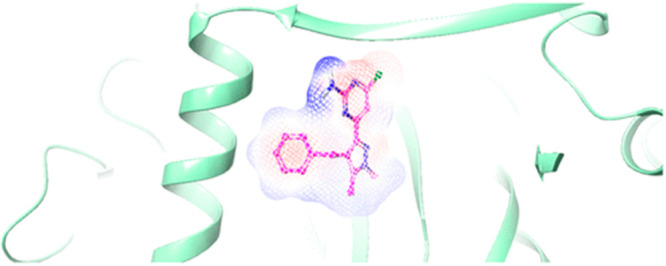
Spirocyclic Thiohydantoin Antagonists of F877L and Wild-Type Androgen Receptor for Castration-Resistant Prostate Cancer
The androgen receptor is a well-validated target for prostate cancer and has been targeted with several different small molecules, including bicalutamide and flutamide, and more recent antagonists, such as enzalutamide and apalutamide. The androgen receptor is especially prone to somatic mutations that cause resistance to current therapies. The F877L mutation, in particular, has been associated with a mechanistic switch that causes antagonists enzalutamide and apalutamide to act as agonists.
In this Issue, Zhang et al. (DOI: 10.1021/acsmedchemlett.1c00032) describe a conformational restriction approach to address the F877L
mutation. The authors hypothesized that this strategy would reduce
conformational flexibility within the ligand to such an extent that
bulky peripheral substituents, which have been used previously, could
be avoided altogether. The authors prepared a series of spirocyclic
thiohydantoins. Several of these compounds, including (R)-29, showed promising activity against wild-type and
F877L androgen receptor in several different in vitro and in vivo models. This work provides evidence
that conformational restriction in androgen receptor ligands may be
a promising strategy to address a common resistance mutation seen
in prostate cancer therapy.
Optimization of Triarylpyridinone Inhibitors of the Main Protease of SARS-CoV-2 to Low-Nanomolar Antiviral Potency
A target of considerable interest in the development of therapeutics for COVID-19 has been the Mpro protease. Mpro cleaves viral polyproteins formed after ribosomal processing. The mutation rate of Mpro between SARS-CoV and SARS-CoV-2 is low, which further makes it a promising target for antiviral drug discovery.
In this Issue, Zhang et al. (DOI: 10.1021/acsmedchemlett.1c00326) have optimized a series of triarylpyridinone inhibitors that further
explored the S3-S4 channel of Mpro. Because of poor cell
permeability with some analogues, the authors also used a parallel
artificial membrane permeability assay (PAMPA) to increase the probability
of success in cell-based assays. The authors found several compounds
that were active in cell culture, including compound 19. This work further extends our understanding of inhibitors of the
Mpro protease and provides a foundation for potential therapeutics
that can block SARS-CoV-2 replication.