



Abstract
Determining how variation in morphology affects animal performance (and ultimately fitness) is key to understanding the complete process of evolutionary adaptation. Long tails have evolved many times in arboreal and semi-arboreal rodents; in deer mice, long tails have evolved repeatedly in populations occupying forested habitat even within a single species (Peromyscus maniculatus). Here, we use a combination of functional modeling, laboratory studies, and museum records to test hypotheses about the function of tail-length variation in deer mice. First, we use computational models, informed by museum records documenting natural variation in tail length, to test whether differences in tail morphology between forest and prairie subspecies can influence performance in behavioral contexts relevant for tail use. We find that the deer- mouse tail plays little role in statically adjusting center of mass or in correcting body pitch and yaw, but rather it can affect body roll during arboreal locomotion. In this context, we find that even intraspecific tail-length variation could result in substantial differences in how much body rotation results from equivalent tail motions (i.e., tail effectiveness), but the relationship between commonly-used metrics of tail-length variation and effectiveness is non-linear. We further test whether caudal vertebra length, number, and shape are associated with differences in how much the tail can bend to curve around narrow substrates (i.e., tail curvature) and find that, as predicted, the shape of the caudal vertebrae is associated with intervertebral bending angle across taxa. However, although forest and prairie mice typically differ in both the length and number of caudal vertebrae, we do not find evidence that this pattern is the result of a functional trade-off related to tail curvature. Together, these results highlight how even simple models can both generate and exclude hypotheses about the functional consequences of trait variation for organismal-level performance.
Introduction
Identifying adaptive traits and their functional significance is a key challenge for evolutionary biologists. Repeated associations between specific traits and environments—cases of parallel or convergent evolution—provide evidence that natural selection may be driving trait evolution (e.g., Mayr 1963; Endler 1986; Harvey and Pagel 1991; Elmer and Meyer 2011; Losos 2011). However, additional experiments are needed to determine the ultimate drivers of trait variation: in particular, testing the functional effects on performance that underlie these associations can support or exclude models of trait evolution as well as highlight phenotypic measurements that may be most relevant for future study of genetic, developmental, and behavioral variation among populations and species (Arnold 1983; Koehl 1996; Losos 2011).
One striking example of a repeated association between a trait and environment is the evolution of long tails in arboreal and semi-arboreal species that occupy forested habitat. This association between tail length and arboreality has been documented using phylogenetically-controlled methods across mammals (Mincer and Russo 2020), across rodents (Verde Arregoitia et al. 2017), as well as within rodents, such as squirrels (Hayssen 2008) and Old World mice and rats (Nations et al. 2021). Even within single species, differences in tail length can evolve repeatedly, as in deer mice (Peromyscus maniculatus; Kingsley et al. 2017). In fact, long-tailed forest and short-tailed prairie forms represent the earliest and most striking morphological distinctions described between ecotypes in this well-studied species (Osgood 1909; Dice 1940; Blair 1950).
In small mammals, such as deer mice, a leading hypothesis to explain the strong association between tail length and forested habitat has been a role for tails in arboreal locomotion (e.g., Horner 1954; Thorington 1970; Kaufman and Kaufman 1992; Hayssen 2008). Several lines of evidence support this hypothesis, including stronger associations of tail length with arboreality than with temperature or latitude (Thorington 1970; Kaufman and Kaufman 1992); within-population associations between tail length and the frequency of arboreal foraging, as measured from stomach contents (Smartt and Lemen 1980); and behavioral observations of tail use during climbing (Horner 1954). Most notably, both deer mice and laboratory mice (Mus musculus) exhibit substantially reduced climbing ability after full or partial tail amputation (Buck et al. 1925; Horner 1954; Siegel 1970). Nonetheless, other studies have questioned the magnitude of any effect of tail use on body orientation: for example, young rats could not self-right using the tail alone (Laouris et al. 1990). Furthermore, most experimental studies of rodent tails have tested the significance of the presence or absence of the tail rather than the effect of natural variation in tail length. Thus, precisely how these habitat-associated tail-length differences are relevant for animal performance remains unclear.
Even within the context of arboreal locomotion, tails can be used in a variety of ways—from orientations that statically change the center of mass position, to motions that dynamically affect body rotation, to serving as a prop or even semi-prehensile tail wrapping and gripping (e.g., Hickman 1979; Cartmill 1985; Larson and Stern 2006; Young et al. 2015). These tail-use behaviors differ among species: tamarins swing their tail to promote dynamic stability, while squirrel monkeys use their tails more often as static counterbalances (Young et al. 2015). These motions likely reflect active tail use: for example, in cats, impairing tail control through sacrocaudal spinal transection reduced balance on narrow beams (Walker et al. 1998). The morphologies that most influence tail function vary according to which tail-use behaviors are most relevant. For example, flexibility and grip strength may be more significant for prehensile tail use, while tail size may be most significant for adjusting the center of mass. Indeed, differences in tail use, such as whether tails are prehensile, are associated with differences in vertebral morphology throughout the tail (e.g., Flower 1885; Organ 2010; Deane et al. 2014). Thus, the behavioral context (in this case, behaviors in which the tail is used) is critical to understanding the functional significance of morphological variation.
In deer mice and other small mammals, locomotion is difficult to observe directly in the wild. However, a number of studies have documented that forest deer mice often nest in trees (Wolff and Hurlbutt 1982; Wolff and Durr 1986), navigate both large-diameter trunks and narrow branches (Graves et al. 1988), and escape up trees when released from traps (reviewed in Horner 1954). Forest deer mice also perform better in both vertical and horizontal climbing assays than prairie mice (Horner 1954); however, only horizontal climbing performance was reduced in deer mice following tail amputation, highlighting the potential significance of tail use during balancing on narrow rods or branches. Horner (1954) found that performance decreased in proportion to the fraction of the tail amputated (full, half, or none), and that the performance cost of tail removal was higher in forest than in prairie subspecies. While balancing on narrow rods, Horner (1954) observed that deer mice swung their tails rapidly around the body, similar to the “tail whip” reported by Larson and Stern (2006), and held the tail depressed below the body while stationary or after recovering from a slip. Together, these results highlight the potential importance of variation in tail length for either statically or dynamically adjusting body position while balancing.
Deer mice also wrapped their tails around narrow branches in a variety of contexts: likely stabilizing motion on narrow and flexible branches, reducing speed while descending sloped branches, sensing for nearby supports, and helping to support the weight and right the mouse while upside down (Horner 1954). The number, length, and shape of the caudal vertebrae, as well as the intervertebral bending angle, likely influence the ability of the tail to curve around narrow objects like those encountered during climbing in natural environments (Brainerd and Patek 1998; Pierce et al. 2011; Russo 2015). In deer mice, forest subspecies consistently have both more and longer caudal vertebrae than prairie subspecies, even though these two traits are genetically and developmentally distinct (Kingsley et al. 2017). However, it is unknown whether this pattern of coincident length and number variation has a measurable effect on tail curvature. Furthermore, the bending angle between vertebrae may be closely linked to vertebral shape, specifically the centrum aspect ratio: larger angles are often associated with narrower vertebrae and smaller angles with wider vertebrae of the same length (Motani et al. 1996; Long et al. 1997; Buchholtz 2001; Buchholtz and Schur 2004; Pierce et al. 2011; but see Morinaga and Bergmann 2019). This relationship may be particularly relevant for distal caudal vertebrae, which articulate solely at the centrum (Flower 1885). Thus, morphological variation in the length, number, and shape of caudal vertebrae may be relevant for tail curvature during climbing.
The behaviors described for climbing deer mice, including both tail swinging and wrapping, are highly similar to those described for Peromyscus gossypinus (Layne 1970), semi-arboreal Apodemus argenteus (Imaizumi 1978), Rattus norvegicus (Hori et al. 2011), and M. musculus (Buck et al. 1925). Together, this previous work highlights two key aspects of tail use behavior in deer mice—balance during horizontal climbing on narrow branches and tail wrapping—and points toward morphological traits that may be relevant for performance during these behaviors.
Here, we aim to understand the functional consequences of rapid and recent tail-length evolution associated with arboreal locomotion, using deer mice as a model system. Focusing on the tail-use behaviors with documented relevance in deer mice, we combine modeling, laboratory measurements, and data from museum records to estimate the effect of intraspecific variation in tail morphology on climbing performance. Based on these results, we determine specific behaviors and morphological features likely to be significant, if arboreal locomotion is important in driving phenotypic evolution. Specifically, we hypothesize that (1) the differences in tail length among deer mouse subspecies could differentially affect body rotation during arboreal locomotion and (2) the differences in caudal vertebra morphology may affect the ability of the tail to curve around narrow branches. Together, this work highlights the utility of functional morphology, behavioral observations, and modeling to guide studies of evolution and to generate specific predictions that can be tested in future studies.
Materials and methods
Mouse husbandry
We focused on laboratory colonies of four subspecies of P. maniculatus: P. m bairdii (originally obtained from the Peromyscus Genetic Stock Center), P. m. nubiterrae (Kingsley et al. 2017), P. m. rubidus, and P. m. gambelii (see below). To disentangle effects of differences in vertebra size from vertebra shape, we also took measurements from a long-tailed but substantially larger species, Peromyscuscalifornicus (California mice; Peromyscus Genetic Stock Center). California mice inhabit primarily chaparral scrub habitat and are known to exhibit climbing behavior in shrubs, but utilize underground nests (Merritt 1974; Meserve 1977). All mice were housed at 23°C on a 16:8-h light:dark cycle in standard mouse cages or larger rat cages in the case of P. californicus (Allentown Inc., Allentown, NJ, USA), with corncob bedding (The Andersons, Inc., Maumee, OH, USA), cotton nestlet (Ancare, Bellmore, NY, USA), Enviro-Dri (Shepherd Specialty Papers, Watertown, TN, USA), and either a red tube or a red hut (BioServ, Flemington, NJ, USA). Mice were housed in groups of two to five individuals matched by subspecies and sex as well as provided with ad libitum water and mouse chow (LabDiet Prolab Isopro RMH 3000 5P75). All breeding colonies and experiments were conducted under and approved by the Harvard IACUC: P. maniculatus (protocol 11-05) and P. californicus (protocol 27-15).
Wild-caught specimens
For vertebra shape analyses, we measured wild-caught P. m. rubidus (forest subspecies) and P. m. gambelii (prairie subspecies) from western and eastern Oregon, USA, respectively. Mice were collected under Oregon Department of Fish and Wildlife Scientific Taking Permit #107-15, with approval from Siuslaw National Forest and the Bureau of Land Management; mice collected under these permits became the founders of the P. m. rubidus and P. m. gambelii colonies noted above (“Mouse husbandry”; imported under Massachusetts Division of Fisheries and Wildlife Importation Permit #043.15IMP). These mice are accessioned in the Harvard University Museum of Comparative Zoology (MCZ) Mammalogy collection (Supplementary Data File S1; X-ray images are available from the MCZ specimen records).
Museum records
We obtained 10,546 museum records for P. maniculatus from two online databases: the Harvard University MCZ and the University of Washington Burke Museum. We accessed the final datasets on September 14, 2020. Of these, we retained records (N = 5259) that included data on tail length, total body length, weight, and capture location (latitude and longitude). We excluded individuals listed as non-adult (i.e., subadult, juvenile, young, and immature; N = 463) and kept those identified as adult or mature as well as those with no age class noted. We further excluded records with: (1) body length (calculated as total - tail length) <40 mm or >150 mm (N = 14); (2) weight = 0 g (N = 4); (3) total length < tail length (N = 4); and (4) weight or body length more than 3.5 standard deviations from the mean (N = 26), as these most likely represent juveniles or errors in measurements or recording. This filtering resulted in a dataset of 4748 records (N = 903 from the MCZ and N = 3845 from the Burke Museum) that we used for further analysis (Supplementary Data File S2). Consistent with previous studies of deer mice, we found no substantial differences between male and female mice (e.g., tail to body length ratio, mean ± standard deviation: males = 0.94 ± 0.20, females = 0.94 ± 0.19), and therefore, combined data for both sexes in subsequent analyses.
Habitat estimates
To test for correlations between morphology and environment, we estimated the local habitat cover within 1 km of each capture site as described previously (Kingsley et al. 2017), using the North American Land Change Monitoring System data (NALCMS 2010) with 30 m spatial resolution, read using the raster package in R (Hijmans 2020). We considered six habitat classes as “forest” (mixed_forest, temp_subpolar_needleleaf_forest, temperate_subpolar_broadleaf_deciduous_forest, subpolar_taiga_needleleaf_forest, tropical_subtropical_broadleaf_deciduous_forest, or tropical_subtropical_broadleaf_evergreen_forest) and the remaining classes as “non-forest.” Based on this classification, and because the distribution of habitat types was bimodal with most sites easily classified as forest or non-forest (Fig. 1), we assigned an individual as a “forest” mouse if >50% of the surrounding habitat was forest and otherwise designated it as a “prairie” mouse. We obtained habitat data for 4607 of the 4748 total museum records (97%).
Fig. 1.

Tail length varies with habitat in deer mice. (A) Deer mouse subspecies include both semi-arboreal “forest” ecotypes (top, P. m. nubiterrae; photo by E. P. Kingsley) and terrestrial “prairie” ecotypes (bottom, P. m. nebrascensis; photo by R.D.H. Barrett). (B) Capture locations for N = 4607 museum records of P. maniculatus with habitat data, shaded by the fraction of forest habitat within 1 km. Inset: histogram showing the distribution of habitat types; count = number of specimen records; dashed line indicates 50% forest. (C) Deer mice from forested habitat have longer tail lengths on average than mice from non-forested habitat. Dashed line indicates tail length equal to body length (N = 1767 < 50% forest, N = 2840 > 50% forest). ***P < 0.001 (Welch’s t-test); note that this comparison does not account for genetic relatedness, but see Kingsley et al. (2017) for the comparison with phylogenetic correction.
Statistical analysis and data presentation
We performed statistical analysis using R (v. 3.6.2, R Core Team 2019), including the packages data.table (Dowle and Srinivasan 2019), dplyr (Wickham et al. 2020), plyr (Wickham 2011), stringr (Wickham 2019), and tidyr (Wickham and Henry 2020) to organize and arrange data. To generate plots for data visualization, we used ggplot2 (Wickham 2016), maps (Becker et al. 2018), ggmap (Kahle and Wickham 2013), and viridis (Garnier 2018).
Developing the mouse model
To assess tail function, we created a model of a deer mouse as a two-part object, consisting of an ellipsoid body and a conical frustum tail. The model is defined by the following eight parameters: the length of the three axes of the ellipsoid body, body mass, tail length, tail tip and tail base diameters, and the density of the tail. To estimate these parameters (and how they vary among individuals), we measured adult laboratory-raised deer mice from four subspecies: P. m. rubidus (forest ecotype, N = 14), P. m. nubiterrae (forest, N = 10), P. m. gambelii (prairie ecotype, N = 14), and P. m. bairdii (prairie, N = 10). We selected mice from different breeding pairs in our laboratory colonies to maximize genetic diversity in the sample and confirmed that the selected individuals were similar in size to the records for wild-caught mice (weight, mean ± standard deviation: laboratory = 18.9 ± 3.8 g; wild = 18.5 ± 4.3 g).
Using frozen carcasses, we severed the tail at the base and measured body weight, tail weight, tail length, and the diameter of the tail base and tail tip; for six individuals, we also used calipers to measure the width and depth of the body at three points (specifically, where the fore- and hind-limbs join the body as well as halfway between these two points). We calculated tail volume as the volume of a conical frustum (frustum height = tail length; frustum diameter at the base and top = measured tail base and tail tip diameters), and calculated tail density as tail mass divided by this volume. Data are available as Supplementary Data File S3. We used Pearson’s correlations (cor.test function) to compare how tail density and the diameter of the tail base and tail tip varied with tail length.
Finally, to estimate how the minor axis lengths of the model body ellipsoid should scale with body length, we first averaged all body diameter measurements (width and depth) to obtain a single value for each individual. We then fit a linear model (lm function, of the form body radius ∼ 0 + body length), requiring an intercept of zero such that body radius should be zero if body length were zero. The resulting fit (best fit coefficient for body length ± standard error = 0.102 ± 0.002) suggested that the minor axis of the ellipsoid body model should scale as one-tenth of body length.
Applying the mouse model
To estimate the effectiveness of tail posture to change the position of the center of mass and of tail motion to generate body rotation, we first defined individualized mouse models for each museum record. In the laboratory-reared mice, we found that tail density was roughly constant among individuals (mean ± standard deviation = 0.0022 ± 0.0004 g/mm3). Furthermore, the measured tail base and tail tip diameters showed only weak relationships with tail length (tail base: Pearson’s R = 0.36, 95% CI = [0.09, 0.59]; tail tip: R = −0.30 [−0.54, −0.01]); we therefore set the tail tip and tail base diameters of each model to equal the median of the measured values (tail tip: d = 0.66 mm; tail base: d = 2.49 mm). We note that this approach is conservative: modeling tail base and tip diameter as functions of tail length would lead tail volume to increase more steeply with tail length, thus increasing the modeled effect of the tail, although the effect is moderate. Based on these laboratory measurements, we assumed constant tail density, tail base, and tail tip diameters, and a constant ratio between body length and body width and depth. We used the reported body length, body weight, and tail length to calculate tail and body centers of mass and moments of inertia.
For each individual, we estimated body and tail centers of mass and moments of inertia following Kwon (1998a, 1998b). To test the effect of static tail orientation on center of mass position, we calculated the difference in vertical center of mass position for each model in two postures: with the tail extended straight behind the mouse and with the tail hanging straight down, the posture for which the effect on the vertical center of mass position is maximized. We binned the results according to habitat (< or >50% forested) to approximate the prairie and forest ecotypes, respectively.
To test the effect of tail motion on body rotation, we used the calculated centers of mass and moments of inertia for the body and tail in the two-body function derived in Jusufi et al. (2010) to estimate body motion for four tail motions, which generated primarily body roll, pitch, or yaw (i.e., rotation around the anterior–posterior axis, the lateral axis, or ventral–dorsal axis, respectively). Specifically, we modeled each motion as a half-cosine discretized in 110 steps. To model body roll, we set the initial conditions such that the mouse was upside down (following the convention in Jusufi et al. [2010], body yaw, ψ = 0; body pitch, θ = 0; body roll, φ = −π) with the tail either perpendicular to the main axis of the body or held at 45°, all the way to the left (tail inclination, γ = 0 or π/4; tail side sweep, η = π/2). To model body pitch, we initiated the mouse pitched vertically and rotated to the side by 90° (ψ = π/2, θ = −15π/32, φ = 0) with the tail at the mouse’s midline, angled 90° ventrally (γ = π/2, η = 0). Finally, to model body yaw, the mouse was initiated upright (ψ = 0, θ = 0, φ = 0) with the tail at γ = π, η = −π/2. We chose these initial positions to reflect postures observed during rod crossing experiments (E. Hager, personal observation; Horner 1954); however, we expect similar results for different initial orientations because the model does not include effects of outside forces.
For each motion, we set one tail angle to rotate through 180° (roll: η; pitch and yaw: γ), while the other remained constant. In each case, the majority of body rotation was along a single axis (roll, pitch, or yaw). To report tail effectiveness, we therefore took the ratio of body output rotation along the axis of largest change (i.e., roll, pitch, or yaw) to tail input rotation (always π radians); in other words, more “effective” tails produce more body rotation for the same amount of tail motion. We ran these models using custom scripts in Python (v. 3.7.6), with matplotlib (Hunter 2007), numpy (Harris et al. 2020), and pandas (McKinney 2010). Scripts used for the mouse model are available at github.com/emilyrhager/HagerHoekstra_ICB_2021.
Vertebra shape and tail curvature
To test the relationship between vertebra size/shape and intervertebral bending angles, we took X-rays of roughly equal numbers of male and female adult laboratory-reared mice from three groups: P. maniculatus nubiterrae (forest, N = 20), P. maniculatus bairdii (prairie, N = 21), and P. californicus (N = 13) using a KEVEK X-ray source and Varian digital imaging panel (Varian Medical Systems, Inc.). We measured centrum length, width, and height at the rostral end of each caudal vertebra from dorsal and lateral aspect radiographs with the tail positioned approximately parallel to the body axis using ImageJ (Schindelin et al. 2012). We then imaged the tail secured in a curved position with the maximum curvature located at a series of sites down the tail, using an approach similar to that described in Hori et al. (2011). We curved each section of the tail maximally without apparent damage and secured it in position for imaging; we then released the tail and curved the adjacent section, such that each vertebra was imaged at least once close to maximum curvature. From these images, we measured the maximum bending angle between each vertebra and its anterior neighbor using the Angle tool in ImageJ (Schindelin et al. 2012). Following this procedure, we measured lateral bending for each individual, and ventral and dorsal bending for a subset of 10 forest and 10 prairie deer mice. As the lateral, dorsal, and ventral bending angles at each joint were strongly correlated (Pearson’s R = 0.79–0.87), we focused here on lateral bending.
To test the nature of the association between vertebra shape and bending angle, we compared nested linear models using data from all vertebrae. We excluded the first five caudal vertebrae that have distinctly different morphology, the last vertebra, and any vertebra measured to be <0.5 mm (8–10 pixels) in width or height (N = 122) as well as any joint that was clearly damaged or dislocated (N = 67). Together, the final dataset included 891 caudal vertebrae from 53 mice at positions C6–C30. All models, estimated using the lmer function (lme4 package, Bates et al. 2015), included lateral bending angle as the response variable, vertebra shape, calculated as (width + height)/(2 × length), as a fixed predictor (i.e., the inverse of relative centrum length [Pierce et al. 2011]), and individual ID as a random effect. We used likelihood ratio tests (anova function in R) to compare models that additionally included a fixed effect of subspecies (intercept varies by subspecies) or an interaction between subspecies and shape (slope and intercept vary by subspecies). The best model included only vertebra shape (Supplementary Table S1), indicating that the relationship between vertebra shape and intervertebral bending angle was the same across subspecies.
To test if patterns observed in one forest-prairie subspecies pair from eastern North America could be extended to additional, independently evolved forest-prairie subspecies, we used dorsal and lateral-aspect X-ray images to measure caudal vertebra length, width, and height for two additional subspecies of P. maniculatus from western North America (P. m. rubidus, forest, N = 21; P. m. gambelii, prairie, N = 10). For these subspecies, we used wild-caught individuals and included all adult mice sampled. For the four P. maniculatus subspecies as well as P. californicus, we calculated the median dimensions of each caudal vertebra in each subspecies and used the relationship between vertebra shape and bending angle derived above to estimate the bending angle for each vertebra position. We used these angles and the lengths of the vertebrae to estimate the radius of curvature expected at each position down the length of the tail, following Carroll et al. (2014), for discrete curvature (R = L/θ).
To test how tail curvature would be impacted if tail length varied through changes in vertebra length or vertebra number alone, we estimated the radius of curvature expected for model P. m. rubidus tails (the longest of the deer mouse subspecies) generated from a median P. m. bairdii tail (the shortest) by either increasing vertebra length alone or vertebra number alone. For the length-only models, we calculated the fraction of total tail length contributed by each vertebra in the prairie tail and scaled each vertebra by the ratio between forest and prairie tail lengths to generate a forest-length tail with the same number of vertebrae as a prairie mouse. We either kept vertebra heights and widths constant (allometric scaling) or scaled the height and width in the same proportion (isometric scaling) and estimated joint angles based on the resulting vertebra shapes. For the number-only model, we began with a prairie-typical tail and added additional vertebrae, each with the same length and shape as the longest prairie vertebra, to make up the difference in length between the forest and prairie tails; since the longest vertebrae also typically have the highest joint angles, this is a conservative approach. Vertebra measurements are available as Supplementary Data File S4, and median values by subspecies as well as vertebra length models are available in Supplementary Data File S5.
Results
Tail extension
We first focused on static and dynamic effects of tail use during balancing because this is the context for which tail amputation had the largest effect in deer mice (Horner 1954). To test the potential performance impact of tail use in this context, we used computational models to approximate the center of mass and moment of inertia of the body and tail for 4748 specimen records from across the species range (Fig. 1).
To first test whether deer mice may substantially lower their center of mass by suspending the tail below the body while balancing on narrow branches, we calculated the difference in center of mass position for models with the tail held straight out behind the mouse versus suspended below the body. However, consistent with the very low mass of the deer mouse tail (1–4% of body mass in both laboratory measurements and estimates for museum specimens, Fig. 2A), we found that this posture likely has very little impact on the center of mass, lowering its vertical height above a perch by <10% (1 mm) even for forest mice (Fig. 2B).
Fig. 2.
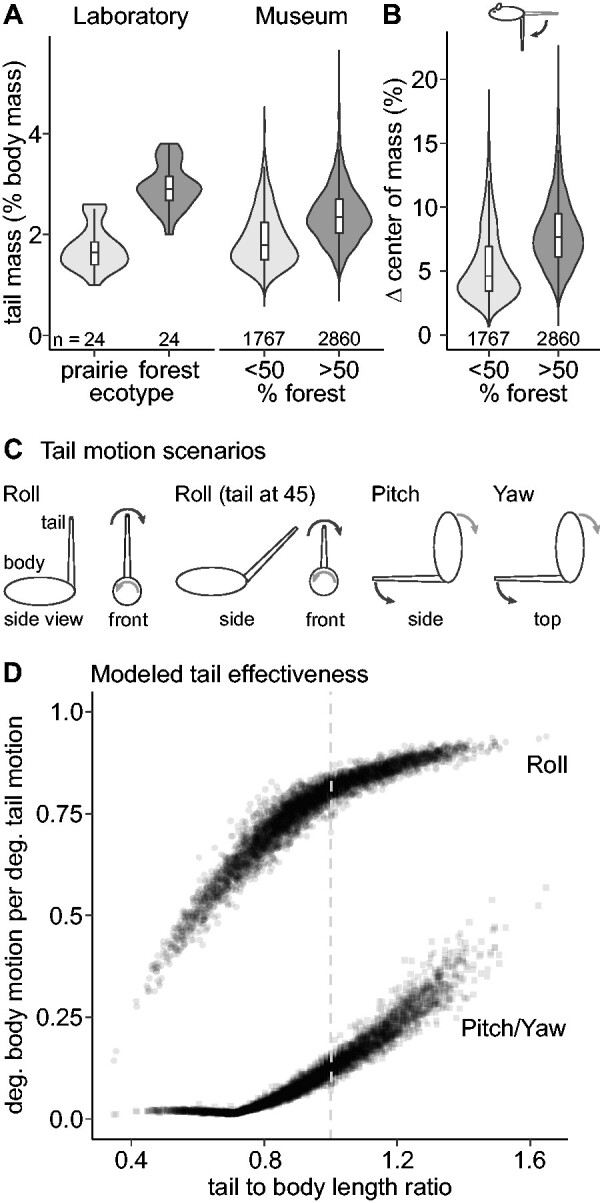
Tail effectiveness. (A) Measurements from laboratory animals (left) and estimates based on museum records (right; using % forest cover to capture ecotype differences) indicate that deer mouse tails are <5% body mass. (B) Estimated change in the vertical center of mass expressed as a percent of the center of mass distance above the perch, achieved by holding the tail straight downward versus horizontally. (C) Modeled tail motion scenarios; mouse is represented as a two-part system consisting of a rigid ellipsoid body and conical frustum tail. We input tail motion to the model (dark gray arrows) and recorded the resulting body motion (light gray arrows). (D) Modeled tail effectiveness for all specimen records (N = 4748), expressed as degrees of body motion output per degree of tail motion input, along the axis with the largest body motion, for roll with the tail perpendicular to the body (circles; corresponding to left model in C) and pitch and yaw (squares; corresponding to right two models in C; note that because of the model symmetries, these two motions generate equivalent outputs). Dashed line indicates tail length = body length.
To test the impact of the deer mouse tail to adjust body rotation, we estimated the body output (degrees of rotation) for four input tail motions; these variously generated primarily body roll (modeled with the tail either perpendicular to the body or at a 45° angle), pitch, or yaw (Fig. 2C). The models suggest, first, that deer mouse tails are likely much more effective for correcting body roll than for adjusting pitch and yaw (Fig. 2D). Notably, roll rotation may be particularly relevant for maintaining arboreal stability (Lammers and Zurcher 2011a). Second, the estimated effectiveness of tail use varies dramatically across the range of observed body dimensions, with longer-tailed forest mice expected to alter body rotation substantially more than short-tailed mice when engaged in the same behavior (10th–90th percentile: 0.47°–0.84° of body roll per degree of tail motion with the tail held at a 45° angle, and 0.60–0.87 with the tail at 90°; Fig. 2D andSupplementary Fig. S1). Finally, we found that tail:body length ratio, the most commonly-used metric of tail length variation in this system, shows a non-linear relationship with effectiveness in this context (Fig. 2D). For example, as tail length increases from 0.6 to 0.8 times body length, the predicted effectiveness of tail motion (in degrees body output/degrees tail input, mean ± standard deviation) for roll increases by 0.17, from 0.52 ± 0.03 to 0.69 ± 0.03; but a similar change in tail length, from 1.0 to 1.2 times body length, increases the effectiveness of tail use by only one third as much, from 0.81 ± 0.02 to 0.87 ± 0.01. Together, these results identify correcting body roll, rather than statically changing the center of mass or adjusting body pitch and yaw, as a specific tail-use behavior for which we expect to see both the largest overall effect on performance in deer mice and the largest differences among individuals and subspecies.
Tail curvature
We next tested how variation in tail morphology, specifically the dimensions of the tail vertebrae, affected tail curvature. We included both forest and prairie subspecies, as well as California mice, which enabled us to distinguish effects of vertebra size and shape. We found that vertebra length, width, height, shape (aspect ratio, defined as [width + height]/[2 × length]), and intervertebral bending angles all varied, both between species and along the length of the tail (Fig. 3A).
Fig. 3.

Tail bending. (A) Dimensions of the caudal vertebrae (proximal to distal), in two subspecies of P. maniculatus (P. m. nubiterrae [P. m. nub.], N = 20; P. m. bairdii, N = 21) and P. californicus (N = 13). Points (mean) and lines (full range) of measured values for each vertebra position in each taxon. A = anterior, P = posterior, mm = millimeters, deg. = degrees. (B) Relationship between vertebra shape and intervertebral bending angle in each taxon. (C) Predicted radius of curvature along the tail (proximal to distal) in four P. maniculatus subspecies (P. m. nubiterrae, N = 20; P. m. bairdii, N = 20; P. m. gambelii [P. m. gam.], N = 10; and P. m. rubidus [P. m. rub.], N = 21), and P. californicus (N = 13). Lines represent a median individual for each taxon. Main: curvature as a function of proportional distance along the tail; inset: as a function of absolute distance along the tail. (D) Radius of curvature predicted for models of a P. m. rubidus (forest)-length tail generated from a P. m. bairdii (prairie)-like tail by changing the vertebra number only (squares) or vertebra length only, either allometrically (i.e., no change to vertebra width; triangles) or isometrically (circles). Gray lines indicate the curves plotted in panel C for comparison. (E) Models of Peromyscus vertebra shape: allometric vertebra length changes between subspecies of P. maniculatus result in longer vertebrae with little impact on the radius of curvature, while isometric changes in vertebra size between P. maniculatus and P. californicus results in larger curvature along the tail. Rel. width = shape, defined as (width + height)/(2× length). A–C: green = forest deer mouse, tan = prairie deer mouse; and black = California mouse.
We first found that California mice had the longest vertebrae and prairie deer mice the shortest (for each caudal vertebra past C5, almost every California mouse vertebra was longer than every forest vertebra at the same position, and every forest vertebra was longer than every prairie vertebra at the same position, Fig. 3A; e.g., the length of the 15th caudal vertebra [C15], mean ± standard deviation: P. californicus, 5.0 ± 0.3 mm; P. m. nubiterrae [forest], 4.2 ± 0.2 mm; P. m. bairdii [prairie], 3.1 ± 0.2 mm). By contrast, while California mice generally had wider, taller caudal vertebrae than deer mice, vertebrae at the same caudal position tended to be similar in width and height in both forest and prairie deer mice (e.g., C15 width: P. californicus, 1.47 ± 0.12 mm; P. m. nubiterrae, 0.96 ± 0.15 mm; P. m. bairdii, 0.89 ± 0.12 mm; C15 height: P. californicus 1.59 ± 0.18 mm; P. m. nubiterrae, 1.20 ± 0.12 mm; P. m. bairdii, 0.94 ± 0.07 mm). Taken together, these measurements of vertebra length, width, and height can be used to estimate variation in vertebra shape. Specifically, while California mice had larger caudal vertebrae across all dimensions when compared with deer mice, the shape of the caudal vertebrae in California mice and prairie deer mice was roughly comparable; by contrast, the longer vertebrae of the forest subspecies also differed in shape (e.g., the shape of the 15th caudal vertebra: P. californicus, 0.30 ± 0.02; P. m. bairdii [prairie], 0.30 ± 0.03; P. m. nubiterrae [forest], 0.26 ± 0.03).
We next tested the relationship between vertebra shape and intervertebral bending angle and found that vertebral shape was correlated with bending angle, with the same relationship in all three taxa (Fig. 3B andSupplementary Table S1). Thus, despite the differences in vertebra size, similarly-shaped California mouse and prairie deer mouse vertebrae exhibited similar joint bending angles, while the relatively longer forest vertebrae were associated with more bending at the joint.
Using the relationship between aspect ratio and bending angle, we next estimated the minimum achievable radius of curvature along the length of the tail for four P. maniculatus subspecies (two forest, two prairie) as well as P. californicus (Fig. 3C). First, we found that the predicted radius of curvature decreased from the proximal to the distal end of the tail, consistent with behavioral observations of tail coiling in rats (Hori et al. 2011). The increased length but similar shape, and thus intervertebral joint angle, of California mouse vertebrae led to a larger predicted radius of curvature along the tail compared with deer mice (predicted radius of curvature at the midpoint of the tail, RCmid: P. californicus = 6.0 mm; P. maniculatus subspecies = 4.4–4.8 mm). Within deer mice, however, allometric vertebral variation among subspecies led to little overall difference in the radius of curvature between forest and prairie mice: forest mice achieved longer vertebrae without a corresponding increase in radius of curvature, largely because the increased vertebra length corresponded to larger intervertebral joint angles.
Forest mice typically have both more and longer tail vertebrae than prairie mice, with each trait contributing equally to the difference in tail length (Kingsley et al. 2017). To assess whether changing tail length through differences in vertebra length or number alone might have functional consequences for tail bending, we next modeled longer, forest-like tails constructed from prairie-like tails either by changing vertebra length alone (isometrically or allometrically) or vertebra number alone (conservatively, by repeating the longest vertebra). While isometric changes, like those between deer and California mice, substantially changed the achievable radius of curvature in the models (RCmid = 7.4 mm, versus P. californicus, 6.0 mm, and P. maniculatus, 4.4–4.8 mm), there was relatively little difference in estimated tail curvature between the estimates for existing forest species and either the length-only or number-only models, assuming no change in vertebra width (as between deer mouse subspecies; RCmid = 4.8 mm [allometric model] and 5.5 [number only model]; Fig. 3D). Thus, we found that caudal vertebra shape is associated with inter-vertebra bending angle in Peromyscus, but that because vertebra length largely changes allometrically between deer mouse subspecies, there is likely not a substantial effect of changing either vertebra length or vertebra number on tail curvature (Fig. 3E). Instead, the repeated evolution of both increased vertebra length and number in forest subspecies relative to prairie subspecies may result from selection for increased tail length through any mechanism.
Discussion
To understand the evolutionary dynamics that shape local adaptation, it is critical to identify the effect of trait variation on performance, and ultimately fitness (Arnold 1983; Koehl 1996; Losos 2011). Modeling the functional effects of these traits, such as the tail-length differences between forest and non-forest rodents, can (1) identify (or exclude) behaviors that are likely to be relevant for trait evolution, (2) focus study on the most functionally-relevant aspects of morphological variation, and (3) uncover phenotypic associations that may reflect important underlying genetic and developmental mechanisms. Here, we combined laboratory measurements, functional models, and museum records of repeatedly-evolved natural variation to assess the performance effect of tail-length and vertebral morphology differences in deer mice. We found that even simple models of tail function, like those used here, can refine our understanding of which aspects of tail morphology and behavior are relevant for performance in a species of interest as well as identify new patterns of variation for future study.
To investigate the impact of tail-length differences on tail effectiveness in deer mice, we modeled a mouse as a two-part system: a rigid ellipsoid body with a rigid, fully-extended, conical frustum tail. While extremely simplified, this model has the key advantage that the relevant shape parameters can be estimated for any individual based solely on commonly-reported field measurements (weight, tail length, and body or total length). This enabled us to estimate the effectiveness of the tail in thousands of museum records sampled across the species range. The model we used (Jusufi et al. 2010) assumes the absence of external forces and is thus applicable in the context of aerial motions such as leaping and self-righting; more detailed data on the limb and tail motions deer mice use during climbing and related forces would be required to include the effect of contact with the substrate (e.g., Lammers and Zurcher 2011b; Chadwell and Young 2015). However, both interactions with the substrate and relative motion of body segments can affect dynamic stability (Lammers and Zurcher 2011a). While it does not address effects generated by interaction with the substrate, this model can nonetheless provide an estimate of the relative effectiveness of forest and prairie tails for altering internal body motion along different axes. The exact values produced by our simplified, rigid mouse model should be considered approximations. Nonetheless, this approach revealed several interesting results.
Deer mice, like other small mammals, have been reported to use their tails in a variety of ways during arboreal locomotion (Horner 1954). Our study implicates a subset of these tail-use behaviors as likely relevant to the evolution of tail-length differences in deer mouse subspecies, and possibly other rodents. In particular, we found that even fully extended, the long tails of forest deer mice have little effect in statically altering the position of the animal’s center of mass or in correcting body pitch and yaw during locomotion. Our results also suggest that the pattern of coincident differences in both caudal vertebra number and length between forest and prairie deer mice also has little relevance for curvature during tail wrapping. By contrast, in the context of correcting body roll, the deer mouse tail may have a relatively large effect on performance, and long forest tails are considerably more effective than short prairie tails.
Additional studies on tail-use behavior and performance can be designed to test these models. For example, it will be important to test (1) the range of intervertebral bending used during live behavior (e.g., Morinaga and Bergmann 2019), (2) whether forest and prairie mice differ in the tail-use behaviors they employ, and (3) the effects of tail use during contact with the substrate. Moreover, while tails are used during arboreal locomotion, variation in tail length also has functional consequences in other contexts, such as terrestrial locomotion, thermoregulation, and injury risk (e.g., Hickman 1979). Other repeatedly-evolved morphological differences between arboreal and terrestrial mammals, such as foot length, likely also have important consequences for arboreal locomotion (Nations et al. 2019). Finally, we note that how differences in performance may translate to differences in fitness (i.e., survival to reproduction) in nature is unknown. Still, our work establishes the ability to correct body roll during arboreal locomotion as a likely important factor driving the evolution of tail-length differences in deer mice.
In addition to identifying a subset of relevant behaviors, our results point to specific, functionally-relevant aspects of tail morphology. For example, we found that the predicted effect of tail-length differences on body roll is non-linear with respect to tail-to-body length ratio, a commonly-used metric of tail variation (e.g., Kingsley et al. 2017). If arboreal locomotion is a driver of tail-length evolution, we may expect a more direct association between arboreality and estimated functional outcome (which includes effects of tail length and shape as well as body mass) than between tail-to-body ratio and habitat. In addition, we found that increasing tail length for short-tailed deer mice has little to no effect on pitch and yaw, but a large impact on roll, while increasing tail length in already-long-tailed mice affects pitch and yaw more than roll. Thus, different behaviors and aspects of performance could be relevant for tail-length evolution in longer- and shorter-tailed regimes. The nonlinearity of the relationship between differences in tail length and performance is also relevant when considering trade-offs between performance benefits and costs of longer tails, such as energetic costs and injury risk. Similarly, when considering variation in caudal vertebrae, our work indicates that both vertebra length and vertebra shape are functionally important traits, but other aspects of morphological variation—including detailed bone shape, musculature and innervation, and intervertebral disc stiffness—are relevant for tail function but were not captured in this study. Instead, we focused on morphological measurements available for large-scale, population comparisons in an evolutionary context: body dimensions (accessible from museum records for many individuals and for populations through time) and a subset of skeletal traits that can be measured in relatively high throughput from X-ray images. Even with these simple, yet highly-accessible, measurements, our work implicates specific morphological features for future analyses across individuals, populations, and species.
Finally, we uncovered patterns of phenotypic variation in vertebral morphology, specifically centrum shape, in deer mice that have not previously been appreciated. Previous studies of deer mice (Barbehenn and New 1957; Kingsley et al. 2017) have consistently found both more and longer tail vertebrae in forest deer mice compared with prairie subspecies in both wild and laboratory-reared mice, despite the lack of genetic or developmental overlap between these two traits in deer mice (Kingsley et al. 2017). Moreover, laboratory studies show that the two traits can evolve independently in mice artificially selected for long tails (Rutledge et al. 1974). Despite the consistent forest-prairie differences in both traits in the wild, we found little evidence for a functional cost associated with changes in either vertebra length or number alone. Instead, our results suggest that, at least in the range of tail lengths observed in the wild, it is more likely that differences in vertebra length and number both evolved as a result of selection on overall tail length. This result is consistent with findings in other taxa: for example, in macaques, longer tails have evolved repeatedly through changes in both caudal vertebra length and number, althought the relative contribution of length and number varies across taxa (Wakamori and Hamada 2019).
Interestingly, the lack of effect of changes in vertebra length on tail curvature within deer mice comes about primarily because within the species, differences in vertebra length seem to occur through mechanisms that alter vertebra length alone, without changing the other dimensions of the vertebrae. By contrast, morphological differences between deer mice and California mice involve isometric changes in vertebra size, and these differences led to a large difference in achievable tail curvature between species. Thus, although we did not find support for a functional trade-off associated with vertebra length and number, we found that the functional consequences of isometric and allometric variation in caudal vertebra length differ. As these results suggest that isometric versus allometric variation in vertebra shape may be both functionally- and evolutionarily-important aspects of morphological variation in deer mice, it will be interesting to determine how genetic, developmental, and environmental factors impact the distribution of caudal vertebra size and shape within the species.
Animals have evolved a tremendous diversity of tail morphologies and associated tail-use behaviors, with functions as diverse as locomotion (e.g., aerial, terrestrial, and aquatic), thermoregulation, and social communication (Hickman 1979). The importance of tail use for performance is highlighted by repeated convergence of widely-diverged species on similar morphologies and behaviors—for example, the prehensile tails of some arboreal chameleons and primates (Organ 2010; Luger et al. 2020). On a narrower scale, parallel tail morphologies can evolve repeatedly within a species, as with “forest” and “prairie” ecotypes of deer mice (Osgood 1909; Dice 1940; Blair 1950; Horner 1954). However, even within species, tail evolution can be highly complex: the distribution of phenotypes reflects a variety of functions as well as potential developmental and genetic constraints, the importance of which may differ among populations. Testing the relationship between inter-individual differences in morphology and specific aspects of performance is a critical step that requires an interdisciplinary approach. By combining population-level data with even simple models of tail function, we can both test existing hypotheses about the relationship between form, function, and fitness as well as generate new hypotheses for future study.
Supplementary Material
Acknowledgments
The authors thank Olivia Harringmeyer, Kelsey Tyssowski, Maya Woolfolk, and two anonymous reviewers for thoughtful feedback on the manuscript; Stephanie Pierce, L. Mahadevan, Robert Full, members of the Hoekstra laboratory, and the organizers and participants of the 2021 SICB Tail Symposium for helpful discussion; and Evan Kingsley and Rowan Barrett for providing photographs. Kyle Turner and Jacob Gable provided assistance in the field. Mark Omura, Judy Chupasko, Madeleine Mullon, and John Mewherter helped prepare and accession museum specimens along with X-ray images. Kate Pritchett-Corning and Sue Griggs-Collette provided critical assistance with field work and establishing breeding colonies and Harvard’s Office of Animal Resources helped with animal care.
Funding
This work was supported by an NIH Training Grant to Harvard University’s Molecules, Cells, and Organisms graduate program [NIH NIGMS T32GM007598 to E.R.H.]; Harvard’s Theodore H. Ashford Fellowship in the Sciences [to E.R.H.]; Chapman Fellowship for the Study of Vertebrate Locomotion and a Putnam Expedition Grant from the Harvard University Museum of Comparative Zoology [to E.R.H.]; and the Howard Hughes Medical Institute [to H.E.H.].
From the symposium “An evolutionary tail: Evo-Devo, structure, and function of post-anal appendages” presented at the virtual annual meeting of the Society for Integrative and Comparative Biology, January 3–7, 2020.
References
- Arnold SJ.1983. Morphology, performance and fitness. Integr Comp Biol 23:347–61. [Google Scholar]
- Barbehenn KR, New JG.. 1957. Possible natural intergradation between prairie and forest deer mice. J Mammal 38:210–8. [Google Scholar]
- Bates D, Mächler M, Bolker B, Walker S.. 2015. Fitting linear mixed-effects models using lme4. J Stat Softw 67:1–48 (doi: 10.18637/jss.v067.i01). [Google Scholar]
- Becker RA, Brownrigg R, Minka TP, Wilks AR, Deckmyn A.. 2018. Maps: draw geographical maps (https://cran.r-project.org/package=maps).
- Blair WF.1950. Ecological factors in speciation of Peromyscus. Evolution 4:253–75. [Google Scholar]
- Brainerd EL, Patek SN.. 1998. Vertebral column morphology, C-start curvature, and the evolution of mechanical defenses in Tetraodontiform fishes. Copeia 1998:971. [Google Scholar]
- Buchholtz EA.2001. Vertebral osteology and swimming style in living and fossil whales (Order: cetacea). J Zool 253:175–90. [Google Scholar]
- Buchholtz EA, Schur SA.. 2004. Vertebral osteology in Delphinidae (Cetacea). Zool J Linn Soc 140:383–401. [Google Scholar]
- Buck CW, Tolman N, Tolman W.. 1925. The tail as a balancing organ in mice. J Mammal 6:267–71. [Google Scholar]
- Carroll D, Hankins E, Kose E, Sterling I.. 2014. A survey of the differential geometry of discrete curves. Math Intell 36:28–35. [Google Scholar]
- Cartmill M.1985. Climbing. In: Hildebrand M, Bramble DM, Liem KF, Wake DB, editors. Functional vertebrate morphology. Cambridge, MA: Harvard University Press. p. 73–88. [Google Scholar]
- Chadwell BA, Young JW.. 2015. Angular momentum and arboreal stability in common marmosets (Callithrix jacchus). Am J Phys Anthropol 156:565–76. [DOI] [PubMed] [Google Scholar]
- Deane AS, Russo GA, Muchlinski MN, Organ JM.. 2014. Caudal vertebral body articular surface morphology correlates with functional tail use in anthropoid primates. J Morphol 275:1300–11. [DOI] [PubMed] [Google Scholar]
- Dice LR.1940. Ecologic and genetic variability within species of Peromyscus. Am Nat 74:212–21. [Google Scholar]
- Dowle M, Srinivasan A.. 2019. data.table: extension of ‘data.frame’ (https://cran.r-project.org/package=data.table).
- Elmer KR, Meyer A.. 2011. Adaptation in the age of ecological genomics: insights from parallelism and convergence. Trends Ecol Evol 26:298–306. [DOI] [PubMed] [Google Scholar]
- Endler JA.1986. Natural selection in the wild. Princeton (NJ): Princeton University Press. [Google Scholar]
- Flower WH.1885. Special characters of the sacral and caudal vertebrae. In: An introduction to the osteology of the mammalia. 3rd edn. London: Macmillan and Co. p. 66–89. [Google Scholar]
- Garnier S.2018. Viridis: default color maps from “matplotlib” (https://cran.r-project.org/package=viridis).
- Graves S, Maldonado J, Wolff JO.. 1988. Use of ground and arboreal microhabitats by Peromyscus leucopus and Peromyscus maniculatus. Can J Zool 66:277–8. [Google Scholar]
- Harris CR, Millman KJ, van der Walt SJ, Gommers R, Virtanen P, Cournapeau D, Wieser E, Taylor J, Berg S, Smith NJ, et al. 2020. Array programming with NumPy. Nature 585:357–62. [DOI] [PMC free article] [PubMed] [Google Scholar]
- Harvey PH, Pagel MD.. 1991. The comparative method in evolutionary biology. New York: Oxford University Press. [Google Scholar]
- Hayssen V.2008. Patterns of body and tail length and body mass in Sciuridae. J Mammal 89:852–73. [Google Scholar]
- Hickman GC.1979. The mammalian tail: a review of functions. Mamm Rev 9:143–57. [Google Scholar]
- Hijmans RJ.2020. Raster: geographic data analysis and modeling (https://cran.r-project.org/package=raster).
- Hori H, Fukutani T, Nakane H, Iino S, Nojyo Y.. 2011. Participation of ventral and dorsal tail muscles in bending movements of rat tail. Anat Sci Int 86:194–203. [DOI] [PubMed] [Google Scholar]
- Horner BE.1954. Arboreal adaptations of Peromyscus, with special reference to use of the tail. Contrib from Lab Vertebr Biol 61:1–85. [Google Scholar]
- Hunter JD.2007. Matplotlib: a 2D graphics environment. Comput Sci Eng 9:90–5. [Google Scholar]
- Imaizumi Y.1978. Climbing behavior of Apodemus argenteus and Apodemus speciosus (Rodentia: Muridae). Appl Entomol Zool 13:304–7. [Google Scholar]
- Jusufi A, Kawano DT, Libby T, Full RJ.. 2010. Righting and turning in mid-air using appendage inertia: reptile tails, analytical models and bio-inspired robots. Bioinspir Biomim 5:045001. [DOI] [PubMed] [Google Scholar]
- Kahle D, Wickham H.. 2013. ggmap: spatial visualization with ggplot2. R J 5:144–61. [Google Scholar]
- Kaufman DM, Kaufman DW.. 1992. Geographic variation in length of tail of white-footed mice (Peromyscus leucopus) in Kansas. J Mammal 73:789–93. [Google Scholar]
- Kingsley EP, Kozak KM, Pfeifer SP, Yang DS, Hoekstra HE.. 2017. The ultimate and proximate mechanisms driving the evolution of long tails in forest deer mice. Evolution 71:261–73. [DOI] [PMC free article] [PubMed] [Google Scholar]
- Koehl MAR.1996. When does morphology matter? Annu Rev Ecol Syst 27:501–42. [Google Scholar]
- Kwon Y-H.1998a. Theories and practices of motion analysis (http://www.kwon3d.com/theories.html).
- Kwon Y-H.1998b. Mechanical basis of motion analysis (http://www.kwon3d.com/theories.html).
- Lammers AR, Zurcher U.. 2011a. Stability during arboreal locomotion. In: Klika V, editor. Theoretical biomechanics. Rijeka, Croatia: InTech. [Google Scholar]
- Lammers AR, Zurcher U.. 2011b. Torque around the center of mass: dynamic stability during quadrupedal arboreal locomotion in the Siberian chipmunk (Tamias sibiricus). Zoology 114:95–103. [DOI] [PubMed] [Google Scholar]
- Laouris Y, Kalli-Laouri J, Schwartze P.. 1990. The postnatal development of the air-righting reaction in albino rats. Quantitative analysis of normal development and the effect of preventing neck-torso and torso-pelvis rotations. Behav Brain Res 37:37–44. [DOI] [PubMed] [Google Scholar]
- Larson SG, Stern JT.. 2006. Maintenance of above-branch balance during primate arboreal quadrupedalism: coordinated use of forearm rotators and tail motion. Am J Phys Anthropol 129:71–81. [DOI] [PubMed] [Google Scholar]
- Layne JN.1970. Climbing behavior of Peromyscus floridanus and Peromyscus gossypinus. J Mammal 51:580–91. [Google Scholar]
- Long JH, Pabst DA, Shepherd WR, McLellan WA.. 1997. Locomotor design of dolphin vertebral columns: bending mechanics and morphology of Delphinus delphis. J Exp Biol 200:65–81. [DOI] [PubMed] [Google Scholar]
- Losos JB.2011. Convergence, adaptation, and constraint. Evolution 65:1827–40. [DOI] [PubMed] [Google Scholar]
- Luger AM, Ollevier A, De Kegel B, Herrel A, Adriaens D.. 2020. Is variation in tail vertebral morphology linked to habitat use in chameleons? J Morphol 281:229–39. [DOI] [PubMed] [Google Scholar]
- Mayr E.1963. Animal species and evolution. Cambridge (MA): Harvard University Press. [Google Scholar]
- Conference proceedings McKinney W.2010. Data structures for statistical computing in Python. In: van der Walt S, Millman J, editors. Proceedings of the 9th Python in Science Conference, Austin, Texas. p. 56–61. [Google Scholar]
- Merritt JF.1974. Factors influencing the local distribution of Peromyscus californicus in northern California. J Mammal 55:102–14. [Google Scholar]
- Meserve PL.1977. Three-dimensional home ranges of Cricetid rodents. J Mammal 58:549–58. [Google Scholar]
- Mincer ST, Russo GA.. 2020. Substrate use drives the macroevolution of mammalian tail length diversity. Proc R Soc B Biol Sci 287:20192885. [DOI] [PMC free article] [PubMed] [Google Scholar]
- Morinaga G, Bergmann PJ.. 2019. Angles and waves: intervertebral joint angles and axial kinematics of limbed lizards, limbless lizards, and snakes. Zoology 134:16–26. [DOI] [PubMed] [Google Scholar]
- Motani R, You H, McGowan C.. 1996. Eel-like swimming in the earliest ichthyosaurs. Nature 382:347–8. [Google Scholar]
- Nations JA, Heaney LR, Demos TC, Achmadi AS, Rowe KC, Esselstyn JA.. 2019. A simple skeletal measurement effectively predicts climbing behaviour in a diverse clade of small mammals. Biol J Linn Soc 128:323–36 (doi: 10.1093/biolinnean/blz085). [Google Scholar]
- Nations JA, Mount GG, Morere SM, Achmadi AS, Rowe KC, Esselstyn JA.. 2021. Locomotory mode transitions alter phenotypic evolution and lineage diversification in an ecologically rich clade of mammals. Evolution 75:376–93. [DOI] [PubMed] [Google Scholar]
- Organ JM.2010. Structure and function of platyrrhine caudal vertebrae. Anat Rec 293:730–45. [DOI] [PubMed] [Google Scholar]
- Osgood WH.1909. A revision of the mice of the American genus Peromyscus. North Am Fauna 28:1–285. [Google Scholar]
- Pierce SE, Clack JA, Hutchinson JR.. 2011. Comparative axial morphology in pinnipeds and its correlation with aquatic locomotory behaviour. J Anat 219:502–14. [DOI] [PMC free article] [PubMed] [Google Scholar]
- R Core Team. 2019. R: a language and environment for statistical computing (https://www.r-project.org/).
- Russo GA.2015. Postsacral vertebral morphology in relation to tail length among primates and other mammals. Anat Rec 298:354–75. [DOI] [PubMed] [Google Scholar]
- Rutledge JJ, Eisen EJ, Legates JE.. 1974. Correlated response in skeletal traits and replicate variation in selected lines of mice. Theor Appl Genet 45:26–31. [DOI] [PubMed] [Google Scholar]
- Schindelin J, Arganda-Carreras I, Frise E, Kaynig V, Longair M, Pietzsch T, Preibisch S, Rueden C, Saalfeld S, Schmid B, et al. 2012. Fiji: an open-source platform for biological-image analysis. Nat Methods 9:676–82. [DOI] [PMC free article] [PubMed] [Google Scholar]
- Siegel MI.1970. The tail, locomotion and balance in mice. Am J Phys Anthropol 33:101–2. [Google Scholar]
- Smartt RA, Lemen C.. 1980. Intrapopulational morphological variation as a predictor of feeding behavior in deermice. Am Nat 116:891–4. [Google Scholar]
- Thorington RW.1970. Lability of tail length of the white-footed mouse, Peromyscus leucopus noveboracensis. J Mammal 51:52–9. [PubMed] [Google Scholar]
- Verde Arregoitia LD, Fisher DO, Schweizer M.. 2017. Morphology captures diet and locomotor types in rodents. R Soc Open Sci 4:160957. [DOI] [PMC free article] [PubMed] [Google Scholar]
- Wakamori H, Hamada Y.. 2019. Skeletal determinants of tail length are different between macaque species groups. Sci Rep 9:1–12. [DOI] [PMC free article] [PubMed] [Google Scholar]
- Walker C, Vierck CJ, Ritz LA.. 1998. Balance in the cat: role of the tail and effects of sacrocaudal transection. Behav Brain Res 91:41–7. [DOI] [PubMed] [Google Scholar]
- Wickham H.2011. The split-apply-combine strategy for data analysis. J Stat Softw 40:1–29. [Google Scholar]
- Wickham H.2016. ggplot2: elegant graphics for data analysis. New York: Springer-Verlag. [Google Scholar]
- Wickham H.2019. stringr: simple, consistent wrappers for common string operations (https://cran.r-project.org/package=stringr).
- Wickham H, François R, Henry L, Müller K.. 2020. dplyr: a grammar of data manipulation (https://cran.r-project.org/package=dplyr).
- Wickham H, Henry L.. 2020. tidyr: tidy messy data (https://cran.r-project.org/package=tidyr).
- Wolff JO, Durr DS.. 1986. Winter nesting behavior of Peromyscus leucopus and Peromyscus maniculatus. J Mammal 67:409–12. [Google Scholar]
- Wolff JO, Hurlbutt B.. 1982. Day refuges of Peromyscus leucopus and Peromyscus maniculatus. J Mammal 63:666–7. [Google Scholar]
- Young JW, Russo GA, Fellmann CD, Thatikunta MA, Chadwell BA.. 2015. Tail function during arboreal quadrupedalism in squirrel monkeys (Saimiri boliviensis) and tamarins (Saguinus oedipus). J Exp Zool Part A Ecol Genet Physiol 323:556–66 (doi: 10.1002/jez.1948). [DOI] [PubMed] [Google Scholar]
Associated Data
This section collects any data citations, data availability statements, or supplementary materials included in this article.