



Abstract
Food is an important determinant of health, featuring prominently in the Sustainable Development Goals. The term “big data” is seldom used in relation to food, partly because food data are scattered across different sectors. The increasing availability of food-related data presents an opportunity to glean new insights on food and food systems. These insights may enhance the quality of products and services and improve decision-making on optimizing food availability, all to the end of producing better health. Yet, knowledge gaps remain about the unique opportunities and challenges linked to big data on food and their use in decision-making. This scoping review explored the available literature linking food with big data and decision-making, using the following research question: What is the current literature on data about food, and how are these data used in decision-making? We searched PubMed until 29 February 2020 and Embase, Web of Sciences, and the Cochrane Database of Systematic Reviews until 8 March 2020. We included studies written in English and conducted narrative analyses to identify relevant themes from included studies. Sixteen studies fulfilled our eligibility criteria, including big data analyses, modelling studies, and reviews. These studies described the added value of using big data and how evidence from big data had or can be used for decision-making, as well as challenges and opportunities for such use. The majority of the included studies examined the link between food and big data, while hypothesizing of how these insights could inform decision-making, including policies, interventions, programs, and financing. There were only two examples wherein big data on food informed decision-making directly. The review highlights several false dichotomies in how the subject is approached in the literature and the importance of context, both between and within countries, in shaping the availability and types of data that can be used as meaningful evidence to inform decision-making. This review shows the paucity of research around the intersection of food, big data, and decision-making, as well as the potential in using big data on food systems to the end of informing decisions to improve the health of populations. Future research and decision-making around health systems can benefit from examining the full spectrum of perspectives on the subject. Future research and decision-making around health systems can also employ the steadfast embrace of technology, which will potentially reduce disparities in big data availability, to the end of improving the health of populations.
Supplementary Information
The online version contains supplementary material available at 10.1007/s11524-021-00562-x.
Keywords: Food, Data, Big data, Decision-making
Introduction
Food is an important determinant of health [1]. Inadequate nutrition can lead to ill health through the “triple malnutrition burden” of undernourishment, micronutrient deficiency, and overnutrition [2]. Tackling the malnutrition burden is linked positively to both human and economic development outcomes [3–7]. The EAT-Lancet Commission on healthy diets from sustainable food systems concluded that addressing issues around food systems may be the single strongest lever to optimize both human health and environmental sustainability globally [8]. It is thus not surprising that food features prominently in the United Nations (UN) Sustainable Development Goals (SDGs) agenda in goals ranging from health to the environment [9].
Food systems are at the intersection of agriculture, industrial, and health system development [1, 3, 10–13]. This makes a full understanding of food systems a substantial challenge and one which may benefit from the application of novel forms of available big data.
Big data may be able to unleash the potential of interventions related to food and nutrition, as well as the environment, worldwide. Big data are characterized by high volume (amount), high velocity (speed), and high variety (formats) [14]. Big data are being produced worldwide in nearly all sectors of society, including business, government, and health care [15]. The expanding space for food-related big data from different sectors presents an opportunity to enable new insights, enhance the quality of products and services, and improve decision-making around food and food systems to the end of reducing the triple malnutrition burden and improving the health of populations [14, 15].
However, as data around food are scattered across different sectors, the extent to which big data have been utilized in relation to food in health-related research and decision-making is not clear [15]. To address this knowledge gap, we conducted a scoping review to describe the available literature linking food with big data and decision-making.
Methods
We conducted a scoping review based on the following research question: What is the current literature on big data with regard to food, and how are these data used in decision-making? The scoping review methodology was deemed appropriate given the breadth of the question. The Preferred Reporting Items for Systematic reviews and Meta-Analyses Extension for Scoping Reviews (PRISMA-ScR) checklist was used to guide reporting [16] (Electronic supplementary materials, Appendix 1).
Information Sources and Search
We searched PubMed on 12, 19, and 22 February 2020 and again on 8 March 2020. The search strategy was formulated by an experienced librarian at Boston University. Based on the team discussion, the strategy was revised and finalized, and we included all relevant studies published in PubMed on 29 February 2020. We also searched Embase, Web of Science, and the Cochrane Database of Systematic Reviews on 8 March 2020.
For each of the databases, the search strategy contained three components: [1] literature on food, using terms related to food, diet, nutrition, and hunger; [2] literature on data for which we used terms related to data science, data analytics, and data mining; and [3] literature on decision-making using terms like decision, judgment, choice, government, legislation, and policy. The full search strategy for PubMed is included in the appendix (Electronic supplementary materials, Appendix 2).
Selection of Sources of Evidence and Eligibility Criteria
All citations from the research databases were downloaded to the Zotero software and then placed into one folder by one reviewer (SFK), who then uploaded the files to Rayyan, a web application for collaborative systematic review [17].
Two reviewers (SFK and CC) conducted independent and blinded screening of all studies. They excluded duplicate studies, those which were retracted, non-English language studies, perspectives and discussion papers, qualitative studies, theoretical papers, conference proceedings and abstracts, and general reports. Both reviewers used the options of reason and label in the Rayyan program to indicate the reasons to include or exclude studies in the initial stages of identification and screening. Further reasons for exclusion were that studies focused on animal health, child health, specific foods, food inflation, medical records, environmental data, testing of a tool, big data techniques, algorithms, machine learning for farming, chemical analyses, social media, news and analysis, and patient-doctor consultations. Disagreements were sorted out by discussion, and discrepancies were resolved by one reviewer (SMA). Later, the list of studies, with the reasons for inclusion/exclusion, was transferred from Rayyan to Microsoft Excel. The full list of studies and the selected studies in each stage with reasons for inclusion/exclusion are available here: https://tinyurl.com/ycfmpxwm.
Data Charting Process and Data Items
We used a "descriptive-analytical” method within the narrative tradition, as proposed by Arksey and O’Malley [18]. This involves applying a common framework to all the papers included to collect standard information on key issues and themes. Both authors (SKM and CC) used the framework independently to review the studies and then jointly merged and finalized the table. One researcher (OB) synthesized the included studies in a narrative form in the Results section.
Results
After screening 1350 titles and abstracts and 63 full texts, 16 unique studies fulfilled our eligibility criteria and were included in this scoping review (Fig. 1). Table 1 provides an overview of the studies included in this review and highlights the main characteristics of each included study including the geographical representation of study. The summary of key findings and main themes is outlined in the following paragraphs.
Fig. 1.
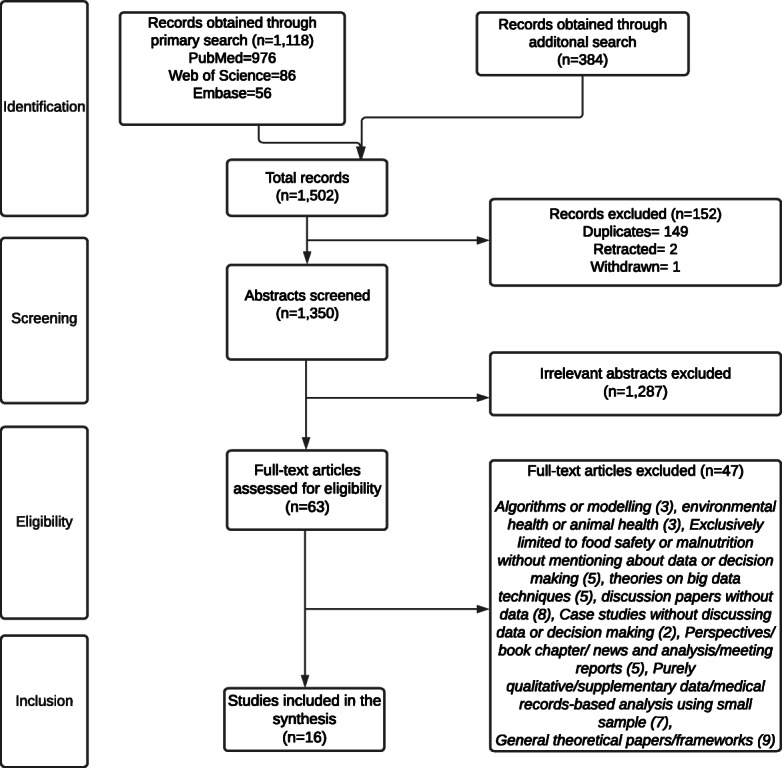
Flow diagram of articles assessed through the different phases of the review
Table 1.
Overview of included studies
| First author | Year | Geographical representation | Country/context | Data | Study measures | Analysis techniques | Food, data, decision-making |
|---|---|---|---|---|---|---|---|
| Bakhtin [19] | 2019 | More than 5 countries | Global | Scientific articles from CrossRef database, US Patent and Trademark Office, National Science Foundation, global news portals with a focus on science and technology, analytical reports of international organisations (FAO, OECD) | Promising areas of food innovation | Big data text mining using iFORA System, principal component analysis | Food, data |
| Bogaardt [20] | 2018 | More than 5 countries | Europe | Mobile apps and sensors, retail data, procurement data | Purchase, preparation, and consumption of food | Risk measures | Food, data |
| Coble [21] | 2018 | One country | USA | Data from precision agriculture technology—aggregate of data from thousands of farms | Impacts of management practices on production outcomes | Moving average, multiple regression, machine learning | Food, data |
| Drewnowski [22] | 2015 | Sub-national | USA | Data from Seattle Obesity Study | Inequalities and disparities in diets and health at the neighbourhood level and their determinants | GIS/GPS mapping of inequalities, prevalence measures | Food, data |
| Dubé [1] | 2014 | Sub-national | Canada | Nielsen ScanTrack and advertising data, 2008-2010 | Purchase behaviour indicators and business practice indicators | Text mining, advanced consumer choice analytics | Food, data |
| Dwivedi [23] | 2019 | Sub-national | USA | 2013 U.S. Census Bureau, CDC Diabetes Interactive Atlas, Behaviour Risk Factor Surveillance System (BRFSS), and Fatality Analysis Reporting System | Geographical variation in health-related quality of life using area-level business patterns and demographic characteristics | Geographically weighted regression models and OLS regression models | Food, data |
| Frelat [24] | 2016 | More than 5 countries | Africa | Land use and production data of more than 13,000 smallholder farm households across 17 sub-Saharan African countries | Off-farm income and market conditions; food availability to feed families | A simple farm household performance indicator produced using artificial neural networks | Food, data |
| GBD research collaborators [25] | 2018 | More than 5 countries | Eastern Mediterranean | GBD data, 1990-2015 | Incidence and prevalence | Bayesian meta-regression model | Food, data |
| Grummon [26] | 2017 | Sub-national | USA | Nielsen Homescan Panel, 2012-2013 | Packaged food and beverage purchases and Supplemental Nutrition Assistance Program (SNAP) status | Linear regression models; adjusted mean differences | Food, data |
| Jo [27] | 2019 | One country | South Korea | 2014–2017 Community Health Survey | Changes in food labelling awareness and utilization and its determinants | Cochran-Armitage trend test, decision tree analysis | Food, data |
| Johnson [28] | 2019 | One country | USA | U.S. Department of Agriculture (USDA) National Farmers Market Directory | Access to fruits and vegetables at farmers’ markets | Interactive data visualizations including geographic maps connected to social media resources | Food, data |
| Källestål [29] | 2020 | Sub-national | Nicaragua | Cuatro Santos Health and Demographic Surveillance database, Nicaragua | Household Food Insecurity Access Scale | Cluster analysis | Food, data |
| Marvin [15] | 2017 | More than 5 countries | Europe | Multiple sources: farm data, meteorological data, food transportation data, surveillance system | Crop contamination/pathogen growth/food quality/ | Incidence measures, predictive modelling, geospatial modelling | Food, data, decision-making |
| Ng [30] | 2014 | One country | USA | Nielsen ScanTrack data and Homescan data, 2007-2012 | Average Daily per Capita Calories Sold in US market | Descriptive—time trend analysis | Food, data |
| Pokhriyal [31] | 2017 | One country | Senegal | Environmental data (food security, economic activity, and accessibility to facilities) and call data records | Global Multidimensional Poverty Index | Gaussian process regression | Food, data |
| Protopop [32] | 2016 | More than 5 countries | Africa, Asia, Latin America | Digital financial services (M-Pesa and M-Shrawi); agribusiness integrated data system (AgriLife); cloud-based transactional platform (FramForce) | Farmers’ insurance coverage, creditworthiness, and access to market information | Descriptive—rate of change analysis | Food, data, decision-making |
GBD Global Burden of Disease network, USA United States of America
Scope of Published Literature
The studies included covered a variety of themes. Five studies were on diet and nutrition including malnutrition and the promotion of fresh food consumption [1], dietary intake and its determinants [20], diets, health and food decision-making [22], nutritional profile of household food and beverage purchases [26], and access to fruits and vegetables at farmers’ markets [28]. Three studies focused on poverty and food security including multiple dimensions of poverty and food security [29], poverty prediction and mapping [31], and food availability [24]. Three studies thematized the food industry including food industry compliance with its calorie reduction pledges [30], food production [19], and evaluation of food labelling policy [27]. One study was about food safety [15]. Two studies touched upon the design and delivery of an agricultural insurance program to smallholder farmers [32] and precision agriculture and farm management [21]. Finally, two studies were about the burden of disease [25] and the geographical variation in health-related quality of life [23].
Types of Big Data Analysed
The types of big data included in this review were diverse. Data types spanned from surveillance data [23–25, 27, 29], supply data [28], and consumption data [20, 22]. For example, to design a research infrastructure on dietary intake and its determinants, Bogaardt and colleagues [20] used data generated by consumers (e.g. collected by apps and sensors), businesses (e.g. retail data), government (e.g. procurement data), and experimental research facilities (e.g. virtual supermarkets) to shed light on data types and design requirements, including business models, data integration and management systems, and governance and ethics around food [20]. Other studies used mobile phone data [15, 31, 32], social media data [15], Global Positioning System (GPS) data [15], agricultural data [21], and environmental data [31]. A text mining study analysed more than 30 million documents [19]. Digital commercial marketing data were applied in three studies, all of which relied on purchased ScanTrack and advertising data from The Nielsen Company (US), LLC [1, 26, 30]. Many studies combined different data sources and analysis methods, e.g. Drewnowski and Kawachi [22] designed the Kavali HUMAN Project to understand food decision-making by drawing on data on diet, physical distance to food sources, financial status, attitudes, stress levels, demographics, cognitive function, and medical and genetic information.
Summary of Results and Insights Emerging
The insights that the included studies could provide were based on big data analysis, modelling studies, and reviews. For example, one analysis that applied forms of big data analysis found that in-store promotion worked for fresh fruits and vegetables and not only for soft drinks [1]. Another study showed that food and beverage manufacturers had met their pledge of selling fewer calories; i.e. they had sold 6.4 trillion fewer calories in 2012 compared to 2007, which translated to a reduction of 78 kilocalories/capita/day [30]. Moreover, results from a modelling study illustrated that targeting poverty through improving market access and off-farm opportunities was a better strategy to increase food security than focusing on agricultural production and closing yield gaps [24]. In another study, models revealed that the density of full-service restaurants and fitness centres was associated with a significant decrease in adult obesity, diabetes, fair or poor health, physical inactivity, and physical and mental distress [23]. Finally, studies explored the use of big data to predict the presence of pathogens or contaminants in the agricultural chain [15] and the use of big data applications targeting smallholder producers in low-income countries [32].
Added Value of Using Big Data
The added value of using big data in the context of food was related to more accuracy and more insights for specific research questions compared to traditional data. Increased accuracy was highlighted by a variety of studies [1, 23–25, 29, 31, 32]. For example, Pokhriyal and Jacques [31] combined environmental and mobile data to provide more accurate predictions of poverty for finest spatial microregions in Senegal compared to concurrent census data, which were used for validation. Källestål et al. [29] applied data mining approaches to surveillance data from Nicaragua to identify “hidden groups”, such as the most food insecure among the poor. Moreover, the Global Burden of Disease study included in this review offered accurate and comprehensive information on the burden of diseases, injuries, and risk factors in the Eastern Mediterranean Region [25]. Other big data studies provided more insights for specific research questions [19, 26, 32]. For example, analyses of big data were able to give “otherwise unattainable insights” on creditworthiness of millions of individual smallholder farmers [32], identify and map dominant technology trends [19], and triangulate previous work diet-related behaviours [26].
Evidence from Big Data for Decision-making
While most included studies referred to how big data could potentially inform decision-making, two studies, both of which were reviews, offered examples of how big data had informed decisions [15, 32]. Protopop and Shanoyan [32] presented work by the World Bank [33] on using big data applications to design and deliver an innovative agricultural insurance program to smallholder farmers in Kenya, Rwanda, and Tanzania. Marvin and colleagues [15] highlighted the example of The Cheesecake Factory (a restaurant chain) of collecting big data on transportation temperature, shelf life, and food withdrawals to be able to quickly recall affected food from restaurants when something was amiss.
The reviewed studies highlighted many examples and possibilities for big data to potentially inform decisions—including policies, interventions, programs, predictions, and planning—as well as financing. First, policies to fight poverty could be better informed by big data that shed light on the characteristics of the households with the lowest levels of well-being [29]. Meanwhile, policies to support the hugely diverse smallholder farming systems could be prioritized based on big data that identify generic patterns [24]. Second, interventions to promote the use of food labelling among people with low levels of education could be developed based on big data insights [27]. Programs to promote health could be geographically tailored to areas with a high density of payday loan centres, as these showed to be associated with adverse health outcomes [23]. Third, prediction and planning could be informed by big data, specifically in the context of agriculture where machine learning provides effective algorithms to help crop yield prediction and crop selection [21]. Another study using text mining served as an early warning system for changing technological landscapes in agriculture [19]. Finally, big data that demonstrated the importance of demand-generating strategies for fresh food could be used to motivate the need for financial support and incentives for the same [1].
Challenges in Using Big Data
Challenges in the use of big data include the insufficient technological, research, and legal infrastructure; issues regarding data availability, sharing, and ownership; and data limitations. Technological infrastructure for big data handling requires more speed, flexibility, and reliability than traditional data systems offer [15], e.g. for the use of mobile phones and advanced traceability systems in food safety monitoring [15] or the use of rural broadband in low-income settings [21]. Such infrastructure requires tremendous monetary investment [1]. While sustainable operational research infrastructure is needed to work with big data [20], the successful application of big data is also conditional on the adequate legal infrastructure. The latter regulates data privacy, security, and sharing [32]. Issues regarding data availability, sharing, and ownership may persist, e.g. when it comes to the availability of call data records, sharing constraints between different organisations [31], or the returns and development of technologies that depend on already established ownership rules [21]. Data limitations are linked to quality [20, 25], relevance, linkage to other data sources [15], aggregation [15], and bias [31]. Bias may include selection bias, e.g. where mobile phone ownership and availability of electricity differ between rural and urban areas, leaving analyses of call record data incomplete [31].
Needs and Opportunities in Using Big Data
Most of the included studies elaborated on needs and opportunities for using big data. First, there is a need to advance Information and Communication Technology, especially in low- and middle-income countries (LMICs), decrease the cost of data storage, grow mobile-cellular coverage in rural areas, and increase use of mobile phone [32]. In addition, applications and approaches for collecting and analysing big data must be further developed [15, 21, 25], and scholars must be trained to apply them [21]. Moreover, win-win solutions that benefit both public and private sectors are required. In high-income countries (HICs), private firms are often the primary driver of big data applications, while in LMIC settings, many big data solutions are launched through public-private initiatives. For example, in Kenya, the aforementioned agricultural insurance product was developed and extended to farmers through collaboration between the private mobile network operator Safaricom, UAP (a large insurance company), and a non-profit Syngenta Foundation for Sustainable Agriculture [32]. Lastly, included studies stressed the importance of moving towards an integrative knowledge platform to create bridges between diverse big data and other types of evidence to inform decision-making [1, 20, 22]. Such platforms could cater for different groups of users and set good examples through full data integration, functional and technical standardization, and appropriate governance by all involved organisations, as well as adequate handling of privacy, data protection, ownership, intellectual property rights, transparency, and trust [20].
Discussion
This scoping review describes the available literature linking food, big data, and decision-making. The 16 studies included in the review cover a diverse array of topics, types of big data, and insights around the subject. Further, the review showcases the added value of using big data, the evidence on how big data had or could be used for decision-making, and the challenges and opportunities for big data use for either food or food systems. The evidence at the intersection of food, big data, and decision-making remains slim. The majority of the included studies examined the link between food and big data, while hypothesizing of how these insights could inform decision-making, including policies, interventions, programs, and financing. There were only two examples of how big data on food had informed decision-making [15, 32]. It is important to note that the insights provided by this scoping review rest not only on big data analysis, but also modelling studies and reviews.
Many studies present false dichotomies around food, big data, and decision-making, for example, global versus local food systems, demand side versus supply side, or public versus private sector. Our review highlights the need to embrace the full spectrum of perspectives on food, big data, and decision-making and to establish sustainable linkages to advance the field. For example, many health promotion interventions focus on an individual’s food choices (the demand), while big data analyses demonstrated the power of the promotion of fresh fruits and vegetables (the supply) [1]. Further, win-win solutions for both public and private sectors are needed, especially in LMICs where many big data solutions are launched through public-private initiatives [32]. Specialists in big data strategies emphasize the importance of data sharing [34], which will only be possible by focusing on synergies instead of contradictions.
Our review shows that the degree to which big data on food can be converted into meaningful evidence that informs decision-making depends highly on the context. For example, critical conditions for successful big data applications include the availability of technological infrastructure [1, 15, 20, 21]. Such infrastructure may include Information and Communication Technology which may be unavailable or insufficient in LMICs, as indicated by the Networked Readiness Index [35]. Even within countries, contextual variations may create differences in big data, e.g. the availability of electricity and mobile phone use between rural and urban areas [31]. However, there is room for changing these dynamics as technological infrastructure is growing rapidly and has the potential to enhance real-time big data generation, storage, and analysis [36]. For example, external stakeholders see high-growth potential particularly in African markets and in the use of shared data storage solutions to save costs from economies of scale [37]. Investment in infrastructure will help overcome some key challenges, including availability and accessibility of data, standardization and interoperability of big data analytics, and data privacy and security concerns, as well as underdeveloped legal infrastructure for governing the sector [38, 39].
Our scoping review design provides comprehensive insights into the literature on food, big data, and decision-making with limitations to consider while interpreting the results. First, the review may have provided a more in-depth insight by including additional databases, searching grey literature and references of included studies, and contacting authors for more information. The review also limited the inclusion to studies written in English. However, the aim of the review was to provide an overview of the landscape of the literature and add value to the current body of knowledge on food, big data, and decision-making, by providing collated and comprehensive insights. Second, we did not conduct a critical appraisal of the individual sources of evidence or within sources of evidence, nor did we describe sources of funding for the included sources of evidence. Such information would have allowed us to not only discover the scarcity of research, but to also characterize the quality of and gaps in the evidence base. We leave these questions for future systematic reviews to address.
Conclusion
This review shows the paucity of research around the intersection of food, big data, and decision-making, as well as the potential in using big data on food systems to the end of informing decisions to improve the health of populations. Further, the review results indicate that, currently, there is a false dichotomy in how the subject is approached in the literature. Future research and decision-making can benefit from addressing the full spectrum of perspectives on food, big data, and decision-making. Importantly, the review highlights the importance of context, both between and within countries, in shaping the availability and types of data that can be used to meaningfully inform decision-making. The steadfast embrace of technology across the globe can help tackle the disparities in big data. Future efforts to improve health through decisions related to food systems should take advantage of these advances.
Supplementary Information
(DOCX 16 kb)
Acknowledgments
We thank Leona Ofei for her support in formatting this paper. The Rockefeller Foundation–Boston University 3‐D Commission (Grant number: 2019 HTH 024).
Footnotes
Publisher’s Note
Springer Nature remains neutral with regard to jurisdictional claims in published maps and institutional affiliations.
Contributor Information
Olivia Biermann, Email: olivia.biermann@ki.se.
Shaffi Fazaludeen Koya, Email: fmshaffi@bu.edu.
Claire Corkish, Email: ccorkish@bu.edu.
Salma M Abdalla, Email: abdallas@bu.edu.
Sandro Galea, Email: sgalea@bu.edu.
References
- 1.Dubé L, Labban A, Moubarac J-C, Heslop G, Ma Y, Paquet C. A nutrition/health mindset on commercial Big Data and drivers of food demand in modern and traditional systems: roadmap paper on metrics and analytics. Ann N Y Acad Sci. 2014;1331(1):278–295. doi: 10.1111/nyas.12595. [DOI] [PubMed] [Google Scholar]
- 2.Gómez MI, Ricketts KD. Food value chain transformations in developing countries: selected hypotheses on nutritional implications. Food Policy. 2013;42:139–150. doi: 10.1016/j.foodpol.2013.06.010. [DOI] [Google Scholar]
- 3.Dubé L, Pingali P, Webb P. Paths of convergence for agriculture, health, and wealth. Proc Natl Acad Sci. 2012;109(31):12294–12301. doi: 10.1073/pnas.0912951109. [DOI] [PMC free article] [PubMed] [Google Scholar]
- 4.Sjauw-Koen-Fa A. Framework for an Inclusive Food Strategy. Utrecht (In The Netherlands): Rabobank; 2012. [Google Scholar]
- 5.Kraak VI, Story M. A public health perspective on healthy lifestyles and public–private partnerships for global childhood obesity prevention. J Am Diet Assoc. 2010;110(2):192–200. doi: 10.1016/j.jada.2009.10.036. [DOI] [PubMed] [Google Scholar]
- 6.Slining M, Yoon E, Davis J, Hollingsworth B, Miles D, Ng S. Complexities of Monitoring Food and Nutrition from Factory to Fork: the University of North Carolina at Chapel Hill Crosswalk Approach. Chapel Hill, NC: University of North Carolina; 2013. [Google Scholar]
- 7.Thomas B, Gostin LO. Tackling the global NCD crisis: innovations in law and governance. J Law Med Ethics. 2013;41(1):16–27. doi: 10.1111/jlme.12002. [DOI] [PubMed] [Google Scholar]
- 8.Willett W, Rockström J, Loken B, Springmann M, Lang T, Vermeulen S, Garnett T, Tilman D, DeClerck F, Wood A, Jonell M, Clark M, Gordon LJ, Fanzo J, Hawkes C, Zurayk R, Rivera JA, de Vries W, Majele Sibanda L, Afshin A, Chaudhary A, Herrero M, Agustina R, Branca F, Lartey A, Fan S, Crona B, Fox E, Bignet V, Troell M, Lindahl T, Singh S, Cornell SE, Srinath Reddy K, Narain S, Nishtar S, Murray CJL. Food in the Anthropocene: the EAT–Lancet Commission on healthy diets from sustainable food systems. Lancet. 2019;393(10170):447–492. doi: 10.1016/S0140-6736(18)31788-4. [DOI] [PubMed] [Google Scholar]
- 9.United Nations (UN). Sustainable Development Goals. United Nations. Accessed Dec 7, 2020. https://sdgs.un.org/goals
- 10.Acemoglu D, Robinson JA. Why Nations Fail: the Origins of Power, Prosperity, and Poverty. 1. ed. New York, NY: Crown Business; 2012.
- 11.Moodie R, Stuckler D, Monteiro C, Sheron N, Neal B, Thamarangsi T, Lincoln P, Casswell S. Profits and pandemics: prevention of harmful effects of tobacco, alcohol, and ultra-processed food and drink industries. Lancet. 2013;381(9867):670–679. doi: 10.1016/S0140-6736(12)62089-3. [DOI] [PubMed] [Google Scholar]
- 12.Swinburn BA, Sacks G, Hall KD, McPherson K, Finegood DT, Moodie ML, Gortmaker SL. The global obesity pandemic: shaped by global drivers and local environments. Lancet. 2011;378(9793):804–814. doi: 10.1016/S0140-6736(11)60813-1. [DOI] [PubMed] [Google Scholar]
- 13.Population Reference Bureau. 2013 World Population Data Sheet. Population Reference Bureau. Published 2013. Accessed December 8, 2020. https://www.prb.org/2013-world-population-data-sheet/
- 14.Gartner Information technology glossary. Big Data. Gartner. Accessed Dec 7, 2020. https://www.gartner.com/en/information-technology/glossary/big-data
- 15.Marvin HJP, Janssen EM, Bouzembrak Y, Hendriksen PJM, Staats M. Big data in food safety: an overview. Crit Rev Food Sci Nutr. 2017;57(11):2286–2295. doi: 10.1080/10408398.2016.1257481. [DOI] [PubMed] [Google Scholar]
- 16.Tricco AC, Lillie E, Zarin W, O'Brien KK, Colquhoun H, Levac D, Moher D, Peters MDJ, Horsley T, Weeks L, Hempel S, Akl EA, Chang C, McGowan J, Stewart L, Hartling L, Aldcroft A, Wilson MG, Garritty C, Lewin S, Godfrey CM, Macdonald MT, Langlois EV, Soares-Weiser K, Moriarty J, Clifford T, Tunçalp Ö, Straus SE. PRISMA extension for scoping reviews (PRISMA-ScR): checklist and explanation. Ann Intern Med. 2018;169(7):467–473. doi: 10.7326/M18-0850. [DOI] [PubMed] [Google Scholar]
- 17.Ouzzani M, Hammady H, Fedorowicz Z, Elmagarmid A. Rayyan—a web and mobile app for systematic reviews. Syst Rev. 2016;5(1):210. doi: 10.1186/s13643-016-0384-4. [DOI] [PMC free article] [PubMed] [Google Scholar]
- 18.Arksey H, O’Malley L. Scoping studies: towards a methodological framework. Int J Soc Res Methodol. 2005;8(1):19–32. doi: 10.1080/1364557032000119616. [DOI] [Google Scholar]
- 19.Bakhtin P, Khabirova E, Kuzminov I, Thurner T. The future of food production – a text-mining approach. Tech Anal Strat Manag. 2019;32:1–13. doi: 10.1080/09537325.2019.1674802. [DOI] [Google Scholar]
- 20.Bogaardt M-J, Geelen A, Zimmermann K, Finglas P, Raats MM, Mikkelsen BE, Poppe KJ, van't Veer P. Designing a research infrastructure on dietary intake and its determinants. Nutr Bull. 2018;43(3):301–309. doi: 10.1111/nbu.12342. [DOI] [Google Scholar]
- 21.Coble KH, Mishra AK, Ferrell S, Griffin T. Big data in agriculture: a challenge for the future. Appl Econ Perspect Policy. 2018;40(1):79–96. doi: 10.1093/aepp/ppx056. [DOI] [Google Scholar]
- 22.Drewnowski A, Kawachi I. Diets and health: how food decisions are shaped by biology, economics, geography, and social interactions. Big Data. 2015;3(3):193–197. doi: 10.1089/big.2015.0014. [DOI] [PMC free article] [PubMed] [Google Scholar]
- 23.Dwivedi P, Huang D, Yu W, Nguyen Q. Predicting geographical variation in health-related quality of life. Prev Med. 2019;126:105742. doi: 10.1016/j.ypmed.2019.05.030. [DOI] [PMC free article] [PubMed] [Google Scholar]
- 24.Frelat R, Lopez-Ridaura S, Giller KE, Herrero M, Douxchamps S, Djurfeldt AA, Erenstein O, Henderson B, Kassie M, Paul BK, Rigolot C, Ritzema RS, Rodriguez D, van Asten PJA, van Wijk MT. Drivers of household food availability in sub-Saharan Africa based on big data from small farms. Proc Natl Acad Sci. 2016;113(2):458–463. doi: 10.1073/pnas.1518384112. [DOI] [PMC free article] [PubMed] [Google Scholar]
- 25.Global Burden of Disease (GBD) 2015 Eastern Mediterranean Region Collaborators. Danger ahead: the burden of diseases, injuries, and risk factors in the Eastern Mediterranean Region, 1990–2015. Int J Public Health. 2018;63(S1):11–23. doi: 10.1007/s00038-017-1017-y. [DOI] [PMC free article] [PubMed] [Google Scholar]
- 26.Grummon AH, Taillie LS. Nutritional profile of Supplemental Nutrition Assistance Program household food and beverage purchases. Am J Clin Nutr. 2017;105(6):1433–1442. doi: 10.3945/ajcn.116.147173. [DOI] [PMC free article] [PubMed] [Google Scholar]
- 27.Jo HS, Jung SM. Evaluation of food labeling policy in Korea: analyzing the Community Health Survey 2014–2017. J Korean Med Sci. 2019;34(32):e211. doi: 10.3346/jkms.2019.34.e211. [DOI] [PMC free article] [PubMed] [Google Scholar]
- 28.Johnson MO, Cozart T, Isokpehi RD. Harnessing knowledge for improving access to fruits and vegetables at farmers markets: interactive data visualization to inform food security programs and policy. Health Promot Pract. 2019;21:152483991987717–152483991987400. doi: 10.1177/1524839919877172. [DOI] [PubMed] [Google Scholar]
- 29.Källestål C, Blandón EZ, Peña R, Peréz W, Contreras M, Persson LÅ, Sysoev O, Selling KE. Assessing the multiple dimensions of poverty. Data mining approaches to the 2004–14 Health and Demographic Surveillance System in Cuatro Santos, Nicaragua. Front. Public Health. 2020;7:409. doi: 10.3389/fpubh.2019.00409. [DOI] [PMC free article] [PubMed] [Google Scholar]
- 30.Ng SW, Slining MM, Popkin BM. The Healthy Weight Commitment Foundation pledge: calories sold from U.S. consumer packaged goods, 2007-2012. Am J Prev Med. 2014;47(4):508–519. doi: 10.1016/j.amepre.2014.05.029. [DOI] [PMC free article] [PubMed] [Google Scholar]
- 31.Pokhriyal N, Jacques DC. Combining disparate data sources for improved poverty prediction and mapping. Proc Natl Acad Sci. 2017;114(46):E9783–E9792. doi: 10.1073/pnas.1700319114. [DOI] [PMC free article] [PubMed] [Google Scholar]
- 32.Protopop I, Shanoyan A. Big data and smallholder farmers: big data applications in the agri-food supply chain in developing countries. Int Food Agribus Manag Rev. 2016;19:173–190. doi: 10.22004/AG.ECON.240705. [DOI] [Google Scholar]
- 33.World Bank Group. Agriculture and Climate Risk Enterprise – Kilimo Salama – Kenya, Rwanda, Tanzania. World Bank Group; 2016. Accessed December 6, 2020. http://documents1.worldbank.org/curated/en/858031490693709582/pdf/113740-BRI-PartnerProfiles-ACRE-PUBLIC.pdf
- 34.van Rijmenam M. How big data can help the developing world beat poverty. DATAFLOQ. Published 2013. Accessed December 7, 2020. https://datafloq.com/read/big-data-developing-world-beat-poverty/168
- 35.The Global Information Technology Report 2015: ICTs for Inclusive Growth. World Economic Forum/INSEAD; 2015. Accessed Dec 8, 2020. https://reports.weforum.org/global-information-technology-report-2015/
- 36.Tortora B. Africa continues going mobile. Gallup. Published 2014. Accessed Dec 8, 2020. https://news.gallup.com/poll/168797/africa-continues-going-mobile.aspx
- 37.United Nations Conference on Trade and Development. Information Economy Report: the Cloud Economy and Developing Countries. United Nations; 2013. Accessed Dec 8, 2020. http://unctad.org/en/PublicationsLibrary/ier2013_en.pdf
- 38.International Telecommunication Union (ITU). Measuring the Information Society Report 2018.; 2018. Accessed Dec 7, 2020. https://www.itu.int/dms_pub/itu-d/opb/ind/D-IND-ICTOI-2018-SUM-PDF-E.pdf
- 39.Naef E, Muelbert P, Raza S, Frederick R, Kendall J, Gupta N. Using Mobile Data for Development. Cartesian, Inc./ Bill and Melinda Gates Foundation; 2014. Accessed Dec 8, 2020. https://docs.gatesfoundation.org/Documents/Using%20Mobile%20Data%20for%20Development.pdf
Associated Data
This section collects any data citations, data availability statements, or supplementary materials included in this article.
Supplementary Materials
(DOCX 16 kb)