



Abstract
Objective
We sought to assess the effect of National Football League (NFL) games played by a regional sports team, the New England Patriots, on emergency department (ED) patient volume.
Methods
We conducted a multicenter, retrospective chart review at the following 3 tertiary centers in New England from 2012 to 2019: Beth Israel Deaconess Medical Center, Boston, MA; Dartmouth Hitchcock Medical Center, Lebanon, NH; and Maine Medical Center, Portland, ME.
Results
Within the NFL season, we observed a 2.6% overall decrease (−10.4 patients) in average total daily volume across the study sites on Sundays when Patriots games were played compared with Sundays when games were not played (P = 0.07; 95% confidence interval [CI], −22.37 to 1.62). We observed a 4.3% reduction (−19.0 patients) in average total daily volume across the study sites on Mondays during which Patriots games were played compared with Mondays without games (P = 0.15; 95% CI, −43.51 to 5.47). Subanalyses on the 5‐hour period corresponding with each Patriots game showed reductions in mean patient volume per hour. Although our primary and subanalyses showed reductions in patient volume during Patriots games, these results were not statistically significant.
Conclusions
Our data support prior studies that showed a minimal impact of major sporting events on ED patient volume at tertiary centers. These results add to the limited data on this topic and can inform administrators whether staffing adjustments are necessary during similar types of sporting events.
Keywords: administration, emergency department utilization, patient volume, sporting events, staffing
1. INTRODUCTION
1.1. Background
Many emergency physicians have experienced a lull in patient arrivals during major sporting events. Several studies support the idea that patient volume decreases during sporting events in close geographic proximity to an emergency department (ED) and during major televised sporting events1 ,2; similar data describe decreases in hourly volumes during televised national sporting events, but no meaningful changes in overall daily ED volume.3, 4 However, several studies describe little change in patient volume at regional referral centers and pediatric hospitals relative to major sporting events.5, 6 This conflicting data suggest that the impact of major sporting events on ED patient volume is multifaceted.
The National Football League (NFL) is composed of 32 professional teams that play an annual regular season from September to December, culminating in a seasonal championship “Super Bowl” in February. Unlike other sports that have a variable schedule, the vast majority of regular season NFL games are played on Sundays. A single NFL team, the New England Patriots, represents multiple states, serving as a “local” team for a catchment area with several tertiary care centers.
1.2. Importance
Predicting patient arrivals and volume remains an essential task of ED operations. Accurate data facilitate optimal resource allocation and can inform staffing patterns. Prior investigations have attempted to forecast ED visits using ambient temperature and calendar events.7, 8 Successfully predicting ED volume peaks and adjusting resources accordingly can help prevent ED overcrowding, which has detrimental effects on the quality of care and increases the number of patients who leave without being seen.9 Thus, a more complete understanding of how public events, such as professional sports games, might impact ED patient volume remains an important administrative goal.
1.3. Goals of this investigation
Given the sparse and conflicting data on how sporting events impact ED patient volume, we sought to characterize the effects of games played by a regional NFL team on patient volume at 3 tertiary EDs in New England.
2. METHODS
2.1. Study design and setting
We conducted a multicenter retrospective chart review of 3 tertiary centers in the following New England states: Massachusetts, New Hampshire, and Maine. We collected ED arrival per hour data from December 2012 to February 2019 at Beth Israel Deaconess Medical Center (BIDMC), Boston, MA; Dartmouth Hitchcock Medical Center (DHMC), Lebanon, NH; and Maine Medical Center (MMC), Portland, ME. To study the regional impact of Patriots games across multiple states, we aggregated patient volume data from all 3 facilities in our analysis.
2.2. Measures
Demographic data on patient age, sex, and gender were collected. Data were deidentified according to Health Insurance Portability and Accountability Act Safe Harbor criteria. The researchers were blinded to individual patient‐level identifiers, and the data abstractors were blinded to the study hypothesis. The study was granted a waiver of informed consentobtained from the institutional review boards at the participating sites. The New England Patriots’ NFL game schedules for the 2012 to 2019 seasons were obtained using publicly available databases. Hourly patient arrival per hour data from each of the study sites were matched with hours during which Patriots games were played.
The Bottom Line.
This retrospective analysis at 3 hospitals found a slight but measurable reduction in emergency department patient volume on Sundays (2.6%) and Mondays (4.3%) when the local professional football team played. This effect was most pronounced during the 5‐hour window surrounding game time.
2.3. Analysis
Patient check‐in per hour data were calculated at each site. Site data were then combined to obtain aggregate volume per hour data. The 24‐hour period of aggregate patient check‐ins per hour was then analyzed on Sundays during which Patriots games were played versus all other Sundays within the NFL season. Major holidays (ie, New Year's Day) that fell on Sundays within the NFL season were included in the analysis. Volume data from MMC for games played beforeDecember 2, 2012, were not available because of the transition to a new electronic health record at the medical center; this date was selected as the start date of the analysis to ensure completeness of the aggregate data across all sites. Aggregate data were used for all analyses, and no comparisons were made within individual facilities.
Our primary analysis examined the number of patients arriving per hour during a 24‐hour period on Sundays during which New England Patriots games were played compared with Sundays within the Patriots’ NFL season that did not have a game played. To minimize confounding factors from differing volumes and staffing schedules from different days of the week, our primary analysis excluded game days that did not fall on a Sunday. Sundays on which the New England Patriots did not play but fell within the season when the Patriots were still in active contention of the season championship were used as a control group.
Subanalyses were conducted of patient check‐ins per hour during the 1‐hour before game start times (approximately 1 PM, 3:05 PM, 4:25 PM, 6:30 PM, or 8:30 PM) and 4 hours after game start times to assess the 5‐hour window within each 24‐hour period that most closely correlated with game times. These 5‐hour segments were compared with a control group of the same 5‐hour segment during which the Patriots did not play but were still in active contention of the season championship. Notably, the 3:05 and 6:30 categories represented only championship playoff games as no regular season NFL games begin during these time slots.
A small fraction of regular season NFL games are played on Mondays. A secondary analysis was conducted to evaluate patient arrivals per hour on Mondays during which Patriots games were played compared with Mondays within the NFL season when the Patriots were still in active contention of the season championship, but Patriots games were not played. The same subanalyses of the 5‐hour time period corresponding to 8:30 PM Monday game start times was conducted as for the primary analysis.
The conditions were compared in aggregate using patient check‐in per hour volume from all 3 sites with independent 2‐tailed t tests and an α level of 0.05. Data analysis was conducted with Microsoft Excel (Microsoft) software and the Python3.8 SciPy library (Anaconda).10, 11
3. RESULTS
A total of 983,894 patient visits were analyzed across 3 EDs: 345,230 at BIDMC; 417,808 at MMC; and 220,856 at DHMC. Demographic datafor each site with an additional breakdown of Sunday games versus Sundays with no Patriots games during the study period are summarized in Table 1.
TABLE 1.
Patient Demographics from December 2012 to February 2019
| Total patients | Male, % | Female, % | Average age, y | Average ESI | |
|---|---|---|---|---|---|
| BIDMC | 345,230 | 45.9 | 54.1 | 52.19 | 2.60 |
| G | 13,412 | 45.4 | 54.6 | 50.60 | 2.65 |
| NG | 31,297 | 45.8 | 54.2 | 51.02 | 2.65 |
| MMC | 417,808 | 49.5 | 50.5 | 45.35 | 2.65 |
| G | 16,975 | 49.8 | 50.2 | 44.07 | 2.68 |
| NG | 40,808 | 49.8 | 50.2 | 43.94 | 2.70 |
| DHMC | 220,856 | 48.0 | 52.0 | 45.59 | 2.91 |
| G | 9,348 | 47.8 | 52.2 | 44.48 | 2.94 |
| NG | 22,368 | 48.4 | 51.6 | 43.66 | 2.96 |
Abbreviations: BIDMC, Beth Israel Deaconess Medical Center; DHMC, Dartmouth Hitchcock Medical Center; ESI, Emergency Severity Index; G, Sunday game; MMC, Maine Medical Center; NG, Sunday non‐game.
A total of 98 Sundays with Patriots games fell between December 2, 2012, and February 3, 2019, compared with 38 Sundays during the NFL season without Patriots games while the team was still in contention for that season's championship. Sundays with games had a mean aggregate volume of 392.3 patients (range, 290–492; SD = 33.0) compared with 402.6 patients (range, 356–483; SD = 28.3) on Sundays without games within the Patriots season. This difference was not statistically significant using a 2‐tailed t test of 2 samples assuming unequal variance (P = 0.07; 95% confidence interval [CI], −22.37 to 1.62).
Table 2 summarizes the subanalyses of each 5‐hour period on Sundays or Mondays correlating to a game start time (approximately 1:00 PM, 3:05 PM, 4:25 PM, 6:30 PM, or 8:30 PM). Average patient check‐ins per hour in aggregate from all 3 sites on Sunday and Monday game days were compared with respective day‐of‐week non‐game days within the Patriots seasons from December 2, 2012, to February 3, 2019. The 95% CIs of 2‐tailed t tests of 2 samples assuming unequal variances are reported.
TABLE 2.
Subanalyses of the 5‐hour game‐time period
| Game day/approximate time | n | 5‐hour period | patient /hour | control patient/hour | Δ patient/hour | P value | 95% CI |
|---|---|---|---|---|---|---|---|
| Sunday/1:00 PM | 51 | 12 PM–5 PM | 23.14 | 24.45 | −1.31 | 0.085 | −2.71 to 0.10 |
| Sunday/3:05 PM | 4 | 2 PM–7 PM | 20.00 | 23.16 | −3.16 | 0.051 | −6.03 to 0.30 |
| Sunday/4:25 PM | 20 | 3 PM‐8 PM | 20.54 | 22.37 | −1.83 | 0.15 | −4.40 to 0.75 |
| Sunday/6:30 PM | 8 | 5 PM‐10 PM | 18.33 | 20.13 | −1.80 | 0.30 | −5.55 to 1.95 |
| Sunday/8:30 PM | 15 | 7 PM‐12 AM | 16.00 | 16.46 | −0.46 | 0.85 | −6.07 to 5.14 |
| Monday/8:30 PM | 7 | 7 PM‐12 AM | 17.40 | 17.84 | −0.44 | 0.90 | −8.12 to 7.23 |
Abbreviation: CI, confidence interval.
Figure 1 summarizes the per hour difference in patient check‐ins using aggregate volume data from all 3 sites on Sundays with games versus Sundays without games within the Patriots season.
FIGURE 1.
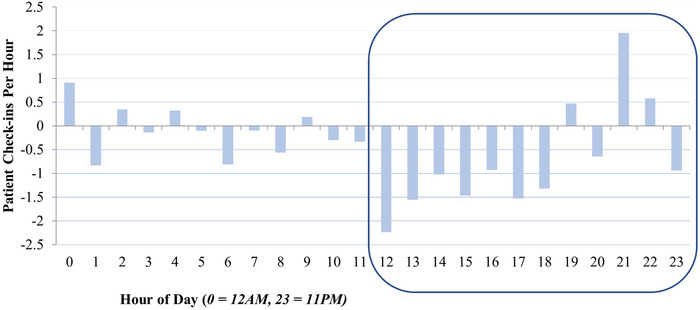
Change in total volume per hour on the Patriots Sunday game days
Between December 2, 2012, to February 3, 2019, 7 Monday night Patriots games were played compared with 122 Mondays during which no Patriots game was played. Mondays with games had a mean of 424.1 patients per day (range, 377–454; SD = 30.5) relative to 443.2 patients per day (range, 315–547; SD = 31.9) on Mondays without Patriots games. This difference was not statistically significant using a 2‐tailed t test of 2 samples assuming unequal variances (P = 0.15; 95% CI, −43.51 to 5.47). Subanalysis of average aggregate check‐ins per hour comparing the 5‐hour game window during Monday games (7 PM‐12 AM, = 17.4 check‐ins per hour) compared with all other Mondays during which Patriots games were not played while the team was still in contention of the championship (7 PM‐12 AM, = 17.8 check‐ins per hour) was not statistically significant (P = 0.90; 95% CI, −8.12 to 7.23).
4. LIMITATIONS
Although a correlation was found between patient volume and Sunday game days, this does not prove causation. A majority of NFL teams play during the same period on Sundays, so the relationship observed at these regional centers in New England might be related to interest in all NFL games rather than exclusively the regional Patriots games as NFL games. Our findings represent the impact of 1 professional sports team in 1 region and may not be generalizable to other regions where a team might have a more or less robust fan base.
Although the sites in this study are all located in New England states within catchment areas where the Patriots are the local NFL team, we did not conduct any analysis on the effect of site proximity to the location of the Patriots home stadium. Our analysis does not differentiate between home and away games. Differentiating between games played at the Patriots home stadium versus those at other stadiums could have shown varying effect sizes on different game days. Any effects observed in our data are unlikely to be related to actual patient attendance at the sporting venue during home games. Community EDs, which commonly have a higher proportion of low‐acuity visits, might be more impacted by reductions in discretionary visits relative to the tertiary centers studied.
Using Sundays when other NFL games are played as a control group does not account for the various other NFL games played on Sundays. This could exert some unmeasured effect on ED patient volume as it is reasonable to expect that patients within New England might have other team allegiances or might watch all NFL games regardless of which team is playing on any given Sunday. Lastly, although we attempted to control for staffing schedules and seasonal variation by using only in‐season comparisons, we were unable to control for several possible confounders including weather, the possibility that other local events were occurring at the time of Patriots games, and patient demographics.
5. DISCUSSION
Anecdotally, many emergency physicians experience a decrease in ED patient volume during major sporting events. Our results, and several prior studies, have failed to statistically validate this subjective impression. Our data confirm studies by Kim et al5 and McGreevy et al6 that show a minimal effect of major sporting events on tertiary ED volume.
In NFL seasons played from 2012 to 2019, across 3 tertiary centers, we found a 2.6% overall reduction (−10.4 patients) in ED patient volume on Sundays during which Patriots games were played compared with Sundays in the NFL season when Patriots games were not played. Although these results were not statistically significant, this observed reduction is potentially meaningful for emergency physicians and administrators. The majority of patient check‐ins per hour decreased around the daytime hours during which NFL games are played (Figure 1). Check‐ins per hour are a surrogate for overall ED patient volume in a single day. Analyzing how many new patients arrive per unit time does not necessarily account for existing patient queues for imaging or consultation results. On a lower overall volume day, bottlenecks in patient disposition might be resolved more efficiently, making the entirety of a clinical shift feel less demanding. This also has impacts for patient care as improved ED throughput is likely to impact the patient experience by reducing wait times, increasing the likelihood of having a private care space, and reducing delays in arrival to disposition time.
The consistent pattern of reduced patient check‐ins per hour during each period surrounding a game (Table 2), although not statistically significant, matches the personal experience of clinicians that suggest fewer patient check‐ins per hour exist surrounding game time. Similar decreases in ED check‐ins during game‐time hours were observed in studies that described the 1999 to 2001 Union of European Football Associations soccer seasons12 and data that showed a 17% decrease in the average number of patients per hour during the Canadian gold medal hockey game in Canadian EDs.13 We expect that the change in daily volume observed would be more pronounced during events of greater magnitude or events that are less frequently broadcast such as an Olympic final or an international tournament such as the Soccer World Cup. This is supported by prior literature. Reich et al2 showed that intense local interest in the regional NFL team playing in the Super Bowl led to a stronger reduction of ED volume relative to other playoff games. Higher magnitude sporting events having proportionate impacts on reductions in ED volume is also described in baseball1 and soccer.3 Data shown in Figure 1 suggest that there may be an increase in patient check‐ins after the conclusion of sporting events, evidenced by the increase in patient check‐ins per hour from 9:00 PM and 10:00 PM. Collectively, these data suggest that it would be pragmatic for ED administrators to anticipate fluctuations of patient check‐ins surrounding game‐time hours. Predicting what type of events have a greater impact on ED patient volume requires further investigation.
Measuring surrogate values, such as television broadcast ratings or number of fans in attendance at the stadium, might be used to predict the impact of sporting events on ED volume. Reis et al1 showed that the timing of ED use by patients relates to the magnitude of sporting event as measured by engagement with television broadcast ratings. We were unable to validate these findings in our subanalysis. All 8 6:30 PM Patriots games (January 20, 2013; January 18, 2015; February 1, 2015; January 22, 2017; February 5, 2017; February 4, 2018; January 20, 2019; February 3, 2019), which were either Super Bowl or conference championship games and would be expected to have higher television ratings,14 did not show a statistically significant reduction in patient visits compared with control hours. Although the 4 3:05 PM championship games (January 22, 2012; January 29, 2014; January 24, 2016; January 21, 2018) showed the largest reduction in patient volume (mean of −3.16 patients/hour), these 4 games all occurred in late January when volume is traditionally low at all 3 study sites because of the seasonal impacts from winter. We were unable to control for weather in our study, but we anticipate that difficult travel conditions or disinterest in venturing into cold weather would be likely to reduce patient check‐ins per hour during these winter championship games.
Results from our secondary analysis also support data suggesting an overall minimal effect of major sporting events on ED volume.5, 6 We would expect to see the most robust effect of Patriots games played on Mondays as this is a weekday during which only 1 NFL game is played and broadcast, thereby eliminating the potential effects of substitute NFL games broadcast on Sundays. Although we observed a 4.3% overall reduction in patient volume on Mondays with Patriots games relative to Mondays without games (−19.0 patients; P = 0.15; 95% CI, −43.51 to 5.47), the subanalysis failed to show a meaningful reduction in Monday game‐time hour volume. This suggests that, as observed in the Sunday data, the impact of the game on ED volume might extend well before or after the hours of the game itself. As with the primary analysis, this nominal overall difference in daily and game‐time volume does not suggest a need for significant ED staffing adjustments during game‐time hours. Further investigation on whether a sporting event might impact the daily volume before or after game day is needed.
This retrospective, multicenter analysis shows minimal overall impact of a regional NFL team's games on hourly ED volume among 3 tertiary centers, suggesting that administrators do not need to make substantial staffing adjustments during these types of sporting events.
CONFLICT OF INTEREST
The authors declare no conflict of interest.
AUTHOR CONTRIBUTIONS
Peter S. Antkowiak, Leon D. Sanchez, and David T. Chiu conceived the study and designed the analysis. Peter S. Antkowiak and David T. Chiu led the data collection. Peter S. Antkowiak, Tania Strout, and Colin Stack coordinated data collection from each of their respective departments. Peter S. Antkowiak, Bryan A. Stenson, and Joshua W. Joseph conducted data analysis and statistics. David T. Chiu and Leon D. Sanchez advised all aspects of the study. All authors contributed to manuscript writing and revising. Peter S. Antkowiak takes responsibility for the manuscript as a whole and is the corresponding author.
Biography
Peter S. Antkowiak, MD, MPH, is a Clinical Instructor of Emergency Medicine at Beth Israel Deaconess Medical Center and Harvard Medical School in Boston, MA, USA.

Antkowiak PS, Stenson BA, Strout TD, et al. A retrospective multistate analysis: Do regional football games impact emergency department patient volume? JACEP Open. 2021;2:e12551. 10.1002/emp2.12551
Funding and support: By JACEP Open policy, all authors are required to disclose any and all commercial, financial, and other relationships in any way related to the subject of this article as per ICMJE conflict of interest guidelines (see www.icmje.org). The authors have stated that no such relationships exist.
Supervising Editor: Nathan Hoot, MD, PhD.
REFERENCES
- 1.Reis BY, Brownstein JS, Mandl KD. Running outside the baseline: impact of the 2004 Major League Baseball postseason on emergency department use. Ann Emerg Med. 2005;46(4):386‐387. [DOI] [PubMed] [Google Scholar]
- 2.Reich NT, Moscati R, Jehle D, et al. The impact of a major televised sporting event on emergency department census. J Emerg Med. 1994;12(1):15‐17. [DOI] [PubMed] [Google Scholar]
- 3.Hughes HE, Colón‐González FJ, Fouillet A, et al. The influence of a major sporting event upon emergency department attendances; a retrospective cross‐national European study. PLoS One. 2018;13(6):e0198665. [DOI] [PMC free article] [PubMed] [Google Scholar]
- 4.Cooke MW, Allan TF, Wilson S. A major sporting event does not necessarily mean an increased workload for accident and emergency departments. Euro96 Group of Accident and Emergency Departments. Br J Sports Med. 1999;33(5):333‐335. [DOI] [PMC free article] [PubMed] [Google Scholar]
- 5.Kim TY, Barcega BB, Denmark TK. Pediatric emergency department census during major sporting events. Pediatr Emerg Care. 2012;28(11):1158‐1161. [DOI] [PubMed] [Google Scholar]
- 6.McGreevy A, Millar L, Murphy B, et al. The effect of sporting events on emergency department attendance rates in a district general hospital in Northern Ireland. Int J Clin Pract. 2010;64(11):1563‐1569. [DOI] [PubMed] [Google Scholar]
- 7.Hoot NR, Epstein SK, Allen TL, et al. Forecasting emergency department crowding: an external, multicenter evaluation. Ann Emerg Med. 2009;54(4):514‐522. [DOI] [PMC free article] [PubMed] [Google Scholar]
- 8.Marcilio I, Hajat S, Gouveia N. Forecasting daily emergency department visits using calendar variables and ambient temperature readings. Acad Emerg Med. 2013;20(8):769‐777. [DOI] [PubMed] [Google Scholar]
- 9.Carter EJ, Pouch SM, Larson EL. The relationship between emergency department crowding and patient outcomes: a systematic review. J Nurs Scholarsh. 2014;46(2):106‐115. [DOI] [PMC free article] [PubMed] [Google Scholar]
- 10.Virtanen P, Gommers R, Oliphant TE, et al. SciPy 1.0: fundamental algorithms for scientific computing in Python. Nat Methods. 2020;17(3):261‐272. [DOI] [PMC free article] [PubMed] [Google Scholar]
- 11.Remenyi D. An Introduction to Statistics Using Microsoft Excel. 2nd ed.Reading, United Kingdom: Academic; Conferences & Publishing International; 2015. [Google Scholar]
- 12.Boyce SH. UEFA Champions League: does live television football affect attendances at accident and emergency departments? Union of European Football Associations. Eur J Emerg Med. 2002;9(1):77. [DOI] [PubMed] [Google Scholar]
- 13.Redelmeier DA, Vermeulen MJ. Emergency department visits during an Olympic gold medal television broadcast. Open Med. 2011;5(2):e112‐e119. [PMC free article] [PubMed] [Google Scholar]
- 14.Tainsky S, Xu J, Zhou Y. Qualifying the game uncertainty effect: a game‐level analysis of NFL postseason broadcast ratings. J Sports Econom. 2014;15(3):219‐236. [Google Scholar]