



Abstract
Tremendous progress has been made in the treatment of ST-segment elevation myocardial infarction (STEMI), the most severe and time-sensitive acute coronary syndrome. Primary percutaneous coronary intervention (PCI) is the preferred method of reperfusion, which has stimulated the development of regional STEMI systems of care with standardized protocols designed to optimize care. However, challenges remain for patients with cardiogenic shock, out-of-hospital cardiac arrest, an expected delay to reperfusion (>120 min), in-hospital STEMI, and more recently, those with Covid-19 infection. Ultimately, the goal is to provide timely reperfusion with primary PCI coupled with the optimal antiplatelet and anticoagulant therapies. We review the challenges and provide insights into the remaining knowledge gaps for contemporary STEMI care.
Keywords: ST-segment elevation myocardial infarction, Regional systems, Cardiogenic shock, Out-of-hospital cardiac arrest, Covid-19, Cangrelor
Graphical abstract
STEMI Care 2021. Regional STEMI systems of care with standardized STEMI protocols ensure higher PCI rates and better survival rates (upper); however, several unique challenges remain in STEMI care (bottom). EMS: Emergency medical service; PCI: Percutaneous coronary intervention; STEMI: ST-segment elevation myocardial infarction. Bar graph adapted with permission from Shah RU. et al. [12]. Created by using BioRender.com.
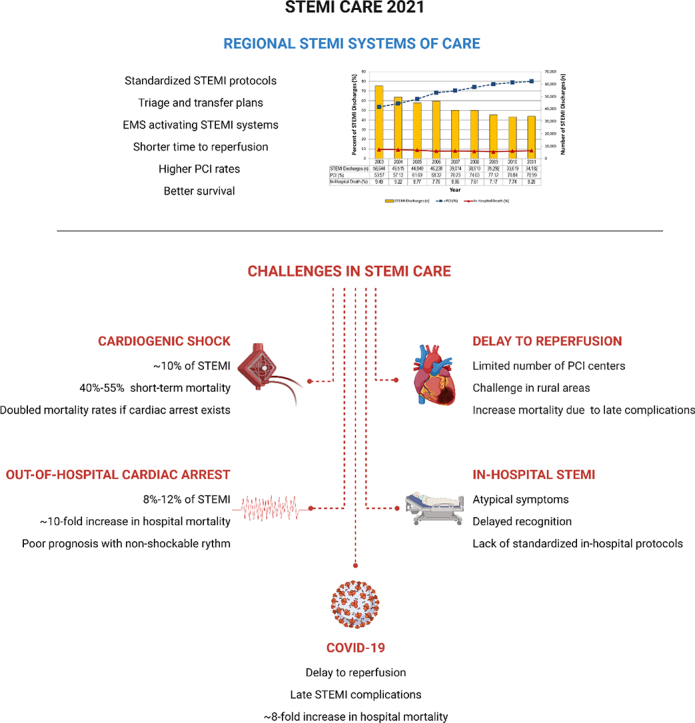
ST-segment elevation myocardial infarction (STEMI) has generated considerable attention over the last several decades with the establishment of regional systems of care throughout the US. Progress has been made in increasing the number of patients receiving the primary percutaneous coronary intervention (PCI), thereby improving the time to reperfusion and reducing mortality rates [1]. Implementing standardized protocols for transporting patients to the nearest PCI center and training emergency medical services to recognize STEMI in the field have increased accessibility to primary PCI and reduced treatment time [1], [2], [3], [4], [5], [6]. However, there is still considerable room for improvement. In particular, limited progress has been made for patients complicated by cardiogenic shock (CS) or out-of-hospital cardiac arrest (OHCA) [7], [8]. Many patients presenting to non-PCI centers still are not treated in the guideline-recommended 120 min from the first medical contact [6]. Besides, many hospitals still do not have standardized protocols for in-hospital STEMI [9]. Lastly, the devastating coronavirus disease 2019 (Covid-19) pandemic challenged STEMI standards of care with both direct and indirect damages [10], [11].
Herein, we discuss the latest in regional STEMI systems of care and current STEMI challenges, including CS, OHCA, patients with an expected delay to reperfusion (>120 min), in-hospital STEMI, and the impact of Covid-19 infection. We conclude our assessment with practical considerations for integrating best practices with the highest-quality individual pharmacological care.
1. Regional STEMI systems of care
The incidence of STEMI has declined over the past decade, and overall the prognosis has improved considerably with increased utilization of primary PCI [12] and the development of regional STEMI systems of care [1], [2], [3], [4], [5], [6]. Recently, the improvements have plateaued, and significant challenges remain to improve STEMI care further. Utilization of standardized protocols and prearranged transfer agreements in regional STEMI systems has led to a reduction in time to reperfusion (door-to-device or first medical contact-to-device) and an improvement in coordination of care between emergency medical service (EMS), emergency department, cardiac catheterization laboratory (CCL), and long-term care staff [1], [2], [3], [4], [5], [6].
Regional STEMI systems of care in the US developed over the last 15 years following the data from DANAMI-2 showing a significant reduction in death, reinfarction, and stroke at 30 days for primary PCI versus fibrinolytic therapy in patients transferred from non-PCI centers [13]. These results stimulated the development of regional systems of care to provide access to primary PCI and standardized protocols for the management of STEMI at both PCI and non–PCI centers (Fig. 1) [1], [2], [3], [4], [5], [6].
Fig. 1.

STEMI Systems of Care and Time to Treatment.
Well-established STEMI systems of care is essential to achieve timely reperfusion in regional STEMI systems for transferred patients from non-PCI centers. EMS indicates emergency medical service; PCI percutaneous coronary intervention. Created by using BioRender.com.
A critical approach to reduce time by quickly identifying STEMI patients in the field has been the focus for EMS, which are frequently the first healthcare professionals to interact with and initiate care. EMS has been empowered to activate the STEMI system when transporting the patient to the nearest PCI center [14]. American College of Cardiology Foundation (ACCF)/American Heart Association (AHA) guidelines recommended training EMS staff to perform a 12-lead ECG in the field to identify STEMI patients [15]. With one call, the paramedic can activate a multi-disciplinary care team to prepare for primary PCI.
Because only one-third of hospitals in the US are capable of PCI [16], many STEMI patients require a transfer from remote areas. One of the earliest regional STEMI systems of care, the Minneapolis Heart Institute “Level 1 MI” program, used distance from the PCI center to designate two zones with specific treatment protocols and transfer plans. Zone 1 consisted of non-PCI centers <60 miles away from the PCI center, and Zone 2 included non-PCI centers 60 to 210 miles [4]. Pharmacoinvasive strategy -half-dose fibrinolytic therapy followed by emergent transfer for early PCI- was incorporated into the protocol for Zone 2 to overcome the challenge in reaching the guideline-recommended first medical contact-to-device of <120 min (Fig. 2) [17], [18].
Fig. 2.

Map of Minnesota with the PCI center (ANW) in Minneapolis (green star), zone 1 hospitals (<60 miles from PCI center) (blue squares), and zone 2 hospitals (60 to 210 miles from PCI center) (red circles). The pharmacological protocols for the PCI center and zone 1 and 2 hospitals are shown.
PCI, percutaneous coronary intervention; TNK, tenecteplase; UFH, unfractionated heparin.
Adapted with permission from Henry T.D. et al. [4].
The most successful STEMI systems of care have standardized their processes and put transfer protocols for prompt and efficient transfers from non-PCI to PCI centers. However, delays in the transfer can occur even in optimized STEMI systems [6], [18]. The most common reasons include non-system-related factors (i.e., prolonged transport time due to weather or distance), patient characteristics (i.e., older age, female sex), and index event characteristics (i.e., absence of chest pain on presentation). False-positive CCL team activation can be another challenging problem [19], [20]. False activations can lead to staff burnout, confusion for families and patients, and excessive use of resources. Unique metrics, such as the CCL activation index and the revascularization index, may help avoid overlooking STEMI patients requiring PCI.
Overall, the critical components of optimized regional STEMI systems of care are well-established standardized STEMI protocols, which should include: (1) predetermined STEMI diagnosis criteria; (2) activation of the system with a single phone call; (3) pre-identified transport plans to PCI centers; and (4) administration of the guideline-recommended antithrombotic therapies. Additionally, regional STEMI systems of care have provided essential insights into STEMI care through the use of detailed prospective registries, which have the advantages of: (1) including all STEMI patients without exclusion criteria; (2) providing a detailed database for high-risk STEMI patients such as CS or OHCA; (3) presenting detailed angiographic features; and (4) compiling robust long-term follow-up data [1], [4], [21].
2. Challenges in STEMI care
Despite the significant improvement, several unique challenges remain in STEMI care, including patients with CS, OHCA, an expected delay to reperfusion (>120 min), in-hospital STEMI, and the implications of the Covid-19 pandemic, require special management consideration.
2.1. Cardiogenic shock
CS is a lethal complication of STEMI with an incidence of ~8-12% and 30-day mortality of 40% to 55% [7], [22], [23]. Concurrent cardiac arrest almost doubled hospital mortality secondary to CS [24]. Early revascularization of the culprit vessel is critical and associated with short- and long-term survival benefits [7], [25]. The recent scientific statement by AHA recommends the management of CS patients may include: (1) Transport of the patient identified in the field by EMS directly to the CS center by bypassing non-CS centers; (2) STEMI patients should be transferred to the nearest PCI center for rapid revascularization and stabilization; (3) early communication with the CS center team; and (4) a consider mobile units from the CS center to be deployed to the referral hospital to stabilize the patient until the transfer can be made [22].
Despite limited randomized trials with a lack of survival benefit, mechanical circulatory support (MCS) has been increasingly used in CS [7], [22], [23], [24], [25], [26], [28]. The recent scientific statement by AHA proposed that STEMI patients complicated by CS (Society for Cardiovascular Angiography and Interventions (SCAI) shock stages from C to E) may benefit from MCS devices in case of persistent hemodynamic instability. However, it should not delay revascularization [7], [22].
2.2. Out-of-hospital cardiac arrest
STEMI patients with OHCA are another high-risk population with a 10-fold increase in mortality compared to non-cardiac arrest STEMI [8]. Initial shockable rhythm and being awake after the initial resuscitation have more favorable outcomes than non-shockable rhythm and being comatose [8], [29], [30]. When coupled with revascularization, therapeutic hypothermia (TH) improves survival and neurological outcomes since every hour delay in cooling increases in-hospital mortality by 20%. Therefore, both ACCF/AHA and ESC guidelines consider TH a class I recommendation with immediate coronary angiography and PCI for STEMI patients with OHCA [15], [31].
In particular, STEMI patients with both CS and CA are the highest risk population with mortality of 44% compared to 19% in CA alone or 23% in CS alone [24]. Therefore, the SCAI CS classification considers CA as an important modifier which has been confirmed by recent validation studies [27].
Following the initial resuscitation, most patients will remain comatose or hypothermic, which challenges administering oral antiplatelet agents. In that respect, cangrelor, an intravenous P2Y12 receptor antagonist, is an alternative agent with rapid onset and offset effects [7].
2.3. Patients with a delay >120 min
While primary PCI is the preferred treatment approach, many STEMI patients transferred from non-PCI centers do not meet the guideline-recommended time of 120 min [6], [18]. The safety and efficacy of pharmacoinvasive reperfusion with half-dose fibrinolytic therapy combined with transfer from remote rural hospitals (>60 miles away from PCI center) for primary PCI were demonstrated in the Level 1 MI program at the Minneapolis Heart Institute [4], [17], [32]. Compared with 600 patients presenting directly to the PCI center, 660 patients transferred from remote hospitals who received pharmacoinvasive therapy had similar 30-day mortality rates despite nearly an hour longer time to treatment (5.5% vs. 5.6%; P = 0.94) [17]. There results were consistent with multiple randomized clinical trials [32].
The primary concern with fibrinolytic therapy is the risk of intracranial hemorrhages documented by the Strategic Reperfusion Early After Myocardial Infarction (STREAM) trial [33]. In STREAM, the rates of major cardiovascular events at 30 days were similar among STEMI patients who received fibrinolytic therapy (half-dose for patients aged 75 years or older) compared with primary PCI. However, there were more intracranial hemorrhages in the fibrinolytic therapy group than the primary PCI group (1.0% vs. 0.2%, P = 0.04; after adjustment, 0.5% vs. 0.3%, P = 0.45). Rates of nonintracranial bleeding were comparable in the two groups. Another essential focus of pharmacoinvasive therapy is the determination of the ideal antiplatelet regimen. Most of the data available have evaluated clopidogrel use. Recently, ticagrelor was compared to clopidogrel in the Ticagrelor in Patients with ST-Elevation Myocardial Infarction Treated with Pharmacological Thrombolysis (TREAT) trial [34]. In TREAT, patients aged <75 years with STEMI, administration of ticagrelor after fibrinolytic therapy did not reduce the frequency of cardiovascular events compared to clopidogrel (6.7% [129/1913] vs. 7.3% [137/1886]). Thus, STEMI patients with an expected delay >120 min can be treated safely and effectively using a pharmacoinvasive approach with half-dose fibrinolytic therapy, aspirin, and clopidogrel.
2.4. In-hospital STEMI
Patients that develop STEMI while in the hospital represent another high-risk population. These patients tend to have prolonged time to treatment because they often present with atypical symptoms. In addition, there is frequently a delay in obtaining an ECG and activation of the STEMI system. Mortality rates may be up to 10-fold higher for in-hospital STEMI patients (31%–42%) than those presented via EMS or independently [9], [35]. In particular, patients who develop STEMI on non-cardiovascular units (e.g., post-anesthesia care, intensive care, or neurologic intensive care units) have significantly higher mortality [35]. Thus, implementing quality improvement programs for in-hospital STEMI is essential to decrease delays and streamline care to improve treatment and outcomes.
2.5. Covid-19 infection
Covid-19, caused by severe acute respiratory syndrome coronavirus-2 (SARS-CoV-2), resulted in a devastating worldwide pandemic. The heart is a critical target for SARS-CoV-2 by direct (viral entry into cardiomyocytes) and indirect (pro-inflammatory response, pro-thrombotic state, demand ischemia, cardiac stress, or plaque rupture) mechanisms [36], [37]. Destabilization of pre-existing atherosclerotic plaque may predispose to STEMI in Covid-19 infection [38]. Troponin is elevated in 15-30% of Covid-19 patients admitted to the hospital and is predictive of higher in-hospital mortality [38].
SARS-CoV-2 spreads mainly via droplets or aerosols from person to person through close contact. Thus, federal and local agencies implemented several measures to mitigate the pandemic, such as stay-at-home orders, social isolation, and deferral of elective procedures. Additional measures implemented by individual healthcare systems include shifting medical resources to patients with Covid-19 infection, canceling in-person appointments, and initiating new triage protocols [39], [40], [41]. These interventions and patient fears contributed to unintended consequences and resulted in a decrease in STEMI and other acute coronary syndrome admissions and an increase in late STEMI complications and OHCA [10], [42], [43]. Overall, STEMI incidences declined remarkably during the Covid-19 pandemic by 38% in the US, 26% in China, and 18.9% in Europe [10], [42], [43].
Early reperfusion is critical in STEMI treatment. However, the ISACS-STEMI Covid-19 registry, established in Europe, reported a significant increase in total ischemic and door-to-balloon times during the Covid-19 pandemic [43]. Although some healthcare systems and experts endorsed fibrinolytic therapy early in the Covid-19 pandemic in order to minimize the risk of virus spread and avoid any delay in reperfusion [44], [45], it became clear that Covid-19 patients with ST-segment elevation frequently had no clear culprit. Also, CCL staff could safely and quickly deal with STEMI in Covid-19. Therefore, primary PCI remains the reperfusion method of choice for Covid-19 patients [11].
In the light of the delays to presentation, the incidence of STEMI complications such as OHCA or mechanical complications (e.g., ventricular septal defect, free wall rupture, papillary muscle rupture, or left ventricular thrombus) have increased considerably compared to the pre-Covid-19 era [46], [47]. Furthermore, in-hospital mortality rates increased by 41% in Europe and 21% in China [42], [43].
In addition to the abovementioned challenges on STEMI systems of care, Covid-19 patients that present with STEMI are a very high-risk population. Initial reports during the early phase of the pandemic revealed heterogeneous findings but were limited by small sample sizes and lack of control groups. A systemic review of case reports and case series reported a relatively higher incidence of non-obstructive lesions (17%) in STEMI patients with concurrent Covid-19 infection. In-hospital mortality was also relatively high (30%), without a significant difference between obstructive and non-obstructive lesions [48]. The recently published NACMI registry, established in North America with a collaboration of multinational societies, provided a more comprehensive view [49]. STEMI patients with concurrent Covid-19 infection (n = 230) were more likely to be diabetic and ethnic minorities. They were more likely to present with atypical symptoms such as dyspnea (54%) and with high-risk features such as CS (18%) and cardiac arrest (11%). Only 78% underwent coronary angiography. Among those patients, the majority (71%) received primary PCI, while 20% were treated medically. Consistent with previous reports, many patients (23%) had no culprit lesion, which may reflect microthrombi, Takotsubo syndrome, spontaneous coronary artery dissection, or myocarditis. STEMI patients with concurrent Covid-19 infection had an increased risk for in-hospital mortality compared with control STEMI patients from the pre-Covid-19 era (33% vs. 4%, P < 0.001) [49].
As Covid-19 extends into the second year with different surge patterns worldwide, the collateral damages and clinical challenges persist for STEMI systems of care. Although federal and local agencies and healthcare systems have evolved and adapted over time, we need to maintain STEMI standards of care. In that respect, a consensus statement from the SCAI, ACC, and the American College of Emergency Physicians (ACEP) recommends to 1) evaluate all STEMI patients in the emergency department before arrival to the CCL, 2) provide appropriate personal protective equipment to all CCL staff, 3) assign one of the CCLs with negative pressure for patients with positive Covid-19 infection, and 4) prefer primary PCI as the reperfusion strategy for patients with STEMI and consider fibrinolytic therapy and pharmacoinvasive strategy only at non-PCI centers or in certain situations where primary PCI is not feasible [11]. Subsequently, AHA Mission: Lifeline recommends increasing public campaigns to raise awareness about a heart attack's signs and symptoms during Covid-19 pandemic [50]. Finally, experts suggest triaging low-risk STEMI patients to step-down units to protect critical care beds for severe Covid-19 patients [51].
3. Current and emergent antithrombotic therapy in STEMI
STEMI typically occurs due to plaque rupture or endothelial erosion, leading to thrombus formation within the artery and subsequently impedes blood flow [52]. High-quality pharmacologic treatment is essential for STEMI patients while en route to a PCI center and during PCI. Antithrombotic therapy, including anticoagulant and antiplatelet agents, are critically important. The ideal choice of pharmacologic treatment should weigh benefits and risks to the patient and take into account comorbid conditions [52], [53] (Fig. 3).
Fig. 3.

Mechanism of thrombus formation with relevant pathways and drug targets.
Adapted with permission from Franchi F. et al. [53].
3.1. Anticoagulant therapy
Two main agents, unfractionated heparin and bivalirudin, are commonly used [53]. High intrapatient and interpatient pharmacokinetic variability and increased risk for heparin-induced thrombocytopenia challenge the use of unfractionated heparin [53]. Despite these limitations and lack of placebo-controlled clinical trials, unfractionated heparin has a class I indication as an anticoagulant during primary PCI from both the ACCF/AHA and ESC guidelines [15], [31]. Bivalirudin infusion has a linear and predictable dose-response profile [53]. Although the evidence for the use of bivalirudin in STEMI patients continues to be controversial, it currently has a class I evidence recommendation by the ACCF/AHA [15] and a class IIa recommendation ESC guidelines [31].
3.2. Anti-platelet therapy
Three different types of antiplatelet therapies are currently approved for use in STEMI patients by the ACCF/AHA guidelines; cyclooxygenase inhibitors, P2Y12 receptor antagonists, and GPIIb/IIIa inhibitors [15].
3.2.1. Oral antiplatelet agents
Aspirin is an irreversible cyclooxygenase receptor inhibitor-1 and prevents platelet activation and aggregation [52]. Low-dose aspirin (81 mg) was shown to be equally effective with less bleeding risk than high-dose (325 mg) and has been incorporated into the guidelines for secondary prevention of cardiovascular events after STEMI [15], [31].
Oral P2Y12 inhibitors are clopidogrel, prasugrel, and ticagrelor. Each differs in its binding site and pharmacokinetics at the P2Y12 receptor. Although clopidogrel is still the most widely used, it has exhibited variability in individual responses related to genetic, clinical, and cellular factors, creating a concern about increased platelet reactivity. Thus, the ESC guidelines stated the recommendation of use “if ticagrelor or prasugrel are not available or are contraindicated” [31]. In a meta-analysis of clinical trials enrolling STEMI patients, prasugrel was more efficacious than clopidogrel in STEMI patients undergoing primary PCI and superior to ticagrelor when used in conjunction with bivalirudin and drug-eluting stents [54]. However, prasugrel is less frequently used because of the black box warning for patients with previous stroke, despite evidence-based pharmacodynamics and clinical studies that it may be the most effective oral agent. The Administration of Ticagrelor in the Cath Lab or in the Ambulance for New ST-Elevation Myocardial Infarction to Open the Coronary Artery (ATLANTIC) trial supported prehospital ticagrelor use to reduce stent thrombosis compared with in-hospital administration in STEMI patients [55]. Several studies have suggested the potential for a drug-drug interaction between ticagrelor and opioids, which could result in reduced platelet inhibition and impaired ticagrelor absorption [56], [57]. Overall, the ACCF/AHA guideline provides a class Ib recommendation for oral antiplatelet agents in STEMI management [15].
3.2.2. Dual antiplatelet therapy
Aspirin plus an oral P2Y12 inhibitor (dual antiplatelet therapy [DAPT]) is the mainstay treatment following PCI. The optimal duration of DAPT after coronary artery stent implantation is still under debate, but current guidelines recommend 1-year DAPT for STEMI patients [15], [31].
The advances in stent technology have challenged the recommendations regarding the optimal duration of DAPT following PCI. Recent randomized studies suggested short-term DAPT with potentially discontinuing aspirin after 3 months. For instance, after completing 3-month DAPT, The Ticagrelor with Aspirin or Alone in High-Risk Patients after Coronary Intervention (TWILIGHT) trial randomized patients into ticagrelor monotherapy versus 12-month DAPT [58]. In TWILIGHT, there were significantly fewer bleeding complications with ticagrelor monotherapy than 12-month DAPT, but mortality risks were similar. However, the study excluded STEMI or CS patients. On the other hand, Ticagrelor Monotherapy After 3 Months in the Patients Treated With New Generation Sirolimus-eluting Stent for Acute Coronary Syndrome (TICO) trial used a similar study design, however, included STEMI patients (36%). TICO trial reported an absolute reduction in major bleeding and cardiovascular events with ticagrelor monotherapy at 1-year [59].
3.2.3. Intravenous P2Y12 inhibitors, cangrelor
Cangrelor is a reversible P2Y12 receptor antagonist and administered as 30 μg/kg bolus followed by 4 μg/kg/min intravenous infusion. The half-life of cangrelor is 6 min in healthy volunteers, and no dose adjustment is required for renal failure patients [60], [61]. Pharmacodynamic measurements of cangrelor have shown extensive platelet inhibition starting at 2 min and continuing through the infusion duration. Platelet function typically recovers entirely within 60 min after stopping the infusion. Compared with other P2Y12 inhibitors, cangrelor's benefit is its rapid onset and quick offset of effects [60], [61]. Platelet Inhibition With Cangrelor and Crushed Ticagrelor in STEMI Patients Undergoing Primary Percutaneous Coronary Intervention (CANTIC) study examined the administration of crushed ticagrelor tablets (180 mg loading dose) with cangrelor or matching placebo in 50 STEMI patients undergoing primary PCI. P2Y12 reaction units were reduced in every patient in the cangrelor group at 5 min post-bolus compared with placebo, which persisted during the entire drug infusion, including 30 min [62]. The CHAMPION PHOENIX trial, including 11,145 patients undergoing elective or urgent PCI, compared cangrelor with clopidogrel. The primary efficacy endpoint (composite of death, myocardial infarction, ischemia-driven revascularization, or stent thrombosis at 48 h) was significantly lower in the cangrelor group. However, the severe bleeding risk was similar in both groups [63].
The ESC and European Cardio-Thoracic Surgery (EACTS) 2018 guidelines on myocardial revascularization recommended cangrelor with class IIb in STEMI patients (P2Y12-inhibitor naïve) as pre-treatment [64], which may be potentially beneficial in STEMI patients with CS or OHCA [7], [22].
3.2.4. GPIIb/IIIa inhibitors
The third type of antiplatelet therapy targets the GPIIb/IIIa molecule, expressed on platelet cell surfaces, which leads to platelet aggregation through binding to fibrinogen in activated platelets. Inhibitors of this molecule prevent fibrinogen binding to the receptor, thereby preventing platelet aggregation. Three GPIIb/IIIa inhibitors are currently approved for use in STEMI patients undergoing PCI: abciximab, eptifibatide, and tirofiban. These three inhibitors are reversible and administered intravenously as a bolus followed by an infusion of variable duration [65]. A recent study suggested that routine usage of GPIIb/IIIa inhibitors compared with selective usage was associated with lower all-cause, 1-year mortality (9.7% vs. 11.0%; P < 0.001) [66]. The overall use of GPIIb/IIIa inhibitors has declined primarily due to the higher bleeding risk. Currently, the ACCF/AHA guideline designates a grade IIA recommendation for all three GPIIb/IIIa inhibitors for STEMI patients [15]. The ESC guideline designates a class IIa recommendation for GPIIb/IIIa inhibitors for STEMI patients as a bailout therapy if there is evidence of no-reflow or a thrombotic complication [31].
4. Practical practice recommendations and conclusions
-
1.
Establishing regional STEMI systems of care by utilizing standardized STEMI protocols and predetermined transfer strategies is crucial to optimize STEMI care. The standardized protocols should include early recognition of STEMI patients with prehospital ECGs, triage quickly to the CCL, and pre-treatment with antithrombotic therapy.
-
2.
CS and OHCA are the significant causes of death in STEMI and require special consideration and experience. The SCAI clinical expert consensus statement on CS classification is a valuable tool to stratify this population to determine which patients benefit from mechanical support. Current guidelines strongly recommend the transfer of these patients to specialized centers with early revascularization and TH for patients with OHCA.
-
3.
A pharmacoinvasive strategy should be considered for STEMI patients with an expected delay >120 min based on the distance from a PCI center and transfer availability.
-
4.
In-hospital STEMI is often associated with delays in treatment time. Thus, quality and performance measures in hospital settings should be implemented to identify and prompt reperfusion early.
-
5.
The devastating Covid-19 pandemic led to direct and indirect challenges for STEMI systems of care. Nonetheless, early reperfusion with primary PCI with appropriate personal protective equipment for CCL staff remains the perfusion method of choice for STEMI patients during the Covid-19 pandemic.
-
6.
Decisions on anticoagulant therapy pre- and intra-PCI should weigh the patient's benefits and risks. With recent emerging data, a shorter DAPT duration followed by discontinuation of the aspirin appears to have similar efficacy with less bleeding risk.
-
7.
Cangrelor offers nearly immediate effects (within 2 min), which may help during time-sensitive PCI and high-risk patients with oral drug administration and absorption issues, such as CS and OHCA complicating STEMI.
Declaration of competing interest
The authors declare that they have no known competing financial interests or personal relationships that could have appeared to influence the work reported in this paper.
References
- 1.Henry T.D. From concept to reality: a decade of progress in regional ST-elevation myocardial infarction systems. Circulation. Jul. 2012;126(2):166–168. doi: 10.1161/CIRCULATIONAHA.112.114140. [DOI] [PubMed] [Google Scholar]
- 2.Jollis J.G., et al. Regional systems of care demonstration project: american heart association mission: lifeline STEMI systems accelerator. Circulation. Aug. 2016;134(5):365–374. doi: 10.1161/CIRCULATIONAHA.115.019474. [DOI] [PMC free article] [PubMed] [Google Scholar]
- 3.Jollis J.G., et al. Impact of regionalization of ST-segment-elevation myocardial infarction care on treatment times and outcomes for emergency medical services-transported patients presenting to hospitals with percutaneous coronary intervention: mission: lifeline accelerator. Circulation. Jan. 2018;137(4):376–387. doi: 10.1161/CIRCULATIONAHA.117.032446. [DOI] [PubMed] [Google Scholar]
- 4.Henry T.D., et al. A regional system to provide timely access to percutaneous coronary intervention for ST-elevation myocardial infarction. Circulation. Aug. 2007;116(7):721–728. doi: 10.1161/CIRCULATIONAHA.107.694141. [DOI] [PubMed] [Google Scholar]
- 5.Fordyce C.B., Henry T.D., Granger C.B. Implementation of regional ST-segment elevation myocardial infarction systems of care: successes and challenges. Interv. Cardiol. Clin. Oct. 2016;5(4):415–425. doi: 10.1016/j.iccl.2016.06.001. [DOI] [PubMed] [Google Scholar]
- 6.Granger C.B. Improving Care of STEMI in the United States 2008 to 2012. J. Am. Heart Assoc. Jan. 2019;8(1) doi: 10.1161/JAHA.118.008096. p. [DOI] [PMC free article] [PubMed] [Google Scholar]
- 7.Henry T.D. Invasive management of acute myocardial infarction complicated by cardiogenic shock: a scientific statement from the American Heart Association. Circulation. Mar. 2021 doi: 10.1161/CIR.0000000000000959. p. [DOI] [PubMed] [Google Scholar]
- 8.Lotfi A., et al. SCAI expert consensus statement on out of hospital cardiac arrest. Catheter. Cardiovasc. Interv. Oct. 2020;96(4):844–861. doi: 10.1002/ccd.28990. [DOI] [PubMed] [Google Scholar]
- 9.Garberich R.F., et al. ST-elevation myocardial infarction diagnosed after hospital admission. Circulation. Mar. 2014;129(11):1225–1232. doi: 10.1161/CIRCULATIONAHA.113.005568. [DOI] [PubMed] [Google Scholar]
- 10.Garcia S., et al. Reduction in ST-segment elevation cardiac catheterization laboratory activations in the United States during COVID-19 pandemic. J. Am. Coll. Cardiol. Jun. 2020;75(22):2871–2872. doi: 10.1016/j.jacc.2020.04.011. [DOI] [PMC free article] [PubMed] [Google Scholar]
- 11.Mahmud E., et al. Management of Acute Myocardial Infarction during the COVID-19 pandemic: a position statement from the Society for Cardiovascular Angiography and Interventions (SCAI), the american College of Cardiology (ACC), and the american College of Emergency Physicia. J. Am. Coll. Cardiol. Nov. 2020;76(11):1375–1384. doi: 10.1016/j.jacc.2020.04.039. [DOI] [PMC free article] [PubMed] [Google Scholar]
- 12.Shah R.U., Henry T.D., Rutten-Ramos S., Garberich R.F., Tighiouart M., Merz C.N.Bairey. Increasing percutaneous coronary interventions for ST-segment elevation myocardial infarction in the United States: progress and opportunity. JACC. Cardiovasc. Interv. Jan. 2015;8(1 Pt B):139–146. doi: 10.1016/j.jcin.2014.07.017. [DOI] [PubMed] [Google Scholar]
- 13.Andersen H.R., et al. A comparison of coronary angioplasty with fibrinolytic therapy in acute myocardial infarction. N. Engl. J. Med. Aug. 2003;349(8):733–742. doi: 10.1056/NEJMoa025142. [DOI] [PubMed] [Google Scholar]
- 14.Russo J., Le May M.R. Time to treatment: focus on transfer in ST-elevation myocardial infarction. Interv. Cardiol. Clin. Oct. 2016;5(4):427–437. doi: 10.1016/j.iccl.2016.06.003. [DOI] [PubMed] [Google Scholar]
- 15.O’Gara P.T., et al. 2013 ACCF/AHA guideline for the management of ST-elevation myocardial infarction: a report of the American College of Cardiology Foundation/American Heart Association task force on practice guidelines. J. Am. Coll. Cardiol. Jan. 2013;61(4):e78–e140. doi: 10.1016/j.jacc.2012.11.019. [DOI] [PubMed] [Google Scholar]
- 16.Langabeer J.R. Growth in percutaneous coronary intervention capacity relative to population and disease prevalence. J. Am. Heart Assoc. Oct. 2013;2(6) doi: 10.1161/JAHA.113.000370. p. [DOI] [PMC free article] [PubMed] [Google Scholar]
- 17.Larson D.M., et al. Safety and efficacy of a pharmaco-invasive reperfusion strategy in rural ST-elevation myocardial infarction patients with expected delays due to long-distance transfers. Eur. Heart J. May 2012;33(10):1232–1240. doi: 10.1093/eurheartj/ehr403. [DOI] [PubMed] [Google Scholar]
- 18.Miedema M.D., et al. Causes of delay and associated mortality in patients transferred with ST-segment-elevation myocardial infarction. Circulation. Oct. 2011;124(15):1636–1644. doi: 10.1161/CIRCULATIONAHA.111.033118. [DOI] [PubMed] [Google Scholar]
- 19.Larson D.M., et al. ‘False-positive’ cardiac catheterization laboratory activation among patients with suspected ST-segment elevation myocardial infarction. JAMA. Dec. 2007;298(23):2754–2760. doi: 10.1001/jama.298.23.2754. [DOI] [PubMed] [Google Scholar]
- 20.Lange D.C., Rokos I.C., Garvey J.L., Larson D.M., Henry T.D. False activations for ST-segment elevation myocardial infarction. Interv. Cardiol. Clin. Oct. 2016;5(4):451–469. doi: 10.1016/j.iccl.2016.06.002. [DOI] [PubMed] [Google Scholar]
- 21.Yildiz M., et al. The Midwest ST-elevation myocardial infarction consortium: design and rationale. Cardiovasc. Revasc. Med. Feb. 2021;23:86–90. doi: 10.1016/j.carrev.2020.08.019. [DOI] [PMC free article] [PubMed] [Google Scholar]
- 22.van Diepen S., et al. Contemporary management of cardiogenic shock: a scientific statement from the American Heart Association. Circulation. Oct. 2017;136(16):e232–e268. doi: 10.1161/CIR.0000000000000525. [DOI] [PubMed] [Google Scholar]
- 23.Thiele H., et al. PCI strategies in patients with acute myocardial infarction and cardiogenic shock. N. Engl. J. Med. Dec. 2017;377(25):2419–2432. doi: 10.1056/NEJMoa1710261. [DOI] [PubMed] [Google Scholar]
- 24.Omer M.A., et al. Clinical characteristics and outcomes of STEMI patients with cardiogenic shock and cardiac arrest. JACC Cardiovasc. Interv. 2020;13(10):1211–1219. doi: 10.1016/j.jcin.2020.04.004. [DOI] [PubMed] [Google Scholar]
- 25.Hochman J.S., et al. Early revascularization and long-term survival in cardiogenic shock complicating acute myocardial infarction. JAMA. Jun. 2006;295(21):2511–2515. doi: 10.1001/jama.295.21.2511. [DOI] [PMC free article] [PubMed] [Google Scholar]
- 26.Baran D.A., et al. SCAI clinical expert consensus statement on the classification of cardiogenic shock: this document was endorsed by the american College of Cardiology (ACC), the American Heart Association (AHA), the Society of Critical Care Medicine (SCCM), and the societ. Catheter. Cardiovasc. Interv. Jul. 2019;94(1):29–37. doi: 10.1002/ccd.28329. [DOI] [PubMed] [Google Scholar]
- 27.Jentzer J.C., van Diepen S., Henry T.D. Understanding how cardiac arrest complicates the analysis of clinical trials of cardiogenic shock. Circ. Cardiovasc. Qual. Outcomes. 2020;13(9) doi: 10.1161/CIRCOUTCOMES.120.006692. [DOI] [PubMed] [Google Scholar]
- 28.Yannopoulos D., et al. Advanced reperfusion strategies for patients with out-of-hospital cardiac arrest and refractory ventricular fibrillation (ARREST): a phase 2, single Centre, open-label, randomised controlled trial. Lancet (London, England) Dec. 2020;396(10265):1807–1816. doi: 10.1016/S0140-6736(20)32338-2. [DOI] [PMC free article] [PubMed] [Google Scholar]
- 29.Rab T., et al. Cardiac arrest: a treatment algorithm for emergent invasive cardiac procedures in the resuscitated comatose patient. J. Am. Coll. Cardiol. Jul. 2015;66(1):62–73. doi: 10.1016/j.jacc.2015.05.009. [DOI] [PubMed] [Google Scholar]
- 30.Mooney M.R., et al. Therapeutic hypothermia after out-of-hospital cardiac arrest: evaluation of a regional system to increase access to cooling. Circulation. 2011;124(2):206–214. doi: 10.1161/CIRCULATIONAHA.110.986257. [DOI] [PubMed] [Google Scholar]
- 31.Ibanez B., et al. 2017 ESC guidelines for the management of acute myocardial infarction in patients presenting with ST-segment elevation: the task force for the management of acute myocardial infarction in patients presenting with ST-segment elevation of the european socie. Eur. Heart J. Jan. 2018;39(2):119–177. doi: 10.1093/eurheartj/ehx393. [DOI] [PubMed] [Google Scholar]
- 32.Larson D.M., McKavanagh P., Henry T.D., Cantor W.J. Reperfusion options for ST elevation myocardial infarction patients with expected delays to percutaneous coronary intervention. Interv. Cardiol. Clin. Oct. 2016;5(4):439–450. doi: 10.1016/j.iccl.2016.06.004. [DOI] [PubMed] [Google Scholar]
- 33.Armstrong P.W., et al. Fibrinolysis or primary PCI in ST-segment elevation myocardial infarction. N. Engl. J. Med. Apr. 2013;368(15):1379–1387. doi: 10.1056/NEJMoa1301092. [DOI] [PubMed] [Google Scholar]
- 34.Berwanger O., et al. Ticagrelor versus clopidogrel in patients with STEMI treated with fibrinolysis: TREAT trial. J. Am. Coll. Cardiol. Jun. 2019;73(22):2819–2828. doi: 10.1016/j.jacc.2019.03.011. [DOI] [PubMed] [Google Scholar]
- 35.Levine G.N., et al. In-hospital ST-segment elevation myocardial infarction: improving diagnosis, triage, and treatment. JAMA Cardiol. Jun. 2018;3(6):527–531. doi: 10.1001/jamacardio.2017.5356. [DOI] [PubMed] [Google Scholar]
- 36.Topol E.J. COVID-19 can affect the heart. Science (80-.) 2020;370(6515):408–409. doi: 10.1126/science.abe2813. [DOI] [PubMed] [Google Scholar]
- 37.Atri D., Siddiqi H.K., Lang J.P., Nauffal V., Morrow D.A., Bohula E.A. COVID-19 for the cardiologist: basic virology, epidemiology, cardiac manifestations, and potential therapeutic strategies. JACC. Basic Transl. Sci. May 2020;5(5):518–536. doi: 10.1016/j.jacbts.2020.04.002. [DOI] [PMC free article] [PubMed] [Google Scholar]
- 38.Sandoval Y., Januzzi J.L., Jaffe A.S. Cardiac troponin for assessment of myocardial injury in COVID-19: JACC review topic of the week. J. Am. Coll. Cardiol. Sep. 2020;76(10):1244–1258. doi: 10.1016/j.jacc.2020.06.068. [DOI] [PMC free article] [PubMed] [Google Scholar]
- 39.Brindis R.G., Bates E.R., Henry T.D. Value of registries in ST-segment-elevation myocardial infarction Care in both the pre-coronavirus disease 2019 and the coronavirus disease 2019 eras. J. Am. Heart Assoc. 2021;10(1) doi: 10.1161/JAHA.120.019958. [DOI] [PMC free article] [PubMed] [Google Scholar]
- 40.Park D.-W., Yang Y. Delay, death, and heterogeneity of primary PCI during the COVID-19 pandemic: an international perspective. J. Am. Coll. Cardiol. Nov. 2020;76(20):2331–2333. doi: 10.1016/j.jacc.2020.09.596. [DOI] [PMC free article] [PubMed] [Google Scholar]
- 41.Emanuel E.J., et al. Fair allocation of scarce medical resources in the time of Covid-19. N. Engl. J. Med. May 2020;382(21):2049–2055. doi: 10.1056/NEJMsb2005114. [DOI] [PubMed] [Google Scholar]
- 42.Xiang D., et al. Management and outcomes of patients with STEMI during the COVID-19 pandemic in China. J. Am. Coll. Cardiol. Sep. 2020;76(11):1318–1324. doi: 10.1016/j.jacc.2020.06.039. [DOI] [PMC free article] [PubMed] [Google Scholar]
- 43.De Luca G., et al. Impact of COVID-19 pandemic on mechanical reperfusion for patients with STEMI. J. Am. Coll. Cardiol. Nov. 2020;76(20):2321–2330. doi: 10.1016/j.jacc.2020.09.546. [DOI] [PMC free article] [PubMed] [Google Scholar]
- 44.Bainey K.R., Bates E.R., Armstrong P.W. ST-segment-elevation myocardial infarction care and COVID-19: the value proposition of fibrinolytic therapy and the pharmacoinvasive strategy. Circ. Cardiovasc. Qual. Outcomes. 2020;13(6) doi: 10.1161/CIRCOUTCOMES.120.006834. [DOI] [PubMed] [Google Scholar]
- 45.Zhang L., Fan Y., Lu Z. Experiences and lesson strategies for cardiology from the COVID-19 outbreak in Wuhan, China, by ‘on the scene’ cardiologists. Eur. Heart J. 2020;41(19):1788–1790. doi: 10.1093/eurheartj/ehaa266. [DOI] [PMC free article] [PubMed] [Google Scholar]
- 46.Hons M.Rashid. Impact of coronavirus disease 2019 pandemic on the incidence and management of out-of-hospital cardiac arrest in patients presenting with acute myocardial infarction in England. J. Am. Heart Assoc. Nov. 2020;9(22) doi: 10.1161/JAHA.120.018379. p. [DOI] [PMC free article] [PubMed] [Google Scholar]
- 47.Riley R.F., Kereiakes D.J., Mahmud E., Smith T.D., Grines C., Henry T.D. ‘Back to the future’ for STEMI?: The COVID-19 experience. JACC. Case Rep. Aug. 2020;2(10):1651–1653. doi: 10.1016/j.jaccas.2020.07.011. [DOI] [PMC free article] [PubMed] [Google Scholar]
- 48.Diaz-Arocutipa C., Torres-Valencia J., Saucedo-Chinchay J., Cuevas C. ST-segment elevation in patients with COVID-19: a systematic review. J. Thromb. Thrombolysis. Mar. 2021;(February) doi: 10.1007/s11239-021-02411-9. [DOI] [PMC free article] [PubMed] [Google Scholar]
- 49.Garcia S., et al. Initial findings from the north american COVID-19 myocardial infarction registry. J. Am. Coll. Cardiol. 2021;77(16):1994–2003. doi: 10.1016/j.jacc.2021.02.055. [DOI] [PMC free article] [PubMed] [Google Scholar]
- 50.American Heart Association’s Mission: Lifeline and Get With The Guidelines Coronary Artery Disease Advisory Work Group and the Council on Clinical Cardiology’s Committees on Acute Cardiac Care and General Cardiology and Interventional Cardiovascular Care* Temporary emergency guidance to STEMI systems of care during the COVID-19 pandemic: AHA’s mission: lifeline. Circulation. Jul. 2020;142(3):199–202. doi: 10.1161/CIRCULATIONAHA.120.048180. [DOI] [PMC free article] [PubMed] [Google Scholar]
- 51.Lopez J.J., Ebinger J.E., Allen S., Yildiz M., Henry T.D. dAdapting STEMI care for the COVID-19 pandemic: the case for low-risk STEMI triage and early discharge. Catheter. Cardiovasc. Interv. Jun. 2020 doi: 10.1002/ccd.28993. [DOI] [PMC free article] [PubMed] [Google Scholar]
- 52.Harari R., Baber U. Optimal antiplatelet therapy in ST-segment elevation myocardial infarction. Interv. Cardiol. Clin. Oct. 2016;5(4):481–495. doi: 10.1016/j.iccl.2016.06.007. [DOI] [PubMed] [Google Scholar]
- 53.Franchi F., Rollini F., Angiolillo D.J. Antithrombotic therapy for patients with STEMI undergoing primary PCI. Nat. Rev. Cardiol. Jun. 2017;14(6):361–379. doi: 10.1038/nrcardio.2017.18. [DOI] [PubMed] [Google Scholar]
- 54.Rafique A.M., et al. Optimal P2Y12 inhibitor in patients with ST-segment elevation myocardial infarction undergoing primary percutaneous coronary intervention: a network meta-analysis. JACC. Cardiovasc. Interv. May 2016;9(10):1036–1046. doi: 10.1016/j.jcin.2016.02.013. [DOI] [PubMed] [Google Scholar]
- 55.Kilic S., et al. Thrombus aspiration and prehospital ticagrelor administration in ST-elevation myocardial infarction: findings from the ATLANTIC trial. Am. Heart J. Feb. 2018;196:1–8. doi: 10.1016/j.ahj.2017.09.018. [DOI] [PubMed] [Google Scholar]
- 56.Ibrahim K., et al. Fentanyl delays the platelet inhibition effects of oral ticagrelor: full report of the PACIFY randomized clinical trial. Thromb. Haemost. Aug. 2018;118(8):1409–1418. doi: 10.1055/s-0038-1666862. [DOI] [PMC free article] [PubMed] [Google Scholar]
- 57.Kubica J., et al. Morphine delays and attenuates ticagrelor exposure and action in patients with myocardial infarction: the randomized, double-blind, placebo-controlled IMPRESSION trial. Eur. Heart J. Jan. 2016;37(3):245–252. doi: 10.1093/eurheartj/ehv547. [DOI] [PMC free article] [PubMed] [Google Scholar]
- 58.Mehran R., et al. Ticagrelor with or without aspirin in high-risk patients after PCI. N. Engl. J. Med. Nov. 2019;381(21):2032–2042. doi: 10.1056/NEJMoa1908419. [DOI] [PubMed] [Google Scholar]
- 59.Kim B.-K., et al. Effect of ticagrelor monotherapy vs ticagrelor with aspirin on major bleeding and cardiovascular events in patients with acute coronary syndrome: the TICO randomized clinical trial. JAMA. Jun. 2020;323(23):2407–2416. doi: 10.1001/jama.2020.7580. [DOI] [PMC free article] [PubMed] [Google Scholar]
- 60.Akers W.S., Oh J.J., Oestreich J.H., Ferraris S., Wethington M., Steinhubl S.R. Pharmacokinetics and pharmacodynamics of a bolus and infusion of cangrelor: a direct, parenteral P2Y12 receptor antagonist. J. Clin. Pharmacol. Jan. 2010;50(1):27–35. doi: 10.1177/0091270009344986. [DOI] [PubMed] [Google Scholar]
- 61.Price M.J. Cangrelor: pharmacology, clinical data, and role in percutaneous coronary intervention. Interv. Cardiol. Clin. Jan. 2017;6(1):39–47. doi: 10.1016/j.iccl.2016.08.012. [DOI] [PubMed] [Google Scholar]
- 62.Franchi F., et al. Platelet inhibition with cangrelor and crushed ticagrelor in patients with ST-segment-elevation myocardial infarction undergoing primary percutaneous coronary intervention. Circulation. Apr. 2019;139(14):1661–1670. doi: 10.1161/CIRCULATIONAHA.118.038317. [DOI] [PubMed] [Google Scholar]
- 63.Bhatt D.L., et al. Effect of platelet inhibition with cangrelor during PCI on ischemic events. N. Engl. J. Med. Apr. 2013;368(14):1303–1313. doi: 10.1056/NEJMoa1300815. [DOI] [PubMed] [Google Scholar]
- 64.Neumann F.-J., et al. 2018 ESC/EACTS guidelines on myocardial revascularization. Eur. Heart J. Jan. 2019;40(2):87–165. doi: 10.1093/eurheartj/ehy394. [DOI] [PubMed] [Google Scholar]
- 65.Stangl P.A., Lewis S. Review of currently available GP IIb/IIIa inhibitors and their role in peripheral vascular interventions. Semin. Intervent. Radiol. Dec. 2010;27(4):412–421. doi: 10.1055/s-0030-1267856. [DOI] [PMC free article] [PubMed] [Google Scholar]
- 66.Orzalkiewicz M., et al. Comparison of routine versus selective glycoprotein IIb/IIIa inhibitors usage in primary percutaneous coronary intervention (from the british cardiovascular interventional Society) Am. J. Cardiol. Aug. 2019;124(3):373–380. doi: 10.1016/j.amjcard.2019.05.010. [DOI] [PubMed] [Google Scholar]