



Abstract
Background:
Depression is one of the major psychiatric disorders in the world. The present study was conducted to determine the prevalence of depression among Iranian school students through a meta-analysis.
Methods:
All national and international information databases including PubMed, Scopus, Web of Science, SID, Magiran, Medlib were searched. The search phase was performed without language and time restrictions, but the searched studies were all in Persian and English, and the sources were updated by 03.08.2020. As the selected studies had high heterogeneity, the random effects model was used.
Results:
In 51 studies with a sample of 537144 people, the prevalence of depression in Iranian school students was 37% (95%CI: 32, 42). In addition, the prevalence of depression in girl school students was 45% (95%CI: 25-65) and in boys was 28% (95%CI: 20-35). The prevalence of mild, moderate and severe depression in school students is 31%, 18% and 11%, respectively. Also, the prevalence of depression in primary school students was 12%, middle school students 32%, high school students 47% and pre-university students 46%.
Conclusions:
About a third of Iranian school students suffer from some degree of depression, and the prevalence of depression in girls is about twice that of boys. The prevalence of mild depression among school students is higher than moderate and severe depression. On the other hand, the prevalence of depression in school students from primary to pre-university level is increasing, which is very worrying.
Keywords: Depression, Iran, prevalence, school students
Introduction
Depression is a serious disorder that affects all aspects of quality of life and leads to economic, social, occupational, and familial problems in affected individuals.[1,2] World Health Organization identifies depression as the fourth cause of disability in the world and predicts that it will be the second leading cause of disability in the world by 2020.[3] Depression is a disorder characterized by a decrease in energy and interest, feeling guilty,[4] difficulty concentrating, inferiority, and thoughts of death and suicide, and is associated with a change in the level of activity, cognitive abilities, speech, sleep, appetite, and other biological rhythms.[5]
The prevalence of depression in children and adolescents is a topic that needs serious attention because of impairment in various social, educational, professional and other functions.[6] Depression in adolescence is a growing psychological problem that can cause educational and academic failure, physical and social problems, and therefore may alter the future of adolescents.[7,8] Depression may aggravate the accompanied chronic diseases such as diabetes, renal failure, and hypertension.[9,10] Several factors can contribute to depression, such as age, sex, educational background, type of school, academic performance, household size, birth rank, occupation and parental education, residence status, history of mental disorders in parents, and family structure[11] and in this regard poor mental and educational performance, weakening of role play, increasing paradox with parents and suicidal thoughts or suicide attempts are the consequences of depression.[12] Depression may lead to obesity and presenting the diabetes and hypertension by itself too[13]. Additionally, depression can predispose the individuals to cardiovascular disease and decreasing the immune system potency and even cancers.[14,15]
Iran is a young country, of which more than half of the population is people under the age of 18 years. In this regard, it is important to study the problems and solve them among adolescent students as future community managers, who account for 25% of the population of the country.[11,16]
Prevalence of depression in students in Rostamzadeh study in Urmia based on Beck questionnaire 68%,[17] in Shojaeizadeh study in Kazerun using zong questionnaire 42%,[18] and in Shakibaei study in Isfahan with questionnaire CDI was reported 22%.[19]
In Iran, many studies have examined the prevalence of depression in school students, and these studies have reported different findings, the need for a meta-analysis study seems necessary to provide us a comprehensive and accurate estimate of the prevalence of depression in Iranian school students. Therefore, the present systematic and meta-analytic study was conducted to determine the prevalence of depression in Iranian school students.
Methods
Study protocol
The present study used systematic review and meta-analysis methods.
Statistical population
Participants in the selected studies were school students with no limitations gender.
Studied results
Primary results
Estimation of the prevalence of depression in Iranian school students by different questionnaires such as: Beck, SCL-90, Zong, and etc.
Secondary results
Estimation of the prevalence of depression in Iranian school students by sex, and depression level (mild, moderate and severe) in Iranian school students.
Search strategy
The present study is a meta-analysis study for determining the prevalence of depression among Iranian school students. international and national database PubMed, Scopus, Web of Science, SID, Magiran, Medlib were deeply searched using valid keywords of “Prevalence, Depression, School students, and Iran “and Latin and their combinations using the (AND, OR) operators. The documents found were published from 1998 to 2019. The search phase was performed without language and time restrictions, but the searched studies were all in Persian and English, and the sources were updated by 03.08.2020. In order to find articles that were not found during the e-search phase, the sources of the available articles were reviewed and thus a manual search was performed, but no new article was found.two researchers independently searched the databases.
Search strategy in PubMed
(((Iran [Affiliation]) AND (Prevalence)) AND (Depression OR Depressive Symptom OR Emotional Depressions)) AND (School Enrollment OR School students)
Inclusion and exclusion criteria
Studies that examined the prevalence of depression in Iranian school students were included and the age group of the study participants was over 5 years old. The exclusion criteria were non-Iranian studies, non-random sample size studies, failure to report required information such as the sample size or the prevalence of general depression or its levels in school students, Our statistical population was healthy individuals and school students who had mental health problems were not included in the study, poor quality of studies according to STROBE1 checklist[17] and the inaccessibility of full text of studies.
Qualitative assessment of studies
The standard and international STROBE checklist was used to assess the quality of the studies. The checklist consists of 22 different sections. In this regard, 51 papers that received at least a score of 16 from the checklist were entered into the meta-analysis process.
Data extraction
In this study, two researcher independently extracted data from studies to minimize reporting bias and error in data collection. The researchers entered the extracted data in a checklist containing: name of author, study title, year of study, city of study, prevalence of depression in boy and girl school students, name of questionnaire, mean age, degree, the severity of depression as mild, moderate and severe, sample size, and the number of girls and boys separately. The third researcher then examined the data extracted by the two previous researchers, so that if there were inconsistencies in both files, it would be reviewed and resolved.
Questionnaires
The Beck Depression Inventory (BDI)2: The Beck questionnaire is a self-report questioner includes 21 items that assess the severity of depression symptoms in emotional, cognitive and physical aspects. Each question had a set of at least four possible response ranting in intensity, a value of 0 to 3 is assigned for each answer. Total score range from 0 to 63. Higher total scores indicate more severe depression symptoms.[18]
The Symptom Checklist-90 (SCL-90-R)3:
The SCL-90-R is normed on individuals 13 years and older. It consists of 90 items and takes 12–15 minutes to complete. It shows nine dimension of symptoms including; somatization, obsessive-compulsive, interpersonal sensitivity, depression, anxiety, hostility, phobic anxiety, paranoid ideation, psychoticism. It consist of a category of “additional items” which helps clinicians assess other aspect of the clients symptoms.[19]
Children Depression Inventory (CDI)4: The Child Depression Inventory is a psychological assessment that shows the severity of depressive symptoms in children and adolescents. This scale has 27 items that are classified into 5 main areas and each question is assigned a score from 0 to 2. Therefore, the overall scoring varies between 0 and 54.[20]
Rutter5: the Rutter Children's Behavior Questionnaire (1967) is a 26- item survey designed to evaluate children's behaviors at school. It completes by teachers. Answers are rated on a scale of 0 to 2, with higher ratings indicating more severe presence of the symptoms. Possible ratings on the scale range from 0 to 52.[21]
Depression, Anxiety and Stress Scale -21 Items (DASS-21)6: The scale has 21 questions, of which 7 are related to depression, 7 to anxiety and 7 to stress assessment. Each question is scored from 0 to 3 and the whole questionnaire is scored from 0 to 63.[22]
And other questionnaires such as
SDS, CES-DC, K-SADS, TRF, DSM-IV, Zong, GSHS, CADS, GHQ-28.
Statistical analysis
A random effects model was used to pooled the results of studies. I2 test was used to evaluate the heterogeneity of studies. Subgroup analysis were done according to the questionnaire type, gender, level of education, level of depression (mild, moderate and sever). The Egger test and funnel plot were used to checked publication bias. Meta-regression was used to investigate the relationship between the year of publication of studies, sample size of studies with the prevalence of depression in school students. Sensitivity analysis was used to investigate influence studies. STATA Ver. 14 was used for data analysis.
Results
In this meta-analysis, 51 articles with a sample of 537144 people were reviewed. The data of the articles reviewed are summarized in Table 1 and the stages of the entry of studies into the meta-analysis process are presented in Figure 1. The results of meta-analysis on the prevalence of depression in Iranian school students based on different Subgroups are shown in Table 2.
Table 1.
Information of the articles entered into the meta-analysis process
| Author | Year of Study | City of Study | Mean Age (year) | Degree of school students | Name of Questionnaire | Prevalence of Depression (%) | Sample Size | Number of girls | Number of boys | Prevalence of depression in girls | Prevalence of depression in boys |
|---|---|---|---|---|---|---|---|---|---|---|---|
| Sooky Z[23] | 2010 | Kashan | 14-17 | High school | Beck | 53.5 | 762 | 762 | - | - | - |
| Monir poor N[24] | 2005 | Rey | 14-18 | High school | Beck | - | 388 | 222 | 166 | - | - |
| Rostamzadeh Z[25] | 2007 | Urmia | 14-18 | High school | Beck | 68.1 | 2023 | - | - | - | - |
| Anvari S[20] | 2009 | Bam | 14-18 | High school | Beck | 74.2 | 472 | 306 | 166 | - | - |
| Riasi HR[26] | 2012 | Birjand | 14-18 | High school | Beck | 51 | 200 | 96 | 104 | 55.2 | 48.1 |
| Zahirodin A[22] | 2004 | Firuzkooh | 14-18 | High school | Beck | - | 604 | 296 | 308 | 73 | 58 |
| Mahmudnia A[27] | 2011 | Gharchak | 14-18 | High school | Beck | - | 475 | - | - | - | - |
| Rahimian E[28] | 2008 | Shahreza | 12-18 | Secondary school and High school | Beck | - | 960 | - | - | - | - |
| Narimani M[29] | 2002 | Ardebil | 14-18 | High school | Beck | - | 197 | 197 | - | - | - |
| Toulabi T[30] | 2014 | KhorramAbad | 14-19 | High school | Beck | - | 152 | - | - | - | - |
| Roshan R[31] | 2002 | Ardebil | 14-18 | High school | Beck | - | 967 | - | - | - | - |
| Rezaei-Barmi M[32] | 2011 | Karaj | 14-18 | High school | Beck | - | 160 | - | - | - | - |
| Modabber Nia MJ[33] | 2007 | Rasht | 14-20 | High school | Beck | 33.9 | 3681 | - | - | - | - |
| Shojaeizadeh D[34] | 2001 | Kazeron | - | Pre university | Zong | 42.9 | 240 | - | 240 | - | - |
| Turi A[35] | 2015 | Birjand | - | High school | DASS-21 | 27.5 | 400 | 200 | 200 | - | - |
| Jahangasht Kh[36] | 2016 | Rasht | - | Secondary School | CDI | 10 | 753 | 398 | 355 | 11.3 | 8.5 |
| Nejati V[37] | 2012 | Tehran | 7-14 | Elementary and Secondary school | Rutter | 4.2 | 347 | - | - | - | - |
| Haghbin S[38] | 2003 | Gachsaran& Yasouj | 7 | Elementary | 1.2 | 2846 | 1446 | 1397 | - | - | |
| Shahsavarani AM[39] | 2013 | Tehran | 14-19 | High school | CADS | 67.1 | 417 | - | - | - | - |
| Haji maghsoudi F[40] | 2004 | Bam | 17-18 | Pre university | SCL-90-R | 49.4 | 259 | 151 | 108 | 48.3 | 50.9 |
| Khodakarami B[41] | 2013 | Hamedan | 11-15 | Secondary School | Woodworth | 49.5 | 400 | 400 | - | - | - |
| Shakibaei[42] F | 2014 | Esfahan | 11-16 | Secondary School | CDI | 22 | 1606 | 803 | 803 | 24.2 | 19.8 |
| Shakiba M[43] | 2012 | Zahedan | - | SCL-90 | 70 | 40 | 40 | - | - | - | |
| Musavi-bazaz SM[44] | 2015 | Bashagard | 14-21 | High school | SCL-90 | 5.4 | 313 | 122 | 191 | 12.3 | 1 |
| Shams G[45] | 2011 | Ardakan&Meibod | 14-18 | High school | SCL-90 | 91.2 | 909 | 553 | 356 | 91.2 | - |
| Azizi-soleiman F[46] | 2016 | - | 6-18 | Elementary, Secondary school and High school | GSHS | 21 | 11701 | 5823 | 5878 | - | - |
| Ahmadi J[47] | 2014 | Shiraz | 6-18 | Elementary, Secondary school and High school | DSM-IV | 3 | 1020 | 510 | 510 | 5 | 1 |
| Ahadi Z[48] | 2016 | - | 6-18 | Elementary, Secondary school and High school | GSHS | - | 13486 | - | - | 22.8 | 19.1 |
| Ghobari-bonab B[49] | 2009 | Tehran | 6-12 | Elementary | TRF | 2 | 1407 | - | - | - | - |
| Ahmadkhaniha H[50] | 2002 | Tehran | 11 | Elementary | K-SADS | 61.4 | 87 | 31 | 56 | 86.7 | 48.2 |
| Hoseinifard SM[51] | 2005 | Rafsanjan | 14-18 | High school | SCL-90 | 2.4 | 830 | - | - | 3.1 | 1.6 |
| Sadeghian E[52] | 2010 | Hamedan | 16 | High school | GHQ-28 | 45.8 | 600 | - | - | - | - |
| Zargham-borojeni A[53] | 2001 | Esfahan | 14-17 | High school | Beck | 43.4 | 323 | 164 | 159 | 55.5 | 30.1 |
| Hoseini SH[54] | 2003 | Rey | 14 | Secondary School | SCL-90 | 41.1 | 350 | - | - | - | - |
| Sepehrmanesh Z[55] | 2008 | Kashan | 17 | High school | SCL-90 | 18 | 400 | - | - | - | - |
| Moghrab M[56] | 2010 | Birjand | - | High school | Beck | 58.8 | 450 | - | - | - | - |
| Jena-abadi H[57] | 2011 | Saravan | 14-19 | High school | SCL-90 | - | 125 | - | - | - | - |
| Ranjbar F[58] | 2003 | Tabriz | 5-16 | Elementary, Secondary school and High school | Rutter | 4.1 | 221 | 99 | 122 | 65.7 | 44.5 |
| Habibpour Z[59] | 2009 | Esfahan | 16-19 | High school | Zong | - | 400 | - | - | - | - |
| Rahimi-kian F[60] | 2007 | Karaj | 13-18 | High school | Beck | 64.8 | 264 | - | - | - | - |
| Rajabi Gh[61] | 2004 | Ahvaz | 15 | High school | CDI | 25.6 | 400 | - | - | - | - |
| Ghorbani B[62] | 2006 | Esfahan | 8-16 | Elementary, Secondary school and High school | CDI | 16.2 | 234 | - | - | - | - |
| Sayyari A[63] | 2002 | - | 13 | Secondary School | 1.7 | 479504 | - | - | - | - | |
| Abdollahian E[64] | 2002 | Mashhad | 10-12 | Elementary | CDI | 10.3 | 2071 | 1022 | 1049 | 13.1 | 7.6 |
| Johari G[65] | 1999 | Ilam | 17-18 | High school | Beck | 29.1 | 372 | - | - | 31 | 27 |
| Shahnazi B[66] | 2007 | Tabriz | 12-18 | Secondary school and High school | CES-DC | 75.8 | 364 | - | - | - | - |
| Bahrami A[67] | 2019 | Mashhad& Sabzevar | 12-18 | Secondary school and High school | Beck | Beck | 940 | 940 | - | - | - |
| Safi-Al-Hosseini FS[68] | 2018 | Bojnurd | 16.1 | High school | Beck | Beck | 384 | 384 | - | - | - |
| Riahi F[69] | 2017 | Kuhdasht | 15-18 | High school | Beck | Beck | 600 | 600 | - | - | - |
| Servatyari K[70] | 2019 | Divandareh | 16-19 | High school | Beck | Beck | 370 | 172 | 198 | - | - |
| Moeini B[71] | 2019 | Hamedan | 15-18 | Secondary School | CES-D | CES-D | 670 | - | - | - | - |
Figure 1.
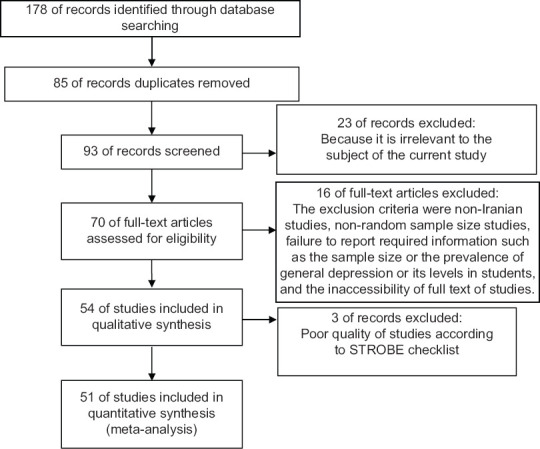
Flowchart of the entry of studies into meta-analysis
Table 2.
The results of meta-analysis on the prevalence of depression in Iranian school students based on different Subgroups
| Subgroups | Number of study | Prevalence of Depression (95% CI) | I2 (%) | P | |
|---|---|---|---|---|---|
| Total | Prevalence of Depression | 40 | 37% (32-42) | 99.9 | <0.001 |
| Total by Sex | Prevalence of Depression in Girl | 12 | 45% (25-65) | 99.7 | <0.001 |
| Prevalence of Depression in boy | 11 | 28% (20-35) | 98.9 | <0.001 | |
| Total by Level | Prevalence of mild Depression | 19 | 31% (25-37) | 98.1 | <0.001 |
| Prevalence of moderate Depression | 19 | 18% (13-23) | 98.7 | <0.001 | |
| Prevalence of severe Depression | 18 | 11% (8-15) | 99 | <0.001 | |
| Total by Grade | Prevalence of Depression in Elementary | 4 | 12% (7-16) | 99 | <0.001 |
| Prevalence of Depression in Guidance | 6 | 32% (14-51) | 99.8 | <0.001 | |
| Prevalence of Depression in High school | 19 | 47% (31-62) | 99.8 | <0.001 | |
| Prevalence of Depression in Pre university | 2 | 46% (40-53) | 53 | 0.145 | |
| Questionnaires | Prevalence of Depression in Beck | 12 | %53 (43-63) | 99.1 | <0.001 |
| Prevalence of Depression in SCL-90 | 7 | %40 (5-74) | 99.9 | <0.001 | |
| Prevalence of Depression in CDI | 5 | %17 (%11-%23) | 97 | <0.001 | |
| Prevalence of Depression in Zong | 1 | %43 (37-49) | --- | --- | |
| Prevalence of Depression in Rutter | 2 | %4 (3-6) | 0 | 0.953 | |
| Prevalence of Depression in GSHS | 1 | %21 (20-22) | --- | --- | |
| Prevalence of Depression in DASS-21 | 1 | %28 (23-32) | --- | --- | |
| Prevalence of Depression in CADS | 1 | %67 (63-72) | --- | --- | |
| Prevalence of Depression in Woodworth | 1 | %50 (45-54) | --- | --- | |
| Prevalence of Depression in DSM-IV | 1 | %3 (2-4) | --- | --- | |
| Prevalence of Depression in TRF | 1 | %2 (1-3) | --- | --- | |
| Prevalence of Depression in K-SADS | 1 | %61 (51-72) | --- | --- | |
| Prevalence of Depression in GHQ-28 | 1 | %46 (42-50) | --- | --- | |
| Prevalence of Depression in CES-DC | 1 | %76 (71-80) | --- | --- |
According to Figure 2, there is no significant relationship between prevalence of depression in Iranian school students and the sample size (P = 0.159).
Figure 2.
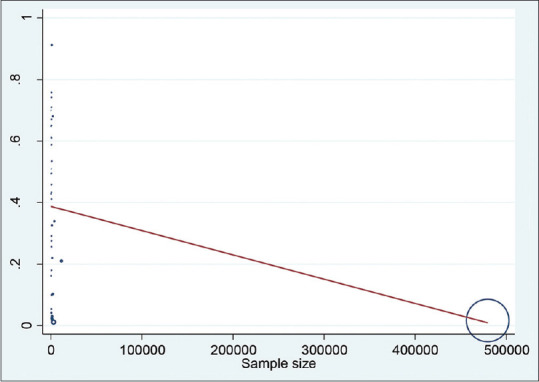
Relationship between prevalence of depression in Iranian school students and the sample size using the meta-regression model
This means that in larger studies (more samples), the prevalence of depression is lower in Iranian school students, but this decrease is not statistically significant.
According to Figure 3, there is no significant relationship between prevalence of depression in Iranian school students and year of study (P = 0.296).
Figure 3.
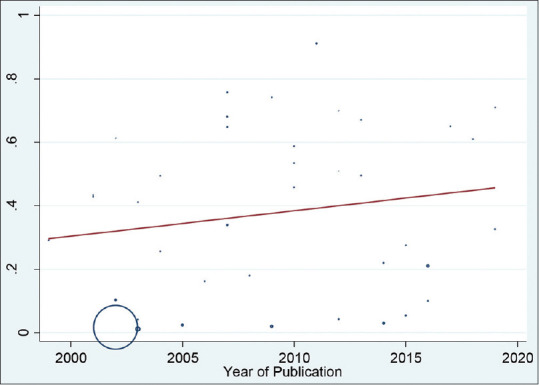
Relationship between the prevalence of depression in Iranian school students and the year of the study using the meta-regression model
That is, over time and during the years 1997 to 2019, the prevalence of depression among Iranian school students has been upward. But this increase is not statistically significant.
Figure 4 shows that the prevalence of depression in Iranian school students is 37% (95%CI: 32%, 42%). The lowest prevalence of depression in school students was 1% (95%CI: 1%, 2%)[38] and the highest was 91% (95%CI: 89%, 93%)[45] [Figure 4].
Figure 4.

Prevalence of depression in Iranian school students with a 95% confidence interval based on the type of questionnaires
In Figure 5 we see that the effect of diffusion bias is significant (P = 0.000). In the sensitivity analysis, we concluded that with the omission of the Shams study in 2011,[48] the prevalence of depression in school students will be reduced to 33% (95%CI: 29%, 37%) and in contrast to the omission of the Sayyari study in 1998[66] it will increase to 36% (95%CI: 29%, 43%). These two studies are, the most influence studies in the final result of the meta-analysis.
Figure 5.
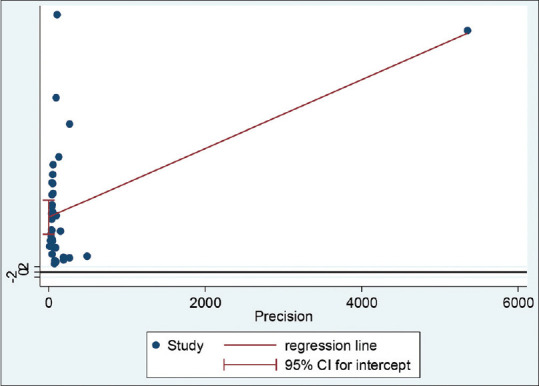
Publication bias prevalence of depression in Iranian school students
Discussion
In the study, which was conducted between 1997 and 2019, the prevalence of depression in school students was reported to vary from 1%[38] to 91%.[45] There are many reasons for these differences, including: different educational levels, type of schools (private or public), school students’ gender, economic and educational status of parents, variety of questionnaires, cultural differences in different cities and regions of Iran. The prevalence of depression was also different in different questionnaires. Due to the different types of questionnaires, differences in the cut-off score of each of them, different number of questions in the questionnaires, lack of uniform distribution of studies among different questionnaires, these differences have occurred.
With the exception of the Rutter questionnaire, the prevalence of depression was higher in girls than in boys. This shows that in the student body, girls are more vulnerable than boys, and since our girls today are the mothers of our country tomorrow and can play a significant role in society in the future as mothers and wives, mental health They should be paid more attention than before.
We could show no association between the prevalence of depression in Iranian school students and the number of research samples. In other words, with an increase in the sample size, the prevalence of depression in Iranian school students did not change significantly. Also, no relationship was found between the prevalence of depression in school students and research year and thus within the duration from 1998 to 2019, the prevalence of depression in Iranian school students has increased but this increase is not statistically significant.
In a meta-analysis study, the prevalence of depression in Iranian college students based on the Beck questionnaire was 40% (40% girls and 39% boys).[72] In another meta-analysis in 2013, the prevalence of depression in Iranian college students was 33%.[73] These studies show that the prevalence of depression in Iranian school students is more than college students. The study found that the incidence of depression in girls was almost two times compared to boys. This difference is likely to result from multiple biological, psychological, social and cognitive factors.
According to Gunilla Olssan study in 1999, the prevalence of depression among high school students in Sweden was 12.3%, which was 17.9% in girls and 6% in boys.[74]
Depression, anxiety and stress are the most common mental disorders of adolescence that threaten the health of the individual and society and are closely related to each other. In another study by Ehrenberg et al., on 366 high school students in Canada, the prevalence of depression using the Beck questionnaire was obtained to be 41.4%.[75]
According to a study by Ehrenberg et al., The prevalence of depression in high school students in Canada is lower than in Iran. In another study, the overall prevalence of depression based on the Beck questionnaire was 71.25%. This study showed that 46.3% of the depressed were female and 53.7% were male. 27.8% of students had mild depression, 29.3% moderate, 7.5% severe, and 6.7% very severe.[74] And the prevalence of depression in Iranian students was lower than Indian students. On the other hand, in the above study, the prevalence of depression in girls was lower than boys, which is not consistent with our study. In another study, in Canadian high school students. According to similar studies in the United Kingdom and the United States, 31.4% of the samples were clinically depressed, as measured by the Beck Depression Inventory.[73] The prevalence of depression was slightly higher in Iranian students than in Canadian students.
The rate of depression in Nigerian Students was 9%,[76] in Taiwanese students was in the range of 12.3% to 13.4%.[77] Similar studies have been conducted on depression in adolescents and high school students in other countries, with depression rate of 30% for Pakistani students.[78]
According to a study conducted by Slee et al. in Australia on pre-school students, the prevalence of depression was 33%.[79] The results of a study on 5423 high school students (sixth to eighth grades) in the United States showed the prevalence of major depressive disorder as 4.4%.[80]
As you can see, the prevalence of depression in Iranian students is higher than students in Nigeria, Taiwan, Australia, the United States and Pakistan.
Study limitations
The main limitations of the current study included the inability of the Iranian databases to combine the keywords, due to differences in the questionnaires, and distribution of number of studies in different regions of Iran (north, south, west and east) were not same.
Conclusions
Considering that about one third of Iranian students suffer from some degree of depression and the prevalence of depression in girls is about twice that of boys. Also, the prevalence of depression in students from primary to pre-university level is increasing and almost one third of Iranian students is anxious. Due to the fact that childhood and adolescence is one of the most critical periods in the life of each person due to psychological, intellectual and social changes that can affect his academic and professional performance. Therefore, the results of this study should be used by policy makers and mental health officials for proper planning to reduce mental disorders.
Financial support and sponsorship
Nil.
Conflicts of interest
There are no conflicts of interest.
References
- 1.Sarokhani D, Parvareh M, Dehkordi AH, Sayehmiri K, Moghimbeigi A. Prevalence of depression among Iranian elderly: Systematic review and meta-analysis. Iranian J Psychiatry. 2018;13:55–64. [PMC free article] [PubMed] [Google Scholar]
- 2.Hassanpour-Dehkordi A. Influence of yoga and aerobics exercise on fatigue, pain and psychosocial status in patients with multiple sclerosis: A randomized trial. J Sports Med Phys Fitness. 2016;56:1417–22. [PubMed] [Google Scholar]
- 3.Kessler RC, Bromet EJ. The epidemiology of depression across cultures. Ann Rev Public Health. 2013;34:119–38. doi: 10.1146/annurev-publhealth-031912-114409. [DOI] [PMC free article] [PubMed] [Google Scholar]
- 4.de Souza J, Ferrari G, Ferrari C. Correlates of Geriatric Depression Scale with Perceived Quality of Life in an Elderly Population. Geriatrics Persia. 2017 [Google Scholar]
- 5.Kaplan H, Sodock B. Comprehensive Textbook of Psychiatry From Williams & Wilkins. 7th ed. Baltimore: USA: 2001. pp. 1284–431. [Google Scholar]
- 6.Tahmasyan K, Anari A. Modeling self somatic efficacy based on Bandura's agentic model from depression in depressed adolescents. J Fam Res. 2009;2:83–93. [Google Scholar]
- 7.Molabaqery M, Zeraati H. Evaluation of the association between marital satisfaction and depressive symptoms in adolescents and their mothers Tuyserkan city in 2004. J Ment Health. 2007;8:50–43. [Google Scholar]
- 8.Kennebeck S, Bonin L. Epidemiology and risk factors for suicidal behavior in children and adolescents. Youth risk behavior. 2005;51:27–30. [Google Scholar]
- 9.Nazar CMJ, Ahmed A, Akhtar MH, Kareem N. The awareness levels, attitude and perception of people about diabetes. J Ren Endocrinol. 2016;2:e01. [Google Scholar]
- 10.Dehghan-Shahreza F. From oxidative stress to endothelial cell dysfunction. J Prev Epidemiol. 2016;1:e04. [Google Scholar]
- 11.ELmissiry M. Screening for depression in a sample of Egyptian secondary school female students. J Affect Disord. 2011;136:61–8. doi: 10.1016/j.jad.2011.06.031. [DOI] [PubMed] [Google Scholar]
- 12.Tahmasyan K, Anari A. The relationship between selfefficacy and depression in adolescents. J Appl Psychol. 2010;1:1–18. [Google Scholar]
- 13.Sebdani AM, Alamdary MP, Abdollahpour N. Depression among patients undergoing hemodialysis; a narrative review. J Prev Epidemiol. 2017;3:e04. [Google Scholar]
- 14.Hajibabaei K. The role of antioxidants and pro-oxidants in the prevention and treatment of cancers. Annals of research in antioxidants. 2016;1 [Google Scholar]
- 15.Kafeshani M. Diet and immune system. Immunopathologia Persa. 2016;1:e04. [Google Scholar]
- 16.Abdolahiyan A. Depression in school age children in Mashhad. J Mashhad Univ Med Sci. 2001;1:1–7. [Google Scholar]
- 17.Von Elm E, Altman D, Egger M, Pocock S, Gøtzsche P, Vandenbroucke J. Strengthening the reporting of observational studies in epidemiology (STROBE) statement: Guidelines for reporting observational studies. BMJ. 2007;335:806–8. doi: 10.1136/bmj.39335.541782.AD. [DOI] [PMC free article] [PubMed] [Google Scholar]
- 18.Beck A, Ward C, Mendelson M, Mock J, Erbaugh J. An inventory for measuring depression. Arch Gen Psychiatry. 1961;4:561–71. doi: 10.1001/archpsyc.1961.01710120031004. [DOI] [PubMed] [Google Scholar]
- 19.Derogatis LR. Symptom Checklist-90-Revised (SCL-90-R) Pearson: Clinical Psychology Pearson Education, Inc. 1994 [Google Scholar]
- 20.Anvari S. Prevalence of depression and its relationship with some demographic indicators in high school students in Bam after the earthquake of 2003. Rescue and Relief Journal. 2009;1:1–7. [Google Scholar]
- 21.Rutter M. A children's behaviour questionnaire for completion by teachers: Preliminary findings. J Child Psychol Psychiatry. 1976;8:1–11. doi: 10.1111/j.1469-7610.1967.tb02175.x. [DOI] [PubMed] [Google Scholar]
- 22.Zahirodin A, Hoseini S, Semnani Y. The prevalence of depression and related factors in high school students in Firoozkooh. Researcher. 2004;9:9–15. [Google Scholar]
- 23.Sooky Z, Sharifi K, Tagharrobi Z, Akbari H, Mesdaghinia A. Depression prevalence and its correlation with the psychosocial need satisfaction among Kashan high-school female students. Feyz J Kashan Univ Med Sci. 2010;14:256–63. [Google Scholar]
- 24.Monirpour N, Yazdan doost R, Atef vahid K, Delavar A, Khosefi H. The Relation Between Demographic Characteristics and Prevalence Rate in Depression among Adolescent Undergraduate Students at Ray City. refahj. 2005;4:189–204. [Google Scholar]
- 25.Rostam Zade Z, Khalil Zade R. The prevalence and severity of depression in Urmia girls’ high school students. Urmia Nurs Midwifery J. 2007;5:56–62. [Google Scholar]
- 26.Riasi M, Mogharab M, Salehi Abar Ghooei M, Hasan Zade Taheri E, Hasan Zade Taheri M. Comparison of depression among normal and gifted students in Birjand city in the academic year of 2008-2009. Modern Care. 2012;9:95–103. [Google Scholar]
- 27.Mahmudnia A, Rastegarpur H, Jokar F. Effect of cognitive group therapy on the reduction of depression of high school student. Clinical Psychology Studies. 2011;2:1–29. [Google Scholar]
- 28.Rahimian Buger E, Najafi M, Khooshabi K, Heidari F, Heidari M. Investigating the prevalence of depression among high school students in Shahreza city. Educational Psychology. 2008;4:136–59. [Google Scholar]
- 29.Narimani M, Roshan R. The prevalence of depression and the effectiveness of behavioral-cognitive therapy in reducing depression in students. J Psychol. 2002;6:244–54. [Google Scholar]
- 30.Toulabi T, Khosh Niyat Nikoo M, Amini F, Nazari H, Mardani M. The influence of a behavior modification interventional program on body mass index in obese adolescents. J Formos Med Assoc. 2012;111:153–9. doi: 10.1016/j.jfma.2011.05.007. [DOI] [PubMed] [Google Scholar]
- 31.Roshan Chesli R, Narimani M. The prevalence and causes of depression among high school students in Ardabil city. Daneshvar. 2002;9:59–66. [Google Scholar]
- 32.Rezaei Barmi M. Comparative study of depression level among male athletic students engaged in individual and team sports versus male nonathletic students of schools from the second board of education in Karaj, Iran. Procedia Soc Behav Sci. 2011;30:352–6. [Google Scholar]
- 33.Modabber-Nia MJ, Shodjai-Tehrani H, Moosavi SR, Jahanbakhsh-Asli N, Fallahi M. The prevalence of depression among high school and preuniversity adolescents: Rasht, northern Iran. Arch Iran Med. 2007;10:141–6. [PubMed] [Google Scholar]
- 34.Shoja’ei-Zadeh D, Rassafiani H R. A Study on Depression among Pre-University Students Kazeron City 1379-80. jrehab. 2001;2:29–32. [Google Scholar]
- 35.Turi A, Miri M, Beheshti D, Yari E, Khodabakhshi H, Anani Sarab G. Prevalence of internet addiction and its relationship with anxiety, stress, and depression in intermediate students in Birjand city in 2014. J Birjand Univ Med Sci. 2015;22:67–75. [Google Scholar]
- 36.Jahangasht K, Asiri S, Pakseresht S, Kazemnejad Leili E. Prevalence of depression symptoms and its related factors in school students. J Compr Nurs Midwifery. 2016;6:8–15. [Google Scholar]
- 37.Nejati V. The prevalence of behavioral problems in elementary school students in Tehran province. Medical Journal of The Islamic Republic of Iran (MJIRI) 2012;30:162–8. HYPERLINK “http://mjiri.iums.ac.ir/ ”. [Google Scholar]
- 38.Haghbin S, Ebrahimi S, Poormahmoodi A, Moohamadi J. Medical examination of children due to enter first grade elementray in Yasuj and Gachsaran-2000-2001. Armaghane Danesh. 2003;8:17–26. [Google Scholar]
- 39.Shahsavarani A, Shahrani H, Sattari K, Mohammadi M, Hakimi Kalkhoran M. Psychometric characteristics and factor structure of children and adolescent depression scale (CADS) and depression status among female adolescents. J Couns Res. 2013;12:91–122. [Google Scholar]
- 40.Haji Maghsoodi F, Yasini M, Karimzadeh A. Prevalence of psychological disorders in youth after natural disasters. Journal of medical research (JMR) 2004;3:56–76. HYPERLINK “https://www.sid.ir/en/Journal/JournalList.aspx?ID=4039. “. [Google Scholar]
- 41.Khodakarami B, Faradmal J, Asghari S, Zaini E, Masumi S. Behavioral disorders among students of girl's guidance schools of Hamadan City and affecting factors. Sci J Hamadan Nurs Midwifery Fac. 2013;21:59–69. [Google Scholar]
- 42.Shakibaei F, Esmaeili M. Study of MDD epidemiology in students of middle school (11-16 yrs. old) of Esfahan city in 2007-8J Res Behave Sci. 2014;12:1–11. [Google Scholar]
- 43.Shakiba M, Ziai M. Comparative study of mental health of female students living in dormitories of welfare organization and University of Sistan & Balouchestan. Zahedan J Res Med Sci (ZJRMS) 2012;14:56–60. [Google Scholar]
- 44.Mousavi Bazaz S, Madani A, Zarei F, Abbasi khaddar E. Prevalence of psychological disorders and its social determinants among high school students in Bashagard. J Prev Med. 2015;2:40–6. [Google Scholar]
- 45.Shams G, Foroughi E, Esmaili Y, Amini H, Ebrahimkhani N. Prevalence rates of obsessive-compulsive symptoms and psychiatric comorbidity among adolescents in Iran. Acta Med Iran. 2011;49:680–7. [PubMed] [Google Scholar]
- 46.Azizi Soleiman F, Esmaeell Motlagh M, Qorbani M, Heshmat R, Ardalan G, Mansourian M, et al. Dietary habits and health related behaviors in Iranian children and adolescents. Int J Pediatr. 2016:2087–97. [Google Scholar]
- 47.Ahmadi J, Amiri A, Ghanizadeh A, Khademalhosseini M, Khademalhosseini Z, Gholami Z, et al. Prevalence of addiction to the internet, computer games, DVD and video and its relationship to anxiety and depression in a sample of Iranian high school students. Iran J Psychiatry Behav Sci. 2014;8:75–80. [PMC free article] [PubMed] [Google Scholar]
- 48.Ahadi Z, Kelishadi R, Qorbani M, Zahedi H, Aram M, Esmaeil Motlagh M, et al. Association of breakfast intake with psychiatric distress and violent behaviors in Iranian children and adolescents: The CASPIAN- IV study. Indian J Pediatr. 2016;83:922–9. doi: 10.1007/s12098-016-2049-7. [DOI] [PubMed] [Google Scholar]
- 49.Ghobari Bonab B, Parand A, Khan Zade H, Firooz Jah A, Molleli G, Nemati S. The prevalence of behavioral problems in elementary school students in Tehran. RES Exceptional Children. 2009;9:223–38. [Google Scholar]
- 50.Ahmad Khaniha H, Turkman Nejad S, Hussaini Moghaddam M. Epidemiology of depression and sexual abuse among street children. IJPCP. 2002;8:14–20. [Google Scholar]
- 51.Hoseini Fard S, Bireshk B, Atef Vahid M. Epidemiology of mental disorders in high school students in Rafsanjan. Iran J HYPERLINK “http://ijpcp.iums.ac.ir/en” Iranian Journal of Psychiatry and Clinical Psychology. 2005;11:71–80. [Google Scholar]
- 52.Sadeghian E, Moghadari Kosha M, Gorji S. The study of mental health status in high school female students in Hamadan city. Sci J Hamadan Univ Med Sci. 2010;17:39–45. [Google Scholar]
- 53.Zargham Borujeni A, Yazdani M, Yazdan nik A. Association between behavioral patterns of parents with depression and suicidal thoughts among adolescents. J Shahrekord Univ Med Sci. 2001;3:46–54. [Google Scholar]
- 54.Hosseini S, Moosavi S, Reza Zadeh H. Assessment of mental health in students of junior high schools in the city of Sari, Iran. Journal of Fundamentals of Mental Health. 2003;6:92–9. [Google Scholar]
- 55.Sepehrmanesh Z, Ahmadvand A, Yavari P, Saei R. Assessing the mental health of adolescents in Kashan, 2004. IRJE. 2008;4:43–9. [Google Scholar]
- 56.Mogharab M, Shayeste Roudi A, Rezaei Z, Meliroudi S, Hajinejad M, Salarkhani K. Depression level in girls’ high school students in Birjand (2009-10) Mod Care J. 2011;7:55–61. [Google Scholar]
- 57.Jenaabadi H, Nastiezaie N. A comparison of aggression, anxiety and depression in HIGH School students in Saravan sity. J Urmia Nurs Midwifery Fac. 2011;9:147–56. [Google Scholar]
- 58.Ranjbar Kuchak Saraei F, Dadash Zade H, Fakhari A, Nabdel Y. Prevalence of psychiatric disorders in children and adolescents in the northwestern region of Tabriz. Medicine. 2003;59:56–60. [Google Scholar]
- 59.Habibpour Z, Sharifi A. A comparative study about the intensity of depression Among girls and boys in teenage perod. J Urmia Nurs Midwifery Fac. 2009;7:10–2. [Google Scholar]
- 60.Rahimikian F, Amelvalizadeh M, Ghobari bonab B, Mehran A, Rahimi N. Frequency and intensity of depression during menstrual period and it's relation with religious attitudes in Karaj high school girls 2003. J Dena. 2006;1:1–9. [Google Scholar]
- 61.Rajabi G, Attari Y. Factor analysis of children and adolescent depression questionnaire. Coins Red(New Red Consult Serv) 2004;3:82–102. [Google Scholar]
- 62.Ghorbani B. Comparison of depression in children and adolescents of ordinary families and families of divorce application in Isfahan. Scholarship Appl Psychol. 2006:95–112. [Google Scholar]
- 63.Sayyari A, Iman Zade F, Karami H, Ramazan Khani A, Alikhani S, Samad Zade H, et al. Investigating the physical and psychological health of primary school students in the academic year of 1998-1999. Med Cult. 2001;2:20–9. [Google Scholar]
- 64.Abdollahian E, Yazdani Farabi S, Amiri Moghadam R. Prevalence of depression among primary school children in Mashhad. IJPCP. 2002;7:42–8. [Google Scholar]
- 65.Johari G. Study of depression in Ilam students. J Ilam Univ Med Sci. 1999;6:34–44. [Google Scholar]
- 66.Shahnazi B. Depression among female students in public schools in Tabriz. J Nurs Midwifery. 2007;3:22–30. [Google Scholar]
- 67.Bahrami A, Salarbashi D, Mohammad-Zadeh M, Tayefi M, Mirmoosavi S, Ferns G, et al. Depression and aggression scores, reported sleep disorders status and their associated factors among adolescent girls in Northern Iran. Curr Psychol. 2019;16:1–12. [Google Scholar]
- 68.Safi-Al-Hosseini F, Saki M, Hamedi A, Saadati H, Lashkardoost H. The prevalence of depression among female high school students in Bojnurd, North Khorasan province, Iran, 2016. J North Khorasan Univ Med Sci. 2018;9:42–8. [Google Scholar]
- 69.Riahi F, Izadi-Mazidi M, TashaKori A, Mansouri L. Prevalence of depression among high school girls in Kuhdasht, Iran. Jundishapur Sci Med J. 2017;16:433–42. [Google Scholar]
- 70.Servatyari K, Yousefi F, Valizadeh Ardalan P, Rasouli M, Hosseini S, Ghaderi M, et al. The prevalence of depression and disappointment and their relationship with Substance addiction tendency among high school students in Divandareh City in 2018. Shenakht J Psychol Psychiatr. 2019;6:1–13. [Google Scholar]
- 71.Moeini B, Bashirian S, Soltanian A, Ghaleiha A, Taheri M. Prevalence of depression and its associated sociodemographic factors among Iranian female adolescents in secondary schools. BMC Psychol. 2019;7:25. doi: 10.1186/s40359-019-0298-8. [DOI] [PMC free article] [PubMed] [Google Scholar]
- 72.Sarokhani D, Veisani Y, Sarokhani M, Esmaelimanesh R, Sayehmiri K, Vafaee R. Prevalence of depression among university students: A systematic review and meta-analysis study. Res Med. 2012;36:36–42. doi: 10.1155/2013/373857. [DOI] [PMC free article] [PubMed] [Google Scholar]
- 73.Sarokhani D, Delpisheh A, Veisani Y, Sarokhani M, Esmaelimanesh R, Sayehmiri K. Prevalence of depression among university students: A systematic review and meta-analysis study. Depress Res Treat. 2013;2013:1–7. doi: 10.1155/2013/373857. [DOI] [PMC free article] [PubMed] [Google Scholar]
- 74.Olsson G, Knorring A. Adolescent depression: Prevalence in Swedish high-school students. Acta Psychiatr Scand. 1999;99:324–31. doi: 10.1111/j.1600-0447.1999.tb07237.x. [DOI] [PubMed] [Google Scholar]
- 75.Ehrenberg M, Cox D, Koopman R. The prevalence of depression in high school students. Adolescence. 1990;25:905–12. [PubMed] [Google Scholar]
- 76.Adewuya A, Ologun Y. Factors associated with depressive symptoms in Nigerian adolescents. Adolese Health. 2006;39:105–10. doi: 10.1016/j.jadohealth.2005.08.016. [DOI] [PubMed] [Google Scholar]
- 77.Huang C, Guo S. Stress, perceived support, resourcefulness and depressive symptoms in Taiwanese adolescents. J Clin Nurs. 2009;18:3271–9. doi: 10.1111/j.1365-2702.2009.02899.x. [DOI] [PubMed] [Google Scholar]
- 78.Khan M, Mahmood S, Badshah A, Ali S, Jamal Y. Prevalence of depression, anxiety and their associated factors among medical students in Karachi, Pakistan. J Palk Med Assoc. 2006;56:583–6. [PubMed] [Google Scholar]
- 79.Slee P. Peer victimization and its relationship to depression among Australian primary school students. Pers Individ Differ. 1995;18:57–62. [Google Scholar]
- 80.Neshatdost T, Khademi M. Study of prevalence of depression in middle school of five area of education organization of Esfahan on 2004. Isfahan, Iran; Isfahan University of medical sciences. 2006 [Google Scholar]