



Abstract
The associations between children’s (N = 301) observed expression of positive and negative emotion in school and symptoms of psychological maladjustment (i.e., depressive and externalizing symptoms) were examined from kindergarten to first grade. Positive and negative emotional expressivity levels were observed in school settings and teachers reported on measures of children’s externalizing and depressive symptoms. In longitudinal panel models testing bidirectional paths, depressive symptoms in kindergarten were negatively associated with positive expressivity in first grade, but not vice versa. Children’s externalizing symptoms in kindergarten predicted higher negative expressivity in school in first grade. There was also significant prediction of externalizing in first grade by negative expressivity during kindergarten. Implications about child psychological maladjustment in early schooling are discussed.
Keywords: child mental health, first grade, kindergarten, negative emotion, positive emotion
Symptoms of psychological maladjustment have roots in a person’s capacity to appropriately express and regulate emotions. Thus, researchers have investigated individuals’ emotional dispositions to understand the etiology of psychological maladjustment (Eisenberg et al., 2001), including the etiology of symptoms of depression (which includes feelings of sadness and irritability) and externalizing problems (e.g., conduct disorder, oppositional defiance, and relational aggression symptoms; Armstrong, Goldstein, & The MacArthur Working Group on Outcome Assessment, 2003). For instance, the tripartite model of depression and anxiety proposes that the presence of a disposition toward negative emotion and lack of positive emotion are risks for depressive symptoms (Clark & Watson, 1991; Lonigan, Phillips, & Hooe, 2003). Furthermore, a lack of positive emotion and the presence of negative emotion have been typically associated with higher externalizing behaviors, such as conduct problems and aggression (e.g., Buss, Kiel, Morales, & Robinson, 2014), although there have been some mixed findings for positive emotion (e.g., Ghassabian et al., 2014; Stifter, Putnam, & Jahromi, 2008), which we discuss further. In this study, we focus on understanding the development of early symptoms of maladjustment given their long-term implications for well-being (Côté et al., 2009; Moffitt, 1993; Olson et al., 2013).
The experience and expression of emotion are overlapping but not synonymous constructs. In early childhood, it is likely that most emotional expression reflects felt emotion, although even young children can mask some emotions (Cole, 1986). Particularly as children transition into formal schooling years, children’s emotion expressivity, or outward expressions of positive or negative emotion, may be an important marker of children’s adjustment (Denham, 2006). The transition to elementary school is often a challenging one, with changing demands and expectations (Entwisle & Alexander, 1998). During this transition, children’s regulation skills are also still maturing (Eisenberg, Spinrad, & Eggum, 2010) and although the expression of emotion is normal, the quality of interactions with peers and teachers likely is related to the ability to suppress the expression of emotion, especially negative emotion, in some school contexts (e.g., the class).
Researchers have typically assessed children’s emotionality with adults’ reports (e.g., Valiente, Swanson, & Lemery-Chalfant, 2012; Zhou, Lengua, & Wang, 2009) or, less commonly, with observations, often in laboratory settings (e.g., Ghassabian et al., 2014; Olino et al., 2011). However, emotion dispositions are also shaped by social experiences and relationships (Eisenberg et al., 2001). Given that depressive and externalizing symptoms (e.g., conduct problems, aggression) are tied to social difficulties with others (Reijntjes, Kamphuis, Prinzie, & Telch, 2010), including in the school context, exploring whether depressive and externalizing symptoms also predict children’s emotional expressivity in naturalistic school settings could help clarify how psychological difficulties impact school experiences and, consequently, emotions expressed at school. Thus, the goal of this study was to examine cross-lagged associations between positive or negative emotional expressivity observed in school settings and depression or externalizing symptoms from kindergarten (K) to first grade (G1).
Emotional Expressivity Predicting Depressive Symptoms and Externalizing Behaviors
Consistent with prior theory (Clark & Watson, 1991; Lonigan et al., 2003), children who express more positive emotion or less negative emotion have lower levels of depressive symptoms in childhood (from age three to 10 in the following studies: Dougherty, Klein, Durbin, Hayden, & Olino, 2010; Eggum et al., 2012; Eisenberg et al., 2001; Ghassabian et al., 2014; Olino et al., 2011). For instance, expressing anger and irritability (both negative emotions) and showing disinterest or lack of pleasure (which displays a lack of positive emotions) in regular activities, such as school activities, are associated with more depressive symptoms (Eggum et al., 2012). Thus, children who demonstrate less positive expressivity and more negativity at school may show more depressive symptoms over time.
Negative emotional expressivity also appears to be a risk factor for externalizing behaviors in childhood (e.g., from age two to 9 in the following studies: Buss et al., 2014; Eisenberg et al., 2001; Eisenberg et al., 2005). For instance, unregulated anger has been associated with aggression (Lochman, Barry, Powell, & Young, 2010). Moreover, negative emotion expression has been positively associated with peer difficulties in childhood (from age three to 16.5 in the following meta-analysis: Dougherty, 2006) and teacher–student conflict in kindergarten (Hernández et al., 2017) , suggesting that negative emotion is predictive of behavioral problems at school and resultant psychological maladjustment (Bukowski & Adams, 2005). Although positive emotional expressivity has been generally negatively associated with externalizing symptoms (e.g., Ghassabian et al., 2014; Olino et al., 2011; Shin et al., 2011), some research suggests that high intensity positive expressivity (e.g., exuberance) is associated with lower self-regulation and more externalizing behaviors in early childhood (Putnam, 2012; Stifter et al., 2008, from age two to 4.5). Particularly in school, intense and unregulated positive expressivity may be distracting and considered inappropriate or defiant behavior. Thus, the association between positive expressivity and externalizing behaviors has been inconsistent, showing both negative (e.g., Ghassabian et al., 2014) and positive associations (e.g., Stifter et al., 2008).
Maladjustment Predicting Emotional Expressivity
Although emotional expressivity has predicted externalizing and depressive symptoms, these symptoms of maladjustment might also predict the propensity to express positive or negative emotion over time. For example, depressive symptoms might contribute to poor social relationships (Reijntjes et al., 2010), and consequently predict heightened negative expressivity in school. Depressed individuals also have a reduced capacity to experience positive emotion (e.g., Kovacs et al., 2015 [among adolescents with a history of childhood onset depression]; Zhou et al., 2009 [among children]). Reduced positive affect and increased negative affect may be a precursor, a symptom, and a consequence of depression and externalizing behaviors (Kovacs et al., 2015), especially in childhood when depression and externalizing symptoms tend to be comorbid (Boylan, Vaillancourt, Boyle, & Szatmari, 2007). Moreover, because children who exhibit conduct problems often have difficult social relationships, we expected externalizing behaviors to be associated with fewer opportunities to express positive emotion and more opportunities to express negative emotion with others at school.
The Present Study
The present study adds to the literature by using multiple methods of assessment to examine possible bidirectional associations between positive or negative expressivity and symptoms of depression or externalizing symptoms from K to G1. We expected positive emotional expressivity to negatively predict depressive symptoms (but not necessarily externalizing behaviors given mixed findings), and negative emotional expressivity to positively predict with externalizing and depressive symptoms. We also tested the possibility that externalizing and depressive symptoms might predict higher negative and lower positive emotional expressivity, and, especially for depression, a reduced capacity to experience or express positive emotion (Boylan et al., 2007).
Method
Participants
Two cohorts of kindergarteners (N = 301; 52% girls; Mage = 5.48 years, SDage = 0.35 years) from a southwestern metropolitan area in the United States were recruited, one year apart, from five schools (26 classrooms; for more information see Hernández et al., 2016). The two cohorts did not differ in terms of background covariates. Participants came from varied ethnic backgrounds (53% Hispanic, 34% White, 8% other, 6% unknown [percentages rounded]), reflecting the ethnic backgrounds of students from the school sites. Thirty percent of mothers and 39% of fathers completed high school or less, 31% of mothers and 24% of fathers attended some college, and 39% of mothers and 37% of fathers graduated college. Family income averaged from $50,000 to $69,999 with a range from > $9,999 to $100,000.
Procedure
Towards the end of the spring semesters of K and G1, teachers received questionnaires and were compensated for completing each participating child’s survey assessing children’s psychological maladjustment. Research assistants were trained to observe and rate child interactions in pre-coded videos (except during the first year of the first cohort) and pilot preschool settings based on prior methods that have demonstrated adequate reliability and predictive validity (e.g., Spinrad et al., 2004). Participants were observed in school by two or three research assistants, two to three times each week for nine to twelve weeks each semester (see Hernández et al., 2017, for more details). Research assistants had a pictorial list of participants for each classroom and coded individual children’s emotional expressivity after a 30-s observation period. Children were coded from the list, in random order, and were not recoded until the entire list of children, if present, was coded. Parents provided information on family (e.g., parental education) and child characteristics (e.g., age).
Measures
Positive and negative emotional expressivity.
In the fall and spring semesters of K and G1, research assistants observed and rated children’s observed intensity, frequency, and duration of children’s positive (e.g., happiness, joy, excitement) and negative (e.g., anger, frustration, sadness) expressivity exhibited in various school settings (e.g., classroom, library, lunch, recess), during 30-s intervals. Positive expressivity indicator examples included smiles, cheeks raised, eyes squinted in an intense smile or wide and bright when excited, chest and head up and upbeat tone. Negative expressivity indicator examples included frowned lips, pouted lips, behavior (e.g., brows down or arched in sadness, crying), vocal tone (e.g., whiny) and content (e.g., “She made me feel bad.”), and vocalizations (e.g., slow, gentle sighs). Emotion expressions were coded on the following scale: 0 = no evidence of emotion; 1 = minimal evidence (e.g., indicator seen once, small intensity and brief [< 3-s]); 2 = moderate evidence (e.g., two indicators, small intensity, and brief; one indicator, small intensity, lasting 4 to 9-s; one indicator, medium intensity, lasting < 5-s); 3 = strong evidence (e.g., three or more indicators, small intensity, and brief; two or more indicators, medium intensity; one or more indicators, small intensity, lasting more than 10-s; one or more indicators, medium intensity, lasting more than 5-s; any high intensity indicator).
Reliability ratings were acquired from randomly selected live observations (8.5% [K] and 10% [G1] of observations) rated simultaneously with coding supervisors and pre-coded videos (used for reliability). Inter-observer reliabilities (based on intraclass correlations) were adequate for positive (.96 [K], .95 [G1]) and negative emotion (.96 [K], .96 [G1]). Observers’ ratings of emotional expressivity in school were averaged across observations for each participant in K (Mtime = 140-min and 51-s) and G1 (Mtime = 158-min and 41-s). The percent of observations in the classroom versus all settings was used as a control variable.
Externalizing symptoms.
Teachers rated children’s externalizing symptoms (1 = never/not true; 3 = often/very true) in K and G1 with the MacArthur Health and Behavior Questionnaire (Armstrong et al., 2003). Oppositional defiance (9 items: αs = .89 [K], .87 [G1], e.g., “Argues a lot with adults”), conduct problems (11 items: αs = .84 [K], .86 [G1], e.g., “Physically attacks people”), and relational aggression (6 items: αs = .94 [K], .94 [G1], “Tries to get others to dislike a peer”) subscale scores were significantly correlated (rs = .63–.78 [K], .71–.83 [G1]). Each subscale was used as an indicator for the K and G1 externalizing latent variables.
Depressive symptoms.
Teachers rated children’s depressive symptoms (1 = never/not true; 3 = often/very true; 6 items, αs = .82 [K], .66 [G1], e.g., “Seems lonely”; MacArthur Health and Behavior Questionnaire; Armstrong et al., 2003). Three parcels, converted by randomly grouping and averaging paired items (Kishton & Widaman, 1994), were used as indicators for the K and G1 depression latent variables.
Results
Preliminary Analyses
Study descriptive statistics and correlations are provided in Table 1. Children who had some missing data (ranging from 0 to 22%) did not differ significantly from the rest who had complete data on study variables (including background covariates of age, Hispanic status, sex, cohort, and socioeconomic status), with one exception. Children who had missing teacher-reported data in G1 were more likely to show depressive symptoms in K, t (284) = 2.91, p = .004.
Table 1.
Descriptive Statistics and Correlations among Study Variables (N = 301)
| Variable | Grade | 1 | 2 | 3 | 4 | 5 | 6 | 7 | 8 | 9 | M | SD | |
|---|---|---|---|---|---|---|---|---|---|---|---|---|---|
| 1. | Externalizing symptoms | K | – | 1.16 | 0.28 | ||||||||
| 2. | Externalizing symptoms | G1 | .37*** | – | 1.11 | 0.24 | |||||||
| 3. | Depressive symptoms | K | .30*** | −.03 | – | 1.23 | 0.36 | ||||||
| 4. | Depressive symptoms | G1 | .06 | .16* | .35*** | – | 1.18 | 0.26 | |||||
| 5. | Negative expressivity | K | .41*** | 24*** | .08 | .06 | – | 0.07 | 0.06 | ||||
| 6. | Negative expressivity | G1 | .34*** | .37*** | .01 | .08 | .47*** | – | 0.05 | 0.05 | |||
| 7. | Positive expressivity | K | −.11a | −.08 | −.21*** | −.13* | −.05 | −.06 | – | 0.92 | 0.27 | ||
| 8. | Positive expressivity | G1 | −.10 | −.05 | −.21*** | −.17** | .00 | −.01 | .64*** | – | 0.82 | 0.26 | |
| 9. | % observations in class | K | .07 | −.13* | .01 | −.04 | .15* | −.02 | −.03 | −.11a | – | 0.61 | 0.05 |
Note. K = kindergarten; G1 = first grade.
p < .10,
p < .05,
p < .01,
p < .001.
Models were tested using Mplus 7.4 (Muthén & Muthén, 1998–2015), full-information maximum-likelihood estimation with robust standard errors to account for missing data, and a sandwich estimator to account for the non-independence of observations due to data clustering. Specifically, we used the TYPE = COMPLEX command with K classroom as the cluster variable to account for the nested structure of the data. Likelihood ratio tests (χ2), confirmatory fit indices (CFI; Bentler, 1990), and the root mean square error of approximation (RMSEA; Browne & Cudeck, 1993) were used to assess model fit.
Externalizing and depression symptom latent constructs were tested for measurement invariance, which evaluates whether a scale assesses the same construct across each time point (see Widaman, Ferrer, & Conger, 2010, for details on configural, strong, and strict invariance comparison tests). We found evidence for at least partial strict measurement invariance across time in the measurement properties of externalizing (partial strict invariance; the variance for the oppositional defiance subscale indicator was left free to vary between K and G1; CFI = .96, RMSEA = .06; standardized factor loadings: .75–.94) and depressive symptoms (strict invariance; CFI = .98, RMSEA = .05; standardized factor loadings: .53–.84) latent variables. These measurement constraints were kept in subsequent analyses.
Cross-lagged Models
In the following models, age, Hispanic status (0 = non-Hispanic; 1 = Hispanic), sex (0 = girl; 1 = boy), cohort, and socioeconomic status (SES; averaged z-scores of family income and parents’ averaged education) variables were originally used as control variables but not included in the final analytical models because they did not significantly predict emotion or maladjustment (all ps > .10). In auxiliary analyses, we did not find any significant interactions of emotion or maladjustment (depressive or externalizing symptoms) with child sex, race/ethnicity (Hispanic, non-Hispanic), or SES for the models’ cross-lagged paths predicting either positive/negative emotion or maladjustment in G1. Additionally, interactions between positive and negative emotional expressivity did not significantly predict externalizing (p = .41) or depression (p = .39) symptoms.
Emotional expressivity and externalizing behaviors.
Models tested the associations between emotional expressivity levels in school and externalizing behaviors from K to G1, controlling for the percent of observations in classroom settings versus all settings (Table 2). Negative emotional expressivity and externalizing behaviors were positively correlated within K and within G1 in bivariate correlations (Table 1) and in the model (Table 2, Column 1). A bidirectional pattern was found for negative emotional expressivity and externalizing behaviors, consistent with bivariate correlations. K negative emotional expressivity significantly predicted more G1 externalizing symptoms (Table 2, Column 1), and K externalizing symptoms significantly predicted higher G1 negative emotional expressivity. Although positive expressivity and externalizing behaviors were negatively correlated within K (p = .06 in bivariate correlations [Table 1], p = .04 in the model [Table 2]), there were no significant lagged pathways between positive expressivity and externalizing behaviors in either direction (Table 2, Column 2), consistent with bivariate correlations from K to G1 (Table 1).
Table 2.
Maladjustment and Emotion Expressivity Cross-Lagged Model Results
| 1. Externalizing symptoms & negative emotion expressivity | 2. Externalizing symptoms & positive emotion expressivity | 3. Depressive symptoms & negative emotion expressivity | 4. Depressive symptoms & positive emotion expressivity | |
|---|---|---|---|---|
| Maladjustment (K) ⇒ Maladjustment (G1) | .39*** | .43*** | .48*** | .46*** |
| Emotion (K) ⇒ Emotion (G1) | .41*** | .64*** | .50*** | .62*** |
| Concurrent relations | ||||
| Maladjustment (K) ⇔ Emotion (K) | .43*** | −.12* | .14 | −.23*** |
| Maladjustment (G1) ⇔ Emotion (G1) | .25** | −.02 | .17a | −.12a |
| Cross-lagged paths | ||||
| Maladjustment (K) ⇒ Emotion (G1) | .22 ** | −.02 | .00 | −.13* |
| Emotion (K) ⇒ Maladjustment (G1) | .14 * | −.05 | .01 | −.08 |
| Model Fit | ||||
| MLR χ2 (df) | 51.58 (26) | 52.65 (26) | 68.50 (27) | 47.70 (27) |
| χ2 p-value | .002 | .002 | < .001 | .008 |
| CFI | .95 | .96 | .92 | .96 |
| RMSEA | .06 | .06 | .07 | .05 |
Note. K = kindergarten; G1 = first grade. Maladjustment = Externalizing or Depressive symptoms; Emotion = Positive or Negative emotion; MLR (maximum-likelihood estimation with robust standard errors). Percent of observations in classroom settings versus all settings was included as a control variable in the models. All regression coefficients are presented in a standardized metric.
p < .10,
p < .05,
p < .01,
p < .001.
We ran auxiliary analyses without two externalizing symptoms items that specifically referred to negative emotions (i.e., Has temper tantrums, Is angry or resentful). Without these items, the pattern of findings remained the same: Negative emotion in K predicted externalizing symptoms in G1; and externalizing symptoms in K predicted negative emotion in G1. Given these auxiliary findings, we kept the analyses as presented in Table 2.
Emotional expressivity and depressive symptoms.
In bivariate correlations, depressive symptoms was significantly correlated with positive expressivity and not correlated with negative expressivity within K, within G1, or in a bidirectional pattern from K to G1 (Table 1). In the model testing associations between negative emotional expressivity levels in school and depressive symptoms from K to G1, depressive symptoms and negative expressivity were marginally positively correlated within G1 (p = .07; Table 2, Column 3). However, there were no significant cross-lagged pathways between negative expressivity and depressive symptoms from K to G1. In the model testing positive expressivity and depressive symptoms, depressive symptoms and positive expressivity were at least marginally negatively correlated within K (p < .001) and G1 (p = .06; Column 4). Depressive symptoms in K negatively predicted G1 positive emotional expressivity levels. Higher K positive expressivity did not significantly predict G1 depressive symptoms, controlling for prior depression levels.
Discussion
In this study, we tested whether positive or negative emotions, expressed in school, would predict children’s psychological maladjustment, and vice versa, across the transition from K to G1. This study contributes to research on emotions and child psychological maladjustment, showing nuanced associations between emotions and psychological maladjustment across time.
Emotional Expressivity and Child Maladjustment
Researchers have found that children’s positive and negative emotion dispositions (as reported by adults or observed in laboratory tasks) predict externalizing and depressive symptoms across childhood (e.g., Dougherty et al., 2010). However, in stringent panel models wherein previous levels of each variable were controlled for, we found that depressive and externalizing symptoms primarily predicted later emotional expressivity observed in school. Only the association between negative emotion and externalizing behaviors was bidirectional, suggesting a reinforcing cycle between these variables. The finding that maladjustment symptoms primarily predicted later emotional expressivity suggests that externalizing and depressive symptoms in early school transitions have implications for children’s emotional expressivity in school, which would reflect children’s overall emotional reaction to school. This challenges current theoretical understanding on the links between expressivity and developing depression and externalizing behaviors, noting how maladjustment can also predict emotional responses in the school context. Although children’s emotion regulation skills are still developing during the transition into elementary school (Eisenberg et al., 2010), our findings suggest the importance of addressing students’ emotions and early externalizing behaviors in tandem to help children adjust to new school environments. For example, interventions programs with emotion regulation and knowledge curriculum components have helped reduce problem behaviors particularly for children with higher levels of behavioral problems before the implementation of the intervention (Conduct Problems Prevention Research Group, 2010; Morris et al., 2014). Such intervention programs addressing both emotional development and externalizing symptoms show promising results as they consider emotion and behavior together.
Depressive symptoms were concurrently associated with low positive emotions in the analytical model, at least at a marginally significant or higher level. Moreover, consistent with these associations and prior research (e.g., Kovacs et al., 2015 [among adolescents with a history of childhood onset depression]; Zhou et al., 2009 [among children]), depressive symptoms in K predicted lower positive expressivity in G1. In the school environment, children are likely expected to activate or upregulate their positive emotion during cooperative tasks and play with peers. A child who shows early symptoms of depression in K may have a harder time meeting these peer engagement demands and, thus, exhibit lower positive emotion in G1. Negative emotions were not concurrently correlated with depressive symptoms in zero-order correlations and were marginally inversely correlated in K and in G1 in the analytical models. Thus, children’s depressive symptoms seem to reflect a lack of positive emotional expressivity in school rather than the presence of global negative emotion in this early transition to formal schooling. The null associations between negative emotions expressed in school and depression contradict previous positive associations between negative emotions and depressive symptoms in childhood (e.g., Lonigan et al., 2003). However, most of the research has relied on self reports (e.g., Lonigan et al., 2003) or parents’ or teachers’ reports of negative emotionality (e.g., Dougherty et al., 2010; Eisenberg et al., 2001) and sometimes negative emotion observed in the laboratory (e.g., Dougherty et al., 2010; Olino et al., 2011). This study used observations of global negative emotion in naturalistic school settings (similar to a few studies; e.g., Broekhuizen, Slot, van Aken, & Dubas, 2016; Denham et al., 2012), which perhaps did not capture all negative emotions experienced in daily circumstances but reflected ones expressed in school. Because challenges at home and school differ somewhat (e.g., exposure to large groups of peers and classroom demands at school), future research that includes observational measures of emotional expressivity across home and school environments would further inform this area of research. Alternatively, internalizing, depression-related, emotions (e.g., sadness) likely are more difficult to observe than overt anger: This may explain why observed global negative expressivity, which probably tapped more anger than internalizing emotions in this study, was not a significant predictor of depressive symptoms. In addition, although teachers are relatively good raters of children’s adjustment (Snyder et al., 2009), perhaps teachers’ reports of depressive symptoms are confounded with perceptions of withdrawn personality characteristics associated with shyness (Eggum et al., 2012), which would not necessarily include symptoms of depression.
Externalizing behaviors were mostly unassociated with positive expressivity in zero-order correlations and in the analytical model (except within K), contrary to some prior research that included participants within the current study’s age range (Ghassabian et al., 2014; Olino et al., 2011; Shin et al., 2011). Like other studies (Buss et al., 2014; Eisenberg et al., 2001; Eisenberg et al., 2005), we found that negative emotion in school predicted higher externalizing behaviors. We also found that externalizing behaviors predicted higher negative emotion in school, perhaps because interactions with peers and teachers are compromised by behavioral problems in school (although this was not directly tested in this study). Teachers’ perceptions of student maladjustment may be associated with how they and peers perceive and interact with students with behavioral difficulties. For instance, teachers express more negative affect and helplessness toward disruptive children compared to non-disruptive children (Spilt & Koomen, 2009), and teachers’ preference for well-behaved children is associated with peer acceptance (Chang et al., 2007). Students demonstrating disruptive or externalizing behaviors may receive more negative responses from teachers and peers, which could hinder students’ enjoyment of school and reinforce negative emotions at school. Thus, children who exhibit externalizing behaviors may be at risk for experiencing higher negative affect over time because of related negative interactions in school.
Study Strengths, Limitations, and Future Directions
Strengths of the study include the use of observations of emotional expression in school, and the examination of bidirectional associations between positive or negative emotional expressivity and maladjustment—both features that have been uncommon in prior research. Previous studies have been designed with emotional expressivity as a predictor (e.g., Dougherty et al., 2010), but not as an outcome, of externalizing and depression symptomology. Because of the longitudinal design of this study, tests of cross-lagged associations were strict. Given that interactions with peers and teachers in school may be compromised by maladjustment, research should also test whether these social relationships potentially mediate the associations between emotional expressivity and maladjustment.
Although we were interested in the school environment and teachers reliably report students’ psychological adjustment (Nolan, Gadow, & Sprafkin, 2001), the sole use of teachers’ reports for depression and externalizing symptoms limits our ability to examine the degree of psychopathology across various contexts using multiple informants. Future research could examine the extent to which these results replicate with additional measures of children’s psychological maladjustment or diagnostic measures. Findings from this study point to the importance of addressing negative emotion and early manifestations of externalizing behaviors given that children who show early antisocial behaviors are at risk for life-course persistent antisocial behavior (Moffitt, 1993). An additional weakness was our inability to code specific emotions such as anxiety and sadness, or exuberance and contentment, given that observations were coded in live settings and adding specific positive or negative emotion codes would have hampered our ability assess interobserver reliability given our restrictions on time, clear visibility of faces in real-life interactions, and resources in the field. Also, there was indication that children with missing data in G1 were more likely to show symptoms of depression in K. Of the missing cases, 58% were missing because of non-response from 21 teachers in first grade and 42% were missing because participating students did not have updated teacher contact information. We did not find any notable systematic differences for children who had some missing data. Overall, the study’s results point to the importance of examining possible bidirectional associations between emotional expressivity (particularly negative emotion) and psychological maladjustment across time. Given that children are expected to express interest and positively engage in school, children with early symptoms of psychological maladjustment in K may be at risk for future school difficulties.
Highlights.
Children’s emotional expressivity levels were observed in school.
Teachers reported on children’s externalizing and depressive symptoms.
Depressive symptoms predicted lower positive emotion expressivity from kindergarten to first grade.
Externalizing symptoms predicted higher negative emotion expressivity from kindergarten to first grade.
Negative emotion expressivity predicted more externalizing symptoms from kindergarten to first grade.
Acknowledgments
Research reported in this publication was supported by the Eunice Kennedy Shriver National Institute of Child Health & Human Development of the National Institutes of Health under Award Number R01HD068522, awarded to Carlos Valiente and Nancy Eisenberg. The content is solely the responsibility of the authors and does not necessarily represent the official views of the National Institutes of Health. We thank the participating families, schools, staff, and research assistants who took part in this study.
Appendix.
Figure 1.
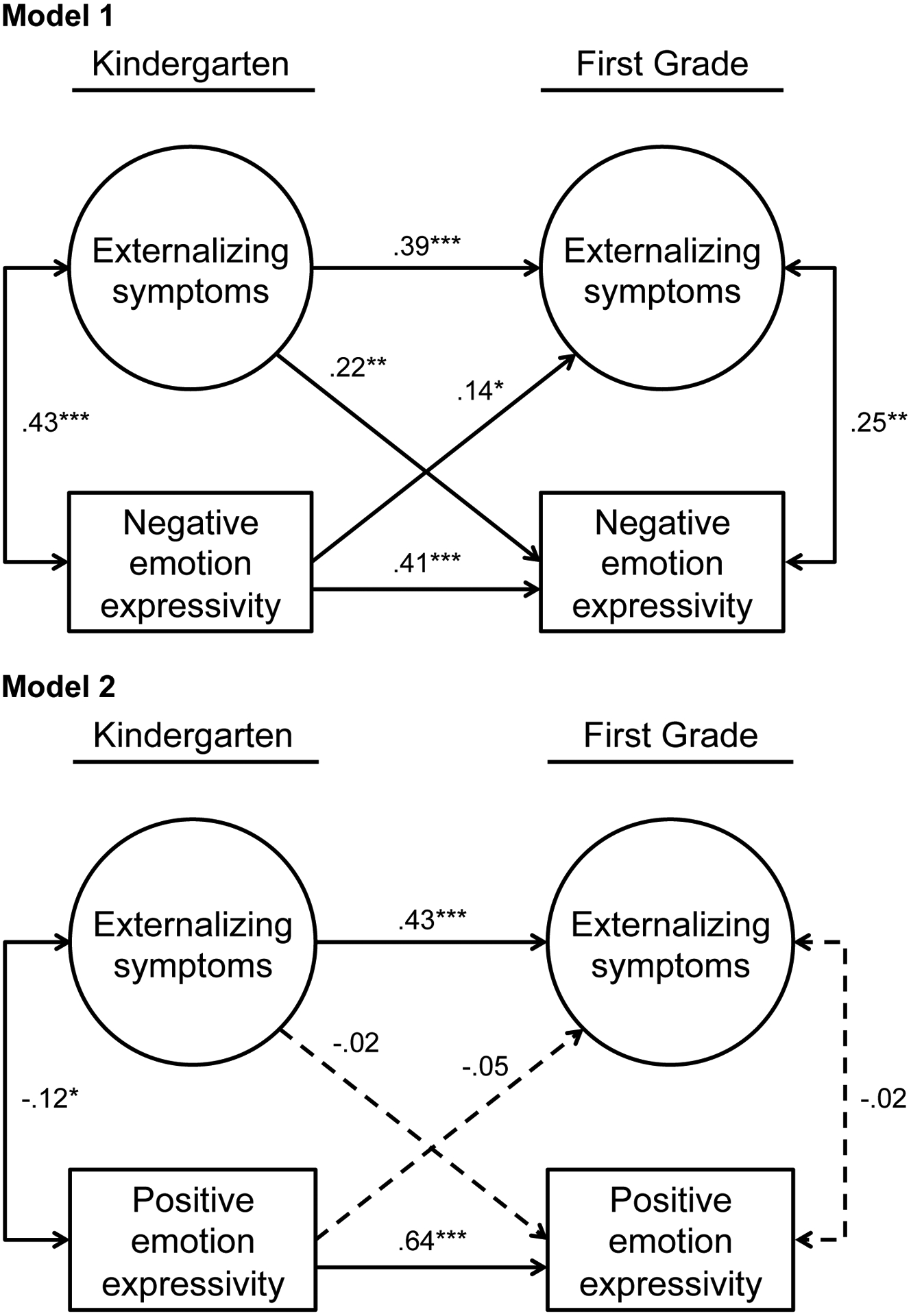

Summary of maladjustment and emotion expressivity cross-lagged model results. Percent of observations in classroom settings versus all settings was included as a control variable in the models. All regression coefficients are presented in a standardized metric. Model fit for Model 1: MLR (maximum-likelihood estimation with robust standard errors) χ2 (26) = 51.58, p = .002, CFI = .95, RMSEA = .06. Model fit for Model 2: MLR χ2 (26) = 52.65, p = .002, CFI = .96, RMSEA = .06. Model fit for Model 3: MLR χ2 (27) = 68.5, p < .001, CFI = .92, RMSEA = .07. Model fit for Model 4: MLR χ2 (27) = 47.7, p < .001, CFI = .96, RMSEA = .05.
a p < .10, * p < .05, ** p < .01, *** p < .001.
References
- Armstrong JM, Goldstein LH, & The MacArthur Working Group on Outcome Assessment. (2003). Manual for the MacArthur health and behavior questionnaire (HBQ 1.0). University of Pittsburgh: MacArthur Foundation Research Network on Psychopathology and Development. [Google Scholar]
- Bentler PM (1990). Comparative fit indexes in structural models. Psychological Bulletin, 107, 238–246. doi: 10.1037/0033-2909.107.2.238 [DOI] [PubMed] [Google Scholar]
- Boylan K, Vaillancourt T, Boyle M, & Szatmari P (2007). Comorbidity of internalizing disorders in children with oppositional defiant disorder. European Child and Adolescent Psychiatry, 16, 484–494. doi: 10.1007/s00787-007-0624-1 [DOI] [PubMed] [Google Scholar]
- Broekhuizen ML, Slot PL, van Aken MAG, & Dubas JS (2016). Teachers’ emotional and behavioral support and preschoolers’ self-regulation: Relations with social and emotional skills during play. Early Education and Development, 28, 135–153. doi: 10.1080/10409289.2016.1206458 [DOI] [Google Scholar]
- Browne MW, & Cudeck R (1993). Alternative ways of assessing model fit. In Bollen KA & Long JS (Eds.), Testing structural equation models (pp. 136–162). Newbury Park, CA: Sage. [Google Scholar]
- Bukowski WM, & Adams R (2005). Peer relationships and psychopathology: Markers, moderators, mediators, mechanisms, and meanings. Journal of Clinical Child and Adolescent Psychology, 34, 3–10. doi: 10.1207/s15374424jccp3401_1 [DOI] [PubMed] [Google Scholar]
- Buss KA, Kiel EJ, Morales S, & Robinson E (2014). Toddler inhibitory control, bold response to novelty, and positive affect predict externalizing symptoms in kindergarten. Social Development, 23, 232–249. doi: 10.1111/sode.12058 [DOI] [PMC free article] [PubMed] [Google Scholar]
- Chang L, Liu H, Fung KY, Wang Y, Wen Z, Li H, & Farver JM (2007). The mediating and moderating effects of teacher preference on the relations between students’ social behaviors and peer acceptance. Merrill-Palmer Quarterly, 53, 603–630. [Google Scholar]
- Clark LA, & Watson D (1991). Tripartite model of anxiety and depression: Psychometric evidence and taxonomic implications. Journal of Abnormal Psychology, 100, 316–336. doi: 10.1037/0021-843X.100.3.316 [DOI] [PubMed] [Google Scholar]
- Cole PM (1986). Children’s spontaneous control of facial expression. Child Development, 57, 1309–1321. doi: 10.2307/1130411 [DOI] [Google Scholar]
- Conduct Problems Prevention Research Group. (2010). The effects of a multiyear universal social-emotional learning program: The role of student and school characteristics. Journal of Consulting and Clinical Psychology, 78, 156–168. doi: 10.1037/a0018607 [DOI] [PMC free article] [PubMed] [Google Scholar]
- Côté SM, Boivin M, Liu X, Nagin DS, Zoccolillo M, & Tremblay RE (2009). Depression and anxiety symptoms: onset, developmental course and risk factors during early childhood. Journal of Child Psychology and Psychiatry, 50, 1201–1208. doi: 10.1111/j.1469-7610.2009.02099.x [DOI] [PubMed] [Google Scholar]
- Denham SA (2006). Social-emotional competence as support for school readiness: What is it and how do we assess it? Early Education and Development, 17, 57–89. doi: 10.1207/s15566935eed1701_4 [DOI] [Google Scholar]
- Denham SA, Bassett HH, Thayer SK, Mincic MS, Sirotkin YS, & Zinsser K (2012). Observing preschoolers’ social-emotional behavior: Structure, foundations, and prediction of early school success. The Journal of Genetic Psychology, 173, 246–278. doi: 10.1080/00221325.2011.597457 [DOI] [PubMed] [Google Scholar]
- Dougherty LR (2006). Children’s emotionality and social status: A meta-analytic review. Social Development, 15, 394–417. doi: 10.1111/j.1467-9507.2006.00348.x [DOI] [Google Scholar]
- Dougherty LR, Klein DN, Durbin CE, Hayden EP, & Olino TM (2010). Temperamental positive and negative emotionality and children’s depressive symptoms: A longitudinal prospective study from age three to age ten. Journal of Social and Clinical Psychology, 29, 462–488. doi: 10.1521/jscp.2010.29.4.462 [DOI] [Google Scholar]
- Eggum ND, Eisenberg N, Reiser M, Spinrad TL, Michalik NM, Valiente C, … Sallquist J (2012). Relations over time among children’s shyness, emotionality, and internalizing problems. Social Development, 21, 109–129. doi: 10.1111/j.1467-9507.2011.00618.x [DOI] [PMC free article] [PubMed] [Google Scholar]
- Eisenberg N, Cumberland A, Spinrad TL, Fabes RA, Shepard SA, Reiser M, … Guthrie IK (2001). The relations of regulation and emotionality to children’s externalizing and internalizing problem behavior. Child Development, 72, 1112–1134. doi: 10.1111/1467-8624.00337 [DOI] [PubMed] [Google Scholar]
- Eisenberg N, Sadovsky A, Spinrad TL, Fabes RA, Losoya SH, Valiente C, … Shepard SA (2005). The relations of problem behavior status to children’s negative emotionality, effortful control, and impulsivity: Concurrent relations and prediction of change. Developmental Psychology, 41, 193–211. doi: 10.1037/0012-1649.41.1.193 [DOI] [PMC free article] [PubMed] [Google Scholar]
- Eisenberg N, Spinrad TL, & Eggum ND (2010). Emotion-related self-regulation and its relation to children’s maladjustment. Annual Review of Clinical Psychology, 6, 495–525. doi: 10.1146/annurev.clinpsy.121208.131208 [DOI] [PMC free article] [PubMed] [Google Scholar]
- Entwisle DR, & Alexander KL (1998). Facilitating the transition to first grade: The nature of transition and research on factors affecting It. The Elementary School Journal, 98, 351–364. doi: 10.1086/461901 [DOI] [Google Scholar]
- Ghassabian A, Szekely E, Herba CM, Jaddoe VW, Hofman A, Oldehinkel AJ, … Tiemeier H (2014). From positive emotionality to internalizing problems: The role of executive functioning in preschoolers. European Child and Adolescent Psychiatry, 23, 729–741. doi: 10.1007/s00787-014-0542-y [DOI] [PubMed] [Google Scholar]
- Hernández MM, Eisenberg N, Valiente C, Spinrad TL, VanSchyndel SK, Diaz A, … Southworth J (2017). Observed emotions as predictors of social relationships in kindergarten. Social Development, 26, 21–39. doi: 10.1111/sode.12179 [DOI] [PMC free article] [PubMed] [Google Scholar]
- Hernández MM, Eisenberg N, Valiente C, VanSchyndel SK, Spinrad TL, Silva KM, … Southworth J (2016). Emotional expression in school context, social relationships, and academic adjustment in kindergarten. Emotion, 16, 553–566. doi: 10.1037/emo0000147 [DOI] [PMC free article] [PubMed] [Google Scholar]
- Kishton JM, & Widaman KF (1994). Unidimensional versus domain representative parceling of questionnaire items: An empirical example. Educational and Psychological Measurement, 54, 757–765. doi: 10.1177/0013164494054003022 [DOI] [Google Scholar]
- Kovacs M, Bylsma LM, Yaroslavsky I, Rottenberg J, George CJ, Kiss E, … Kapornai K (2015). Positive affectivity is dampened in youths with histories of major depression and their never-depressed adolescent siblings. Clinical Psychological Science, 4, 661–674. doi: 10.1177/2167702615607182 [DOI] [PMC free article] [PubMed] [Google Scholar]
- Lochman JE, Barry T, Powell N, & Young L (2010). Anger and aggression. In Nangle DW, Hansen DJ, Erdley CA & Norton PJ (Eds.), Practitioner’s guide to empirically based measures of social skills (pp. 155–166). New York, NY: Springer. [Google Scholar]
- Lonigan CJ, Phillips BM, & Hooe ES (2003). Relations of positive and negative affectivity to anxiety and depression in children: Evidence from a latent variable longitudinal study. Journal of Consulting and Clinical Psychology, 71, 465–481. doi: 10.1037/0022-006x.71.3.465 [DOI] [PubMed] [Google Scholar]
- Moffitt TE (1993). Adolescence-limited and life-course-persistent antisocial behavior: A developmental taxonomy. Psychological Review, 100, 674–701. doi: 10.1037/0033-295X.100.4.674 [DOI] [PubMed] [Google Scholar]
- Morris P, Mattera SK, Castells N, Bangser M, Bierman K, & Raver C (2014). Impact findings from the Head Start CARES demonstration: National evaluation of three approaches to improving preschoolers’ social and emotional competence. Washington, DC: Office of Planning, Research and Evaluation, Administration for Children and Families, U.S. Department of Health and Human Services. [Google Scholar]
- Muthén LK, & Muthén BO (1998–2015). Mplus User’s Guide (6th ed.). Los Angeles, CA: Muthén & Muthén. [Google Scholar]
- Nolan EE, Gadow KD, & Sprafkin J (2001). Teacher reports of DSM-IV ADHD, ODD, and CD symptoms in schoolchildren. Journal of the American Academy of Child & Adolescent Psychiatry, 40, 241–249. doi: 10.1097/00004583-200102000-00020 [DOI] [PubMed] [Google Scholar]
- Olino TM, Lopez-Duran NL, Kovacs M, George CJ, Gentzler AL, & Shaw DS (2011). Developmental trajectories of positive and negative affect in children at high and low familial risk for depressive disorder. Journal of Child Psychology and Psychiatry, 52, 792–799. doi: 10.1111/j.1469-7610.2010.02331.x [DOI] [PMC free article] [PubMed] [Google Scholar]
- Olson SL, Sameroff AJ, Lansford JE, Sexton H, Davis-Kean P, Bates JE, … Dodge KA (2013). Deconstructing the externalizing spectrum: Growth patterns of overt aggression, covert aggression, oppositional behavior, impulsivity/inattention, and emotion dysregulation between school entry and early adolescence. Development and Psychopathology, 25, 817–842. doi: 10.1017/S0954579413000199 [DOI] [PMC free article] [PubMed] [Google Scholar]
- Putnam SP (2012). Positive emotionality. In Zentner M & Shiner RL (Eds.), Handbook of temperament (pp. 105–123). New York: Guilford Press. [Google Scholar]
- Reijntjes A, Kamphuis JH, Prinzie P, & Telch MJ (2010). Peer victimization and internalizing problems in children: A meta-analysis of longitudinal studies. Child Abuse & Neglect, 34, 244–252. doi: 10.1016/j.chiabu.2009.07.009 [DOI] [PubMed] [Google Scholar]
- Shin N, Vaughn BE, Akers V, Kim M, Stevens S, Krzysik L, … Korth B (2011). Are happy children socially successful? Testing a central premise of positive psychology in a sample of preschool children. The Journal of Positive Psychology, 6, 355–367. doi: 10.1080/17439760.2011.584549 [DOI] [Google Scholar]
- Snyder J, Bullard L, Wagener A, Leong PK, Snyder J, & Jenkins M (2009). Childhood anxiety and depressive symptoms: Trajectories, relationship, and association with subsequent depression. Journal of Clinical Child & Adolescent Psychology, 38, 837–849. doi: 10.1080/15374410903258959 [DOI] [PubMed] [Google Scholar]
- Spilt JL, & Koomen HMY (2009). Widening the view on teacher-child relationships: Teachers’ narratives concerning disruptive versus nondisruptive children. School Psychology Review, 38, 86–101. [Google Scholar]
- Spinrad TL, Eisenberg N, Harris E, Hanish L, Fabes RA, Kupanoff K, … Holmes J (2004). The relation of children’s everyday nonsocial peer play behavior to their emotionality, regulation, and social functioning. Developmental Psychology, 40, 67–80. doi: 10.1037/0012-1649.40.1.67 [DOI] [PubMed] [Google Scholar]
- Stifter CA, Putnam S, & Jahromi L (2008). Exuberant and inhibited toddlers: Stability of temperament and risk for problem behavior. Development and Psychopathology, 20, 401–421. doi: 10.1017/S0954579408000199 [DOI] [PMC free article] [PubMed] [Google Scholar]
- Valiente C, Swanson J, & Lemery-Chalfant K (2012). Kindergartners’ temperament, classroom engagement, and student-teacher relationship: Moderation by effortful control. Social Development, 21, 558–576. doi: 10.1111/j.1467-9507.2011.00640.x [DOI] [Google Scholar]
- Widaman KF, Ferrer E, & Conger RD (2010). Factorial invariance within longitudinal structural equation models: Measuring the same construct across time. Child Development Perspectives, 4, 10–18. doi: 10.1111/j.1750-8606.2009.00110.x [DOI] [PMC free article] [PubMed] [Google Scholar]
- Zhou Q, Lengua LJ, & Wang Y (2009). The relations of temperament reactivity and effortful control to children’s adjustment problems in China and the United States. Developmental Psychology, 45, 724–739. doi: 10.1037/a0013776 [DOI] [PMC free article] [PubMed] [Google Scholar]