



Summary
The estimated prevalence of anti-HCV was 3.3% (1.8-5.5%) in the general population in Taiwan with several regional disparities. The reactive anti-HCV in different regions may vary between 0% and 65%. The National Hepatitis C Program (NHCP) office estimated approximately 623,323 persons reactive with anti-HCV based on several extensive region- and cohort-wide studies. Taiwan has accelerated its efforts to eliminate hepatitis C since 2018 by committing to achieve World Health Organization (WHO)'s 2030 goal of treating 80% of eligible patients by 2025. Many aggressive measures by the Ministry of Health and Welfare (MOHW) have been ongoing including several key success factors such as political commitment by the MOHW to finance this national program and improve National Health Insurance (NHI) reimbursement restrictions for treatment. Meanwhile, the Taiwan Centers for Disease Control (CDC) instituted harm reduction programs and the Health Promotion Administration (HPA) started to improve awareness and perform national screening programs. The NHCP office instituted monitoring, evaluation, micro-elimination and funding to linkage to care programs. In addition to sustainable financing, it is imperative to scale-up screening coverage through a precision public health approach to fill the gap of under-diagnosis. Hopefully, we can achieve early elimination by announcing the treatment target of 250000 CHC patients by 2025.
Keywords: HCV elimination, Taiwan's effort, National Hepatitis C Program
Introduction
Hepatitis C virus (HCV) infection is a major cause of liver cirrhosis and hepatocellular carcinoma (HCC) affecting approximately 70-80 million chronic hepatitis C (CHC) patients globally and 0.7 million die of its complication annually (1). HCV infection remains a public health issue with an estimated prevalence of 3.3% (1.8-5.5%) in the general population and there are several regional disparities in terms of prevalence of hepatitis C in Taiwan. Therefore, the percentage of anti-HCV seropositivity in different regions may vary between 0% and 65%. Moreover, great disparities of anti-HCV seropositivity population between different cohorts were also noted. Compared to younger cohorts, older cohorts displayed higher prevalence in anti-HCV seropositivity (2,3).
Major transmission of HCV is through an iatrogenic route in the early years. The risk of iatrogenic exposure has diminished nowadays, and the HCV endemic has turned into sporadic phase. Nationwide, a large-scale and population-representative anti-HCV screening program is missing at present, and the reactive anti- HCV population in Taiwan extrapolated by division of epidemiology research, National Hepatitis C Program (NHCP) office is approximately 423,283 to 745,109 persons (median: 623,323 persons) based on several extensive region- and cohort-wide anti-HCV seropositivity studies in 2016. Furthermore, according to previous community screening results, patients with CHC and seropositive for HCV RNA accounted for about 65% of the reactive anti-HCV population. In this case, there are an estimated 275,134 to 484,321 patients with CHC and viremia (median: 405,160 patients) in Taiwan (3-6). The median prevalence of 405,160 is thereby adopted for convenience as the estimate of patients with CHC that requires proper treatment in Taiwan.
World Health Organization (WHO) launched an ultimate goal at the 69th World Health Assembly (WHA) in May 2016 to eliminate viral hepatitis as a public health threat by 2030. To achieve such a goal, the execution plan can be divided into three strategies: reduction of new chronic hepatitis B/hepatitis C infection by 90%, reduction of dying from hepatitis B/hepatitis C by 65% and proper treatment for 80% of patients with chronic hepatitis B/hepatitis C (7). In addition, to effectively stop viral hepatitis transmission and allow patients with viral hepatitis receiving safe, affordable and effective care and treatment, WHO also recommends the international society implementing universal health coverage, providing a continuum of hepatitis services and introducing a public health approach. To respond to the ultimate goal set by WHO, Ministry of Health and Welfare (MOHW), Taiwan convenes expert meetings and establishes policy guidelines to meet the national goal of treating 80% of eligible patients by 2025 with strong government support (5,6,8,9). Excluding 80,000 CHC patients already successfully treated with peginterferon plus ribavirin (PR) before the direct acting antiviral agents (DAA) era, it is doing this by treating 250,000 new CHC patients between 2017 and 2025 with DAA.
Treatment situations in Taiwan before 2017
Antiviral therapies for HCV infection have been reimbursed by the Taiwan National Health Insurance (NHI) since 2003 and provided around 20-30% treatment coverage with 95,000 treated patients up to 2017 (10). From 2003 to 2016, the interferon (IFN)- based with or without ribavirin therapy was the standard treatment for HCV infection, which achieved an overall sustained virologic response (SVR) rate of 76-84% in Taiwan (11,12). Although the SVR rates of IFN-based therapies in Asia were satisfactorily higher than those in the western countries (54%-63%) (11,12), the ineligibility and treatment-related adverse events (AEs) often raise safety concerns, especially in patients with prior treatment failure, higher age, low platelet count, certain comorbidities, or hepatic decompensation (13). These concerns may have partially contributed to the enormous gap observed between clinical efficacy and community effectiveness in HCV treatment (3), despite the high SVR rate and wide NHI coverage in Taiwan.
With introduction of novel DAA agents, which are IFN-free, all-oral, with higher efficacy, excellent safety profile, and shorter treatment duration, a paradigm shift of HCV treatment landscape is emerging. In Taiwan, DAAs have been reimbursed by NHI since 2017 and are currently available for HCV viremic patients regardless of liver fibrosis status and genotype.
Political commitment
Because of the heavy disease burden and even though Taiwan is not a member of WHO, Taiwan still took serious actions to follow the WHO guidelines on control of viral hepatitis (14). When the WHA adopted the global health sector strategy on viral hepatitis in 2016, it immediately caught the attention of the Taiwanese people and government, and efforts towards elimination of CHC were seriously considered. The NHCP office had been set up soon in December 2016 under the guidance of MOHW. The organization chart is shown in Figure 1. The first co-conveners were minister of health and welfare (Dr. Shih-Chung Chen) and academician Ding-Shinn Chen. There are six task force groups in the program including clinical medicine, organization coordination, dissemination, epidemiology, economic evaluation and foresight research, and industry cooperation. After 2 years, efforts from experts, public health officers, legislators, and government leaders have culminated in a consensus of reaching the WHO goals by 2025, 5 years earlier than the 2030 deadline set by WHO.
Figure 1.
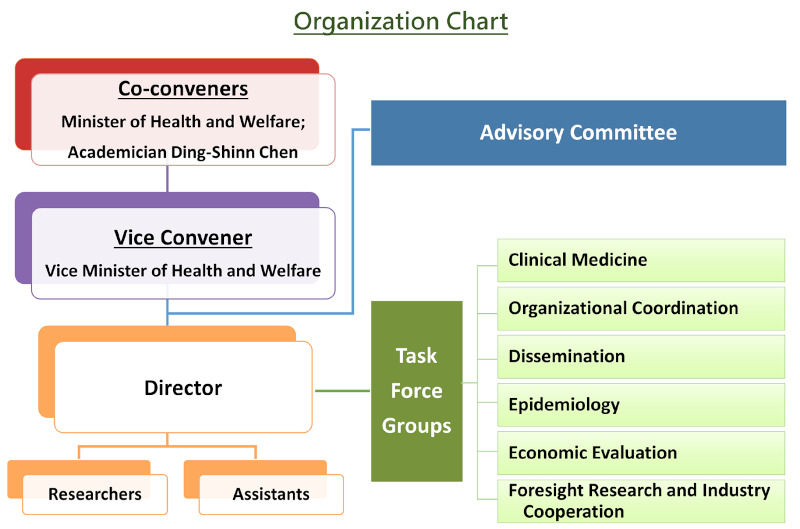
National Hepatitis C Program (NHCP) Office, Ministry of Health and Welfare since December 2016.
Finance a national program
Based on models similar to those used by Razavi's study (15), Chen et al. conclude that Taiwan will achieve WHO targets by increasing patients treated annually to 30,000 by 2025 (16). Political commitment by the MOHW is to finance this national program and remove NHI reimbursement restrictions for treatment. A nationwide program that reimbursed the DAAs for CHC patients with advanced hepatic fibrosis was launched on January 24, 2017 under the NHI, a mandatory single-payer scheme that provides universal high-quality health care for more than 99% of Taiwan residents (17). This program recruited CHC patients who received DAA therapy under the NHI's reimbursement criteria since January 24, 2017 until now. A special budget supporting the DAAs treatment was arranged for nearly 120,000 patients in 2017- 2020, corresponding to 30% treatment coverage with two billion New Taiwan Dollar (NTD) in 2017, 4.8 billion NTD in 2018, 5.6 billion NTD in 2019, and 8.4 billion in 2020. Including 80,000 successfully treated patients with PR, the overall coverage rate of treatment was 50% by 2020. Briefly, only patients with advanced fibrosis, F3 and F4 were covered due to the limited budget during 2017-2018. At the beginning, prior PR failure experience was required for reimbursement, and this was no longer needed after May 15, 2017. As the NHI gradually expanded different DAA regimens, the HCV genotypes that were covered by reimbursed DAAs increased in number. Two DAAs targeting HCV genotypes 1a and 1b, daclatasvir/asunaprevir and ombitasvir/paritaprevir/ritonavir±ribavirin, were reimbursed first. Elbasvir/grazoprevir±ribavirin for treating genotypes 1a, 1b and 4 were reimbursed as of August 1, 2017. Ledipasvir/sofosbuvir±ribavirin for genotypes 1a, 1b, 4, 5 and 6 and sofosvuvir±ribavirin for genotype 2 were reimbursed as of January 1, 2018. Two pan-genotypic DAAs glecaprevir/pibrentasvir, and sofosvuvir/velpatasvir, that covered genotypes 1-6, was reimbursed by the NHI beginning August 1, 2018 and June 1, 2019, respectively. Furthermore, treatment restrictions based on fibrosis stage were removed in 2019. The number of patients treated annually has vastly increased, rising from 9,500 patients in 2017 to 46,000 in 2019. In addition, a registry platform including all patients who applied for the NHI-reimbursed DAAs was established. The registry included patients' demographic characteristics, DAAs regimens, baseline information about HCV RNA viral load, genotype, liver fibrosis status and RNA viral load at the end of DAA therapy and 12 weeks after therapy.
Taiwan Hepatitis C Policy Guideline 2018-2025
For effective policy communication and coordination, MOHW announced the "Taiwan Hepatitis C Policy Guideline 2018-2025" (6) and identified three policy directions to achieve the goal for 2025, which includes: i) Therapy spear-heading prevention: to prevent new infection by reducing the number of infectious, namely CHC patients, via affordable and available treatment; ii) Screening support therapy: to launch screening activity to identify around 120,000 CHC patients since about half of the CHC patients are not diagnosed; iii) Prevention securing outcomes: to block transmission routes to prevent new-infections and re-infections, as well as to block other liver-disease risk factors such as alcohol.
There are several main challenges to move forward to these three policy directions, such as sustainable financing, effective and efficient screening, continuum of care, and improving accessibility. Therefore, the policy guidelines have highlighted three core strategies, including:
i) Precision public health: to launch public health interventions such as smart screening in terms of effectiveness and efficiency. The policy guidelines aim for different prevention and control strategies for four target populations (including highly hepatitis C prevalent area, mountains and offshore islands, special population and general areas) based on the concept of precision public health (Figure 2):
Figure 2.
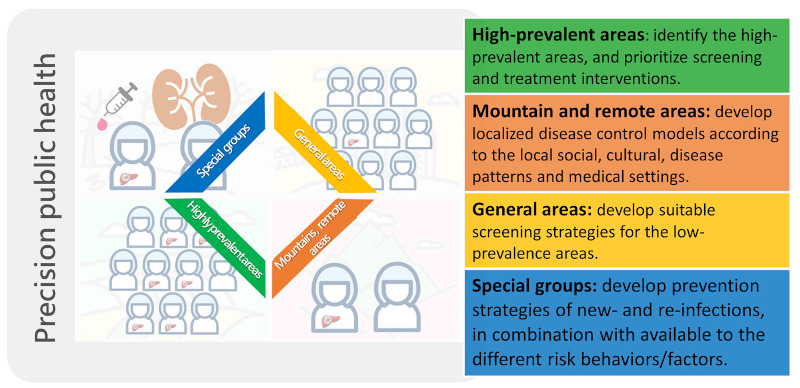
Precision public health.
(a) Highly hepatitis C prevalent area: Define highly hepatitis C prevalent area and prioritize intervention (active screening and treatment) for target population.
(b) Mountains and offshore islands: Prioritize the establishment of accessible hepatitis C prevention and control models depending on local customs (e.g. drinking habit, loss of young and middle-aged labor force, etc.) to facilitate local treatment services.
(c) Special population: Refers to high-risk HCV infection population, including patients undergoing dialysis, community/incarceration drug addicts (through IV injections) and subjects conducting unprotected sexual intercourse (male-to-male or with sex workers). The key hepatitis C prevention and control focuses on the development of strategies preventing HCV infection and re-infection, and measures in combination with available routine inspection/intervention.
(d) General areas: For lower hepatitis C prevalent areas (general areas), a suitable screening program should be built based on the concept of cost-effectiveness. For example, establishing an accessible and cost-effective screening program out of available health examination programs (with alternative indicators).
ii) Continuum of care: to link prevention, screening, diagnosis, treatment, and follow-up together via the support of case management system and information platform. Although this is a patient-centered policy guideline, because most patients with CHC lack disease awareness or fail to seek medical assistance actively, how to screen these patients and connect them to subsequent treatments to provide a patient-centered continuum of care is the key to success. In addition, except connection of screening, diagnosis and treatment, it is also required to establish a three-phase/five-tier-packaged healthcare program with health promotion and infection prevention as leading strategies and regular disease follow-up and integrative management as continuous measures. In addition to providing first-line, patient-centered continuum of care, an interdisciplinary hepatitis C prevention task force is also required in order to coordinate all services and businesses between central and local authorities, private institutions and non-governmental organizations (NGOs) (Figure 3) to promote a rolling plan and achieve a common goal on the basis of interdisciplinary teamwork.
Figure 3.
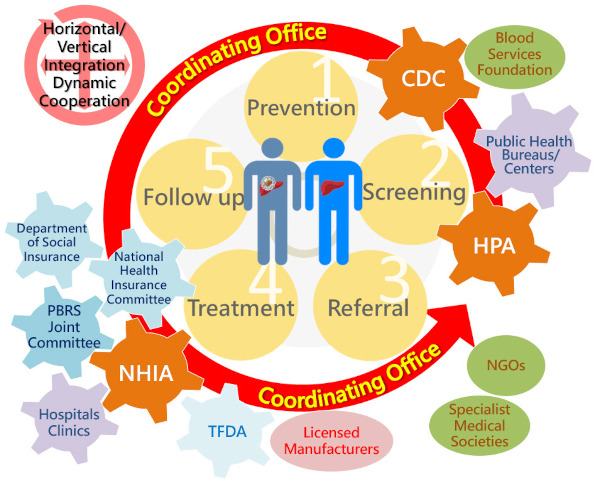
HCV elimination coordinating office.
iii) Localized care delivery: to increase access and improve equality, especially in remote areas with scarce medical resources. According to the hepatitis C epidemiology studies in Taiwan, highly hepatitis C prevalent areas are mainly located in regions with poor medical resources or an economically disadvantaged population, or in remote areas with poor public transport, suggesting that restricted access to medical resources becomes the primary hinderance of successful treatment for hepatitis C in these areas. To provide effective treatment for patients with CHC, a localized care delivery model (local screening, diagnosis, treatment and follow-ups) is required (Figure 4) in order to facilitate localized care delivery, increase accessibility to healthcare services, and promote right of equality to healthcare services.
Figure 4.
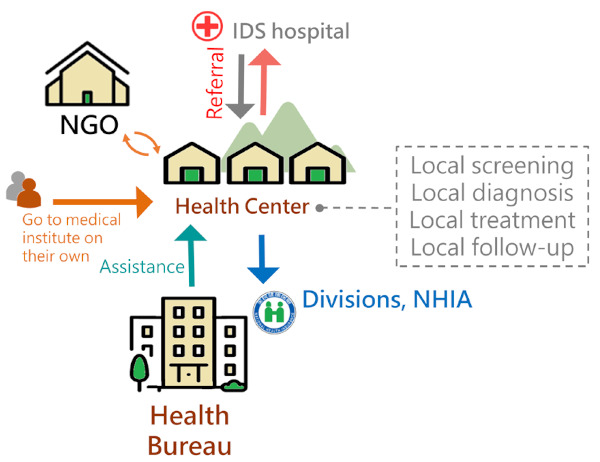
Localized care delivery.
Micro-elimination of special groups
Higher prevalence of HCV infection has been reported among certain populations (18-21) in Taiwan. The anti-HCV prevalence of 20-40% was reported in patients with end-stage renal disease (ESRD) under hemodialysis due to increased nosocomial infection risk (18,19). The majority of the people who inject drugs (PWID) were found to be seropositive for anti-HCV at a rate of 91.3%. Moreover, 57.1% of these patients were coinfected with HIV (20). In HIV-negative and HIV-positive men who have sex with men (MSM), the overall HCV seroprevalence rates were 0.4% and 5.5%, respectively (21). A national survey of HIV-positive patients found that the overall HCV seroprevalence among HIV-positive patients was decreasing, but remained high at 94.0% among PWID. By contrast, anti-HCV seropositivity was relatively low among HIV-positive homosexual men compared to HIV-positive heterosexuals, at 3.5% and 10.9%, respectively (22). In the era of DAA treatment, it can improve the adherence of patients, minimize the side effects and enhance the SVR rate, even in difficult-to-cure populations (23).
Micro-elimination approach, which focuses on treating smaller, targeted high-risk subpopulations, has been proposed as an effective means to tackle HCV (24). According to the Taiwan hepatitis C policy guidelines, we coordinate the prevention, health literacy, screening, diagnosis, treatment, follow-up, and patient management services, both vertically and horizontally. Also, we encourage the gastroenterologist to cooperate with nephrologist, psychiatrist and infectious disease physician to perform micro elimination in these high risk patients. The NHI agrees to expand prescription privilege to infectious disease physicians to treat dual HIV+HCV infected patients with DAA (25). Meanwhile, a new inter-disciplinary collaborative care model implemented by collaborating teams of dialysis practitioners and gastroenterologists working under auspices of Changhua Public Health Bureau have screened 3657 patients from 31 dialysis facilities and treated 173 HCV infected patients with a 96% SVR rate (26) in Changhua county. In addition, a large proportion of the prison population in Taiwan is composed of criminalized persons with injected substance use. In 2019, 27,893 incarcerated persons were convicted of substance use-related crimes, accounting for 49.5% of the total prison population. Injected substance use is prohibited in Taiwan's prison system. Those incarcerated patients had HCV infection before they entered prison. Yang et al. have performed a micro-elimination program for incarcerated persons in Taiwan. They invited 1402 incarcerated persons to perform an anti-HCV screening test, and 824 (59%) accepted. The prevalence of anti- HCV seropositivity was 33.5% (276/824) with a viremic rate of 69.2% (191/276). In total, 165 patients received glecaprevir/pibretasvir therapy and achieved a 100% SVR 12 rate (27).
Preventive measures for specific high-risk populations
For those high risk populations for HCV infection, we set several preventive strategies and measures to block the possible transmission routes.
i) For high-risk HCV infection populations [e.g. patients with HIV infection, patients undergoing dialysis, drug addicts (through IV injections), drug addicts residing in incarcerated or correctional facilities (through IV injections), unprotected sexual intercourse (male-to-male), unprotected sexual intercourse with sex workers], it is required to adopt core strategies along with available routine tests and interventional measures against new-and re-infections.
ii) Establish better knowledge, awareness and literacy about prevention of HCV transmission among high-risk populations, healthcare personnel, nursing staff, staff of community healthcare service departments, and tattoo or piercing artists.
iii) Audit the competence of long-term care or nursing care facilities in implementing infection control procedures.
iv) Audit the competence of tattoo artists or piercing artists in implementing infection control procedures.
v) Audit the competence of folk therapists (responsible for scraping, bleeding, cupping and acupuncture therapy) in implementing infection control procedures.
vi) Execute testing, management and therapeutic protocols for known HCV infected populations residing in incarcerated or correctional facilities.
Remove treatment restrictions
As previous mentioned that highly hepatitis C prevalent areas are mainly located in regions with poor medical resources or economically disadvantaged populations, or in remote areas with poor public transport, suggesting restricted access to medical resources. To improve accessible medical care for CHC patients in remote areas, the NHI agrees to set up a clinic in health centers of remote areas, which is named an outreach clinic. The physician from the medical center continues to support the health center to overcome the handicap of medical care accessibility in remote villages. The NHCP office continues to resolve several barriers in HCV elimination such as an adequate yearly budget, with no limitations on hepatic fibrosis status, no limitation for patients with persistent ant-HCV seropositivity for > 6 months, approval of timely pangenotypic regiments, reimbursement for DAAs in GT1 patients aged > 12 years and precision screening strategies. Extended localized care delivery to general practitioner (GP with specialist training in gastroenterological field) by resolving HCV RNA and genotyping prescription issues and reducing GP income tax by adjusting the cost of tax.
Implement awareness and national screening program
A nationwide, large-scale and population-representative anti-HCV screening program has been previously missing. In light of the experience from other high-income countries, such as United States, Japan, Australia, Germany, and Spain, the number of treated patients is decreasing as the pool of diagnosed and under-care patients is also decreasing (7). Meanwhile, there are about 120,000 CHC patients awaiting to be diagnosed in Taiwan, and screening is becoming challenging and critical on the road toward elimination. But, HCV prevalence has great geographic variation in Taiwan, as the cost-effectiveness of the screening program would also greatly vary across different populations. The screening cost per CHC patient identified, which includes anti-HCV and HCV RNA testing, would increase rapidly while HCV prevalence is lowered. Therefore, it is vital that we develop tailored screening tools and delivery programs according to different population characteristics.
The first core strategy is precision public health. According to different risk areas, we set different public health interventions such as: i) In those high-prevalent areas: identify the high-prevalent areas and give them high priority for coordinated intervention; ii) In those mountain and remote areas: develop specific disease control models according to local social, cultural disease patterns and medical settings; iii) In those general areas: develop screening strategies specifically fitting low-prevalence areas; iv) In those special groups: develop prevention strategies for new- and re-infections according to different risk behaviors/factors.
How to identify the higher HCV prevalence areas, we use previous seven large epidemiologic studies and database form Taiwan as an index including HCV diagnosis rate in national health insurance administration claims data from 2010 to 2016 and stratify them into 7 levels. If the anti-HCV positive rate fulfilled all the available indices, it reached high prevalence definition level 7. If the anti-HCV positive rate fulfills all available indices but 1, it reaches high prevalence definition level 6. Overall, 40% and 41% fulfilled level 6 and 7 respectively (Figure 5A). We can estimate the percentage of hepatitis C patients in every area according to the risk level. Figure 5B shows that choosing risk level 4 or above can be considered for universal screening for HCV because of screening 8% of the population could find 25% of CHC patients. It could be very cost effective. The universal screening program for HCV has been set up by health promotion administration, MOHW on September 28, 2020 where adults older than 45 years can receive both the anti-HCV and HBsAg screening test once in their lifetime.
Figure 5.
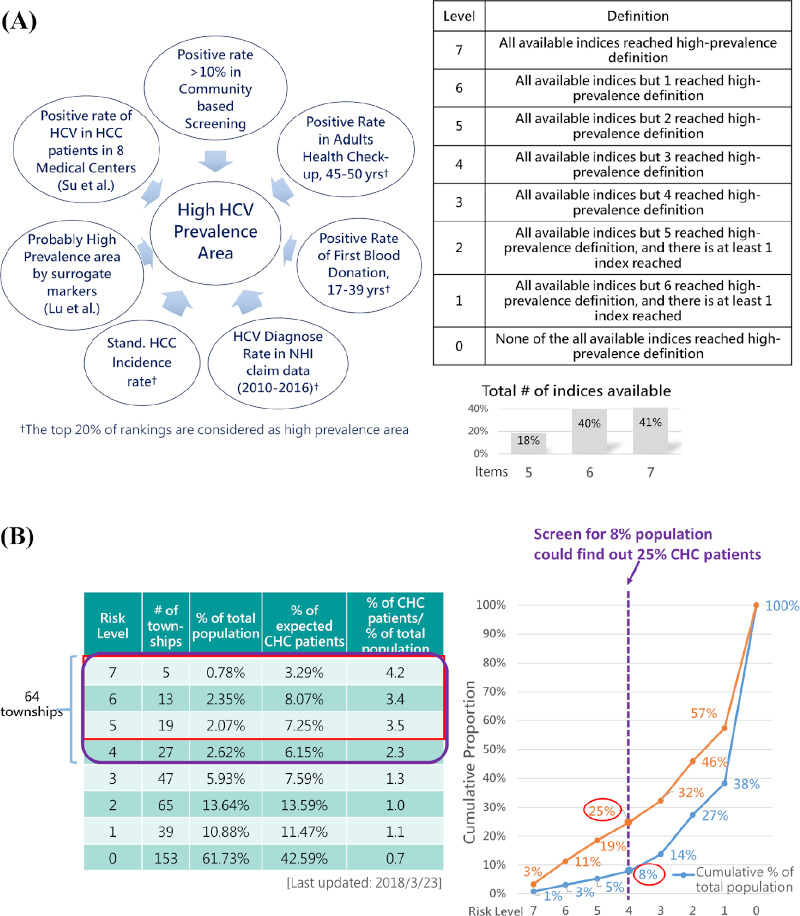
(A) Seven indices of higher HCV prevalence; (B) Estimated percentage of chronic hepatitis C patients by risk levels.
Conclusion and perspective
Taiwan has accelerated its efforts to eliminate hepatitis C since 2018 by committing to achieve WHO's 2030 goal of treating 80% of eligible patients by 2025. Obviously, Taiwan is on track to eliminate HCV by 2025 because of aggressive measures by the MOHW. These include several key success factors including political commitment by the MOHW to finance this national program and remove NHI reimbursement restrictions for treatment. In addition, the Taiwan Centers for Disease control instituted harm reduction programs and the NHCP office instituted monitoring, evaluation and micro-elimination. We are continuing to expand other measures noted as key success factors, including awareness and active screening programs, and funding linkage to care programs. In addition to sustainable financing, it is imperative to scale-up the screening coverage through a precision public health approach to fill the gap of under-diagnosis. Hopefully, we can bring the battle against HCV to the end and achieve early elimination by announcing the treatment target of 250000 CHC patients by 2025.
Funding: This work was supported in part from a grant of Ministry of Science and Technology, Taiwan (MOST109-2314-B-182A-063).
Conflict of Interest
The authors have no conflicts of interest to disclose.
References
- 1. World Health Organization. Global report on access to hepatitis C treatment: focus on overcoming barriers. Geneva. 2016. https://www.who.int/publications/i/item/global-report-on-access-to-hepatitis-c-treatment---focus-on-overcoming-barriers (accessed on June 1, 2021).
- 2. Bennett H, Waser N, Johnston K, Kao JH, Lim YS, Duan ZP, Lee YJ, Wei L, Chen CJ, Sievert W, Yuan Y, Li H. A review of the burden of hepatitis C infection in China, Japan, South Korea and Taiwan. Hepatol Int. 2015; 9:378-390. [DOI] [PubMed] [Google Scholar]
- 3. Yu ML, Yeh ML, Tsai PC, et al. Huge gap between clinical efficacy and community effectiveness in the treatment of chronic hepatitis C: a nationwide survey in Taiwan. Medicine (Baltimore). 2015; 94:e690. [DOI] [PMC free article] [PubMed] [Google Scholar]
- 4. Polaris Observatory HCV Collaborators. Global prevalence and genotype distribution of hepatitis C virus infection in 2015: a modelling study. Lancet Gastroenterol Hepatol. 2017; 2:161-176. [DOI] [PubMed] [Google Scholar]
- 5. Wu GH, Pwu RF, Chen SC, Chen DS. Taiwan is on track of accelerating hepatitis C elimination by 2025. Liver Int. 2020; 40:1506-1507. [DOI] [PubMed] [Google Scholar]
- 6.Taiwan hepatitis C policy guidelines 2018-2025. Taipei City: Ministry of Health and Welfare, Executive Yuan Taiwan, 2019. [Google Scholar]
- 7. World Health Organization. Global health sectors strategy on viral hepatitis 2016-2021: towards ending viral hepatitis. Geneva 2016. https://www.who.int/publications/i/item/WHO-HIV-2016.06 (accessed on June 1, 2021).
- 8. Wu GH, Pwu RF, Chen SC. Achieving hepatitis C elimination in Taiwan-Overcoming barriers by setting feasible strategies. J Formos Med Assoc. 2018; 117:1044-1045. [DOI] [PubMed] [Google Scholar]
- 9. Chen DS. Taiwan commits to eliminating hepatitis C in 2025. Lancet Infect Dis. 2019; 19:466-467. [DOI] [PubMed] [Google Scholar]
- 10. Wu GH, Pwu RF, Chen SC. Achieving hepatitis C elimination in Taiwan-Overcoming barriers by setting feasible strategies. J Formos Med Assoc. 2018; 117:1044-1045. [DOI] [PubMed] [Google Scholar]
- 11. Kao JH. Hepatitis C virus infection in Taiwan: past, present and future. J Formos Med Assoc. 2016; 115:65-66. [DOI] [PubMed] [Google Scholar]
- 12. Yu ML, Chuang WL. Treatment of chronic hepatitis C in Asia: when east meets west. J Gastroenterol Hepatol. 2009; 24:336-345. [DOI] [PubMed] [Google Scholar]
- 13. Liu CH, Yu ML, Peng CY, Hsieh TY, Huang YH, Su WW, Cheng PN, Lin CL, Lo CC, Chen CY, Chen JJ, Ma Q, Brooks-Rooney C, Kao JH. Real-world anti-viral treatment decisions among chronic hepatitis C patients in Taiwan: the INITIATE study. J Formos Med Assoc. 2019; 118:1014-1023. [DOI] [PubMed] [Google Scholar]
- 14. Chen DS. Fighting against viral hepatitis: lessons from Taiwan. Hepatology. 2011; 54:381-392. [DOI] [PubMed] [Google Scholar]
- 15. Razavi H, Sanchez Gonzalez Y, Yuen C, Cornberg M. Global timing of hepatitis C virus elimination in high-income countries. Liver Int. 2020; 40:522-529. [DOI] [PubMed] [Google Scholar]
- 16. Chen DS, Hamoudi W, Mustapha B, et al. Strategies to manage hepatitis C virus infection disease burden -Volume 4. J Viral Hepat. 2017; 24 supple 2:44-63. [DOI] [PubMed] [Google Scholar]
- 17. Wu TY, Majeed A, Kuo KN. An overview of the healthcare system in Taiwan. Lond J Prim Care (Abingdon). 2010; 3:115-119. [DOI] [PMC free article] [PubMed] [Google Scholar]
- 18. Chen DS, Kuo GC, Sung JL, Lai MY, Sheu JC, Chen PJ, Yang PM, Hsu HM, Chang MH, Chen CJ, Hahn LC, Choo QL, Wang TH, Houghton M. Hepatitis C virus infection in an area hyperendemic for hepatitis B and chronic liver disease: the Taiwan experience. J Infect Dis. 1990; 162:817-822. [DOI] [PubMed] [Google Scholar]
- 19. Liu CH, Kao JH. Treatment of hepatitis C virus infection in patients with end-stage renal disease. J Gastroenterol Hepatol. 2011; 26:228-239. [DOI] [PubMed] [Google Scholar]
- 20. Hsieh MH, Tsai JJ, Hsieh MY, Huang CF, Yeh ML, Yang JF, Chang K, Lin WR, Lin CY, Chen TC, Huang JF, Dai CY, Yu ML, Chuang WL. Hepatitis C virus infection among injection drug users with and without human immunodeficiency virus co-infection. PloS One. 2014; 9:e94791. [DOI] [PMC free article] [PubMed] [Google Scholar]
- 21. Tseng YT, Sun HY, Chang SY, Wu CH, Liu WC, Wu PY, Lu CL, Hsieh CY, Hung CC. Seroprevalence of hepatitis virus infection in men who have sex with men aged 18- 40 years in Taiwan. J Formos Med Assoc. 2012; 111:431-438. [DOI] [PubMed] [Google Scholar]
- 22. Li CW, Yang CJ, Sun HY, Tsai MS, Lin SP, Lin TY, Cheng CY, Lee YC, Huang YS, Liu CE, Lee YT, Tang HJ, Wang NC. Changing seroprevalence of hepatitis C virus infection among HIV-positive patients in Taiwan. PloS One. 2018; 13:e0194149. [DOI] [PMC free article] [PubMed] [Google Scholar]
- 23. Llaneras J, Riveiro-Barciela M, Lens S, et al. Effectiveness and safety of sofosbuvir/velpatasvir/ voxilaprevir in patients with chronic hepatitis C previously treated with DAAs. J Hepatol. 2019; 71:666-672. [DOI] [PubMed] [Google Scholar]
- 24. Lazarus JV, Safreed-Harmon K, Thursz MR, Dillon JF, EI-Sayed MH, Elsharkawy AM, Hatzakis A, Jadoul M, Prestileo T, Razavi H, Rockstroh JK, Wiktor SZ, Colombo M. The micro-elimination approach to eliminating hepatitis C: strategies and operational considerations. Semin Liver Dis. 2018; 38:181-192. [DOI] [PubMed] [Google Scholar]
- 25. Liou BH, Sun HY, Yang CJ, et al. Real-world experience with coformulated ledipasvir and sofosbuvir for HIV-positive patients with HCV genotype 2 infection: a multicenter retrospective study. Infect Dis Ther. 2021; 10:827-838. [DOI] [PMC free article] [PubMed] [Google Scholar]
- 26. Hu TH, Su WW, Yang CC, et al. Elimination of hepatitis C virus in a dialysis population: a collaborative care model in Taiwan. Am J Kidney Dis. 2021; S0272-6386(21)00575-8. [DOI] [PubMed] [Google Scholar]
- 27. Yang TH, Fang YJ, Hsu SJ, Lee JY, Chiu MC, Yu JJ, Kuo CC, Chen CH. Micro-elimination of chronic hepatitis C by universal screening plus direct acting antivirals for incarcerated persons in Taiwan. Open Forum Infect Dis. 2020; 7:ofaa301. [DOI] [PMC free article] [PubMed] [Google Scholar]