



Abstract
Contemporary theories of decision-making are compared with respect to their predictions about the judgments that are hypothesized to underlie risky choice framing effects. Specifically, we compare predictions of psychophysical models, such as prospect theory, to the cognitive representational approach of fuzzy-trace theory in which the presence or absence of zero is key to framing effects. Three experiments implemented a high-power design in which many framing problems were administered to participants, who rated the attractiveness of either the certain or risky options. Experiments also varied whether truncation manipulations were within-subjects or between-subjects and whether both options were present. Violations of both strong and weak rationality were clearly observed in attractiveness ratings of options. However, truncation effects showed that these violations were conditional on the form of the decision problem. Truncation effects that involved adding or subtracting zero—which should not matter in almost all decision theories—showed that such rationality violations were attenuated when zero was deleted, but were amplified when zero was emphasized, per predictions of fuzzy-trace theory. This is the first such demonstration using attractiveness ratings of certain and risky options. Ratings also revealed that framing effects are inherently comparative: The attractiveness of a given option is a function of zero versus non-zero contrasts both within and between options. Indeed, we observed a losing-nothing-is-better effect that violates attribute framing and prospect theory such that a probability of losing nothing was rated as substantially better than a probability of gaining nothing, in accord with fuzzy-trace theory.
In the familiar framing effect (Tversky & Kahneman, 1981), participants make choices that are doubly irrational inasmuch as they violate both strong and weak rationality (e.g., Li, Rohde, & Wakker, 2017). Strong rationality implies that participants’ choice frequencies should not differ between certain versus risky options whose expected values are equivalent (e.g., receiving $1000 for sure vs. gambling on a 50–50 chance of receiving $2000 or nothing, which averages out to $1000). This strong criterion of rationality implies risk neutrality for equivalent options, but participants typically violate this criterion; they do not choose certain and risky options equally often. Weak rationality refers to avoiding reversals in risk preferences. However, participants’ choices typically violate this criterion of rationality, too; preferences for certain options over equivalent risky options typically reverse as a function of whether the outcomes are framed as gains (saving lives, winning money) or as losses (losing lives, losing money). Despite the wide appeal of rationality criteria (LeBoeuf & Shafir, 2003), reviewers have concluded that these violations of rationality in risky choice are among the most solid and well-replicated phenomena in psychology (Kühberger, 1998; Levin, Schneider, & Gaeth, 1998; Steiger & Kühberger, 2018).
A fundamental question about these patterns of choices is whether they are driven by comparing competing options when making choices or by evaluative judgments about the individual options that figure in choices. As a concrete example, consider the classic dread disease problem in the upper portion of Table 1. It could be that requiring participants to choose between these pairs of options is what causes them to favor the certain option “200 people saved for sure” while also favoring the risky option “1/3 probability no one dies and 2/3 probability 600 people die.” Kühberger and Gradl (2013) noted in this connection that choice and judgment tasks do not always yield identical preferences (e.g., Fischer & Hawkins, 1993; Tversky, Slovic, & Kahneman, 1990).
Table 1.
Standard and Truncated Versions of the Asian Disease Framing Effect
| Problem component | Content |
|---|---|
| Standard version | |
| Preamble | Imagine the U.S. is preparing for the outbreak of an unusual Asian disease, which is expected to kill 600 people. There are 2 options: |
| Gain frame options | A: 200 people saved for sure. |
| B: 1/3 probability 600 people saved and 2/3 probability no one saved. | |
| Loss frame options | C: 400 people die for sure. |
| D: 1/3 probability no one dies and 2/3 probability 600 people die. | |
| Gist of options | A = Some people are saved. |
| B = Some people are saved or no people are saved. | |
| C = Some people die. | |
| D = Some people die or no people die. | |
| Zero-truncated version | |
| Preamble | Imagine the U.S. is preparing for the outbreak of an unusual Asian disease, which is expected to kill 600 people. There are 2 options: |
| Gain frame options | A: 200 people saved for sure. |
| B: 1/3 probability 600 people saved. | |
| Loss frame options | C: 400 people die for sure. |
| B: 2/3 probability 600 people die. | |
| Non-zero truncated version | |
| Preamble | Imagine the U.S. is preparing for the outbreak of an unusual Asian disease, which is expected to kill 600 people. There are 2 options: |
| Gain frame options | A: 200 people saved for sure. |
| B: 2/3 probability no one saved. | |
| Loss frame options | C: 400 people die for sure. |
| B: 1/3 probability no one dies. |
In fact, some have argued that judgment is actually a more sensitive index of the framing effect than choice, especially when it comes to separating the component parts of the effect (Peters & Levin, 2008). Moreover, it is easy to see in Table 1 that in traditional choice problems, both the strong and weak irrationality aspects of framing effects would also occur if participants evaluate the individual options in particular ways. To illustrate, suppose that participants interpret the certain positively valenced option in the gain frame as being desirable and the certain negatively valenced option in the loss frame as being undesirable. This interpretation would be consistent with what is called “attribute framing,” for example, rating the same sample of ground beef that is described as “75% lean” (positively valenced) as more preferred than one labeled “25% fat” (negatively valenced) (e.g., Levin and Gaeth, 1988; Levin, Schneider, & Gaeth, 1998). As Kühberger and Gradl (2013) have argued, people might ignore or pay less attention to the risky option in either frame. If so, attribute framing implies that the certain option would be chosen more often than the risky one in the gain frame but less often than the risky option in the loss frame, accounting for the risky-choice framing effect (see also Gamliel & Kreiner, 2020).
Obviously, the question of whether the framing effect reflects comparisons of options in choice or separate judgments of options turns on whether participants actually judge individual options in ways that are congruent with their irrational choices. The original theory of framing effects is prospect theory, which assumes psychophysical judgments of probabilities (e.g., 2/3 probability) and of outcomes (e.g., 600 people die) that are combined to determine the overall subjective value of each option (Kahneman & Tversky, 1979; Tversky & Kahneman, 1992). Nonlinearities in perceptions of probabilities or outcomes predict violations of both strong and weak rationality. Based strictly on prospect theory, judgments of each option are the basis for choices and, hence, they should coincide.
Fuzzy-trace theory (FTT) offers an alternative account of framing effects (e.g., Reyna, 2012). According to FTT, people extract the gist of inputs (the options in framing problems) as they encode the verbatim surface form (e.g., exact probabilities and outcomes). However, for a variety of reasons (e.g., the accessibility, stability, manipulability, and meaningfulness of gist), most people base their choices on the simplest gist that distinguishes options (Reyna & Brainerd, 1995). (Note that FTT has long assumed that multiple levels of representation are processed and that they all contribute to preferences but the simplest gist receives greater weight; cf. Mandel & Kapler, 2018). In problems such as these in which only one option offers the possibility of a zero outcome, the simplest gist is categorical (Broniatowski & Reyna, 2018). Therefore, preferences turn on the categorical contrast between some and none, also called the zero effect (Zhang & Slovic, 2019).
Specifically, it can be seen in the upper part of Table 1 that the simplest gist of the certain option in the gain frame of the dread disease problem is “some people are saved,” whereas the simplest gist of the risky option is “some people are saved or no people are saved,” which makes the certain option more attractive than the risky option. It can also be seen that the simplest gist of the certain option in the loss frame is “some people die,” whereas the simplest gist of the risky option is “some people die or no people die,” which makes risk more attractive than certainty.
Crucially, according to FTT, the level of representation used for decision-making involves comparing options (Broniatowski & Reyna, 2018; Reyna, 2012; Reyna & Brainerd, 2011). When the possibility of a zero outcome is present in neither option, and thus does not distinguish them, decision makers rely on more fine-grained representations, such as ordinal gist (less-more as opposed to some-none). If ordinal gist does not distinguish options, they ultimately rely on verbatim representations of exact quantities, which produces indifference when expected values are equal. Therefore, gist judgments of the value of an option depend on the context of the other option in FTT (some compared to none, more compared to less), but such judgments do not depend on the other option in prospect theory.
Despite the theoretical importance of judgments in distinguishing theories, there is surprisingly little direct evidence on whether participants evaluate individual options in ways that are congruent with their choices. In fact, there appear to be only two relevant studies, one by Peters and Levin (2008) and one by Kühberger and Gradl (2013). The methodologies of these studies resemble a familiar paradigm in memory research, wherein participants choose which of two (or more) candidate items was previously encoded and then make additional judgments about those items (e.g., confidence, remember/know, source). Eyewitness identification of criminal suspects from photospreads is a classic illustration of this choice + judgment procedure (e.g., Lampinen, 2016; Lampinen, Erickson, Moore, & Hittson, 2014). In Peters and Levin’s procedure, participants first responded to a series of five standard framing problems, two of which were traditional equal expected-value problems similar to the one in Table 1. Gain frame problems were administered to half of the participants and loss frame problems were administered to the other half. Next, two blocks of judgment trials were administered. During the first, participants rated the attractiveness of each of the certain options from the earlier framing problems on a 7-point scale [−3 (very bad) to +3 (very good)]. During the second, they rated each of the risky options from the earlier framing problems on the same scale. By the end of the experiment, then, the participants had chosen between the usual certain and risky options in a series of framing problems, and they had separately rated all of the individual options for attractiveness.
Peters and Levin (2008) found that their judgment data could not fully explain the framing effect, and indeed, there was only limited evidence of framing effects on judgment in traditional problems. On the one hand, their participants exhibited violations of both strong and weak rationality on the equal expected-value choice problems, selecting the certain option more often than the risky option in the gain frame but doing the opposite in the loss frame. On the other hand, the judgment data did not exhibit violations of weak rationality and provided only mixed evidence of violations of strong rationality. In the gain frame, attractiveness ratings were higher for certain options than for risky ones for one problem, but they did not differ significantly for the other problem. In the loss frame, attractiveness ratings of certain versus risky options did not differ significantly for either problem. Also, when participants’ ratings of individual options were correlated with their choices in the two framing problems, three of four correlations were not significant. In short, there was no clear evidence that judgments about individual options could explain the framing effect in traditional choice problems.
Kühberger and Gradl (2013) implemented a slightly different procedure, in which participants were presented with a single framing problem (the dread disease problem). In two of their experiments, this problem was presented in the gain frame to half of the participants and in the loss frame to the other half. In a third experiment, both frames were presented to each participant. Participants chose their preferred option on this problem, and they separately rated each option for attractiveness on an 11-point scale [−5 (very bad) to +5 (very good)]. On the choice tasks, violations of strong and weak rationality were both present: Participants preferred the certain option of saving 200 lives in the gain frame but preferred the risky option of a 1/3 probability that no one dies and 2/3 probability that 600 people die in the loss frame. On the judgment tasks, the results were similar to Peters and Levin’s (2008) in one respect and different in another. The point of similarity was that framing affected the perceived attractiveness of certain options more than the perceived attractiveness of risky ones; in fact, it did not affect the latter significantly. In Experiment 2, for instance, the mean ratings of the certain options were +.9 (gain frame) and −.7 (loss frame), whereas the corresponding ratings of risky options were +.2 (gain frame) and +.1 (loss frame). The point of difference was that in two experiments, the mean rating of the certain option was both significantly higher than the mean rating of the risky option in the gain frame and significantly lower in the loss frame. Thus, in those experiments, judgments about individual options displayed violations of both strong and weak rationality. However, that was not true in the third experiment, in which the ratings of the certain and risky options were virtually the same.
Summing up, two conclusions emerge from the judgment data that were reported by Peters and Levin (2008) and by Kühberger and Gradl (2013). First, to some degree, participants would appear to evaluate the individual options in framing problems, but oddly, they seem to ignore the risky option in favor of processing only the certain option—perceiving that option to be more attractive in the gain frame than in the loss frame. This can produce violations of both strong and weak rationality, and is consistent with attribute framing. At the very least, the data of both studies suggest that judgment focuses on certain options to the relative exclusion of risky ones. Kühberger and Gradl noted that this pattern is also consistent with the information leakage account (e.g., McKenzie, 2004; McKenzie & Nelson, 2003; Sher & McKenzie, 2006), which suggests that problem frame affects certain options but not risky ones (but see Reyna & Brainerd, 1991). Second, the pattern of judgment focusing on certain options to the relative exclusion of risky ones may or may not be sufficient to explain the framing effect, depending on whether the correct picture is provided by Peter and Levin’s experiment and Kühberger and Gradl’s third experiment, or whether the correct picture is provided by Kühberger and Gradl’s first two experiments. There are important methodological differences among these experiments (e.g., fixed versus random presentation, numbers of framing problems) that may be responsible for the discrepant findings. The safest conclusion is that it remains uncertain whether the framing effect can be explained by judgments that participants make about individual options.
The Present Experiments
Do Judgments Account for Choices?
A major purpose of our research was to find answers to two related questions that, together, would resolve this uncertainty—namely, whether participants’ judgments of both or only one of the options in framing problems could account for choices, specifically, whether the observed patterns of judgments are congruent with both the strong and weak irrationality aspects of the framing effect. First, with respect to how fully the individual options are evaluated, we saw that prior findings suggest that problem frame may affect the perceived attractiveness of the certain options but not the attractiveness of risky ones. However, that result may be due to a source of noise in the procedure that has been used to elicit ratings of framing options: The options were rated in isolation, without the context that is normally supplied by the preamble of the framing problem itself. For instance, participants simply rated “1/3 probability no one dies and 2/3 probability 600 people die” without the accompanying preamble “Imagine that the U.S. is preparing for the outbreak of an unusual Asian disease, which is expected to kill 600 people.” If participants have previously responded to the framing problem itself, as they did in Peters and Levin’s (2008) experiment, they might recall that context when they rate this option, or they might generate an alternative context. In some of Kühberger and Gradl’s (2013) experiments, participants rated the options without prior exposure to the framing problems that contained them and, hence, would have had to generate idiosyncratic contexts. Two important points about spontaneous generation of contexts are that (a) the perceived attractiveness of options will vary as a function of whether those contexts are ones in which people do not normally die (e.g., attending baseball games) or ones in which large numbers of people die (e.g., natural disasters), and (b) risky options are arguably more sensitive to this source of noise than certain options. In the experiments that we report, potential noise from self-generated contexts was eliminated by ensuring that participants always encoded the relevant context (problem preamble) just before they judged an option.
Second, in order to obtain more reliable data on whether framing affects judgments about risky as well as certain options, we administered a more extensive sample of framing problems than in prior experiments, so that participants made judgments about much larger numbers of certain and risky options. Here, we noticed that although judgments about individual options failed to account for the framing effect in the experiments discussed above, differences in ratings were always in the correct direction: higher ratings of certain than risky options in the gain frame, coupled with higher ratings of risky than certain options in the loss frame. By increasing the number of replications, we hoped to determine whether both effects are actually reliable, although one might be smaller than the other. Third, we did not present choice problems prior to judgments to avoid the potential confound that responding to choice problems could influence later judgments.
Testing Predictions of Prospect Theory and Fuzzy Trace Theory
Another important purpose of the research was to extend tests of FTT’s and prospect theory’s predictions from choices to judgments. That is, to provide further evidence on whether participants evaluate risky options as well as certain ones, we also studied how the evaluation of individual options reacts to a pair of manipulations whose effects on the framing effect in choice have been studied—namely, truncation manipulations. Remember that the simplest gists for the risky options in the dread disease problem are “some people are saved or no people are saved” (gain frame) and “some people die or no people die” (loss frame). Clearly, one component of each gist is more attractive than the other—for instance, “some people are saved” is preferable to “no people are saved.” In prior research (e.g., Kühberger & Tanner, 2010; Reyna & Brainerd, 1991; Reyna, Chick, Corbin, & Hsia, 2014), two truncation procedures were developed that either emphasize or de-emphasize such categorical gist contrasts between options. Thus, in one condition, the zero complement of each risky option is deleted, so that “1/3 probability 600 people saved and 2/3 probability no one saved” becomes “1/3 probability 600 people saved” and “1/3 probability no one dies and 2/3 probability 600 people die” becomes “2/3 probability 600 people die.” This truncation eliminates categorical contrasts, which FTT predicts should diminish framing effects, as has been observed.
With respect to judging each risky option, saving some people is good but saving some people or saving no one is good and bad, so that the former should be rated as higher than the latter according to FTT. Similarly, some people dying is bad but some people dying or no one dying is bad and good, so that the former should be rated as lower than the latter according to FTT. In other words, this truncation of the zero part of the risky option maintains the more attractive part of the gist of the gamble in the gain frame and the less attractive part in the loss frame. Prospect theory predicts no difference in evaluations of options when the zero outcome is eliminated because zero contributes literally nothing to judgments (Kahneman & Tversky, 1979; Tversky & Kahneman, 1992). The probability of the zero outcome also does not contribute to judgments in prospect theory because that probability is multiplied by the zero outcome, yielding zero. Thus, the phrase “weighting zero” referring to probability makes no sense in prospect theory and related approaches.
In the other truncation condition, the non-zero complement of each risky option is eliminated, so that the risky option in the gain frame becomes “2/3 probability no one saved” and the risky option in the loss frame becomes “1/3 probability no one dies.” This truncation emphasizes categorical contrasts between options, according to FTT. No one saved is bad compared to some saved and no one dies is good compared to some dying. With respect to judgments, this truncation emphasizes the less attractive part of the gist in the gain frame and the more attractive part in the loss frame.
These effects are predicted to occur despite the fact that participants understand that the zero complements are implied when only non-zero complements are stated, and that the non-zero complements are implied when only zero complements are stated; that is, for example, “1/3 probability no one dies” implies “2/3 probability 600 people die” (see Chick et al., 2016). Participants are informed that the truncated complements are implied because they are given instructions, examples, and tested for comprehension of these instructions (see below).
Thus, to summarize predictions for the two truncations, if the framing effect is a by-product of judgments about the individual options, these truncation manipulations should affect judgments about individual options, too. Both prospect theory and FTT predict that judgments will vary in ways that reflect violations of strong and weak rationality under standard conditions (i.e., with both complements present). However, there are differences between theories with respect to effects of truncation. Specifically, for FTT, relative to the standard forms of the risky options, eliminating the zero complements should increase the perceived attractiveness of the risky option in the gain frame but decrease its perceived attractiveness in the loss frame. Prospect theory predicts no differences. Also, for FTT, relative to the standard forms of the risky options, eliminating the non-zero complements should decrease the perceived attractiveness of the risky option in the gain frame but increase its perceived attractiveness in the loss frame. Because the zero outcome is qualified by a probability, and because problems are not ambiguous, predictions of prospect theory are, again, no differences in framing effects (see Kühberger & Tanner, 2010).
Context: Does the Presence of the Other Option Influence Ratings?
A final aim of our research, which is taken up in Experiment 2, was to determine whether the basic patterns of evaluation of framing options that were established in Experiment 1 are influenced by the extent to which participants compare both options when they evaluate individual options. In Experiment 1, as mentioned, participants rated individual options in the context of full framing problems; that is, they encoded the problem preamble + the certain option + the risky option when one of the options was presented for rating. Consequently, they could compare the risky option whenever they rated a certain one or they could compare the certain option whenever they rated a risky one. (Whether they rated the certain vs. risky options was varied between-subjects in all experiments.) In Experiment 2, we investigated whether the mere presence of the other option (as in Experiment 1), despite never being rated by an individual participant, mattered. Participants were presented with framing problems that contained only one of the options. Participants again rated either the certain or risky option but without the ability to directly compare it to the other option. In particular, we examined whether obtaining the framing pattern in judgments of options would change if the other option were eliminated. If judgments are made relative to the unrated option, then judgments in Experiment 2 should differ from those in Experiment 1. Experiment 2 also provides a clearer test of the degree to which attribute framing influences results because participants rated the certain gain and certain loss options by themselves.
In all truncation conditions of both experiments, participants received full information about the parts of the gamble that were deleted, eliminating ambiguity, and quizzes assessed their understanding of these disambiguating instructions. Thus, the manipulations were designed to test predictions of FTT by emphasizing or de-emphasizing categorical gist representations, not by providing partial as opposed to full information. If prospect theory is correct, ratings should produce evidence of framing effects in full as well as in zero-truncated conditions because all of the psychophysical ingredients are present. Conversely, if FTT is correct, then the presence of zero should highlight categorical gist, augmenting framing effects, and deleting zero should remove the categorical gist contrast between options, reducing framing effects.
Experiment 1
In this experiment, participants were exposed to 60 standard framing problems in total, with each problem being presented in the usual two formats—gain frame and loss frame. Within each frame, three versions of each of 20 base problems were presented: standard, zero complement deleted from the risky option, and non-zero complement deleted from the risky option. Participants rated either the certain option or the risky option. Importantly, these problems were pure judgment tasks: Participants did not choose between the options that were presented for individual problems; they simply rated the attractiveness of one of them, either the certain or the risky option. The overriding question is the extent to which the framing effects and truncation effects that are routinely observed for conventional choice problems are also observed for this pure judgment procedure.
Method
Participants
The participants were 129 undergraduates who participated in this experiment in order to fulfill a course requirement. Each participant was randomly assigned to one of the four cells of a 2 (type of option: certain vs. risky) × (problem set: A vs. B) factorial structure. Problem sets varied materials to increase generality but were not a theoretical focus.
Materials
There were two types of materials. First, there was a four-item ambiguity questionnaire (Chick et al., 2016), which was administered to ensure that participants did not misunderstand the meaning of certain and risky options—specifically, that participants understood that the complementary outcome was always zero and that, when options specified particular numerical values, those values were the only possible outcomes (e.g., that “300 turtles die for sure” means that neither more nor less than 300 turtles could die and that “3/5 probability that 500 turtles die” means exactly 3/5, neither less than nor more than 3/5).
Second, the main experimental materials were a series of 60 framing problems that were sampled from a larger group of 120 problems (e.g., Reyna, Chick et al., 2014). Half of the problems involved non-monetary outcomes (e.g., lives) and half involved money. Each problem conformed to the traditional format in Table 1; that is, it consisted of a preamble, together with a certain option and a risky option that were worded using gain or loss language. Probabilities generally ranged from .20 to .50 for the non-zero gains (losses were identical net gains as depicted in Table 1 but phrased as losses) and the stakes ranged from tens to thousands. For example, a variation on lives problems stipulated that 1000 people were expected to die from a disease and the choice was between two programs to combat the disease: 300 people saved for sure versus 30% chance 300 saved and 70% chance no one saved. Other problems concerned an impending hurricane threatening 2000 lives and choices between evacuation routes in which 1500 people die for sure versus 3/4 probability 2,000 people die and 1/4 probability no one dies. Non-monetary outcomes also included jobs saved/lost, acres saved/lost of a rainforest, and deadly strains of E. Coli in spinach. Monetary outcomes included money gained/lost on game shows, in casinos, in consumer behavior studies, and by playing computer games. Problems were drawn from previous research (for a review, see Broniatowski & Reyna, 2018).
The 120 problems were divided into 2 sets (set A and set B). In set A, 10 problems were administered in the gain frame, and 10 were administered in the loss frame. In set B, the 10 problems that were administered in the gain frame in set A were now administered in the loss frame and the 10 problems that were administered in the loss frame in set A were now administered in the gain frame. The two problem sets were counterbalanced across participants, with set A being administered to half of the participants and set B being administered to the other half of the participants. This problem-set factor had no effect on performance—it produced neither a main effect nor any interactions with the other design factors. Therefore, it is not mentioned further, and it is not included in the ANOVAs that are reported for Experiment 1 and Experiment 2.
Three versions of each problem were administered to each participant: (a) standard; (b) zero complement deleted from the risky option (see the example in the middle portion of Table 1); and (c) non-zero complement deleted from the risky option (see the example in the bottom portion of Table 1). Half of the problems that were administered to individual participants were worded as gains and half were worded as losses. Presentation order was random for each participant. There were 30 gain frame items (10 base problems × 3 truncation versions) and 30 loss frame items (10 base problems × 3 truncation versions). Participants did not respond to these test items in the traditional way, by choosing between the certain and risk options. They never chose between any of the options, but instead, they simply rated one of the options on a 1 – 6 scale that was anchored by “strongly do not prefer” on the low end and “strongly prefer” on the high end, and they rated that option three times over the three versions of each problem: (a) once with the standard version; (b) once with the zero complement of the risky option deleted; and (c) once with the non-zero complement of the risky option deleted.
Procedure
Participants sat in front of a computer screen and responded to all test items with mouse clicks on buttons that appeared on the screen. The procedure consisted of two steps. The first was composed of consent, general instructions, and the four-item questionnaire. After providing consent, each participant read a page of instructions about the upcoming experiment, which included illustrative framing problems. The instructions stressed that the problem preambles and options meant exactly what they said, that the stated numbers should be interpreted literally, and that the numbers should not be misinterpreted as permitting values that were smaller or larger than the stated values. Using simple language and examples, the instructions also explained that the complementary outcome was always zero. Reading of the instructions was self-paced and was followed by the four-item questionnaire to ensure that the instructions had been understood.
The second step was 60 rating items in which the participant rated either the certain option (half the participants) or the risky option (half the participants) of gain-frame and loss-frame problems, presented in random order. Two screens were presented for each rating item. The first presented a framing problem, centered in 72-font, for 20 sec. For instance:
- A hurricane is expected to hit a major city and kill 2,000 people. City planners have proposed 2 evacuation procedures:
- 500 people are saved for sure.
- 1/4 probability 2000 people are saved and a 3/4 probability that no one is saved.
The second screen presented one of the options (certain or risky, depending on the participants’ condition) by itself, and the participant was required to assign a rating to it before the program advanced to the next problem. For instance:
- Rate your preference for Option A: 500 people are saved for sure.
- Strongly do not prefer
- Somewhat do not prefer
- Slightly do not prefer
- Slightly prefer
- Somewhat prefer
- Strongly prefe
Results and Discussion
The descriptive findings are presented in Table 2, where mean preference ratings are displayed by condition. The findings in Table 2 are broken down by frame (gain vs. loss), option (certain vs. risky), and problem version (standard vs. risky zero complement deleted vs. risky non-zero complement deleted). Before reporting the detailed significance tests, we describe four qualitative patterns in Table 2 that are of overriding theoretical importance.
Table 2.
Mean Preference Ratings (SDs in Parentheses) and Estimated Choices of Certain and Risky Options in Three Versions of the Framing Effect in Experiment 1
| Panel A: All Participants | |||||||
|---|---|---|---|---|---|---|---|
| Frame/option | Truncation | ||||||
| Delete zero complement | Standard | Delete non-zero complement | Grand means | ||||
| Rating | Choice | Rating | Choice | Rating | Choice | Rating | |
| Gain frame: | |||||||
| Certain option | 3.87 (.77) | .70 | 3.99 (.82) | .73 | 4.31 (.84) | .86 | 4.06 |
| Risky option | 3.40 (.81) | .48 | 3.19 (.78) | .39 | 2.93 (.84) | .31 | 3.17 |
| Mean | 3.64 | 3.59 | 3.62 | 3.62 | |||
| Loss frame: | |||||||
| Certain option | 3.29 (.80) | .42 | 3.18 (.76) | .39 | 2.87 (.71) | .20 | 3.11 |
| Risky option | 3.32 (.85) | .45 | 3.61 (.77) | .66 | 3.90 (.80) | .72 | 3.61 |
| Mean | 3.31 | 3.40 | 3.39 | 3.37 | |||
| Panel B: Participants Scoring 100% on Ambiguity Test | |||||||
| Frame/option | Truncation | ||||||
| Delete zero complement | Standard | Delete non-zero complement | Grand means | ||||
| Rating | Choice | Rating | Choice | Rating | Choice | Rating | |
| Gain frame: | |||||||
| Certain option | 3.96 (.95) | .71 | 3.95 (.91) | .68 | 4.31 (.92) | .86 | 4.07 |
| Risky option | 3.34 (.83) | .46 | 3.17 (.88) | .40 | 2.85 (.83) | .26 | 3.12 |
| Mean | 3.65 | 3.56 | 3.58 | 3.60 | |||
| Loss frame: | |||||||
| Certain option | 3.28 (.93) | .43 | 3.06 (.82) | .32 | 2.88 (.77) | .25 | 3.07 |
| Risky option | 3.37 (.88) | .49 | 3.62 (.88) | .63 | 3.90 (.86) | .71 | 3.63 |
| Mean | 3.33 | 3.34 | 3.39 | 3.35 | |||
Note. All four options of each of 20 framing problems were rated on a 1–6 scale, which was anchored by 1 = strongly do not prefer and 6 = strongly prefer. Proportion choice was estimated based on ratings (1–3 do not choose and 4–6 choose).
Qualitative Patterns
It is clear that judgments about certain and risky options can account for the framing effect because those judgments parallel the effect, exhibiting both strong and weak irrationality. First, with respect to violations of strong rationality, consider the findings for the standard version of the framing problem, which appear in the second column of Table 2. In the gain frame, there was a difference of .80 points between the mean ratings of certain and risky options. In the loss frame, there was a difference of .43 points in the mean ratings of certain and risky options. Second, with respect to violations of weak rationality, it is apparent that the direction of this difference was the opposite in the gain and loss frames. In the gain frame, certain options received higher average ratings than risky ones (3.99 vs. 3.19), but in the loss frame, risky options received higher average ratings than certain ones (3.61 vs. 3.18).
Third, it is also apparent that in contrast to prior studies, problem frame changed participants’ evaluation of the risky option as well as the certain option. As mentioned above, the results of Peters and Levin’s (2008) and Kühberger and Gradl’s (2013) studies suggested that their participants did not evaluate the risky option, the reason being that judgments about certain options were affected by problem frame but judgments about risky options were not. However, our data showed that both options were affected by problem frame. Returning to the results for standard problems in the second column of Table 2, it can be seen that ratings of the certain option were higher in the gain frame than in the loss frame (3.99 vs. 3.l8), whereas ratings of the risky option were higher in the loss frame than in the gain frame (3.61 vs. 3.19). Another instructive datum is that the across-frame difference in ratings of certain options was roughly 50% larger than the across-frame difference in ratings of risky options (MΔ = .81 vs. .42). Obviously, this provides a straightforward statistical explanation of previous failures to find a reliable difference in ratings of risky options—namely, that it is a more precise effect that requires greater power to detect.
Turning to the fourth pattern in Table 2, the effects of truncation manipulations have been investigated for choice, beginning with a study by Reyna and Brainerd (1991). There are two modal findings. The first is that relative to standard problems, deleting the zero complement of risky options reduces violations of strong rationality by decreasing the spread between the choice rates for the two options, in both the gain and loss frames. Indeed, in most choice studies the effect is no longer reliable (e.g., Kühberger & Tanner, 2010). The second modal finding is that relative to standard problems, deleting the non-zero complement of risky options amplifies violations of strong rationality by increasing the spread between the choice rates for the two options in both frames.
It can be seen in Table 2 that both of these modal effects of truncation are paralleled by each manipulation’s effects on judgments about individual options. Taking zero truncation first, relative to standard problems, this manipulation shrinks the difference between the ratings of certain and risky options from .80 to .47 in the gain frame and from .43 to .03 in the loss frame. Non-zero truncation has the opposite effect, increasing the difference between the ratings of certain and risky options from .80 to 1.38 in the gain frame and from .43 to 1.03 in the loss frame. Thus, participants’ evaluations of the individual options not only illustrate the framing effect, they can also track the known effects of truncation manipulations.
In order to compare our results to those from earlier choice experiments, Table 2 also displays the proportion of preferred choices estimated based on ratings (1–3 do not choose and 4–6 choose). The estimated choice data mirror the patterns we have just discussed and are generally similar to previous studies with choice data, especially for losses (e.g., Kühberger & Tanner, 2010; Reyna et al., 2014). The differences between estimated choices of certain and risky options diverge from zero truncation to standard to non-zero truncation problems, namely, from .22 to .34 to .55 for gains and from −.03 to −.27 to −.52 for losses, respectively. Note that for gains, ratings (and choices estimated from ratings) reflected a preference for the certain option in the zero-truncated condition, which is generally not found with choice data. For risky options, which were the loci of the truncation manipulation, patterns for ratings mirrored patterns for choices: the observed order of attractiveness of those options was zero truncation > standard > non-zero truncation in the gain frame and non-zero truncation > standard > zero truncation in the loss frame.
Statistical Tests
In order to secure statistical tests of these patterns, we computed a 2 (option: certain vs. risky) × 2 (frame: gain vs. loss) × 3 (truncation condition: standard problems vs. risky zero complement deleted vs. risky non-zero complement deleted) analysis of variance (ANOVA) of the rating scores for 60 framing options. Only results that were significant at the .05 level are reported below. (See also Supplemental Materials for statistical comparisons of means, Cohen’s ds, and exact probabilities in Table 1S and standard errors in Table 2S for all three experiments).
With respect to the two patterns (violations of both strong and weak rationality), the supportive omnibus result would be a Frame × Option interaction, and a large interaction of that sort was observed, F(1, 127) = 139.82, MSE = .66, ηp2 = .52. Consistent with choice data in the framing effect, this was a cross-over interaction, in which mean ratings were higher for certain than for risky options in the gain frame but were higher for risky than for certain options in the loss frame. Planned comparisons of the grand means in the fourth ratings column of Table 2 revealed that over the three versions of the framing problems (standard, risky zero complement deleted, and risky non-zero complement deleted), the difference between mean ratings was reliable (i.e., significant) for both the gain frame and the loss frame (see Table 1S). Because the framing effect normally refers to standard problems rather than truncated problems, we repeated those tests for just the mean ratings of the options of standard problems (second ratings column of Table 2), and the outcome was the same—higher ratings of certain options in the gain frame but higher ratings of risky options in the loss frame.
Turning to the third pattern that was discussed above (moving from the gain to the loss frame decreases ratings of certain options but increases ratings of risky options), we conducted planned comparisons of the differences between the gain and loss frame ratings of risky options and certain ones (see Table 1S). The analyses of the grand means (fourth ratings column of Table 2) showed that over the three versions of the framing problems, ratings of risky options were higher in the loss frame than in the gain frame, and ratings of certain options were higher in the gain frame than in the loss frame. The corresponding analyses of the means for just the standard problems also showed that ratings of risky options were higher in the loss frame than in the gain frame, and that ratings of certain options were higher in the gain frame than in the loss frame. Thus, when presented with conventional framing problems, participants did not ignore risky options in favor of only evaluating certain options because problem frame affected both types of options.
With respect to the fourth pattern that was discussed above (that judgments about certain and risky options react to truncation manipulations much like the framing choice effect reacts), the supportive result would be an Option × Frame × Truncation Condition interaction, and a large interaction of that sort was observed, F(2, 254) = 69.82, MSE = .22, ηp2 = .36. The nature of the interaction can be seen in Table 2, by comparing the mean ratings in the second column (standard problems) to the mean ratings in the first column (risky zero complement deleted) and to the mean ratings in the third column (risky non-zero complement deleted). When the interaction was broken down, there were six key findings (see also Table 1S). (a) When the zero complement was deleted, the differences between the ratings of the certain and risky options in the gain and loss frames were smaller than the corresponding differences for standard problems (medium vs. large for gains and null vs. medium for losses). (b) When the zero complement was deleted, the rating difference between certain and risky options in the gain frame was significant but the difference for the loss frames was not significant. (c) When the non-zero complement was deleted, the differences between the ratings of the certain and risky options in the gain and loss frames were larger than the corresponding differences for standard problems (very large vs. large for gains and large vs. medium for losses). (d) For standard problems and when the non-zero complement was deleted, the ratings differences between certain and risky options in the gain and loss frames were significant. (e) In the gain frame, mean ratings of risky options were highest in the zero truncation condition and were lowest in the non-zero truncation condition. (f) Conversely, in the loss frame, mean ratings of risky options were highest in the non-zero truncation condition and lowest in the zero truncation condition.
Experiment 2
In the first experiment, we learned that when participants are confronted with standard framing problems and are asked to evaluate the attractiveness of one of the options, their evaluations parallel the framing effect itself in the sense that they display violations of both strong and weak rationality: Ratings differed reliably for certain versus risky options in both frames, and the direction of that difference reversed between the gain and loss frames. Further, participants evaluated both options because problem frame affected both: Ratings of certain options were higher in the gain frame than in the loss frame, whereas ratings of risky options were higher in the loss frame than in the gain frame. Importantly, these judgment effects reacted to truncation manipulations much like the framing effect reacts: Specifically, the rating spread between certain and risky options increased when the non-zero complement was deleted from risky options but it shrank when the zero complement was deleted from risky options. These lines of evidence all converge on the conclusion that judgments about options produce patterns that are similar to patterns for framing effects for choices.
However, Experiment 1 leaves open the question of whether judgments were based on perceptions of the individual options or whether judgments were based on comparisons between options. The question is whether the presence of the other option provides a context for comparison that influences both judgments and choices, thereby creating or augmenting framing effects. Theories differ on this point, with prospect theory not predicting such a difference and FTT predicting a difference. FTT predicts a difference because the categorical contrasts between the options (and within the gamble) elicit the categorical gist representation of each option. Hence, gaining nothing is bad relative to gaining something, but losing nothing is good compared to losing something (Broniatowski & Reyna, 2018; Reyna, 2012; Reyna et al., 2014).
Therefore, in Experiment 2, we conducted a test of this contextual hypothesis by modifying the design of Experiment 1 in such a way that eliminates direct comparisons between certain and risky options that could produce framing effects in judgment. Recall that in Experiment 1, framing problems were presented along with the usual certain and risky options, after which one of the options was represented and participants rated it. Although the task was always to rate a single option (and was never to choose between the options), the availability of both options allowed comparison. Note that the possibility of comparison applies to the earlier experiments of Kühberger and Gradl (2013) and Peters and Levin (2008), as their participants also rated individual options after encoding entire framing problems containing both options.
Comparisons between options were reduced in Experiment 2 by incorporating a simple modification. Once again, participants were exposed to a large number of framing problems, after each of which they rated a single option. Now, however, the presentation of each framing problem included only the to-be-rated options, making it more difficult (relative to Experiment 1) to directly compare options before rating one of them. For example, consider the problem
- A hurricane is expected to hit a major city and kill 2,000 people. City planners have proposed 2 evacuation procedures:
- 500 people saved for sure.
- 1/4 probability 2000 people are saved and a 3/4 probability no one is saved.
In Experiment 2, participants in the certain-option condition were administered the following version of this problem:
- A hurricane is expected to hit a major city and kill 2,000 people. City planners have proposed 2 evacuation procedures. One of them is:
-
a500 people saved for sure.
-
a
Participants in the risky-option condition were administered the following version of the same problem:
- A hurricane is expected to hit a major city and kill 2,000 people. City planners have proposed 2 evacuation procedures. One of them is:
-
b1/4 probability 2000 people are saved and 3/4 probability no one is saved
-
b
Two important features of this procedure should be noted. First, on a given trial, participants who received the certain version of this problem were not presented with the corresponding risky option, and participants who received the risky version were not presented with the corresponding certain option. Thus, participants rated each option in isolation without comparing it to the other option. Second, recall that the certain-versus-risky option design factor was manipulated between participants, so that participants in the certain-option condition were never exposed to any risky options, and participants in the risky-option condition were never exposed to any certain options.
Discouraging comparisons between certain and risky options could affect the results of Experiment 1 in two broad ways. First, it is conceivable that participants’ evaluation of individual options is driven purely by the content of an option and not by comparing it to the content of the other option. In that event, the qualitative and quantitative patterns in Experiment 1 will be preserved in the present experiment. Because the probabilities and outcomes are identical in Experiments 1 and 2, prospect theory makes this prediction. Second, suppose that participants’ evaluation of individual options is dependent on the content of the other option as well as on the valence of the options, so that the evaluations in Experiment 1 were determined by comparisons between them. Under this scenario, qualitative and quantitative patterns in Experiment 1 will not be preserved in key respects in the present experiment. FTT makes this prediction.
Without the usual contrasts between outcomes, the exact patterns depend on the information that participants now rely on to evaluate options. In particular, for certain options, attribute framing should produce positive ratings in the gain frame and negative ratings in the loss frame (Gamliel & Kreiner, 2020; Levin and Gaeth, 1988; Levin, Schneider, & Gaeth, 1998). According to FTT, too, participants’ evaluation of individual options in choice tasks is driven by the valence of the option, as in attribute framing, but the gist pivots on the content of the other option, which predictably reverses effects of attribute framing on risky options (risky losses worse than risky gains) to create choice framing effects when the zero outcome is present (risky gains worse than risky losses). Under this scenario, the judgment framing effects that were observed in Experiment 1 would differ in crucial ways from those to be observed in Experiment 2. Ratings (as opposed to choices) make it easier to observe such subtle modulations of framing effects.
Method
Participants
The participants were 125 undergraduates who participated in this experiment in order to fulfill a course requirement. Each participant was randomly assigned to one of the four cells of a 2 (type of option: certain vs. risky) × (problem set: A vs. B) factorial structure. Experiment 2 was conducted in parallel with Experiment 1, with participants sampled from the same participant pool as in Experiment 1.
Materials
The same materials were used in this experiment as in Experiment 1, except for a revision of the framing problems presented on the first screen of each testing trial. Previously, 60 problems were presented, 30 gain frame and 30 loss frame, in 3 versions: standard (20 problems), zero complement deleted from risky options (20 problems), and non-zero complement deleted from risky options (20 problems). All of these problems were presented in the conventional format of a preamble, a certain option, and a risky option. In the present experiment, one of the two options was deleted from each problem, either the certain option for 60 problems (20 for each version) or the risky option for 60 problems (20 for each version). The option that remained was always the one that was rated following problem presentation.
Procedure
The procedure involved the same two phases as in Experiment 1: (a) Participants provided informed consent, received instructions about the upcoming experiment, and responded to the four-item questionnaire. (b) Participants read the preamble and rated the single option--either certain or risky--that was presented in the 60 gain and loss framing problems, with the 60 individual rating items being presented in random order.
Results and Discussion
The descriptive findings are presented in Table 3, where mean ratings are displayed by condition. Before reporting the significance tests, we consider qualitative patterns in Table 3 that are of greatest theoretical significance.
Table 3.
Mean Preference Ratings (SDs in Parentheses) and Estimated Choices of Certain and Risky Options in Three Versions of the Framing Effect in Experiment 2
| Frame/option | Truncation | ||||||
|---|---|---|---|---|---|---|---|
| Delete zero complement | Standard | Delete non-zero complement | Grand means | ||||
| Rating | Choice | Rating | Choice | Rating | Choice | Rating | |
| Gain frame: | |||||||
| Certain option | 3.70 (.59) | .67 | 3.54 (.71) | .58 | 3.51 (.76) | .63 | 3.58 |
| Risky option | 3.32 (.72) | .41 | 3.18 (.74) | .28 | 2.67 (.68) | .15 | 3.06 |
| Mean | 3.51 | 3.37 | 3.10 | 3.32 | |||
| Loss frame: | |||||||
| Certain option | 2.10 (.55) | .02 | 2.09 (.71) | .05 | 2.08 (.71) | .02 | 2.09 |
| Risky option | 2.22 (.77) | .08 | 2.54 (.77) | .13 | 3.15 (.77) | .39 | 2.64 |
| Mean | 2.16 | 2.31 | 2.60 | 2.37 | |||
Note. All four options of each of 20 framing problems were rated on a 1–6 scale, which was anchored by 1 = strongly do not prefer and 6 = strongly prefer. Proportion choice was estimated based on ratings (1–3 do not choose and 4–6 choose).
Qualitative Patterns
We divide the patterns into two groups. The first group of findings were sometimes attenuated but were similar overall in direction to the results of Experiment 1, whereas the second group clearly differed from the results of Experiment 1.
Similar patterns.
First, even when risky options were not directly compared to certain ones and certain options were not directly compared to risky ones, ratings of those options continued to exhibit violations of both strong and weak rationality: Ratings of certain and risky options differed in each frame, and the direction of the difference in the gain frame was the opposite of the direction in the loss frame. For example, consider the mean ratings for the standard version of the framing problem, which appear in the second ratings column of Table 3. As in the traditional choice effect, certain options received higher average ratings than risky ones in the gain frame, but risky options received higher average ratings than certain ones in the loss frame. Also as in Experiment 1, when ratings were pooled over the three versions of each problem (standard, risky zero complement deleted, risky non-zero complement deleted), average ratings were higher for certain options than for risky ones in the gain frame, but risky options received higher average ratings than certain ones in the loss frame.
A second similarity between this experiment and Experiment 1 is that problem frame affected ratings of both certain and risky options, although the effect for risky options was the opposite of that in Experiment 1. For standard problems, there was an average difference of 1.45 in participants’ ratings of certain options in the two frames (certain gain > certain loss), and there was an average difference of .64 in their ratings of risky options—but risky gains were rated higher than risky losses. Similarly, in the zero-truncated condition, risky gains were rated 1.10 points higher than risky losses. This gain-loss difference between risky options reversed in the non-zero-truncated condition, when options such as none die were rated .48 points higher than gain options such as none saved. Although the latter difference was in the “right” direction (i.e., consistent with framing effects), it was weaker than the corresponding difference in Experiment 1 of .97. Interestingly, the certain option was rated .38 points higher than the risky option in the zero-deleted condition, but only in the gain frame, in the direction favoring prospect theory. When ratings were pooled over the three truncation conditions, there was an average difference of 1.49 in participants’ ratings of certain options in the two frames, and there was an average difference of .42--in the wrong direction (i.e., not consistent with the usual framing effect)--in their ratings of risky options (see also below).
A third similarity between this experiment and Experiment 1 is that judgments about certain and risky options reacted to the truncation manipulations in a similar way as the framing effect itself is known to react. Recall that in the choice version of framing problems, deleting the zero complement of risky options shrinks the spread between the choice rates for the two options, in both the gain and loss frames, whereas deleting the non-zero complement increases the spread between the two options. It can be seen in Table 3 that effects of truncation were generally observed in each manipulations’ effects on judgments about individual options except that zero-deleted and standard gains did not differ. Nevertheless, the usual widening differences were observed for all three conditions for losses (−.12, −.45, and −1.07), and non-zero-deleted gains differed more (.84) than both standard and zero-deleted gain conditions (.36 and .38).
Different patterns.
The patterns that were just reported demonstrate that at a qualitative level, differences within each frame in the relative attractiveness of certain versus risky options were observed overall when individual options were rated in the absence of the other option. However, the next four patterns show that those framing effects were modulated by discouraging comparing a rated option to the other option. The first of these patterns is that removing the other option reduced the perceived attractiveness of both options when they were phrased as losses. For instance, the grand mean rating over all truncation conditions in this experiment was 2.09 (loss frame) for certain options and was 2.64 (loss frame) for risky options. The corresponding ratings in Experiment 1 were 3.11 and 3.61, respectively, declines of about one rating point on average. In contrast to losses, over all truncation conditions, certain gains declined about half a point and risky gains remained about the same. Overall, then, loss options were perceived to be far less attractive when they could not be evaluated with reference to the other loss option, but the perceived attractiveness of gain options was less affected. The overall gain-loss difference in Experiment 2 is consistent with a greater role for attribute framing in this experiment relative to Experiment 1. This result pinpoints the chief difference between rating one option while directly comparing it to the other option (Experiment 1) versus without directly comparing it to the other option (Experiment 2): Rating a certain or a risky option that is framed as a loss without being able to compare it to the other option makes the rated option seem far less attractive.
The second pattern concerns how problem frame affected ratings of certain versus risky options. As mentioned, moving from the gain frame to the loss frame in Experiment 1 caused ratings of certain options to decrease and ratings of risky options to increase. This first pattern of certain options decreasing from gain to loss was also observed when participants rated individual options without the other option. The second pattern of risky options increasing was not, however. Instead, as with certain options, ratings of risky options also decreased between the gain and loss frame. When ratings are pooled across the three truncation conditions, the gain-to-loss decrease for the risky option was from 3.06 to 2.64. The decrease was smaller than the gain-to-loss decline in ratings of certain options (−.42 compared to −1.49), but it characterized two of the three truncation conditions: There was a gain-to-loss decline for the risky options in the standard (from 3.18 to 2.54) and zero truncation conditions (from 3.32 to 2.22), but as in Experiment 1, there was gain-to-loss increase in the non-zero truncation condition (from 2.67 to 3.15). Again, the gain-to-loss decline in risky options is consistent with attribute framing, but it is not consistent with risky choice framing effects in two out of three conditions.
The third pattern concerns ratings across truncation conditions for certain options within either gain or loss frames. Unlike Experiment 1, the certain options within each frame were rated similarly across conditions, which makes sense because they were the same conditions as far as the participants were concerned because only the risky option was manipulated by truncation. Ratings of the certain option for gains differed slightly across truncation conditions but in a direction that was the opposite of the pattern observed in Experiments 1 (or 3) and in risky choice problems. Ratings of the certain option for losses did not differ significantly across truncation conditions. Thus, for gains and losses, patterns for ratings of certain options across conditions in Experiment 2 differed from those observed in Experiment 1, indicating that the presence of the other option influenced ratings.
Although risky options decreased in the gain frame across truncation conditions and increased in the loss frame across truncation conditions as described above, the preferred options in each frame differed more dramatically in Experiment 1 than in Experiment 2 in the conditions with zeros. Thus, the fourth pattern was that in the non-zero truncated condition, where typical framing differences were largest in both experiments, the certain option was rated more highly in the gain frame in Experiment 1 (4.31) than in Experiment 2 (3.51) and the risky option was rated more highly in the loss frame in Experiment 1 (3.90) than in Experiment 2 (3.15). Hence, the opportunity to compare zero and non-zero outcomes across options, as in Experiment 1 and in risky choice tasks, amplified framing differences.
Statistical Results
In order to secure statistical tests of these patterns, we conducted two types of analyses. First, we computed a 2 (option: certain vs. risky) × 2 (frame: gain vs. loss) × 3 (truncation condition: standard vs. zero complement deleted vs. non-zero complement deleted) ANOVA on rating data for the individual options. Second, as a way of integrating the results of the two experiments, we also conducted a 2 (experiment: 1 vs. 2) × 2 (option) × 2 (frame) × 3 (truncation condition) ANOVA of the rating data for both experiments. As before, only results that were significant at the .05 level are reported.
We divide the results for the Option × Frame × Truncation Condition ANOVA into two groups—namely, those that evaluate patterns that are similar to Experiment 1 and those that evaluate patterns that were different. We then conclude by reporting the results of the Experiment × Option × Frame × Truncation Condition ANOVA. Although comparing different experiments can be problematic, note that these experiments are less subject to those problems because they were run in the same semester drawing from the same population.
Similar patterns.
The most important point of similarity is that judgments again paralleled the framing effect in choice by displaying violations of strong and weak rationality—ratings of certain and risky options differed in both frames and, overall, the direction of the difference was the opposite in the gain and loss frames. More specifically, certain options were rated as more attractive than risky ones in the gain frame, whereas risky options were rated as more attractive than certain ones in the loss frame. As in Experiment 1, the supportive omnibus result would be an Option × Frame interaction. Collapsing across truncation conditions, there was indeed an Option × Frame interaction, F(1, 123) = 85.28, MSE = .63, ηp2 = .41. Consistent with the framing effect in choice problems, this was a cross-over, in which mean ratings were higher for certain than for risky options in the gain frame (3.58 vs. 3.06) but were higher for risky than for certain options in the loss frame (2.64 vs. 2.09). Planned comparisons of these differences in mean ratings revealed that both were significant (Table 1S).
The second point of similarity is that problem frame affected the ratings of both certain and risky options. Here, the Option × Frame interaction again supports the omnibus result, with the further pairwise results that ratings of certain options were reliably different between the gain and loss frames and so were ratings of risky options. A series of planned comparisons for certain options revealed a significant difference of that sort in the standard condition, the zero truncation condition, and the non-zero truncation condition (Table 1S). Another series of planned comparisons for risky options revealed a significant difference between frames in the standard condition, the zero truncation condition, and the non-zero truncation condition (Table 1S). However, importantly, gain-loss differences in the standard and zero truncation conditions for the risky option were in the opposite direction than typical framing effects.
A third point is that the truncation manipulation affected judgments of individual options in much the same way that it did in Experiment 1, which is also how it affects the framing effect in choice problems—again with the exception that gain-loss differences were about the same for zero-truncated and standard conditions for gains. The omnibus result that would support that conclusion is an Option × Frame × Truncation Condition interaction, and there was a large interaction of that sort F(2, 246) = 73.61, MSE = .17, ηp2 = .37. Planned comparisons of this interaction revealed three things (Table 1S). First, for standard problems, the difference between mean ratings of certain versus risky options was significant in both the gain frame and the loss frame. Second, for zero-truncated problems, the difference between mean ratings of certain versus risky options was significant in the gain frame only. Third, for non-zero truncated problems, the difference between mean ratings of certain versus risky options was significant in both the gain frame and the loss frame. As is typical in risky choice framing, certain-risky differences increasingly diverged from the zero truncation to the non-zero truncation condition.
Different patterns.
Important points of difference between this experiment and Experiment 1 are (a) that rating individual options without the other option suppressed ratings of both certain and risky options in the loss frame, (b) that the between-frame difference in ratings of risky options interacted with truncation condition, and (c) that overall mean ratings were higher in the gain frame than in the loss frame. The supportive omnibus result is again the Option × Frame × Truncation Condition interaction and relevant pairwise comparisons, which we know were reliable (i.e., were statistically significantly different). Here, a series of follow-up tests of this interaction revealed (a) that ratings of risky options decreased reliably between the gain and loss frames for standard and zero-truncated options, but that (b) they increased reliably between the gain and loss frame for non-zero truncated options. Per our discussion of the gist of each option and attribute valence, it makes sense that the direction of change would differ for the non-zero truncation condition versus the other two conditions.
Finally, concerning point (c), the supportive omnibus result is simply a main effect for frame, and of course, there was a very large main effect, F(1, 246) = 271.38, MSE = .11, ηp2 = .69. As mentioned, there was nearly a one-point difference in overall mean ratings in the two frames, which was driven by the especially large difference for certain options.
In order to compare our results to those from earlier choice experiments, Table 3 also displays the proportion of “choices” estimated based on ratings (1–3 do not choose and 4–6 choose). Contrary to psychophysical theories that assume no effect of comparisons between options, for the most part, the estimated choice data in Experiment 2 did not resemble the estimated choice data observed in Experiment 1 in an absolute sense, with the exception of the zero-truncated gain frame. All other differences in estimated choices between certain and risky options were in the same directions as in Experiment 1 but preference rates were attenuated. The estimated choices for losses were exceedingly low with the possible exception of the risky option in the non-zero truncated condition (.39 estimated choice compared to .72 in Experiment 1). The inferred choice proportions for certain and risky losses indicate that neither loss option would be “preferred” without the context provided by the other option, although differences between options were negligible in the zero-truncated condition. In other words, participants would be expected to choose the lesser of two evils but to be truly indifferent between options only in the zero-truncated condition. Prior research has repeatedly ruled out the argument that standard framing effects in choice are the result of a methodological artifact reflecting indecisiveness or indifference (e.g., Reyna et al., 2018; Steiger & Kühberger, 2018). The rating results of Experiments 1 and 3 (presented below) further underscore that framing effects are not the result of indifferent preferences.
Experiment × Option × Frame × Truncation Condition ANOVA.
Experiment 2 was conducted during the same semester as Experiment 1, with the participants in both experiments being sampled from the same pool and with no overlap between the two participant samples. As the same factorial structure was implemented in both experiments, similarities and differences in their results can be summarized and integrated by adding experiment as a between-subjects factor and analyzing the rating data of both experiments simultaneously. As in the earlier experiments, problem set was not significant and did not interact with experiment in the following analyses. We also added participants’ scores on the four-item questionnaire to this ANOVA as a covariate. It will be recalled that these items measure participants’ understanding of the instructions that the non-zero complement is zero, that numerical outcomes other than the stated ones are not possible, and whether they are aware of the correct deleted or implicit information. Participants’ scores on the questionnaire were not a significant covariate in this ANOVA, and hence, we do not discuss this variable further.
To begin, there was a main effect for experiment that reflected the fact that mean ratings were higher on average in Experiment 1 than in Experiment 2, F(1, 249) = 74.83, MSE= 2.17, ηp2 = .23. An Experiment × Frame interaction, F(1, 249) = 72.58, MSE= .65, ηp2 = .23, indicated that this difference in mean ratings was larger in the loss frame.
Next, there was a large Option × Frame interaction, F(1, 249) = 220.49, MSE= .65, ηp2 = .47. This interaction measures both the strong and weak irrationality aspects of the framing effect, and it shows that, overall, judgments about individual options exhibited both effects (certain options rated more highly than risky ones in the gain frame with the opposite pattern in the loss frame). Notwithstanding other differences that resulted from rating individual options with and without directly comparing the other option, violations of strong and weak rationality were preserved.
Turning to the truncation manipulations, there was a significant Option × Truncation interaction, F(2, 498) = 6.62, MSE = .11, ηp2 = .03, but this two-way interaction was qualified by a three-way interaction as follows. When truncation manipulations are executed in conventional choice tasks, the standard result is an Option × Frame × Truncation Condition interaction because the magnitude of the strong irrationality aspect of the framing effect (the certain-risky difference across frames, i.e., the Option × Frame component of the interaction) varies across truncation conditions. There was also a large interaction of that sort in this ANOVA, F(2, 498) = 120.83, MSE = .19, ηp2 = .33, showing that the magnitude of the strong irrationality component in judgment also varies across truncation conditions (MΔs = .48, .76, and 1.09 for the standard, zero truncation, and non-zero truncation conditions). However, the overall finding that risky losses were rated lower in Experiment 2 than Experiment 1 reflects the fact that a major pattern in Experiment 1 (and feature of risky choice) was not replicated in Experiment 2: Risky options were not rated higher in the loss than gain frame in two of three truncation conditions. Indeed, there was an Experiment × Frame × Truncation interaction in this ANOVA, F(2, 498) = 28.80, MSE = .19, ηp2 = .10.
Finally, there was a main effect for frame, F(1, 249) = 22.95, MSE= .65, ηp2 = .08. This is because individual options seemed more attractive overall when they were phrased as gains than when they were phrased as losses (grand means = 3.47 and 2.86). As noted above, the interaction between frame and experiment indicated that gains approached losses in Experiment 1 (because of opposing differences between certain and risky options that offset one another), but gains were rated higher than losses in Experiment 2.
Experiment 3
Given the importance of the truncation manipulations to theoretical adjudication, it would be interesting to know whether the effects we observed were robust when that factor, too, was manipulated between-subjects (as suggested in the review process). Therefore, we ran a replication study in which 289 participants from the same population were randomly assigned to one of three truncation conditions, as well as to type-of-option (certain vs. risky) and problem-set (A vs. B in which gain problems for one group were presented as losses in the other group, and vice versa) groups. The same 120 problems were used in total as before, but each participant now received 20 of those problems. Because we were interested in emulating the usual conditions of risky choice (per Experiment 1), both options were present for comparison, but only one type of option was rated throughout by a given participant.
Method
Participant recruitment, materials, and procedures were identical to those of Experiment 1 with the exceptions that 12-point font was used and the truncation conditions were presented between subjects: A total of 97 participants were assigned to the zero-deleted condition, 94 participants to the standard condition, and 98 participants to the non-zero-deleted condition. As in Experiment 1, participants received one of two materials sets such that gain problems for one group were presented as loss problems in the other group (and vice versa) and participants rated either the certain option or the risky option (always with both options present): A total of 145 participants rated the certain option, whereas a total of 144 participants rated the risky option.
Results and Discussion
We computed a 2 (option: certain vs. risky) × 2 (frame: gain vs. loss) × 3 (truncation condition: standard vs. zero complement deleted vs. non-zero complement deleted) ANOVA on rating data for the individual options. Again, we collapsed across materials (problem sets) and outcome type (non-monetary/monetary), which did not differ significantly. As can be seen in Table 4, violations of both strong and weak rationality were observed, namely, the certain option was rated higher than the risky option for gains (Δ = 1.07) and was rated lower than the risky option for losses (Δ = −.65). The certain option for gains was higher than that for losses (4.08 vs. 2.95), consistent with attribute framing, but this difference reversed for the risky options because the risky loss was rated higher than the risky gain (3.60 vs. 3.01). As before, these patterns were modulated by truncation such that differences between certain and risky options were smallest when zero was deleted, intermediate in the standard condition, and largest when zero was emphasized: Δ’s = .36, .61, and 1.60, respectively. For losses, certain and risky options did not differ significantly when zero was deleted although differences were smallest but significant for gains. Estimated choices showed a similar diverging pattern across truncation conditions.
Table 4.
Mean Preference Ratings (SDs in Parentheses) and Estimated Choices of Certain and Risky Options in Three Versions of the Framing Effect in Experiment 3
| Frame/option | Truncation | ||||||
|---|---|---|---|---|---|---|---|
| Delete zero complement | Standard | Delete non-zero complement | Grand means | ||||
| Rating | Choice | Rating | Choice | Rating | Choice | Rating | |
| Gain frame: | |||||||
| Certain option | 3.88 (.77) | .64 | 3.92 (.86) | .64 | 4.44 (.70) | .81 | 4.08 |
| Risky option | 3.32 (.85) | .46 | 3.27 (.67) | .42 | 2.46 (.77) | .21 | 3.01 |
| Mean | 3.60 | 3.60 | 3.45 | 3.55 | |||
| Loss frame: | |||||||
| Certain option | 3.05 (.77) | .38 | 3.10 (.76) | .38 | 2.71 (.84) | .26 | 2.95 |
| Risky option | 3.21 (.87) | .44 | 3.67 (.59) | .59 | 3.93 (.95) | .65 | 3.60 |
| Mean | 3.13 | 3.39 | 3.32 | 3.28 | |||
Note. All four options of each of 20 framing problems were rated on a 1–6 scale, which was anchored by 1 = strongly do not prefer and 6 = strongly prefer. Proportion choice was estimated based on ratings (1–3 do not choose and 4–6 choose).
These results were confirmed by main effects of option, F(1, 283) = 7.91, MSE = .77, ηp2 = .03 and frame, F(1, 283) = 21.88, MSE = .49, ηp2 = .07, as well as interactions of option and frame, F(1, 283) = 219.42, MSE = .49, ηp2 = .44; frame and truncation, F(2, 283) = 3.16, MSE = .49, ηp2 = .02; and frame, option, and truncation, F(2, 283) = 43.31, MSE = .49, ηp2 = .23. In Experiment 3 as in Experiment 1 (when both options were also present), risky gains did not differ from risky losses when zero was deleted (null effect), they diverged significantly in the standard condition (medium effect), and diverged most sharply in the zero emphasis condition (large effect). The losing-nothing-is-better effect was observed in all three experiments, though most evidently when losing nothing was compared to losing something in Experiments 1 and 3. Although risky gains were rated as more attractive than risky losses when the certain option was not available in Experiment 2, this pattern reversed direction in Experiments 1 and 3 in the standard framing condition and became even more pronounced when zero was emphasized, emulating risky choice framing effects. These patterns are summarized in Figure 1 for all three experiments.
Figure 1.
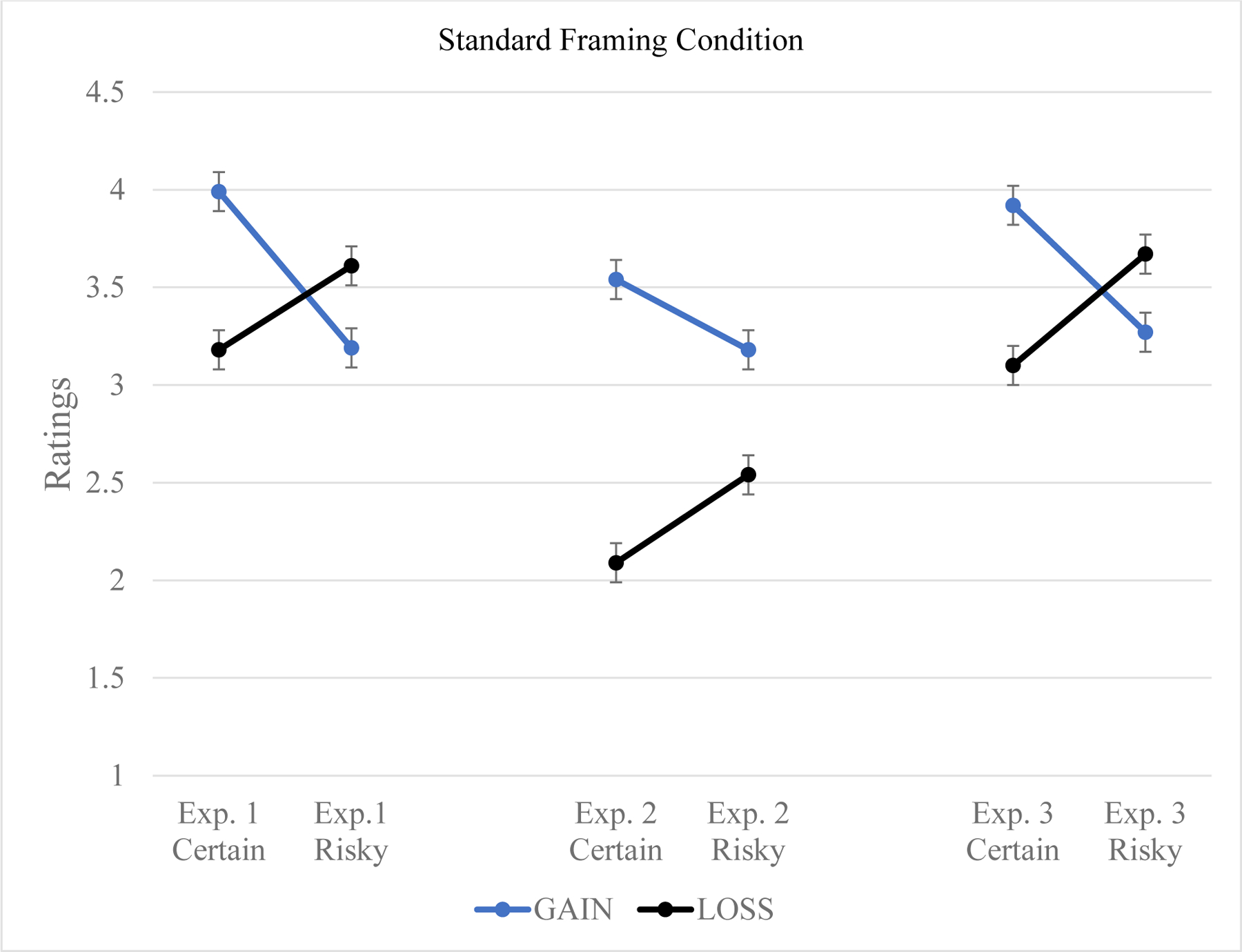
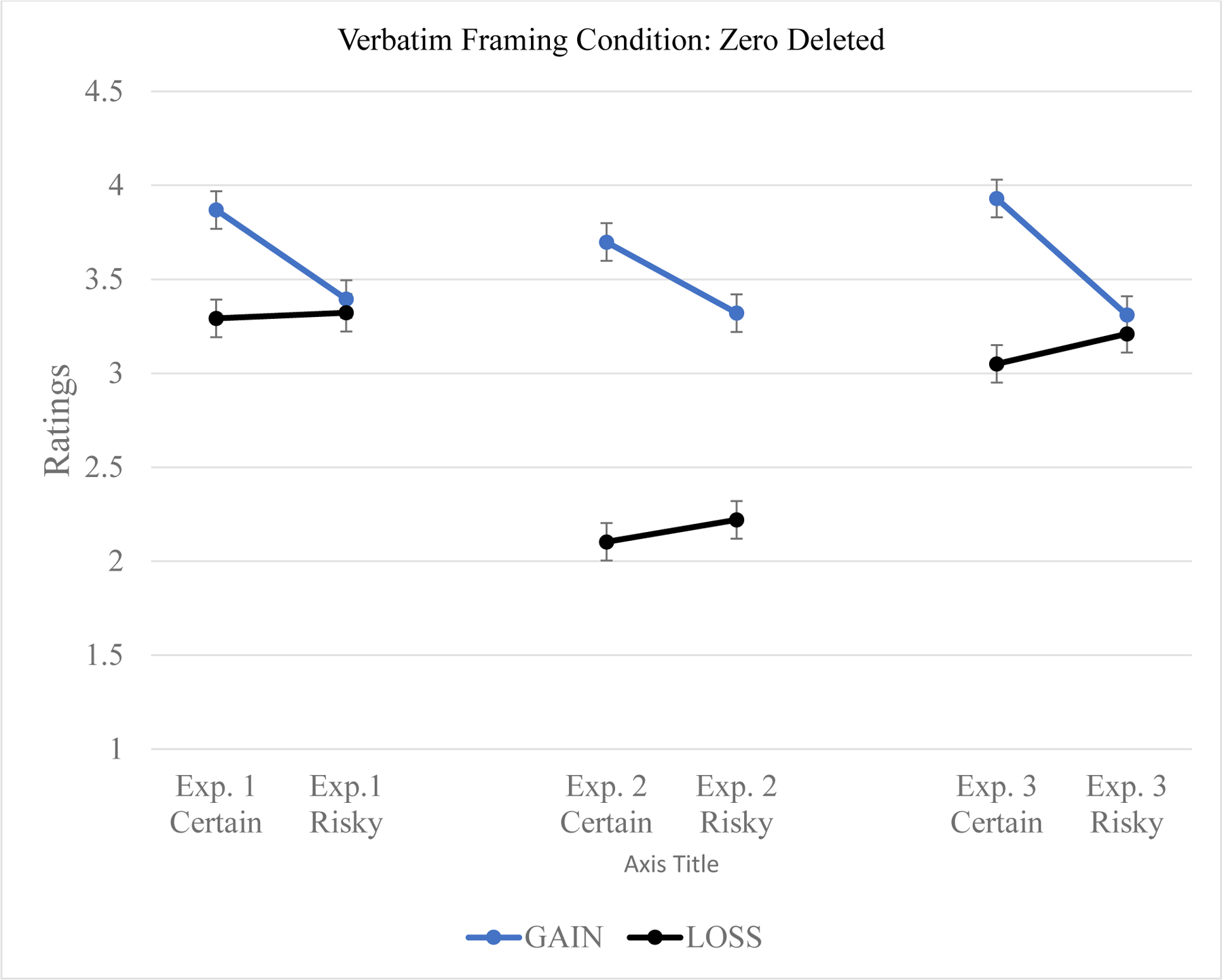
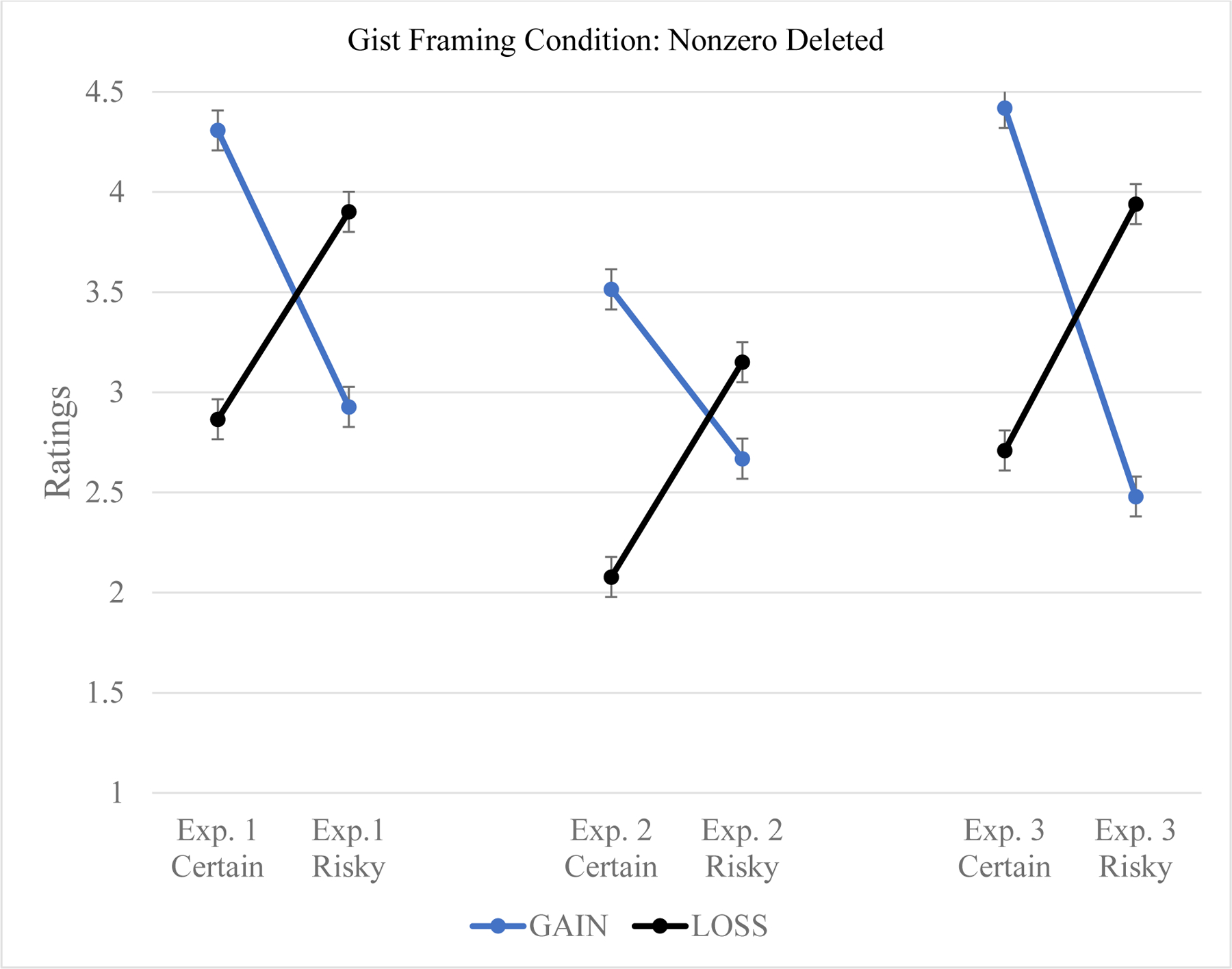
Mean Ratings of Certain and Risky Options for the Standard, Verbatim, and Gist Framing Conditions in Experiments 1, 2, and 3
General Discussion
Based on the original theory that introduced systematic predictions for risky choice framing, prospect theory, the violations of strong and weak rationality reflected in the framing effect should both result from judgments that participants make about the attractiveness of individual options. If the latter hypothesis is correct, choice should not be necessary to produce the effect. Rather, it should be possible to generate a parallel version of the effect in pure judgment tasks, in which participants simply rate the attractiveness of the certain and risky options of standard framing problems. The rationale for this prediction is that choices are a function of perceptions of the outcomes and the probabilities of those outcomes in risky choice tasks. Although separate hypotheses have addressed differences between choices and judgments, there are no mechanisms in any of the versions of prospect theory that predict differences between choices and judgments. In fact, according to prospect theory, choices are assumed to reflect the psychophysical judgments of quantities in decision problems.
Despite the important theoretical issues that are stake, surprisingly little research has been published about the relationship between judgments and risky-choice framing effects. The small number of prior experiments investigating whether judgments produced violations of strong and weak rationality were inconclusive, although we replicated their significant findings. Our much larger sample of decisions, along with modifications in procedures, produced consistent findings emulating risky choice framing when both options were presented.
Relative to that prior research, the present experiments yielded two broad findings. Most important, the data argue against the hypothesis that the framing effect results from processes that are unique to choice. Both violations of strong and weak rationality were clearly observed in attractiveness ratings of individual options. For standard framing problems, people did not judge certain and risky options to be equivalent despite being equal in expected value and these differences reversed for gains versus losses. These findings are consistent with prospect theory.
However, a number of crucial findings are not consistent with prospect theory. First, evaluations diverged for certain and risky options across truncation conditions, in accordance with the predictions of FTT. This divergence was observed for both gains and losses. The emphasis on the zero outcome in the gamble differed across truncation conditions. In theories such as prospect theory, zero literally does not matter and it should not change judgments. However, there was a powerful predicted effect of zero in these experiments. The information in all three truncation conditions was the same (instructions disambiguated problems and results were preserved when participants passed quizzes about these instructions), yet processing differed. Simply subtracting zero caused framing effects to weaken and to disappear for losses in all three experiments. In addition, simply subtracting zero made the risky gain and risky loss options indistinguishable when both options were provided, an effect that replicated across experiments. The contrast between the zero-deleted and non-zero deleted framing problems was especially stark.
Our results demonstrate the effectiveness of the truncation manipulation in judgments of risky options for the first time and track its effect in risky choice tasks. Although it seems a truism that people do not process decision quantities objectively, that is exactly what processing of the risky options in the zero-deleted conditions seemed to reflect: All four risky options (gains and losses in Experiments 1 and 3) in the zero-deleted condition were rated similarly, a pattern also observed in risky choice tasks. When both options were present, as in risky choice tasks, risky gains did not differ from risky losses when zero was deleted. Thus, in the zero-deleted condition, people exhibited both strong and weak rationality when they could compare options.
However, unlike most choice tasks, participants violated strong rationality for gains in the zero-deleted condition because ratings for the certain gain were elevated relative to the risky gain (or to the losses of either type). In all three experiments and in all three truncation conditions, certain gains were evaluated more positively than corresponding certain losses, consistent with attribute framing. Violations of strong rationality for gains in the zero-deleted condition are consistent with prospect theory but that does not explain why such effects were never observed for losses in any of the experiments. Given the disambiguating instructions, it is possible that participants inferred the missing zero complement in the zero-deleted condition, a mechanism that has been observed occasionally in risky choice framing (Chick et al., 2016). Nevertheless, risky options in the zero-deleted conditions did not differ between gain and loss frames when both options were presented, mimicking the lack of framing effects typically observed for risky choices when zero is deleted.
Framing differences emerged consistently when zero was introduced in the risky option, as in standard framing. Such differences became more pronounced when processing focused on zero alone in the risky option, and the complementary non-zero part of the gamble was backgrounded. These effects occurred for gains and losses and the truncation pattern was robust across experiments. Framing effects were especially large when participants could easily compare zero to non-zero outcomes across options, as in Experiments 1 and 3. All of these framing effects are predicted by FTT’s simple assumptions about zero versus non-zero differences in categorical gist. Results showed that participants were capable of processing verbatim quantities under conditions that de-emphasized zero —trading off outcome magnitudes and their probabilities, ultimately producing similar perceptions of equal-expected-value options. But the qualitative gist, in combination with affective values (e.g., saving lives is good), drove decisions when categorical distinctions between zero and non-zero were salient.
In general, patterns of judgments more closely mimicked those of choices when both options were available for comparison, even though only one option was rated. This finding is not consistent with prospect theory because perceptions of one option are not predicted to be affected by perceptions of the other option. However, consistent with prospect theory, in Experiment 2, people treated equivalent outcomes differently depending on whether they were described as upward deviations from a reference point—200 saved—or as downward deviations from that reference point—400 die. In particular, they exhibited attribute framing because they rated the upward deviations as more positive than the equivalent downward deviations. In isolation from other options, gains were generally viewed as positive and losses were viewed as negative (except when none was saved and none died, which reversed polarity, a losing-nothing-is-better effect). The difference in ratings between certain options in Experiment 2, especially in the zero-deleted condition, might be viewed as a straightforward measure of pure loss aversion, again, a concept consistent with prospect theory.
Indeed, ratings in the zero-deleted condition are the cleanest test of the psychophysical principles of prospect theory because the psychological effects of zero are eliminated. In that condition, when categorical gist is eliminated as a means of discriminating between options and the context provided by the other option is stripped away, there is some evidence that psychophysics can produce a small difference between options, but again only in the gain frame; differences in the loss frame were not obtained. Although this difference has only rarely been observed in choice experiments, ratings may afford a more sensitive measure of the perceptions of options, compared with choices.
These results also bear on the attentional account of framing bias, which Keren (2011) describes as follows: “The most prevailing facet of framing is to direct attention to some aspects (while suppressing others) that will enhance a particular interpretation and eventually result in a specific response. Indeed, the most fundamental explanation of framing effects may be in attentional terms: Given the capacity limitations of the cognitive system, some selection has to be made and different frames evidently direct attentional resources to different aspects by cueing the system toward one or the other attribute” (p. 21). However, although this account is broadly consistent post hoc with FTT’s predictions, FTT explains differences within frames (i.e., deletions focus attention on what remains), as opposed to only across frames (e.g., 200 saved does not necessarily evoke 400 die, and vice versa). Moreover, attention per se does not seem to add to FTT’s explanation grounded in research on mental representation (Reyna, 2012). Also, some results seem to contradict attentional and working-memory capacity limitations accounts. For example, in Experiment 2, more information was deleted, and thus attention was more focused on what remained (compared to the other experiments) and yet framing effects were relatively weaker not stronger. In addition, research has shown that framing effects occur when there is little burden on working memory (problems are written out in front of people), judgments and decisions based on gist are often independent of working-memory capacity (Reyna, 2012), and those with higher working-memory capacity have shown greater framing effects not lower effects (Corbin, McElroy, & Black, 2010). Working memory may contribute to censoring of framing effects (e.g., some individuals presented with both gains and losses notice and inhibit framing differences), but it does not explain the causes of framing effects to begin with (Broniatowski & Reyna, 2018).
Concluding Comments
Authors of literature reviews have pointed out that leading theories of the framing effect can be tested by understanding how participants judge individual options, and by comparing those processes to the ones involved in making choices between options (Kühberger & Gradl, 2013). However, the sparse literature on judgments of options has not provided conclusive evidence about the different theoretical possibilities (see also Keren, 2011). The main conclusions that emerged from prior work were that participants ignore risky options in favor of evaluating only certain options, and that the extent to which the framing effect is caused by choice-specific processes remained unclear.
The first conclusion grew out of data showing that ratings of certain options were sometimes affected by problem frame, but ratings of risky options never were. Those data were theoretically challenging because an explanation must be found for why participants would only evaluate certain options. For instance, Kühberger and Gradl (2013) proposed a valence-consistency explanation, which is congruent with the information leakage account of the framing effect (Sher & McKenzie, 2008). According to that explanation, only certain options attract evaluative processing because the valence of certain options is always unambiguous (positive in the gain frame, negative in the loss frame), whereas the valence of risky options is always mixed (positive and negative complements in both frames). The second conclusion (that the extent to which choice-specific processes cause the framing effect remains unclear) is a consequence of mixed findings on how participants evaluate certain options. Sometimes, they were evaluated in ways that are consistent with the framing effect (higher ratings in the gain frame than in the loss frame), but at other times, they were not.
The results of Experiments 1 and 3 resolved this latter uncertainty, as well as removing the theoretical complexity of having to explain why only the certain options would be evaluated. Our experiments implemented a high-power design in which many standard framing problems were administered to participants, who rated the attractiveness of certain options or risky options. The procedure of having participants rate the attractiveness of all four options, rather than simply choosing between pairs of certain and risky options, has the statistical advantage of doubling the degrees of freedom that are available to test theoretical predictions, from two to four. With traditional choice problems, one can separately measure the relative attractiveness of certain versus risky options in the gain frame and in the loss frame. That can also be done with the present judgment methodology, but further, one can measure the relative attractiveness of certain options in the gain and loss frames and the relative attractiveness of risky options in the gain and loss frames.
This design produced highly reliable effects that told a simple story under conditions similar to choice, namely, when the other option is available. With the other option present, judgments about certain and risky options can account for the framing effect because those judgments exhibit violations of both strong and weak rationality: Certain options were rated more highly than risky ones in the gain frame, risky options were rated more highly than certain ones in the loss frame, certain options were rated more highly in the gain frame than in the loss frame, and risky options were rated more highly in the loss frame than in the gain frame. All four differences were again observed in a between-subjects replication experiment.
The last of these four differences (i.e., risky options rated more highly in the loss than the gain frame) changed direction in Experiment 2 such that risky losses were evaluated more negatively than risky gains. This result demonstrates that removing comparisons between options reduces similarities between judgments and choices. (The evaluation of certain options across truncations also changed from Experiment 1 to 2; see below.) This effect of the context of other options indicates that purely psychophysical explanations of choice that focus on perceptions of individual options, such as prospect theory, are not tenable. Instead, choices reflect categorical contrasts both between options and within options—with a central role for zero in these contrasts, as predicted by an alternative theory of risky choice, FTT.
Another important set of results that adjudicates between theories was obtained for truncation manipulations. In risky choice tasks, truncation manipulations affect preference in specific ways originally predicted by FTT (and since replicated independently): the framing effect shrinks when the zero complement is deleted from risky options but it intensifies when the non-zero complement is deleted (e.g., Kühberger & Tanner, 2010; Reyna & Brainerd, 1991). When these manipulations were implemented with the present judgment tasks, the results were qualitatively similar to results with choice problems: Overall, the discrepancy between subjects’ ratings of certain versus risky options was largest in the non-zero truncation condition, intermediate in the standard condition, and smallest in the zero-truncation condition. These results are the first demonstration of truncation effects on framing using judgments, without having participants make choices either before or after making judgments.
The certain option did not change in the usual way across truncations in Experiment 2, when the risky option was not shown to participants. In the other two experiments in which the risky option was shown, the certain option soared to its highest level for gains and plunged to its lowest level for losses in the zero-emphasis condition. Strikingly, the pattern was exactly the reverse for the risky options in the zero-emphasis condition: A probability of losing nothing was evaluated as good and definitely better than a probability of gaining nothing, which was evaluated as bad. This pattern held in both such experiments for risky options supporting predictions of FTT but failing to support predictions of all utility-type theories, such as prospect theory, in which a probability of gaining or losing nothing is nothing. If one assumes that the complementary non-zero outcome was brought to mind, and thus the utility was not zero, this assumption cannot account for the large differences between the standard conditions (non-zero complement present) and zero-emphasis conditions (non-zero complement absent). These effects demonstrate the contextual relativity of gist--that losing nothing is good compared to losing something and gaining nothing is bad compared to gaining something. Crucially, a probability of losing nothing was rated as superior to a probability of gaining nothing, especially in the context of categorically contrasting outcomes (as in Experiments 1 and 3). Theoretically, contextual relativity of gist should generalize beyond effects of zero to any potential outcomes that differ categorically (in the psychological sense of being qualitatively different) across alternatives and that discriminate the alternatives (Reyna, 2012).
Overall, the key benefit of these results is that they greatly reduce the complexity of our theoretical task when it comes to explaining framing effects. That is, because framing effects observed using judged attractiveness of the certain and risky options of framing problems were generally analogous to framing effects in choice, they can be brought under the same theoretical umbrella. Thus, gist representations are likely involved in both judgments and choices, although fine-grained judgments may tap more precise representations. These results also suggest that choice preferences are inherently comparative and are driven by the simplest gist that distinguishes some quantity from none. Taken together, our results show that decision makers exhibit a range of capabilities for decisions with the same objective content, ranging from strong and weak rationality to systematic violations of rationality, namely, opposite gain-loss preferences based on the presence or absence of zero. Our results further support recent efforts to develop formal models that incorporate assumptions that differ fundamentally from traditional decision theories (Broniatowski & Reyna, 2018; Reyna & Brainerd, 2011).
Supplementary Material
Acknowledgments
Preparation of this manuscript was supported by grants from the USDA National Institute of Food and Agriculture (grant 1003856, accession no. NYC-321444 and NYC-321407), National Institutes of Health (RC1AG036915), National Institute of Nursing Research (R01NR014368), and National Science Foundation (SES1536238).
References
- Brainerd CJ, & Reyna VF (2005). The science of false memory. New York: Oxford University Press. [Google Scholar]
- Brainerd CJ, & Reyna VF (2016). Fuzzy-trace theory and lifespan cognitive development. Developmental Review. 38, 89–121. [DOI] [PMC free article] [PubMed] [Google Scholar]
- Broniatowski DA, & Reyna VF (2018). A formal model of fuzzy-trace theory: Variations on framing effects and the Allais Paradox. Decision, 5(4), 205–252. 10.1037/dec0000083 [DOI] [PMC free article] [PubMed] [Google Scholar]
- Chick CF, Reyna VF, & Corbin JC (2016). Framing effects are robust to linguistic disambiguation: A critical test of contemporary theories. Journal of Experimental Psychology: Learning, Memory, and Cognition, 42, 238–256. 10.1037/xlm0000158 [DOI] [PMC free article] [PubMed] [Google Scholar]
- Corbin J, McElroy T, & Black C (2010). Memory reflected in our decisions: Higher working memory capacity predicts greater bias in risky choice. Judgment and Decision Making, 5(2), 110–115. [Google Scholar]
- Fischer GW, & Hawkins SA (1993). Strategy compatibility, scale compatibility, and the prominence effect. Journal of Experimental Psychology: Human Perception and Performance, 29, 580–597. [Google Scholar]
- Gamliel E, & Kreiner H (2020). Applying fuzzy-trace theory to attribute-framing bias: Gist and verbatim representations of quantitative information. Journal of Experimental Psychology: Learning, Memory, and Cognition, 46(3), 497 506. 10.1037/xlm0000741 [DOI] [PubMed] [Google Scholar]
- Kahneman D, & Tversky A (1979). Prospect theory: An analysis of decision under risk. Econometrica, 47, 263–291. 10.2307/1914185 [DOI] [Google Scholar]
- Keren G (2011). On the definition and possible underpinnings of framing effects: A brief review and a critical evaluation. In Keren G (Ed.) Perspectives on framing (pp. 3–33). New York: Psychology Press. [Google Scholar]
- Kühberger A (1998). The influence of framing on risky decisions: A meta-analysis. Organizational Behavior and Human Decision Processes, 75, 23–55. [DOI] [PubMed] [Google Scholar]
- Kühberger A, & Gradl P (2013). Choice, rating, and ranking: Framing effects with different response modes. Journal of Behavioral Decision Making, 26, 109–117. [Google Scholar]
- Kühberger A, & Tanner C (2009). Risky choice framing: Task versions and a comparison of prospect theory and fuzzy-trace theory. Journal of Behavioral Decision Making, 23(3), 314–329. 10.1002/bdm.656 [DOI] [Google Scholar]
- Lampinen JM (2016). ROC analyses in eyewitness identification research. Journal of Applied Research in Memory and Cognition, 5, 21–33. [Google Scholar]
- Lampinen JM, Erickson WB, Moore KN, & Hittson A (2014). Effects of distance on face recognition: Implications for eyewitness identification. Psychonomic Bulletin & Review, 21, 1489–1494. [DOI] [PubMed] [Google Scholar]
- LeBoeuf RA, & Shafir E (2003). Deep thoughts and shallow frames: On the susceptibility to framing effects. Journal of Behavioral Decision Making, 16, 77–92. 10.1002/bdm.433 [DOI] [Google Scholar]
- Levin IP, & Gaeth GJ (1988). How consumers are affected by the framing of attribute information before and after consuming the product. Journal of Consumer Research, 15, 374–378. [Google Scholar]
- Levin IP, Schneider SL, & Gaeth GJ (1998). All frames are not created equal: A typology and critical analysis of framing effects. Organizational Behavior & Human Decision Processes, 76, 149–188. [DOI] [PubMed] [Google Scholar]
- Li Z, Rohde KIM, & Wakker PP (2017). Improving one’s choices by putting oneself in others’ shoes—An experimental analysis. Journal of Risk and Uncertainty, 54(1), 1–13. 10.1007/s11166-017-9253-3 [DOI] [Google Scholar]
- Mandel DR, & Kapler IV (2018) Cognitive style and frame susceptibility in decision-making. Frontiers in Psychology, 9, 1461. doi: 10.3389/fpsyg.2018.01461 [DOI] [PMC free article] [PubMed] [Google Scholar]
- McKenzie CR (2004). Framing effects in inference tasks—and why they are normatively defensible. Memory and Cognition, 32, 874–885. [DOI] [PubMed] [Google Scholar]
- McKenzie CR & Nelson JD (2003). What a speaker’s choice of frame reveals: Reference points, frame selection, and framing effects. Psychonomic Bulletin & Review, 10, 596–602. [DOI] [PubMed] [Google Scholar]
- Peters E, & Levin IP (2008). Dissecting the risky-choice framing effect: Numeracy as an individual-difference factor in weighting risky and riskless options. Judgment and Decision Making, 3, 435–448. [Google Scholar]
- Reyna VF, & Brainerd CJ (1991). Fuzzy-trace theory and framing effects in choice. Gist extraction, truncation, and conversion. Journal of Behavioral Decision Making, 4, 249–262. [Google Scholar]
- Reyna VF, & Brainerd CJ (2011). Dual processes in decision making and developmental neuroscience: A fuzzy-trace model. Developmental Review, 31, 180–206. [DOI] [PMC free article] [PubMed] [Google Scholar]
- Reyna VF, Chick CF, Corbin JC, & Hsia AN (2014). Developmental reversals in risky decision making: Intelligence agents show larger decision biases than college students. Psychological Science, 25, 76–84. [DOI] [PMC free article] [PubMed] [Google Scholar]
- Reyna VF, Estrada SM, DeMarinis JA, Myers RM, Stanisz JM, & Mills BA (2011). Neurobiological and memory models of risky decision making in adolescents versus young adults. Journal of Experimental Psychology: Learning, Memory, and Cognition, 37, 1125–1142. [DOI] [PubMed] [Google Scholar]
- Reyna VF, Helm RK, Weldon RB, Shah PD, Turpin AG, & Govindgari S (2018). Brain activation covaries with reported criminal behaviors when making risky choices: A fuzzy-trace theory approach. Journal of Experimental Psychology: General, 147(7), 1094–1109. 10.1037/xge0000434 [DOI] [PMC free article] [PubMed] [Google Scholar]
- Sher S, & McKenzie CR (2008). Framing effects and rationality. In Chater N, & Oaksford M (Eds.), The probabilistic mind: Prospects for Bayesian cognitive science (pp. 79–96). Oxford, England: Oxford University Press. [Google Scholar]
- Steiger A, & Kühberger A (2018). A meta-analytic re-appraisal of the framing effect. Zeitschrift für Psychologie, 226(1), 45–55. 10.1027/2151-2604/a000321 [DOI] [Google Scholar]
- Tversky A, & Kahneman D (1981). The framing of decisions and the psychology of choice. Science, 211, 453–458. [DOI] [PubMed] [Google Scholar]
- Tversky A, & Kahneman D (1992). Advances in prospect theory: Cumulative representation of uncertainty. Journal of Risk and Uncertainty, 5, 297–323. 10.1007/BF00122574 [DOI] [Google Scholar]
- Tversky A, Slovic P, & Kahneman D (1990). The causes of preference reversal. American Economic Review, 80, 204–217. [Google Scholar]
- Zhang Y, & Slovic P (2019). Much ado about nothing: The zero effect in life‐saving decisions. Journal of Behavioral Decision Making, 32, 30–37. 10.1002/bdm.2089 [DOI] [Google Scholar]
Associated Data
This section collects any data citations, data availability statements, or supplementary materials included in this article.