



Abstract
Introduction and importance
Self-inflicted abdominal stab injury with an intention of self-harm is uncommon. Moreover, self-inflicted injury leading to avulsion of the colon has rarely been reported in the literature. We report a case of a 42-years-female with schizoaffective disorder who presented with self-inflicted stab injury on the abdomen resulting in abdominal evisceration.
Presentation of case
A 42-years-female with schizoaffective disorder (F25) for 10 years presented to the emergency department with multiple, self-inflicted injuries on the abdomen. A large free portion of the omentum and segment of the bowel were brought in a plastic carry bag. Examination revealed multiple transverse hesitation cuts in the epigastrium and a single deep penetrating transverse cut resulting in the evisceration of the omentum and colon. Intra-operatively, avulsion of a large portion of the greater omentum and missing segment of the mid transverse colon was observed. The patient underwent an immediate abdominal exploration and side-to-side colo-colic anastomosis along with diversion ileostomy. At three months following primary surgery, ileostomy closure was done.
Conclusion
Patients with schizophrenia spectrum psychosis are at risk of self-harm and in our case a schizoaffective patient presented with self-inflicted injuries that required an emergency abdominal exploration and repair. This case highlights a multi-disciplinary approach for the management of these cases and mandates clinicians and caregivers to be more vigilant to restrict injuries in the future.
Keywords: Self-inflicted injury, Abdominal evisceration, Colon injury, Schizoaffective disorder
Highlights
-
•
Self-inflicted abdominal stab injuries resulting in segmental transection of the transverse colon is rare.
-
•
Self-inflicted injuries in psychotic patients can occur without any warning signs and despite treatment compliance.
-
•
Severe injuries on the abdomen can be life threatening and requires emergent surgical management.
1. Introduction
Self-infliction injuries are acts of deliberately harming one's own body with or without an intention of committing suicide [1]. They may be associated with risk factors like adolescence, negative life events, history of childhood sexual abuse, personal and environmental factors, low emotional expressivity, and low self-esteem [2]. Self-infliction injuries may include injuries to any part of the body; nevertheless not many cases related to colon injuries have been recorded. Colon injury has been reported in 15% to 39% of patients with penetrating abdominal injuries and the ascending and transverse colon are the most commonly injured segments [3]. The mechanism of injury to the colon commonly involves penetrating injuries as stab and gunshot injury, blunt trauma, and de-vascularization injury secondary to avulsion of the supporting mesentery. The treatment choices available for colon injuries are exploration with primary repair (suture repair or resection and anastomosis) and diversion with stoma formation [4]. This work has been reported in line with the SCARE criteria [5].
2. Case presentation
A 42-years-female with schizoaffective disorder (F25) for 10 years presented with multiple transverse hesitation cuts in the epigastrium with a single deep penetrating transverse cut resulting in the evisceration of the omentum and colon.
At presentation in the emergency room (ER), she was conscious, pale with a blood pressure of 90/60 mmHg, pulse 120 beats per minute, and respiratory rate of 22 breaths per minute. On examination, multiple transverse hesitation cuts on the epigastrium and large transverse penetrating cut measuring 10 × 3 cm in the epigastrium with evisceration of omentum and parts of the bowel were seen. A large free portion of the omentum and segment of the bowel was brought along in a plastic carry bag.
After resuscitation, the patient was transferred to the operating room within fourty-five minutes since injury and abdomen was explored through a midline incision. Intra-operatively, intraperitoneal hematoma with avulsion of a large portion of the greater omentum and missing segment of the mid transverse colon was observed (Fig. 1). However, no solid organ injuries were noted. Thorough peritoneal lavage was done, all omental vessels were suture ligated, either margins of the transverse colon refreshed followed by side-to-side colo-colic anastomosis after mobilizing the left and right colon (Fig. 2). A diversion ileostomy was made and the abdomen was closed with a drain in the pelvis.
Fig. 1.
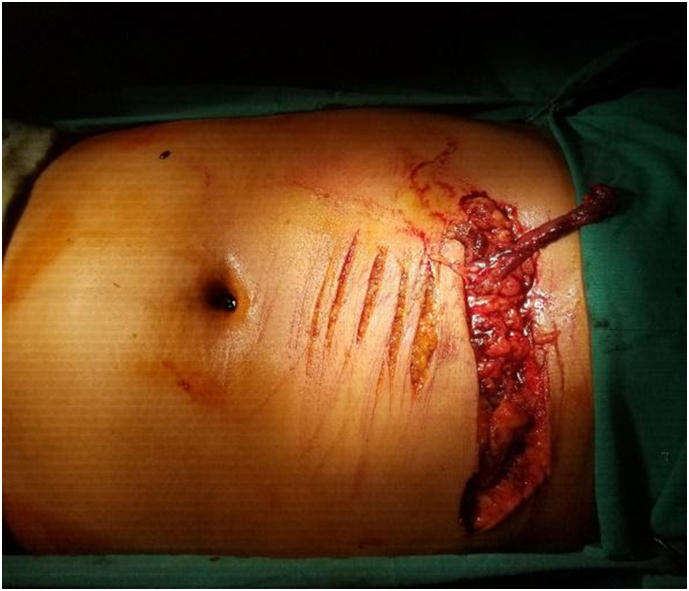
Picture showing multiple transverse hesitation cuts and a single deep penetrating transverse cut with avulsed transverse colon.
Fig. 2.

Picture showing colo-colic anastomosis at the time of surgery.
Her post-operative period was uneventful and she was discharged on the 9th postoperative day. She was on her regular follow-up with the surgical and psychiatry department and later underwent ileostomy closure after 3 months of the primary surgery.
3. Discussion
Despite low mortality rates, self-inflicted injuries can be associated with significant morbidities and they mostly occur in the background of mental illness. A study by Arpi et al. reports the most common method for attempted suicide and self-inflicted injury to be poisoning (68%) and cutting or piercing (20%) [6]. An extensive study by Herpertz et al. describes common methods of self-harm in psychiatric patients to be skin cutting, head and limb banging, skin burning, and severe skin scratching [7]. Careful monitoring of these patients and restricting access to means of self-harm are of paramount importance.
It is important to recognize alarming features of suicidal thoughts and ideas, death wishes and plans, accessibility to means, and methods of committing suicides that apprehend a tendency to attempt suicide. A history of self-infliction or prior suicidal attempts amongst these individuals could be present. This can predict those who are at possible risk of committing suicide or inflicting severe injuries to themselves. In our case, there was no history of previous suicidal attempts or self-harm and our patient had been compliant with her psychiatric treatment. Moreover, the clinicians tried to evaluate the cause of self-infliction and the stressor that led to trauma and our patient admitted to stabbing herself but did not know as to why she did it. They ruled out concurrent hallucinatory experience that could have possibly enacted the act of injury.
A review on self-inflicted injuries by David et al. reported the requirement of surgical management for nearly 75% of self-inflicted wounds [8]. Primary repair can be performed for injuries involving <50% of the colonic wall, however, injuries involving >50% of the colonic wall or extensive mesenteric injuries require resection with anastomosis. Fecal diversion should be considered as a damage control surgery in critically ill patients [9].
Patients sustaining penetrating colon injury without signs of shock, significant hemorrhage, severe contamination, or delay to surgical intervention can be managed with colon repair or resection with anastomosis rather than routine colostomy.
4. Conclusions
Safekeeping and supervision of psychotic patients are of utmost importance, and mandates clinicians and caregivers to be more vigilant. However, the question remains unanswered as to what stressors lead to such life-threatening injuries in these patients who are compliant with medications and otherwise stable.
Declaration of competing interest
Nothing to state.
Acknowledgments
Acknowledgement
The authors acknowledge the patient for consenting to the case details and photographs for publication.
Ethical approval
Not required.
Funding
None.
CRediT authorship contribution statement
Anuj Parajuli (AP) and Aakash Mishra (AM) = Study concept, Data collection, Original draft preparation.
AP and Suman Kumar Shrestha (SKS) = Surgical care of the patient.
Roshan Ghimire (RG) = Editing of the manuscript.
SKS = Senior author and Manuscript reviewer.
All authors were involved in reviewing the final draft of the manuscript.
All authors have made a significant contribution to preparing the case report.
Guarantor
Aakash Mishra accepts full responsibility for the work and/or the conduct of the study, had access to the data, and controls the decision to publish.
Registration of research studies
Not applicable.
Consent for publication
Written informed consent was obtained from the patient for publication of this case report and accompanying images. A copy of the written consent is available for review by the Editor-in-Chief of this journal on request.
Note
No patient and author details are included in the figure.
Provenance and peer review
Not commissioned, externally peer-reviewed.
References
- 1.Hawton K., Harriss L., Hall S., Simkin S., Bale E., Bond A. Deliberate self-harm in Oxford, 1990–2000: a time of change in patient characteristics. Psychol. Med. 2003;33:987–995. doi: 10.1017/S0033291703007943. [DOI] [PubMed] [Google Scholar]
- 2.Fliege H., Lee J.-R., Grimm A., Klapp B.F. Risk factors and correlates of deliberate self-harm behavior: a systematic review. J. Psychosom. Res. 2009;66:477–493. doi: 10.1016/j.jpsychores.2008.10.013. [DOI] [PubMed] [Google Scholar]
- 3.Park, editor. Trauma Handb. Elsevier; 2009. Colon and rectal trauma; pp. 235–242. [DOI] [Google Scholar]
- 4.Choi W.J. 2011;27:166. doi: 10.3393/jksc.2011.27.4.166. [DOI] [PMC free article] [PubMed] [Google Scholar]
- 5.Agha R.A., Franchi T., Sohrabi C., Mathew G., Kerwan A., Thoma A., Beamish A.J., Noureldin A., Rao A., Vasudevan B., Challacombe B., Perakath B., Kirshtein B., Ekser B., Pramesh C.S., Laskin D.M., Machado-Aranda D., Miguel D., Pagano D., Millham F.H., Roy G., Kadioglu H., Nixon I.J., Mukherjee I., McCaul J.A., Ngu J.Chi-Yong, Albrecht J., Rivas J.G., Raveendran K., Derbyshire L., Ather M.H., Thorat M.A., Valmasoni M., Bashashati M., Chalkoo M., Teo N.Z., Raison N., Muensterer O.J., Bradley P.J., Goel P., Pai P.S., Afifi R.Y., Rosin R.D., Coppola R., Klappenbach R., Wynn R., Wilde R.L.De, Surani S., Giordano S., Massarut S., Raja S.G., Basu S., Enam S.A., Manning T.G., Cross T., Karanth V.K.L., Kasivisvanathan V., Mei Z. The SCARE 2020 guideline: updating consensus Surgical CAse REport (SCARE) guidelines. Int. J. Surg. 2020;84:226–230. doi: 10.1016/j.ijsu.2020.10.034. [DOI] [PubMed] [Google Scholar]
- 6.Doshi A., Boudreaux E.D., Wang N., Pelletier A.J., Camargo C.A. National study of US emergency department visits for attempted suicide and self-inflicted injury, 1997–2001. Ann. Emerg. Med. 2005;46:369–375. doi: 10.1016/j.annemergmed.2005.04.018. [DOI] [PubMed] [Google Scholar]
- 7.Herpertz S. Self-injurious behaviour psychopathological and nosological characteristics in subtypes of self-injurers. Acta Psychiatr. Scand. 1995;91:57–68. doi: 10.1111/j.1600-0447.1995.tb09743.x. [DOI] [PubMed] [Google Scholar]
- 8.David J.A., Rifkin W.J., Chiu E.S. Current management of self-inflicted wounds in surgery: a critical review. Ann. Plast. Surg. 2018;81:S79–S88. doi: 10.1097/SAP.0000000000001706. [DOI] [PubMed] [Google Scholar]
- 9.Yamamoto R., Logue A., Muir M. Colon trauma: evidence-based practices. Clin. Colon Rectal Surg. 2018;31:011–016. doi: 10.1055/s-0037-1602175. [DOI] [PMC free article] [PubMed] [Google Scholar]