



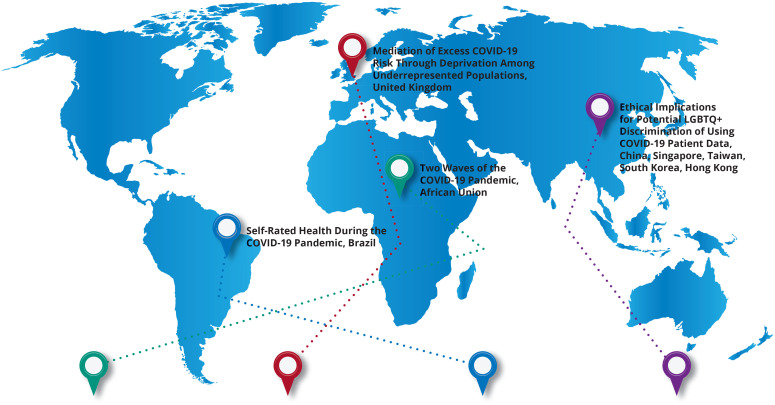
The Two Waves of the COVID-19 Pandemic in Africa
Salyer et al. performed the first comprehensive review of COVID-19 data from all 55 African Union member states collected between February 14 and December 31, 2020. By December 31, African countries reported 2 763 421 COVID-19 cases and 65 602 deaths, accounting for 3.4% of cases and 3.6% of deaths globally. More than 80% of reported cases were from 9 of the 55 countries, and 18 countries reported case fatality rates greater than the global rate of 2.2%. At the peak of the first wave in July 2020, on average, 18 273 new cases were reported daily. During the second wave, this number increased to 23 790. However, the number of member states with stringent social measures decreased from 48 during the first wave to 36 as of December 31, 2020. Salyer et al. concluded that the African continent's second wave of the COVID-19 pandemic was more severe than its first wave.
Citation. Salyer SJ, Maeda J, Sembuche S, et al. The first and second waves of the COVID-19 pandemic in Africa: a cross-sectional study. Lancet. 2021;397(10281):1265–1275. https://doi.org/10.1016/S0140-6736(21)00632-2
The Mediation of Excess COVID-19 Risk Through Deprivation Among Underrepresented Populations
Although there is growing evidence that COVID-19 risk is disproportionately higher among underrepresented populations, there is a dearth of evidence regarding the influence of material deprivation on this association. The authors conducted a mediation analysis involving a 4-way counterfactual approach using UK Biobank data with linked COVID-19 outcomes to determine the role of deprivation in the excess risk of COVID-19 among ethnic minorities. Models that shifted 25% of the most deprived individuals from deprivation resulted in a 40% to 50% reduction of excess COVID-19 risk among South Asian and Black individuals, suggesting that policies targeting material deprivation could substantially reduce the excess risk of COVID-19 in underrepresented populations.
Citation. Razieh C, Zaccardi F, Islam N, et al. Ethnic minorities and COVID-19: examining whether excess risk is mediated through deprivation. Eur J Public Health. 2021; Epub ahead of print. https://doi.org/10.1093/eurpub/ckab041
Brazilians' Self-Rated Health During the COVID-19 Pandemic
The spread of COVID-19 in Brazil prompted its government to release recommendations and various initiatives, such as physical distancing and business closures, with the goal of preventing transmission. Szwarcwald et al. used results from the ConVid Behavior Survey—a cross-sectional Web-based study carried out from April through May 2020 in Brazil—to identify factors contributing to lower self-rated health during the COVID-19 pandemic. The authors found that 29.4% of the 45 161 participants included in the study reported worsening health, with women having significantly greater odds of reporting worsening health. People who reported seeking mental health care, seeking care for COVID-19, sleep problems, worsening back pain, depression, sedentary behaviors, and adhering to social distancing, among other factors, were associated with reporting worsening health status. The authors conclude that a multitude of social, health, and behavioral factors have affected self-rated health during the COVID-19 pandemic in Brazil.
Citation. Szwarcwald CL, Damacena GN, Barros MBA, et al. Factors affecting Brazilians' self-rated health during the COVID-19 pandemic. Cad Saude Publica. 2021;37(3):e00182720. https://doi.org/10.1590/0102-311X00182720
Ethical Implications for Potential LGBTQ+ Discrimination of Using COVID-19 Patient Data
Multiple countries in the Asia-Pacific region are using big data to identify and track COVID-19–positive individuals and to alert others of possible exposure to COVID-19. The use of big data in tracking COVID-19 cases is pivotal but poses significant ethical concerns for individual privacy. The authors used the principle of double effect, which states that 4 conditions must be met to use data with both good and bad effects, to determine whether data usage was ethical in specific circumstances. For example, the second clause of the principle of double effect states that a good effect must not result from a bad effect. In South Korea, information disclosure on COVID-19 cases revealed secondary issues, including stigmatization of LGBTQ+ (lesbian, gay, bisexual, transgender, queer) neighborhoods and revealing LGBTQ+ status to families of those affected. This analysis highlights the need to deliberate about surveillance tools that use private data before releasing the data to the public to retain public trust and privacy.
Citation. Ngan OMY, Kelmenson AM. Using big data tools to analyze digital footprint in the COVID-19 pandemic: some public health ethics considerations. Asia Pac J Public Health. 2021;33(1):129–130. https://doi.org/10.1177/1010539520984360
Footnotes
Prepared by Rebekah C. Hughes, Ahlam K. Abuawad, Vrinda Kalia, Megan E. Marziali, and Luis E. Segura. Columbia University, New York, NY. Correspondence should be sent to the AJPH Global News Team at les2196@cumc.columbia.edu.