



Abstract
Most large employers self-insure their employee health benefits, creating a motivation for employers to improve health care’s value.
Employers who are also health care providers can aim for value through the direct provision of clinical services, not just through wellness programs or the design of insurance products.
Innovation and design methods can be systematically applied to health care problems to guide decisions about solutions which should or should not be scaled.
A virtual, on-demand urgent care service provided by a health care provider organization to its employees has the potential to reduce unnecessary emergency department visits and decrease the total cost of care.
Keywords: Innovation, Avoidable emergency department visits, Employee health, Telemedicine, Design
Background
Most large employers are self-insured, assuming the financial risk of health care costs for their covered employees and family members1. In these arrangements, insurance companies provide administrative support and claims processing, but the employers are at risk for the total cost of care and can influence the design of insurance benefits. When the employers are also health care provider organizations, they can manage their employees’ health through the creation of direct clinical programs. As the employer, insurer, and provider of care, they have a financial advantage over traditional insurance plans when they replace costlier care settings that are often required as a condition of conventional reimbursement with less costly delivery models, such as telemedicine care. In conventional arrangements these services might be avoided by providers all together because they are not reimbursed. In addition, in using their own clinical programs, and making those programs easy to reach by their employees, they effectively drive that care into their system. They are not paying other organizations or clinicians to provide that care. Therefore, they obtain those services for their employees at wholesale rather than resale prices—or at least they are able to distribute margins in more efficient ways through the organization. These opportunities to disintermediate conventional insurance create a laboratory for health care provider organizations to conceive, test, and refine clinical programs that might be valuable to employees and non-employee patient populations under alternative payment models.2–4
In 2010, emergency department (ED) visits accounted for an estimated $328 billion in the U.S., and 20% were potentially avoidable5. As the number and related costs associated with ED visits continue to grow6, identifying clinically appropriate, and lower cost alternatives for low-acuity needs could be critical for stemming rising costs in employer-sponsored and non-sponsored plans. In 2014, 25% of the ED use among University of Pennsylvania Health System (“Penn Medicine”) employees was felt to be avoidable, motivating Penn Medicine to identify solutions. We describe the three-year journey of applying design and innovation principles to understand drivers of avoidable ED use, develop a telemedicine-based solution, and operationalize the service.
Organizational context
Penn Medicine is a large academic medical center serving large portions of southeast Pennsylvania, New Jersey, and Delaware, with six acute care facilities and hundreds of outpatient practices. Penn Medicine provides its employees a Preferred Provider Organization (PPO) health plan as the only insurance option, covering over 50,000 lives including employees and their families. As a large provider organization, Penn Medicine offers a broad range of highly regarded and advanced clinical services. For that reason, Penn Medicine has two motivations for encouraging employees to receive their care from Penn Medicine providers: (1) care provided by Penn Medicine is of high-quality, and (2) purchasing services from within the organization enables Penn Medicine to purchase care at cost. Already, Penn Medicine is the provider of choice for the majority of its employees.
As is common in other organizations, decisions about employee benefits at Penn Medicine were made by leadership in Penn Medicine’s Human Resources department who aim to provide employees with generous access to services with great value to the employee in order to maintain Penn Medicine as an employer of choice. Like many other employers, decisions about benefits plans historically had been aided by commercial third-party administrators who provided guidance based on benchmarks from other organizations. Increasingly, Penn Medicine has adopted a model of internal strategic decision making and guidance given a strong relationship with academic and university faculty at the University of Pennsylvania’s Perelman School of Medicine and Wharton School, where leadership and business education occurs at the University.
Personal context
The Penn Medicine center for Health Care Innovation (CHCI)
When the Center for Health Care Innovation was created in 2012,7,8 the health and wellbeing of Penn Medicine’s employees was one of CHCI’s first assignments. During this time, innovation centers were being created by a number of health systems with a wide range of objectives: technology transfers and commercialization, app development, and redesign of care processes. CHCI focused largely on redesigning care processes. Penn Medicine’s CEO at the time, Ralph Muller, requested, “We are a $6 billion operation. Don’t start new companies. Make us better at what we currently do.” With that directive, CHCI was staffed with a cross-functional group of clinicians, project managers, economists, statisticians and, centrally, designers. While some staff members are on an academic promotion track within the University of Pennsylvania, CHCI is staffed largely by individuals supported by operational funds from Penn Medicine, not grant dollars. Similarly, while grant dollars can support the work and efforts within CHCI and traditional academic publications are encouraged, it is funded as an operational arm of the health system in support of Penn Medicine’s objectives—to improve the quality of care delivered to patients, enhance revenue, lower cost, and improve the welfare of employees and the community. Many of the innovation products of CHCI are later tested using conventional health-services research approaches, depending on the level of evidence requested from Penn Medicine leadership.
Penn Medicine’s Human Resources department partnered with CHCI to evaluate and improve the design of employee health care benefits (e. g., changing insurance structure or programs offered) to improve health outcomes, experience, and utilization. This focus was believed to offer three opportunities: (1) Penn Medicine could develop ways to provide better care for its employees, (2) successful models might translate to improvements for Penn Medicine’s patients more generally, and (3) successful models might be directly offered to employees of large regional employers.
Early on, CHCI took advantage of Penn’s university environment to sponsor a student team within a semester-long consulting course through Wharton’s Master of Business Administration (MBA) program. The team identified that 11 Penn Medicine employees visited an ED per day on average, often for conditions that could have been treated in outpatient settings. This objective data from a trusted source outside of the health system was critical for persuading leadership to prioritize the challenge.
Problem
Avoidable ED visits were identified as an opportunity to lower costs among Penn Medicine employees. In an analysis of Fiscal Year (FY) 2014 claims, nearly one in five insured plan members had an ED visit, costing the institution $7.0 million. An estimated 50% of these visits were considered avoidable9. In addition, among ED visits, 50% of spending occurred in non-Penn Medicine EDs. Two opportunities were apparent: reducing avoidable ED visits could result in cost savings and reducing the proportion of non-Penn Medicine ED utilization was an opportunity to generate revenue and potentially improve the quality of care. The challenge for CHCI was to understand why avoidable ED visits and ED visits outside of Penn Medicine were occurring so frequently, then develop strategies for intercepting and redirecting plan members to Penn Medicine facilities or lower cost alternatives that treat conditions currently managed in EDs.
The Double Diamond
To solve care delivery challenges, CHCI uses an iterative, disciplined approach toward specifying problems and testing solutions. Formally, the process involves four components consisting of divergent and convergent action as represented by a Double Diamond framework (Fig. 1). Divergent actions are those that expand the area of knowledge and the range of possible actions. Convergent actions seek to concentrate the information gathered or created in the divergent phases to focus the path forward. The first diamond clarifies the problem origins and identifies measurable goals for improvement. The second diamond creates a wide range of possible solutions and through rapid experimentation identifies the solutions likely to succeed.
Fig. 1.

Double Diamond Framework used to guide the innovation process at Penn Medicine.
Discipline is balanced by flexibility. Within this framework, mental pauses are planned to broaden and critically question prior assumptions along the way. The innovation process model can be taken too seriously or too far. Sometimes the steps are obvious and omittable, or it’s better to move in directions other than left to right. Defining a measurable outcome is the most important step to ensure efforts are well-aimed and metrics of success are clear. However, the process of defining the appropriate solution is iterative and can reveal whether the correct outcome is being measured.
Diamond 1: discover and define the problem
Discover
To discover, contextual inquiry is used to understand why patients present to the ED for avoidable reasons. First, CHCI interviewed eight patients with low-acuity needs in Penn Medicine’s EDs who had a similar demographic makeup as Penn Medicine employees – younger than 65 and privately insured – asking them to share the decision leading up to their current ED visit. At the request of the institution’s privacy officer, Penn Medicine employees were not interviewed to avoid the perception that their employer was monitoring employees’ individual health care use.
Second, contextual inquiry interviews were extended to providers and practice administrators to understand their perspectives on why patients present to the ED for avoidable conditions. Nurses that staff a Nurse Access (NAC) Line at one of Penn Medicine’s largest primary care practices were interviewed and observed. Patients of the practice can use the NAC Line for urgent health needs, and a registered nurse provides self-care advice, contacts a patient’s primary care provider (PCP) when necessary, schedules subsequent in-person sick visits, and directs patients to the ED when clinically indicated.
Third, published studies exploring why patients present to the ED instead of lower-acuity settings for low-acuity conditions were reviewed.10–13
Based on the learnings from the discover phase, patients had multiple barriers to receiving outpatient modes of care when urgent needs arose and wanted care pathways that were more easily accessible, could solve their clinical needs without multiple redirections, were conveniently located, and could be accessed during times convenient for them, not just convenient to providers (Fig. 2).
Fig. 2.
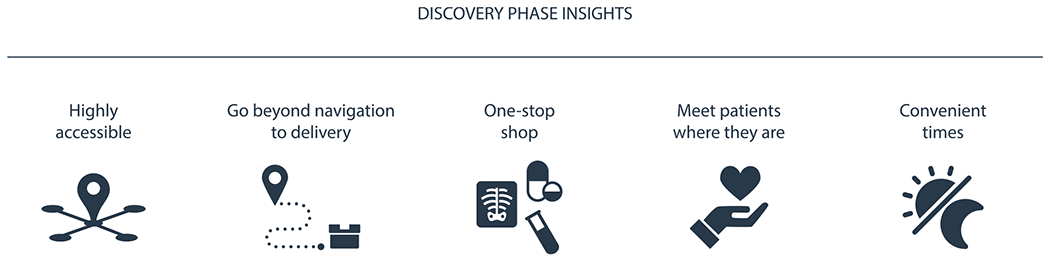
Insights from patients, providers, and the literature about what patients want when they have urgent, low-acuity needs.
Define
The define step helps formulate the problem to be solved and the solution’s criteria for success using the insights revealed during the discover phase. While avoidable ED visits were the focus of CHCI’s initial mandate, after discovery, the objectives were broadened. The new objective was to intercept and reroute employees from low-value to high-value care settings, including providing care when appropriate in Penn Medicine facilities. The discover phase identified the need for a solution that provided employees comparable convenience and access as an ED, and secondarily aimed at lower cost. If costs were the primary objective, solutions may lose sight of employees’ need for greater convenience and access. By focusing on convenience and access first, a more patient-centered solution could be designed that still encompassed the initial focus on reducing avoidable ED visits.
Solution
Diamond 2: diverge and validate towards the solution
CHCI developed solutions that would adhere to the solution criteria from the discover and define steps, and then tested a series of prototypes and conducted a series of low-cost nano-pilots to validate assumptions of what solutions might work. This process ultimately led to the development of an employee-specific, telemedicine-based solution to be implemented and scaled at Penn Medicine.
Diverge
To gain insights, prototypes of five ideas were reviewed with patients and primary care staff (Fig. 3). This facilitated gathering feedback about potential options, refine the ideas with end user input, and identify key design principles for a future solution. Through this process, the following key insights were discovered:
Employees prioritized convenient hours, self-scheduling, and promptly connecting with a provider when urgent health needs arose
PCPs were concerned about seeing patients not usually seen in their clinical practices
A solution needed to overcome geographic barriers
Automated symptom triaging could be inaccurate, leading to unwanted health outcomes, and would require extensive testing to treat a large variety of conditions
Patients were concerned about privacy with in-person visits at their work desk or space
Fig. 3.

Prototype design, revealed attributes, and challenges uncovered.
Proposed solution
Through lessons learned during the first three Double Diamond steps (discover, define, diverge), CHCI proposed pilot testing “FirstCall” – a 24/7 nurse access line solution for employees offering on-demand physician support to enable access to care from work or home, quick escalation of clinical questions, and immediate treatment or redirection to more appropriate care setting.
The primary goal remained the same: create a service with comparable convenience and access for low-acuity needs. FirstCall, by design, would not be condition-specific and patients were not required to have established care with a Penn Medicine PCP. FirstCall could coordinate any needed follow-up, driving subsequent in-person utilization towards a Penn Medicine outpatient practice or a Penn ED, should emergency care be clinically necessary.
Validate
CHCI validated FirstCall by using “fake back ends” and conducting nano-pilots using “vapor tests”14 to explore specific assumptions and improve the solution’s initial design. The “fake back end” approach allows teams to quickly answer the question “What happens if people use it?” by creating temporary infrastructure that reduces the need for premature and expensive operational buildout. Patients receive a real service but one that is not hardened into the day-to-day workflow of the health system. For example, FirstCall was initially staffed 24/7 by an ad hoc, flexible workforce, including the existing NAC line, PCPs, overnight telemedicine intensive care unit (ICU) providers, and ED providers. If a nurse was the frontline provider, physicians or nurse practitioners were immediately available 24/7 to provide clinical support for cases that required a prescription or escalation of care and decision making.
FirstCall was initially offered over 3 months during the winter of 2015, first to a limited number of employees from one of Penn Medicine’s acute care facility and a large ambulatory practice site. This scaled approach allowed CHCI to test the convenience and accessibility of the service, which was measured with Net Promoter Scores. The NPS is a standard customer experience measure used in multiple industries15 and asked users, “How likely is it that you would recommend FirstCall to a friend or colleague?” Respondents give a rating between 0 (not at all likely) and 10 (extremely likely). The NPS is the absolute percentage point difference between promoters (a score of 9 or 10) and detractors (a score of 0–6) and ranges from 100 to −100.
The outcome of avoidable ED utilization was measured two ways: (1) self-reported questions (“What would you have done without FirstCall?“) were asked to patients after each encounter, and (2) insurance claims data were analyzed using a difference-in-difference analysis, comparing reductions in ED use among employees 3 months before and after FirstCall with the same trends among adult dependents ineligible to use the service at the time.
Nano-pilots using a website as a vapor tests were used by CHCI to examine patients’ communication preferences to see if employees preferred communicating using video, on-screen chat boxes, or telephone alone. Nano-pilots are experiments integrated within operations or a larger pilot that answer the question “What must be true for this idea to succeed?” and rapidly test critical assumptions in context. As opposed to pilots for clinical trials, nano-pilots enroll very few patients and are completed in days to weeks. Nano-pilots are designed to provide insight into subtle elements of design and to test feasibility but are not powered to provide definitive evidence. In this vapor test determined patient’s communication preferences by allowing the patients to choose options such as a chat box, video visit, or telephone only call, but not all of the options were available. By “clicking” from a set of choices they revealed their preferences. Those choosing unavailable options were notified the options of their unavailability and all users were directed to call FirstCall after indicating their preferred option.
Results
In total, 179 employees called FirstCall during the pilot period. The most common condition was upper respiratory infections (n = 105, 59%). The majority of the calls occurred between 7am and 7pm on weekdays.
The Net Promoter Score was +38 (67% promoters with scores 9 to 10 minus 29% detractors with scores 0 to 6, n = 42). Net Promoter Scores vary widely across industries. Apple leads the computer market with an NPS of 72.16 Kaiser-Permanente leads the health insurance market with an NPS of 40, three times higher than the industry average of 13.17 Patients who were likely to recommend FirstCall cited the benefits of immediate access to a doctor, convenience, fast appointment access, electronic prescribing, and the ability to pick up prescriptions on the way home from work. Patients who were unlikely to recommend FirstCall cited not getting the desired prescription, calling and reaching a voicemail when the provider was unavailable because of staffing gaps, and receiving instructions to call their PCP office.
Based on self-report, 24% of callers reported they would have gone to the ED had FirstCall not existed. The claims data analysis revealed that FirstCall reduced the proportion of ED visits by 15% when compared to trends in ineligible adult dependents.
Out of 380 clicks on the website used for the vapor test, 68 (18%) chose a phone call, 99 (26%) chose a non-functioning video option, and 213 (56%) chose a non-functioning chat option.
From pilot to scale
Based on these pilot results, Penn Medicine’s Human Resources department and executive leadership supported operationalizing and scaling FirstCall. To transition the project from CHCI to an operational team, CHCI staff collaborated with and transitioned FirstCall’s operations to Penn Medicine’s Center for Connected Care, who oversee the virtual care services used by Penn Medicine to deliver care, including telemedicine-based ICU, trauma-obstetrics, post-acute care, pharmacy, and remote patient monitoring in the home.
To scale, FirstCall needed to staff the service to match projected demand. By July 2017, the start of Penn Medicine’s employee benefit year, the goal was to offer FirstCall to the nearly 40,000 Penn Medicine employees and their adult beneficiaries. FirstCall was assigned a director of operations and hired a medical director, virtual front office staff, and five certified registered nurse practitioners (CRNPs). CRNPs, as opposed to the RN/MD teams commonly used in the initial testing phase, were chosen as the primary model for three reasons: (1) CRNPs could provide “one-stop-shop” convenience without the added step of escalating to an MD for clinical decision-making or prescriptions; (2) CRNPs provided a competent, efficient, scalable provider model that is more cost-effective than RN/MD teams combined; and (3) cost-sharing was achieved during the scaling phase by having the CRNPs support the broader Center for Connected Care operations, in between FirstCall visits, particularly overnight needs for the telemedicine ICU program.
A video conferencing option was pursued after vapor test results indicated sufficient demand and Penn Medicine’s executive leadership expressed interests in testing a video-based platform for future use elsewhere in the health system. Providers accessed the technology through the electronic medical record and patients accessed it through their patient portal on personal smartphones. FirstCall has become Penn Medicine’s largest application of patient-to-provider video conferencing to date.
FirstCall remains fully operational, averaging over 2000 visits per month and over 80% of clinical encounters occur using video conferencing technology. With the merging of Penn Medicine and Lancaster General Hospital and Princeton Medical Center, FirstCall is now offered to over 60,000 employees and their family members.
Unresolved questions and lessons for the field
FirstCall’s pilot results showed early evidence of cost-reduction and shifts to higher-value care settings for low-acuity conditions. However, the sample size was small and reflected only a brief period. Ultimately, the long-term evaluation of a highly convenient, accessible services like FirstCall will require scientific rigor to confidently understand it’s benefits and tradeoffs. A full economic assessment of FirstCall remains essential to determine if the program achieves fewer ED visits and keep patients healthy at work, at an acceptable cost.
Privacy was a concern. Employees were covered under an insurance plan Penn Medicine managed, so they had the ability to observe all employee claims. But that omniscience also required responsibly managing the privacy of employees. CHCI, Penn Medicine’s Human Resources, and Penn Medicine’s Privacy Officer established a privacy committee to oversee and adjudicate decisions about what kind of data could be used for what purposes, generally eliminating use of individual-level data except for linkage across other data sources or across years and reporting only aggregated results. The rules for how data are managed and who has access to data continues to be refined so that potentially sensitive information remains protected.
In conclusion, the application of virtual care pathways may provide convenient, highly accessible, and high-quality care on par with EDs for avoidable conditions. Whether virtual care is the best solution for other health care challenges remains largely unknown. However, healthcare provider organizations who apply design and innovation principles are in a better position to determine the value of any new clinical service across a multitude of stakeholders, in particular – patients.
Footnotes
Declaration of competing interest
The authors declare that they have no known competing financial interests or personal relationships that could have appeared to influence the work reported in this paper.
References
- 1.Claxton G, Rae M, Long M, Damico A, Whitmore H. Health benefits in 2018: modest growth in premiums, higher worker contributions at firms with more low-wage workers. Health Aff. (Millwood). November 2018;37(11):1892–1900. 10.1377/hlthaff.2018.1001. [DOI] [PubMed] [Google Scholar]
- 2.Finn P, Gupta A, Lin S, Onitskansky E. Growing employer interest in innovative ways to control healthcare costs. McKinsey & company. https://healthcare.mckinsey.com/growing-employer-interest-innovative-ways-control-healthcare-costs. Accessed June 20, 2019. [Google Scholar]
- 3.Joszt L Employers play an increasingly important role in the move to value-based care. AJMC.com. https://www.ajmc.com/conferences/acdc-spring-2018/employers-play-an-increasingly-important-role-in-the-move-to-valuebased-care. Accessed June 20, 2019.
- 4.Olson A, Japinga M, Crook H, Saunders R, Taylor DH. Value innovations by employers: examples beyond cost sharing. Duke margolis center for health policy. https://healthpolicy.duke.edu/sites/default/files/atoms/files/value_innovations_by_employers_examples_beyond_cost_sharing.pdf. Accessed June 20, 2019.
- 5.Galarraga JE, Pines JM. Costs of ED episodes of care in the United States. Am J Emerg Med. March. 2016;34(3):357–365. 10.1016/j.ajem.2015.06.001. [DOI] [PubMed] [Google Scholar]
- 6.Lin MP, Baker O, Richardson LD, Schuur JD. Trends in emergency department visits and admission rates among US acute care hospitals. JAMA Intern Med. December 1 2018; 178(12):1708–1710. 10.1001/jamainternmed.2018.4725. [DOI] [PMC free article] [PubMed] [Google Scholar]
- 7.Terwiesch C, Mehta SJ, Volpp KG. Innovating in health delivery: the Penn medicine innovation tournament. Healthc (Amst). June 2013;1(1-2):37–41. 10.1016/j.hjdsi.2013.05.003. [DOI] [PubMed] [Google Scholar]
- 8.Asch DA, Terwiesch C, Mahoney KB, Rosin R. Insourcing health care innovation. N Engl J Med. May 8 2014;370(19):1775–1777. 10.1056/NEJMp1401135. [DOI] [PubMed] [Google Scholar]
- 9.Gandhi SO, Sabik L. Emergency department visit classification using the NYU algorithm. Am J Manag Care. April 2014;20(4):315–320. [PubMed] [Google Scholar]
- 10.Lobachova L, Brown DF, Sinclair J, Chang Y, Thielker KZ, Nagurney JT. Patient and provider perceptions of why patients seek care in emergency departments. J Emerg Med. January 2014;46(1):104–112. 10.1016/j.jemermed.2013.04.063. [DOI] [PubMed] [Google Scholar]
- 11.Kangovi S, Barg FK, Carter T, Long JA, Shannon R, Grande D. Understanding why patients of low socioeconomic status prefer hospitals over ambulatory care. Health Aff. July 2013;32(7):1196–1203. 10.1377/hlthaff.2012.0825. [DOI] [PubMed] [Google Scholar]
- 12.Doctor K, Correa K, Olympia RP. Evaluation of an after-hours call center: are pediatric patients appropriately referred to the emergency department? Pediatr Emerg Care. November 2014;30(11):798–804. 10.1097/PEC.0000000000000262. [DOI] [PubMed] [Google Scholar]
- 13.Leibowitz R, Day S, Dunt D. A systematic review of the effect of different models of after-hours primary medical care services on clinical outcome, medical workload, and patient and GP satisfaction. Fam Pract. June 2003;20(3):311–317. 10.1093/fampra/cmg313. [DOI] [PubMed] [Google Scholar]
- 14.Asch DA, Rosin R. Innovation as discipline, not fad. N Engl J Med. August 13 2015;373 (7):592–594. 10.1056/NEJMp1506311. [DOI] [PubMed] [Google Scholar]
- 15.Reichheld FF. The one number you need to grow. Updated December https://hbr.org/2003/12/the-one-number-you-need-to-grow; 2003. Accessed September 11, 2020, 2020.
- 16.Retently. The reasons behind apple’s customer loyalty and high NPS. https://www.retently.com/blog/apple-nps/. Accessed June 27, 2019.
- 17.Permanente K Kaiser Permanente again tops annual consumer loyalty study, https://about.kaiserpermanente.org/our-story/news/accolades-and-awards/kaiser-permanente-again-tops-annual-consumer-loyalty-study. Accessed June 27, 2019.