



Abstract
Objective:
Although peer difficulties and sluggish cognitive tempo (SCT) are related, studies have yet to examine environmental factors that may advance further understanding this association. The current study tested whether peer difficulties, specifically social competence and peer victimization, interacted with school support, a component of school climate, in relation to adolescents’ SCT symptoms. Further, we explored whether these relations would be differentially associated with SCT in adolescents with and without attention-deficit/hyperactivity disorder (ADHD).
Method:
Adolescents (N = 288; Mage = 14.08, 45% female, 82.6% White; 52% with ADHD) completed measures of social competence, peer victimization, school climate support, and SCT and ADHD inattentive (IN) symptoms. Parents also reported on adolescents’ social competence, SCT, and ADHD-IN symptoms.
Results:
Results indicated that adolescent and parent ratings of lower social competence were both associated with higher adolescent-reported SCT symptoms in the context of low, but not high, school support. Relational and non-physical victimization were associated with higher self-reported SCT symptoms in the context of low school support. Lower adolescent- and parent-reported social competence were also related to higher parent-reported SCT symptoms, with these associations not moderated by school support. These results remained after controlling for demographics and ADHD-IN symptoms and were similar across adolescents with and without ADHD.
Conclusions:
Findings from the current study are the first to provide evidence that peer difficulties and school climate are jointly related to adolescents’ self-reported SCT and underscore the importance of continued research investigating social adversity and environmental factors in relation to SCT.
Keywords: adolescence, attention-deficit/hyperactivity disorder, peer difficulties, school climate, sluggish cognitive tempo
Sluggish cognitive tempo (SCT) includes a collection of behaviors characterized by excessive daydreaming, mind-wandering, lethargy, and drowsiness that are related to, yet empirically distinct from, attention-deficit/hyperactivity inattentive (ADHD-IN) symptoms (Becker et al., 2016). One of the most consistent correlates linked to SCT includes social functioning, with SCT being strongly associated with increased withdrawal, loneliness, and conflicted shyness, above and beyond ADHD symptoms (e.g., Sáez, Servera, Burns, & Becker, 2019b; Willcutt et al., 2014). Despite the established link between peer difficulties and SCT symptoms, very few studies have investigated environmental factors that may help to explain this association further. Environmental factors are important to consider within a developmental psychopathology framework, particularly as SCT symptoms have lower heritability than ADHD-IN symptoms (Moruzzi, Rijsdijk, & Battaglia, 2014). The current study tested school support, a component of school climate, as a possible moderator of the association between peer difficulties and SCT symptoms in a sample of adolescents with and without ADHD.
Peer Difficulties and SCT Symptoms
Peer difficulties predict long-term emotional, social, and functional impairments among adolescents with and without ADHD (McQuade, 2020). A growing body of research indicates that SCT is associated with both general social impairment (Becker et al., 2016) and specific types of peer difficulties (Marshall, Evans, Eiraldi, Becker, & Power, 2014; Sáez et al., 2019b) in school-aged youth, above and beyond ADHD symptoms. Specifically, SCT is uniquely associated with more narrow social domains including social withdrawal (Becker, Garner, Tamm, Antonini, & Epstein, 2019b; Rondon, Hilton, Jarrett, & Ollendick, 2020; Willcutt et al., 2014), conflicted shyness (Sáez, Servera, Becker, & Burns, 2019a), and peer disengagement (Becker et al., 2019b). Longitudinal studies find teacher-reported SCT symptoms to predict poorer teacher-reported peer functioning over a six-month period in school-aged children (Becker, 2014), in addition to parent-reported SCT predicting children’s social impairment over one and two year intervals (Bernad, Servera, Becker, & Burns, 2016). Although less studied compared to youth samples, parent-reported SCT symptoms have been uniquely associated with parent-reported social impairment (Becker & Langberg, 2013) and social withdrawal (Rondon et al., 2020) in adolescence. Becker et al. (Becker, Burns, Leopold, Olson, & Willcutt, 2018) also found parent ratings of SCT symptoms in early childhood to prospectively predict social withdrawal, shyness, and global soicial difficulties in mid-adolescence.
Given the nature of SCT (e.g., daydreaming, lost in thoughts) and established external correlates of SCT (e.g., depressive symptoms, behavioral inhibition sensitivity), it is increasingly believed that SCT symptoms may be best conceptualized as a form of internalizing psychopathology (see Becker & Willcutt, 2019). Theoretical and empirical evidence highlights the nature of peer difficulties in contributing to adolescents’ internalizing psychopathologies (Epkins & Heckler, 2011; Obradović, Burt, & Masten, 2009; Schwartz, Lansford, Dodge, Pettit, & Bates, 2015; Sheppard, Giletta, & Prinstein, 2019). Thus, in addition to being an external correlate of SCT, peer difficulties may contribute to the presentation of adolescents’ SCT symptoms. Adolescence is a developmental period marked by increased time spent with peers, greater emphases on peer relationships, and heightened emotional reactivity to peer difficulties (Sheppard et al., 2019). Thus, increased peer difficulties during this developmental period are likely to be particularly detrimental to adolescents’ mental health. Although various constructs are used to operationalize peer difficulties, the current study examined adolescents’ social competence and peer victimization as two indicators of peer difficulties. Social competence refers to individual-based differences in the ability to effectively initiate friendships, exhibit appropriate social skills, and maintain positive peer interactions (Burt, Obradović, Long, & Masten, 2008). Lower social competence during adolescence poses a vulnerability for maladaptive socio-emotional functioning (Burt et al., 2008; Obradović et al., 2009). Additionally, peer victimization is another robust risk factor for adolescents’ internalizing problems (Sheppard et al., 2019). Research emphasizes the value of differentiating among types of peer victimization (Card & Hodges, 2008), including physical (e.g., target of physical aggression such as hitting, kicking, or pushing), relational (e.g., direct attempts to exclude peer from the social group by spreading rumors or gossiping), and non-physical (e.g., teasing, calling peer names) victimization (Sheppard et al., 2019).
There are several reasons why lower social competence and peer victimization might contribute to SCT symptoms. First, lower social competence and peer victimization are related to adolescents’ internalizing problems (Burt et al., 2008; Obradović et al., 2009; Vannucci & Ohannessian, 2018), potentially interfering with successful peer engagement and increasing social withdrawal (Obradović et al., 2009) which are both external behavioral correlates of SCT (Becker et al., 2019b; Willcutt et al., 2014). Second, more frequent peer difficulties contribute to greater loneliness, social withdrawal, and cognitive rumination (Erath, Flanagan, & Bierman, 2007; Flanagan, Erath, & Bierman, 2008; Storch & Masia-Warner, 2004), which are themselves also associated with SCT (Becker, Burns, Smith, & Langberg, 2020; Sáez et al., 2019b).
Moderation by School Support
In addition to examining peer difficulties in relation to SCT, it is important to evaluate broader environmental factors may mitigate or exacerbate risk of peer difficulties (Card & Hodges, 2008). Very few studies have examined environmental factors that may be related to SCT. In a large sample of college students, retrospective accounts of a negative family emotional climate strengthened the links between SCT with both ADHD-IN and depressive symptoms (Fredrick et al., 2018). In a sample of children and adolescents ages 8–17 years, exposure to interpersonal, but not non-interpersonal, trauma was uniquely associated with greater SCT symptoms controlling for multiple forms of psychopathology (Musicaro, Ford, Suvak, Sposato, & Andersen, 2020). These studies provide preliminary evidence that SCT is impacted by interpersonal stressors, and the current study extends these findings by examining school support as a moderator in the relation of peer difficulties on SCT.
An authoritative school climate, comprising qualities such as disciplinary structure and student support, fosters adolescents’ socio-emotional functioning (Cornell, Shukla, & Konold, 2015). One aspect of the school climate, school support, refers to adolescents’ perceptions of teachers and staff members as supportive, available, and responsive (Cornell et al., 2015), which may be particularly relevant for influencing relations between peer difficulties and adolescents’ SCT. Greater school support has been concurrently linked to lower internalizing symptoms in adolescence (Wang, 2009). Regarding SCT, teacher-rated SCT symptoms, but not ADHD or internalizing symptoms, are prospectively associated with lower teacher-student closeness (Holdaway & Becker, 2018), suggesting a potential association between SCT and school support. Although school support may be directed related to SCT, it may also impact the magnitude of the relation between peer difficulties and adolescents’ SCT symptoms. That is, adolescents with lower social competence and frequent peer victimization may experience higher SCT behaviors in the context of low school support. In line with this possibility, adolescents’ ratings of peer victimization are more strongly related to mental health symptoms in the context of low compared to high school support (Stadler, Feifel, Rohrmann, Vermeiren, & Poustka, 2010). Additional studies have shown adolescents’ perceptions of higher social support (i.e., peers) buffer against the negative socio-emotional effects of peer victimization (Schacter & Juvonen, 2020).
Given that SCT is associated with heightened social withdrawal and peer disengagement (Becker et al., 2019b; Marshall et al., 2014; Willcutt et al., 2014), and that exposure to interpersonal interactions may improve social competence (Haugen, Säfvenbom, & Ommundsen, 2013), low school support may undermine opportunities for interpersonal communication, thereby maintaining or exacerbating SCT. Additionally, poor social competence and peer victimization may contribute to cognitive disengagement (i.e., daydreaming, mind-wandering), similar to research describing maladaptive daydreaming as a way to cope with ongoing social adversity and manage isolation (Somer, 2002). It is possible that SCT reflects a cognitive coping response to negative social experiences (Becker & Barkley, 2021). These peer difficulties may also contribute to behavioral (i.e., withdrawal, lethargy) disengagement, and research proposes that withdrawal and lethargy reflect the behavioral manifestation of hypo-reactivity responses from adverse experiences (D’Andrea, Pole, Depierro, Freed, & Wallace, 2013). Similar to the Musicaro et al. (2020) study in which interpersonal trauma was uniquely linked to higher SCT, potentially via posttraumatic stress responses, the combination of peer victimization and low school support may result in increased SCT symptoms.
Potential Role of ADHD
Finally, an ongoing empirical question is whether SCT is different across ADHD and non-ADHD samples (Becker et al., 2020). Although SCT was initially identified in ADHD samples, research to date provides strong evidence that SCT is distinct from ADHD-IN and remains uniquely associated with similar impairments across youth with and without ADHD (Becker et al., 2020; Willcutt et al., 2014). Thus, we did not anticipate peer difficulties and school support to be differentially related to SCT in adolescents with and without ADHD.
Current Study
The current study is the first to test whether school support moderates the relation between peer difficulties, including both social competence and peer victimization, and adolescent- and parent-reported SCT symptoms. Consistent with past research highlighting self-report of peer victimization (Card & Hodges, 2008) and self- and other-report of social competence (Ladd, 2005) as ideal for measurement, adolescents reported on their experiences of peer victimizations whereas adolescent and parents both provided ratings of adolescents’ perceived social competence. Further, given increased recognition of the importance of self-report of SCT (Becker et al., 2020; Smith, Eadeh, Breaux, & Langberg, 2019), adolescents reported on their own SCT symptoms, and parent-report of adolescents’ SCT was also collected. Finally, as a test of robustness, we examined whether analyses in the current study remained when controlling for ADHD-IN symptoms. The following were hypotheses of the current study:
Due to the unique association of SCT and social impairment in adolescence (Becker & Langberg, 2013; Rondon et al., 2020), we anticipated self- and parent-report of lower social competence to be uniquely associated with greater SCT symptoms. Moreover, given that interpersonal interactions may augment social competencies (Haugen et al., 2013), we expected the relation between lower social competence and higher adolescent SCT to be stronger in the context of low, but not high, school support.
Based on evidence showing social support to moderate the relation of peer victimization with internalizing symptoms (Schacter & Juvonen, 2020; Stadler et al., 2010), and research linking SCT to internalizing problems in adolescence (Becker et al., 2020), we expected adolescent ratings of peer victimization to be associated with greater self -and parent-reported SCT symptoms in the context of low, but not high, school support.
Finally, given that SCT is separable from ADHD-IN and uniquely associated with multiple impairments (Becker et al., 2020; Willcutt et al., 2014), we explored but did not expect peer difficulties and school support to be associated with adolescents’ SCT differently for adolescents with or without ADHD.
Methods
Participants
Participants were 288 adolescents (158 males, 130 females) with and without ADHD between the ages of 13 and 15 years (M=14.09, SD=0.36). Participants were recruited from local public schools at two sites in Southeast and Midwest United States. For purposes of the larger study, recruitment targeted an approximately equal number of adolescents with and without ADHD. Around half of the sample (n=151) was diagnosed with DSM-5 ADHD (112 with Predominantly Inattentive Presentation and 39 with Combined Presentation). The remaining 137 participants comprised a comparison sample of adolescents without ADHD. Sample description and comparisons between the ADHD and comparison groups can be found in Table 1.
Table 1.
Sample Characteristics
| Total Sample (N = 288) |
ADHD Group (n = 151) |
Comparison Group (n = 137) |
Group Differences | |
|---|---|---|---|---|
|
| ||||
| M±SD | M±SD | M±SD | ||
| Age | 14.09±0.36 | 14.06±0.36 | 14.11±0.35 | t=1.14, p=.26 |
| Primary Household Income ($USD)a | 94,686±33,827 | 87,200±35,005 | 102,883±30,569 | t=4.05, p<.001 |
| N (%) | N (%) | N (%) | ||
|
|
||||
| Female | 130 (45.1) | 54 (35.8) | 76 (55.5) | Χ2=11.27, p<.001 |
| Race | Χ2=9.18, p=.06 | |||
| White | 238 (82.6) | 123 (81.5) | 115 (83.9) | |
| Black | 16 (5.6) | 12 (7.9) | 4 (2.9) | |
| Asian | 13 (4.5) | 3 (2.0) | 10 (7.3) | |
| American Indian/Alaskan | 1 (0.3) | 1 (0.7) | 0 (0) | |
| Bi/Multiracial | 20 (6.9) | 12 (7.9) | 8 (5.8) | |
| Hispanic/Latinx | 13 (4.5) | 6 (4.0) | 7 (5.1) | Χ2=0.22, p=.64 |
| Medication Use | ||||
| ADHD | 104 (36.1) | 103 (68.2) | 1 (0.7) | Χ2=141.78, p<.001 |
| Other Psychiatric | 32 (11.1) | 25 (16.6) | 7 (5.1) | Χ2=9.53, p=.002 |
| Sleep (including melatonin) | 36 (12.5) | 27 (17.9) | 9 (6.6) | Χ2=8.40, p=.004 |
| Other psychiatric diagnosesa ,b | 101 (35.1) | 69 (45.7) | 32 (23.4) | Χ2=15.74, p<.001 |
| Any externalizing (ODD/CD) | 39 (13.5) | 33 (21.9) | 6 (4.4) | Χ2=18.74, p<.001 |
| Any anxiety | 69 (24.0) | 43 (28.5) | 26 (19.0) | Χ2=3.56, p=.06 |
| Any depression | 22 (7.6) | 14 (9.3) | 8 (5.8) | Χ2=1.20, p=.27 |
Note. ADHD=attention-deficit/hyperactivity disorder. ODD/CD=oppositional defiant disorder/conduct disorder. Any anxiety=presence of generalized anxiety disorder, social phobia, obsessive-compulsive disorder, and/or posttraumatic stress disorder (PTSD). Any depression=presence of major depression or dysthymia.
Family income and psychiatric diagnoses were assessed at the first time point in the fall of 8th grade, whereas remaining data in this study were collected at the second timepoint in the spring of 8th grade. One family did not provide income information.
Presence of comorbid mental health diagnosis based on parent or adolescent report (only parents were administered ODD and PTSD modules) during the diagnostic interview.
Procedure
This study was approved by the institutional review boards (IRB) at Cincinnati Children’s Hospital Medical Center and Virginia Commonwealth University. Data in the current study were collected in 2017–2018 at the second timepoint of a prospective study of adolescents with and without ADHD (Becker, Langberg, Eadeh, Isaacson, & Bourchtein, 2019). For this study, only data from the second timepoint (spring of eighth grade) are being examined because this is when the school support and peer victimization measures were included and longitudinal data collection was ongoing at the time of analysis. For recruitment for the broader study from which the current data were drawn, parents contacted the research staff in response to recruitment materials and were administered a phone screen to determine eligibility for the study. Inclusion criteria included: a) enrollment in eighth grade, b) estimated Full Scale IQ ≥ on the Weschler Abbreviated Scale of Intelligence, Second Edition (WASI-II) (Wechsler, 2011), and c) meeting criteria for either the ADHD or comparison group as defined below. Exclusion criteria included a) past or current diagnoses per parent-report of autism spectrum disorders, bipolar disorder, or schizophrenia disorder and b) previous diagnosis per parent-report of an organic sleep disorder (e.g., obstructive sleep apnea, narcolepsy, restless leg syndrome). Following the screening assessment, eligible families were invited to an in-person study visit to complete rating scales and other study measures.
Of the 302 participants enrolled in the broader study, 288 completed rating scales at the second timepoint used in the current study (151 with ADHD, 137 without ADHD; Χ2 = 3.67, p > .05). Participants included in this study did not differ from the other participants in the broader study on sex, race, ethnicity, or study site or adolescent-reported SCT (all ps > .05), though participants included in this study had significantly higher IQ scores and lower adolescent-reported ADHD-IN and parent-reported SCT and ADHD-IN scores than participants not included in this study (ps < .05).
Diagnostic assessment.
During the inclusion visit, all adolescents were evaluated for an ADHD diagnoses in accordance with the Fifth Edition of the Diagnostic and Statistical Manual for Mental Disorders (DSM-5) criteria. The parent version of the Children’s Interview for Psychiatric Syndromes (P-ChIPS) (Weller, Weller, Teare, & Fristad, 1999) was used to determine adolescent eligibility for the ADHD group. Adolescents were required to meet all DSM-5 criteria for either ADHD Combined Presentation or Predominately Inattentive Presentation according to parent-report on the P-ChIPS. Adolescents participated in the comparison group if parents endorsed ≤ 4 symptoms of both inattention and hyperactivity/impulsivity. See Becker et al. (2019c) for additional details.
Measures
Child Concentration Inventory, Second Edition (CCI-2).
Adolescent-reported SCT symptoms were measured with the CCI-2 (Sáez et al., 2019b). Originally a 16-item measure, recent factor analysis reported poor discriminative validity for three items with adolescent self-reported ADHD-IN symptoms (Becker et al., 2020), and the 13-item scale was therefore used in the current study. The CCI-2 is rated on a four-point scale (0 = never, 1 = sometimes, 2 = often, 3 = always), with higher scores indicating greater SCT symptoms. Studies using scores on the CCI-2 have reported strong psychometric properties (for a review, see Becker, 2020), including high internal consistency (Becker et al., 2019a; Sáez et al., 2019b), moderate correlations with parent and teacher-reported SCT (Sáez et al., 2019b), and invariance across sex and across adolescents with and without ADHD (Becker et al., 2020). Internal consistency in the current study was excellent (α = .92).
ADHD Self-Report Scale (ASRS).
Adolescent-reported ADHD symptoms were assessed with the ASRS, which reflects the 18 DSM ADHD symptoms (Kessler et al., 2005). Adolescents reported on the nine-item inattention subscale using a four-point scale (0 = never, 3 = very often). Past research has document moderate associations between the ASRS and interview-based assessments of ADHD symptoms (Sonnby et al., 2015), and discriminative validity from SCT items on the CCI-2 in adolescence (Becker et al., 2020). Internal consistency for scores on the inattention subscale was good (α = .85).
Child and Adolescent Behavior Inventory (CABI).
Parent report of adolescents’ SCT symptoms was measured with the 15-item SCT subscale of the CABI (Burns, Lee, Servera, McBurnett, & Becker, 2015). Parents rated the adolescents’ SCT behaviors over the past month on a 6-point scale (0 = almost never, 5 = almost always). The CABI items correspond to the items on the full version of the CCI-2 (“my child stares off into space”). Studies using scores on the CABI SCT scale have demonstrated strong psychometric properties (see Becker, 2020), including excellent internal consistency and interrelations with teacher-reported SCT symptoms (Sáez et al., 2019a). Internal consistency in the current study was excellent (α = 94).
Vanderbilt ADHD Diagnostic Rating Scale (VADRS).
Parents report of adolescents’ ADHD-IN symptoms were measured with the inattentive subscale of the VADRS (Wolraich, 2003; Wolraich, Feurer, Hannah, Baumgaertel, & Pinnock, 1998). Scores on the VADRS have demonstrated strong internal consistency, factor structure, and concurrent validity with other ADHD assessment instruments (Wolraich, 2003). In the current study, internal consistency was excellent (α = .94).
Problem Behavior Frequency Scale – Revised (PBFS-R).
The PBFS-R (Farrell, Kung, White, & Valois, 2000) is a youth self-report measure of various types of peer victimization and aggression. The factor structure and concurrent validity of the PFBS-R with teacher reports of school behavior has been recently validated in a large sample of adolescents (Farrell, Sullivan, Goncy, & Le, 2016). Although the original PBFS includes seven subscales, the current study utilized a revised version to assess physical victimization (e.g., originally labeled physical aggression, “someone threatened to hit or physically harm you”), relational victimization (e.g., “someone spread a false rumor about you”), non-physical victimization (originally labeled verbal aggression, e.g., “someone teased you to make you mad”). Although the original scale instructs participants to rate the frequency of victimization on a 6-point scale (1 = never, 6 = 20 or more times), very few participants endorse the higher frequency categories (Farrell et al., 2020) and so each item was converted to a binary yes/no scale (0 = no, 1 = yes) for whether or not the item was experienced in the last past 30 days. The items were then summed for each subscale to create a count variable of endorsed victimization experiences. Internal consistency for scores on the relational (α = .70), non-physical (α = .72), and physical (α = .70) subscales were acceptable.
Self-Perception Profile for Adolescents (SPPA).
The SPPA (Harter, 2012) is a well-validated measure of self- and other-perceived competence across academic, social, and athletic domains. For purposes of the current study, adolescents and parents completed the social competence subscale (six items on the self-report version; two items on the parent-report version), including items such as peer connectedness, acceptance, and social confidence. Each social acceptance item consists of two opposing descriptions (“Some teenagers find it hard to make friends” but “for others, it is pretty easy”) which are each further divided into whether that descriptor is ‘sort of true’ or ‘really true’ for the adolescent. Scores on the social competence subscale have demonstrated good psychometric properties in multiple adolescent samples (Harter, 2012; Vannucci & Ohannessian, 2018). In the current study, adolescent α = .77 and parent-report α = .79.
Authoritative School Climate Survey (ASCS).
The ASCS (Cornell, 2015) is a self-report measure of the quality and experience of an authoritative school climate. The self-report ASCS total scale and school support subscale has been used in multiple studies and scores on these scales have demonstrated adequate reliability and validity (Cornell et al., 2015; Konold et al., 2014), in addition to being significantly associated with teacher ratings of student support (Heilbrun, Cornell, & Konold, 2018). The eight-item school support subscale measures adolescents’ perceptions of supportiveness, teacher-student relationship, and availability of staff members. Each item was rated on a 4-point Likert scale (1 = strongly disagree, 4 = strongly agree). Internal consistency for scores on the school support subscale was excellent (α = .90).
Analytic Strategy
SPSS version 26 was used for all analyses, with very little (<3%) missing data across study variables. Zero-order correlations were conducted to examine interrelations among adolescent demographics, SCT and ADHD-IN symptoms, social competence, peer victimization, and school support. Demographic variables (i.e., sex, race) significantly related to either adolescent- or parent-reported SCT symptoms were entered as covariates in primary analyses.
Next, a series of interactions were tested using the PROCESS macro with bootstrapped sampling (5,000) (Hayes, 2017). Specifically, separate models were used to test the two-way interactions of adolescent-reported peer victimization (i.e., physical, relational, non-physical) and school support in relation to adolescent- and parent-reported SCT symptoms. Similarly, the two-way interactions of adolescent- and parent-reported social competence with school support were tested in separate models in relation to adolescent- and parent-reported SCT symptoms. Covariates across these analyses included significant demographic variables, site of data collection, and adolescent- and parent-reported ADHD-IN symptoms, consistent with the informant for SCT symptoms. Significant two-way interactions were probed at specific levels of adolescents’ ratings of school support (i.e., −1SD, the mean, and +1SD). Finally, a series of three-way interactions were conducted to explore whether interactions between peer difficulties and school support in relation to SCT symptoms differed across adolescents with and without ADHD.
Results
Bivariate Associations of Peer Difficulties and School Support with SCT
All study variables were normally distributed (skew < 2.00, kurtosis < 4.00). Table 2 presents inter-correlations and descriptive statistics for adolescent demographics, ADHD-IN symptoms, peer difficulties, school support, and SCT symptoms. Study site and sex were both correlated with adolescent-reported SCT symptoms and included as covariates in subsequent analyses. Correlational results showed that all types of peer victimizations were positive correlated with adolescent-reported SCT symptoms (ps < .01), whereas non-physical victimization was the only type of peer victimization correlated with parent-reported SCT symptoms. Adolescent- and parent-reported social competence were also each correlated with lower adolescent- and parent-reported SCT symptoms. Similarly, adolescent report of school support was associated with lower adolescent- and parent-reported SCT symptoms.
Table 2.
Means, Standard Deviations, and Bivariate Correlations among Study Variables
| Variable | 1 | 2 | 3 | 4 | 5 | 6 | 7 | 8 | 9 | 10 | 11 | 12 | 13 | 14 |
|---|---|---|---|---|---|---|---|---|---|---|---|---|---|---|
| 1. Group | -- | |||||||||||||
| 2. Site | −.02 | -- | ||||||||||||
| 3. Sex | −.21** | .06 | -- | |||||||||||
| 4. Race | −.06 | −.19** | −.09 | -- | ||||||||||
| 5. SR Physical | .16** | −.01 | −.25** | −.02 | -- | |||||||||
| 6. SR Relational | .10 | .09 | .00 | .00 | .51** | -- | ||||||||
| 7. SR Non-Physical | .12* | .05 | −.08 | −.00 | .59** | .65** | -- | |||||||
| 8. SR Competence | −.09 | −.12 | −.12* | .04 | −.12* | −.19** | −.23** | -- | ||||||
| 9. PR Competence | −.31** | .05 | .08 | −.12* | −.03 | −.03 | −.10 | .38** | -- | |||||
| 10. SR Support | −.06 | −.09 | −.03 | .02 | −.24** | −.15* | −.25** | .14* | .−.07 | -- | ||||
| 11. PR ADHD-IN | .70** | .05 | −.21** | .03 | .13* | .07 | .05 | −.04 | −.35** | −.06 | -- | |||
| 12. PR SCT | .47** | .06 | −.05 | .04 | .10 | .08 | .14* | −.17** | −.37** | −.09 | .67** | -- | ||
| 13. SR ADHD-IN | .43** | .02 | −.04 | −.01 | .16** | .21** | .18** | −.24** | −.16** | −.20** | .41** | .31** | -- | |
| 14. SR SCT | .24** | .12* | .16** | −.10 | .20** | .23** | .25** | −.37** | −.12* | −.27** | .27** | .35** | .67** | -- |
|
| ||||||||||||||
| Mean | -- | -- | .45 | .82 | .66 | 1.03 | .86 | 3.00 | 2.87 | 3.13 | 1.09 | .84 | 1.01 | .85 |
|
| ||||||||||||||
|
Standard Deviation
|
-- | -- | .50 | .39 | 1.13 | 1.41 | 1.21 | .73 | .97 | .58 | .77 | .82 | .54 | .55 |
Note. For group, 0 = comparison, 1 = ADHD. For site, 0 = CCCHMC, 1 = VCU, For sex 0 = male, 1 = female. For race, 0 = non-White, 1 = White. SR = self-report. Physical = physical victimization. Relational = relational victimization. Non-physical = non-physical victimization. Competence = social competence. Support = school support. SCT = sluggish cognitive tempo. PR = parent-report. ADHD-IN = attention-deficit/hyperactivity disorder inattention.
p < .05.
p < .01.
School Support as a Moderator of Social Competence in Relation to SCT
Table 3 presents regression coefficients, standard errors, t-values, and semi-partial correlations for adolescent and parent-reported school competence in relation to adolescent-report (top panel) and parent-report (bottom panel) of SCT symptoms.
Table 3.
Adolescent and Parent-Reported Social Competence Interacting with School Support in Relation to Adolescent-Reported (Left Panel) and Parent-Reported (Right Panel) SCT Symptoms
| DV = Adolescent-reported SCT | DV = Parent-reported SCT | ||||||||||
|---|---|---|---|---|---|---|---|---|---|---|---|
| SR Social Competence |
F (6, 271) = 54.39, R2 = .55, p < .001 |
F (6, 269) = 39.78, R2 = .47, p < .001 |
|||||||||
| b | SE | B | t | sr 2 | b | SE | B | t | sr 2 | ||
|
|
|||||||||||
| Site | .07 | .05 | .06 | 1.43 | .06 | Site | −.03 | .07 | −.02 | −.44 | −.02 |
| Sex | .16** | .05 | .15 | 3.52 | .14 | Sex | .10 | .07 | .06 | 1.32 | .06 |
| SR ADHD-IN | .61*** | .04 | .60 | 13.87 | .57 | PR ADHD-IN | .68*** | .05 | .66 | 14.35 | .64 |
| SR Competence | −.57*** | .15 | −.75 | −3.74 | −.15 | SR Competence | −.53* | .24 | −.49 | −2.24 | −.10 |
| SR Support | −.53*** | .15 | −.56 | −3.54 | −.15 | SR Support | −.42 | .24 | −.31 | −1.79 | −.08 |
| SR Competence × Support | .14 ** | .05 | .78 | 2.91 | .12 | PR Competence × Support | .13 | .08 | .48 | 1.66 | .07 |
|
| |||||||||||
| PR Social Competence | F (6, 269) = 48.31, R2 = .52, p < .001 | F (6, 269) = 42.83, R2 = .49, p < .001 | |||||||||
|
|
|||||||||||
| b | SE | B | t | sr 2 | b | SE | B | t | sr 2 | ||
|
|
|||||||||||
| Site | .09 | .05 | .08 | 1.91 | .08 | Site | .02 | .07 | .01 | .21 | .01 |
| Sex | .19*** | .05 | .17 | 4.06 | .17 | Sex | .13 | .07 | .08 | 1.78 | .08 |
| SR ADHD-IN | .65*** | .04 | .64 | 14.23 | .62 | PR ADHD-IN | .61** | .05 | .59 | 12.21 | .53 |
| PR Competence | −.39** | .14 | −.70 | −2.86 | −.12 | PR Competence | −.49* | .21 | −.61 | −2.38 | −.10 |
| SR Support | −.46** | .13 | −.48 | −3.44 | −.15 | SR Support | −.40* | .20 | −.29 | −1.99 | −.09 |
| PR Competence × Support | .11 ** | .04 | .72 | 2.66 | .11 | PR Competence × Support | .10 | .06 | .45 | 1.60 | .07 |
Note. For site, 0 = Site 1, 1 = Site 2. For sex, 0 = male, 1 = female. PR = parent-report. SR = adolescent self-report. Physical = physical victimization. Sup. = school supportsr2 = squared semi-partial correlations.
p < .05.
p < .01.
Social competence and adolescent-reported SCT symptoms.
Adolescent- and parent-reported social competence interacted with school support in relation to adolescent-report of SCT symptoms. As presented in Figure 1 (top panel), adolescent-reported social competence was associated with fewer SCT symptoms in the context of low (b = −.20, p < .001) and mean (b = −.12, p < .001), but not high (b = −.03, p = .468), levels of school support. Further, parent-reported social competence was associated with fewer adolescent-reported SCT symptoms when ratings of school support was low (b = −.10, p = .005), but unrelated in the context of mean (b = −.04, p = .130) and high (b = .03, p = .403) levels of support (see Figure 1, bottom panel).
Figure 1.
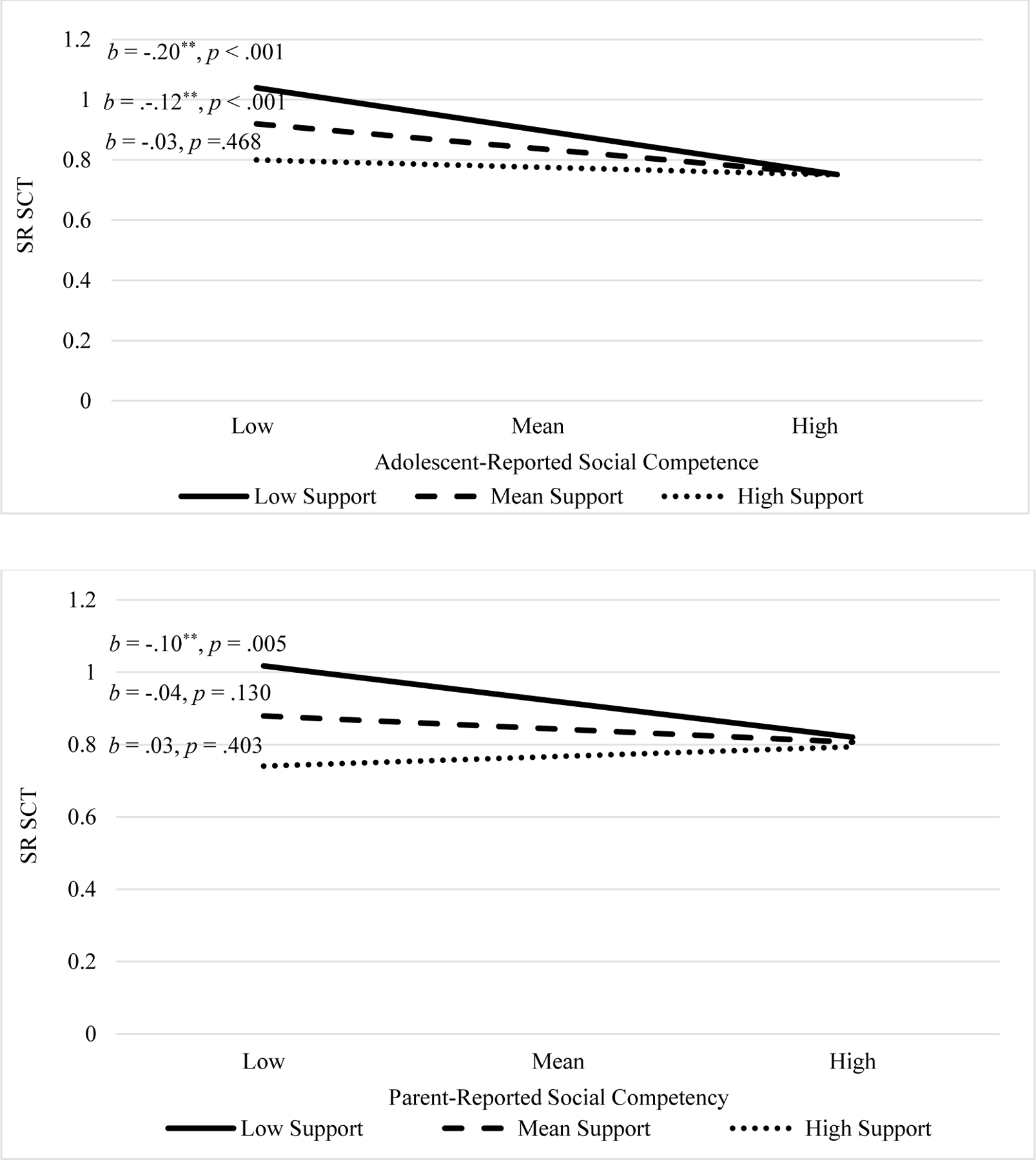
Simple Slope Analyses of Adolescent-Reported (Top Panel) and Parent-Reported (Bottom Panel) Social Competence Interacting with School Support in Relation to Adolescent-Reported SCT
Social competence and parent-reported SCT symptoms.
The two-way interactions of adolescent- or parent-reported social competence and school support in relation to parent ratings of adolescents’ SCT symptoms were non-significant, and analyses were re-run to examine main effects. Covariates in these models included site, sex, and parent-reported ADHD-IN symptoms. Adolescents’ self-report (β = −.14, p = .003, sr2 = −.13) and parents’ report of adolescents’ social competence (β = −.21, p < .001, sr2 = −.19) were each uniquely associated with lower parent ratings of SCT symptoms. The main effect of school support was unrelated to parent-reported SCT symptoms in both models.
School Support as a Moderator of Peer Victimization in Relation to SCT
Table 4 presents results for adolescent-reported peer victimization and school support in relation to SCT symptoms.
Table 4.
Adolescent-Reported Peer Victimization Interacting with School Support in Relation to Adolescent-Reported (Left Panel) and Parent-Reported (Right Panel) SCT Symptoms
| DV = Adolescent-reported SCT | DV = Parent-Reported SCT | ||||||||||
|---|---|---|---|---|---|---|---|---|---|---|---|
| Physical Victimization | F (6, 271) = 48.51, R2 = .52, p < .001 | F (6, 269) = 36.41, R2 = .45, p < .001 | |||||||||
| b | SE | B | t | sr 2 | b | SE | B | t | sr 2 | ||
|
|
|||||||||||
| Site | .09 | .05 | .08 | 1.86 | .08 | Site | −.01 | .07 | −.01 | −.14 | −.01 |
| Sex | .23*** | .05 | .21 | 4.75 | .20 | Sex | .15 | .08 | .09 | 1.92 | .09 |
| SR ADHD-IN | .64*** | .04 | .63 | 14.16 | .62 | PR ADHD-IN | .70*** | .05 | .68 | 14.50 | .66 |
| SR Physical | .17 | .11 | .34 | 1.54 | .07 | SR Physical | .05 | .17 | .07 | .31 | .01 |
| SR Support | −.07 | .05 | −.08 | −1.53 | −.06 | SR Support | −.05 | .07 | −.04 | −.69 | −.03 |
| SR Physical × Support | −.04 | .04 | −.22 | −1.00 | −.04 | SR Physical × Support | −.01 | .06 | −.05 | −.20 | −.01 |
|
| |||||||||||
| Relational Victimization | F (6, 271) = 50.05, R2 = .53, p < .001 | F (6, 269) = 36.57, R2 = .45, p < .001 | |||||||||
| b | SE | B | t | sr 2 | b | SE | B | t | sr 2 | ||
|
|
|||||||||||
| Site | .06 | .05 | .06 | 1.39 | .06 | Site | −.01 | .07 | −.01 | −.13 | −.01 |
| Sex | .20*** | .05 | .18 | 4.29 | .18 | Sex | .13 | .07 | .09 | 1.82 | .08 |
| SR ADHD-IN | .64*** | .04 | .64 | 14.61 | .61 | PR ADHD-IN | .70*** | .05 | .68 | 14.50 | .66 |
| SR Relational | .32*** | .09 | .83 | 3.41 | .14 | SR Relational | −.08 | .15 | −.14 | −.55 | −.03 |
| SR Support | −.03 | .05 | −.04 | −.69 | −.03 | SR Support | −.09 | .08 | −.07 | −1.19 | −.05 |
| SR Relational × Support | −.10** | .03 | −.76 | −3.14 | −.13 | SR Relational × Support | .03 | .05 | .17 | .67 | .03 |
|
| |||||||||||
| Non-Physical Victimization | F (6, 271) = 51.68, R2 = .53, p < .001 | F (6, 269) = 37.80, R2 = .46, p < .001 | |||||||||
| b | SE | B | t | sr 2 | b | SE | B | t | sr 2 | ||
|
|
|||||||||||
| Site | .08 | .05 | .07 | 1.71 | .07 | Site | −.02 | .07 | −.01 | −.24 | −.01 |
| Sex | .20*** | .05 | .18 | 4.37 | .18 | Sex | .15* | .07 | .09 | 2.00 | .09 |
| PR ADHD-IN | .64*** | .04 | .63 | 14.73 | .61 | PR ADHD-IN | .70*** | .05 | .67 | 14.62 | .66 |
| SR Non-Physical | .34*** | .09 | .76 | 3.63 | .15 | SR Non-Physical | .13 | .15 | .21 | .92 | .04 |
| SR Support | −.02 | .05 | −.02 | −.39 | −.02 | SR Support | −.01 | .08 | −.01 | −.18 | −.01 |
| SR Non-Physical × Support | −.10** | .03 | −.63 | −3.09 | −.13 | SR Non-Physical × Support | −.02 | .05 | −.11 | −.48 | −.02 |
Note. For site, 0 = Site 1, 1 = Site 2. For sex, 0 = male, 1 = female. SR = self-report. PR = parent-report. Physical = physical victimization. Sup. = school support. Relational = relational victimization. Non-physical = non-physical victimization. sr2 = squared semi-partial correlations.
p < .05.
p < .01
p < .001.
Peer victimization and adolescent-reported SCT symptoms.
Although the non-physical victimization × school support interaction was non-significant, non-physical victimization was uniquely associated with higher self-reported SCT symptoms.
Adolescent-reported relational and non-physical victimization both interacted with school support in relation to self-reported SCT symptoms. As displayed (Figure 2, top panel), relational victimization was positively associated with greater adolescent-reported SCT symptoms in the context of low school support (b = .08, p > .001), though unrelated at both mean (b = .02, p = .162) and high values (b = −.03, p = .228) of school support. Similarly, non-physical victimization was positively associated with greater adolescent-reported SCT symptoms at both low (b = .09, p > .001) and mean (b = .04, p = .046) values of school support, but not at high levels (b = −.02, p = .623) (Figure 2, bottom panel).
Figure 2.
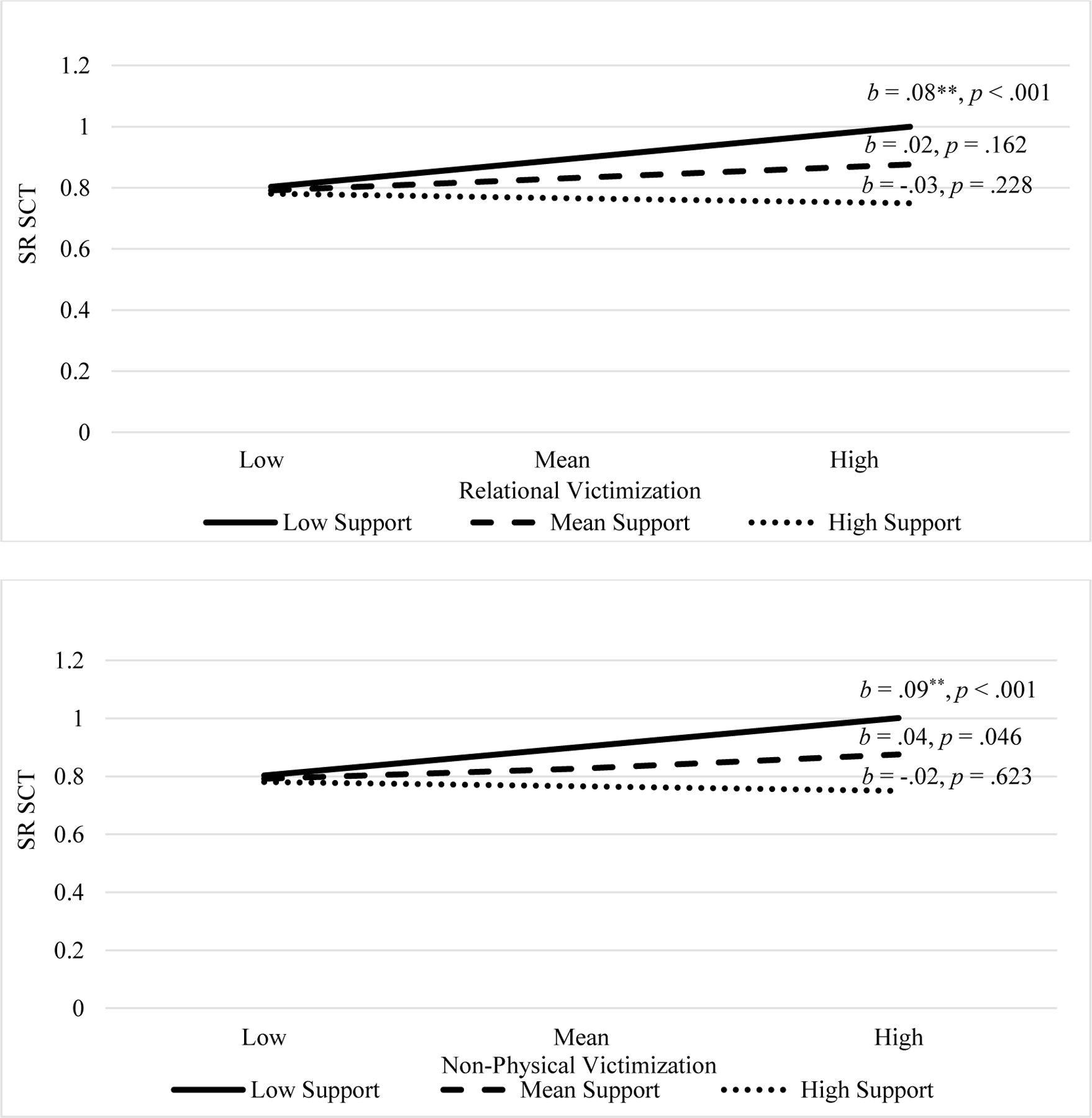
Simple Slope Analyses of Relational Victimization (Top Panel) and Non-Physical Victimization (Bottom Panel) Interacting with School Support in Relation to Adolescent-Reported SCT
Peer victimization and parent-reported SCT symptoms.
In contrast to the adolescent-reported model, none of the peer victimization × school support interactions were significant in relation to parent-reported SCT symptoms (Table 4). After removing the non-significant two-way interaction, a main effect emerged of non-physical victimization in relation to parent-reported SCT symptoms (β = .10, sr2 = .10, p = .030), controlling for site, sex, parent reported ADHD-IN symptoms, and school support.
Moderation of Peer Difficulties with School Support by ADHD Diagnostic Status
No significant three-way interactions emerged across all analyses, suggesting that interactions of peer difficulties and school support in relation to adolescent- and parent-reported SCT were similar between adolescents with and without ADHD. Thus, analyses were re-run to examine whether results would remain significant while controlling for diagnostic status. As expected, previous models were identical, with the four significant two-way interactions and three main effect models remaining significant when controlling for ADHD group status.
Discussion
The current study is the first to examine whether an environmental factor in the school context – school support – moderates the association between peer difficulties and SCT symptoms. In a sample of adolescents with and without ADHD, findings demonstrated that adolescent and parent ratings of poorer social competence were associated with greater self-reported SCT symptoms in the context of low school support, whereas greater social competence was related to lower parent-reported SCT symptoms irrespective of school support. Additionally, adolescents’ ratings of relational and non-physical victimization were associated with greater self-reported SCT in the specific context of low school support. These analyses were significant controlling for ADHD-IN symptoms and did not differ for adolescents with or without ADHD. Collectively, findings extend the literature by providing initial evidence for environmental factors being important to evaluate when examining links between functioning and SCT.
Social Competence in Relation to SCT and the Role of School Support
Adolescent and parent ratings of lower social competence were related to higher self-reported SCT symptoms among adolescents reporting low, but not high, school support. Although school support did not moderate the link between social competence and parent-reported SCT, adolescent and parent ratings of lower social competence were each uniquely associated with higher parent-reported SCT symptoms, controlling for ADHD-IN symptoms. These cross-informant effects further add to the substantial evidence supporting an association between poorer social competence and SCT symptoms. Before interpreting these findings, we acknowledge that the concurrent associations of social competence and adolescents’ SCT cannot establish temporality or causation, especially given the number of studies linking SCT to multiple types of social impairments indicative of poor social competence (i.e., withdrawal, loneliness, poor peer engagement) (Becker, 2014; Becker et al., 2019b; Marshall et al., 2014; Rondon et al., 2020; Sáez et al., 2019a; Willcutt et al., 2014). As these behaviors are vulnerabilities for peer difficulties and internalizing symptoms (Epkins & Heckler, 2011), the interplay of individual-based social competencies and SCT is likely bidirectional and reciprocal in nature.
Nevertheless, results build on prior studies linking lower social competence to internalizing problems (Erath et al., 2007; Flanagan et al., 2008) by documenting relations with adolescents’ SCT symptoms. In an environment with less perceived opportunities for emotional support and communication, difficulties navigating peer interactions may be exacerbated, thereby increasing SCT-related behaviors. For instance, as peer relations require increased sophistication in adolescence (Flanagan et al., 2008), difficulties initiating and maintaining social interactions may contribute to heightened behavioral (withdrawal) and cognitive (mind-wandering) avoidance. Conversely, positive interactions with adults may facilitate adolescents’ peer engagement (Gregory et al., 2010), thus reducing symptoms of SCT.
Although school support did not moderate the impact of social competence on parent-reported SCT symptoms, social competence was associated with parent-reported SCT symptoms. Thus, results for social competence in relation to SCT were not merely a result of shared method variance attributable to adolescent report, adding to the body of evidence linking SCT to parent-reported social impairments (Bernad et al., 2016; Marshall et al., 2014) These findings suggest that regardless of adolescents’ perception of school support, lower social competence is associated with adolescents’ SCT behaviors as observed by parents.
Peer Victimization in Relation to SCT and the Role of School Support
Additionally, experiences of peer victimization were linked to greater self-reported SCT symptoms among adolescents perceiving low school support. These findings are consistent with studies showing peer victimization to be more strongly associated with internalizing symptoms in the context of low perceived social support (Schacter & Juvonen, 2020). A recent study found parent- and youth-reported interpersonal trauma to be associated with SCT symptoms in a community sample of children and adolescents (Musicaro et al., 2020), suggesting that social adversity may play a role in SCT. The current study extended these findings by showing both relational and non-physical, but not physical victimization, to be uniquely associated with elevated SCT. Findings for specific forms of peer victimization are consistent with studies observing associations between relational, but not physical, victimization with internalizing symptoms in adolescents with ADHD (Becker, Mehari, Langberg, & Evans, 2017). Additionally, relational and non-physical victimization comprise experiences of peer ignoring and withdrawal (Card & Hodges, 2008) which are unique correlates of SCT symptoms (Becker et al., 2019b).
There are two possible explanations for these findings. First, ongoing experiences of trauma have been associated with physiological reactivity, which manifests behaviorally as lethargy and drowsiness (D’Andrea et al., 2013). Given that interpersonal forms of victimization are often more chronic in nature, compared to physical victimization (Sheppard et al., 2019), interpersonal victimization coupled with low support may result in blunted physiological reactivity which mirrors symptoms of SCT (Musicaro et al., 2020). Further, parent-reported SCT symptoms are uniquely associated with greater sympathetic nervous reactivity to perceived peer rejection in school-aged children (Becker & McQuade, 2020), suggesting that SCT-related behaviors may reflect an overactive behavioral inhibition system due in part to negative social experiences (i.e., peer victimization) (Becker & McQuade, 2020). Second, interpersonal peer victimizations may enhance self-focused attention, including rumination and fears (Storch & Masia-Warner, 2004). Thus, might SCT reflect a cognitive coping response to ongoing social adversity? Self-reported SCT symptoms have been linked to greater mind-wandering and rumination in adolescence (Becker et al., 2020; Fredrick & Becker, 2020), controlling for ADHD-IN symptoms. Adolescents exposed to interpersonal victimization, in addition to perceiving less support, may engage in mind-wandering and daydreaming as a form of coping in the midst of adversity (Somer, 2002). Although speculative, the opportunity is ripe for additional research to consider the underpinnings and function of SCT behaviors (see Becker & Barkley, 2021).
Importantly, moderation findings were only significant for adolescent-reported SCT symptoms. Adolescent ratings of peer victimization were unrelated to parent-report of SCT, which demonstrates a distinction between the findings for peer victimization compared to those for social competence. It is possible that the impact of peer victimization and school support on adolescents’ SCT behaviors may primarily unfold in the school environment or during interactions with peers. Although individual-based differences in social competence may be apparent across setting (Burt et al., 2008), and thus visible to other informants like parents, the effects of peer victimization on SCT behaviors may be limited to the school or peer environment.
ADHD Diagnostic Status Did Not Further Moderate Associations
Results did not indicate that interactions of peer difficulties and school support in relation to adolescents’ SCT symptoms differ for adolescents with or without ADHD. Further, the findings discussed above remained above and beyond ADHD group status. These results are consistent with prior evidence finding non-significant moderation effects for group status on the relation between SCT and internalizing domains (Becker et al., 2020; Willcutt et al., 2014). Future research would benefit from continuing to test the development and correlates of SCT in non-ADHD samples, as well as clinical samples beyond ADHD.
Clinical Implications
Our study findings underscore the positive benefits of supportive interpersonal relationships within the school environment for potentially mitigating the effects of peer difficulties on adolescents’ SCT, aligning with research advocating for promoting the emotional climate of schools to prevent the negative sequalae of peer victimization (Cornell et al., 2015). Adolescents experiencing social difficulties or peer victimizations may benefit from adults that offer encouragement, emotional support, and problem-solving, which may reduce the tendency to be cognitively and behaviorally disengaged (e.g., SCT behaviors). Additionally, given that parent- and adolescent-report of lower social competence was associated with SCT, findings converge with suggestions for considering social skills training as an intervention to improve assertiveness and peer engagement among youth with elevated SCT (Becker et al., 2019b). In addition, it would be worthwhile for studies examining bullying prevention and other school-based strategies to include SCT as an outcome measure. Assessing SCT in broader school-based interventions would allow for evaluating whether these efforts reduce SCT symptoms and examine how the magnitude of effects for SCT compare to other dimensions of mental health.
Limitations and Future Directions
Alongside strengths of the current study, including assessment of multiple types of peer difficulties in adolescents with and without ADHD and the consideration of an environmental factor, limitations are also important to note. Primarily, examining concurrent associations between peer difficulties, school support, and SCT symptoms prevents conclusion regarding directionality or causality. Social withdrawal and peer disengagement, elevated in youth with SCT (Becker et al., 2019b; Rondon et al., 2020; Sáez et al., 2019b), may undermine social competence and increase vulnerability for being the recipient of peer victimization (Erath et al., 2007). An important next step will be longitudinal designs that tease apart the interplay of social competence, peer victimization, and SCT. Although self-report of peer victimization and school support is considered the standard method of assessment (Cornell et al., 2015; Farrell et al., 2016), research should leverage teacher- and peer-report of peer victimization and school support to circumvent concerns with shared method variance. Similarly, the moderating effect of school support on the relation between peer victimizations and SCT was exclusive to adolescents’ own report of SCT. This underscores the importance of levering a multi-informant assessment of SCT (Becker et al., 2020), especially as parents may be less attuned to the presence and potential impacts of adolescents’ peer difficulties in the school context (Sheppard et al., 2019). Further, school support is one facet of a school climate, and student engagement and structure (Cornell et al., 2015) are also likely to function as risk or protective factors in the relation of peer difficulties and SCT. Finally, participants included in analyses were drawn from a second timepoint of a broader longitudinal study and had higher IQ scores and lower ADHD-IN and SCT symptoms compared to participants not included at this timepoint; future research would benefit from examining the role of school support in adolescents with more severe ADHD or SCT symptomatology. Additionally, the sample consisted primarily of White adolescents from families with higher incomes, limiting generalizability to diverse racial/ethnic and socioeconomic backgrounds. This is important given that adolescents of minority background are at heightened risk of victimization and discrimination (Cornell et al., 2015). Examining environmental and contextual correlates of SCT in diverse groups, including direct assessment of factors such as discrimination and racism, will continue to advance our understanding of the nature of SCT.
In conclusion, this study provides initial evidence that peer difficulties, specifically poor social competence and peer victimization, in addition to school support, are factors associated with SCT symptoms among adolescents with and without ADHD. As SCT continues to receive empirical support for both a correlate and precursor to internalizing problems (e.g., Becker et al., 2018, 2020; Bernad et al., 2016; Smith et al., 2019; Willcutt et al., 2014) investigations of the etiological underpinnings of SCT across ADHD and non-ADHD samples is needed to advance the theoretical and clinical implications of SCT.
Acknowledgments
Funding. This research was supported by award number R305A160126 from the Institute of Education Sciences (IES), U.S. Department of Education. Stephen Becker is supported by award number K23MH108603 from the National Institute of Mental Health (NIMH). The content is solely the responsibility of the authors and does not necessarily represent the official views of the IES or the NIMH.
Footnotes
Disclosure statement. The authors declare no potential conflicts of interest with respect to the research, authorship, or publication of this article.
References
- Becker SP (2014). Sluggish cognitive tempo and peer functioning in school-aged children: A six-month longitudinal study. Psychiatry Research, 217(1–2), 72–78. [DOI] [PubMed] [Google Scholar]
- Becker SP (2020). Systematic review: Assessment of sluggish cognitive tempo over the past decade. Journal of the American Academy of Child and Adolescent Psychiatry Advance online publication. doi: 10.1016/j.jaac.2020.10.016 [DOI] [PMC free article] [PubMed] [Google Scholar]
- Becker SP, & Barkley RA (2021). Field of daydreams? Integrating mind wandering in the study of sluggish cognitive tempo and ADHD. JCPP Advances, 1, e12002. doi: 10.1111/jcv2.12002 [DOI] [PMC free article] [PubMed] [Google Scholar]
- Becker SP, Burns GL, Leopold DR, Olson RK, & Willcutt EG (2018). Differential impact of trait sluggish cognitive tempo and ADHD inattention in early childhood on adolescent functioning. Journal of Child Psychology and Psychiatry, 59, 1094–1104. doi: 10.1111/jcpp.12946 [DOI] [PMC free article] [PubMed] [Google Scholar]
- Becker SP, Burns GL, Smith ZR, & Langberg JM (2020). Sluggish cognitive tempo in adolescents with and without ADHD: Differentiation from adolescent-reported ADHD inattention and unique associations with internalizing domains. Journal of Abnormal Child Psychology, 48, 391–406. doi: 10.1007/s10802-019-00603-9 [DOI] [PMC free article] [PubMed] [Google Scholar]
- Becker SP, Epstein JN, Tamm L, Tilford AA, Tischner CM, Isaacson PA, . . . Beebe DW (2019a). Shortened sleep duration causes sleepiness, inattention, and oppositionality in adolescents with attention-deficit/hyperactivity disorder: Findings from a crossover sleep restriction/extension study. Journal of the American Academy of Child and Adolescent Psychiatry, 58, 433–442. doi: 10.1016/j.jaac.2018.09.439 [DOI] [PMC free article] [PubMed] [Google Scholar]
- Becker SP, Garner AA, Tamm L, Antonini TN, & Epstein JN (2019b). Honing in on the social difficulties associated with sluggish cognitive tempo in children: Withdrawal, peer ignoring, and low engagement. Journal of Clinical Child and Adolescent Psychology, 48(2), 228–237. doi: 10.1080/15374416.2017.1286595 [DOI] [PMC free article] [PubMed] [Google Scholar]
- Becker SP, & Langberg JM (2013). Sluggish cognitive tempo among young adolescents with ADHD: Relations to mental health, academic, and social functioning. Journal of Attention Disorders, 17(8), 681–689. doi: 10.1177/1087054711435411 [DOI] [PubMed] [Google Scholar]
- Becker SP, Langberg JM, Eadeh H-M, Isaacson PA, & Bourchtein E (2019c). Sleep and daytime sleepiness in adolescents with and without ADHD: Differences across ratings, daily diary, and actigraphy. Journal of Child Psychology and Psychiatry, 60, 1021–1031. doi: 10.1111/JCPP.13061 [DOI] [PMC free article] [PubMed] [Google Scholar]
- Becker SP, Leopold DR, Burns GL, Jarrett MA, Langberg JM, Marshall SA, . . . Willcutt EG (2016). The internal, external, and diagnostic validity of sluggish cognitive tempo: A meta-analysis and critical review. Journal of the American Academy of Child and Adolescent Psychiatry, 55(3), 163–178. doi: 10.1016/j.jaac.2015.12.006 [DOI] [PMC free article] [PubMed] [Google Scholar]
- Becker SP, & McQuade JD (2020). Physiological correlates of sluggish cognitive tempo in children: Examining autonomic nervous system reactivity during social and cognitive stressor tasks. Journal of Abnormal Child Psychology, 48(7), 923–933. doi: 10.1007/s10802-020-00651-6 [DOI] [PMC free article] [PubMed] [Google Scholar]
- Becker SP, Mehari KR, Langberg JM, & Evans SW (2017). Rates of peer victimization in young adolescents with ADHD and associations with internalizing symptoms and self-esteem. European Child and Adolescent Psychiatry, 26(2), 201–214. doi: 10.1007/s00787-016-0881-y [DOI] [PMC free article] [PubMed] [Google Scholar]
- Becker SP, & Willcutt EG (2019). Advancing the study of sluggish cognitive tempo via DSM, RDoC, and hierarchical models of psychopathology. European Child and Adolescent Psychiatry, 28, 603–613. doi: 10.1007/s00787-018-1136-x [DOI] [PMC free article] [PubMed] [Google Scholar]
- Bernad M, Servera M, Becker SP, & Burns GL (2016). Sluggish cognitive tempo and ADHD Inattention as predictors of externalizing, internalizing, and impairment domains: A 2-year longitudinal study. Journal of Abnormal Child Psychology, 44(4), 771–785. doi: 10.1007/s10802-015-0066-z [DOI] [PMC free article] [PubMed] [Google Scholar]
- Burns GL, Lee S, Servera M, McBurnett K, & Becker SP (2015). Child and Adolescent Behavior Inventory - Parent Version 1.0 Pullman, WA: Author. [Google Scholar]
- Burt KB, Obradović J, Long JD, & Masten AS (2008). The interplay of social competence and psychopathology over 20 years: Testing transactional and cascade models. Child Development, 79(2), 359–374. doi: 10.1111/j.1467-8624.2007.01130.x [DOI] [PubMed] [Google Scholar]
- Card NA, & Hodges EV (2008). Peer victimization among schoolchildren: Correlations, causes, consequences, and considerations in assessment and intervention. School Psychology Quarterly, 23(4), 451. [Google Scholar]
- Cornell D, Shukla K, & Konold T (2015). Peer victimization and authoritative school climate: A multilevel approach. Journal of Educational Psychology, 107(4), 1186. [Google Scholar]
- D’Andrea W, Pole N, Depierro J, Freed S, & Wallace DB (2013). Heterogeneity of defensive responses after exposure to trauma: Blunted autonomic reactivity in response to startling sounds. International Journal of Psychophysiology, 90(1), 80–89. doi: 10.1016/j.ijpsycho.2013.07.008 [DOI] [PubMed] [Google Scholar]
- Epkins CC, & Heckler DR (2011). Integrating etiological models of social anxiety and depression in youth: Evidence for a cumulative interpersonal risk model. Clinical Child and Family Psychology Review, 14(4), 329–376. doi: 10.1007/s10567-011-0101-8 [DOI] [PubMed] [Google Scholar]
- Erath SA, Flanagan KS, & Bierman KL (2007). Social anxiety and peer relations in early adolescence: Behavioral and cognitive factors. Journal of Abnormal Child Psychology, 35(3), 405–416. doi: 10.1007/s10802-007-9099-2 [DOI] [PubMed] [Google Scholar]
- Farrell AD, Kung EM, White KS, & Valois RF (2000). The structure of self-reported aggression, drug use, and delinquent behaviors during early adolescence. Journal of Clinical Child Psychology, 29(2), 282–292. [DOI] [PubMed] [Google Scholar]
- Farrell AD, Sullivan TN, Goncy EA, & Le A-TH (2016). Assessment of adolescents’ victimization, aggression, and problem behaviors: Evaluation of the Problem Behavior Frequency Scale. Psychological Assessment, 28(6), 702–714. doi: 10.1037/pas0000225 [DOI] [PMC free article] [PubMed] [Google Scholar]
- Farrell AD, Thompson EL, Mehari KR, Sullivan TN, & Goncy EA (2020). Assessment of in-person and cyber aggression and victimization, substance use, and delinquent behavior during early adolescence. Assessment, 27, 1213–1229. [DOI] [PMC free article] [PubMed] [Google Scholar]
- Flanagan KS, Erath SA, & Bierman KL (2008). Unique associations between peer relations and social anxiety in early adolescence. Journal of Clinical Child and Adolescent Psychology, 37(4), 759–769. doi: 10.1080/15374410802359700 [DOI] [PubMed] [Google Scholar]
- Fredrick JW, & Becker SP (2020). Sluggish cognitive tempo symptoms, but not ADHD or internalizing symptoms, are uniquely related to self-reported mind-wandering in adolescents with ADHD. Journal of Attention Disorders, 108705472092309. doi: 10.1177/1087054720923091 [DOI] [PMC free article] [PubMed] [Google Scholar]
- Fredrick JW, Luebbe AM, Mancini KJ, Burns GL, Epstein JN, Garner AA, . . . Becker SP (2018). Family environment moderates the relation of sluggish cognitive tempo to attention-deficit/hyperactivity disorder inattention and depression. Journal of Clinical Psychology, 75(1), 221–237. doi: 10.1002/jclp.22703 [DOI] [PMC free article] [PubMed] [Google Scholar]
- Gregory A, Cornell D, Fan X, Sheras P, Shih T-H, & Huang F (2010). Authoritative school discipline: High school practices associated with lower bullying and victimization. Journal of Educational Psychology, 102(2), 483. [Google Scholar]
- Harter S (2012). Self-perception profile for adolescents: Manual and questionnaires Denver, CO: Univeristy of Denver, Department of Psychology. [Google Scholar]
- Haugen T, Säfvenbom R, & Ommundsen Y (2013). Sport participation and loneliness in adolescents: the mediating role of perceived social competence. Current psychology, 32(2), 203–216. [Google Scholar]
- Hayes AF (2017). Introduction to mediation, moderation, and conditional process analysis: A regression-based approach: Guilford publications. [Google Scholar]
- Heilbrun A, Cornell D, & Konold T (2018). Authoritative school climate and suspension rates in middle schools: Implications for reducing the racial disparity in school discipline. Journal of School Violence, 17(3), 324–338. [Google Scholar]
- Holdaway AS, & Becker SP (2018). Sluggish cognitive tempo and student–teacher relationship quality: Short-term longitudinal and concurrent associations. School Psychology Quarterly, 33(4), 537–546. doi: 10.1037/spq0000245 [DOI] [PMC free article] [PubMed] [Google Scholar]
- Kessler RC, Adler L, Ames M, Demler O, Faraone S, Hiripi E, . . . Spencer T (2005). The World Health Organization Adult ADHD Self-Report Scale (ASRS): a short screening scale for use in the general population. Psychological Medicine, 35(2), 245. doi: 10.1017/S0033291704002892 [DOI] [PubMed] [Google Scholar]
- Konold T, Cornell D, Huang F, Meyer P, Lacey A, Nekvasil E, . . . Shukla K (2014). Multilevel multi-informant structure of the Authoritative School Climate Survey. School Psychology Quarterly, 29(3), 238. [DOI] [PubMed] [Google Scholar]
- Ladd GW (2005). Children’s peer relations and social competence: A century of progress: Yale University Press. [Google Scholar]
- Marshall SA, Evans SW, Eiraldi RB, Becker SP, & Power TJ (2014). Social and academic impairment in youth with ADHD, predominately inattentive type and sluggish cognitive tempo. Journal of Abnormal Child Psychology, 42(1), 77–90. doi: 10.1007/s10802-013-9758-4 [DOI] [PMC free article] [PubMed] [Google Scholar]
- McBurnett K, Villodas M, Burns GL, Hinshaw SP, Beaulieu A, & Pfiffner LJ (2014). Structure and validity of sluggish cognitive tempo using an expanded item pool in children with attention-deficit/hyperactivity disorder. Journal of Abnormal Child Psychology, 42, 37–48. [DOI] [PubMed] [Google Scholar]
- McQuade JD (2020). Peer functioning in adolescents with ADHD. In Becker SP (Ed.), ADHD in adolescence: development, assessment, and treatment (pp. 128–147). New York, NY: Guilford Press. [Google Scholar]
- Moruzzi S, Rijsdijk F, & Battaglia M (2014). A twin study of the relationships among inattention, hyperactivity/impulsivity and sluggish cognitive tempo problems. Journal of Abnormal Child Psychology, 42(1), 63–75. doi: 10.1007/s10802-013-9725-0 [DOI] [PubMed] [Google Scholar]
- Musicaro RM, Ford J, Suvak MK, Sposato A, & Andersen S (2020). Sluggish cognitive tempo and exposure to interpersonal trauma in children. Anxiety, Stress, & Coping, 33(1), 100–114. doi: 10.1080/10615806.2019.1695124 [DOI] [PubMed] [Google Scholar]
- Obradović J, Burt KB, & Masten AS (2009). Testing a dual cascade model linking competence and symptoms over 20 years from childhood to adulthood. Journal of Clinical Child and Adolescent Psychology, 39(1), 90–102. [DOI] [PubMed] [Google Scholar]
- Rondon AT, Hilton DC, Jarrett MA, & Ollendick TH (2020). Sleep, internalizing problems, and social withdrawal: Unique associations in clinic-referred youth with elevated sluggish cognitive tempo symptoms. Journal of Attention Disorders, 24(4), 524–534. doi: 10.1177/1087054718756197 [DOI] [PubMed] [Google Scholar]
- Sáez B, Servera M, Becker SP, & Burns GL (2019a). Optimal items for assessing sluggish cognitive tempo in children across mother, father, and teacher ratings. Journal of Clinical Child and Adolescent Psychology, 48(6), 825–839. doi: 10.1080/15374416.2017.1416619 [DOI] [PMC free article] [PubMed] [Google Scholar]
- Sáez B, Servera M, Burns GL, & Becker SP (2019b). Advancing the multi-informant assessment of sluggish cognitive tempo: Child self-report in relation to parent and teacher ratings of SCT and impairment. Journal of Abnormal Child Psychology, 47(1), 35–46. doi: 10.1007/s10802-018-0436-4 [DOI] [PMC free article] [PubMed] [Google Scholar]
- Schacter HL, & Juvonen J (2020). When do friendships help versus hurt? Perceived best friend victimization and support as moderators of peer victimization-related distress. The Journal of Early Adolescence, 40(6), 804–827. doi: 10.1177/0272431619874402 [DOI] [Google Scholar]
- Schwartz D, Lansford JE, Dodge KA, Pettit GS, & Bates JE (2015). Peer victimization during middle childhood as a lead Indicator of internalizing problems and diagnostic outcomes in late adolescence. Journal of Clinical Child and Adolescent Psychology, 44(3), 393–404. doi: 10.1080/15374416.2014.881293 [DOI] [PMC free article] [PubMed] [Google Scholar]
- Sheppard CS, Giletta M, & Prinstein MJ (2019). Peer victimization trajectories at the adolescent transition: Associations among chronic victimization, peer-reported status, and adjustment. Journal of Clinical Child and Adolescent Psychology, 48(2), 218–227. doi: 10.1080/15374416.2016.1261713 [DOI] [PubMed] [Google Scholar]
- Smith ZR, Eadeh H-M, Breaux RP, & Langberg JM (2019). Sleepy, sluggish, worried, or down? The distinction between self-reported sluggish cognitive tempo, daytime sleepiness, and internalizing symptoms in youth with attention-deficit/hyperactivity disorder. Psychological Assessment, 31(3), 365–375. [DOI] [PubMed] [Google Scholar]
- Somer E (2002). Maladaptive daydreaming: A qualitative inquiry. Journal of Contemporary Psychotherapy, 32(2–3), 197–212. [Google Scholar]
- Sonnby K, Skordas K, Olofsdotter S, Vadlin S, Nilsson KW, & Ramklint M (2015). Validation of the World Health Organization adult ADHD self-report scale for adolescents. Nordic Journal of Psychiatry, 69(3), 216–223. doi: 10.3109/08039488.2014.968203 [DOI] [PubMed] [Google Scholar]
- Stadler C, Feifel J, Rohrmann S, Vermeiren R, & Poustka F (2010). Peer-victimization and mental health problems in adolescents: Are parental and school support protective? Child Psychiatry and Human Development, 41(4), 371–386. doi: 10.1007/s10578-010-0174-5 [DOI] [PMC free article] [PubMed] [Google Scholar]
- Storch EA, & Masia-Warner C (2004). The relationship of peer victimization to social anxiety and loneliness in adolescent females. Journal of Adolescence, 27(3), 351–362. doi: 10.1016/j.adolescence.2004.03.003 [DOI] [PubMed] [Google Scholar]
- Vannucci A, & Ohannessian CM (2018). Self-competence and depressive symptom trajectories during adolescence. Journal of Abnormal Child Psychology, 46(5), 1089–1109. doi: 10.1007/s10802-017-0340-3 [DOI] [PubMed] [Google Scholar]
- Wang M-T (2009). School climate support for behavioral and psychological adjustment: testing the mediating effect of social competence. School Psychology Quarterly, 24(4), 240. [Google Scholar]
- Wechsler D (2011). WASI-II: Wechsler abbreviated scale of intelligence: PsychCorp. [Google Scholar]
- Weller E, Weller R, Teare M, & Fristad M (1999). Parent version-children’s interview for psychiatric syndromes (P-ChIPS) American Psychiatric, Washington, DC. [Google Scholar]
- Willcutt EG, Chhabildas N, Kinnear M, Defries JC, Olson RK, Leopold DR, . . . Pennington BF (2014). The internal and external validity of sluggish cognitive tempo and its relation with DSM–IV ADHD. Journal of Abnormal Child Psychology, 42(1), 21–35. doi: 10.1007/s10802-013-9800-6 [DOI] [PMC free article] [PubMed] [Google Scholar]
- Wolraich ML (2003). Psychometric properties of the Vanderbilt ADHD diagnostic parent rating scale in a referred population. Journal of Pediatric Psychology, 28(8), 559–568. doi: 10.1093/jpepsy/jsg046 [DOI] [PubMed] [Google Scholar]
- Wolraich ML, Feurer ID, Hannah JN, Baumgaertel A, & Pinnock TY (1998). Obtaining systematic teacher reports of disruptive behavior disorders utilizing DSM-IV. Journal of Abnormal Child Psychology, 26(2), 141–152. [DOI] [PubMed] [Google Scholar]