



Abstract
We assessed sexually transmitted disease/human immunodeficiency virus (HIV) service availability at the primary sexually transmitted disease safety net clinic by phase I Ending the HIV Epidemic jurisdiction status. HIV testing was >90%. In Ending the HIV Epidemic jurisdictions, 22% of primary safety net clinics initiated and/or provided preexposure prophylaxis (PrEP), 46.6% provided PrEP education or referral only, and 29.9% did not provide any PrEP services.
Timely and appropriate sexually transmitted disease (STD) and human immunodeficiency virus (HIV) clinical services are important to reduce STD/HIV transmission.1 The availability of such STD testing and treatment can increase access to care and decrease STD infectiousness by shortening the duration of infection.1 Similarly, timely access to HIV testing and treatment can reduce viral load and decrease HIV infectiousness.2 However, in the United States, everyone does not have equal access to health services; 8.0% of people in the United States lacked health insurance during some part of 2019.3 Therefore, safety net clinics are important providers of STD and HIV services for some, including those who are uninsured or underinsured.4 Safety net providers may also reach some subpopulations at highest risk for STDs and HIV. In addition to providing affordable services, safety net providers may serve an important role in the provision of confidential, high-quality, same-day STD/HIV services.4 Such services have been noted as reasons some people may chose STD clinics for STD/HIV services.5
In addition, the United States has launched Ending the HIV Epidemic (EHE), an initiative to end the epidemic by 2030, in part by increasing HIV screening and uptake of preexposure prophylaxis (PrEP) for HIV.6,7 In phase 1, EHE is focused on jurisdictions with the most frequent HIV transmission including counties and some rural states.7 One setting that may be important for achieving the goals of the EHE initiative is STD clinics. A study of 40 STD clinics in 12 cities found high rates of HIV diagnoses in this setting, particularly among men who have sex with men (MSM), a key population for HIV prevention.8 Therefore, we examined the availability of key STD/HIV services offered by clinics who were the primary provider of STD safety net services in EHE and non-EHE jurisdictions as reported by local health departments (LHDs). These data could serve as a baseline to evaluate both EHE and STD prevention efforts in these jurisdictions.
MATERIALS AND METHODS
From March to May 2018, we surveyed 668 LHDs (i.e., city, county, or regional health departments) to assess public STD infrastructure including availability of key STD/HIV safety net clinical services. First, we included the 51 counties with the highest combined STD cases and rates of syphilis, chlamydia, and gonorrhea in 2015. This included all LHDs funded for STD prevention by the Centers for Disease Control and Prevention’s Division of STD Prevention. Next, we selected a random sample of 617 LHDs stratified by jurisdiction population size and US Census region, for a total sample size of 668. The sample of 617 was selected from the LHDs who responded to the 2017 National Profile Study, which assessed the infrastructure of LHDs in the United States.9 Web surveys were sent to the local STD contact or local health official who were encouraged to seek information from others as needed. The National Center for HIV/AIDS, Viral Hepatitis, STD, and TB Prevention determined that the study was exempt from human subjects review.
The STD infrastructure survey assessed various aspects of STD prevention and contained a section on the primary safety net clinic in the jurisdiction that provided STD clinical services. Safety net clinics were defined as clinics providing affordable care for uninsured or underinsured persons. We included questions about the type of clinic, if same-day services were provided, and whether the following services were available: key STD point-of-care (POC) services (e.g., testing and treatment), HIV testing and PrEP-related services. Clinic type was recoded into STD clinic (included specialized STD clinics and combination STD–family planning clinics) and non-STD clinic (family planning clinic, federally qualified health center, general public health clinic, university-affiliated clinic, and other clinic). Preexposure prophylaxis services included the following: risk assessment and education, referral to PrEP provider, initiate PrEP (patient provided with starter pack and linked to PrEP provider), and provision of PrEP (patients return for routine testing associated with the ongoing provision of PrEP). For one analysis, PrEP was recoded into a categorical variable based on intensity of the services provided: no PrEP services, education and/or referral only, and initiate or provide PrEP. Finally, for those providing PrEP, we asked 2 follow-up questions focusing on providing ongoing monitoring for patients on PrEP as part of the provision of PrEP and whether the jurisdiction had a PrEP coordinator.
Analyses were weighted for nonresponse, jurisdiction size, and US Census region to represent LHDs. We used the Rao-Scott χ2 test to compare services in EHE and non-EHE counties. All analyses were conducted in SAS (version 9.4). Responding LHDs were similar to nonresponding LHDs, except that small LHDs were less likely to respond than larger LHDs (P = 0.04).
RESULTS
A total of 326 LHDs responded to the survey (49% response rate), and 83 (21%) were in EHE jurisdictions. Local health departments in EHE and non-EHE jurisdictions significantly differed by jurisdiction population size and US Census region (Supplemental Digital Content 1, http://links.lww.com/OLQ/A672). More LHDs in EHE jurisdictions were in larger jurisdictions (≥500,000) and were in the south as compared with LHDs in non-EHE jurisdictions. Approximately two-thirds (65%; n = 241) of LHDs were aware of a safety net clinic in their jurisdiction that provided STD services. Of these LHDs, there was no significant difference in whether the clinic was an STD clinic by EHE (37%) and non-EHE jurisdictions (42%; Supplemental Digital Content 2, http://links.lww.com/OLQ/A672).
Overall, 240 LHDs provided information on the availability of same-day services at the primary POC for safety net STD services: 70 in EHE jurisdictions and 170 in non-EHE jurisdictions (Table 1). More of the primary clinics in EHE jurisdictions offered same-day services (79.4; 95% confidence interval, 68.1–90.7) compared with clinics in non-EHE jurisdictions (63.5; 95% confidence interval, 55.2–71.9; P < 0.05). Of clinics offering same-day services, those in EHE jurisdictions had a higher average percentage of appointments set aside for same-day services than did those in non-EHEs jurisdictions (mean, 72.2% vs. 62.4%; P < 0.001). In total, 225 LHDs provided information on specific STD/HIV services: 67 in EHE jurisdictions and 158 in non-EHE jurisdictions. Almost all of the primary safety net clinics for STD services offered HIV testing, including 91% of clinics in non-EHE jurisdictions and 100% in EHE jurisdictions. Fewer clinics reported offering PrEP services compared with HIV testing, but there were no significant differences by EHE jurisdiction for PrEP services. Although there were no significant differences by EHE status, in EHE jurisdictions, 22% of primary safety net clinics initiated and/or provided PrEP, 46.6% provided PrEP education or referral only, and 29.9% did not provide any PrEP services (Fig. 1). Among jurisdictions offering PrEP at the primary STD safety net clinic, most (88.0%) were providing ongoing medical monitoring and two-thirds (68.6%) had a PrEP coordinator in their jurisdiction (Supplemental Digital Content 3, http://links.lww.com/OLQ/A672).
TABLE 1.
STD/HIV Services Offered at Primary Point of Care for Safety Net STD Services (Primary Clinic) by EHE and Non-EHE Jurisdiction, 2018
| Services* | EHE Jurisdiction† | P | |||
|---|---|---|---|---|---|
| No | Yes | ||||
| n | % (95% CI) | n | % (95% CI1 | ||
| Same-day services for symptomatic persons and persons whose partner has an STD (n = 240) | 170 | 70 | 0.043 | ||
| No | 31 | 19.8 (13.0–26.6) | 10 | 16.9 (6.3–27.4) | |
| Yes | 117 | 63.5 (55.2–71.9) | 58 | 79.4 (68.1–90.7) | |
| Unsure | 22 | 16.7 (9.8–23.5) | 2 | 3.7 (0.0–8.8) | |
| % of appointments set aside for same-day, mean (SE) | 62.4 (4.5) | 72.2 (6.0) | <0.001 | ||
| Provides service (n = 225)§ | 158 | 67 | |||
| HIV | |||||
| HIV testing | 148 | 91.4 (85.8–96.9) | 67 | 100 (100–100) | — |
| HIV PrEP risk assessment and education | 82 | 45.2 (36.5–54.0) | 28 | 34.4 (21.9–46.9) | 0.170 |
| Referral to PrEP provider | 95 | 54.6 (45.7–63.5) | 36 | 46.1 (32.8–59.4) | 0.297 |
| Initiate PrEP (patients provided with starter pack and linked to PrEP provider) | 26 | 12.7 (7.4–17.9) | 9 | 8.9 (1.7–16.0) | 0.431 |
| Provision of PrEP (patients return for routine testing associated with the ongoing provision of PrEP) | 43 | 22.7 (15.8–29.7) | 14 | 13.3 (4.9–21.6) | 0.115 |
| Provision of nPEP for HIV | 25 | 14.4 (8.5–20.2) | 12 | 12.1 (4.4–19.9) | 0.655 |
| STD tests | |||||
| Darkfield microscopy (syphilis) | 17 | 8.7 (3.9–13.6) | 15 | 11.9 (4.8–19.1) | 0.449 |
| POC RPR testing (syphilis) | 39 | 19.9 (13.3–26.6) | 25 | 25.7 (14.9–36.5) | 0.356 |
| POC gonococcal urethritis testing for symptomatic men | 36 | 20.0 (13.1–26.9) | 22 | 18.6 (9.8–27.3) | 0.805 |
| POC wet mount with KOH preparation (trichomoniasis) | 83 | 50.2 (41.4–59.1) | 45 | 62.2 (48.8–75.5) | 0.149 |
| Extragenital chlamydia and/or gonorrhea testing | 118 | 70.7 (62.4–79.0) | 49 | 64.7 (52.5–79.0) | 0.526 |
| Gonorrhea culture | 88 | 51.4 (42.6–60.3) | 38 | 48.4 (35.0–61.7) | 0.707 |
| STD treatment (POC) | |||||
| Ceftriaxone 250 mg (gonorrhea) | 140 | 84.9 (77.9–91.9) | 61 | 92.5 (86.0–99.0) | 0.140 |
| Benzathine penicillin G (Bicillin-LA) 2.4 million units (syphilis) | 124 | 72.2 (63.9–80.6) | 57 | 86.0 (76.8–95.3) | 0.046 |
Less than 1% (0.1%) of respondents did not know the types of services offered at the main clinic for STD referrals and were recoded as missing.
EHE jurisdiction consists of LHDs listed in phase I of the EHE initiative.
All n’s are unweighted, and percentages are weighted.
For services, % are row percentages for each grouping.
CI indicates confidence interval; MB/GV, methylene blue/gentian violet stain; nPEP, nonoccupational postexposure prophylaxis; RPR, rapid plasma reagin.
Figure 1.
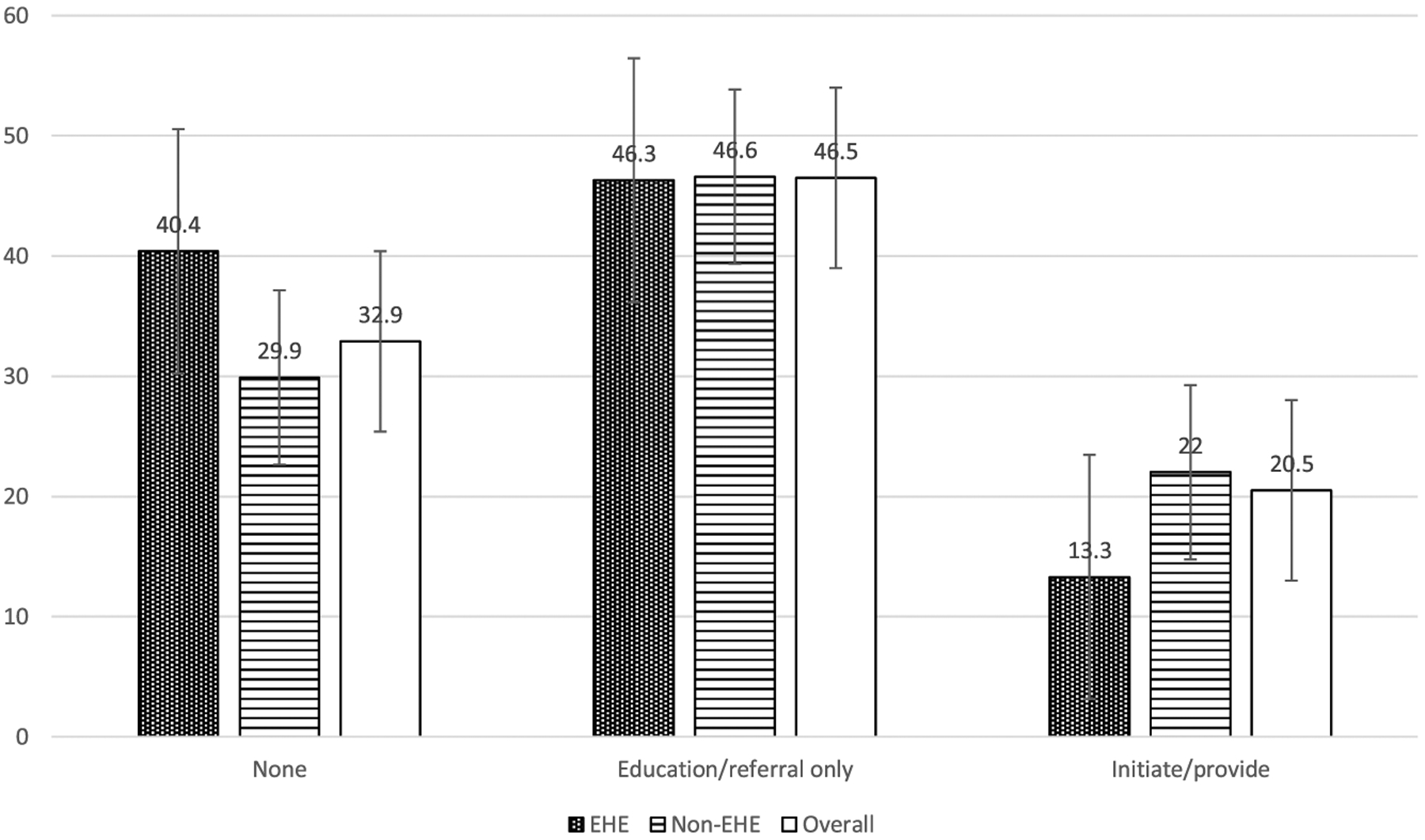
Intensity of PrEP services provided by primary clinic providing safety net STD services (n = 225). Note. P = 0.19. Error bars show SEs. “Initiate and/or provide” PrEP can also include provision of PrEP education or referral. Preexposure prophylaxis was recoded into a categorical variable based on intensity of the services provided: no PrEP services, education and/or referral only, and initiate or provide PrEP.
We also compared STD POC testing and treatment offered by primary safety net providers of STD services by EHE status. We did not identify any significant differences for POC STD testing by EHE status. Only 25.7% of the primary clinics in EHE jurisdictions provided POC rapid plasma reagin testing for syphilis, and 48.4% provided gonorrhea culture, which is important to test for antimicrobial resistance. The majority of clinics in EHE jurisdictions (64.7%) provided extragenital chlamydia/gonorrhea testing, which is recommended for MSM. Most of the primary safety net clinics for STD services in EHE jurisdictions also had key STD treatments available onsite. Clinics in EHE jurisdictions had slightly higher reports of having POC syphilis treatment available.
DISCUSSION
In general, specific STD/HIV services provided by primary safety net clinics for STD services largely did not differ by EHE status. However, we did find a few differences worth noting. Although on average all clinics had relatively high availability of same-day services, clinics in EHE jurisdictions had both higher reports of offering same-day services and, among this group, a higher percentage of appointments set aside for same-day appointments. As previously noted, timely services are very important for prevention efforts in that they can reduce further transmission of STD and HIV.1,2 Safety net clinics for STD services in EHE jurisdictions also had slightly higher availability of POC treatment of syphilis, which can lessen delays in treatment and potentially reduce the serious consequences of untreated syphilis. Among MSM, syphilis has been increasing especially among those living with HIV.10 We identified other positives for STD/HIV prevention efforts regarding clinical services offered at the primary safety net clinics for STD services. First, the widespread availability of HIV testing in safety net clinics could be of benefit to the EHE initiative’s goal of increasing HIV screening. Also, availability of same-day treatment of gonorrhea was high, which is important to curb transmission of the second most commonly reported STD in the United States.11 Finally, the majority of primary safety net clinics offered some type of PrEP services, which is also an important component of the EHE initiative.
We also identified some areas for improvement. Although many clinics provided at least PrEP education or referrals, few either initiated or provided PrEP. It is possible that EHE funding will increase access to PrEP in these settings. In addition, although access to HIV testing and POC STD treatment of gonorrhea and syphilis was high, access to some POC STD tests was lower. After our data were collected, the COVID-19 pandemic temporarily disrupted the availability of STD/HIV services (e.g., services were reduced or unavailable).12–14 In some circumstances, providers were encouraged to use telemedicine or oral antibiotics in place of injectable antibiotics.12–14 We do not know yet if or how the pandemic will impact STD/HIV services in the future.
Our study does have some limitations. Our response rate was less than ideal, although this is similar to the declining trends in response rates for national surveys. Our sample was designed to be representative of the United States rather than EHE jurisdictions; therefore, our sample of clinics in EHEs may be overrepresented by LHDs in the south. Another study of EHE phase 1 jurisdictions found that the south accounted for more than half of HIV tests.15 Thus, our findings of HIV testing available in 100% of primary STD safety net clinics may be an overestimate. In addition, most of the clinics in EHE jurisdictions used as primary safety net services were not specialty STD clinics. However, STD care has been shifting to other clinical settings in some areas,11 and the clinics that we sampled are used to providing safety net STD services. Our data were collected before the COVID-19 pandemic, and the long-term impact of the pandemic on STD/HIV services is unknown. Finally, we sought to assess the availability of services and not adequacy of services at the primary safety net STD clinic in the jurisdiction.
The current availability of key STD and HIV clinical services may not be sufficient to meet some goals of STD or HIV prevention efforts; however, the EHE initiative may help enhance or increase services such as PrEP in safety net STD clinics.
Supplementary Material
Conflict of Interest and Sources of Funding:
The authors have no conflicts of interest to disclose. The study was supported by the Centers for Disease Control and Prevention (FOA OT13-1302: Building Capacity of the Public Health System to Improve Population Health through National, Nonprofit Organizations). No financial disclosures were reported by the authors of this article.
Footnotes
The findings and conclusions in this report are those of the authors and do not necessarily represent the official position of the Centers for Disease Control and Prevention.
Supplemental digital content is available for this article. Direct URL citations appear in the printed text, and links to the digital files are provided in the HTML text of this article on the journal’s Web site (http://www.stdjournal.com)
REFERENCES
- 1.Barrow RY, Ahmed F, Bolan GA, et al. Recommendations for providing quality sexually transmitted diseases clinical services, 2020. MMWR Recomm Rep 2020; 68:1–20. [DOI] [PMC free article] [PubMed] [Google Scholar]
- 2.CDC. CDC’s Role in Ending the HIV Epidemic: A Plan for America. Atlanta, GA: US Department of Health and Human Services, CDC, 2019a. Available at: https://www.cdc.gov/endhiv/docs/CDC-role-ending-HIV-508.pdf. [Google Scholar]
- 3.Keisler-Starkey K, Bunch LN. U.S. Census Bureau Current Population Reports, P60–271, Health Insurance Coverage in the United States: 2019. Washington, DC: U.S. Government Publishing Office, 2020. Available at: https://www.census.gov/library/publications/2020/demo/p60-271.html. Accessed October 29, 2020. [Google Scholar]
- 4.Cramer R, Leichliter JS, Gift TL. Are safety net sexually transmitted disease clinical and preventive services still needed in a changing health care system? Sex Transm Dis 2014; 41:628–630. [DOI] [PMC free article] [PubMed] [Google Scholar]
- 5.Hoover KW, Parsell BW, Leichliter JS, et al. Continuing need for sexually transmitted disease clinics after the Affordable Care Act. Am J Public Health 2015; 105 Suppl 5(Suppl 5):S690–S695. [DOI] [PMC free article] [PubMed] [Google Scholar]
- 6.Fauci AS, Redfield RR, Sigounas G, et al. Ending the HIV epidemic: A plan for the United States. JAMA 2019; 321:844–845. [DOI] [PubMed] [Google Scholar]
- 7.U.S. Department of Health & Human Services (US DHHS). What Is Ending the HIV Epidemic: A Plan for America? Available at: https://www.hiv.gov/federal-response/ending-the-hiv-epidemic/overview. Accessed October 30, 2020.
- 8.Llata E, Braxton J, Asbel L, et al. New human immunodeficiency virus diagnoses among men who have sex with men attending sexually transmitted disease clinics, STD Surveillance Network, January 2010 to June 2013. Sex Transm Dis 2018; 45:577–582. [DOI] [PMC free article] [PubMed] [Google Scholar]
- 9.National Association of County and City Health Officials—NACCHO. Forces of Change Survey. 2017. Available at: https://www.naccho.org/uploads/downloadable-resources/2017-Forces-of-Change-Main-Report1.pdf. Accessed November 30, 2019.
- 10.Abara WE, Hess KL, Neblett Fanfair R, et al. Syphilis trends among men who have sex with men in the United States and Western Europe: A systematic review of trend studies published between 2004 and 2015. PLoS One 2016; 11:e0159309. [DOI] [PMC free article] [PubMed] [Google Scholar]
- 11.CDC. Sexually Transmitted Disease Surveillance 2018. Atlanta, GA: U.S. Department of Health and Human Services, 2019. [Google Scholar]
- 12.Barbee LA, Dombrowski JC, Hermann S, et al. “Sex in the Time of COVID”: clinical guidelines for sexually transmitted disease management in an era of social distancing. Sex Transm Dis 2020; 47:427–430. [DOI] [PMC free article] [PubMed] [Google Scholar]
- 13.Nagendra G, Carnevale C, Neu N, et al. The potential impact and availability of sexual health services during the COVID-19 pandemic. Sex Transm Dis 2020; 47:434–436. [DOI] [PMC free article] [PubMed] [Google Scholar]
- 14.Napoleon SC, Maynard MA, Almonte A, et al. Considerations for STI clinics during the COVID-19 pandemic. Sex Transm Dis 2020; 47:431–433. [DOI] [PMC free article] [PubMed] [Google Scholar]
- 15.Essuon AD, Zhao H, Wang G, et al. HIV testing outcomes among Blacks or African Americans—50 local U.S. jurisdictions accounting for the majority of new HIV diagnoses and seven states with disproportionate occurrences of HIV in rural areas, 2017. MMWR Morb Mortal Wkly Rep 2020; 69:97–102. [DOI] [PMC free article] [PubMed] [Google Scholar]
Associated Data
This section collects any data citations, data availability statements, or supplementary materials included in this article.