



Abstract
Neutral nanoparticles (NPs) of copper (Cu), iron (Fe) and zinc (Zn) are widely used in agriculture. Polymer seed coating with different metal NPs may supply important nutrients during plant growth and consequently enhances yields. In this research, three kinds of metal NPs were conducted to optimize the optimal concentration through seed coating for improving plant growth and productivity of tomato. Seeds of Venice tomato cultivars were coated by polymer‐based mixture with different concentrations of Cu, Fe and Zn NPs, respectively. At harvest, seed germination, internode length, average weight of single fruit, yield and fruit shape index were measured. When compared with control, the internode length increased by 7.3% and 6.8% with low concentration of Fe NPs and Zn NPs, respectively. The average weight per fruit improved over control by 10.2% and 7.5% with low concentration of Cu NPs and Fe NPs, respectively. The yield with low concentration of Cu NPs and Fe NPs increased the yield by 10.7% and 6.5% compared with control. These results indicated that polymer seed coating with low concentration of metal NPs may promote the uptake of some nutrient and thus improve the productivity of tomato.
1. INTRODUCTION
Tomato (Lycopersicon esculentum) is the second most important vegetable crop in the world as reported by the World Health Organization [1]. The production demands of tomato is higher because tomato is consumed or utilized in miscellaneous ways including raw, cooked, drink formulations and so on [2]. Fertilizer is one of the key factors for improvement of crop yield, agricultural productivity and food security. Fertilizer is mainly delivered through the root to the plant; however, seed coating and the parts above ground are new uptake avenues for delivering nutrients to the plants [3]. The history of research, development, demonstration, popularization and utilization on seed coating agent and seed coating technology in China has lasted for over 20 years [4]. Nutrient can be supplied by dipping the seeds in different types of nutrient solution for a certain time or seed treatment by coating the nutrient to the seed surface using some adherent inert materials. Nutrient seed coating is an efficient technique for improving stand establishment and plant growth. It also helps in improving the seedling growth and crop productivity, at the same time, seed coating is a cost effective and efficient approach due to uniform nutrient application than that of soil fertilization, as very less amount of nutrient is required in this method [5]. Seed coating agent is widely used in crop protection, and its function has been gradually recognized. Seed coating agent can not only enhance seed germination rate, healthy growth of seedling, and improve crop quality, but also reduce the use amount of seeds seedling and increase the output.
In recent years, nanoparticles (NPs) have attracted much attention from researchers due to their attributes and physical characteristics such as small size, good shape, and bigger surface area to mass ratio [6]. NPs are different metal oxides, magnetic particles, nanotubes, ceramics etc. [7]. Nanomaterials are becoming popular in agricultural work because of the excellent properties of these particles. Many researchers have shown that nanostructure materials could be used in agriculture for the following: fertilizers for plant growth, improve seed material quality and yield [7, 8], pesticides for pest and disease management [9, 10], and sensors for monitoring soil quality and plant health [9].
At present, Cu, Fe and Zn NPs have been used as seed pre‐treatment agents for promoting seed germination, seeding growth and stress tolerance in some crop plants [11, 12]. Although different nanomaterials were used in agriculture, very little is known about the effects of polymer seed coating with different metal nanomaterials and their different concentrations. Therefore, it is necessary to screen the optimal nanomaterial type and concentration for tomato polymer seed coating with Cu, Fe and Zn NPs. Consequently, the aim of this research was to study the effects of polymer seed coating with three metal NPs on plant growth and yields of tomato.
2. MATERIALS AND METHODS
2.1. NPs production and characteristics
The Cu NPs, Fe NPs and Zn NPs were produced by flow‐levitation method as described in our research studies [13]. Physicochemical characteristics of three NPs were obtained from TEM‐microscopy and X‐ray diffraction meter, and the specific parameters as we described before [7, 13].
2.2. Preparation of NPs aqueous suspension
NPs aqueous suspensions were prepared in triangle bottle with double‐distilled water. The samples were dispersed for 30 s and repeated 3–5 times by a Dispergator (Scientz JY 92‐IIN) in an ice‐water bath. Subsequently, stock NPs suspension was diluted with double‐distilled water to the required working concentrations with the subsequent dispersing.
2.3. Experimental location and materials preparation
This study was initiated at the crop‐planting base of Shenzhou Space Biotechnology group, CAST, located in Haikou, China, during 2018–2019. Venice tomato (Solanum lycopersicum L.) variety was used in the study, and the seeds were obtained from Lvheng Technology Co., Ltd. The tomato seed moisture content was 3.5%. The plump seeds were coated by polymer seed coating with Cu NPs (Cu NPs1: 2 × 10⁻⁹ mM, Cu NPs2: 2 × 10⁻⁸ mM), Fe NPs (Fe NPs1: 1.8 × 10⁻⁵ mM, Fe NPs2: 1.8 × 10⁻⁴ mM) and Zn NPs (Zn NPs1: 4.6 × 10⁻⁶ mM, Zn NPs2: 4.6 × 10⁻⁵ mM), respectively, while untreated seeds were taken as control. The detailed method is described as follows:
-
(1)
Preparation of seed coating agent (polymer‐based mixture): Pre‐prepared NPs aqueous suspension was added to 5% film former SC7709 (macromolecule polymers) forming NPs with different working concentrations, and solution was dispersed with the description above, and then the red colour paste was used as the colourant, with a colourant concentration of 4%–5%.
-
(2)
Coating: When seed coating agent and seeds were prepared, the plump seeds were coated by seed coating equipment (Satec Concept ML2000) at room temperature. Each type of NPs was coated with 4 ml seed coating agent (polymer‐based mixture) for 300 tomato seeds.
The coated seeds were dried in a ventilated and dry place, and then the seeds can be used for sowing after 4 h.
2.4. Experimental design
All experiments were performed in a randomized design in factorial arrangement, with three replications. The tomato seeds (coated or uncoated) were cultured in the seedling tray containing cultivated soil in the greenhouse. The percentage of seed germination was calculated from 300 seeds per treatment. When the height of seedling reached about 6–8 cm, the seedling with good growth state and consistent growth were selected and transplanted into each experimental field in the greenhouse. A total of 50 plump seeds were used for each replication, with a row spacing of 40 cm × 40 cm. After transplanting, the seedling growth process was managed according to the routine method of the greenhouse management.
2.5. Measurement of internode length
Six plants were randomly selected from each replication, and plant internode length, which is defined as the length of the first tomato inflorescence to the sixth tomato inflorescence, was measured by tape at harvest.
2.6. Measurement of tomato fruit traits
At harvest, six plants were randomly selected from each replication and the average weight per fruit, yield (the three plants were divided into a group), fruit number per plant and fruit shape index (the shape index is calculated by dividing the polar diameter by the equatorial diameter) were measured. The temperature begins to increase rapidly during April in Haikou, causing the outbreak of Fusarium wilt and tomato root knot nematodes, and the latter experimental data is no longer representative. So, all indices were measured at the end of March.
2.7. Statistical analysis
All data were analysed by analysis of variance (ANOVA) followed by Duncan's multiple test and t‐test with SPSS 17.0 software (SPSS Inc.).
3. RESULTS
3.1. Effects of Cu NPs, Fe NPs and Zn NPs seed coating on seed germination
The seed germination percentage was recorded after 2 weeks for each treatment. Germination percentage of tomato seed was between 86.33% and 87% in different treatments (Table 1). There were no significant differences in different metal NPs seed coating. The results show that germination percentage of tomato seeds was not affected by metal NPs.
TABLE 1.
Effects of different treatment on the seed germination percentage
| Treatments | NPs type | NPs concentration (mM) | No. of seeds | Germination percentage (%) |
|---|---|---|---|---|
| Coated | Cu NPs1 | 2.0 × 10⁻⁹ | 300 | 87.00 |
| Cu NPs2 | 2.0 × 10⁻⁸ | 300 | 86.67 | |
| Fe NPs1 | 1.8 × 10⁻⁵ | 300 | 86.00 | |
| Fe NPs2 | 1.8 × 10⁻⁴ | 300 | 86.33 | |
| Zn NPs1 | 4.6 × 10⁻⁶ | 300 | 86.33 | |
| Zn NPs2 | 4.6 × 10⁻⁵ | 300 | 86.67 | |
| Uncoated | ‐ | ‐ | 300 | 86.33 |
Abbreviation: NP, nanoparticle.
3.2. Effects of Cu NPs, Fe NPs and Zn NPs seed coating on the internode length
The internode lengths of tomatoes whose seeds were coated with polymer‐based mixture with three NPs were analysed. Seed coating with Fe NPs and Zn NPs affected the internode length of tomato, however, Cu NPs did not affect the internode length compared with control (p > 0.05; Figure 1).
FIGURE 1.
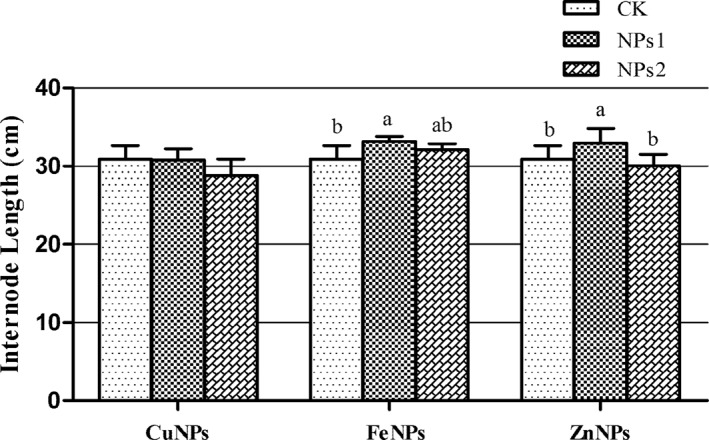
The effect of three metal NPs on the internode length of tomato
Seed coating with Fe NPs significantly increased the internode length. Compared with control, internode length increased by 7.3% and 4% for seed coating with Fe NPs1 and NPs2, respectively. The results showed that the effect of Fe NPs1 was better than NPs2 (Figure 1).
Similarly, seed coating with low concentration Zn NPs (Zn NPs1) significantly increased the internode length. Compared with control, internode length increased by 6.8% at seed coating with Zn NPs1, however, seed coating with NPs2 have no significant differences in internode length (Figure 1).
3.3. Effects of Cu NPs, Fe NPs and Zn NPs seed coating on the average weight per fruit
Seed coating with Cu NPs and Fe NPs significantly affected the average weight of a single fruit of tomato; however, Zn NPs did not affect the average weight of single fruit compared with the control (Figure 2).
FIGURE 2.

The effect of three metal NPs on the average weight per fruit of tomato
Seed coating with Cu NPs1 and Cu NPs2 significantly increased the average weight of single fruit. Compared with control, the average weight of single fruit increased by 10.2% and 6.9%, respectively. The average weight of the single fruit of Cu NPs1 was 3.0% higher than Cu NPs2 (Figure 2).
Similar to Cu NPs, seed coating with Fe NPs1 and Fe NPs2 significantly increased the average weight of a single fruit. Compared with control, the average weight of single fruit increased by 7.5% and 4.5%, respectively. NPs1 was 2.7% higher than Fe NPs2 (Figure 2).
3.4. Effects of Cu NPs, Fe NPs and Zn NPs seed coating on the yield
Similar to the effect of three metal NPs on average weight per fruit, seed coating with Cu NPs and Fe NPs affected the yield of tomato; however, Zn NPs did not affect the yield compared with control (Figure 3).
FIGURE 3.

The effect of three metal NPs on the yield of tomato
Seed coating with Cu NPs1 and Cu NPs2 increased the yield. Compared with control, the yield increased by 10.7% at seed coating with Cu NPs1; however, seed coating with Cu NPs2 had no significant differences in yield (Figure 3).
Seed coating with Fe NPs1 increased the yield. Compared with control, the yield increased by 6.5% for seed coating with Fe NPs1, whereas seed coating with Fe NPs2 had no significant differences in the yield (Figure 3).
3.5. Effects of Cu NPs, Fe NPs and Zn NPs seed coating on fruit number per plant and fruit shape index
The fruit number per plant for all treatments is 17, there was no difference when compared with control (Figure 4). At the same time, the fruit shape index of the detected fruits varied from 0.80 to 0.83 (Figure 5), there was no differences compared with control (0.81). The fruit of tomato is oblate to round in shape. The result indicated that NPs coating have no effect on fruit number per plant and fruit shape index.
FIGURE 4.

The effect of three metal NPs on the fruit number per plant of tomato
FIGURE 5.

The effect of three metal NPs on the fruit shape index of tomato
4. DISCUSSION
Nanotechnology is a new developing field with their attributes and physical characteristics to accelerate the development of fertilizer status. Different types of NPs, including those manufactured from elements not traditionally classified as nutrients (e.g. titanium, silicon, silver) and nanoforms of micronutrients such as Zn, Fe, Cu and Mn, have been demonstrated as being able to improve crop growth and/or content of these elements [9]. Seed coating with fungicides and insecticides has been tested in different crops such as corn [14], canola [14] and rice [15] before planting, and found it was favourable for seed germination, plant growth and yield attributes [15]. The results of this study highlighted the potential of seed coating by polymer‐based mixture with three NPs application as they improved the internode length, average weight of single fruit and yield of tomato. The phenomenon suggests that NPs is helpful to improve the growth of tomato.
Copper is an essential microelement for plant growth. On the whole, 1 kg of dry plant tissue contains 10 mg of Cu. Seed coating with Cu NPs increased significantly the average weight of single fruit and yield of tomato, however, the internode length did not have significant changes compared with control. The average weight of a single fruit increased by 10.2% and 6.9% with low concentration Cu NPs and high concentration Cu NPs, respectively. Low concentration Cu NPs was 3.0% higher than that of high concentration Cu NPs. Similar phenomena were observed in yield, compared with control, low concentration Cu NPs increased by 10.7%. Wiatrak [16] demonstrated that wheat seed coating with a mixed formulation of Cu, Zn and Mn (at 65, 395 and 530 ml/kg seed) significantly increased plant biomass and grain yield, but the Cu, Mn and Zn contents of wheat did not show the changes in harvest wheat. A study by Hafeez et al. [17] revealed that Cu NPs have the potential to improve growth and yield of wheat, but the effect depends on concentration. At the same time, the study demonstrated that Cu NPs absorbed in chitosan hydrogel can enhance tomato growth and quality attributes [18]. Compared with untreated controls, yields of tomato and eggplant were 33% or 34% greater with CuO NPs [19]. However, Cu NPs (at 335 and 570 mg/L) showed notable inhibited plant growth of mung bean (Phaseolus radiatus L.) and wheat (Triticum aestivum L.), respectively [20]. Trujillo‐Reys et al. [21] showed that Cu NPs/CuO NPs reduced water content, root length and dry biomass of the lettuce plants.
Iron is an essential microelement for plant growth and development. Our results showed that low concentration Fe NPs increased significantly the internode length, average weight of single fruit and yield of tomato. However, high concentration Fe NPs inhibited plant growth and improved yields of tomato. Similarly, nanoscale zero‐valent iron reduced plant growth and biomass on cattail (Typha latifolia) and hybrid poplar (Populous deltoids × Populous nigra) when treated with concentration higher than 200 mg/L [22]. Besides, metal NPs' oxides can also promote plant growth. Rui et al. [23] used Fe2O3 NPs as a fertilizer to replace traditional Fe fertilizers in the process of peanut growth; they found that Fe2O3 NPs enhanced plant height, root length and biomass of peanut plants by regulating phytohormone contents and antioxidant enzyme activity. The radical length and biomass were increased in seeds of mung bean to Fe NPs in comparison to the ions [24]. Jeyasubramanian et al. [25] observed that Fe2O3 NPs can improve enhancement in growth rate and productivity of spinach growth in hydroponics. However, Trujillo‐Reyes et al. [21]showed that Fe NPs, unlike Cu NPs, did not affect the chlorophyll content, plant growth, catalase (CAT), and ascorbate peroxidase (APX) activities of lettuce (Lactuca sativa).
Zn is a precursor of growth hormone auxin, and adequate Zn supply may be useful for auxin‐regulated growth promotion [3]. In our experiment, seed coating with Zn NPs increased significantly the internode length of tomato, the effect of low concentration Zn NPs seed coating was better than high concentration Zn NPs. The low concentration Zn NPs seed coating promoted the internode length growth, this may be attributed to provision of Zn for growth cascades like protein synthesis, membrane functioning and cell elongation. Similarly, ZnO NPs have been reported to enhance seed germination and promote root and shoot length in maize [26]. However, seed coating with Zn NPs did not increase seed germination percentage, the average weight of single fruit and yield compared with the control in our research. De Rosa et al. [27] reported that ZnO NPs reduced the germination percentage of alfalfa and tomato by 40% and 20%, respectively. Lin and Xing [28] observed that Zn NPs and ZnO NPs inhibited seed germination percentage of ryegrass and corn, but not affecting seed germination in radish, rape, lettuce and cucumber. Similar results were observed in rice [29], cucumber [30], black mustard [31], corn [32] and maize [33]. However, facile coating of urea with low‐dose ZnO NPs promotes wheat performance, compared with the control, grain yield increased significantly, 51% or 39%, with ZnO‐NPs‐coated or uncoated urea [34]. The study by Upadhyaya et al. [35] revealed that rice seeds treated with Zn NPs increased germination. Similarly, Youssef and Elamawi [6] noticed that lower concentrations of ZnO NPs (especially 10 and 25 mg/L) enhanced seed germination and improved seedling growth, while higher concentrations (100 and 200 mg/L) resulted in phytotoxicity for plants. Besides, Zn seed coating promotes the growth, grain yield and grain biofortification of bread wheat [3]. So, Zn NPs seed coating could show promise for crop improvement.
Seed coating with three metal NPs have no significant differences in seed germination percentage, fruit number per plant and fruit shape index. Before the end of the experiment, the plants with NPs seed coating were not infected with Fusarium wilt, bacterial wilt and late blight, while the control plants were infected with different degrees. This may occur from either the anti‐pathogenic activity of the NPs itself. Besides, Cu NPs can inhibit the growth of bacteria and fungi on the surface. Cu NPs application (73.5% control) was shown to be more effective than currently available non‐Cu NPs formulations (57.8%) in a field study where tomato (L. esculentum) was exposed to Phytophthora infestans [36]. A few reports have also found that CuO NPs, MnO NPs or ZnO NPs were effective in suppression of some crop diseases. Compared with untreated control, CuO NPs, MnO NPs or ZnO NPs reduced disease estimates (area‐under‐the‐disease‐progress‐curve) by 31%, 28% or 28%, respectively [18]. Recently, inorganic nano‐biocides, such as silver [37] and zinc oxide [1], have paid great attention in the application for plant diseases control. NPs also have a great ability to control plant pathogens compared with chemical pesticides. Therefore, the use of NPs is an alternative and effective way to control plant diseases, and the NPs have advantages of being environmentally friendly and cheap [38]. The use of these NPs to control plant pathogens via direct antibacterial activity against the pathogens and by stimulating induced resistance in treated plants against the pathogens is considered a source of major concern. Besides, regarding the safety of nanomaterials, studies had been concerned, researchers will need to prove that nanotechnologies do not have negative impact on the environment [39].
Notably, as discussed in the above studies, increased plant growth and improve yields are reported with NPs but the mechanism of action is unclear. This may occur from either the anti‐pathogenic activity of the NP itself, or indirectly through the induction of key defensive pathways and metabolites within the plant. However, the increase in the crop's yield and quality due to plant nutrition optimization and pathogen protection are actual tasks [9, 10].
5. CONCLUSION
Polymer seed coating with low concentration of metal NPs may promote the uptake of some nutrients and thus improve the productivity of tomato. This might be because all organisms need trace amounts of metallic elements as nutrients to facilitate their metabolisms and other biological activities. NPs have advantages of high activity, high stability, and high effectiveness in delivering nutrients to the targets in comparison to their solid or ionic counterparts. NPs, at low concentrations, could be used as nutrient carriers and supply nutrients to the organisms to enhance their growth. Our results would provide an alternative way to promote seedling healthy growth, and improve the productivity of tomato.
ACKNOWLEDGEMENT
The work was supported by independent research and development project of the China Aerospace Science Technology Corporation: Developing biological experimental device for space biological experiment service platform.
Zhao, X. , et al.: Influence of seed coating with copper, iron and zinc nanoparticles on growth and yield of tomato. IET Nanobiotechnol. 15(8), 674–679 (2021). 10.1049/nbt2.12064
REFERENCES
- 1. Elsharkawy, M. , et al.: Zinc oxide nanostructures as a control strategy of bacterial speck of tomato caused by Pseudomonas syringae in Egypt. Environ. Sci. Pollut. Res. 27, 19049–19057 (2020) [DOI] [PubMed] [Google Scholar]
- 2. Paul, S.K. , et al.: Development of chitosan based optimized edible coating for tomato (Solanum lycopersicum) and its characterization. J. Food Sci. Techol. 55, 2446–2456 (2018) [DOI] [PMC free article] [PubMed] [Google Scholar]
- 3. Rehman, A. , Farooq, M. : Zinc seed coating improves the growth, grain yield and grain biofortification of bread wheat. Acta Physiol. Plant. 38, 238 (2016) [Google Scholar]
- 4. Deng, Q.X. , Zeng, D.F. : Physicochemical property testing of a novel maize seed coating agent and its antibacterial mechanism research. J. Soil Sci. 5, 45–52 (2015) [Google Scholar]
- 5. Farooq, M. , Wahid, A. , Siddique, K.H.M. : Micronutrient application through seed treatments‐a review. J. Soil Sci. Plant Nutr. 12, 125–142 (2012) [Google Scholar]
- 6. Youssef, M.S. , Elamawi, R.M. : Evaluation of phytotoxicity, cytotoxicity, and genotoxicity of ZnO nanoparticles in Vicia faba . Environ. Sci. Pollut. Res. 27, 18972–18984 (2020) [DOI] [PubMed] [Google Scholar]
- 7. Zhao, H. , et al.: Pepper plants response to metal nanoparticles and chitosan in nutrient media. Aust. J. Crop Sci. 13, 433–443 (2019) [Google Scholar]
- 8. Joshi, H. , Meena, D. , Tank, H.K. : Nanotechnology in agriculture: a review. Int. J. Curr. Microbiol. Appl. Sci. 7, 1763–1770 (2018) [Google Scholar]
- 9. Servin, A. , et al.: A review of the use of engineered nanomaterials to suppress plant disease and enhance crop yield. J. Nanopart. Res. 17, 92–112 (2015) [Google Scholar]
- 10. Ruttkay‐Nedecky, B. , et al.: Nanoparticles based on essential metals and their phytotoxicity. J. Nanobiotechnol. 15, 33–38 (2017) [DOI] [PMC free article] [PubMed] [Google Scholar]
- 11. Panyuta, O. , et al.: The effect of pre‐sowing seed treatment with metal nanoparticles on the formation of the defensive reaction of wheat seedlings infected with the eyespot causal agent. Nanoscale Res. Lett. 11, 92 (2016) [DOI] [PMC free article] [PubMed] [Google Scholar]
- 12. Taran, N. , et al.: Effect of zinc and copper nanoparticles on drought resistance of wheat seedlings. Nanoscale Res. Lett. 12, 60 (2017) [DOI] [PMC free article] [PubMed] [Google Scholar]
- 13. Chen, Y. , et al.: Tomato response to metal nanoparticles introduction into the nutrient medium. IET Nanobiotechnol. 14, 382–388 (2020) [DOI] [PMC free article] [PubMed] [Google Scholar]
- 14. Accinelli, C. , et al.: A liquid bioplastic formulation for film coating of agronomic seeds. Crop Prot. 89, 123–128 (2016) [Google Scholar]
- 15. Zeng, D. , Shi, Y. : Preparation and application of a novel environmentally friendly organic seed coating for rice. J. Sci. Food Agric. 89, 2181–2185 (2009) [Google Scholar]
- 16. Wiatrak, P. : Influence of seed coating with micronutrients on growth and yield of winter wheat in southeastern coastal plains. Am. J. Agric. Biol. Sci. 8, 230–238 (2013) [Google Scholar]
- 17. Hafeez, A. , et al.: Potential of copper nanoparticles to increase growth and yield wheat. J. Nanosci. Adv. Technol. 1, 6–11 (2015) [Google Scholar]
- 18. Juárez‐Maldonado, A. , et al.: Cu nanoparticles absorbed on chitosan hydrogels positively alter morphological, production, and quality characteristics of tomato. J. Appl. Bot. Food Qual. 89, 183–189 (2016) [Google Scholar]
- 19. Elmer, W.H. , White, J.C. : The use of metallic oxide nanoparticles to enhance growth of tomatoes and eggplants in disease infested soil or soilless medium. Environ. Sci. Nano. 3, 1072–1079 (2016) [Google Scholar]
- 20. Lee, W.M. , et al.: Toxicity and bioavailability of copper nanoparticles to the terrestrial plants mung bean (Phaseolus radiatus) and wheat (Triticum aestivum): plant agar test for water‐insoluble nanoparticles. Environ. Toxicol. Chem. 27, 1915–1921 (2008) [DOI] [PubMed] [Google Scholar]
- 21. Trujillo‐Reyes, J. , et al.: Exposure studies of core‐shell Fe/Fe3O4 and Cu/CuO NPs to lettuce (Lactuca sativa) plants: are they a potential physiological and nutritional hazard? J. Hazard. Mater. 267, 255–263 (2014) [DOI] [PubMed] [Google Scholar]
- 22. Ma, X. , Gurung, A. , Deng, Y. : Phytotoxicity and uptake of nanoscale zero‐valent iron (nZVI) by two plant species. Sci. Total Environ. 443, 844–849 (2013) [DOI] [PubMed] [Google Scholar]
- 23. Rui, M.M. , et al.: Iron oxide nanoparticles as a potential iron fertilizer for peanut (Arachis hypogaea). Front. Plant Sci. 7, 1–10 (2016) [DOI] [PMC free article] [PubMed] [Google Scholar]
- 24. Raju, D. , Mehta, U.J. , Beedu, S.R. : Biogenic green synthesis of monodispersed gum kondagogu (Cochlospermum gossypium) iron nanocomposite material and its application in germination and growth of mung bean (Vigna radiata) as a plant model. IET Nanobiotechnol. 10, 141–146 (2016) [DOI] [PMC free article] [PubMed] [Google Scholar]
- 25. Jeyasubramanian, K. , et al.: Enhancement in growth rate and productivity of spinach grown in hydroponics with iron oxide nanoparticles. RSC Adv. 6, 15451–15459 (2016) [Google Scholar]
- 26. Estrada‐Urbina, J. , et al.: Nanoscale zinc oxide particles for improving the physiological and sanitary quality of a Mexican landrace of red maize. Nanomaterials. 8, 247–258 (2018) [DOI] [PMC free article] [PubMed] [Google Scholar]
- 27. De la Rosa, G. , et al.: Effects of ZnO nanoparticles in alfalfa, tomato, and cucumber at the germination stage: root development and X‐ray absorption spectroscopy studies. Pure Appl. Chem. 85, 2161–2174 (2013) [Google Scholar]
- 28. Lin, D. , Xing, B. : Phytotoxicity of nanoparticles: inhibition of seed germination and root growth. Environ. Pollut. 150, 243–250 (2007) [DOI] [PubMed] [Google Scholar]
- 29. Chen, J. , et al.: Nitric oxide ameliorates zinc oxide nanoparticles‐induced phytotoxicity in rice seedlings. J. Hazard. Mater. 297, 173–182 (2015) [DOI] [PubMed] [Google Scholar]
- 30. Zhang, R. , et al.: Phytotoxicity of ZnO nanoparticles and the released Zn(II) ion to corn (Zea mays L.) and cucumber (Cucumis sativus L.) during germination. Environ. Sci. Pollut. Res. 22, 11109–11117 (2015) [DOI] [PubMed] [Google Scholar]
- 31. Zafar, H. , et al.: Effect of ZnO nanoparticles on Brassica nigra seedlings and stem explants: growth dynamics and antioxidative response. Front. Plant Sci. 7, 535 (2016) [DOI] [PMC free article] [PubMed] [Google Scholar]
- 32. López‐Moreno, M.L. , et al.: Effect of ZnO nanoparticles on corn seedlings at different temperatures; X‐ray absorption spectroscopy and ICP/OES studies. Microchem. J. 134, 54–61 (2017) [Google Scholar]
- 33. Wang, F. , et al.: Decreased ZnO nanoparticle phytotoxicity to maize by arbuscular mycorrhizal fungus and organic phosphorus. Environ. Sci. Pollut. Res. 25, 23736–23747 (2018) [DOI] [PubMed] [Google Scholar]
- 34. Dimkpa, C.O. , et al.: Facile coating of urea with low‐dose ZnO nanoparticles promotes wheat performance and enhances Zn uptake under drought stress. Front. Plant Sci. 11, 168 (2020) [DOI] [PMC free article] [PubMed] [Google Scholar]
- 35. Upadhyaya, H. , et al.: Physiological impact of zinc nanoparticle on germination of rice (Oryza sativa L) seed. J. Plant Sci. Phytopathol. 1, 62–70 (2017) [Google Scholar]
- 36. Giannousi, K. , Avramidis, I. , Dendrinou‐Samara, C. : Synthesis, characterization and evaluation of copper based nanoparticles as agrochemicals against Phytophthora infestans . RSC Adv. 3, 21743–21752 (2013) [Google Scholar]
- 37. Salam, M.A. , et al.: Synthesis of nanocomposites of polypyrrole/carbon nanotubes/silver nanoparticles and their application in water disinfection. RSC Adv. 7, 16878–16884 (2017) [Google Scholar]
- 38. Elsharkawy, M.M. , Mousa, K.M. : Induction of systemic resistance against Papaya ring spot virus (PRSV) and its vector Myzus persicae by Penicillium simplicissimum GP17‐2 and silica (SiO2) nanopowder. Int. J. Pest Manag. 61, 353–358 (2015) [Google Scholar]
- 39. Sekhon, B.S. : Nanotechnology in agri‐food production: an overview. Nanotechnol. Sci. Appl. 7, 31–53 (2014) [DOI] [PMC free article] [PubMed] [Google Scholar]