



Abstract
Background:
Parental cannabis use is associated with increased risks of cannabis use among offspring, yet few studies have explored the mechanisms influencing intergenerational continuity in cannabis use. To understand the mechanism by which intergenerational cannabis use is influenced, this work explores cannabis use across three generations using a family expansion of the Theory of Reasoned Action (TRA).
Methods:
Data come from the Young Women and Child Development Study which began when teen mothers were pregnant and followed mother-child dyads for 17 years (N = 240). Constructs include cannabis use of grandparents, mothers, and teens, and TRA constructs of behavioral and normative beliefs, intention, and behavior. Hypotheses were tested using Structural Equation Modeling.
Results:
Grandfather’s cannabis use was significantly linked to mother’s normative beliefs (β = .22, p = .006), but not attitudes (β = .12, p = .182). Teen mothers’ attitude was associated with intention (β = .79, p < .001); intention predicted cannabis behavior (β = .61, p < .001). Teen mothers’ cannabis use was predictive of adolescent’s attitude (β = .21, p = .002); attitude predicted intention (β = .73, p < .001) and intention predicted behavior (β = .60, p < .001).
Discussion:
Parents play an influential role in the cannabis use behaviors of adolescents. Future work should consider interventions that target both parent and adolescents, increasing knowledge and skills related to parent-child communication, parental monitoring, and positive parental role modeling to reduce intergenerational continuity of cannabis use.
Keywords: Cannabis Use, Adolescents, Intergenerational Cannabis Use, Theory of Reasoned Action, Offspring of Teen Mothers
Background
Cannabis use is prevalent and remains one of the most frequently used illicit drugs by adolescents in the United States (Scheier and Griffin, 2021) with more than one-third of high school students reporting ever having used cannabis and about one-fifth reporting current use (Kann et al., 2018). Evidence suggests that parental history of cannabis use is associated with increased risks of cannabis use among their offspring (Bailey, 2016; Kosty et al., 2015; Madras et al., 2019; Tiberio et al., 2020; Vermeulen-Smit et al., 2015) – children with mothers or fathers who reported past-year cannabis use were more likely to report current cannabis use than peers without parents who were using (O’Loughlin; 2019). While the influence of parental cannabis use on offspring’s cannabis use behaviors is established, few studies have explored the mechanisms influencing the intergenerational continuity in cannabis use. Further, only one identified study has explored the influence of grandparent cannabis use behaviors on the cannabis use behaviors of grandchildren (Bailey et al., 2016), while one other has explored adolescent protective factors (active coping, activity involvement, and academic achievement) in decreasing the likelihood of cannabis use in a three-generation sample (Rothenberg et al., 2020). Last, while there is evidence that being born to a teen mother increases the risk of cannabis use among adolescent offspring (see Cederbaum et al., 2020 for review), no three-generation study has included this vulnerable population of parents and offspring. To better understand these intergenerational processes and the mechanism by which intergenerational cannabis use is influenced, this work explores cannabis use across three generations (grandparents, teen mothers, and offspring) using a family expansion of the Theory of Reasoned Action (Hutchinson and Wood, 2007).
Cannabis use in adolescence
Nearly all cannabis use begins during adolescence (Anthony, 2016) with the number of cannabis users (adolescents 12 years or older) having steadily increased from 25.8 million (11.0%) in 2002 to 43.5 million (15.9%) in 2018 (Welty et al., 2019). Recent data from two national surveillance studies indicate that about 45% of high school seniors have used cannabis in their lifetime; 20–25% report cannabis use in the past 30 days (Johnston et al., 2019; Kann et al., 2018). The increasing potency of today’s cannabis and popularity of drugs containing synthetic cannabinoids could amplify the impact of cannabis use on the developing adolescent brain (Elsohly, 2016; Lubman, 2015). Early initiation of cannabis use among adolescents is associated with adverse outcomes later in life, including behavioral problems, impaired cognition (Broyd et al., 2016), preclinical or clinical symptoms of depression and anxiety (Gobbi et al., 2019), addiction later in life (Han et al., 2019) including cannabis use disorder, and advancement to use of other illicit drugs (Silins et al., 2014), warranting the importance of clarifying mechanisms underlying youth’s cannabis use.
Intergenerational Continuity in Substance Use
Intergenerational continuity of substance use may occur through multiple mechanisms, including genetics (Polderman et al., 2015; Dick et al., 2016), family environment, and parenting (Hill et al, 2018). The influence of parental cannabis use on offspring’s cannabis use can occur through increased visibility of cannabis use, ease of access, transmission of pro-cannabis norms, and role modeling (Kerr et al., 2015). In fact, parents’ early cannabis use as adolescents (Nadel and Thornberry, 2017; Sokol et al., 2018) and current use (Epstein, et al., 2020; Hill et al., 2018; Kosty et al., 2015; O’Laughlin et al., 2019) are both directly associated with cannabis use in adolescence and young adulthood.
Few studies examining substance use behaviors have included three generations (Bailey et al., 2016, Brook et al., 2012; Brook et al., 2015; Rothenberg et al., 2020; Steinhausen et al., 2017); only two of these works examined cannabis use specifically (Bailey et al., 2016; Rothenberg et al., 2020). Bailey and colleagues (2016) found a significant association between both parent and adolescent cannabis use and adolescent perceived norms with cannabis use; there was no significant link between grandparent and grandchild cannabis use). Rothenberg and colleagues (2020) focused on protective factors in adolescents that reduced the likelihood of cannabis use among those with parents who used cannabis. In this study, the role of grandparents’ cannabis use was not been examined. No identified studies have focused on teen mothers and their offspring within the three generation models, even though teen mothers are more likely to report cannabis use behaviors over time (DeGenna et al., 2015) and offspring of teen mothers experience increased risk for substance use (Cederbaum et al., 2020). To address these gaps, our work examines cannabis use across three generations among this specific population who is particularly vulnerable to substance use/misuse.
Theoretical Framework
The Theory of Reasoned Action (TRA) provides the foundational framework for this study. The theory suggests that behavioral intentions, previously viewed as immediate precursors to behavior, are a function of attitudes and beliefs about the probability that a behavior will lead to specific outcomes (Fishbein and Ajzen, 1975). An essential determinant of an individual’s behavior is intention, posited to be directly influenced by one’s beliefs (attitude) towards a certain behavior and their subjective norms (the notion that those important to them may disapprove/approve of the behavior; Fishbein and Ajzen, 1975). Both attitudes and norms are likely be influenced by the multifaceted system individuals are nested in (Bronfenbrenner, 1979) and family might be one of key systems shaping individuals’ beliefs and norms. Following this logic, adolescent cannabis use can be influenced by their interaction within their family systems.
Hutchinson and Wood (2007) proposed a family expansion of the Theory of Planned Behavior, applied in our study to the Theory of Reasoned Action, which has been applied in prior studies (Cederbaum et al., 2016; Cederbaum et al., 2017). The expanded model enables the researcher to conceptualize how parent’s attitudes and norms may be impacted by external influences (i.e. their own parents cannabis use behavior) and in turn, influence a parent’s intentions and behaviors; in turn, parent’s behaviors may subsequently function as external influences on adolescent cannabis use attitudes and norms, which are the predictors of an adolescents behaviors (i.e. a parent’s use of cannabis may lend to more permissive cannabis use attitudes, which in turn influence the adolescent’s intention to use cannabis and their actual cannabis use behaviors) In this work, the path model allows for the exploration of proximal and distal influences on mother’s cannabis use behaviors and in turn, the proximal and distal influences of adolescent cannabis use.
TRA to understand cannabis use behavior and intergenerational transmission
Emerging studies have attributed adolescent cannabis use to the intergenerational transmission of norms, beliefs, values, and intentions (Henry and Augustyn, 2017; Hill et al., 2018). Previous studies have demonstrated that theoretical constructs within the traditional TRA predict cannabis use behaviors in adolescence (Malmberg et al., 2012) and young adulthood (Ito et al., 2015; Wu et al., 2015). Specifically, Malmberg and colleagues (2012) found that having a positive behavioral beliefs towards cannabis use and viewing cannabis use as more normative were predictive of intention to use cannabis. This is supported by the findings of others who noted that perceived parental and peer norms are among the key drivers of these substance use behaviors (Cederbaum, 2016; Malmberg et al., 2012). Individual’s norms can come from multiple referent groups including parents, siblings, peers, and grandparents (Bailey et al., 2016; Henry and Augustyn, 2017; Hill et al., 2018).
Adolescents who have parents who currently use cannabis are more likely to report their cannabis use (Epstein et al., 2020; Henry et al., 2017; Hill et al., 2018; Knight et al., 2014; Kosty et al., 2015; Nadel and Thornberry, 2017; O’Laughlin et al., 2019; Sokol et al., 2018); this may be driven by the association of parental cannabis use and perceived parental cannabis use approval and decrease in the perceived harm of regular cannabis use among adolescents (Kosterman et al., 2016). Prior work found an association between parental substance use and adolescent perceived norms about substance use (Lochbuehler et, al., 2016; Rusby et al., 2018); youth whose parents used cannabis frequently reported fewer negative cannabis expectations, more pro-cannabis norms and lower expectations of punishment for use. Thus, the link between parental cannabis use and cannabis initiation is mediated by norms (Bailey et al., 2016). Consequently, the adolescents’ perceived parental cannabis use norms contribute to their use of cannabis (Bailey et al., 2016).
The role of grandparents provides insight into the developmental history of parents, as well as the active role grandparents play in the lives of their grandchildren (Bailey et al., 2016). While three-generation studies focusing on the influence of grandparents’ substance use on the young adult are rare, prior studies underscore how family history of substance use is an important predictor of adolescent risk behavior (Bailey et al., 2016; Brook et, al 2012; Brook et al., 2015; Rothenberg et al., 2020). Yet only two identified studies have attempted to explore intergenerational cannabis use across three generations; while both found links between parent and child cannabis used behaviors, only one included all three generations in models (Bailey et al., 2016). Given that substance use by family members other than parents can directly influence the behavioral and normative beliefs, and in turn intentions and behaviors of adolescents (Cederbaum, 2016; Hutchinson and Wood, 2007; Malmberg et al., 2012) understanding the paths from distal predictors, such as grandparent’s cannabis use, to adolescent cannabis use, will help us better understand the intergenerational links between the cannabis use of grandparents, mothers, and their offspring. Identification of these intergenerational risk factors is prerequisite to the identification of prevention and intervention targets. We also explored possible gender differences in the hypothesized paths, considering that the impact of parental substance use on youth substance use might be more prominent among same-gender parent-child dyads (Cho, 2018) particularly in mother-daughter dyads (Kosty et al., 2015). Clarifying gender variations in the intergenerational transmission of substance use between parents and offspring is important to develop effective intervention strategies and deploy resources in a more targeted way (Capaldi et al., 2016).
Methods
The Young Women and Child Development Study (YCDS) is a longitudinal study examining a comprehensive range of developmental outcomes among teen mothers and their children (Lee et al., 2017; Oxford et al., 2010). Data collection started in 1988; mother-child dyads were followed approximately every year for 17 years (N = 240). Study eligibility included: (a) being younger than 18 years old at the time of enrollment; (b) not married; (c) planning to bear and parent the child, and (d) able to speak English. The sample was racially diverse (48.8% White, 27.1% African American, 6.7% Native American, 4.6% Hispanic, 4.6% Other, 4.2% Asian/Pacific Islander, 4.2% Black/White); 40% of the children were female. At the initial interview mean age of participants was 16.1 years (SD = 1.01). Among children, 71.7% reported no prior pregnancy and 21.7% reported public assistance as their main source of income. Sample retention rates were consistently high, averaging 94.6%. Participants were compensated $15–50 per interview depending on the data collection wave. The study and data collection procedure were approved by the human subjects review committee at the affiliated universities.
Grandparents Measures
Data were collected at the first wave of the data collection (time when teen mother was pregnant). Grandfather and grandmother use of cannabis was measured by asking mothers the question “Do either of your parents (or guardians) smoke marijuana (grass, hash, pot)?” for each parent separately. The item was rated with a 3-point scale (0 = no, 1 = used to but quit, 2 = yes, sometimes, 3 = yes, often). A majority of grandfathers (N = 112; 63.3%) and grandmothers (N = 155; 69.2%) reported never having used cannabis.
Maternal Measures
Behavioral attitude toward cannabis use (at child age 11.5 years)
Behavioral attitude toward cannabis use (at child age 11.5 years) was assessed using three items. With the stem “For you, would using marijuana during the next six months be…” were anchored with a 5-point response scale (0 = very bad to 4 = very good; 0 = very unpleasant to 4 = very pleasant; and 0 = very harmful to 4 = very helpful, respectively).
Normative beliefs toward cannabis use (at child age 11.5 years)
Normative beliefs toward cannabis use (at child age 11.5 years) were measured with one question that asked, “What do most people who are important to you think about you using marijuana during the next six months?”. The item was evaluated on a 4-point response scale (0 = think I definitely should not to 3 = think it’s okay).
Intention to use cannabis (at child age 11.5 years)
Intention to use cannabis (at child age 11.5 years) was assessed with a single item that asked “How likely is it that you will use marijuana during the next six months?”. The item was rated on a 5-point response scale (0 = very unlikely to 4 = very likely).
Maternal cannabis use (at child age 15 years)
Maternal cannabis use (at child age 15 years) was measured by asking number of times mothers reported using cannabis in the past 6 months (0 = never, 1 = less than once a month, 2 = about once a month, 3 = less than once a week, 4 = about once a week, 5 = 2–5 times a week, 6 = every day, 7 = more than once a day). A majority of mothers reported never having used cannabis (N = 164; 77.0%).
Adolescent Measures (youth age 16 and 17 years)
Behavioral attitude toward cannabis use (age 16).
Three items assessed behavioral attitude. A single item “Do you think if you smoked marijuana in the next year it would be…” was anchored with a 5-point response scale (0 = very bad to 4 = very good; 0 = very foolish to 4 = very wise; and 0 = very negative to 4 = very positive).
Normative belief toward cannabis use (age 16)
Normative belief toward cannabis use (age 16) were captured with two items that asked what people who are important to youth (i.e., mother and second parent figure) would think about the youth using cannabis during the next six months. The items were evaluated on a 4-point response scale (0 = think I definitely should not to 3 = think it’s okay).
Intention to use cannabis (youth age 16)
Intention to use cannabis (youth age 16) was measured with a single item that asked, “If things went as you would like them to, how likely is it that you will smoke marijuana in the next year?”. The item was rated on a 5-point response scale (0 = very unlikely to 4 = very likely).
Cannabis use (age 17).
Cannabis use was measured by the number of times youth reported using marijuana in the past 6 months (0 = never, 1 = less than once a month, 2 = about once a month, 3 = less than once a week, 4 = about once a week, 5 = 2–5 times a week, 6 = every day, 7 = more than once a day). A majority reported having used cannabis at least once (N = 112; 60.9%).
Covariates
Covariates included child gender (male = 0; female = 1) and child race (0 = White, 1 = non-white). Youth’s internalizing (Mean = 1.96, SD = 2.01) and externalizing problems (Mean = 7.45, SD = 4.06) assessed using the Child Behavior Checklist (Achenbach, 1991) at age 4.5, the earliest assessment available, were added as covariates indicating earlier symptoms of psychopathology, which has been linked to adolescence substance use (Colder et al., 2013).
Analytic Plan
The hypotheses for the present study were tested using Structural Equation Modeling (SEM), a general linear model estimated from the covariance matrix of variables (Bollen, 1989). We performed a two-step SEM approach as recommended by Bollen (1989) and Anderson and Gerbing (1988). First, we conduct a confirmatory factor analysis (CFA) to evaluate whether latent variables reasonably represented observed variables (the measurement). Then, using the latent factors established in the CFA, we test hypothesized paths among grandparent’s cannabis use and mothers’ attitudes and normative beliefs, intention, as well as behavior toward cannabis use, which in turn influence adolescent’s attitudes and normative beliefs, intention, and then eventually adolescent cannabis use (the structure). In the final stage, a multiple group analysis approach was used to test for gender differences in the degree to which maternal cannabis use is influential on youth’s attitudes and norms. A set of fit indices, including comparative fit index (CFI ≥ .95), root mean square error of approximation (RMSEA ≤ .06), and standardized root mean squared residual (SRMR < .08), was used to estimate fit of models (Hu and Bentler, 1999). All analyses were conducted in Mplus version 8 (Muthén and Muthén, 1998–2017). Missing data were managed with full information maximum likelihood estimation (FIML), a recommended method to address missing data (Schlomer et al., 2010).
Results
Descriptive statistics for the path analysis variables are presented in Table 1 and bivariate correlations among analysis variables are shown in Table 2. Informed by the TPB model, we first estimated a CFA model with three latent constructs including maternal attitude, child behavioral attitude, and child behavioral norms. Factor loading of one indicator for each factor was fixed at 1 to scale the other indicator(s) and the factors were set to be correlated. The CFA model fits the data well—CFI = .987, RMSEA = .057, and SRMR = .055. All indicators had high factor loadings (β= .72 to .92) and were statistically significant (p < .001), empirically confirming the latent constructs. Standardized factor loadings and the intercorrelations among the factors (see Figure 1).
Table 1.
Descriptive statistics
| M | |||
|---|---|---|---|
| 41% | |||
| 59% | |||
| 62% | |||
| 1.96 | 2.01 | 0 – 9 | |
| 7.45 | 4.06 | 0 – 19 | |
| .44 | .76 | 0 – 3 | |
| .56 | .89 | 0 – 3 | |
| .87 | 1.07 | 0 – 4 | |
| 1.06 | 1.25 | 0 – 4 | |
| .90 | 1.02 | 0 – 4 | |
| .67 | .91 | 0 – 3 | |
| .69 | 1.23 | 0 – 4 | |
| .85 | 1.86 | 0 – 7 | |
| 1.08 | 1.15 | 0 – 4 | |
| .83 | .96 | 0 – 4 | |
| .90 | 1.03 | 0 – 4 | |
| .30 | .59 | 0 – 3 | |
| .37 | .71 | 0 – 3 | |
| 1.06 | 1.35 | 0 – 4 | |
| 2.03 | 2.44 | 0 – 7 |
Table 2.
Correlations Among Analysis Variables
| 1 | 2 | 3 | 4 | 5 | 6 | 7 | 8 | 9 | 10 | 11 | 12 | 13 | 14 | 15 | 16 | |
|---|---|---|---|---|---|---|---|---|---|---|---|---|---|---|---|---|
| 1. Child gender | ||||||||||||||||
| 2. Child race/ethnicity | .07 | |||||||||||||||
| 3. Child internalizing | −.09 | .04 | ||||||||||||||
| 4. Child externalizing | −.19* | −.07 | .52** | |||||||||||||
| 5. Grandmother marijuana use | .04 | .08 | .08 | .05 | ||||||||||||
| 6. Grandfather marijuana use | .07 | .06 | .05 | .23** | .35** | |||||||||||
| 7. Maternal attitude: good/bad | −.07 | .18* | .08 | .08 | .04 | .09 | ||||||||||
| 8. Maternal attitude: pleasant/unpleasant | −.05 | .08 | .04 | .10 | .07 | .12 | .73** | |||||||||
| 9. Maternal attitude: helpful/harmful | −.19 | .18* | .15 | .10 | .06 | .13 | .78** | .68** | ||||||||
| 10. Maternal norms | −.02 | .26** | −.01 | .06 | .14* | .24** | .55** | .46** | .49** | |||||||
| 11. Maternal intention | −.06 | .15* | −.03 | .10 | .10 | .10 | .67** | .67** | .57** | .38** | ||||||
| 12. Maternal behavior | −.02 | .08 | −.05 | .05 | .19** | .15 | .46** | .50** | .40** | .30** | .62** | |||||
| 13. Child attitude: good/bad | .08 | .12 | −.00 | −.04 | .07 | .04 | .08 | .17* | .13 | −.04 | .14* | .18* | ||||
| 14. Child attitude: wise/foolish | .01 | .14 | −.11 | −.10 | .02 | −.06 | .04 | .15* | .08 | −.04 | .14 | .20** | .78** | |||
| 15. Child attitude: positive/negative | .03 | .09 | −.05 | −.06 | .05 | −.05 | .03 | .14 | .05 | −.05 | .12 | .21** | 79** | .84** | ||
| 16. Child norms: mother | .01 | .14 | −.03 | .01 | .03 | −.08 | .19** | .20** | .20** | .19** | 21** | .18* | 34** | 33** | .28** | |
| 17. Child norms: father | .08 | .12 | −.09 | −.13 | −.08 | −.16 | −.05 | .02 | .00 | −.04 | .00 | −.01 | .40** | .37** | 39** | 57** |
| 18. Child intention | .04 | .08 | −.06 | −.15 | .03 | −.09 | .07 | .10 | .13 | −.02 | .07 | .18* | 74** | .69** | .69** | 35** |
| 19. Child behavior | −.07 | .09 | .01 | .03 | .06 | .02 | .09 | .05 | .04 | .03 | .06 | .12 | .53** | 44** | 45** | 27** |
Figure 1.
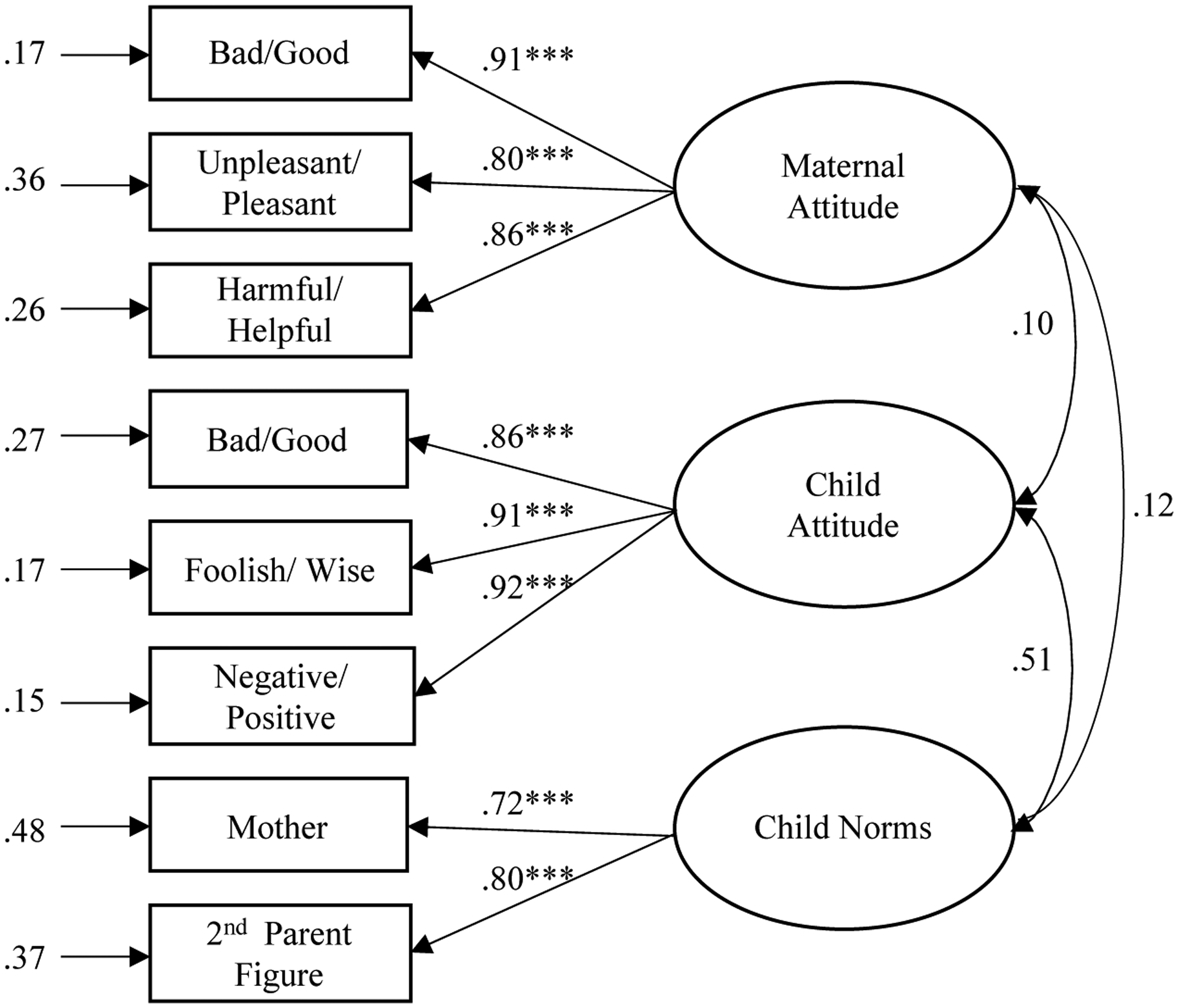
Confirmatory Factor Analysis of Attitude Items and Norms
Note. *** p < .001. Factor loadings are standardized.
Next, the hypothesized paths were estimated (the structural part of the model) to test the paths among grandparent, mother, and child variables. The results are presented in Figure 2. The model explained 37.5% of the variance and demonstrated a good model fit—CFI = .969, RMSEA = .039, and SRMR = .065. Grandfather’s use of cannabis was significantly linked to mother’s normative beliefs (β = .22, p = .006), but not to mother’s attitude (β = .12, p = .182). Grandmother’s use of cannabis was not significantly associated with either mother’s attitude (β = .03, p = .727) or normative belief (β = .07, p = .366). As theorized, mothers’ attitudes were associated with her intention to use cannabis (β = .79, p < .001), and in turn, intention predicted cannabis use (β = .61, p < .001). Moving through the family expansion of the Theory of Reasoned Action, mothers’ behavior was predictive of adolescent’s attitudes towards cannabis use (β = .21, p = .002), which in turn was associated with the adolescent’s intention to use cannabis (β = .73, p < .001); adolescent’s intention to use cannabis predicted cannabis use behavior (β = .60, p < .001). There were significant correlations between grandmother and grandfather cannabis use (r = .35, p < .001), mother’s behavioral and normative beliefs (r = .58, p < .001), or child’s attitude and normative beliefs (r = .51, p < .001).
Figure 2.
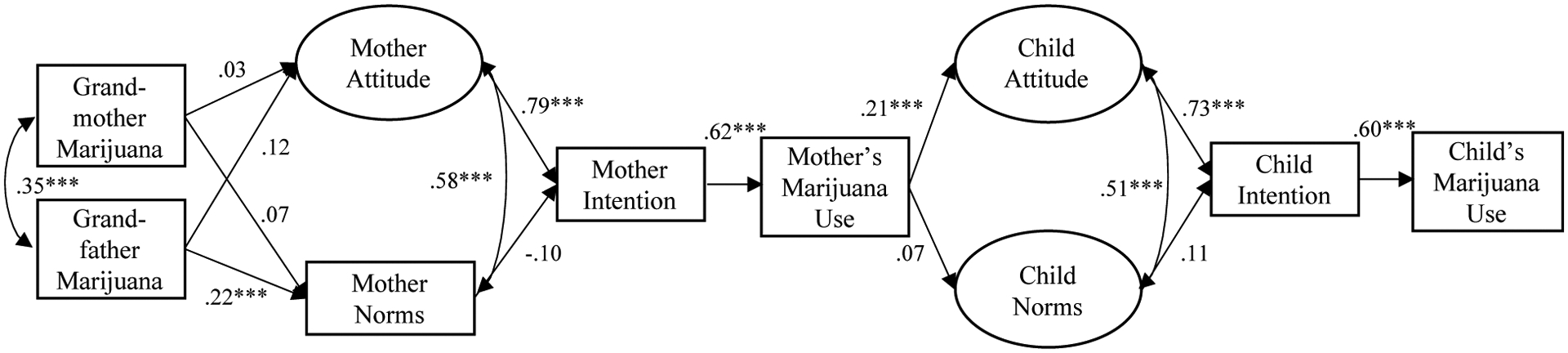
Path model of intergenerational model of theory of reasoned action on marijuana use
Note. *** p < .001.
Finally, a multiple group analysis was conducted to test for gender differences related to mothers’ cannabis use – mother’s cannabis use to youth’s attitude and norms. The path from maternal cannabis use to youth’s attitude was significant only for girls (β = .41, p < .001), while the path from maternal cannabis use to youth’s norm was significant only for boys (β = .25, p < .015).
Discussion
Adolescents of teen mothers are at greater risk for substance use (Cederbaum et al., 2020). While links between parental and child substance use have been previously established (Bailey et al. 2016; Madras et al, 2019; Tiberio et al., 2020; Vermeulen-Smit et al., 2015), this study is one of few (Bailey et al., 2016; Rothenberg et al., 2020) with a three-generation model to explore the cannabis use across generations and then its underlying mechanisms. Consistent with the TRA, behavioral beliefs were predictive of intention which, in turn, predicted cannabis use behavior for both mothers and youth. The findings support prior work using the family expansion of TRA (Hutchinson and Wood, 2007; Cederbaum et al., 2016; Cederbaum et al., 2017), showing that parent cannabis use behaviors (both from grandfather to mothers and mothers to adolescents) were significantly associated with cannabis use in next generation. The findings highlight the complexity of intergenerational transmission of cannabis use but establish areas for future prevention work.
Parental Influence
Parents play an influential role in the cannabis use behaviors of adolescents; role modeling of substance use behaviors is a particularly significant predictor of these same behaviors among their offspring (Rusby et al., 2018). As posited by the family expansion of the Theory or Reasoned Action (Cederbaum et al., 2016; Cederbaum et al., 2017), in this work we found that teen mother’s cannabis use behaviors were a significant predictor of adolescent permissive attitudes towards cannabis use for girls and norms for boys; these in turn were predictive of the adolescent’s intention to use cannabis, with intention predicting adolescent cannabis use. Current study findings highlight that maternal cannabis use sets the risk process in motion, although the mechanisms linking maternal cannabis use to youth’s own reasoned action process for cannabis use may differ for two genders. These findings contradict some prior studies (Kosty et al., 2015) and confirm some others (Vermeulen-Smit et al.,2015). The associations between maternal cannabis use and adolescent attitudes or norms may also be driven by direct observations and perceptions of the parental behaviors as social norms (Kerr et al., 2015; Rusby et al., 2018). Thus, problem behaviors among parents are likely to be associated with early initiation of problem behaviors for their offspring (Cho, 2018). This finding is in line with findings by Bailey and colleagues (2016) and extends this line of inquiry by testing the influence of parent cannabis use behaviors on behavioral beliefs and norms across generations.
Theorized paths underlying cannabis use across three generations
While both grandparent and parent cannabis use behaviors influenced the subsequent generation, these behaviors did not influence the same theoretical constructs. Grandparent cannabis use was predictive of mother’s perceived norms, but not their behavioral beliefs. This link may occur because social norms can be influenced by perceptions of parent substance use behaviors (Lochbuehler et al., 2016; Rusby et al., 2018); as such, grandparent behaviors influenced the perception of cannabis use norms among mothers. The influence of mothers’ behaviors on adolescents showed that maternal cannabis use behaviors were predictive of behavioral beliefs, but not norms. This finding is well supported by prior TRA work which shows a stronger link between external influence on behavioral beliefs as compared to norms (McEachan et al, 2016). For teen mothers, this relationship may have been less salient because of known relationship challenges that arise when adolescents become pregnant (Jacobs and Mollborn, 2012). As posited in TRA (Fishbein and Ajzen, 1975) and shown in relevant studies using TRA to understand cannabis use (Ito et al., 2015; Malmberg et al., 2012; Wu et al., 2015), behavioral beliefs significantly predicted intention to use cannabis; in turn, intentions to use cannabis predicted cannabis use behaviors. Taken together, our study findings support paths hypothesized in the TRA (Fishbein and Ajzen, 1975) and the family expansion (Hutchinson and Wood, 2007).
Limitations
While a theoretically grounded analysis of intergenerational cannabis use across three generations is a unique and important contribution to the literature, there are several study limitations. First, this study focuses on a specific population—teen mothers, their parents, and adolescent offspring. Because teen mothers are more likely than older mothers to live with their family of origin and/or get greater support from family after the birth of their child, intergenerational cannabis use may have a differential influence on children of teen mothers. As such, the generalization of our study findings to families with different demographic characteristics should be carried out cautiously. Second, a number of items were measured using a single item. Although the items fit each construct of the theory and use of a single-items measure is common with TRA constructs (Kavanaugh and Schwartz, 2009), more robust measures of norms and behaviors should be considered in future work. Further, all data were self-reported; it is possible that cannabis use was under-reported by teen mothers and their adolescent offspring. Last, cannabis use of fathers and paternal grandparents has not been included. Given work that shows the association of these parenting behaviors on the substance use behaviors of adolescents, this should be included in future work.
Conclusion
This study supports the prior findings connecting cannabis use across three generations (Bailey et al., 2016; Rothenberg et al., 2020) and extends the work by examining a mediational theory to explore mechanisms by which intergenerational cannabis use is influenced. The inclusion of self-reported and prospective data from grandparents, mothers, and adolescents is another strength. Using a theory-driven path model we found the grandparent cannabis use behaviors have a significant influence on mothers’ beliefs but not attitude, which in turn influence intentions and behaviors. Mothers’ behaviors set adolescents’ attitude but not their norms in motion, which in turn influence intentions and eventually adolescent cannabis use behaviors. Findings contribute to the existing literature and lend new insight into how cannabis use may be influenced or maintained across generations. The results allow for identification of prevention and intervention points for reducing cannabis use. Future work should consider interventions that target both parents and adolescents, increasing knowledge and skills related to parent-child communication (to influence attitudes and norms), parental monitoring (reduce opportunity), and positive parental role modeling (refraining from cannabis use around adolescents) to reduce intergenerational continuity of cannabis use.
Highlights:
Parents influence the cannabis use behaviors of their children.
Knowledge about mechanisms by which intergenerational cannabis use is influenced is limited
Interventions that target both parent and adolescents, are needed to reduce intergenerational continuity of cannabis use
Acknowledgements:
This work was funded by a grant from the National Institute of Child Health and Human Development (R03HD097379; PI: J.O. Lee).
Funding:
This work was supported by the National Institute of Child Health and Human Development (R03HD097379; PI: J.O. Lee) and National Institute of Drug Abuse (R01DA05208 PI: Gilchrist & Morrison)
Footnotes
Declarations of Interest: None
Contributor Information
Julie A. Cederbaum, University of Southern California, Suzanne Dworak-Peck School of Social Work.
Woo Jung Lee, University of Southern California, Suzanne Dworak-Peck School of Social Work.
Lucinda Okine, University of Southern California, Suzanne Dworak-Peck School of Social Work.
Lei Duan, University of Southern California, Suzanne Dworak-Peck School of Social Work.
Jungeun Olivia Lee, University of Southern California, Suzanne Dworak-Peck School of Social Work.
References
- Achenbach T, 1991. Integrative guide for the 1991 CBCL 4–18, YSR, and TRF profiles. University of Vermont, Department of Psychiatry. [Google Scholar]
- Anderson JC, Gerbing DW, 1988. Structural equation modeling in practice: A review and recommended two-step approach. Psychol Bull, 103, 411–423. [Google Scholar]
- Anthony CJ, Lopez-Quintero C, Alshaarawy O, 2016. Cannabis epidemiology: A selective review. Curr Pharm Des, 22, 6340–6352. [DOI] [PMC free article] [PubMed] [Google Scholar]
- Bailey JA, Hill KG, Guttmannova K, Epstein M, Abbott RD, Steeger CM, Skinner ML (2016). Associations between parental and grandparental marijuana use and child substance use norms in a prospective, three-generation study. J Adolesc Health, 59, 262–268. doi: 10.1016/j.jadohealth.2016.04.010 [DOI] [PMC free article] [PubMed] [Google Scholar]
- Bollen KA 1989. Structural equations with latent variables. New York, John Wiley & Sons, Inc. [Google Scholar]
- Bronfenbrenner U (1979). The ecology of human development. Harvard University Press. [Google Scholar]
- Brook JS, Balka EB, Zhang C, & Brook DW, 2015. Intergenerational transmission of externalizing behavior. J Child Fam Studies, 24, 2957–2965. doi: 10.1007/s10826-014-0099-x [DOI] [PMC free article] [PubMed] [Google Scholar]
- Brook JS, Zhang C, Balka EB, & Brook DW, 2012. Pathways to children’s externalizing behavior: A three-generation study. J Genet Psychol, 173, 175–197. doi: 10.1080/00221325.2011.594821 [DOI] [PMC free article] [PubMed] [Google Scholar]
- Broyd SJ, van Hell HH, Beale C, Yuecel M, Solowij N, 2016. Acute and chronic effects of cannabinoids on human cognition—A systematic review. Biol Psychiatry, 79, 557–567. doi: 10.1016/j.biopsych.2015.12.002 [DOI] [PubMed] [Google Scholar]
- Capaldi DM, Tiberio SS, Kerr DC, Pears KC, 2016. The relationships of parental alcohol versus tobacco and marijuana use with early adolescent onset of alcohol use. J Studies on Alcoh Drugs, 77, 95–103. [DOI] [PMC free article] [PubMed] [Google Scholar]
- Cederbaum JA, Adhikari AB, Guerrero EG, Hutchinson MK, 2016. Relationship satisfaction and communication among urban minority HIV-positive and HIV-negative mothers: The influence on daughter’s alcohol use. J Fam Issues, 37, 155–176. doi: 10.1177/0192513X13513582 [DOI] [PMC free article] [PubMed] [Google Scholar]
- Cederbaum JA, Jeong CH, Yuan C, Lee JO, 2020. Sex and substance use behaviors among children of teen mothers: A systematic review. J Adolesc, 79, 208–220. doi: 10.1016/j.adolescence.2020.01.008 [DOI] [PMC free article] [PubMed] [Google Scholar]
- Cederbaum JA, Rodriguez AJ, Sullivan K, Gray K, 2017. Attitudes, norms, and the effect of social connectedness on adolescent sexual risk intention. J Sch Health, 87, 575–583. doi: 10.1111/josh.12532 [DOI] [PubMed] [Google Scholar]
- Cho BY, 2018. Associations of father’s lifetime cannabis use disorder with child’s initiation of cannabis use, alcohol use, and sexual intercourse by child gender. Subst Use Misuse, 53, 2330–2338. doi: 10.1080/10826084.2018.1473439 [DOI] [PMC free article] [PubMed] [Google Scholar]
- Colder CR, Colder CR, Scalco M, Scalco M, Trucco EM, Trucco EM, … Hawk LW Jr, 2013. Prospective associations of internalizing and externalizing problems and their co-occurrence with early adolescent substance use. J Ab Child Psychol, 41, 667–677. doi: 10.1007/s10802-012-9701-0 [DOI] [PMC free article] [PubMed] [Google Scholar]
- De Genna NM, Goldschmidt L, Cornelius MD, 2015. Maternal patterns of marijuana use and early sexual behavior in offspring of teenage mothers. Matern Child Health J, 19, 626–634. doi: 10.1007/s10995-014-1550-8 [DOI] [PMC free article] [PubMed] [Google Scholar]
- Dick DM, Adkins AE, Sally I, Kuo C, 2016. Genetic influences on adolescent behavior. Neurosci Biobehav Rev, 70, 198–205. doi: 10.1016/j.neubiorev.2016.07.007 [DOI] [PMC free article] [PubMed] [Google Scholar]
- ElSohly MA, Mehmedic Z, Foster S, Gon C, Chandra S, Church JC, 2016. Changes in cannabis potency over the last 2 decades (1995–2014): Analysis of current data in the United States. Bio Psychiatry, 79(7), 613–619. doi: 10.1016/j.biopsych.2016.01.004 [DOI] [PMC free article] [PubMed] [Google Scholar]
- Epstein M, Bailey JA, Furlong M, Steeger CM, Hill KG, 2020. An intergenerational investigation of the associations between parental marijuana use trajectories and child functioning. Psychol Addict Beh, 38, 830–838. doi: 10.1037/adb0000510 [DOI] [PMC free article] [PubMed] [Google Scholar]
- Fishbein M, Ajzen I, 1975. Belief, attitude, intention, and behavior: An introduction to theory and research. Addison-Wesley. [Google Scholar]
- Gobbi G, Atkin T, Zytynski T, Wang S, Askari S, Boruff J, Ware M, Marmorstein N, Cipriani A, Dendukuri N & Mayo N (2019). Association of cannabis use in adolescence and risk of depression, anxiety, and suicidality in young adulthood: a systematic review and meta-analysis. JAMA Psychiatry, 76(4), 426–434. doi: 10.1001/jamapsychiatry.2018.4500 [DOI] [PMC free article] [PubMed] [Google Scholar]
- Han B, Compton WM, Blanco C, & Jones CM (2019). Time since first cannabis use and 12-month prevalence of cannabis use disorder among youth and emerging adults in the United States. Addiction, 114(4), 698–707. doi: 10.1111/add.14511 [DOI] [PMC free article] [PubMed] [Google Scholar]
- Henry KL, & Augustyn MB (2017). Intergenerational continuity in cannabis use: The role of parent’s early onset and lifetime disorder on child’s early onset. J Adolesc Health, 60(1), 87–92. doi: 10.1016/j.jadohealth.2016.09.005 [DOI] [PMC free article] [PubMed] [Google Scholar]
- Hill M, Sternberg A, Suk HW, Meier MH, Chassin L (2018). The intergenerational transmission of cannabis use: Associations between parental history of cannabis use and cannabis use disorder, low positive parenting, and offspring cannabis use. Psychol Addict Behav, 32, 93–103. doi: 10.1037/adb0000333 [DOI] [PMC free article] [PubMed] [Google Scholar]
- Hemsing N, & Greaves L (2020). Gender norms, roles and relations and cannabis-use patterns: A scoping review. International Journal of Environmental Research and Public health, 17(3), 947. [DOI] [PMC free article] [PubMed] [Google Scholar]
- Hu L, Bentler PM, 1999. Cutoff criteria for fit indexes in covariance structure analysis: Conventional criteria versus new alternatives. Structural Equation Modeling, 6, 1–55. [Google Scholar]
- Hutchinson MK & Wood EB, 2007. Reconceptualizing adolescent sexual risk in a parent-based expansion of the theory of planned behavior. J Nurs Scholarsh, 39, 141–146. doi: 10.1111/j.1547-5069.2007.00159.x [DOI] [PubMed] [Google Scholar]
- Ito TA, Henry EA, Cordova KA, Bryan AD, 2015. Testing an expanded theory of planned behavior model to explain marijuana use among emerging adults in a promarijuana community. Psychol Addict Beh, 29, 576–598. doi: 10.1037/adb0000098 [DOI] [PMC free article] [PubMed] [Google Scholar]
- Jacobs J, Mollborn S, 2012. Early motherhood and the disruption in significant attachments: Autonomy and reconnection as a response to separation and loss among African American and Latina teen mothers. Gender & Society, 26, 922–944. doi: 10.1177/0891243212459073 [DOI] [PMC free article] [PubMed] [Google Scholar]
- Johnston LD, Miech RA, O’Malley PM, Bachman JE, Patrick ME, 2020. Monitoring the Future national survey results on drug use, 1975–2019: Overview, key findings on adolescent drug use. Institute for Social Research. Retrieved from https://eric.ed.gov/?id=ED604018 [Google Scholar]
- Kann L, McManus T, Harris WA, Shanklin SL, Flint KH, Queen B, Lowry R, Chyen D, Whittle L, Thornton J, Lim C, Bradford D, Yamakawa Y, Leon M, Brener N, & Ethier KA, 2018. Youth Risk Behavior Surveillance - United States, 2017. Morbidity and mortality weekly report. Surveillance summaries (Washington, D.C.: 2002), 67(8), 1–114. doi: 10.15585/mmwr.ss6708a1 [DOI] [PMC free article] [PubMed] [Google Scholar]
- Kavanaugh ML, Schwartz EB, 2009. Perspective assessment of pregnancy intentions using a single-versus a multi-item measure. Perspect Sex Reproduc Health, 41, 238–243. doi: 10.1363/4123809 [DOI] [PMC free article] [PubMed] [Google Scholar]
- Kerr DC, Tiberio SS, Capaldi DM, 2015. Contextual risks linking parents’ adolescent marijuana use to offspring onset. Drug Alcohol Depend, 154, 222–228. doi: 10.1016/j.drugalcdep.2015.06.041 [DOI] [PMC free article] [PubMed] [Google Scholar]
- Kosterman R, Bailey JA, Guttmannova K, Jones TM, Eisenberg N, Hill KG, Hawkins JD, 2016. Marijuana legalization and parents’ attitudes, use, and parenting in Washington State. J Adolesc Health, 59, 450–456. doi: 10.1016/j.jadohealth.2016.07.004 [DOI] [PMC free article] [PubMed] [Google Scholar]
- Kosty DB, Farmer RF, Seeley JR, Gau JM, Duncan SC, Lewinsohn PM, 2015. Parental transmission of risk for cannabis use disorders to offspring. Addiction, 110, 1110–1117. doi: 10.1111/add.12914 [DOI] [PMC free article] [PubMed] [Google Scholar]
- Lee JO, Gilchrist LD, Beadnell BA, Lohr MJ, Yuan C, Hartigan LA, Morrison DM, 2017. Assessing variations in developmental outcomes among teenage offspring of teen mothers: Maternal life course correlates. J Res Adolesc, 27, 550–565. doi: 10.1111/jora.12293 [DOI] [PMC free article] [PubMed] [Google Scholar]
- Lochbuehler K, Schuck K, Otten R, Ringlever L, & Hiemstra M (2016). Parental smoking and smoking cognitions among youth: A systematic review of the literature. Eur Addict Res, 22, 215–232. doi: 10.1159/000446022 [DOI] [PubMed] [Google Scholar]
- Lubman DI, Cheetham A, Yücel M, 2015. Cannabis and adolescent brain development. Pharmacol Therapeutics, 148, 1–16. doi: 10.1016/j.pharmthera.2014.11.009 [DOI] [PubMed] [Google Scholar]
- Madras BK, Han B, Compton WM, Jones CM, Lopez EI, McCance-Katz EF, 2019. Associations of parental marijuana use with offspring marijuana, tobacco, and alcohol use and opioid misuse. JAMA Network Open, 2, e1916015–e1916015. doi: 10.1001/jamanetworkopen.2019.16015 [DOI] [PMC free article] [PubMed] [Google Scholar]
- Malmberg M, Overbeek G, Vermulst AA, Monshouwer K, Vollebergh WA, Engels RC, 2012. The theory of planned behavior: Precursors of marijuana use in early adolescence? Drug Alcohol Depend, 123, 22–28. doi: 10.1016/j.drugalcdep.2011.10.011 [DOI] [PubMed] [Google Scholar]
- MaloneBeach EE, Hakoyama M, Arnold S, 2018. The good grandparent: Perspectives of young adults. Marr Fam Rev, 54, 582–597. doi: 10.1080/01494929.2017.1414724 [DOI] [Google Scholar]
- Muthén LK, Muthén BO, 1998–2017. Mplus user’s guide, 8th ed.. Los Angeles, CA: Muthén & Muthén. [Google Scholar]
- Nadel EL, Thornberry TP, 2017. Intergenerational consequences of adolescent substance use: Patterns of homotypic and heterotypic continuity. Psychol Addict Beh, 31, 200–211. doi: 10.1037/adb0000248 [DOI] [PMC free article] [PubMed] [Google Scholar]
- O’ Loughlin JL, Dugas EN, O’ Loughlin EK, Winickoff JP, Montreuil A, Wellman RJ, Hanusaik N, 2019. Parental cannabis use is associated with cannabis initiation and use in offspring. J Pediatr, 206, 142–147. doi: 10.1016/j.jpeds.2018.10.057 [DOI] [PubMed] [Google Scholar]
- Oxford ML, Lee JO, & Lohr MJ (2010). Predicting markers of adulthood among adolescent mothers. Social Work Res, 34, 33–44. 10.1093/swr/34.1.33 [DOI] [PMC free article] [PubMed] [Google Scholar]
- Polderman TJ, Benyamin B, De Leeuw CA, Sullivan PF, Van Bochoven A, Visscher PM, Posthuma D, 2015. Meta-analysis of the heritability of human traits based on fifty years of twin studies. Nat Genet, 47, 702–709. 10.1038/ng.3285 [DOI] [PubMed] [Google Scholar]
- Rothenberg WA, Sternberg A, Blake A, Waddell J, Chassin L, Hussong A, 2020. Identifying adolescent protective factors that disrupt the intergenerational transmission of cannabis use and disorder. Psychol Addict Beh, 34, 864–876. 10.1037/adb0000511 [DOI] [PMC free article] [PubMed] [Google Scholar]
- Rusby JC, Light JM, Crowley R, & Westling E, 2018. Influence of parent–youth relationship, parental monitoring, and parent substance use on adolescent substance use onset. J Fam Psychol, 32, 310–320. 10.1037/fam0000350 [DOI] [PMC free article] [PubMed] [Google Scholar]
- Scheier LM, & Griffin KW (2021). Youth marijuana use: A review of causes and consequences. Curr Opin Psychol, 38, 11–18. 10.1016/j.copsyc.2020.06.007 [DOI] [PubMed] [Google Scholar]
- Schlomer GL, Bauman S, Card NA, 2010. Best practices for missing data management in Counseling Psychology. J Couns Psychol, 57, 1–10. 10.1037/a0018082 [DOI] [PubMed] [Google Scholar]
- Silins E, Horwood LJ, Patton GC, Fergusson DM, Olsson CA, Hutchinson DM, Spry E, Toumbourou JW, Degenhardt L, Swift W, Coffey C, Tair RJ, Letcher P, Copeland J, Mattick RP, 2014. Young adult sequelae of adolescent cannabis use: an integrative analysis. Lancet Psychiatry, 1, 286–293. 10.1016/S2215-0366(14)70307-4 [DOI] [PubMed] [Google Scholar]
- Sokol NA, Okechukwu CA, Chen JT, Subramanian SV, Rees VW, 2018. Maternal cannabis use during a child’s lifetime associated with earlier initiation. Amer J Prev Med, 55, 592–602. 10.1016/j.amepre.2018.06.023 [DOI] [PMC free article] [PubMed] [Google Scholar]
- Steinhausen HC, Jakobsen H, Munk-Jørgensen P, 2017. Family aggregation and risk factors in substance use disorders over three generations in a nation-wide study. PloS One, 12, e0177700. 10.1371/journal.pone.0177700 [DOI] [PMC free article] [PubMed] [Google Scholar]
- Tiberio SS, Kerr DCR, Bailey JA, Henry KL, Capaldi DM, 2020. Intergenerational associations in onset of cannabis use during adolescence: A data synthesis approach. Psychol Addict Behav, 34, 877–889. 10.1037/adb0000625 [DOI] [PMC free article] [PubMed] [Google Scholar]
- Vermeulen-Smit E, Verdurmen JEE, Engels RCME, & Vollebergh WAM (2015). The role of general parenting and cannabis-specific parenting practices in adolescent cannabis and other illicit drug use. Drug and Alcohol Dependence, 147, 222–228 [DOI] [PubMed] [Google Scholar]
- Welty LJ, Harrison AJ, Abram KM, Olson ND, Aaby DA, McCoy KP, Washburn JJ, & Teplin LA (2016). Health disparities in drug- and alcoholuse disorders: A 12-year longitudinal study of youths after detention, Am J Public Health 106, 872–880. doi: 10.2105/AJPH.2015.303032 [DOI] [PMC free article] [PubMed] [Google Scholar]
- Wu LT, Swartz MS, Brady KT, Hoyle RH, Workgroup NA, 2015. Perceived cannabis use norms and cannabis use among adolescents in the United States. J Psychiat Res, 64, 79–87. 10.1016/j.jpsychires.2015.02.022 [DOI] [PMC free article] [PubMed] [Google Scholar]