



Abstract
Copper-mediated nucleophilic radiofluorination using boronic precursors is a promising, general method to label aromatic compounds with [18F]fluoride. However, in various reports large amounts of precursor (60 μmol) were needed to achieve high radiochemical conversions (RCCs), which is neither ideal nor practical for the preparation of 18F radiopharmaceuticals. To investigate this matter, we studied alcohol-enhanced Cu-mediated nucleophilic radiofluorination using a variety of model reactions in which we varied the concentration of [18F]fluoride (no carrier added or isotope diluted) and the amount of precursor, base and Cu(OTF)2(Py)4. We found that lower amounts of precursors (e.g. 15 μmol) could be used, and that the amount of base (e.g., K2CO3 or KHCO3) played a critical and limiting role in the labeling reactions. Greater than one-equivalent of base and sufficient amounts of precursors and Cu(OTf)2(Py)4 were required to achieve good to high RCCs. The RCCs were also dependent on the overall concentration of the labeling reactions, with low reaction volumes and high concentrations of reagents being preferred. Our findings will help to improve the design of radiolabeling protocols using alcohol-enhanced copper-mediated radiofluorination of boronic precursors for the preparation of 18F labeled radiopharmaceuticals and other radiohalogen-labeled compounds.
Keywords: fluorine-18, radiofluorination, copper-mediated radiosynthesis, optimization
Graphical Abstract
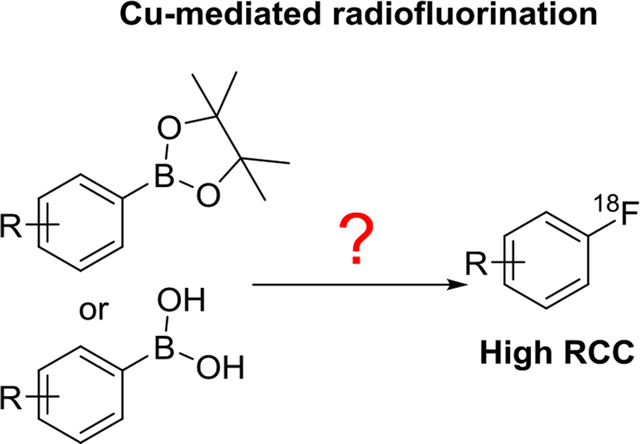
The amount of base plays a critical and limiting role in the copper-mediated radiofluorination using boronic precursors. Greater than one-equivalent of the base and sufficient amounts of precursor and Cu(OTf)2(Py)4 are required to achieve good to high RCCs. The RCCs are also dependent on the concentration of the labeling reactions, with low reaction volumes and high concentrations of reagents being preferred.
Introduction
Copper-mediated nucleophilic radiofluorination is a promising method to label an aromatic ring without the requirement of a strong electron-withdrawing group1–3. Boronic acids and esters are probably the most versatile precursors for this radiosynthetic methodology. Beside radiofluorination, copper-mediated nucleophilic radiochemistry using boronic precursors has been used for labeling with other radioisotopes (Br4, I5–7, At7 and 11C8) with great success. For radiofluorination of aromatic compounds, the alcohol-enhanced copper-mediated radiofluorination appears to be the most favorable one for achieving high radiochemical conversions (RCCs)1. The large amount of precursors (60 μmol) used in the radiolabeling step, however, is not ideal for the preparation of 18F labeled radiopharmaceuticals: (1) It can be challenging to purify the final product (which is present in only nmol levels) from H-or HO-substituted by-products2,9 (which elute in front of the desired product upon reversed phase HPLC and can tail into the product peak); (2) Processing of the larger reaction mixture (e.g., using solid phase extraction, HPLC injection) can be impractical; and (3) The synthesis of boronic precursors for novel compounds may be difficult and hence supplies limited. The potential of copper-mediated nucleophilic radiofluorination has been demonstrated previously10,11, but the factors that are important for the success of this chemistry have not been elucidated. The aim here was to study the factors that influence the RCCs using model reaction to develop practical guidelines for the development of 18F labeled radiopharmaceuticals and other radiohalogen-labeled compounds using this methodology.
Experimental
All chemicals were obtained from standard commercial sources and used without further purification. No-carrier-added [18F]fluoride was produced by 18O (p, n)18F reaction through proton irradiation of enriched 18O water (95%) using a RDS111 cyclotron or an ACSI TR-19 cyclotron. High performance liquid chromatography (HPLC) was performed with an ultraviolet detector and a well-scintillation NaI (Tl) detector. An Altima C18 250 × 4.6 mm 10 μm analytical column was used for analysis. Acetonitrile and water with 0.1% TFA were used as the HPLC mobile phase. Radio-TLC was accomplished using a Bioscan AR-2000 imaging scanner (Bioscan, Inc., Washington, DC). Silica gel TLC plates were used for TLC analysis (except for volatile radioactive products, a capillary filled with silica gel, fabricated in house, was used). Cu(OTf)2(Py)4 was prepared according to the literature2. The complexes of potassium carbonate/Kryptofix 222 (1:2 in molarity) and potassium bicarbonate/Kryptofix 222 (1:1 in molarity) were prepared by lyophilizing their solutions in water/acetonitrile. [18F]Fluoride was prepared by heating a solution of [18F]TsF12 in acetonitrile with a known amount of base/K222 at 105 °C for 2–3 minutes, removing acetonitrile under a flow of argon or nitrogen at 105 °C, and re-dissolving in 9:1 dimethylacetamide (DMA)/n-butanol (n-BuOH).
General procedure for alcohol-enhanced copper-mediated radiofluorination.
Into a 10-mL Pyrex tube were added an aliquot of [18F]fluoride/base/K222 solution, an aliquot of precursor solution, and an aliquot of Cu(OTf)2(Py)4 solution. If needed, 9:1 DMA/n-BuOH was added to reach the designed total volume. Under air atmosphere, the tube was capped with a septum screw cap. After being vortexed briefly, the tube was heated in an oil bath at 100 to 110 °C for a designed time. After cooling to room temperature, water (0.4 mL) was added to the reaction mixture through the septum using a syringe, and the vessel was vortexed briefly to dissolve any insoluble material, including unreacted [18F]fluoride stuck to the vessel; full recovery of fluoride (both reacted and unreacted) is needed to calculate an accurate RCC. The above reaction mixture was then analyzed by radio-TLC and/or radio-HPLC to identify the radiolabeled product and to determine the radiochemical conversions.
Results and Discussion
The previously reported model reactions using aryl boronic acid and aryl boronic pinacol esters under similar conditions were used to study the alcohol-enhanced copper-mediated radiofluorination (Scheme 1)1. DMA with the optimal n-BuOH in a ratio of 9:1 was used as the reaction solvent because this ratio gave high RCC and was friendly to HPLC purification. In order to reduce the amount of precursor required, the effect of reaction concentration was studied by diluting the reaction gradually with 9:1 DMA/n-BuOH.
Scheme 1.

Model reactions of alcohol-enhanced copper-mediated radiofluorination using aromatic boronic acid (Ar-B(OH)2) and boronic pinacol ester (Ar-B(pin)) precursors.
As shown in Figure 1. 99% RCC was observed for both boronic acid and ester precursors at the relative concentration of 1 (60 μmol of precursor in 0.4 mL solution), which is a good starting point for the study. At a relative concentration of 0.25, the RCCs were reduced to 83% and 70%, respectively, for each precursor. Below 0.25, the RCCs dropped sharply. Therefore, the relative concentration of 0.25 or 15 μmol precursor in 0.4 mL solution was used for the following studies. This concentration is similar to reported ones (60 μmol in 1.2 mL solution) with RCCs of 93% and 88%, respectively1. These results indicate that RCCs are dependent on reaction concentration and that high concentrations are required to achieve high RCCs. Non-radioactive fluoride (0.17 μmol) was added to model reactions in order to simulate radiolabeling using large amounts of radioactivity. The purpose is to make sure that the model reaction on small scale will be reproducible on a large scale.
Figure 1.

The effect of reaction concentration on radiochemical conversion (Ar: 4-formylphenyl). Reaction conditions: Relative concentration = 1: K2CO3/K222 (5.5 μmol), precursor (60 μmol), Cu(OTf)2(Py)4 (26.4 μmol) in 9:1 DMA/n-BuOH (400 μL), 100 °C/20 min. RCC was determined by radio-TLC.
As shown in Figure 2, no differences in RCCs of the model reactions for no-carrier-added and carrier-added radiolabeling were observed using 4 types of precursors (electron-withdrawing/donating/neutral, boronic acid/ester) and all the RCCs are high. This result implies that the alcohol-enhanced copper-mediated nucleophilic radiofluorination is a robust reaction and is different from conventional nucleophilic substitution, which normally requires a large excess (1000 fold) of precursor to achieve good yields13.
Figure 2.

Copper-mediated radiofluorination: no-carrier-added vs. carrier-added (0.17 μmol). Reaction conditions: K2CO3/K222 (1.1 μmol), precursor (15 μmol), Cu(OTf)2(Py)4 (6.6 μmol) in 9:1 DMA/n-BuOH (400 μL), 105 °C/20 min. RCC was determined by radio-HPLC.
Because bases are required for nucleophilic substitution of [18F]fluoride in radiofluorination reactions, we next studied the effect of base on RCCs by varying the amount of base (K2CO3/K222 or KHCO3/K222) in the model reaction (Figure 3). The RCCs were greatly reduced for three model reactions when the amount of base was above certain level, the ratio of base over Cu(OTf)2(Py)4 appearing to be 1 for K2CO3 and 2 for KHCO3. Below these levels, however, the RCCs are high and are independent of the amount of base used in this study. Even though only K2CO3 and KHCO3 were studied here, the results suggest that the amount of base is critical for successful alcohol-enhanced copper-mediated radiofluorination using boronic compounds as precursors and is consistent with the previously reported detrimental effect of K2CO3/K222 on copper-mediated radiofluorination.14,15 Too much base resulted in low RCCs, probably due to decomposition of or interference from Cu(OTf)2(Py)4 and/or boronic precursors. Weak base (KHCO3) appears to be better tolerated than strong base (K2CO3) for copper-mediated radiolabeling1.
Figure 3.

The effect of bases on radiochemical conversions (a) K2CO3 and (b) KHCO3. Reaction conditions: K2CO3/K222 (1.1–11 μmol) or KHCO3/K222 (2.75–13.7 μmol), precursor (15 μmol), Cu(OTf)2(Py)4 (6.6 μmol) in 9:1 DMA/n-BuOH (400 μL), 105 °C/20 min. RCC was determined by radio-TLC.
The effect of the amount of precursor and Cu(OTf)2(Py)4 on RCCs was studied further. As shown in Figure 4, variable amounts of K2CO3/K222 (4.4 to 8.8 μmol) with 6.6 μmol Cu(OTf)2(Py)4 and 15 μmol precursor were used to obtain RCCs from 0% to 46%, depending on the amount of Cu(OTf)2(Py)4 used (in blue). Once again, the results show how sensitive RCCs are to the ratio of base/Cu(OTf)2(Py)4. Increasing the amount of precursor from 15 μmol to 30 μmol has no effect on RCCs (in orange). However, increasing the amount of Cu(OTf)2(Py)4 from 6.6 μmol to 13.2 μmol significantly improved the RCCs (in red). This result suggests that the amount of Cu(OTf)2(Py)4 or the ratio of base/Cu(OTf)2(Py)4 is critical in the labeling reactions. Another study was carried out with the amount of base remaining constant (Figure 5). Starting from 5 μmol Cu(OTf)2(Py)4 (about one equivalent of base), the RCCs were significantly increased from 10% to 73% with 10 μmol Cu(OTf)2(Py)4 and to 90% with 20 μmol Cu(OTf)2(Py)4. However, under the best conditions, (5.5 μmol precursor and 20 μmol Cu(OTf)2(Py)4), reducing the amount of precursor to less than one equivalent of base results in less than 8% RCC. As expected, when the amount of base is reduced to half, the RCC was improved from 34% to 77%. When a very small amount of base (K2CO3/K222, 0.044 μmol) was used, RCCs are still dependent on the amount of Cu(OTf)2(Py)4 used (Figure 6), which is another example of the reagent concentration effect. Finally, it is worthwhile to note that the addition of additional pyridine, which was reported previously to be important for copper-mediated radiofluorination,3,16 has no benefit in the alcohol-enhanced model reactions. On the contrary, too much pyridine resulted in reduced RCCs in the model reactions (see Table S1).
Figure 4.

Effect of precursor and Cu(OTf)2(Py)4 on radiochemical conversions. The reaction was carried out using 4-formylphenylboronic acid as precursor at 105 °C/20 min in 9:1 DMA/n-BuOH (400 μL). RCC was determined by radio-TLC.
Figure 5.

Effect of precursor and Cu(OTf)2(Py)4 on radiochemical conversions. The reaction was carried out using 4-formylphenylboronic acid as precursor at 105 °C/20 min in 9:1 DMA/n-BuOH (200 μL). RCC was determined by radio-TLC.
Figure 6.

Effect of Cu(OTf)2(Py)4 on radiochemical conversions. Reaction conditions: K2CO3/K222 (0.044 μmol), precursor (4-formylphenylboronic acid) (15 μmol), Cu(OTf)2(Py)4 (0.33–6.7 μmol) in 9:1 DMA/n-BuOH (400 μL), 105 °C/20 min. RCC was determined by radio-TLC.
Collectively, all the above results point to the fact that the amount of base plays a critical and limiting role in the copper-mediated radiofluorination. Greater than one equivalent of base and sufficient amount of precursor and Cu(OTf)2(Py)4 (for high concentration) are necessary to achieve high RCCs. In addition, small reaction volumes are preferred to keep the concentration of reagents high, which is also critical for the success of the RCC. Based on the above studies, model reactions were carried out using only 15 μmol precursor to afford comparable or even higher RCCs, as shown in Figure 7. The RCCs determined by radio-HPLC (in parentheses) are generally higher than those determined by radio-TLC, because the silica-based C18 column can retain [18F]fluoride, resulting in higher observed RCCs.
Figure 7.

RCCs of model radiosyntheses under optimized conditions. Reaction conditions: Precursor (15 μmol), K2CO3/K222 (1 mg, 1.1 μmol), Cu(OTf)2(Py)4 (4.5 mg, 6.6 μmol), 9:1 DMA/n-BuOH (0.4 mL), 105 °C/20min. Note: a. RCC was determined by radio-TLC and radio-HPLC (reported in parentheses). Typical analytical radio-HPLCs see supplementary information Figure S3–Figure S11.
The above information was used for the radiosynthesis of 3-[18F]fluorobenzoic acid (3-[18F]FBA) and [18F]WC-DZ-F. 3-[18F]FBA is an analogue of 4-[18F]fluorobenzoic acid ([18F]FBA), a commonly used building block for radiosynthesis. 3-[18F]FBA was previously radiosynthesized in low yield using a nitro precursor. As shown in Table 1, 97% RCC was achieved using 20 mg Cu(OTf)2(Py)4 within 10 min at 110 °C, compared to 85% using 4.5 mg Cu(OTf)2(Py)4. The large amount of Cu(OTf)2(Py)4 can be removed easily using the standard solid phase extraction method. After deprotection with 1N HCl, 3-[18F]FBA was obtained in 92% RCC. 3-[18F]FBA can be used for radiosynthesis of small molecule radiopharmaceuticals or as an alternative of FBA for conjugation reactions.
Table 1.
Radiosynthesis of 3-[18F]Fluorobenzoic acid.

| |||||
|---|---|---|---|---|---|
| Precursor [mg(μmol)] |
K2CO3/K222 [mg(μmol)] |
Cu(OTf)2(Py)4 [(mg(μmol)] |
RCC (%) | Deprotection RCC (%) |
|
| 110°C/5min | 110°C/10min | ||||
| 4.6(15) | 2.5(2.81) | 4.5(6.6) | / | 85 | 77 |
| 4.6(15) | 2.5(2.81) | 20(29) | 92 | 97 | 92 |
Note: Reaction conditions: a. as shown in the table; b. 1N HCl, 110 °C/5min. RCC was determined by radio-TLC/Radio-HPLC.
[18F]WC-DZ-F is a PET tracer for imaging poly (ADP-ribose) polymerase 1 (PARP-1) expression in tumors12. It was radiosynthesized via a two-step method, starting from the radiosynthesis of 4-[18F]fluorobenzaldehyde and followed by a reaction catalyzed by 10% Pd/C. The procedure is not friendly to automation modules. The one-pot radiosynthesis of [18F]WC-DZ-F using the boronic ester precursor is ideal for automated production (Table 2). Since the compound has nucleophilic nitrogen atoms, it could provide challenges for this approach beyond those encountered with the prior-investigated precursors. As shown in the table, the use of small amount of base (0.5 mg K2CO3/K222) only slightly improved the RCC from 17% to 23%. However, the use of a large amount of Cu(OTf)2(Py)4 (20 mg) greatly increased the RCCs. The use of weak base (KHCO3) gave the best RCCs. Therefore, [18F]WC-DZ-F was radiosynthesized using 15 μmol precursor, 20 mg Cu(OTf)2(Py)4, KHCO3 as base and in 200 μL solvent, and isolated in 29% yield (decay corrected) with over 99% radiochemical purity (see supplementary information). The molar activity of [18F]WC-DZ-F is 56 GBq/μmol (1510 mCi/μmol) at the end of synthesis starting from only 1 GBq (27 mCi) [18F]fluoride, and the molar activity of [18F]fluoride, measured as [18F]TsF is 56–67 GBq (1510–1810 mCi/μmol) at the same time point. This result indicates that there is not much cold fluoride arising from the large amount of Cu(OTf)2(Py)4; this is very important for using this method to make radiopharmaceuticals without reducing molar activity of the final product. In the semi-preparative HPLC, the UV peak of [18F]WC-DZ-F is well separated from the peaks before (Figure S1), but the analytical HPLC shows masses from these peaks (Figure S2). The HPLC conditions for purification were not optimized, but the observation here indicates the challenge of purification due to tailing of using large amount of precursor. The benefit of using a large amount of Cu(OTf)2(Py)4 is consistent with the proposed dual roles of copper in copper-mediated fluorination (coordinating the aryl and fluoride ligands and promoting their coupling, and serving as an oxidant to generate the key CuIII intermediate)17. This strategy has recently been used in the preparation of 18F labeled radiopharmaceuticals18,19.
Table 2.
Radiosynthesis of [18F]WC-DZ-F using copper-mediated radiofluorination.
| Entry | Precursor [μmol] |
Base [mg(μmol)] |
Cu(OTf)2(Py)4 [mg(μmol)] |
RCC (%) 110°C/20min |
|---|---|---|---|---|
| 1 | 15 | K2CO3/K222 1(1.1) | 4.5(6.6) | 17 |
| 2 | 15 | K2CO3/K222 0.5(0.55) | 4.5(6.6) | 23 |
| 3 | 15 | K2CO3/K222 1(1.1) | 20(29) | 36, 37 |
| 4 | 15 | KHCO3/K222 3(6.3) | 20(29) | 43, 50 |
Rapid Cu-catalyzed radioiodination of boronic esters at room temperature has been reported7, using 15 μmol precursor and [125I]iodide in 0.1 N NaOH methanolic solution, however, at small scale. Radioiodine is normally provided from a vendor in 0.1 N NaOH solution. The amount of base (NaOH) varies with the amount of radioactivity used, which may result in non-reproducible labeling results. Based on the information discussed above, we neutralized the 0.1 N NaOH stock solution with 0.1 M toluenesulfonic acid (TsOH) in DMSO, and we were able to label [124I]KX-17 in greater than 99% isolated yield using only 0.77 μmol (0.3 mg) precursor (See supplementary information for details). No labeling reaction was observed under this neutral condition at room temperature, but heating at 110 °C for 12 min resulted in total conversion. The molar activity is 180 GBq/μmol (4865 mCi/μmol) at the end of synthesis starting from only 0.055 GBq (1.45 mCi) [124I]NaI. The labeling reactions under neutral conditions appeared to be clean: the color of Cu(OTf)2(Py)4 remained the same during the reaction, the borate precursor remained stable according to analytical HPLC and minimal amounts of by-products were formed during the labeling (Figure S12). Based on the knowledge from the copper-mediated radiofluorination, we were able to radiosynthesize [124I]KX-1 in high RCC and high molar activity without much optimization.
Conclusions
Alcohol-enhanced copper-mediated radiofluorination using boronic precursors was studied in model reactions. We found that the amount of base plays a critical and limiting role in the labeling reactions. Greater than one-equivalent of the base and sufficient amounts of precursors and Cu(OTf)2(Py)4 were required to achieve good to high radiochemical conversions (RCCs). The radiochemical conversion was also dependent on the concentration of the labeling reaction, with low reaction volumes and high reagent concentrations being preferred. The above information will help improve the design of radiolabeling protocols using alcohol-enhanced copper-mediated radiochemistry of boronic precursors for the preparation of 18F labeled radiopharmaceuticals and other radiohalogen-labeled compounds.
Supplementary Material
Acknowledgements
This work was supported by the National Institutes of Health (NIH: CA025836 and CA220284 to J.A.K. and EB029752 to J.R. Garbow and B.E. Rogers). The authors thank the Cyclotron Facility in Medicine School, Washington University in Saint Louis for 18F production.
Data Availability Statement:
Data is contained within the article or supplementary information.
References
- 1.Zischler J, Kolks N, Modemann D, Neumaier B, Zlatopolskiy BD. Alcohol-Enhanced Cu-Mediated Radiofluorination. Chemistry – A European Journal. 2017;23(14):3251–3256. [DOI] [PubMed] [Google Scholar]
- 2.Tredwell M, Preshlock SM, Taylor NJ, et al. A General Copper-Mediated Nucleophilic 18F Fluorination of Arenes. Angewandte Chemie International Edition. 2014;53(30):7751–7755. [DOI] [PubMed] [Google Scholar]
- 3.Mossine AV, Brooks AF, Makaravage KJ, et al. Synthesis of [18F]Arenes via the Copper-Mediated [18F]Fluorination of Boronic Acids. Organic Letters. 2015;17(23):5780–5783. [DOI] [PMC free article] [PubMed] [Google Scholar]
- 4.Zhou D, Chu W, Voller T, Katzenellenbogen JA. Copper-Mediated Nucleophilic Radiobromination of Aryl Boron Precursors: Convenient Preparation of a Radiobrominated PARP-1 Inhibitor. Tetrahedron letters. 2018;59(20):1963–1967. [DOI] [PMC free article] [PubMed] [Google Scholar]
- 5.Wilson TC, McSweeney G, Preshlock S, et al. Radiosynthesis of SPECT tracers via a copper mediated 123I iodination of (hetero)aryl boron reagents. Chemical Communications. 2016;52(90):13277–13280. [DOI] [PubMed] [Google Scholar]
- 6.Zhang P, Zhuang R, Guo Z, Su X, Chen X, Zhang X. A Highly Efficient Copper-Mediated Radioiodination Approach Using Aryl Boronic Acids. Chemistry – A European Journal. 2016;22(47):16783–16786. [DOI] [PubMed] [Google Scholar]
- 7.Reilly SW, Makvandi M, Xu K, Mach RH. Rapid Cu-Catalyzed [211At]Astatination and [125I]Iodination of Boronic Esters at Room Temperature. Organic letters. 2018;20(7):1752–1755. [DOI] [PMC free article] [PubMed] [Google Scholar]
- 8.Makaravage KJ, Shao X, Brooks AF, Yang L, Sanford MS, Scott PJH. Copper(II)-Mediated [11C]Cyanation of Arylboronic Acids and Arylstannanes. Organic Letters. 2018;20(6):1530–1533. [DOI] [PMC free article] [PubMed] [Google Scholar]
- 9.Mossine AV, Brooks AF, Bernard-Gauthier V, et al. Automated synthesis of PET radiotracers by copper-mediated 18F-fluorination of organoborons: Importance of the order of addition and competing protodeborylation. Journal of Labelled Compounds and Radiopharmaceuticals. 2018;61(3):228–236. [DOI] [PMC free article] [PubMed] [Google Scholar]
- 10.Taylor NJ, Emer E, Preshlock S, et al. Derisking the Cu-Mediated 18F-Fluorination of Heterocyclic Positron Emission Tomography Radioligands. Journal of the American Chemical Society. 2017;139(24):8267–8276. [DOI] [PubMed] [Google Scholar]
- 11.Wright JS, Kaur T, Preshlock S, et al. Copper-mediated late-stage radiofluorination: five years of impact on preclinical and clinical PET imaging. Clinical and Translational Imaging. 2020;8(3):167–206. [DOI] [PMC free article] [PubMed] [Google Scholar]
- 12.Zhou D, Xu J, Mpoy C, et al. Preliminary evaluation of a novel 18F-labeled PARP-1 ligand for PET imaging of PARP-1 expression in prostate cancer. Nuclear Medicine and Biology. 2018;66:26–31. [DOI] [PMC free article] [PubMed] [Google Scholar]
- 13.Cai L, Lu S, Pike VW. Chemistry with [18F]Fluoride Ion. European Journal of Organic Chemistry. 2008;2008(17):2853–2873. [Google Scholar]
- 14.Mossine AV, Brooks AF, Ichiishi N, Makaravage KJ, Sanford MS, Scott PJH. Development of Customized [18F]Fluoride Elution Techniques for the Enhancement of Copper-Mediated Late-Stage Radiofluorination. Scientific Reports. 2017;7(1):233. [DOI] [PMC free article] [PubMed] [Google Scholar]
- 15.Zlatopolskiy BD, Zischler J, Krapf P, et al. Copper-Mediated Aromatic Radiofluorination Revisited: Efficient Production of PET Tracers on a Preparative Scale. Chemistry – A European Journal. 2015;21(15):5972–5979. [DOI] [PubMed] [Google Scholar]
- 16.Antuganov D, Zykov M, Timofeeva K, Antuganova Y, Orlovskaya V, Krasikova R. Effect of Pyridine Addition on the Efficiency of Copper-Mediated Radiofluorination of Aryl Pinacol Boronates. ChemistrySelect. 2017;2(26):7909–7912. [Google Scholar]
- 17.Ye Y, Schimler SD, Hanley PS, Sanford MS. Cu(OTf)2-Mediated Fluorination of Aryltrifluoroborates with Potassium Fluoride. Journal of the American Chemical Society. 2013;135(44):16292–16295. [DOI] [PubMed] [Google Scholar]
- 18.Bowden GD, Chailanggar N, Pichler BJ, Maurer A. Scalable 18F processing conditions for copper-mediated radiofluorination chemistry facilitate DoE optimization studies and afford an improved synthesis of [18F]olaparib. Organic & Biomolecular Chemistry. 2021;19(32):6995–7000. [DOI] [PubMed] [Google Scholar]
- 19.Guibbal F, Isenegger PG, Wilson TC, et al. Manual and automated Cu-mediated radiosynthesis of the PARP inhibitor [18F]olaparib. Nature Protocols. 2020;15(4):1525–1541. [DOI] [PubMed] [Google Scholar]
Associated Data
This section collects any data citations, data availability statements, or supplementary materials included in this article.
Supplementary Materials
Data Availability Statement
Data is contained within the article or supplementary information.