



Abstract
Persistent organic pollutants (POPs) are xenobiotic chemicals of global concern due to their long-range transport capabilities, persistence, ability to bioaccumulate, and potential to have negative effects on human health and the environment. Identifying POPs in both the environment and human body is therefore essential for assessing potential health risks, but their diverse range of chemical classes challenge analytical techniques. Currently, platforms coupling chromatography approaches with mass spectrometry (MS) are the most common analytical methods employed to evaluate both parent POPs and their respective metabolites and/or degradants in samples ranging from d rinking water to biofluids. Unfortunately, different types of analyses are commonly needed to assess both the parent and metabolite/degradant POPs from the various chemical classes. The multiple time-consuming analyses necessary thus present a number of technical and logistical challenges when rapid evaluations are needed and sample volumes are limited. To address these challenges, we characterized 64 compounds including parent per- and polyfluoroalkyl substances (PFAS), pesticides, polychlorinated biphenyls (PCBs), industrial chemicals, and pharmaceuticals and personal care products (PPCPs), in addition to their metabolites and/or degradants, using ion mobility spectrometry coupled with MS (IMS-MS) as a potential rapid screening technique. Different ionization sources including electrospray ionization (ESI) and atmospheric pressure photoionization (APPI) were employed to determine optimal ionization for each chemical. Collectively, this study advances the field of exposure assessment by structurally characterizing the 64 important environmental pollutants, assessing their best ionization sources, and evaluating their rapid screening potential with IMS-MS.
Keywords: Ion Mobility Spectrometry, Pesticides, Pharmaceuticals, PFAS
Introduction
Xenobiotics are of great concern to humans and the environment due to their wide use in agriculture, industrial processes, and ubiquitous presence in consumer products. Many xenobiotics are considered persistent organic pollutants (POPs) and have been shown to pose carcinogenic, mutagenic, or reproductive/developmental hazards (1). The Stockholm Convention on POPs is an international treaty designed to protect human health and the environment. Through this treaty, a number of chemicals were recognized as of great concern, including per- and polyfluoroalkyl substances (PFAS), pesticides, polychlorinated biphenyls (PCBs), industrial chemicals, and industrial chemical byproducts (2). In 2001, the Stockholm Convention listed twelve substances which have harmful impacts on human health or the environment (Table 1). In 2017, an additional sixteen POPs were added to the list, and currently, three more chemicals are under review. To date, the original twelve listed substances have either been phased out completely or their use restricted; however, many are persistent and are still detected in soil, water, and blood (3). There are also a large number of POPs not yet identified including emerging chemicals, and pharmaceuticals and personal care products (PPCPs)(4). These unknown POPs and other POPs formed by metabolism and degradation further complicate exposure studies. Metabolism of xenobiotics through various enzymes including cytochrome P450 oxidases, UDP-glucuronosyltransferases (SULT), and glutathione S-transferases(GULT) is extremely common (5). POPs are also commonly degraded by bacteria, or through photochemical and other processes, forming intermediates and metabolites that are often more toxic and stable than the parent compounds (6). Thus, the ability to identify not only the parent POPs but also their metabolites and degradants is essential to fully characterizing exposure and understanding potential adverse effects on human health and the environment (7, 8).
Table 1.
The POPs and their metabolites/degradants used in this study (grouped by chemical classifications, Stockholm Convention annex, and ionization method)
| Namea | Ionization | SC annex | Classification | |
|---|---|---|---|---|
| 1 | Bisphenol A | ESI[−] | N/A | Industrial chemical |
| Bisphenol A mono β-D-glucuronide | APPI[+]and ESI[+,−] | |||
| Bisphenol A sulfate | ESI[−] | |||
| 2 | PCE | APPI[+] | N/A | Industrial chemical |
| TCVG | APPI[+] and ESI[+,−] | |||
| TCVC | ||||
| NAC-TCVC | ||||
| 3 | TCE | APPI[+] | N/A | Industrial chemical |
| DCVG | APPI[+] and ESI[+,−] | |||
| DCVC | ||||
| NAC-DCVC | ||||
| 4 | Naphthalene | APPI[+] | N/A | PAH |
| 2,3-Dihydroxynaphthalene | ESI[−] | |||
| 1,5-Dihydroxynaphthalene | ||||
| 1,2-Dihydroxynaphthalene | ||||
| PCB3 | APPI[+] | A | PCB | |
| 4′-MeO-PCB 3 | ||||
| 4′-OH-PCB3 | ESI[−] | |||
| 3′-OH-PCB3 | ||||
| 5 | 2′-OH-PCB3 | |||
| 2-PCB3 sulfate | ||||
| 3′-PCB3 sulfate | ||||
| 4′-PCB3 sulfate | ||||
| 6 | PCB 11 | APPI[+] | A | PCB |
| 4-MeO-PCB 11 | ||||
| 4-OH-PCB 11 | ESI[−] | |||
| 4′-PCB 11 sulfate | ||||
| 7 | 4-OH-PCB 52 | ESI[−] | A | PCB |
| 4-PCB 52 sulfate | ||||
| 8 | 4,4′-DDMU | APPI[+] and ESI[+] | B | Pesticide |
| p,p′-DDE | APPI[+] | |||
| 9 | Aldrin | APPI[+] and ESI[+] | A | Pesticide |
| Dieldrin | APPI[+] | |||
| 10 | Endosulfan | APPI[+] | A | Pesticide |
| Endosulfan sulfate | ESI[+,−] | |||
| 11 | Hexachlorobenzene | APPI[+] | C | Pesticide |
| Pentachlorobenzene | ||||
| 1,2,3,4-Tetrachlorobenzene | ||||
| 1,2,4-Trichlorobenzene | ||||
| 1,4-Dichlorobenzene | ||||
| 12 | PFOS | ESI[−] | A | PFAS |
| PFOA | ||||
| 6:2 FTAB | ESI[−] | N/A | ||
| 6:2 FTS | ||||
| PFHxS | ||||
| PFHpA | ||||
| PFBS | ||||
| PFHxA | ||||
| PFPeA | ||||
| PFBA | ||||
| 13 | Estrone | APPI[+] and ESI[+] | N/A | PPCP |
| Estrone 3-β-D-glucuronide | ESI[+,−] | |||
| Estrone 3-sulfate | ||||
| 14 | Paracetamol | APPI[+] and ESI[+,−] | N/A | PPCP |
| Paracetamol β-D-glucuronide | ESI[+,−] | |||
| Paracetamol sulfate | ||||
| 15 | Propofol | APPI[+] and ESI[+] | N/A | PPCP |
| Propofol-D-glucuronide | ESI[+,−] | |||
| 16 | Mycophenolic acid | APPI[+] and ESI[+,−] | N/A | PPCP |
| Mycophenolic acid-D-glucuronide | ESI[+,−] | |||
| 17 | Morphine | ESI[+,−] | N/A | PPCP |
| Morphine 6-β-D-glucuronide | ||||
| 18 | Curcumin | APPI[+] and ESI[+,−] | N/A | PPCP |
| Curcumin β-D-glucuronide | ESI[+,−] |
Abbreviated chemical names are shown in Table 1, and full names and additional information are included in Supplemental Table 1
Due to the chemical diversity of parent POPs and their metabolites and degradants, to date, multiple time-consuming sample extractions and analytical methods are commonly employed (9). For example, traditional methods use a solid-phase or liquid-liquid extraction to isolate and concentrate the molecules of interest. Then, a number of analytical approaches often coupling gas, liquid, or supercritical fluid chromatography (GC, LC, or SCF) with mass spectrometry (MS) are used to accurately identify and quantify the molecules in the environmental and human samples (10). While current methods for sample preparation (e.g., extraction and derivatization) and analytical measurements of POPs and their metabolites/degradants provide high selectivity and throughput, the increasing number of POPs and the structural differences in their metabolites and degradation products make it difficult to rapidly screen for the broad range of chemicals in cases of complex or unknown exposures. Additional separation and coupled separation techniques are thus of great interest for the exposure assessment studies. For example, ion mobility spectrometry coupled with MS (IMS-MS) has shown great promise in screening diverse POPs including PFAS and PCBs and their subsequent products without extensive sample preparation (10, 11); however, extensive analyses of their metabolites and degradant products has not been performed. IMS is a rapid separation technique, occurring on a millisecond time frame and allowing gas-phase structural analyses (12). By coupling IMS with MS, both structure and m/z information can be obtained for the molecules of interest, and high sensitivity small molecule measurement have been reported for IMS-MS analyses in a variety of matrices including a limit of detection of 100 pg/mL in serum (11–14). Additionally, since IMS-MS occurs post-ionization, various ionization sources can be used and it can be implemented after GC or LC separations when multidimensional characterization is desired.
In this study, we utilized IMS-MS to characterize 27 chemicals listed by the Stockholm Convention and 37 POPs from a range of other chemical classes of concern, including PAHs, PCBs, industrial products and byproducts, PPCPs, PFAS, pesticides and their corresponding metabolites and degradation products. These chemicals were selected as many are included in the Agency for Toxic Substances and Disease Registry (ATSDR) or International Agency for Research on Cancer (IARC) monographs. Additionally, the selected PPCPs as well as their sulfate and glucuronide metabolites are frequently detected in wastewater.. In the IMS-MS evaluations, all chemicals were assessed for their preferred ionization method and isomer separations to determine if simultaneous rapid screening of both parents and metabolites was possible in the same analysis or if multiple evaluations must be performed (15). This study therefore used electrospray ionization (ESI) and atmospheric pressure photoionization (APPI) sources to assess both the parent and metabolites/degradants of the specific POPs noted in Table 1. Since these two sources provide complementary chemical assessments (e.g., ESI works well for polar molecules while APPI is commonly utilized for nonpolar molecules), evaluating the different chemicals with both is important. The results for simultaneous evaluations of the parent and metabolites/degradants in solvents and complex mixtures such as aqueous film-forming foams (AFFFs) therefore showcase capabilities and challenges for performing rapid assessments of each molecule type with IMS-MS.
Materials and methods
Sample preparation
Chemical standards for all molecules except the PCBs were obtained from US EPA (Dr. Ann Richard) or were purchased from Sigma-Aldrich (St. Louis, MO), Santa Cruz Biotechnology (Dallas, TX), and Toronto Research Chemicals (Ontario, CA) (Supplemental Table 1). All purchased chemical standards were > 97% pure according to the manufacturers. The PCB standards were synthesized as detailed in Grimm et al. (16). High-purity solvents (≥ 99.9%) including water, methanol, acetone, acetic acid, and toluene were purchased from Sigma-Aldrich. PCBs and PAHs were dissolved in toluene and diluted to a final concentration of 5 μM in 50:50 methanol:acetone. The remaining standards were diluted in 80:20:0.1 methanol:water:acetic acid to a final concentration of 1 to 10 μM (Supplemental Table 1). AFFF samples were acquired from Chemguard (Marinett, WI), FireStopper International (Varhaug, Norway), and Angus Fire (Angier, NC) and diluted 100-fold in deionized water.
IMS-MS analyses
An Agilent 6560 IMS-QTOF MS (Agilent Technologies, Santa Clara) was utilized for all nitrogen gas drift tube IMS (DTIMS) measurements in this work, and all individual standards were directly injected in triplicate into the APPI and ESI sources and evaluated in both positive and negative ionization modes. Furthermore, blanks were injected between each standard to make sure no carryover occurred during the runs. PFAS standards and AFFF solutions were run in triplicate with only ESI in negative ionization mode due to their known preference for this analysis type (17). For the IMS analyses, the ions were passed through the inlet glass capillary, focused by a high-pressure ion funnel, and accumulated in an ion funnel trap (18). Ions were then pulsed into the 78.24-cm-long IMS drift tube filled with ~ 3.95 Torr of nitrogen gas, where they traveled under the influence of a weak electric field (10–20 V/cm). Ions exiting the drift tube were refocused by a rear ion funnel prior to quadrupole time-of-flight(QTOF) MS detection, and their drift time was recorded. For each detected feature, collision cross-section(CCS) values were calculated using a single electric field voltage (19). Drift times and CCS values for each tested substance are listed in Supplemental Table 1. The detailed instrumental settings follow those previously published in an interlaboratory examination and drift tube IMS CCS analyses and can be found in Supplemental Document 1 (19). Prior to each experimental analysis, the instrument was tuned and a mass calibration was performed using Agilent Tune Mix (G2421A/G2432A, Agilent).
LC-IMS-MS instrumental analysis
For the AFFF analyses (20), 20 μL of each sample was injected on a ZORBAX SB C-18 column (2.1 × 50 mm, 1.8 μM; Agilent) using a 1260 Infinity II system (Agilent). LC conditions were as detailed by (17) with mobile phase A consisting of 5 mM ammonium acetate in 95% water and mobile phase B made up of 5 mM ammonium acetate in 95% methanol. The initial chromatographic condition was maintained at 90% A and 10% B for 0.5 min. The gradient was ramped such that there was 30% B by 2 min, 95% B by 14 min, and 100% B by 14.5 min. The 100% B condition was held for 2 min, resulting in a total run time of 16.5 min. Following each run, the amount of B was returned to 10% for 6 min to equilibrate the column prior to the next injection. A flow rate of 0.4 mL/min was used through the entire gradient. Blank samples were performed before and after each AFFF analysis run to ensure that no carryover existed between samples. Blank subtraction was also utilized to make sure contaminates were not included in the evaluations. IMS-MS analyses were performed using ESI in negative mode.
Data analysis
The Agilent IM-MS Browser software was utilized for all single-field CCS calculations. Agilent Mass Profiler software was utilized to assess the drift times for the observed ions and calculate the CCS values. Relative standard deviations (RSDs) of < 1% were observed for all triplicate CCS measurements.
Results and discussion
In this study, 64 chemicals were studied with 18 parent POPs from various chemical classes including industrial chemicals, PAH, PCB, pesticides, PFAS and pharmaceuticals, and 46 of their metabolites or degradation products (Table 1). Many of the assessed chemicals are recognized as chemicals of concern by the Stockholm Convention. For example, chemicals categorized in Table 1 as Annex A are those where production must be eliminated, Annex B must be restricted, and Annex C currently have measures being taken to reduce their unintentional release (21). While some chemicals analyzed in this study have not been listed by the Stockholm Convention, they are also considered POPs and may have adverse human health effects. For example, chemicals in the treaty such as PCBs, pesticides, and PFAS were of great interest in our study due to their known toxic effects. Pesticides that were analyzed in our study included aldrin, dieldrin, heptachlor, hexachlorobenzene, and endosulfan. These organochlorine pesticides have classic POP qualities, and exposure is associated with adverse health effects such as endocrine disruption or carcinogenicity. Studying PCBs is also important as their persistence in the environment corresponds to their degree of chlorination with half-lives varying from 10 days to one and a half years with potential endocrine disruptors and have genotoxic properties. In our study, PCB 3 and its isomeric metabolites were evaluated as the structure of these chemicals can have varying effects on their metabolism and elimination. Finally, PFAS were studied as this category of chemicals has gained worldwide attention due to their potential hazardous human health effects and ecological environments (22). In 2009, perfluorooctanoic acid (PFOA) and perfluorooctane sulfonate (PFOS) were added to the Stockholm Convention and their use was banned or severely restricted (2). PFAS as a class have a variety of applications including chemical industry, consumer products, and production of AFFFs because of their unique properties such as thermal stability, hydrophobicity, and surface activity (23). Because these characteristics allow manufactured goods to have beneficial properties such as stain and water resistance, > 5000 PFAS are thought to have been produced (24, 25). Because of their chemical properties, PFAS have long-distance transport potential, bioaccumulate, and have toxic effects such as immunotoxicity, genotoxicity, reproductive toxicity, neurotoxicity, and carcinogenicity. This makes PFAS in general of great concern and especially since some PFAS can be metabolized or degraded. Therefore, exposure to PFAS can be from direct sources such as drinking water or air inhalation, or indirect sources including the uptake of transformation products (26).
Investigation of a preferred ionization method for POP parent and metabolites/degradants
Analysis of the 64 chemicals with IMS-MS was performed using both an ESI and APPI source. The ESI studies were performed in both positive (ESI[+]) and negative (ESI[−]) ion modes to study the protonated and deprotonated ions, while APPI was only performed in positive mode (APPI[+]) to assess protonation and positive radical formation. While the APPI negative ion mode was initially evaluated for deprotonated ions, it was not used in this study due to its lower sensitivity when compared to the ESI[−] analyses (27). In our analysis of the 18 parent POPs and 46 metabolites and degradation products, we detected a total of 108 different ions as some molecules ionized in both the APPI and ESI sources for both polarity modes. Thus, a total of 108 CCS values are reported in Supplemental Table 1. In the comparison of the ionization modes, most chemicals (n = 42) were detected in ESI[−] mode, followed by APPI[+] (n = 29) and then ESI[+] (n = 21), with 6 chemicals found in all modes (Fig. 1A). ESI[−] also had the greatest number of unique identifications with 30, illustrating its potential as the most comprehensive ion source for these molecules. Since it is established ESI works best for polar molecules, while APPI is optimal for nonpolar compounds (28), our findings also reflect that most of our parent POPs studied were nonpolar and more commonly observed with APPI[+], while their metabolites/degradants were polar and observed in ESI. A majority of the molecules detected with APPI could also be detected using the ESI source, except for PAH, PCB, TCE/PCE, and some pesticides. The different ionization modes and compound classes were then assessed to see if linear correlations in CCS versus m/z plots occurred (Fig. 1B, C). While we noticed that the chemicals greatly overlapped in CCS for the different ionization modes (Fig. 1B), in Fig. 1C, the PFAS separated from all other POPs with a much lower slope due to their high degree of fluorination. In addition, m/z-specific areas such as those for the PAHs were also noted to be smaller than the other classes allowing their distinction. To further illustrate known metabolic and degradation pathways, specific examples for the different classes are given below.
Fig. 1.
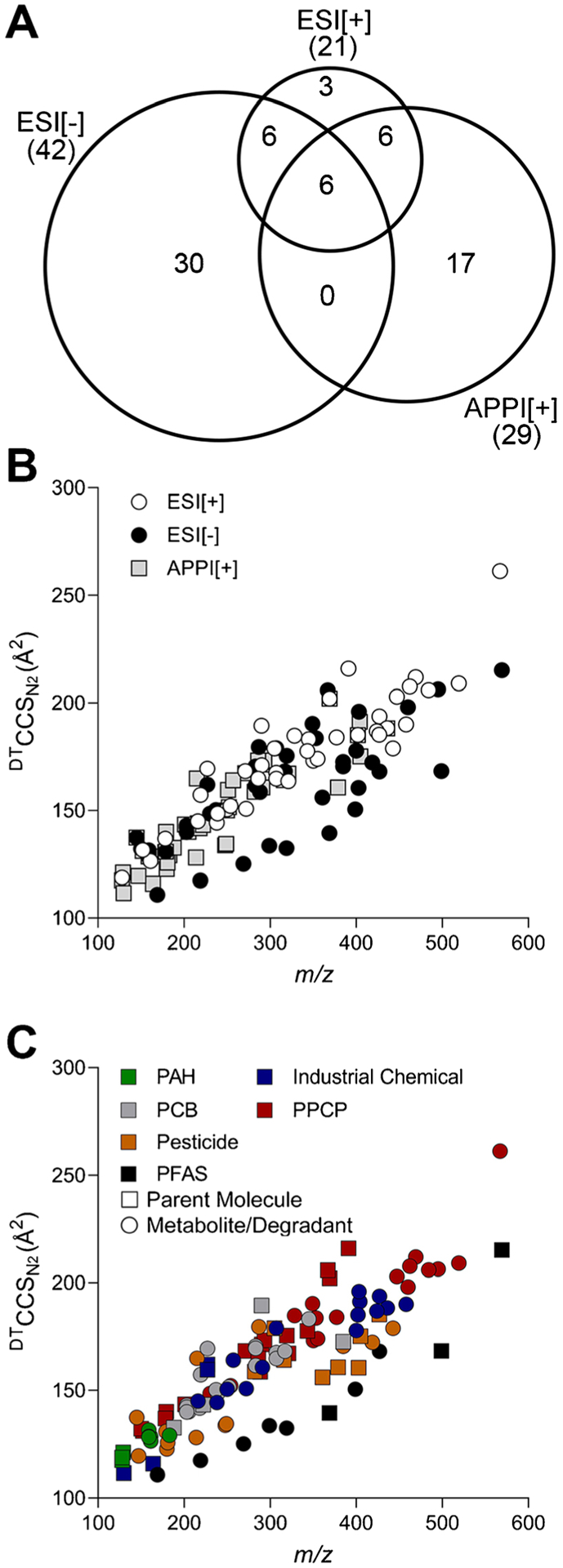
A Number of chemicals detected using each ionization method. B CCS values were calculated for each ion observed and are plotted against m/z values for each ionization mode. ESI[+] (white), ESI[−] (black), and APPI[+] (gray). C The observed CCS and m/z values are also graphed for all parent POPs (squares) and metabolites/degradants(circles) for each chemical class with industrial chemicals (blue), PAH (green), PCB (gray), pesticides (orange), pharmaceuticals (red), polyphenols (purple), and PFAS (black). Additionally, information for each data point can be found in Supplemental Table 1
PCB parents and metabolites
PCBs were commonly used industrial chemicals in adhesives, electrical equipment, and oil-based paints (29) from the 1920s until their production in the USA was banned in 1979. Despite their discontinued production, PCBs can still be detected worldwide, including in Arctic regions (30). Furthermore, exposure to PCBs has known adverse human health effects, with recent findings suggesting some metabolites also have toxic properties (31). Specifically, some hydroxyl PCBs have higher estrogenic activity than their parents, act as disruptors of thyroid homeostasis, and have neurotoxic potential. Additionally, hydroxyl PCBs are transferrable from mothers to fetuses via the placenta (32) and some can inhibit glucuronidation and sulfation reactions, hindering their elimination (31). The specific PCBs analyzed in this study were PCB 3 and PCB 11, because these lower chlorinated PCBs have gained attention in recent years due to their detectability in air samples (33). Furthermore, these PCBs are likely to undergo cytochrome P450 enzyme catalysis where they can hydroxylate and form sulfate metabolites (31) (Fig. 2A).
Fig. 2.

A Enzymatic metabolism pathway of PCB 3 (31) where metabolites are hydroxyl (OH), methoxy (MeO), and sulfate conjugates of parent PCB 3. B IMS drift time separations of parent PCB 3 and MeO metabolites in APPI[+] and hydroxyl and sulfate metabolites in ESI[−]. The nested IMS–MS spectra of the hydroxyl and sulfate isomers (right) illustrate the same m/z values but multiple peaks on the drift time axis. C Comparison of the PCB ion abundances using ESI and APPI sources
In our study, the parent PCBs and their methoxy metabolites were only detected using the APPI source due to their nonpolar structures. Because the parent PCBs and methoxy metabolites do not have functional groups that are easily protonated or deprotonated, they predominantly form radicals with APPI. However, the hydroxyl and sulfate metabolites were preferentially detected using ESI[−] because of the additional polar functional groups which easily deprotonate. Relative abundances of sulfate PCB ions detected by ESI were considerably higher than those of all other PCB ions detected in all modes. The abundances of hydroxylated ions detected by ESI were comparable to those of PCB 3 and the methoxy metabolite detected by APPI (Fig. 2B). Furthermore, isomeric separation was also observed between 3′-PCB 3 sulfate and 4′-PCB 3 sulfate (Fig. 2B). However, while 2′-OH-PCB 3 could be distinguished from 3′-OH-PCB 3 and 4′-OH-PCB 3, 3′-OH-PCB 3 and 4′-OH-PCB 3 could not be separated (Fig. 2B). These findings are noteworthy because OH-PCBs have varying adverse effects. For instance, it has been reported that 4′-OH-PCB 3 is a carcinogen, while 3′-OH-PCB 3 and 2′-OH-PCB 3 are not (34). Hydroxylated and sulfated PCBs also bind to thyroid hormones with varying affinities (35). Although some isomers are indistinguishable with this technique, the ability to separate some of these molecules with IMS is still useful for screening samples and deciding when it is necessary for additional front-end separation techniques such as LC or GC. Additionally, both APPI and ESI sources have a similar response to the PCB ions detected with each mode except the sulfate ions which have much higher relative abundances in negative mode due to their higher ionizability (Fig. 2C).
PPCPs, industrial chemicals, and their metabolites
This study also analyzed common wastewater pollutants and their metabolites. The increasing occurrence of POPs in wastewater has received attention in recent years because of potential adverse human health and ecosystem effects (36). The pollutants of concern in wastewater include PPCPs and industrial chemicals. These have been documented to have endocrine-disrupting effects, possible carcinogenicity to humans and lead to disruptions in the ecosystems, as well as being of possible concern to human health through the food chain (37). Here, we assessed common wastewater pollutants including bisphenol A (BPA) (Fig. 3), paracetamol/acetaminophen (Fig. 4), propofol, mycophenolic acid, morphine, and estrone as many have been documented as endocrine disruptors in fish (38, 39). Furthermore, these chemicals are metabolized with SULT and GULT, and sulfate and mono β-D-glucuronide conjugates are formed (Fig. 3A, Fig. 4A)(40). As expected, when analyzed individually, the parent, sulfate, and glucuronide versions of these molecules were readily separated based on m/z and IMS drift time, but the additional IMS dimension gives further confidence for identifying these compounds from other components in biological and environmental samples. BPA parent and metabolites were all detected in ESI[−] and separated based on m/z and drift time (Fig. 3B). The high polarity of the sulfate metabolite showed higher ionization than both BPA and the glucuronide metabolite. However, despite the low abundance of BPA, it could still be identified in the sample. While the APPI source could only ionize the BPA glucuronide metabolite, the relative abundance was very similar to what was observed using the ESI source (Fig. 3C). In the example of paracetamol and its sulfate and glucuronide metabolites, they were all detected using both ESI[+] and ESI[−] and readily separated based on m/z and IMS drift time (Fig. 4B). Although the sample contained each standard in equimolar concentrations, different relative abundances were observed based on ionization type. ESI[+] had higher ionization of paracetamol glucuronide as an [M+Na]+ ion but low ionization of paracetamol sulfate [M+Na]+, while the opposite was observed for the deprotonated ions using ESI[−]. Also, paracetamol sulfate was not observed as an [M+H]+ ion in ESI[+], while paracetamol glucuronide was. The parent paracetamol had similar ionization response in both positive and negative ESI modes, and while detected with APPI, the response was slightly lower (Fig. 4C). Furthermore, in ESI[+], two conformers were observed for the [M+H]+ adduct of paracetamol. These two peaks may be due to either structural flexibility of paracetamol or the differences in its protonation sites (protomers) as both situations have been observed for other small molecules. Importantly, this signature provides added identification confidence for paracetamol in complex mixtures (41, 42). When examining the metabolites for paracetamol, the sodiated glucuronide conjugate exhibited a lower drift time than its protonated form illustrating compaction due to the Na+ binding both the parent atoms and conjugate together. However, this did not occur in the sulfated conjugate and it is expected that the Na+ only bound to the sulfate oxygens.
Fig. 3.

A Metabolism of bisphenol A by SULT and GULT, where metabolites occur due to sulfate and mono β-D-glucuronide conjugates of bisphenol A. B IMS drift time separation of bisphenol A and the sulfate and mono β-D-glucuronide metabolites. Due to ion suppression by bisphenol A sulfate, the abundance of bisphenol A is shown in the insert. C Comparison of BPA ion abundances using ESI and APPI sources
Fig. 4.

A Metabolism of paracetamol by SULT and GULT, where metabolites occur due to sulfate and mono β-D-glucuronide conjugates of paracetamol. B IMS drift time distributions of paracetamol and the sulfate and mono β-D-glucuronide metabolites where the top two panels show [M+H]+ and [M+Na]+ ions and the bottom two panels show the [M−H]− ions. C The comparison of ion abundances illustrates all compounds were detected with ESI, while only one was detected with APPI
Since it was observed that a majority of the common wastewater pollutants and their metabolite standards ionized best with the ESI source, these chemicals were further evaluated with ESI for rapid screening capabilities. In wastewater samples, the commonly found pollutants include bisphenol A, paracetamol, propofol, and mycophenolic acid and their metabolites with concentrations ranging from detection limits of 0.05–50 ng/L to levels as high as 43,000 μg/L (15, 43). To evaluate the ionization differences and IMS separations of these chemicals with IMS-MS, we combined all of the standards in an equimolar mixture to form our own “wastewater” sample. Similar to when the chemicals were analyzed individually, we were able to detect all parent chemicals except for bisphenol A in ESI[+] and propofol in ESI[−] (Fig. 5A). Ion abundances of all chemicals detected in both positive and negative ESI modes from the equimolar solutions are also illustrated, indicating detection but some ionization differences (Fig. 5B). As expected, the sulfate and glucoronide conjugates had significantly higher abundances in ESI[−] than all the parent chemicals, while several of the sodiated parent chemicals ionized best in ESI[+].
Fig. 5.

A IMS drift time distributions of commonly found chemicals in wastewater including propofol, paracetamol, mycophenolic acid, and bisphenol A and their sulfate and glucuronide metabolites. The right panel shows ([M+H]+ and [M+Na]+ ions observed in ESI[+], and the left panel illustrates [M−H]− ions observed in ESI[−]. B The comparison of ion abundances illustrates both ESI[+] and ESI[−] are needed to detect all chemicals but if only one mode is utilized a majority of chemicals can still be analyzed
Analysis of pesticides and their metabolites or degradation products
The original Stockholm Convention listed 12 chemicals which were primarily polyhalogenated organic compounds with high lipid solubility; this feature allows them to bioaccumulate in fatty tissue of animals and have great stability and resist hydrolysis and photolytic degradation in the environment (6). Included in these polyhalogenated organic compounds are the organochlorine pesticides aldrin, dieldrin, hexachlorobenzene, and endosulfan. These chemicals and their degradation products (Fig. 6A) were also assessed with IMS-MS since aldrin and endosulfan can degrade through oxidative pathways mediated by microbial or enzymatic processes and hexachlorobenze degrades through dechlorination processes. These chemicals were detected primarily using APPI[+] as most do not have polar functional groups. However, the molecules with sulfate were also detected using ESI and interestingly no significant difference in detected abundances for protonated and deprotonated endosulfan was observed; however, the sodiated ions had comparatively low abundances (Fig. 6B).
Fig. 6.

A Oxidation and dechlorination degradation of endosulfan, aldrin, and hexachlorobenzene are common in the environment. B A comparison of ion abundances using ESI and APPI sources illustrates most compounds are only detected with APPI, but those with sulfates are only detected with ESI
PFAS and their degradation products in AFFFs
PFAS precursors are abundant in the environment and have been detected in many human samples (44). Their transformation products often have longer half-lives and can be more toxic than their precursors. Therefore, the analyses of both PFAS precursors and degradation products are necessary to assess possible human health effects. Limited studies have been conducted on the environmental occurrence and transformation of PFAS (45, 46). However, it is known that 6:2 FTAB, 6:2 FTS, PFOS and PFOA, degrade to shorter-chain PFAS including PFHpA, PFHxA, PFHxS, PFPeA, PFBS, and PFBA as shown in Fig. 7A (44). Degradation of PFAS has been observed in microorganism-mediated processes, activated sludge plants, and aerobic sediment (47). Additionally, remediation methods such as atmospheric pressure plasma jet treatment have elucidated possible degradation pathways of PFOS and PFOA (48).
Fig. 7.

A The degradation pathways which occur under aerobic conditions for common PFAS in AFFFs (45). B IMS drift time separation of PFAS and C comparison of ion abundances of PFAS using ESI[−]. D Nested IMS and MS spectra of the observed PFAS and possible degradation products in three AFFFs
Using ESI[−], PFAS were identified by either their [M−H]−and/or [M−HCO2]− ions and separated based on their m/z and IMS drift time values (Fig. 7B). Since the PFAS of interest for this study were preferentially ionizable by ESI[−], this was the only source utilized for their evaluations (17). Furthermore, abundance measurements showed that the longer-chain PFAS such as PFOS, PFHxS, PFOA, PFHpA, and PFBS had similar responses, but the short-chain PFAS including PFHxA, PFPeA, and PFBA had lower relative abundances (Fig. 7C). Next, the AFFFs Firestopper, Tridol, and Chemguard were assessed because these complex mixtures are commonly deployed in massive amounts during fire incidents and are thus released into the environment (49). Understanding the environmental presence of PFAS from these products can assist in exposure assessment and bioremediation efforts (20) (Fig. 7D). In our studies, we specifically looked for 6:2 FTAB since it is a known ingredient of AFFFs and can degrade using a pathway showed in Fig. 7A. Interestingly, in the AFFF analyses, 6:2 FTAB was only detected in Firestopper while it was observed at low levels in Tridol and absent from Chemguard. Firestopper also had high amounts of 6:2 FTS, the subsequent degradation product of 6:2 FTAB, and the only short-chain PFAS detected was PFHxA, illustrating a majority of the components stayed as 6:2 FTAB and 6:2 FTS. In Tridol, both 6:2 FTAB and 6:2 FTS were detected as well as the short-chain degradation products PFHxA and PFHxA. Since Tridol did not contain any of its expected precursors for PFHxA, either full degradation occurred or an additional pathway may exist that is currently unknown. In Chemguard, 6:2 FTAB was not detected but its degradation product 6:2 FTS was detected. PFOA and its subsequent degradation product PFHpA were also observed in this AFFF. In Chemguard, PFHpA showed isomeric separation of branched and linear PFHpA in the drift time distributions, where the branched occurs at a shorter drift time (17). Interestingly, our standard from Fig. 7B only showed the linear form and only the branched form was detected in Tridol. The short-chain PFHxA was also detected in Chemguard which may have occurred by the degradation of either 6:2 FTS or PFOA. IMS-MS analyses of the AAAFs were very impactful in this case as it helped highlight isomeric forms for the PFHpA that may be different in toxicity.
Conclusion
POPs remain a major issue for human and environmental health, and their large-scale production, diversity, complexity, and wide distribution worldwide require new analytical methods to perform rapid and confident exposure assessments. IMS-MS shows great promise for these studies due to its rapid, multidimensional characteristics enabling screening capabilities of POPs and their metabolites and/or degradation products. To demonstrate the utility of IMS-MS for environmental exposure assessment, in this study, we analyzed a wide range (n = 64) of POPs and their metabolites/degradation products, including PCB, PAH, PFAS, industrial chemicals, pesticides, and PCPP. For assessment of the PCB, PAH, and some pesticides, APPI[+] was necessary for their detection due to the nonpolar chemistry of each. However, analyses of the PCB and PAH metabolites preferred ESI[−]. For other common POPs such as PCPP and some industrial byproducts found in wastewater, ESI[+] or [−] may be sufficient for analysis of both parent and metabolite/degradant products and ESI was noted to have higher sensitivity than APPI, providing better rapid chemical screenings at lower concentrations. Additionally, in the analysis of PFAS and their degradants in AFFF solutions, ESI[−] was the optimal analysis mechanism. In all of the studies, IMS-MS illustrated separation capabilities for the isomeric species such as hydroxyl and sulfate PCB, and linear and branched PFAS, although some limitations in the separation of isomeric species, such as the separation of 3′-OH-PCB 3 and 4′-OH-PCB, did occur. While additional separation techniques such as LC may be needed in some cases for the positive identification of molecules such as the PCB metabolites, IMS-MS illustrated a potential screening capability for the POPs and the metabolites and degradants in wastewater and AFFFs without having to perform derivatization and the excessive sample cleanup needed by many current techniques.
Supplementary Material
Acknowledgements
This work was funded, in part, by grants from the National Institutes of Health (P30 ES025128, P42 ES027704, and P42 ES031009) and a cooperative agreement with the United States Environmental Protection Agency (STAR RD 84003201). The views expressed in this manuscript do not reflect those of the funding agencies. The use of specific commercial products in this work does not constitute endorsement by the authors or the funding agencies.
Footnotes
Competing interests The authors declare no competing interests.
Supplementary Information The online version contains supplementary material available at https://doi.org/10.1007/s00216-021-03686-w.
References
- 1.Tang HP. Recent development in analysis of persistent organic pollutants under the Stockholm Convention. Trends Anal Chem. 2013;45. [Google Scholar]
- 2.Wang T, Wang Y, Liao C, Cai Y, Jiang G. Perspectives on the inclusion of perfluorooctane sulfonate into the Stockholm Convention on persistent organic pollutants. Environ Sci Technol. 2009;43(14):5171–5. [DOI] [PubMed] [Google Scholar]
- 3.Richardson SD, Kimura SY. Water analysis: emerging contaminants and current issues. Anal Chem. 2020;92(1):473–505. [DOI] [PubMed] [Google Scholar]
- 4.Richmond EK, Grace MR, Kelly JJ, Reisinger AJ, Rosi EJ, Walters DM. Pharmaceuticals and personal care products (PPCPs) are ecological disrupting compounds (EcoDC). Elementa-Sci Anthrop 2017;5. [Google Scholar]
- 5.Omiecinski CJ, Vanden Heuvel JP, Perdew GH, Peters JM. Xenobiotic metabolism, disposition, and regulation by receptors: from biochemical phenomenon to predictors of major toxicities. Toxicol Sci. 2011;120(Suppl 1):S49–75. [DOI] [PMC free article] [PubMed] [Google Scholar]
- 6.Zacharia JT. Degradation pathways of persistent organic pollutants (POPs) in the environment. In: Donyinah SK, editor. Persistent organic pollutants. London, UK: IntechOpen; 2019. [Google Scholar]
- 7.Vermeulen R, Schymanski EL, Barabasi AL, Miller GW. The exposome and health: where chemistry meets biology. Science. 2020;367(6476):392–6. [DOI] [PMC free article] [PubMed] [Google Scholar]
- 8.Liu K, Lee C, Singer G, Woodworth M, Ziegler TR, Kraft C, et al. Large-scale, enzyme-based xenobiotic identification for exposomics. Nature Communications. 2021. [DOI] [PMC free article] [PubMed] [Google Scholar]
- 9.Aly NA, Casillas G, Luo YS, McDonald TJ, Wade TL, Zhu R, et al. Environmental impacts of Hurricane Florence flooding in eastern North Carolina: temporal analysis of contaminant distribution and potential human health risks. J Expo Sci Environ Epidemiol 2021; 31(5)810–822. [DOI] [PMC free article] [PubMed] [Google Scholar]
- 10.Dodds JN, Alexander NLM, Kirkwood KI, Foster MR, Hopkins ZR, Knappe DRU, et al. From pesticides to per- and polyfluoroalkyl substances: an evaluation of recent targeted and untargeted mass spectrometry methods for xenobiotics. Anal Chem. 2021;93(1):641–56. [DOI] [PMC free article] [PubMed] [Google Scholar]
- 11.Zhang X, Romm M, Zheng X, Zink EM, Kim YM, Burnum-Johnson KE, et al. SPE-IMS-MS: an automated platform for sub-sixty second surveillance of endogenous metabolites and xenobiotics in biofluids. Clin Mass Spectrom. 2016;2:1–10. [DOI] [PMC free article] [PubMed] [Google Scholar]
- 12.Dodds JN, Baker ES. Ion mobility spectrometry: fundamental concepts, instrumentation, applications, and the road ahead. J Am Soc Mass Spectrom. 2019;30(11):2185–95. [DOI] [PMC free article] [PubMed] [Google Scholar]
- 13.Kanu AB, Dwivedi P, Tam M, Matz L, Hill HH. Ion mobility-mass spectrometry. J Mass Spectrom. 2008;43(1):1–22. [DOI] [PubMed] [Google Scholar]
- 14.Hoaglund CS, Valentine SJ, Sporleder CR, Reilly JP, Clemmer DE. Three-dimensional ion mobility/TOFMS analysis of electrosprayed biomolecules. Anal Chem. 1998;70(11):2236–42. [DOI] [PubMed] [Google Scholar]
- 15.Wang X, Yu N, Yang J, Jin L, Guo H, Shi W, et al. Suspect and non-target screening of pesticides and pharmaceuticals transformation products in wastewater using QTOF-MS. Environ Int. 2020;137:105599. [DOI] [PubMed] [Google Scholar]
- 16.Grimm FA, Klaren WD, Li X, Lehmler HJ, Karmakar M, Robertson LW, et al. Cardiovascular effects of polychlorinated biphenyls and their major metabolites. Environ Health Perspect. 2020;128(7):77008. [DOI] [PMC free article] [PubMed] [Google Scholar]
- 17.Dodds JN, Hopkins ZR, Knappe DRU, Baker ES. Rapid characterization of per- and polyfluoroalkyl substances (PFAS) by ion mobility spectrometry-mass spectrometry (IMS-MS). Anal Chem. 2020;92(6):4427–35. [DOI] [PMC free article] [PubMed] [Google Scholar]
- 18.Baker ES, Clowers BH, Li F, Tang K, Tolmachev AV, Prior DC, et al. Ion mobility spectrometry-mass spectrometry performance using electrodynamic ion funnels and elevated drift gas pressures. J Am Soc Mass Spectrom. 2007;18(7):1176–87. [DOI] [PMC free article] [PubMed] [Google Scholar]
- 19.Stow SM, Causon TJ, Zheng X, Kurulugama RT, Mairinger T, May JC, et al. An interlaboratory evaluation of drift tube ion mobility-mass spectrometry collision cross section measurements. Anal Chem. 2017;89(17):9048–55. [DOI] [PMC free article] [PubMed] [Google Scholar]
- 20.Luo YS, Aly NA, McCord J, Strynar MJ, Chiu WA, Dodds JN, et al. Rapid characterization of emerging per- and polyfluoroalkyl substances in aqueous film-forming foams using ion mobility spectrometry-mass spectrometry. Environ Sci Technol. 2020;54(23):15024–34. [DOI] [PMC free article] [PubMed] [Google Scholar]
- 21.Convention S All POPs listed in the Stockholm Convention Châtelaine, Switzerland: Stockholm Convention; 2019. [Available from: http://www.pops.int/TheConvention/ThePOPs/AllPOPs/tabid/2509/Default.aspx. [Google Scholar]
- 22.Xiao F Emerging poly- and perfluoroalkyl substances in the aquatic environment: a review of current literature. Water Res. 2017;124: 482–95. [DOI] [PubMed] [Google Scholar]
- 23.Gluge J, Scheringer M, Cousins IT, DeWitt JC, Goldenman G, Herzke D, et al. An overview of the uses of per- and polyfluoroalkyl substances (PFAS). Environ Sci-Proc Imp. 2020;22(12):2345–73. [DOI] [PMC free article] [PubMed] [Google Scholar]
- 24.OECD. Synthesis paper on per- and polyfluorinated chemicals (PFCs), environment, health and safety. Environment, Health and Safety Division of the Environment Directorate, OECD: Paris, France; 2013. [Google Scholar]
- 25.Buck RC, Franklin J, Berger U, Conder JM, Cousins IT, de Voogt P, et al. Perfluoroalkyl and polyfluoroalkyl substances in the environment: terminology, classification, and origins. Integr Environ Assess Manag. 2011;7(4):513–41. [DOI] [PMC free article] [PubMed] [Google Scholar]
- 26.Sunderland EM, Hu XC, Dassuncao C, Tokranov AK, Wagner CC, Allen JG. A review of the pathways of human exposure to poly- and perfluoroalkyl substances (PFASs) and present understanding of health effects. J Expo Sci Environ Epidemiol. 2019;29(2):131–47. [DOI] [PMC free article] [PubMed] [Google Scholar]
- 27.Kosyakov DS, Ul’yanovskii NV, Anikeenko EA, Gorbova NS. Negative ion mode atmospheric pressure ionization methods in lignin mass spectrometry: a comparative study. Rapid Commun Mass Spectrom. 2016;30(19):2099–108. [DOI] [PubMed] [Google Scholar]
- 28.Zheng X, Dupuis KT, Aly NA, Zhou Y, Smith FB, Tang K, et al. Utilizing ion mobility spectrometry and mass spectrometry for the analysis of polycyclic aromatic hydrocarbons, polychlorinated biphenyls, polybrominated diphenyl ethers and their metabolites. Anal Chim Acta. 2018;1037:265–73. [DOI] [PMC free article] [PubMed] [Google Scholar]
- 29.US EPA. Learn about polychlorinated biphenyls (PCBs). Washington, D.C.: United States Environmental Protection Agency; 2020. [Available from: https://www.epa.gov/pcbs/learn-about-polychlorinated-biphenyls-pcbs#commercial. [Google Scholar]
- 30.Aslam SN, Huber C, Asimakopoulos AG, Steinnes E, Mikkelsen O. Trace elements and polychlorinated biphenyls (PCBs) in terrestrial compartments of Svalbard. Norwegian Arctic Sci Total Environ. 2019;685:1127–38. [DOI] [PubMed] [Google Scholar]
- 31.Grimm FA, Hu D, Kania-Korwel I, Lehmler HJ, Ludewig G, Hornbuckle KC, et al. Metabolism and metabolites of polychlorinated biphenyls. Crit Rev Toxicol. 2015;45(3):245–72. [DOI] [PMC free article] [PubMed] [Google Scholar]
- 32.Guvenius DM, Aronsson A, Ekman-Ordeberg G, Bergman A, Noren K. Human prenatal and postnatal exposure to polybrominated diphenyl ethers, polychlorinated biphenyls, polychlorobiphenylols, and pentachlorophenol. Environ Health Perspect. 2003;111(9):1235–41. [DOI] [PMC free article] [PubMed] [Google Scholar]
- 33.Herrick RF, Meeker JD, Altshul L. Environmental health indoor exposures, assessments and interventions. Myatt TA, Allen JG, editors. Oakville, ON, CA: Apple Academic Press; 2016. [Google Scholar]
- 34.Espandiari P, Glauert HP, Lehmler HJ, Lee EY, Srinivasan C, Robertson LW. Initiating activity of 4-chlorobiphenyl metabolites in the resistant hepatocyte model. Toxicol Sci. 2004;79(1):41–6. [DOI] [PubMed] [Google Scholar]
- 35.Grimm FA, Lehmler HJ, He X, Robertson LW, Duffel MW. Sulfated metabolites of polychlorinated biphenyls are high-affinity ligands for the thyroid hormone transport protein transthyretin. Environ Health Perspect. 2013;121(6):657–62. [DOI] [PMC free article] [PubMed] [Google Scholar]
- 36.Lin JCX XH, Keller AA, He L, Gu YH, Zheng WW, Sun DY, Lu ZB, Huang JW, Huang XF, Li GM. Occurrence and risk assessment of emerging contaminants in a water reclamation and ecological reuse project. Sci Total Environ 2020;744. [DOI] [PubMed] [Google Scholar]
- 37.Hube S, Wu B. Mitigation of emerging pollutants and pathogens in decentralized wastewater treatment processes: a review. Sci Total Environ. 2021;779:146545. [DOI] [PubMed] [Google Scholar]
- 38.Vajda AM, Barber LB, Gray JL, Lopez EM, Bolden AM, Schoenfuss HL, et al. Demasculinization of male fish by wastewater treatment plant effluent. Aquat Toxicol. 2011;103(3–4):213–21. [DOI] [PubMed] [Google Scholar]
- 39.Guiloski IC, Ribas JLC, Piancini LDS, Dagostim AC, Cirio SM, Favaro LF, et al. Paracetamol causes endocrine disruption and hepatotoxicity in male fish Rhamdia quelen after subchronic exposure. Environ Toxicol Pharmacol. 2017;53:111–20. [DOI] [PubMed] [Google Scholar]
- 40.Lv YZ, Yao L, Wang L, Liu WR, Zhao JL, He LY, et al. Bioaccumulation, metabolism, and risk assessment of phenolic endocrine disrupting chemicals in specific tissues of wild fish. Chemosphere. 2019;226:607–15. [DOI] [PubMed] [Google Scholar]
- 41.Plasencia MD, Isailovic D, Merenbloom SI, Mechref Y, Novotny MV, Clemmer DE. Resolving and assigning N-linked glycan structural isomers from ovalbumin by IMS-MS. J Am Soc Mass Spectrom. 2008;19(11):1706–15. [DOI] [PMC free article] [PubMed] [Google Scholar]
- 42.Isailovic D, Kurulugama RT, Plasencia MD, Stokes ST, Kyselova Z, Goldman R, et al. Profiling of human serum glycans associated with liver cancer and cirrhosis by IMS-MS. J Proteome Res. 2008;7(3):1109–17. [DOI] [PMC free article] [PubMed] [Google Scholar]
- 43.Sim WJ, Lee JW, Lee ES, Shin SK, Hwang SR, Oh JE. Occurrence and distribution of pharmaceuticals in wastewater from households, livestock farms, hospitals and pharmaceutical manufactures. Chemosphere. 2011;82(2):179–86. [DOI] [PubMed] [Google Scholar]
- 44.Zhang W, Pang S, Lin Z, Mishra S, Bhatt P, Chen S. Biotransformation of perfluoroalkyl acid precursors from various environmental systems: advances and perspectives. Environ Pollut. 2021;272:115908. [DOI] [PubMed] [Google Scholar]
- 45.Schaefer CE, Choyke S, Ferguson PL, Andaya C, Burant A, Maizel A, et al. Electrochemical transformations of perfluoroalkyl acid (PFAA) precursors and PFAAs in groundwater impacted with aqueous film forming foams. Environ Sci Technol. 2018;52(18): 10689–97. [DOI] [PubMed] [Google Scholar]
- 46.Liu JX, Avendano SM. Microbial degradation of polyfluoroalkyl chemicals in the environment: a review. Environ Int. 2013;61:98–114. [DOI] [PubMed] [Google Scholar]
- 47.Shaw DMJ, Munoz G, Bottos EM, Duy SV, Sauve S, Liu J, et al. Degradation and defluorination of 6:2 fluorotelomer sulfonamidoalkyl betaine and 6:2 fluorotelomer sulfonate by Gordonia sp. strain NB4–1Y under sulfur-limiting conditions. Sci Total Environ. 2019;647:690–8. [DOI] [PubMed] [Google Scholar]
- 48.Singh RK, Fernando S, Baygi SF, Multari N, Thagard SM, Holsen TM. Breakdown products from perfluorinated alkyl substances (PFAS) degradation in a plasma-based water treatment process. Environ Sci Technol. 2019;53(5):2731–8. [DOI] [PubMed] [Google Scholar]
- 49.Aly NA, Luo YS, Liu Y, Casillas G, McDonald TJ, Kaihatu JM, et al. Temporal and spatial analysis of per and polyfluoroalkyl substances in surface waters of Houston ship channel following a large-scale industrial fire incident. Environ Pollut. 2020;265(Pt B): 115009. [DOI] [PMC free article] [PubMed] [Google Scholar]
Associated Data
This section collects any data citations, data availability statements, or supplementary materials included in this article.