



Abstract
Background:
Differences in patient characteristics, changes in treatment algorithms, and advances in medical technology could each influence the applicability of older randomized trial results to contemporary clinical practice. The Dual Antiplatelet Therapy (DAPT) Study found that longer duration DAPT decreased ischemic events at the expense of greater bleeding, but subsequent evolution in stent technology and clinical practice may attenuate the benefit of prolonged DAPT in a contemporary population. We evaluated whether the DAPT Study population is different from a contemporary population of US patients receiving percutaneous coronary intervention (PCI), and estimated the treatment effect of extended duration antiplatelet therapy after PCI in this more contemporary cohort.
Methods:
We compared characteristics of drug-eluting stent (DES)-treated patients randomized in the DAPT Study to a sample of more contemporary DES-treated patients in the NCDR CathPCI Registry from July 2016-June 2017. After linking trial and registry data, we employed inverse-odds of trial participation weighting to account for patient and procedural characteristics and estimated a contemporary “real-world” treatment effect of 30 vs. 12 months of DAPT after coronary stent procedures.
Results:
The US DES-treated trial cohort included 8864 DAPT Study patients and the registry cohort included 568,540 patients. Compared to the trial population, registry patients had more comorbidities and were more likely to present with myocardial infarction and receive 2nd generation DES. After reweighting trial results to represent the registry population, there was no longer a significant effect of prolonged DAPT on reducing stent thrombosis (reweighted treatment effect: −0.40, 95% CI: −0.99%, 0.15%), major adverse cardiac and cerebrovascular events (reweighted treatment effect: −0.52, 95% CI: −2.62%, 1.03%), or myocardial infarction (reweighted treatment effect: −0.97%, 95% CI: −2.75%, 0.18%), but the increase in bleeding with prolonged DAPT persisted (reweighted treatment effect: 2.42%, 95% CI: 0.79%, 3.91%).
Conclusion:
Differences between patients and devices used in contemporary clinical practice compared with the DAPT Study were associated with attenuation of benefits and greater harms attributable to prolonged DAPT duration. These findings limit applicability of average treatment effects from the DAPT Study in modern clinical practice.
Keywords: Dual antiplatelet therapy, percutaneous coronary intervention, real-world, generalizability
Introduction
The evidence on optimal duration of dual antiplatelet therapy (DAPT) after percutaneous coronary intervention (PCI) continues to evolve. Prior randomized trials of longer DAPT duration beyond 1 year have found that longer DAPT duration leads to fewer ischemic events at the expense of greater bleeding events.1–3 However, trial patients are often not representative of real-world populations at time of enrolment, and real-world populations and practice patterns can change over time, both of which may preclude the clear application of older trial results to modern practice.4, 5 In particular, evolution in stent technology and increased use of intravascular imaging have likely reduced the risk of stent thrombosis, and may attenuate the ischemic benefit of longer DAPT durations. Thus, it becomes important to understand whether the results of prior trials of DAPT duration are applicable to the population of patients receiving PCI in more contemporary practice.
The DAPT Study was a large pragmatic clinical trial that randomized patients undergoing PCI between August 2009 and July 2011 to 30 months versus 12 months of DAPT and found that longer duration DAPT decreased ischemic events at the expense of greater bleeding.1 Based on these results, current guidelines recommend continuation of DAPT beyond 1 year for patients with acceptable bleeding risk.6, 7 DAPT Study patients were broadly representative of patients undergoing PCI at the time of enrolment,8 and the DAPT Study remains the only randomized trial of DAPT duration powered to detect differences in stent thrombosis. However, characteristics of patients undergoing PCI may have shifted,9 and stent technology has since evolved. More recently, statistical methods have been developed that allow one to quantify these differences and estimate how the DAPT Study results may generalize to the contemporary population of patients receiving PCI.10, 11
This study evaluated applicability of the DAPT Study to contemporary clinical practice using the National Cardiovascular Data Registry (NCDR) CathPCI registry. We aimed to answer the following questions: 1) is the contemporary US PCI population different from the population included in the DAPT Study; and 2) how would average treatment effects of the DAPT Study change if the trial had included patients similar to those encountered in more contemporary clinical practice. Such results can provide important insights about the applicability of the DAPT Study’s primary results to the “real-world” population and can serve as an example to evaluate the applicability of other cardiovascular clinical trials to broader populations.
Methods
Population
We included all U.S. drug-eluting stent (DES)-treated patients enrolled between 2009–2011 and randomized in the DAPT Study (trial cohort). The rationale and design of the DAPT Study have previously been described.1 The study included patients >18 years of age undergoing PCI with an FDA-approved stent. Patients had to be free from ischemic and bleeding events while being treated with DAPT for the first 12 months after PCI to be eligible for randomization and could not be on long term oral anticoagulants or have history of major bleeding. The full exclusion criteria for enrollment and for randomization at 12 months after PCI are listed in Table I in the Supplement.
We additionally examined a more contemporary population of patients undergoing PCI with DES in the NCDR CathPCI Registry between July 1, 2016 and June 30, 2017. To generate our registry cohort (i.e. target population), we excluded registry patients previously enrolled in the DAPT Study and registry patients not prescribed a P2Y12 inhibitor at discharge since they would not have been eligible for the DES arms of the DAPT Study.
Variables
This study examined major clinical events evaluated in the DAPT Study, including stent thrombosis, myocardial infarction (MI), death, stroke, major bleeding, and major adverse cardiac and cerebrovascular events (MACCE). MACCE was defined as a composite of death, MI, and stroke.
Patient characteristics examined included sociodemographic information (age, sex, race, and ethnicity); medical history (body mass index, diabetes, smoking, chronic lung disease); cardiovascular history (hypertension, prior MI, prior congestive heart failure [CHF], peripheral arterial disease [PAD], prior PCI, prior cerebrovascular disease, and prior coronary artery bypass grafting [CABG]); presentation (coronary syndrome presentation, NYHA class within 2 weeks, cardiomyopathy/LV systolic dysfunction); and procedural characteristics (treated vessel, high risk features, stent type [1st generation vs 2nd generation DES], minimum stent diameter, and total stent length). These variables were collected in the trial data collection form for trial participants and from the NCDR CathPCI Registry data for the registry population. All variables had <2% missing data.
Statistical analysis
Trial cohort patients were linked to the CathPCI registry from 2009–2011 using indirect identifiers and a deterministic algorithm based on matching of age or date of birth, sex, PCI date, stent type, hospital discharge date, and a hospital identifier, as part of the broader EXTEND-DAPT Study.12 The overall goal was to reweight the trial cohort to resemble the registry cohort with regard to all measured covariates, and then re-estimate the randomized treatment effects in this reweighted sample (Figure 1).10, 11 To do so, we first pooled the linked trial cohort with the registry cohort and estimated models to predict the probability of trial participation for each individual based on sociodemographic information, medical history, cardiovascular history, presentation, and procedural characteristics captured in the CathPCI Registry using logistic regression.
Figure 1. Estimating real-world treatment effects of the DAPT Study.

Estimating real-world treatment effects of the DAPT Study. The DAPT Study population was reweighted to resemble the contemporary real-world population of patients undergoing PCI with regards to all measured covariates. The DAPT Study randomized treatment effects were then re-estimated in this reweighted sample. The re-weighted trial results represent the cumulative incidence of outcomes expected among patients in the real-world cohort if they had been assigned randomized treatment in the trial and treated according to contemporary standards with regards to stent generation.
Next, we employed inverse odds of trial participation weighting methods to re-estimate the trial baseline characteristics and cumulative incidence of the trial outcomes from the treatment and placebo arms of the full DAPT trial cohort based on the distribution of characteristics present in the registry cohort (Expanded Methods in the Supplement).13–15 The intuition underlying these methodologies is to up-weight individuals in the linked trial cohort with characteristics more common in the registry cohort and down-weight individuals in the linked trial cohort with characteristics less common in the registry cohort, so as to create a pseudo-population that resembles the distribution of observed covariates of the registry cohort. The re-weighted trial results represent the cumulative incidence of outcomes expected among patients in the registry cohort if they had been assigned randomized treatment in the trial and treated according to contemporary standards with regards to stent generation. We normalized weights to minimize the impact of extreme weights.16 Notably, the linked trial cohort was only used in order to perform initial reweighting using a common set of covariates captured in the NCDR data collection form, and all subsequent comparisons to the DAPT Study were based on the full trial cohort.
We compared trial-ascertained sociodemographic information, medical history, cardiovascular history, presentation, and procedural characteristics between the full trial cohort and the reweighted linked trial cohort representing the registry cohort using standardized differences.
We estimated a “real-world” treatment effect by subtracting the reweighted incidence rate of events observed in the trial cohort treatment arm from the reweighted incidence rate of events observed in the trial cohort placebo arm. We compared this treatment effect to the full trial cohort treatment effect and calculated a confidence interval for this difference from a bootstrap with 500 iterations.
Several sensitivity analyses were undertaken to test study assumptions (Figure I in the Supplement). Because the DAPT Study randomized patients 1 year after initial enrollment, a true contemporary target population of the trial may not be fully represented by all patients undergoing PCI. Therefore, in order to understand the possible effect of selection between enrolment and randomization, we performed supplemental analyses comparing characteristics of the entire sample of US DES-treated patients enrolled in the DAPT Study to those of the US DES-treated patients randomized at 12 months using standardized differences. Additionally, in order to create a refined registry cohort of patients meeting more specific trial exclusion criteria, we repeated all analyses among CathPCI registry patients receiving DES aged 65 and older that had linkage to 2016 Centers for Medicare and Medicaid Services (CMS) inpatient fee-for-service claims data (CMS-linked registry cohort) so that we could use CMS claims to identify additional criteria for exclusion (Table II in the Supplement). Using claims, we were able to exclude patients with clinical events or revascularization in the initial 12 months after stent placement or anticoagulation use; however, because data on switching P2Y12 inhibitor dose or type and life expectancy were not available within the NCDR CathPCI Registry or in claims, these DAPT Study exclusion criteria were not applied in the CMS-linked analysis. We compared this CMS-linked registry cohort to the trial cohort subpopulation of patients aged 65 years or older who could be successfully linked via the CathPCI Registry to CMS claims (CMS-linked trial cohort). Additionally, we included validated claims-based comorbidity and frailty measures as additional covariates in generating the propensity score models in this CMS-linked analysis.17, 18 Finally, in order to investigate whether the linked trial cohort could sufficiently capture the variation in patient characteristics of the full trial cohort, we reweighted the linked trial cohort outcomes based on the full trial cohort characteristics and compared these estimated effects to the actual observed outcomes in the full trial cohort.
Additionally, we conducted a post-hoc analysis excluding stent type as a potential covariate in the propensity score model to understand the contribution of stent type to any observed differences between trial and reweighted trial results. We also repeated our analyses stratifying by the DAPT score cutoff of 2 to assess the ability of the DAPT score to discriminate between projected risks and benefits in the contemporary real-world population.
All analyses were conducted in SAS v 9.4 (SAS Institute, Cary, NC). This study was approved by the institutional review board at Beth Israel Deaconess Medical Center with waiver of informed consent. The data that support the findings of this study, the methods used in the analysis, and materials used to conduct the research can be made available from the corresponding author upon reasonable request.
Results
Of 11,648 patients randomized in the DAPT Study, 8,864 were in the US and received a DES and were included in the full trial cohort (Figure IIa in the Supplement). Of these, 5743 patients were able to be linked to the NCDR CathPCI registry for reweighting purposes. In the NCDR CathPCI registry population, there were 568,540 patients from 7/1/2016 through 6/30/2017 included who received a DES and P2Y12 inhibitor at discharge and had not previously participated in the DAPT Study (Figure IIb in the Supplement).
Differences in patient characteristics between cohorts
Compared to the 8,864 US DES-treated patients in the full trial cohort, the registry cohort was older, more likely to be female, and less likely to be white (Table 1). Additionally, registry patients were more likely to have diabetes as well as prior cardiovascular disease (PAD, CHF, MI, atrial fibrillation, or cerebrovascular disease) and prior CABG.
Table 1.
Baseline characteristics of trial cohort and registry cohort
| Trial cohort* (n=8864) |
Reweighted linked trial cohort to represent registry cohort† (n=5743) |
Standardized Difference (%) | |
|---|---|---|---|
| Demographics | |||
| Age (years; Mean±SD) | 61.8±10.2 | 65.0±9.9 | −31.4 |
| Female | 26.1% [25.2%,27.1%] |
31.1% [29.9%,32.3%] |
−11.0 |
| Race-Non-White | 8.9% [8.3%,9.5%] |
18.5% [17.5%,19.6%] |
−28.4 |
| Hispanic or Latino | 3.5% [3.2%,3.9%] |
5.4% [4.9%,6.1%] |
−9.2 |
| BMI (Kg/m2; Mean±SD) | 30.8±5.8 (8864) | 30.4±5.3 (5743) | 7.6 |
| Medical History | |||
| Diabetes mellitus | 31.7% [30.7%,32.6%] |
39.2% [38.0%,40.5%] |
−15.9 |
| Insulin | 9.4% [8.8%,10.0%] |
11.7% [10.9%,12.6%] |
−7.8 |
| Oral Medications | 18.7% [17.9%,19.6%] |
20.2% [19.2%,21.3%] |
−3.7 |
| Diet controlled or no treatment | 3.7% [3.3%,4.1%] |
7.4% [6.7%,8.1%] |
−16.3 |
| Hypertension | 76.5% [75.6%,77.3%] |
79.7% [78.6%,80.8%] |
−7.9 |
| Current cigarette smoker or within past year | 24.0% [23.1%,24.9%] |
23.3% [22.2%,24.4%] |
1.7 |
| Stroke/TIA | 3.2% [2.9%,3.6%] |
8.7% [8.0%,9.5%] |
−23.5 |
| History of major bleeding | 0.7% [0.6%,0.9%] |
1.7% [1.4%,2.0%] |
−8.8 |
| Congestive heart failure | 5.0% [4.6%,5.5%] |
11.4% [10.6%,12.3%] |
−23.4 |
| Peripheral arterial disease | 6.0% [5.5%,6.5%] |
11.7% [10.8%,12.5%] |
−20.0 |
| Previous percutaneous coronary intervention (PCI) | 31.1% [30.2%,32.1%] |
34.5% [33.3%,35.8%] |
−7.3 |
| Coronary artery bypass graft (CABG) | 12.1% [11.4%,12.8%] |
17.5% [16.5%,18.5%] |
−15.3 |
| Atrial fibrillation | 3.1% [2.8%,3.5%] |
5.3% [4.7%,5.9%] |
−10.7 |
| History of cancer | 10.0% [9.4%,10.7%] |
12.5% [11.7%,13.4%] |
−8.0 |
| Previous Myocardial Infarction (MI) | 21.1% [20.2%,21.9%] |
28.2% [27.1%,29.4%] |
−16.7 |
| Positive Stress Test | 39.9% [38.7%,41.1%] |
26.9% [25.8%,28.1%] |
27.8 |
| Indication for Index Procedure | |||
| Acute coronary syndrome | 24.7% [23.8%,25.6%] |
38.1% [36.8%,39.4%] |
−29.2 |
| STEMI | 9.5% [8.9%,10.1%] |
15.1% [14.2%,16.0%] |
−17.0 |
| NSTEMI | 15.2% [14.4%,15.9%] |
23.0% [21.9%,24.1%] |
−20.1 |
| Unstable Angina | 17.3% [16.5%,18.1%] |
14.7% [13.7%,15.6%] |
7.3 |
| Stable Angina | 36.9% [35.9%,37.9%] |
31.4% [30.2%,32.7%] |
11.5 |
| Other | 21.1% [20.3%,22.0%] |
15.8% [14.9%,16.8%] |
13.7 |
| Procedural characteristics | |||
| DES Generation | |||
| First Generation | 41.7% [40.6%,42.7%] |
0.0% [0.0%,0.1%] |
119.3 |
| Second Generation | 58.3% [57.3%,59.4%] |
100.0% [99.9%,100.0%] |
−119.3 |
| Number of Treated Lesions (per patient; Mean±SD) | 1.3±0.6 (8864) | 1.4±0.6 (5743) | −18.2 |
| Number of Treated Vessels(per patient; Mean±SD) | 1.1±0.3 (8847) | 1.1±0.4 (5732) | −7.2 |
| Number of Stents(per patient; Mean±SD) | 1.5±0.8 (8864) | 1.7±0.9 (5743) | −28.4 |
| Minimum Stent Diameter (per Patient) <3mm | 47.1% [46.1%,48.2%] |
51.4% [50.1%,52.7%] |
−8.6 |
| Total stent lengths (mm)(sum per patient; Mean±SD) | 27.4±16.9 (8864) | 33.3±21.1 (5743) | −31.0 |
| Modified ACC/AHA Lesion Class B2 or C | 42.3% [41.4%,43.3%] |
55.4% [54.3%,56.6%] |
−26.4 |
| Vessel | |||
| Left Main | 0.8% [0.6%,1.0%] |
4.1% [3.6%,4.5%] |
−21.4 |
| Left anterior descending artery | 39.9% [39.0%,40.8%] |
35.1% [34.0%,36.1%] |
10.0 |
| Right coronary artery | 33.1% [32.3%,34.0%] |
35.4% [34.3%,36.4%] |
−4.8 |
| Left circumflex artery | 23.0% [22.2%,23.8%] |
22.4% [21.5%,23.3%] |
1.5 |
| Venous or Arterial Graft | 3.2% [2.9%,3.5%] |
3.1% [2.7%,3.5%] |
0.5 |
| DAPT Score | |||
| Mean±SD | 1.6±1.5 | 1.6±1.6 | −0.6 |
| DAPT Score ≥ 2 (%) | 51.2% [50.1%,52.2%] |
51.7% [50.4%,53.0%] |
−1.1 |
All characteristics presented were ascertained from the trial.
Trial cohort consists of all US DAPT trial patients treated with DES.
Column represents linked trial cohort (n=5743) reweighted based on registry-ascertained characteristics to represent characteristics of contemporary registry cohort characteristics (n=568,540).
Registry patients were more likely to present with NSTEMI or STEMI, whereas trial patients were more likely to present with stable angina.
Trial and registry patients also had differences in procedural characteristics. Nearly 100% of registry patients received a second-generation DES, whereas only 58% of trial patients received a second-generation DES. Additionally, registry patients were more likely to have left-main disease, an ACC/AHA B2 or C class lesion, and longer mean stent lengths. Overall, the mean DAPT score in the trial cohort was similar to the mean DAPT score in the registry cohort (1.6 for both), and the percentage of patients with DAPT score ≥2 was similar in the trial and registry cohorts (51% vs 52%).
“Real-world” treatment effects
The treatment effect of longer duration P2Y12 inhibitor therapy in the DAPT trial cohort was a 1.01% decrease in stent thrombosis (95% CI −1.41%, −0.54%), which was driven by a 0.96% decrease in definite stent thrombosis (95% CI: −1.33%, −0.54%; Table 2, Figure 2a). After reweighting the trial cohort to represent the registry cohort, longer duration P2Y12 inhibitor therapy was no longer associated with a reduction in stent thrombosis (reweighted treatment effect: −0.40, 95% CI: −0.99%, 0.15%) or definite stent thrombosis (reweighted treatment effect: −0.21, 95% CI: −0.66%, 0.20%).
Table 2.
Treatment effect for prolonged DAPT versus normal DAPT in trial cohort and reweighted trial cohort to reflect registry cohort characteristics
| Trial cohort | Reweighted to registry cohort | Difference | |||||
|---|---|---|---|---|---|---|---|
| Outcome | P2Y12 inhibitor group KM Rate at 30 Month [95% CI] |
Placebo group KM Rate at 30 Month [95% CI] |
Treatment Effect [95% CI] |
P2Y12 inhibitor group KM Rate at 30 Month [95% CI] |
Placebo group KM Rate at 30 Month [95% CI] |
Treatment Effect [95% CI] |
Difference in Treatment Effect [95% CI] |
| Stent thrombosis | 0.45% [0.28%, 0.64%] |
1.45% [1.08%, 1.81%] |
−1.01% [−1.41%, −0.54%] |
0.47% [0.14%, 0.77%] |
0.87% [0.49%, 1.31%] |
−0.40% [−0.99%, 0.15%] |
−0.60% [−1.18%, 0.02%] |
| Definite | 0.35% [0.19%, 0.56%] |
1.31% [0.94%, 1.65%] |
−0.96% [−1.33%, −0.54%] |
0.35% [0.08%, 0.58%] |
0.56% [0.24%, 0.89%] |
−0.21% [−0.66%, 0.20%] |
−0.75% [−1.22%, −0.21%] |
| Probable | 0.12% [0.02%, 0.24%] |
0.14% [0.05%, 0.26%] |
−0.02% [−0.18%, 0.14%] |
0.12% [0.00%, 0.23%] |
0.31% [0.05%, 0.53%] |
−0.19% [−0.52%, 0.13%] |
0.17% [−0.08%, 0.44%] |
| MACCE | 4.41% [3.87%, 5.03%] |
6.31% [5.57%, 7.11%] |
−1.90% [−2.95%, −0.92%] |
6.36% [4.74%, 7.45%] |
6.88% [5.52%, 8.20%] |
−0.52% [−2.62%, 1.03%] |
−1.38% [−2.93%, 0.74%] |
| Death | 2.01% [1.62%, 2.46%] |
1.64% [1.27%, 2.04%] |
0.37% [−0.23%, 0.90%] |
2.84% [1.61%, 3.65%] |
2.59% [1.54%, 3.38%] |
0.25% [−1.20%, 1.49%] |
0.12% [−1.06%, 1.43%] |
| MI | 2.14% [1.74%, 2.56%] |
4.41% [3.81%, 4.99%] |
−2.27% [−3.01%, −1.54%] |
3.41% [2.14%, 4.15%] |
4.39% [3.38%, 5.35%] |
−0.97% [−2.75%, 0.18%] |
−1.30% [−2.34%, 0.39%] |
| Stroke | 0.77% [0.51%, 1.02%] |
0.95% [0.69%, 1.25%] |
−0.18% [−0.60%, 0.20%] |
0.87% [0.44%, 1.31%] |
1.19% [0.51%, 1.72%] |
−0.32% [−0.93%, 0.53%] |
0.14% [−0.68%, 0.75%] |
| GUSTO severe or moderate bleeding | 2.52% [2.08%, 3.03%] |
1.63% [1.23%, 2.01%] |
0.89% [0.33%, 1.51%] |
3.59% [2.39%, 4.49%] |
2.44% [1.46%, 3.16%] |
1.15% [−0.08%, 2.45%] |
−0.25% [−1.45%, 0.93%] |
| Severe | 0.74% [0.49%, 0.99%] |
0.57% [0.36%, 0.78%] |
0.17% [−0.18%, 0.50%] |
1.20% [0.44%, 1.72%] |
0.94% [0.28%, 1.37%] |
0.26% [−0.60%, 1.06%] |
−0.08% [−0.86%, 0.66%] |
| Moderate | 1.78% [1.40%, 2.21%] |
1.09% [0.80%, 1.40%] |
0.70% [0.22%, 1.23%] |
2.40% [1.51%, 3.09%] |
1.53% [0.77%, 2.07%] |
0.87% [−0.08%, 1.92%] |
−0.18% [−1.13%, 0.75%] |
| BARC type 2, 3, or 5 bleeding | 5.65% [4.97%, 6.34%] |
3.05% [2.56%, 3.53%] |
2.60% [1.77%, 3.44%] |
5.78% [4.38%, 6.82%] |
3.34% [2.28%, 4.15%] |
2.44% [0.85%, 3.94%] |
0.16% [−1.28%, 1.50%] |
| Type 2 | 3.15% [2.64%, 3.70%] |
1.58% [1.20%, 1.95%] |
1.57% [0.89%, 2.25%] |
2.71% [1.75%, 3.44%] |
1.23% [0.64%, 1.76%] |
1.48% [0.36%, 2.39%] |
0.09% [−0.83%, 1.19%] |
| Type 3 | 2.62% [2.16%, 3.12%] |
1.54% [1.18%, 1.94%] |
1.08% [0.53%, 1.68%] |
3.58% [2.40%, 4.44%] |
2.09% [1.16%, 2.67%] |
1.49% [0.32%, 2.74%] |
−0.41% [−1.54%, 0.71%] |
| Type 5 | 0.14% [0.05%, 0.25%] |
0.10% [0.02%, 0.19%] |
0.04% [−0.10%, 0.19%] |
0.07% [0.00%, 0.13%] |
0.07% [0.00%, 0.12%] |
0.00% [−0.12%, 0.13%] |
0.04% [−0.11%, 0.20%] |
95% Confidence intervals were calculated from bootstrapping. CI=confidence interval, KM=Kaplan-Meier, MACCE=major adverse cardiovascular or cerebrovascular events, MI=myocardial infarction
Figure 2. Cumulative incidence rate in outcomes for prolonged DAPT versus normal DAPT in trial cohort and reweighted trial cohort to reflect contemporary registry cohort characteristics.
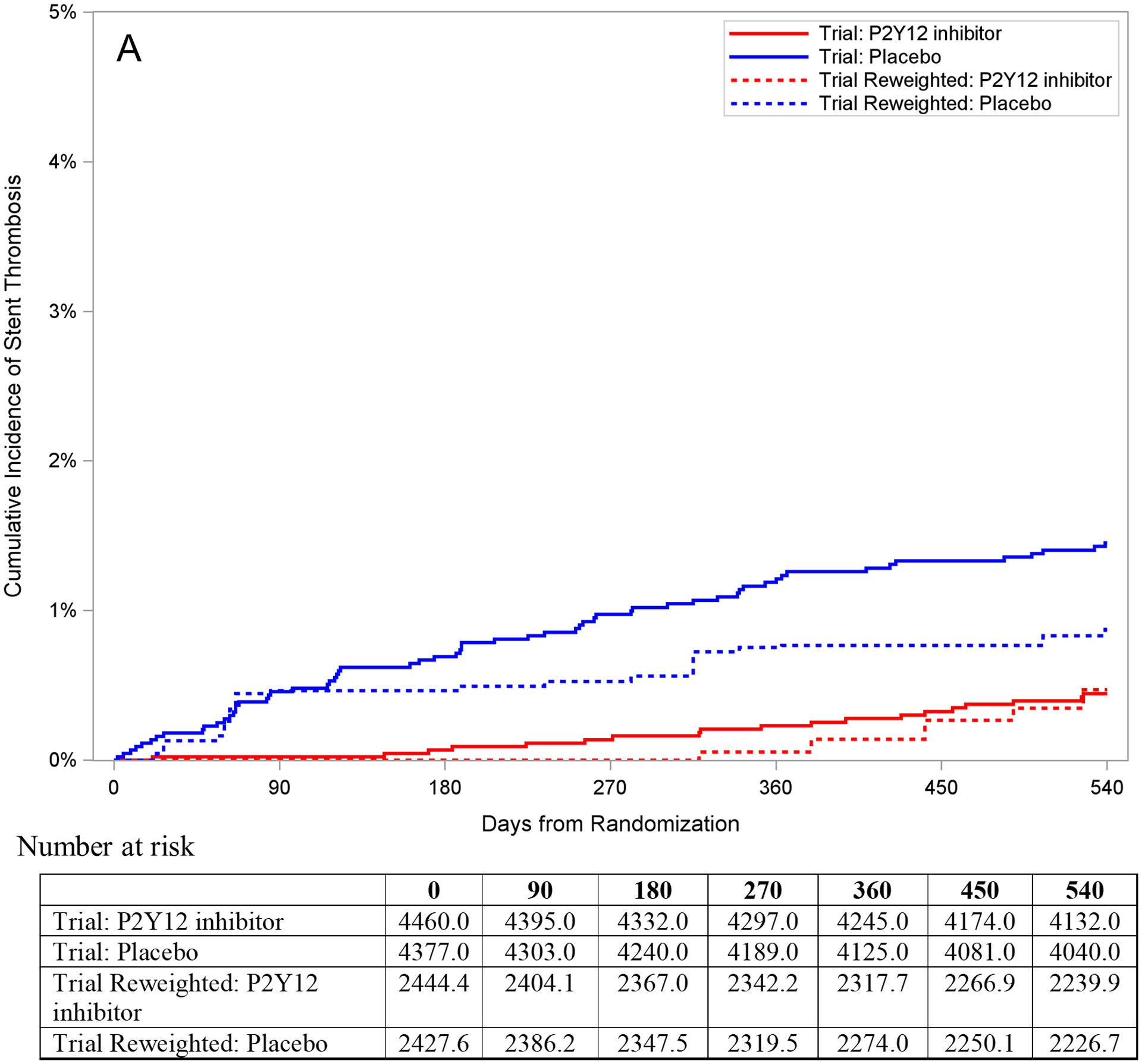


Cumulative incidence rate in outcomes for prolonged DAPT versus normal DAPT in trial cohort and reweighted trial cohort to reflect contemporary registry cohort characteristics. a. stent thrombosis, b. major adverse cardiac and cerebrovascular events, c. GUSTO Moderate or Severe Bleeding, d. BARC 2, 3, or 5 Bleeding
In the trial cohort, longer duration P2Y12 inhibitor therapy was associated with a 1.90% decrease in MACCE (95% CI: −2.95%, −0.92%), which was driven by a 2.27% decrease in MI (95% CI: −3.01%, −1.54%; Table 2, Figure 2b). After reweighting to represent the registry cohort, there was no longer a reduction in MACCE (reweighted treatment effect: −0.52, 95% CI: −2.62%, 1.03%) or MI (reweighted treatment effect: −0.97%, 95% CI: −2.75%, 0.18%) with longer DAPT duration.
In the trial cohort, longer duration P2Y12 inhibitor therapy was associated with a 0.89% increase in GUSTO moderate or severe bleeding (95% CI: 0.33%, 1.51%; Table 2, Figure 2c) and 2.60% increase in BARC 2, 3, or 5 bleeding (95% CI: 1.77%, 3.44%, Figure 2d). After reweighting to represent the registry cohort, the effects of longer duration P2Y12 inhibitor therapy on increasing bleeding persisted (GUSTO bleeding reweighted treatment effect: 1.15%, 95% CI: −0.08%, 2.45%; BARC bleeding reweighted treatment effect: 2.44%, 95% CI: 0.85%, 3.94%).
Supplemental results
In comparing the entire sample of US DES-treated patients enrolled in the DAPT Study to those of the US DES-treated patients who were randomized at 12 months using standardized differences, we found no meaningful differences in baseline characteristics (Table III in the Supplement). Upon repeating analyses in the subpopulation of CMS-linked trial cohort patients and a CMS-linked registry cohort implementing all trial exclusion criteria, similar patterns were observed to those of the main findings. CMS-linked registry cohort patients had more cardiovascular and non-cardiovascular comorbidities and were more likely to present with acute coronary syndrome compared with CMS-linked trial cohort patients (Table IV in the Supplement). Additionally, the point estimates for the effect of prolonged P2Y12 inhibitor therapy on stent thrombosis, MACCE and MI were attenuated after reweighting, suggesting that exclusion between enrollment and randomization and did not meaningfully alter the reweighted trial treatment effects of prolonged DAPT after PCI (Table V in the Supplement). Additionally, upon reweighting the linked trial cohort outcomes based on the full trial cohort characteristics and comparing these to the observed outcomes in the full trial cohort, we found no differences in incidence of outcomes (Table VI in the Supplement), suggesting that the inability to link all trial participants to the CathPCI Registry for reweighting purposes did not introduce unmeasured confounding.
In a post-hoc analysis excluding stent type as a covariate in the propensity score model, our results were similar to the full propensity score model in that there was no reduction in MACCE and a continued increase in bleeding with prolonged DAPT after reweighting (Table VII in the Supplement). However, reductions in stent thrombosis and MI with prolonged DAPT were present when reweighting did not account for stent type. Additionally, in subgroup analysis after stratifying by DAPT score, we found that the projected ischemic benefits of prolonged DAPT seen in the original trial were not evident in the subgroup of patients with DAPT score <2, whereas the bleeding risk persisted (Table VIII in the Supplement). In contrast, in the subgroup of patients with DAPT score ≥2, longer DAPT led to a significant reduction in stent thrombosis, an attenuated effect on MACCE compared with the original trial data, and a non-significant impact on bleeding.
Discussion
This study evaluated the applicability of the DAPT Study to a more contemporary registry population of patients receiving PCI. First, we found that patients randomized in the DAPT study were different than those undergoing PCI in a contemporary registry, with registry patients having greater comorbidities and receiving treatment with a second generation DES. After reweighting trial results to represent the registry population undergoing PCI, the population average treatment effects of prolonged DAPT on reducing definite stent thrombosis, MI, and MACCE were no longer evident, while the increase in bleeding with prolonged DAPT persisted. These results not only have implications for the applicability of the DAPT Study to clinical practice, but also for the applicability of other cardiovascular trials to real-world populations more broadly.
The estimated average treatment effects after reweighting the DAPT Study to represent a contemporary generalizable PCI population are consistent with newer clinical trials of DAPT duration, which demonstrate safety of shorter duration DAPT to reduce bleeding risk,19–21 albeit with continued P2Y12 monotherapy instead of aspirin monotherapy as occurred in the DAPT Study. However, the DAPT Study remains the only randomized trial of DAPT duration that is powered to detect change in rare ischemic events such as stent thrombosis. The difference between the original DAPT Study treatment effects and the estimated contemporary treatment effects of prolonged DAPT were driven both by improvements in stent technology and changes in patient characteristics. Nearly all registry patients received second-generation DES, whereas only 58% of trial patients received a second-generation DES. In a post-hoc subgroup analysis of DAPT Study patients receiving everolimus-eluting stents, the effects of prolonged DAPT on reducing stent thrombosis and MI persisted, though were attenuated, and effects on reducing MACCE were not significant.22 In our study, after accounting for both differences in stent type and a greater burden of comorbidities seen in the contemporary registry population, the estimated contemporary treatment effects of prolonged DAPT in reducing stent thrombosis and MI were no longer evident. Notably, in supplemental analyses excluding stent type from our propensity score model, our results suggested that improvements in stent technology were responsible for attenuation in the benefit of prolonged DAPT on ischemic outcomes, but not for the changes observed in bleeding risk. These findings highlight the importance of variables other than stent type, such as patient characteristics, in our estimated contemporary treatment effects. Thus, through accounting for differences in patient and procedural factors, our study may help reconcile the seemingly disparate results from prior clinical trials demonstrating the utility of prolonged DAPT and newer trials demonstrating harms of prolonged DAPT.
Our finding that longer duration DAPT may have more limited benefits and greater harms when applied broadly in a contemporary real-world population has implications for clinical practice. These results illustrate the importance of a nuanced interpretation of clinical trials to guide clinical decision-making and highlight the risks of simply applying topline trial results to all patients encountered in contemporary clinical practice. It is important to note that the reweighted treatment effects in this study only represent average treatment effects across a population, and that there still are subsets of patients who may benefit from prolonged DAPT beyond 1 year after PCI, including those at low bleeding and higher ischemic risk (e.g. patients with high DAPT score).23 For instance, projected ischemic benefits of prolonged DAPT were evident, although attenuated, with negligible increase in bleeding for the subgroup of registry patients with DAPT Score ≥2. Given the differences between the trial and contemporary registry populations, a higher DAPT score cutoff could potentially be used in the future, particularly among high bleeding risk patients. Our results emphasize the importance of accounting for patient-specific factors and leveraging risk scores when available in deciding how a clinical trial’s results apply to a particular patient.
Our findings must be interpreted in context of their limitations. First, given the unique design of the DAPT Study, it is possible that selection from the sample of patients initially enrolled in the trial to obtain the sample of patients eligible for randomization at 12 months may affect estimated real-world treatment effect estimates. For instance, there may be differential dropout, nonadherence, or clinical events that can lead to exclusion between enrollment and randomization and may also affect the treatment effects of prolonged DAPT after PCI. However, notably, the covariate distribution among all of those enrolled in the trial at baseline is similar to the covariate distribution among those randomized at 12 months, suggesting that selection during this time period did not significantly alter the measured characteristics of the trial population in aggregate. Additionally, we found directionally similar results in the subset of the registry cohort that was linked to CMS data for whom we were able to identify patients meeting almost all exclusion criteria.
Second, our ability to detect statistically significant differences in treatment effects between trial and reweighted trial cohorts was limited as the confidence intervals for estimated differences were wide. Third, our real-world treatment effects were estimated based on the subset of trial participants that could be linked to the NCDR CathPCI Registry. However, in supplemental analysis, the linked trial cohort was able to reproduce the observed results of the full trial cohort after reweighting, suggesting that the inability to link all trial patients did not introduce selection bias to the trial cohort. Fourth, there may be differences between the extrapolated registry treatment effect and the actual treatment effect that would be observed if a contemporary trial were conducted due to changes in care over time that might influence the treatment effect. Fifth, there may be differences between the extrapolated registry treatment effect and the actual treatment effect that would be observed if a contemporary trial were conducted due to unmeasured factors that could not be accounted for in the reweighting process, despite our use of an extensive list of covariates in the NCDR registry known to affect outcomes. Finally, our NCDR cohort reflects data through 2017 and transported trial results may need to be updated with more contemporary data should PCI patients and practice patterns change substantially in the future.
In conclusion, we evaluated the applicability of the DAPT Study to a more contemporary US population of patients receiving PCI. We found that patients enrolled in the DAPT Study were different from those encountered in routine practice and that on average these differences were associated with less benefit and greater harm with prolonged DAPT duration after reweighting the trial to represent contemporary PCI patients. These results highlight the need to evaluate the applicability of cardiovascular clinical trials to contemporary real-world populations more broadly. As cardiovascular practice guidelines are updated, future studies can use the methods in this study to quantify differences between trial and registry populations to understand whether the average treatment effects of completed clinical trials would be applicable to contemporary populations.
Supplementary Material
Clinical perspective.
- What is new?
- Compared to patients randomized in the DAPT Study, contemporary patients receiving percutaneous coronary intervention (PCI) in the CathPCI registry had more comorbidities and were more likely to present with myocardial infarction and receive 2nd generation drug-eluting stents
- After reweighting the DAPT Study results to represent the contemporary US population of patients undergoing PCI, there was no longer a significant effect of prolonged DAPT on reducing stent thrombosis, major adverse cardiac and cerebrovascular events, or myocardial infarction, but the increase in bleeding with prolonged DAPT persisted
- What are the clinical implications?
- These findings limit applicability of average treatment effects from the DAPT Study in modern clinical practice.
- These results illustrate the importance of a nuanced interpretation of clinical trials to guide clinical decision-making and highlight the risks of simply applying topline trial results to all patients encountered in contemporary clinical practice.
Acknowledgments
The authors would like to acknowledge Dr. Issa Dahabreh for his contribution to the study design and critical revision of the manuscript.
Sources of Funding
This research was supported by the National Heart, Lung, and Blood Institute (1R01HL136708, Bethesda, MD) and the American College of Cardiology’s National Cardiovascular Data Registry (NCDR, Washington, DC). The views expressed in this manuscript represent those of the authors, and do not necessarily represent the official views of the NCDR or its associated professional societies identified at CVQuality.ACC.org/NCDR.
Disclosures
Dr. Butala reports consulting fees and ownership interest in HiLabs, outside the submitted work. Dr. Shen is an employee of Biogen, Inc. Dr. Secemsky receives grants from AstraZeneca, BD Bard, Boston Scientific, Cook Medical, CSI, Medtronic, Philips, and UCSF. He consults for BD Bard, CSI, Medtronic, and Philips and is on the speaking bureau of BD Bard, Cook Medical and Medtronic. Dr Mauri is an employee of Medtronic, Inc. Dr. Kereiakes has received consultant fees from SINO Medical Sciences Technologies, Inc., Boston Scientific Corporation, Svelte Medical Systems, Inc., Orchestra Biomed, Inc., Shockwave, Elixir Medical Corporation, and Abbott Vascular. Dr. Curtis receives salary support under contracts with the American College of Cardiology and CMS. Dr. Gibson reports grants and personal fees from Angel Medical Corporation, grants and personal fees from Bayer Corp., grants and personal fees from CSL Behring, grants and personal fees from Janssen Pharmaceuticals, grants and personal fees from Johnson & Johnson Corporation, personal fees from The Medicines Company, personal fees from Boston Clinical Research Institute, personal fees from Cardiovascular Research Foundation, personal fees from Eli Lilly and Company, personal fees from Gilead Sciences, Inc., personal fees from Novo Nordisk, personal fees from Web MD, personal fees from UpToDate in Cardiovascular Medicine, grants and personal fees from Portola Pharmaceuticals, personal fees from Amarin Pharma, personal fees from Amgen, personal fees from Boehringer Ingelheim, personal fees from Chiesi, personal fees from Merck & Co, Inc., personal fees from PharmaMar, personal fees from Sanofi, personal fees from Somahlution, personal fees from St. Francis Hospital, personal fees from Verreseon Corporation, personal fees from Boston Scientific, personal fees from Duke Clinical Research Institute, personal fees from Impact Bio, LTD, personal fees from MedImmune, personal fees from Medtelligence, personal fees from Microport, personal fees from PERT Consortium, other from nference, non-financial support from Baim Institute, grants from Bristol-Myers Squibb, grants from SCAD Alliance, personal fees from GE Healthcare, personal fees from Caladrius Bioscience, personal fees from CeleCor Therapeutics, personal fees from Thrombolytic Science, personal fees from AstraZeneca, personal fees from Eidos Therapeutics, personal fees from Kiniksa Pharmaceuticals. Dr. Yeh has research grants from Abbott Vascular, Abiomed, AstraZeneca, Cook, BD Bard, Boston Scientific, Medtronic, and Philips. Consulting: Abbott Vascular, AstraZeneca, Boston Scientific, and Medtronic. All other authors have nothing to disclose.
Non-standard abbreviations and acronyms
- DAPT
dual antiplatelet therapy
- PCI
percutaneous coronary intervention
- NCDR
National Cardiovascular Data Registry
- DES
drug-eluting stent
- MI
myocardial infarction
- MACCE
major adverse cardiac and cerebrovascular events
- CHF
congestive heart failure
- PAD
peripheral arterial disease
- CABG
coronary artery bypass grafting
- CMS
Centers for Medicare and Medicaid Services
Footnotes
References
- 1.Mauri L, Kereiakes DJ, Yeh RW, Driscoll-Shempp P, Cutlip DE, Steg PG, Normand S-LT, Braunwald E, Wiviott SD, Cohen DJ, et al. Twelve or 30 Months of Dual Antiplatelet Therapy after Drug-Eluting Stents. New England Journal of Medicine. 2014;371:2155–2166. [DOI] [PMC free article] [PubMed] [Google Scholar]
- 2.Bonaca MP, Bhatt DL, Cohen M, Steg PG, Storey RF, Jensen EC, Magnani G, Bansilal S, Fish MP, Im K, et al. Long-Term Use of Ticagrelor in Patients with Prior Myocardial Infarction. New England Journal of Medicine. 2015;372:1791–1800. [DOI] [PubMed] [Google Scholar]
- 3.Bittl JA, Baber U, Bradley SM and Wijeysundera DN. Duration of Dual Antiplatelet Therapy: A Systematic Review for the 2016 ACC/AHA Guideline Focused Update on Duration of Dual Antiplatelet Therapy in Patients With Coronary Artery Disease: A Report of the American College of Cardiology/American Heart Association Task Force on Clinical Practice Guidelines. J Am Coll Cardiol. 2016;68:1116–39. [DOI] [PubMed] [Google Scholar]
- 4.Kennedy-Martin T, Curtis S, Faries D, Robinson S and Johnston J. A literature review on the representativeness of randomized controlled trial samples and implications for the external validity of trial results. Trials. 2015;16:495. [DOI] [PMC free article] [PubMed] [Google Scholar]
- 5.van Deudekom FJ, Postmus I, van der Ham DJ, Pothof AB, Broekhuizen K, Blauw GJ and Mooijaart SP. External validity of randomized controlled trials in older adults, a systematic review. PloS one. 2017;12:e0174053. [DOI] [PMC free article] [PubMed] [Google Scholar]
- 6.Levine GN, Bates ER, Bittl JA, Brindis RG, Fihn SD, Fleisher LA, Granger CB, Lange RA, Mack MJ, Mauri L, et al. 2016 ACC/AHA Guideline Focused Update on Duration of Dual Antiplatelet Therapy in Patients With Coronary Artery Disease. A Report of the American College of Cardiology/American Heart Association Task Force on Clinical Practice Guidelines. 2016;68:1082–1115. [DOI] [PubMed] [Google Scholar]
- 7.Valgimigli M, Bueno H, Byrne RA, Collet J-P, Costa F, Jeppsson A, Jüni P, Kastrati A, Kolh P, Mauri L, et al. 2017 ESC focused update on dual antiplatelet therapy in coronary artery disease developed in collaboration with EACTS: The Task Force for dual antiplatelet therapy in coronary artery disease of the European Society of Cardiology (ESC) and of the European Association for Cardio-Thoracic Surgery (EACTS). European Heart Journal. 2017;39:213–260. [DOI] [PubMed] [Google Scholar]
- 8.Yeh RW, Czarny MJ, Normand S-LT, Kereiakes DJ, Holmes DR Jr, Brindis RG, Weaver WD, Rumsfeld JS, Roe MT and Kim S. Evaluating the generalizability of a large streamlined cardiovascular trial: comparing hospitals and patients in the dual antiplatelet therapy study versus the national cardiovascular data registry. Circulation: Cardiovascular Quality and Outcomes. 2015;8:96–102. [DOI] [PMC free article] [PubMed] [Google Scholar]
- 9.Alkhouli M, Alqahtani F, Kalra A, Gafoor S, Alhajji M, Alreshidan M, Holmes DR and Lerman A. Trends in Characteristics and Outcomes of Patients Undergoing Coronary Revascularization in the United States, 2003–2016. JAMA network open. 2020;3:e1921326. [DOI] [PMC free article] [PubMed] [Google Scholar]
- 10.Stuart EA, Cole SR, Bradshaw CP and Leaf PJ. The use of propensity scores to assess the generalizability of results from randomized trials. Journal of the Royal Statistical Society Series A, (Statistics in Society). 2001;174:369–386. [DOI] [PMC free article] [PubMed] [Google Scholar]
- 11.Dahabreh IJ, Robertson SE, Tchetgen EJ, Stuart EA and Hernan MA. Generalizing causal inferences from individuals in randomized trials to all trial-eligible individuals. Biometrics. 2019;75:685–694. [DOI] [PMC free article] [PubMed] [Google Scholar]
- 12.Strom JB, Tamez H, Zhao Y, Valsdottir LR, Curtis J, Brennan JM, Shen C, Popma JJ, Mauri L and Yeh RW. Validating the use of registries and claims data to support randomized trials: Rationale and design of the Extending Trial-Based Evaluations of Medical Therapies Using Novel Sources of Data (EXTEND) Study. Am Heart J. 2019;212:64–71. [DOI] [PMC free article] [PubMed] [Google Scholar]
- 13.Li L, Shen C, Li X and Robins JM. On weighting approaches for missing data. Statistical methods in medical research. 2013;22:14–30. [DOI] [PMC free article] [PubMed] [Google Scholar]
- 14.Dahabreh IJ, Robertson SE, Steingrimsson JA, Stuart EA and Hernán MA. Extending inferences from a randomized trial to a new target population. Stat Med. 2020;39:1999–2014. [DOI] [PubMed] [Google Scholar]
- 15.Robertson SE, Steingrimsson JA, Joyce NR, Stuart EA and Dahabreh IJ. Estimating subgroup effects in generalizability and transportability analyses. arXiv. Preprint posted online September 30, 2021. doi: arXiv:2109.14075 [stat.ME]. 2021. [DOI] [PMC free article] [PubMed] [Google Scholar]
- 16.Cole SR and Hernán MA. Constructing Inverse Probability Weights for Marginal Structural Models. American Journal of Epidemiology. 2008;168:656–664. [DOI] [PMC free article] [PubMed] [Google Scholar]
- 17.Elixhauser A, Steiner C, Harris DR and Coffey RM. Comorbidity measures for use with administrative data. Medical care. 1998:8–27. [DOI] [PubMed] [Google Scholar]
- 18.Segal JB, Chang HY, Du Y, Walston JD, Carlson MC and Varadhan R. Development of a Claims-based Frailty Indicator Anchored to a Well-established Frailty Phenotype. Med Care. 2017;55:716–722. [DOI] [PMC free article] [PubMed] [Google Scholar]
- 19.Watanabe H, Domei T, Morimoto T, Natsuaki M, Shiomi H, Toyota T, Ohya M, Suwa S, Takagi K, Nanasato M, et al. Effect of 1-Month Dual Antiplatelet Therapy Followed by Clopidogrel vs 12-Month Dual Antiplatelet Therapy on Cardiovascular and Bleeding Events in Patients Receiving PCI: The STOPDAPT-2 Randomized Clinical Trial. Jama. 2019;321:2414–2427. [DOI] [PMC free article] [PubMed] [Google Scholar]
- 20.Hahn JY, Song YB, Oh JH, Chun WJ, Park YH, Jang WJ, Im ES, Jeong JO, Cho BR, Oh SK, et al. Effect of P2Y12 Inhibitor Monotherapy vs Dual Antiplatelet Therapy on Cardiovascular Events in Patients Undergoing Percutaneous Coronary Intervention: The SMART-CHOICE Randomized Clinical Trial. Jama. 2019;321:2428–2437. [DOI] [PMC free article] [PubMed] [Google Scholar]
- 21.Mehran R, Baber U, Sharma SK, Cohen DJ, Angiolillo DJ, Briguori C, Cha JY, Collier T, Dangas G, Dudek D, et al. Ticagrelor with or without Aspirin in High-Risk Patients after PCI. N Engl J Med. 2019;381:2032–2042. [DOI] [PubMed] [Google Scholar]
- 22.Hermiller JB, Krucoff MW, Kereiakes DJ, Windecker S, Steg PG, Yeh RW, Cohen DJ, Cutlip DE, Massaro JM, Hsieh WH et al. Benefits and Risks of Extended Dual Antiplatelet Therapy After Everolimus-Eluting Stents. JACC Cardiovascular interventions. 2016;9:138–47. [DOI] [PubMed] [Google Scholar]
- 23.Yeh RW, Secemsky EA, Kereiakes DJ, Normand SL, Gershlick AH, Cohen DJ, Spertus JA, Steg PG, Cutlip DE, Rinaldi MJ, et al. Development and Validation of a Prediction Rule for Benefit and Harm of Dual Antiplatelet Therapy Beyond 1 Year After Percutaneous Coronary Intervention. Jama. 2016;315:1735–49. [DOI] [PMC free article] [PubMed] [Google Scholar]
Associated Data
This section collects any data citations, data availability statements, or supplementary materials included in this article.