



INTRODUCTION
US Hispanics have a 2.3 times greater risk of death from COVID-19 compared to non-Hispanic whites.1 We assessed COVID-19 vaccination rates among Hispanic populations in the ten most populous US cities and describe the availability of Spanish language COVID-19 vaccination resources.
METHODS
We identified the top 10 most populated cities in the USA and percent of the population that identified as Hispanic using Census.gov. To assess the percent of Hispanics vaccinated with at least one dose of COVID-19 vaccine, we extracted data from the COVID-19 Vaccination Map from the Centers for Disease Control and Prevention (CDC) website (accessed last July 19, 2021). We also assessed the percent of Hispanics with limited English proficiency (LEP) using the American Community Survey data from 2019.
Two co-authors (MP, DMN) independently queried “(City) department of public health” through an online Google search. Similar to previous studies, ease of website navigation was measured via the number of clicks to information on COVID-19 vaccines in English and in Spanish.2,3 We also counted the number of clicks to access information on registration for a COVID-19 vaccine in Spanish. From each state’s DPH website, we identified common “big-box” retailers distributing vaccines and recorded whether the main COVID-19 vaccine information page and appointment scheduling were available in Spanish on their website. All data were extracted independently by two co-authors (MP and DMN); discrepant results were resolved by a third reviewer (AB). Due to non-parametric data, medians and interquartile ranges (IQR) were calculated for clicks to COVID-19 vaccine information using STATA4 and a signed-rank Wilcoxon test was used to assess differences in English and Spanish availability.
RESULTS
Figure 1 shows the percent of the total population that have received at least one dose of a COVID-19 vaccine, the percent Hispanic that have received at least one dose of a COVID-19 vaccine, and the percent Hispanic that speaks English “less than very well” by city.
Figure 2.
Percent total population that has received at least one dose of a COVID-19 vaccine, percent of Hispanics that have received at least one dose of a COVID-19 vaccine, and percent of Hispanic with limited English proficiency by city. Percent total vaccinated and Hispanic vaccinated obtained from individual city’s Department of Public Health websites. Percent Hispanic with limited English proficiency obtained from the American Community Survey (2019).1 Cities are listed in descending order of total population.
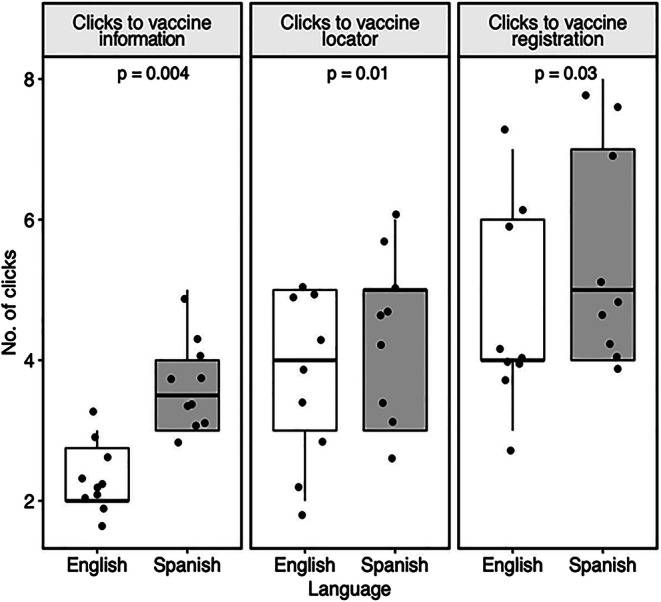
Upon accessing the DPH sites, the median number of clicks to reach COVID-19 vaccine information was 2 (IQR 0.75) for English and 3.5 (IQR 1) for Spanish (p = 0.004). The median number of clicks to reach COVID-19 vaccine locator sites from DPH websites in English was 4 (IQR 2) and 5 (IQR 1.23) for Spanish (p = 0.01). The median number of clicks to the COVID-19 vaccine registration in English was 4 (IQR 2) and 5 (IQR 3) for Spanish (p = 0.03) (Fig. 2).
Figure 1.

The number of clicks to reach COVID-19 vaccine information, locator, and registration in English and Spanish from the Department of Health websites.
Of the eight “big-box” retailers identified from the vaccine locator maps, five did not have the main COVID-19 vaccine information page available in Spanish and four had neither the information page nor vaccine scheduling available in Spanish.
DISCUSSION
Our study shows that in the top 10 most populous US cities, vaccination rates among Hispanics ranged from 29 to 49%. Despite large proportions of the Hispanic populations in these cities, having limited English proficiency (29 to 49%), retrieving information on COVID-19 vaccines, and registration in Spanish required more clicks compared to English language information. Half of big-box retailers listed on vaccine locators failed to provide information to schedule an appointment in Spanish.
While vaccination rates among Hispanics have been improving nationally5, this population faces existing inequities around technology access.6,7 More clicks could present additional barriers. We recommend that links to vaccine registration be listed on the main page of all vaccine distributors. The importance of quick access and navigability of online resources in Spanish is critical to encourage eligible individuals to register and receive the COVID-19 vaccine.7
LIMITATIONS
Our focus on the ten most populous US cities excludes counties or smaller cities with proportionally high percentages of Hispanic populations. Our results are listed by city, yet vaccine data was reported at the county level. To account for this, we included all counties that make up a city’s population. Due to differences in reporting of race and ethnicity on the county websites, we were unable to conduct significance testing of vaccination rates among Hispanics and non-Hispanic whites. We also chose to focus on browsers that are on English as a default; results may vary if browsers are pre-set as Spanish.
Acknowledgements
The authors would like to thank Wen Wan, PhD, for her guidance on the statistical analysis.
Author Contribution
AB, MP, and DM wrote the manuscript, researched data, and take responsibility for the contents of this article. AB and VA reviewed and edited the manuscript.
Declarations
Conflict of Interest
The authors declare that they do not have a conflict of interest.
Footnotes
Maria Paz and Diana Marino-Nunez are co-first authors.
Publisher’s Note
Springer Nature remains neutral with regard to jurisdictional claims in published maps and institutional affiliations.
References
- 1.Artiga S, Hill L, and Haldar S. COVID-19 Cases and Deaths by Race/Ethnicity: Current Data and Changes Over Time. KFF. https://www.kff.org/racial-equity-and-health-policy/issue-brief/covid-19-cases-and-deaths-by-race-ethnicity-current-data-and-changes-over-time/. Published October 8, 2021. Accessed November 5, 2021.
- 2.Walton R. Looking for Answers: A Usability Study of Online Finding Aid Navigation. Am Arch. 2017;80(1):30-52. 10.17723/0360-9081.80.1.30.
- 3.Karani A, Thanki H, Achuthan S. Impact of University Website Usability on Satisfaction: A Structural Equation Modelling Approach. Management and Labour Studies. 2021;46(2):119–138. doi: 10.1177/0258042X21989924. [DOI] [Google Scholar]
- 4.StataCorp . Stata Statistical Software: Release 17. College Station, TX: StataCorp LLC.; 2021. [Google Scholar]
- 5.Ndugga N, Hill L, Artiga S, and Haldar S. Latest Data on COVID-19 Vaccinations Race/Ethnicity. KFF. https://www.kff.org/coronavirus-covid-19/issue-brief/latest-data-on-covid-19-vaccinations-race-ethnicity/. Published November 3, 2021. .
- 6.Press VG, Huisingh-Scheetz M, Arora VM. Inequities in Technology Contribute to Disparities in COVID-19 Vaccine Distribution. JAMA Health Forum. 2021;2(3):e210264–e210264. doi: 10.1001/jamahealthforum.2021.0264. [DOI] [PubMed] [Google Scholar]
- 7.Centers for Disease Control and Prevention. Health Equity Considerations and Racial and Ethnic Minority Groups. https://www.cdc.gov/coronavirus/2019-ncov/community/health-equity/race-ethnicity.html. Published April 19, 2021. Accessed November 5, 2021.