



Abstract
Cuticular wax on plant aerial surfaces plays a vital role in the defense against various stresses, and the genes related to wax metabolism have been well documented in several model plants. However, there is very limited research on the key enzymes and transcription factors (TFs) associated with carbon chain distribution and wax biosynthesis in citrus fruit. In this study, an analysis of wax metabolites indicated that even carbon-chain (C24-C28) metabolites are the dominant wax components in citrus fruit, and a 3-ketoacyl-CoA synthase (KCS) family gene (CsKCS20) plays an important role in the carbon chain distribution during wax biosynthesis in a wax-deficient mutant (MT). Expression of CsKCS20 in yeast indicated that CsKCS20 can catalyze the biosynthesis of C22 and C24 very-long-chain fatty acids (VLCFAs). In addition, transcriptome and sequence analysis indicated that the differential expression of CsKCS20 between the wild-type (WT) and MT fruit can be partly attributed to the regulation of CsMYB96, which was further confirmed by yeast one-hybrid (Y1H) assays, electrophoretic mobility shift assays (EMSAs) and dual luciferase assays. The functions of CsMYB96 and CsKCS20 in wax biosynthesis were further validated by heterologous expression in Arabidopsis. In summary, this study elucidates the important roles of CsKCS20 and CsMYB96 in regulating VLCFA elongation and cuticular wax biosynthesis, which provides new directions for the improvement of citrus fruit wax quality in genetic breeding programs.
Introduction
The plant aerial surface is generally coated with a layer of cuticular wax that is synthesized by epidermal cells and acts as a barrier between the environment and plants [1–3]. Recently, many reports have suggested that the total content of wax and the proportions of individual wax components vary significantly among different species and drive adaption to diverse terrestrial habitats during the evolutionary process [4, 5]. In Arabidopsis, C29 alkanes are the dominant component of wax in various organs, while C31 and C33 alkanes and several triterpenes are the dominant wax metabolites in tomato fruit [1, 6, 7]. As odd-chain alkanes are transformed from the corresponding even-chain very-long-chain fatty acyl-CoAs (VLC acyl-CoAs) and/or aldehydes [8–10], it can be inferred that C30, C32 and C34, which originate from the fatty acid elongation process, are the dominant carbon chain lengths in Arabidopsis and tomato. AtKCS6/CER6 and SlCER6 are important proteins in the fatty acid elongase (FAE) complex, and functional analysis has revealed that they are responsible for the biosynthesis of VLCFAs above C24 and C28, respectively [11, 12]. In addition, previous research on the diversity of cuticular wax between Satsuma mandarin and “Newhall” navel orange has demonstrated that wax biosynthesis is synchronous with fruit maturation by transcriptomic and metabolomic profiling [13, 14]. However, different from the findings in Arabidopsis and tomato, research on citrus wax has revealed that C24, C26 and C28 aldehydes are the dominant wax metabolites [13–15], and there has been very limited research on the regulation of the special carbon chain distribution and wax components in citrus fruit.
Owing to its important role in the response to several stresses, the transcriptional regulation of Arabidopsis wax has been extensively studied. MYB96 has been identified as a well-known transcription factor (TF) that participates in cuticular wax biosynthesis; it can directly induce the expression of genes involved in cuticular wax biosynthesis, such as AtKCS1, AtKCS2, AtKCS6 and AtKCR1 [16–18]. In addition, other MYB TFs, such as MYB16 [19], MYB94 [20] and MYB106 [21], were also reported to participate in VLCFA and wax biosynthesis in many crops. In addition, WAX INDUCER 1/SHINE 1 (WIN1/SHN1) and the homologs SHN2/3, which belong to the APETALA 2/Ethylene Responsive Factor (AP2/ERF) family proteins, also act as activators of cuticular wax biosynthesis [22, 23]. In fruit crops, the hydrophobic characteristic of cuticular wax not only influences the growth and ripening process [24] but also prevents water loss and promotes defense against pathogen infection to maintain postharvest quality [2, 25]. In tomato fruit, several TFs, such as SlMYB31, Woolly (Wo), TOMATO AGAMOUS-LIKE1 (TAGL1) and SHN1, can directly bind to the promoter of wax biosynthesis genes (such as SlCER6) and increase the wax content in tomato fruit [26–28]. However, for other important fruits, such as citrus, research on TFs involved in fruit cuticular wax biosynthesis is limited.
Citrus is one of the most important fruits worldwide and has attracted much attention in research illustrating the regulatory mechanism of fruit quality formation. However, the high heterozygosity, long juvenile phase and difficulty in transgenic processes have largely hindered the validation of such regulatory mechanisms, and there are only a limited number of reports on the biosynthesis of anthocyanins and carotenoids based on natural mutants [29–31]. Over the past decade, although several glossy citrus mutants have been analyzed by integrated transcriptome and metabolome analysis, the findings are mainly focused on the description of wax-deficient phenotypes, influence on plastid membrane lipids and defense against fungal pathogens [15, 32, 33]. In this study, by comparing “Newhall” navel orange (WT) with its glossy mutant (MT), in which the elongation of VLC acyl-CoAs above C20 is blocked, we identified a wax biosynthesis enzyme, CsKCS20, which can catalyze the elongation process to form C22 and C24 VLCFAs and plays important roles in carbon chain distribution and cuticular wax biosynthesis in citrus fruit. In addition, CsKCS20 can be directly activated by CsMYB96 (homolog of AtMYB96) to promote the formation of C22 and C24 VLC acyl-CoAs and wax biosynthesis in citrus fruit. Our findings are expected to fill the gap in knowledge regarding the molecular mechanisms underlying the special carbon chain distribution and wax biosynthesis on citrus fruit surfaces.
Results
Wax deficiency in the glossy “Newhall” navel orange mutant increased fruit water loss
The surface of mature MT fruit was much glossier than that of WT fruit (Fig. 1a). To analyze the microstructure of cuticular wax crystals, we evaluated the flavedo of mature WT and MT fruit by scanning electron microscopy (SEM) (Fig. 1b). The WT fruit surface exhibited an amorphous structure of epicuticular wax, with a scattered distribution of dense platelets and crystalline plates. In contrast, the MT fruit surface showed much fewer rugged wax crystals and a smooth wax film. Cuticular wax is very important in plant resistance to drought stress and shelf life maintenance of fresh fruit by reducing nonstomatal water loss [25]. The postharvest water loss of the MT was substantially higher than that of the WT during the whole storage period, particularly at 24 days after storage, with an approximately 2.37-fold change in the MT (18.40 ± 0.38%) relative to that in the WT (7.77 ± 0.47%) (Fig. 1c). However, no significant differences were found between the WT and MT fruit in internal quality, including TSS, TA and maturity index (TSS/TA ratio), indicating that the internal quality was hardly influenced (Fig. 1d, e, and f).
Figure 1.

Comprehensive descriptions of the appearance and internal quality of fruit. (a) Phenotypic comparison between WT and MT fruit from the same garden. (b) SEM result of WT and MT fruit flavedo. (c) Water loss of WT and MT fruit. (d) Total soluble solids (TSS). (e) Total acid (TA). (f) Maturity index (TSS TA−1). Values shown are the mean ± SD (n = 12 in water loss analysis and n = 3 in TSS, TA and TSS TA−1 analysis). The asterisks (*) indicate significant differences (* P < 0.05 with Student’s t-test).
Blocking VLCFA elongation above C20 led to wax deficiency in MT fruit
To further investigate the specific difference in wax components between the MT and WT, fruit cuticular wax was quantified by gas chromatography-flame ionization detection (GC-FID). As shown in Fig. 2a, the total wax decreased by an approximately 8-fold change in MT (142.46 ± 18.17 μg dm−2) relative to that in WT (1138.10 ± 46.16 μg dm−2). Analyses of individual cuticular wax components revealed that almost all aliphatic compounds were reduced in the MT compared with those in the WT (Fig. 2b). The cuticular wax of WT fruit consisted of chain lengths of 20–34 carbons, among which the even-carbon chains C24, C26 and C28 were dominant over C30 and C32 (Fig. 2c), while the components of cuticular wax above C20 significantly decreased on the MT fruit surface (Fig. 2c). These results demonstrated that the cuticular wax biosynthesis pathways were significantly influenced and that the elongation of VLCFAs above C20 was more seriously blocked in the MT. In addition, since the components of C24, C26 and C28 are dominant in citrus wax and are the early products of VLCFA elongation of C20 metabolites, WT and MT fruits are appropriate materials for studying the molecular mechanism underlying the carbon chain distribution in citrus fruit wax.
Figure 2.
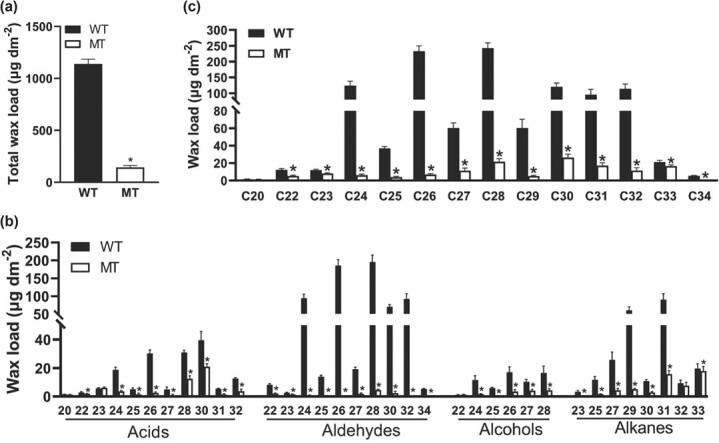
Cuticular wax profiles of WT and MT fruit flavedo. (a) Total wax content. (b) Cuticular wax chemical components. (c) Distribution of carbon chain lengths. Values shown are mean ± SD (n = 3–4). The asterisks (*) indicate significant differences (* P < 0.05 with Student’s t-test).
ER-localized CsKCS20 played a vital role in the distribution of carbon chains above C20 in citrus fruit wax
Considering that β-ketoacyl-CoA synthase (KCS) is the rate-limiting enzyme in the VLCFA elongation process and determines the carbon chain distribution of wax components, we first analyzed the expression of all 16 KCS family genes based on previous transcriptome data [32] (Supplementary Fig. S1). Nine KCSs were expressed in the mature flavedo of the WT and MT (FPKM >10) (Supplementary Table S1). To further confirm the differential expression of these nine genes between the WT and MT, their flavedo was collected at the mature stage in 2019 and 2020 and then used to analyze the transcriptional levels of these genes by qRT–PCR. As a result, the expression of CsKCS3, CsKCS6, CsKCS10, CsKCS11–3, CsKCS19–1 and CsKCS20 was significantly reduced in the MT (Fig. 3a and Supplementary Fig. S2). Although several KCS genes were downregulated, such as CsKCS6, which might influence the biosynthesis of VLCFAs above C24, it is worth noting that CsKCS20, the closest homolog to AtKCS20 and AtKCS2, which is speculated to catalyze the production of C22 and C24 VLCFAs, was the most significantly downregulated in MT. This result is in agreement with the blocked biosynthesis of cuticular wax components above C20. Hence, it could be inferred that downregulation of CsKCS20 might decrease the amount of metabolites longer than C20 in the cuticular wax of the MT.
Figure 3.

Transcription levels of candidate KCSs and subcellular localization. (a) Transcription levels of candidate genes related to the very-long-chain fatty acid elongation pathway in the two genotypes in 2020. (b) Subcellular localization of CsKCS20 in N. benthamiana leaves transformed by agroinfiltration. RFP-HDEL was used as an endoplasmic reticulum marker. Values shown are the mean ± SD (n = 3–4). The asterisks (*) represent significant differences (* P < 0.05 with Student’s t-test).
Moreover, we performed transient overexpression of a CsKCS20-GFP fusion protein in tobacco leaves with the ER membrane marker RFP-HDEL. The results revealed that the CsKCS20 protein was colocalized with the ER membrane marker (Fig. 3b), revealing that CsKCS20 is localized to the ER, which is consistent with its function in catalyzing VLCFA formation on the ER.
CsKCS20 catalyzed the formation of C22 and C24 fatty acids in yeast cells
Due to its low accumulation of C22 and C24 VLCFAs [34], the yeast mutant strain BY4741 Δfah1 was used to investigate the function of KCS20. The CsKCS20 protein was expressed in BY4741 Δfah1 yeast, and the yeast fatty acyl chains were quantified by gas chromatography–mass spectrometry (GC–MS) (Fig. 4a).
Figure 4.

Heterologous expression of CsKCS20 in the BY4741 Δfah1 yeast strain. Total fatty acids were extracted from the BY4741 Δfah1 yeast strain expressing the empty vector or CsKCS20. (a) GC–MS map. (b) Fatty acid production. Values shown are the mean ± SD (n = 4). The asterisks (*) indicate significant differences (* P < 0.05 with Student’s t-test).
As shown in Fig. 4b, the yeast cells expressing CsKCS20 accumulated larger amounts of C22 (0.17 ± 0.01 vs. 0.01 ± 0.01 μg/OD600 unit) and C24 (0.24 ± 0.02 vs. 0.03 ± 0.01 μg/OD600 unit) VLCFAs than those expressing the empty vector. In contrast, no significant differences in C20, C26 and C28 VLCFAs were observed between them.
CsMYB96 specifically bound to the CsKCS20 promoter and significantly activated its expression
Sequencing analysis revealed that there was no difference in the promoter and coding sequences of CsKCS20 between MT and WT (Supplementary Table S2a and b). We therefore hypothesize that CsKCS20 may be regulated by an upstream TF whose expression level is different in the MT and WT. To trace the upstream TF that regulates CsKCS20 expression, we analyzed the promoter of CsKCS20 and the expression patterns of TFs related to wax biosynthesis in the flavedo of mature MT and WT fruit. The results showed that the promoter of CsKCS20 harbored at least four conserved motifs, which are analogous to the DNA binding sequences of the MYB family (Supplementary Fig. S3). In addition, CsMYB96, an important TF that regulates wax synthesis, was consistently downregulated in the MT from 2018 to 2020 and exhibited a high correlation with the expression pattern of CsKCS20 (Supplementary Fig. S4). Thus, it could be inferred that CsMYB96 may be responsible for the difference in CsKCS20 expression and cuticular wax between the MT and WT.
The subcellular localization assay indicated that the CsMYB96 protein was colocalized with the nuclear marker DAPI (Fig. 5a), which is consistent with the function of CsMYB96 in regulating gene expression in the nucleus. To determine whether CsMYB96 binds to the promoter of CsKCS20, Y1H and EMSAs were conducted. The Y1H results indicated that CsMYB96 could bind to the promoter of CsKCS20 (Fig. 5b). In addition, the EMSA results indicated that purified 6*HIS-CsMYB96–6*HIS protein could specifically bind to the 20-bp probe containing the CAGTTA sequence found in the CsKCS20 promoter, while the mutant probe (GGGGGG) hardly affected the binding activity (Supplementary Fig. S5a and Fig. 5c). In addition, three other predicted binding sites were also combined with the purified 6*His-CsMYB96–6*His protein (Supplementary Fig. S5b). To further investigate the regulatory effect of CsMYB96 on CsKCS20 expression, a dual-luciferase assay (LUC) was carried out. Approximately 1.7 kb of the CsKCS20 promoter, including the MYB binding consensus sequence, was fused to the firefly luciferase reporter gene. The LUC/REN ratio was increased by approximately 2.44–5.14-fold relative to the empty SK control, indicating that CsMYB96 can significantly induce the expression of CsKCS20 (Fig. 5d). In summary, these results demonstrated that CsMYB96 can directly activate the expression of CsKCS20.
Figure 5.

Subcellular localization and interaction of CsKCS20 and CsMYB96. (a) Subcellular localization of CsMYB96 in N. benthamiana leaves transformed by agroinfiltration. DAPI staining was used as a nuclear marker. (b) Interaction of CsMYB96 with the promoter of CsKCS20 in the yeast one-hybrid assay. (c) Electrophoretic mobility shift assay (EMSA) indicating the binding of CsMYB96 to the promoter of CsKCS20. (d) Activation effect of CsMYB96 on the promoter of CsKCS20 detected by the dual-luciferase assay. Values shown are the mean ± SD (n = 3–4). The asterisks (*) represent significant differences (* P < 0.05 with Student’s t-test). Three independent replications were performed.
Ectopic expression of CsKCS20 and CsMYB96 increased cuticular wax on Arabidopsis stems
To further understand the exact function of CsKCS20 and CsMYB96 in cuticular wax biosynthesis, overexpression (OE) of CsKCS20 and CsMYB96 was conducted in Arabidopsis Col-0. Among the transgenic lines, CsKCS20 OE-4, CsKCS20 OE-8, CsMYB96 OE-13 and CsMYB96 OE-29 were selected for further experiments (Supplementary Fig. S6a). The total wax load in the inflorescence stems of CsKCS20 OE-4 and CsKCS20 OE-8 was significantly higher than that of the WT, which could be mainly attributed to the increase in C29 alkanes (Fig. 6a and b). An analysis of the cuticular wax of CsMYB96 OE-13 and CsMYB96 OE-29 transgenic lines revealed that the cuticular wax content was 124% and 139% that of the wild type, respectively (Fig. 6a), which was also generally higher than that of the CsKCS20 OE lines. These results could be ascribed to the significant accumulation of most dominant stem cuticular wax components, including C26 and C28 primary alcohols, C29 secondary alcohols, C29 alkanes and C29 ketones (Fig. 6b).
Figure 6.

Cuticular wax results for the inflorescence stems of Arabidopsis Col-0 and CsKCS20 OE and CsMYB96 OE transgenic lines. (a) Total cuticular wax contents. (b) Cuticular wax compositions. Values shown are the mean ± SD (n = 3–4). The asterisks (*) indicate significant differences relative to wild-type (* P < 0.05 with Student’s t-test).
Discussion
Although cuticular wax plays vital roles in the ripening process and postharvest storage, little is known about the enzymes responsible for the carbon chain distribution of cuticular wax components and the related transcriptional regulation in citrus fruit. Here, we demonstrate that CsKCS20 can catalyze the formation of C22 and C24 VLC acyl-CoAs to participate in the carbon chain distribution in wax components of citrus fruit and is directly induced by the R2R3-MYB transcription factor CsMYB96, a predominant regulator of cuticular wax metabolism.
CsKCS20 regulates the carbon chain distribution in the wax components of citrus fruit
Approximately 450 million years ago, after the evolution of biosynthesis pathways of wax to cover the aerial surface of plants against desiccation and ultraviolet radiation stress, ancestral freshwater algae successfully landed and adapted to diverse terrestrial habitats [4, 5, 35]. During the following evolution from bryophytes to seed plants, the primary carbon chain lengths of wax components developed from C24 and C26 to above C28. Wax components with longer carbon chain lengths (> C28) usually have stronger hydrophobic ability than wax components with shorter carbon chain lengths, which contributes to higher hydrophobicity and moisture retention capacity for adaptation to different habitats [5]. The carbon chain distribution of wax components in the “Newhall” navel orange surface found in this study is consistent with the finding previously reported in other citrus species that C24, C26 and C28 are relatively dominant over C30 and C32 (Fig. 2b and c) [13–15]. These findings are different from those in other plants, such as apple and Arabidopsis, which have abundant C29 and C31 wax components derived from C30 and C32 VLC acyl-CoAs [1, 2]. The phylogenetic tree indicated that Citrus is phylogenetically more ancient than Arabidopsis and is placed on a different evolutionary branch than apple [36]. In addition, the original habitats of citrus were the subtropical and tropical regions of northeastern India, northern Myanmar and southwestern China, whose environmental moisture is higher than that in temperate regions of central Asia, the center of origin of domesticated apple [37–40]. These results indicate that the dominant positions of C24, C26 and C28 wax components in the cuticular wax of citrus fruit might be ascribed to evolution and adaptation to the habitat.
In this study, the formation of wax components above C20 on the fruit surface was significantly blocked in the MT, leading to a dramatic reduction in wax derivatives (Figs. 1 and 2). This phenotype provides an opportunity to explore the regulatory mechanism of the specific carbon chain distribution of C24, C26 and C28 in citrus wax components. It has been reported that cuticular wax components with various carbon chain lengths (C20−C34) are catalyzed by different KCSs to form VLC acyl-CoAs [1, 3]. Therefore, the deficiency in wax components above C20 implies that the VLCFA elongation process in the MT flavedo is influenced, which may be particularly associated with KCS genes. In this study, qRT–PCR analysis showed that the differentially expressed genes related to VLC acyl-CoA biosynthesis (such as KCS3, KCS6 and KCS20) were highly correlated with the disruption of carbon chain distribution in citrus fruit (Fig. 3a). Previous studies have shown that KCS6 is responsible for the biosynthesis of VLC acyl-CoAs above C24/C28 [11, 24]. Moreover, our sequence analysis indicated that CsKCS20 shares high homology with AtKCS20/2, which is responsible for the biosynthesis of C22 and C24 VLCFA derivatives [41, 42]. In addition, the yeast assay also confirmed that CsKCS20 can induce the accumulation of C22 and C24 VLCFAs in yeast cells (Fig. 4). The ER localization of CsKCS20 and overexpression of CsKCS20 in Arabidopsis significantly increased the wax content in stems, which further verifies the function of CsKCS20 in wax biosynthesis in citrus fruit (Fig. 3b and6). It is worth noting that AtKCS2 is the homolog of AtKCS20 and is functionally redundant in C22 VLCFA elongation and wax biosynthesis in Arabidopsis [41,42]. However, CsKCS2 is hardly expressed in citrus flavedo based on the previous transcriptome data in our group [32], implying that CsKCS20 may play a more dominant role in C22 and C24 VLCFA biosynthesis than CsKCS2 in citrus flavedo. Moreover, the expression of CsKCS20 was also significantly decreased in another wax-deficient mutant (“Ganqi 3”), as indicated by transcriptome analysis [43], which further indicates that CsKCS20 may be one of the most important genes in the formation of cuticular wax in citrus fruit. In addition, previous studies have reported that duplication, sub/neofunctionalization and redundancy of the KCS family occurred in the process of evolution from aquatic plants to terrestrial plants [5, 44]. Therefore, the finding that CsKCS20 in Citrus is a functional ortholog of Arabidopsis AtKCS20 indicates that KCS20 might be highly conserved in the evolution process of land plants and act as a vital regulator in wax formation. Overall, these results indicate that CsKCS20 plays an important role in citrus fruit wax biosynthesis and the specific carbon chain distribution in citrus wax components.
The positive regulation of CsMYB96 on CsKCS20 enriches the regulatory network of citrus cuticular wax
Cuticular wax biosynthesis is crucial for plant development and growth, and several TFs, such as MYB96 [18] and SHN1/2/3 [22, 23], were identified to regulate wax biosynthesis. Here, we found that CsMYB96 is involved in regulating wax biosynthesis by analyzing the cis-acting elements of the CsKCS20 promoter and its coexpression pattern with CsMYB96 (Supplementary Fig. S3 and S4). The results of subcellular localization, Y1H assay and EMSAs demonstrated that CsMYB96 acts as a TF and can directly bind to the promoter of CsKCS20 (Fig. 5a, b, c and Supplementary Fig. S5). A dual luciferase assay further verified that CsMYB96 significantly induced the activity of the CsKCS20 promoter (Fig. 5d). Moreover, stable overexpression of CsMYB96 in Arabidopsis significantly induced the expression of AtKCS20 and increased the wax content in Arabidopsis stems (Fig. 6 and Supplementary Fig. S6). Our results validate the important role of CsMYB96 in regulating fruit wax biosynthesis in citrus, and the regulation of CsKCS20 by CsMYB96 enriches the regulatory network of citrus cuticular wax. Interestingly, the contents of VLC aldehydes in CsKCS20 and CsMYB96 OE transgenic Arabidopsis stems showed no significant accumulation compared with those in the WT (Fig. 6b), although the amount of VLC aldehydes was significantly decreased in MT fruit compared with that in WT fruit (Fig. 2b). Over the past decades, many studies have reported that aliphatic alkanes are the main wax component in Arabidopsis, while aliphatic aldehydes are dominant in the cuticular wax of citrus fruit [1, 2, 14, 15]. Moreover, VLC aldehydes have been proposed as the intermediate products of alkanes in plants [8–10, 45]. Therefore, the molecular mechanism of wax biosynthesis and regulation can be partly distinguished among species, as aldehydes are quickly converted to downstream alkanes in Arabidopsis but accumulate in citrus fruits. Hence, ectopic expression of CsKCS20 and CsMYB96 in Arabidopsis could significantly increase VLC alkanes instead of aldehydes in the stems, and the massive accumulation of VLC aldehydes in citrus fruit needs to be further investigated. In addition, in previous research on Arabidopsis, the MYB96-deficient myb96–1 mutant exhibited a serious decrease in total wax load in leaves and stems, in which a number of wax biosynthetic genes were downregulated, such as AtKCS1, AtKCS2, AtKCS6, and AtKCR1 [18]. In this study, the expression of CsMYB96 was significantly reduced in the MT from 2018 to 2020 (Supplementary Fig. S4), and the expression of several wax biosynthetic genes, including CsKCS20 and CsKCS6, was decreased accordingly (Fig. 3a). Furthermore, the promoter of CsKCS6 (approximately 1.6 kb) also contains at least six binding sites for CsMYB96, which is similar to that of CsKCS20. Therefore, these results imply that CsMYB96 may directly activate several wax biosynthetic genes (such as CsKCS6) in addition to CsKCS20, and the dramatic downregulation of CsMYB96 can result in the downregulation of CsKCS20, CsKCS6 and other wax biosynthetic genes, which finally leads to the wax-deficient phenotype on the MT fruit surface. To date, many studies have demonstrated that several proteins can interact with MYB96 to participate in wax biosynthesis, such as MYB30-INTERACTING E3 LIGASE 1 (MIEL1) [46]. Both previous transcriptome data in our group and another report by Liu et al. showed that CsMYB16 is continuously downregulated in MT compared with WT, and its homologous gene AtMYB16 is involved in cuticle formation [19, 32, 43]. Overall, to expand the regulatory network in the future, CsMYB96 can act as a bait to explore interacting factors (such as CsMYB16) to more comprehensively analyze wax accumulation to improve citrus fruit wax quality and maintain shelf life.
Point mutations, deletions and retrotransposon insertions are important sources of bud mutants that can be used for breeding valuable fruit crops such as citrus [30, 47] and persimmon [48]. The combination of these mutations with reverse genetics approaches can facilitate the exploration of important genes to improve the fruit quality of perennial fruit crops. In this study, we elucidated the regulatory mechanism of wax biosynthesis in citrus fruit based on CsKCS20 and CsMYB96. However, because of the identical promoters and coding sequences of CsKCS20 and CsMYB96 in the WT and MT (Supplementary Table S2), further work should be focused upstream of CsKCS20 and CsMYB96 to explain the glossy phenotype of MT fruit.
Materials and methods
Plant materials and growth conditions
The spontaneous glossy mutant (MT) of “Newhall” navel orange (WT) (Citrus sinensis Osbeck) was initially found in 2005 in a garden in Anyuan County of Jiangxi Province, China. The mutant phenotype remained stable from 2005 to 2012 after grafting onto different rootstocks.
MT and WT fruits were harvested at commercial maturity in the same garden from five different trees with 20 representative fruit from each tree in 2018, 2019 and 2020. The flavedo was separated with four biological replicates of MT and WT samples (each replicate contained eight fruits), frozen in liquid nitrogen immediately, and stored at −80°C. Other materials were used for cuticular wax extraction and fruit quality analysis [33].
Nicotiana benthamiana and Arabidopsis thaliana were cultivated under 50–75% humidity, 100–120 mol m−2 sec−1 light, a 16-h/8-h light/dark cycle and 24°C (N. benthamiana) or 20–22°C (Arabidopsis thaliana) [49].
Scanning electron microscopy
The epicuticular wax crystal morphology on the flavedo was imaged by a JEOL JSM-6390LV scanning electron microscope (SEM) as described by Wang et al. [14].
Water loss determination
The water loss of WT and MT fruit was measured following the method of Wang et al. [13] under dark conditions and at three-day intervals.
Total soluble solid and titratable acid analysis
Total soluble solids (TSS) and titratable acid (TA) were analyzed according to the instructions of Zhu et al. [30] and Sheng et al. [50], respectively. The TSS/TA ratio represented the maturity index.
Cuticular wax extraction and analysis
Fruit cuticular wax was extracted with chloroform from eight fruits with the method of Wang et al. [14] and analyzed as described by Yang et al. [49]. Four biological replicates were analyzed for WT and MT. An Agilent 6890B gas chromatograph-flame ionization detector (GC-FID) equipped with a TG-1MS capillary column (30 m × 0.25 mm × 0.25 μm) was used to analyze the cuticular wax samples. Quantification of individual compounds was based on the FID peak area relative to that of the internal standard n-tetracosane and qualitative analysis by gas chromatography coupled with DSQ II mass spectrometry under the same conditions with helium as the carrier gas.
The wax of A. thaliana stems was extracted as described by Lü et al. [51]. Samples were quantified and qualified as described above with a 0.5 mL min−1 flow rate of carrier gas.
RNA extraction and quantitative RT–PCR (qRT–PCR)
After the extraction of total RNA from citrus flavedo following the method of Zhu et al. [30], the HiScript® II Q RT SuperMix for qPCR (+gDNA wiper) Kit was used to synthesize cDNA. qRT–PCR primers were designed as described in a previous study by Wang et al. [13]. qRT–PCR was carried out as described by Zhu et al. [30], and CsACTIN was used as the internal reference. Primer sequences are shown in Supplementary Table S3.
Phylogenetic analysis
Multiple sequence alignment and a neighbor-joining tree were performed using Clustal X version 2.0 and MEGA 7, respectively [52, 53].
Yeast assay
The coding sequence of CsKCS20 was obtained from cDNA from “Newhall” navel orange and cloned into the p426 yeast expression vector. The fatty acid methyl esters (FAMEs) of the yeast strain were analyzed as described by Yang et al. [34]. Individual FAMEs were determined by the characteristic ion fragments. Quantification was based on each peak area relative to that of the internal standard heptadecanoic acid (C17:0).
Subcellular localization of CsKCS20 and CsMYB96
The coding sequences of CsKCS20 and CsMYB96 without stop codons were obtained from the cDNA of the WT and inserted into the pDONR207 vector and then into the pK7FWG2 vector to obtain 35S::CsKCS20::GFP and 35S::CsMYB96::GFP vectors. Both vectors were transiently transformed into tobacco leaves with RFP-HDEL as an ER marker [54], and DAPI staining was used as the nuclear marker [55]. Confocal laser scanning microscopy (Leica, TCS SP8) was used to capture the pictures [30].
Yeast one-hybrid assay (Y1H)
Y1H assays were carried out following the description by Han et al. [56] with some modifications. The promoter of CsKCS20 was cloned into the pABAi vector. The full-length sequence of CsMYB96 was cloned into the pGADT7 vector (AD).
Recombinant protein purification and electrophoretic mobility shift assay (EMSA)
To obtain the CsMYB96 protein, its coding sequence was amplified and inserted into the pET32a vector. The recombinant protein was purified using the Ni-NTA His Bind® Resin Kit (product no. 3421974) following the manufacturer’s instructions. EMSA was carried out using the method of Shi et al. [57].
Dual luciferase assay
pGreen II 0029 62-SK was used as the effect vector, and the coding sequence of CsMYB96 was introduced into it. The pGreen II 0800-LUC vector was used as the reporter vector, and the promoter of CsKCS20 was inserted into it. The experiment was conducted as described by Han et al. [56] and Zhang et al. [47]. Tobacco leaves were infected by infiltration with a mixture of Agrobacterium cells containing CsMYB96, the CsKCS20 promoter and P19 (4:1:1, v/v/v).
Transgenic experiments of A. thaliana
The full-length coding sequences of CsKCS20 and CsMYB96 were inserted into the pK7WG2D vector through the pDONR207 vector. Agrobacterium carrying the 35S::CsKCS20 and 35S::CsMYB96 constructs was used for Arabidopsis transformation [58]. Homozygous transgenic lines of the T3 generation were used for phenotype analysis.
Statistical analysis
Significant differences were analyzed by paired t-test when they passed the homogeneity test of variance and by unpaired t-test when they did not. The statistical analyses were performed and figures were drawn with GraphPad Prism 8.2.1 software (GraphPad Software Inc.). Data are presented as the mean value ± the standard deviation (SD). P < 0.05 was used to indicate a significant difference and is represented with a single asterisk (*).
Supplementary Material
Acknowledgments
This research was funded by the National Key Research and Development Program of China (No. 2018YFD1000200), China Agriculture Research System of MOF and MARA (No. CARS-27) and National Natural Science Foundation of China (No. 31972473). We are grateful to Prof. Zuoxiong Liu (Foreign Language School of Huazhong Agricultural University) for help revising and improving the English language of the manuscript. We also thank Prof. Shiyou Lü (Hubei University) for the provision of the p426 vector and yeast strain BY4741 Δfah1 and Prof. Xueren Yin (Zhejiang University) for the dual luciferase assay vectors.
Authors contributions
Y.W. performed the experiments, analyzed the data and wrote the manuscript. J.Z. and K.S. helped Y.W. to carry out some of the experiments. Y.W., X.P.Y. and F.Z. analyzed the data and revised the manuscript. X.P.Y., Z.X.C., Y.Z.H. and R.W.X. provided technical assistance. Y.J.C. designed the research and revised the manuscript.
Data availability
All data in this work are available within the paper and its Supplementary Information files. Supplementary Information accompanies this paper.
Conflicts of interest
We declare that there are no conflicts of interest.
Supplementary data
Supplementary data is available at Horticulture Research online.
References
- 1. Bernard A, Joubes J. Arabidopsis cuticular waxes: advances in synthesis, export and regulation. Prog Lipid Res. 2013;52:110–29. [DOI] [PubMed] [Google Scholar]
- 2. Lee SB, Suh MC. Advances in the understanding of cuticular waxes in Arabidopsis thaliana and crop species. Plant Cell Rep. 2015;34:557–72. [DOI] [PubMed] [Google Scholar]
- 3. Lewandowska M, Keyl A, Feussner I. Wax biosynthesis in response to danger: its regulation upon abiotic and biotic stress. New Phytol. 2020;227:698–713. [DOI] [PubMed] [Google Scholar]
- 4. Fernandez V, Guzman-Delgado P, Graca Jet al. Cuticle structure in relation to chemical composition: re-assessing the prevailing model. Front Plant Sci. 2016;7:427. [DOI] [PMC free article] [PubMed] [Google Scholar]
- 5. Kong L, Liu Y, Zhi Pet al. Origins and evolution of cuticle biosynthetic machinery in land plants. Plant Physiol. 2020;184:1998–2010. [DOI] [PMC free article] [PubMed] [Google Scholar]
- 6. Segado P, Dominguez E, Heredia A. Ultrastructure of the epidermal cell wall and cuticle of tomato fruit (Solanum lycopersicum L.) during development. Plant Physiol. 2016;170:935–46. [DOI] [PMC free article] [PubMed] [Google Scholar]
- 7. Bauer S, Schulte E, Thier H-P. Composition of the surface wax from tomatoes. Eur Food Res Techno. 2004;219:223–8. [Google Scholar]
- 8. Chen X, Goodwin SM, Boroff VLet al. Cloning and characterization of the WAX2 gene of Arabidopsis involved in cuticle membrane and WAX production. Plant Cell. 2003;15:1170–85. [DOI] [PMC free article] [PubMed] [Google Scholar]
- 9. Bernard A, Domergue F, Pascal Set al. Reconstitution of plant alkane biosynthesis in yeast demonstrates that Arabidopsis ECERIFERUM1 and ECERIFERUM3 are core components of a very-long-chain alkane synthesis complex. Plant Cell. 2012;24:3106–18. [DOI] [PMC free article] [PubMed] [Google Scholar]
- 10. Bourdenx B, Bernard A, Domergue Fet al. Overexpression of Arabidopsis ECERIFERUM1 promotes wax very-long-chain alkane biosynthesis and influences plant response to biotic and abiotic stresses. Plant Physiol. 2011;156:29–45. [DOI] [PMC free article] [PubMed] [Google Scholar]
- 11. Trenkamp S, Martin W, Tietjen K. Specific and differential inhibition of very-long-chain fatty acid elongases from Arabidopsis thaliana by different herbicides. Proc Natl Acad Sci U S A. 2004;101:11903–8. [DOI] [PMC free article] [PubMed] [Google Scholar]
- 12. Vogg G, Fischer S, Leide Jet al. Tomato fruit cuticular waxes and their effects on transpiration barrier properties: functional characterization of a mutant deficient in a very-long-chain fatty acid beta-ketoacyl-CoA synthase. J Exp Bot. 2004;55:1401–10. [DOI] [PubMed] [Google Scholar]
- 13. Wang J, Sun L, Xie Let al. Regulation of cuticle formation during fruit development and ripening in 'Newhall' navel orange (Citrus sinensis Osbeck) revealed by transcriptomic and metabolomic profiling. Plant Sci. 2016;243:131–44. [DOI] [PubMed] [Google Scholar]
- 14. Wang J, Hao H, Liu Ret al. Comparative analysis of surface wax in mature fruits between Satsuma mandarin (Citrus unshiu) and 'Newhall' navel orange (Citrus sinensis) from the perspective of crystal morphology, chemical composition and key gene expression. Food Chem. 2014;153:177–85. [DOI] [PubMed] [Google Scholar]
- 15. Liu DC, Zeng Q, Ji Q-Xet al. A comparison of the ultrastructure and composition of fruits' cuticular wax from the wild-type 'Newhall' navel orange (Citrus sinensis [L.] Osbeck cv. Newhall) and its glossy mutant. Plant Cell Rep. 2012;31:2239–46. [DOI] [PubMed] [Google Scholar]
- 16. Lee HG, Seo PJ. MYB96 recruits the HDA15 protein to suppress negative regulators of ABA signaling in Arabidopsis. Nat Commun. 2019;10:1713. [DOI] [PMC free article] [PubMed] [Google Scholar]
- 17. Guo L, Yang H, Zhang Xet al. Lipid transfer protein 3 as a target of MYB96 mediates freezing and drought stress in Arabidopsis. J Exp Bot. 2013;64:1755–67. [DOI] [PMC free article] [PubMed] [Google Scholar]
- 18. Seo PJ, Lee SB, Suh MCet al. The MYB96 transcription factor regulates cuticular wax biosynthesis under drought conditions in Arabidopsis. Plant Cell. 2011;23:1138–52. [DOI] [PMC free article] [PubMed] [Google Scholar]
- 19. Oshima Y, Mitsuda N. The MIXTA-like transcription factor MYB16 is a major regulator of cuticle formation in vegetative organs. Plant Signal Behav. 2013;8:e26826. [DOI] [PMC free article] [PubMed] [Google Scholar]
- 20. Lee SB, Suh MC. Cuticular wax biosynthesis is up-regulated by the MYB94 transcription factor in Arabidopsis. Plant Cell Physiol. 2014;56:48–60. [DOI] [PubMed] [Google Scholar]
- 21. Oshima Y, Shikata M, Koyama Tet al. MIXTA-like transcription factors and WAX INDUCER1/SHINE1 coordinately regulate cuticle development in Arabidopsis and Torenia fournieri. Plant Cell. 2013;25:1609–24. [DOI] [PMC free article] [PubMed] [Google Scholar]
- 22. Broun P, Poindexter P, Osborne Eet al. WIN1, a transcriptional activator of epidermal wax accumulation in Arabidopsis. Proc Natl Acad Sci U S A. 2004;101:4706–11. [DOI] [PMC free article] [PubMed] [Google Scholar]
- 23. Aharoni A, Dixit S, Jetter R. The SHINE clade of AP2 domain transcription factors activates wax biosynthesis, alters cuticle properties, and confers drought tolerance when overexpressed in Arabidopsis. Plant Cell. 2004;16:2463–80. [DOI] [PMC free article] [PubMed] [Google Scholar]
- 24. Leide J, Hildebrandt U, Reussing Ket al. The developmental pattern of tomato fruit wax accumulation and its impact on cuticular transpiration barrier properties: effects of a deficiency in a beta-ketoacyl-coenzyme a synthase (LeCER6). Plant Physiol. 2007;144:1667–79. [DOI] [PMC free article] [PubMed] [Google Scholar]
- 25. Lara I, Heredia A, Dominguez E. Shelf life potential and the fruit cuticle: the unexpected player. Front Plant Sci. 2019;10:770. [DOI] [PMC free article] [PubMed] [Google Scholar]
- 26. Xiong C, Xie Q, Yang Qet al. WOOLLY, interacting with MYB transcription factor MYB31, regulates cuticular wax biosynthesis by modulating CER6 expression in tomato. Plant J. 2020;103:323–37. [DOI] [PubMed] [Google Scholar]
- 27. Al-Abdallat AM, Al-Debei HS, Ayad JYet al. Over-expression of SlSHN1 gene improves drought tolerance by increasing cuticular wax accumulation in tomato. Int J Mol Sci. 2014;15:19499–515. [DOI] [PMC free article] [PubMed] [Google Scholar]
- 28. Gimenez E, Dominguez E, Pineda Bet al. Transcriptional activity of the MADS box ARLEQUIN/TOMATO AGAMOUS-LIKE1 gene is required for cuticle development of tomato fruit. Plant Physiol. 2015;168:1036–48. [DOI] [PMC free article] [PubMed] [Google Scholar]
- 29. Butelli E, Licciardello C, Zhang Yet al. Retrotransposons control fruit-specific, cold-dependent accumulation of anthocyanins in blood oranges. Plant Cell. 2012;24:1242–55. [DOI] [PMC free article] [PubMed] [Google Scholar]
- 30. Zhu F, Luo T, Liu Cet al. An R2R3-MYB transcription factor represses the transformation of α- and β-branch carotenoids by negatively regulating expression of CrBCH2 and CrNCED5 in flavedo of citrus reticulate. New Phytol. 2017;216:178–92. [DOI] [PubMed] [Google Scholar]
- 31. Huang D, Wang X, Tang Zet al. Subfunctionalization of the Ruby2-Ruby1 gene cluster during the domestication of citrus. Nat Plants. 2018;4:930–41. [DOI] [PubMed] [Google Scholar]
- 32. Wan H, Liu H, Zhang Jet al. Lipidomic and transcriptomic analysis reveals reallocation of carbon flux from cuticular wax into plastid membrane lipids in a glossy 'Newhall' navel orange mutant. Hortic Res. 2020;7:41. [DOI] [PMC free article] [PubMed] [Google Scholar]
- 33. He Y, Han J, Liu Ret al. Integrated transcriptomic and metabolomic analyses of a wax deficient citrus mutant exhibiting jasmonic acid-mediated defense against fungal pathogens. Hortic Res. 2018;5:43. [DOI] [PMC free article] [PubMed] [Google Scholar]
- 34. Yang X, Wang Z, Feng Tet al. Evolutionarily conserved function of the sacred lotus (Nelumbo nucifera Gaertn.) CER2-LIKE family in very-long-chain fatty acid elongation. Planta. 2018;248:715–27. [DOI] [PubMed] [Google Scholar]
- 35. Edwards D. Cells and tissues in the vegetative sporophytes of early land plants. New Phytol. 1993;125:225–47. [DOI] [PubMed] [Google Scholar]
- 36. Xu Q, Chen L-L, Ruan Xet al. The draft genome of sweet orange (Citrus sinensis). Nat Genet. 2013;45:59–66. [DOI] [PubMed] [Google Scholar]
- 37. Wu GA, Terol J, Ibanez Vet al. Genomics of the origin and evolution of citrus. Nature. 2018;554:311–6. [DOI] [PubMed] [Google Scholar]
- 38. Velasco R, Zharkikh A, Affourtit Jet al. The genome of the domesticated apple (malus x domestica Borkh.). Nat Genet. 2010;42:833–9. [DOI] [PubMed] [Google Scholar]
- 39. Kim H, Yu SI, Jung SHet al. The F-box protein SAGL1 and ECERIFERUM3 regulate cuticular wax biosynthesis in response to changes in humidity in Arabidopsis. Plant Cell. 2019;31:2223–40. [DOI] [PMC free article] [PubMed] [Google Scholar]
- 40. Koch K, Hartmann KD, Schreiber Let al. Influences of air humidity during the cultivation of plants on wax chemical composition, morphology and leaf surface wettability. Environ Exp Bot. 2006;56:1–9. [Google Scholar]
- 41. Lee SB, Jung S-J, Go Y-Set al. Two Arabidopsis 3-ketoacyl CoA synthase genes, KCS20 and KCS2/DAISY, are functionally redundant in cuticular wax and root suberin biosynthesis, but differentially controlled by osmotic stress. Plant J. 2009;60:462–75. [DOI] [PubMed] [Google Scholar]
- 42. Franke R, Höfer R, Briesen Iet al. The DAISY gene from Arabidopsis encodes a fatty acid elongase condensing enzyme involved in the biosynthesis of aliphatic suberin in roots and the chalaza-micropyle region of seeds. Plant J. 2009;57:80–95. [DOI] [PubMed] [Google Scholar]
- 43. Liu DC, Yang L, Wang Yet al. Transcriptome sequencing identified wax-related genes controlling the glossy phenotype formation of 'Ganqi 3′, a bud mutant derived from wild-type 'Newhall' navel orange. Tree Genet Genomes. 2016;12:55. [Google Scholar]
- 44. Guo HS, Zhang Y-M, Sun X-Qet al. Evolution of the KCS gene family in plants: the history of gene duplication, sub/neofunctionalization and redundancy. Mol Gen Genomics. 2016;291:739–52. [DOI] [PubMed] [Google Scholar]
- 45. Cheesbrough TM, Kolattukudy PE. Alkane biosynthesis by decarbonylation of aldehydes catalyzed by a particulate preparation from Pisum sativum. Proc Natl Acad Sci U S A. 1984;81:6613–7. [DOI] [PMC free article] [PubMed] [Google Scholar]
- 46. Lee HG, Kim J, Suh MCet al. The MIEL1 E3 ubiquitin ligase negatively regulates cuticular wax biosynthesis in Arabidopsis stems. Plant Cell Physiol. 2017;58:1249–59. [DOI] [PubMed] [Google Scholar]
- 47. Zhang Y, Ye J, Liu Cet al. Citrus PH4-Noemi regulatory complex is involved in proanthocyanidin biosynthesis via a positive feedback loop. J Exp Bot. 2020;71:1306–21. [DOI] [PMC free article] [PubMed] [Google Scholar]
- 48. Yamane H, Ichiki M, Tao Ret al. Growth characteristics of a small-fruit dwarf mutant arising from bud sport mutation in Japanese persimmon (Diospyros kaki thunb.). HortScience. 2008;43:1726–30. [Google Scholar]
- 49. Yang X, Zhao H, Kosma DKet al. The acyl desaturase CER17 is involved in producing wax unsaturated primary alcohols and cutin monomers. Plant Physiol. 2017;173:1109–24. [DOI] [PMC free article] [PubMed] [Google Scholar]
- 50. Sheng L, Shen D, Yang Wet al. GABA pathway rate-limit citrate degradation in postharvest citrus fruit evidence from HB pumelo (Citrus grandis) x Fairchild (Citrus reticulata) hybrid population. J Agric Food Chem. 2017;65:1669–76. [DOI] [PubMed] [Google Scholar]
- 51. Lu S, Zhao H, Parsons EPet al. The glossyhead1 allele of ACC1 reveals a principal role for multidomain acetyl-coenzyme a carboxylase in the biosynthesis of cuticular waxes by Arabidopsis. Plant Physiol. 2011;157:1079–92. [DOI] [PMC free article] [PubMed] [Google Scholar]
- 52. Kumar S, Stecher G, Tamura K. MEGA7: molecular evolutionary genetics analysis version 7.0 for bigger datasets. Mol Biol Evol. 2016;33:1870–4. [DOI] [PMC free article] [PubMed] [Google Scholar]
- 53. Dereeper A, Guignon V, Blanc Get al. Phylogeny.Fr: robust phylogenetic analysis for the non-specialist. Nucleic Acids Res. 2008;36:W465–9. [DOI] [PMC free article] [PubMed] [Google Scholar]
- 54. Wang P, Richardson C, Hawkins TJet al. Plant VAP27 proteins: domain characterization, intracellular localization and role in plant development. New Phytol. 2016;210:1311–26. [DOI] [PubMed] [Google Scholar]
- 55. Chazotte B. Labeling nuclear DNA using DAPI. Cold Spring Harb Protoc pdb prot5556. 2011. 10.1101/pdb.prot5556. [DOI] [PubMed] [Google Scholar]
- 56. Han X, Mao L, Lu Wet al. Positive regulation of the transcription of AchnKCS by a bZIP transcription factor in response to ABA-stimulated suberization of kiwifruit. J Agric Food Chem. 2019;67:7390–8. [DOI] [PubMed] [Google Scholar]
- 57. Shi M, Liu X, Zhang Het al. The IAA- and ABA-responsive transcription factor CgMYB58 upregulates lignin biosynthesis and triggers juice sac granulation in pummelo. Hortic Res. 2020;7:139. [DOI] [PMC free article] [PubMed] [Google Scholar]
- 58. Clough SJ, Bent AF. Floral dip: a simplified method for agrobacterium-mediated transformation of Arabidopsis thaliana. Plant J. 1998;16:735–43. [DOI] [PubMed] [Google Scholar]
Associated Data
This section collects any data citations, data availability statements, or supplementary materials included in this article.
Supplementary Materials
Data Availability Statement
All data in this work are available within the paper and its Supplementary Information files. Supplementary Information accompanies this paper.