



Abstract
Background:
Systemic sclerosis is a rare autoimmune disease characterized by skin and organ fibrosis, and vasculopathy. Raynaud’s phenomenon is almost universally present in systemic sclerosis and can be the most debilitating symptom. Raynaud’s phenomenon may lead to the development of digital ulcers, potentially complicated by infection, tissue necrosis, and auto-amputation. Recommended treatments have variable efficacy.
Methods:
We report the case of a 30-year-old woman with diffuse systemic sclerosis suffering from severe Raynaud’s phenomenon and digital ulcers with digital tissue necrosis who was treated with combination therapy of an endothelin receptor antagonist and phosphodiesterase 5 inhibitor. In addition, we reviewed the literature on the topic.
Results:
Previous therapy with calcium-channel blockers, intravenous iloprost, and bosentan had all failed to control symptoms. We added sildenafil in combination with bosentan and observed a rapid and sustained treatment effect. Raynaud’s phenomenon severity, number of attacks, and attack duration decreased within 2 weeks of initiating treatment. Furthermore, this resulted in the healing of established digital ulcers.
Conclusion:
Our case report suggests that combination therapy may be a feasible treatment for the most severely affected and refractory patients. In our literature review, we found one retrospective study and three additional cases with similarly encouraging results.
Keywords: Raynaud’s phenomenon, digital ulcers, systemic sclerosis, endothelin receptor antagonists, phosphodiesterase inhibitors
Introduction
Systemic sclerosis (SSc) is a chronic autoimmune condition characterized by internal organ fibrosis and vasculopathy. 1 Vascular phenomena are almost universally present. The most common manifestation is Raynaud’s phenomenon (RP) affecting more than 95% of patients. 2 Digital ulcers (DU) often complicate RP with potential progression to tissue necrosis, superadded bacterial infection, or auto-amputation. 3 While interstitial lung disease (ILD) and pulmonary arterial hypertension (PAH) are the leading causes of mortality in patients with SSc, RP and DU remain a significant challenge in clinical practice and impact upon patient activities of daily living and quality of life.4,5
Although there are several treatment recommendations for RP (including non-pharmacological approaches, such as stress and cold-exposure avoidance), pharmacological treatment is the mainstay of therapy in more advanced disease.5,6 Medical therapy includes calcium-channel blockers (CCB), such as nifedipine, and vasodilating agents, such as intravenous iloprost. Bosentan, an endothelin receptor antagonist (ERA), is only approved for the prevention of new DU, but not for treating established DU. 6
In PAH, combination therapy with ambrisentan (an ERA) and tadalafil (a phosphodiesterase-5-inhibitor (PDE5-i)) has been shown to improve survival. 7 For RP and DU, combination therapies have rarely been reported. In our article, we describe a patient with diffuse SSc and effects of combination therapy with sildenafil and bosentan on RP and DU over time. In addition, we reviewed the literature for similar cases and summarized the overall reported experience using combination therapy.
Case presentation
A 30-year-old female patient with diffuse SSc had been followed regularly in our Rheumatology outpatient clinic. SSc had been present for 10 years on the basis of clinical and laboratory features of the disease (sclerodactyly, RP/DU, positive anti-nuclear and anti-Scl70 antibodies). Severe RP and DU had complicated her disease with previous episodes of bacterial infection and necrosis reported. Other manifestations of SSc included dysphagia. Past medical history included hypothyroidism and hysterectomy (following complications of bleeding due to placenta previa in a previous pregnancy). Over the past 2 years, she reported an increasing frequency and intensity of RP attacks lasting for up to 30 min and occurring up to 25 times per day. On examination, DU were present at the fingertips of the second and third finger of the right hand. There was a healed DU on the thumb. On the left hand, there was a healed DU on the second finger and additional ulcers on the first, third, fourth, and fifth finger. Associated tissue necrosis was seen on the right middle finger (Figure 1(a)). Current medication included bosentan (125 mg twice daily), nifedipine (20 mg once daily), and levothyroxine. Previous treatment included hydroxychloroquine, which was discontinued after 3 months due to headache. Methotrexate had been administered but stopped due to inefficacy. Intermittent iloprost infusions had been used but were also discontinued due to lack of efficacy and poor tolerability (headaches). Topical treatments had no effect.
Figure 1.
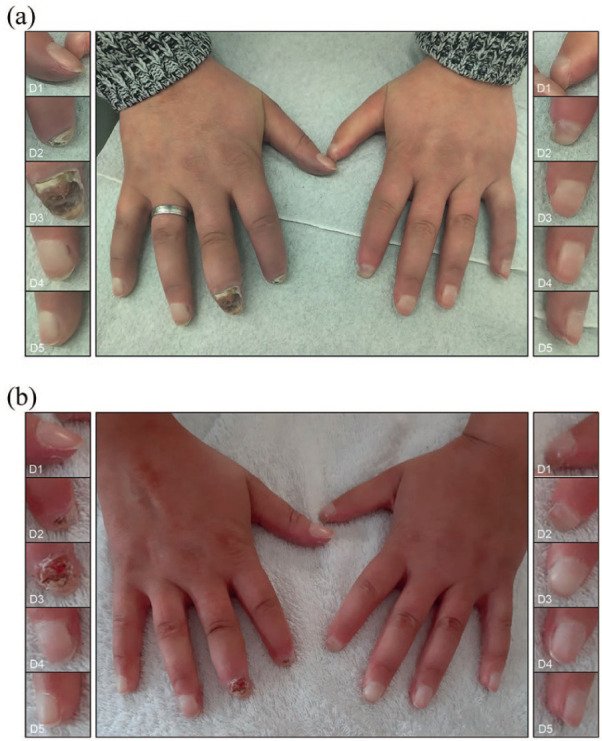
Clinical images of the patient’s digits: (a) there is marked tissue necrosis with digital ulcers and (b) 12 weeks following treatment initiation, there is improved DU healing.
In summary, this young patient was suffering from severe vasculopathy associated with SSc with impending digital auto-amputation due to tissue necrosis in the context of previous treatment that had been discontinued due to either inefficacy or side effects.
Her vital parameters were within the normal range except for borderline hypotension. Her laboratory values were all within the normal range except for slightly elevated liver function tests, which was attributed to bosentan, and elevation of creatine kinase of 400 U/L (normal range < 200 U/L) without overt myositis. Anti-nuclear antibodies were positive with a titer of 1:1000 showing homogeneous pattern and mitotic figures. Anti-Scl70 antibodies were quantified by enzyme-linked immunosorbent assay (ELISA) and were positive at a level of 131 U/mL (normal < 7 U/mL). NT-proBNP was not elevated, electrocardiographic signs of right heart disease were absent, and pulmonary function tests were unremarkable. Nailfold videocapillaroscopy (NVC) showed an “active pattern” according to the classification by Cutulo. 8
Differential diagnoses
While DU with tissue necrosis represent a common complication of SSc, other causes were considered: Macrovascular disease (such as thrombotic occlusion of distal arteries) was excluded by ultrasonography and functional vasogram. Comorbidities such as diabetes mellitus were excluded as contributing factors.
Treatment
Considering the refractory DU and severe attacks of RP, it was decided to add sildenafil to the treatment with bosentan, thus combining an ERA with a PDE5-i. Treatment was initiated during the winter months at an initial dose of 20 mg of sildenafil per day, which was well tolerated and increased to 20 mg twice daily after the first week. Because of borderline hypotension, we decided to stop treatment with the CCB as we assumed the blood pressure to potentially decline further with sildenafil.
Outcome and follow-up
The patient noted an improvement in RP attack severity and duration after 2 weeks on combination treatment with marked clinical improvement of DU observed (Figure 1(b)). Ongoing benefits were observed over the following 6 months, in which the patient reported sustained improvement of RP and DU (Figure 2(a)–(c)). There were no clinical or laboratory adverse events, especially no hypotensive episodes, and the patient continues therapy without complications. The full dose of 20 mg of sildenafil three times per day was not required because the patient already significantly improved subjectively and the objective measures for RP and DU healing had also improved with a dose of 20 mg twice daily.
Figure 2.

Effect of bosentan and sildenafil on Raynaud’s attack frequency, duration, and intensity. (a) The maximum number of attacks decreased from more than 25 per day to 3 after 4 weeks of treatment. (b) The maximum duration of attacks decreased from 30 min to a maximum of 2 min within the first weeks of treatment and was sustained. (c) The Raynaud’s Condition Score (RCS) ranging from 0 to 10 (10 being the most intense score) decreased from 10 to 3 after 4 weeks.
Discussion
We report the case of a young female patient with diffuse SSc who suffered from severe vasculopathy despite maximal medical management. She markedly improved following treatment with combination therapy of bosentan and sildenafil.
A review of the current literature found only four papers in which combination therapy has been used in RP and DU associated with SSc including three case reports9–11 and a single retrospective monocentric study, which reported the effect of bosentan and sildenafil on NVC and clinical improvement. 12 Table 1 summarizes these papers and the respective treatment regimens used in each case. The first description of successful treatment of digital ulcerations with sildenafil and bosentan was published in 2009 9 and reports the case of a 72-year-old female with diffuse SSc who suffered from refractory DU for 10 years. During combination therapy, complete healing of the wounds was observed within a few months. The second case of a 57-year-old woman, also suffering from diffuse SSc, experienced a complete occlusion of her ulcers on fingers and toes who also improved with combination therapy. A third case report described the benefit of combination therapy on macrovascular lesions in a 48-year-old woman with limited SSc and lower limb peripheral arterial occlusive disease who was initially treated with sildenafil monotherapy, resulting in DU healing. However, maximum walking distance increased only moderately. After the addition of bosentan, walking distance improved considerably and limb claudication symptoms were greatly improved. 11
Table 1.
Overview of published cases and studies of combination therapy with bosentan and sildenafil in systemic sclerosis.
| Reference | Year | N | Type | Dose used | Outcome(s) | Adverse events |
|---|---|---|---|---|---|---|
| Ambach et al. 9 | 2009 | 1 | Case report | BOS 62.5 mg/day, increased to 125 mg/day and SIL 25 mg/day, decreased to 12.5 mg/day | Complete healing of DU and prophylaxis of new lesions | Flush symptoms, headache, transient elevation of liver enzymes |
| Catarsi et al. 10 | 2013 | 1 | Case report | BOS 62.5 mg/day, increased to 125 mg/day and SIL 25 mg/day, increased to 30 mg/day Concurrent medication with low-dose corticosteroids, CCB, and antiplatelets |
Full recovery of skin ulcers on fingers and toes | None |
| Omarjee et al. 11 | 2017 | 1 | Case report | Week 1–44: SIL 20 mg/day Week 45–59: SIL 20 mg/day + BOS 62.5 mg/day Concurrent medication with CCB, antiplatelets, and statins |
Healing of DU with SIL monotherapy; improvement of PAD and maximal walking distance with combination therapy | None |
| Bellando-Randone et al. 12 | 2016 | 123 | Retrospective study | 1. BOS (29 patients) 2. SIL (63 patients) BOS + SIL (31 patients) |
Group 1: Controversial changes in RCS, SHAQ, and NVC pattern Group 2: Reduction in SHAQ, RCS, and “active” pattern in NVC Group 3: Shift from “active”/“late” to “early” pattern in NVC only in early SSc (ACR/EULAR points ⩽ 10); reduction in SHAQ and RCS regardless of ACR/EULAR points |
Not reported |
ACR/EULAR: American College of Rheumatology/European League against Rheumatism; BOS: bosentan; CCB: calcium-channel blocker; DU: digital ulcer; NVC: nailfold videocapillaroscopy; PAD: periphery arterial disease; RCS: Raynaud’s condition score; SHAQ: Scleroderma Health Assessment Questionnaire; SIL: sildenafil; SSc: systemic sclerosis.
In the most extensive published study, the effect of combined sildenafil and bosentan therapy on the Raynaud’s Condition Score (RCS) changes in NVC and Scleroderma Health Assessment Questionnaire (SHAQ) was retrospectively analyzed in 123 patients with SSc. 12 Patients were categorized into two groups according to American College of Rheumatology/European League against Rheumatism (ACR/EULAR) criteria. The first group had a modified Rodnan skin score (mRSS) >10, the second group (mRSS ⩽ 10) was characterized by the absence of skin thickening of the fingers of both hands extending proximal to the metacarpophalangeal joints and PAH. These two groups were divided into three subgroups receiving either bosentan, sildenafil, or both. Data after 3 and 6 months were compared to the baseline. The RCS and SHAQ improved significantly with both bosentan and combination therapy with sildenafil. A change in the pattern of NVC from “active” or “late” pattern to “early” pattern was only observed with combination therapy in the group with early disease onset (ACR/EULAR criteria of ten points or less). The authors therefore suggest a particular benefit and vascular protection with a combination strategy in the early phases of the disease. 12 Similar findings, but with different substances, have been reported with combination therapy in SSc patients with PAH. 13
Regarding the pathogenesis of SSc, the current disease model assumes that changes in the vascular matrix already occur in early disease stages. Continued inflammation may lead to a profibrotic milieu, resulting in perivascular tissue modeling and eventually, skin fibrosis. 1 An example of the pathophysiological correlate of these changes is increased endothelin-1 levels with consecutive activation of myofibroblasts in the affected organs such as skin or lungs. Endothelin also acts as a vasoactive mediator, causing potent vasoconstriction. 14 RP is a typical early symptom of SSc and affects 95% of patients. 2 Approximately half of the patients experience DU. A chronic recurrent course is not uncommon, which results in a considerable risk of bacterial infection in addition to significant disruption to daily routine. DU are associated with a severe disease course and organ involvement 5 and tend to occur earlier in patients with anti-Scl70 positivity. 15
In the presented case, we describe a significant improvement of DU and RP and, probably most importantly, a subjective increase in quality of life with combination therapy. While there is ample published evidence on the use of the two drugs for PAH, comparatively little is reported on their combined use for DU and RP in SSc. While certainly seasonal effects play a role in RP severity, in our patient, DU and tissue necrosis had been present for the past year. In addition, combination therapy was initiated during winter. Therefore, we feel that an improvement due to seasonal variation can be excluded.
The 2017 revised EULAR recommendations for the treatment of SSc recommend the use of sildenafil for DU. Bosentan is recommended in combination with CCB, iloprost, or PDE5-i, especially for refractory DU. Sildenafil is considered useful for the treatment of RP, while the use of bosentan is not recommended. 6
Bosentan is an endothelin A and B receptor antagonist that has been approved for the treatment of PAH in the United States and Europe. Bosentan does not lead to faster healing of ulcerations, but it can prevent the appearance of new DU. Therefore, it has been approved for this indication in Europe based on results from two randomized clinical trials.16,17 In comparison, Sildenafil exerts its effects via inhibition of the PDE5, which results in an increased cGMP concentration and subsequent vasodilation. 18 Small single-center studies showed a positive effect on DU and RP in SSc with an improvement of RP (decrease of attack frequency and duration). In addition, it has been shown to result in healing of DU.19–21 Based on these encouraging results, the SEDUCE trial was performed, but could not demonstrate a shorter time to healing of DU; nevertheless, the rate of DU was lower in treated patients versus untreated patients after eight and twelve weeks. 22 However, in Germany and the United States, the use of sildenafil is restricted to PAH and has not been approved for the treatment of DU or RP. Since both drugs are metabolized via the cytochrome P450 system 3A4 (CYP3A4), pharmacological inhibition of sildenafil by bosentan may occur. This has been confirmed in a pharmacological study in patients with PAH. 23 While we did not observe this effect in our patient, it has to be noted that doses used in this study differed from the doses we used in our patient.
In summary, a combination of sildenafil and bosentan represents a potentially useful treatment option from a pathophysiological point of view. Surprisingly, only small studies and case reports have provided evidence for the positive effect of combination therapy on DU and RP in SSc. Based on the published reports and our own case, combination therapy may be considered in refractory patients.
Acknowledgments
We are indebted to the patient who provided written informed consent for the publication of this report.
Footnotes
Declaration of conflicting interests: The author(s) declared no potential conflicts of interest with respect to the research, authorship, and/or publication of this article.
Funding: The author(s) received no financial support for the research, authorship, and/or publication of this article.
ORCID iD: Peter Korsten  https://orcid.org/0000-0001-6065-5680
References
- 1. Allanore Y, Simms R, Distler O, et al. Systemic sclerosis. Nat Rev Dis Primers 2015; 23(1): 15002. [DOI] [PubMed] [Google Scholar]
- 2. Meier FMP, Frommer KW, Dinser R, et al. Update on the profile of the EUSTAR cohort: an analysis of the EULAR Scleroderma Trials and Research group database. Ann Rheum Dis 2012; 71(8): 1355–1360. [DOI] [PubMed] [Google Scholar]
- 3. Brand M, Hollaender R, Rosenberg D, et al. An observational cohort study of patients with newly diagnosed digital ulcer disease secondary to systemic sclerosis registered in the EUSTAR database. Clin Exp Rheumatol 2015; 33(4 Suppl. 91): S47–S54. [PubMed] [Google Scholar]
- 4. Tyndall AJ, Bannert B, Vonk M, et al. Causes and risk factors for death in systemic sclerosis: a study from the EULAR Scleroderma Trials and Research (EUSTAR) database. Ann Rheum Dis 2010; 69(10): 1809–1815. [DOI] [PubMed] [Google Scholar]
- 5. Hughes M, Herrick AL. Digital ulcers in systemic sclerosis. Rheumatology 2017; 56(1): 14–25. [DOI] [PubMed] [Google Scholar]
- 6. Kowal-Bielecka O, Fransen J, Avouac J, et al. Update of EULAR recommendations for the treatment of systemic sclerosis. Ann Rheum Dis 2017; 76(8): 1327–1339. [DOI] [PubMed] [Google Scholar]
- 7. Coghlan JG, Galiè N, Barberà JA, et al. Initial combination therapy with ambrisentan and tadalafil in connective tissue disease-associated pulmonary arterial hypertension (CTD-PAH): subgroup analysis from the AMBITION trial. Ann Rheum Dis 2017; 76(7): 1219–1227. [DOI] [PMC free article] [PubMed] [Google Scholar]
- 8. Lambova SN, Müller—Ladner U. Nailfold capillaroscopy in systemic sclerosis—state of the art: the evolving knowledge about capillaroscopic abnormalities in systemic sclerosis. J Sclero Relat Disord. Epub ahead of print 15 April 2019. DOI: 10.1177/2397198319833486. [DOI] [PMC free article] [PubMed] [Google Scholar]
- 9. Ambach A, Seo W, Bonnekoh B, et al. Low-dose combination therapy of severe digital ulcers in diffuse progressive systemic sclerosis with the endothelin-1 receptor antagonist bosentan and the phosphodiesterase V inhibitor sildenafil. J Dtsch Dermatol Ges 2009; 7(10): 888–891. [DOI] [PubMed] [Google Scholar]
- 10. Catarsi E, Doveri M, Tavoni A. Bosentan and sildenafil: successful treatment in a sclerodermic patient with refractory ulcers. Reumatismo 2013; 65(2): 79–81. [DOI] [PubMed] [Google Scholar]
- 11. Omarjee L, Fontaine C, Mahe G, et al. Improvement of peripheral artery disease with Sildenafil and Bosentan combined therapy in a patient with limited cutaneous systemic sclerosis: a case report. Medicine 2017; 96(25): e6988. [DOI] [PMC free article] [PubMed] [Google Scholar]
- 12. Bellando-Randone S, Lepri G, Bruni C, et al. Combination therapy with Bosentan and Sildenafil improves Raynaud’s phenomenon and fosters the recovery of microvascular involvement in systemic sclerosis. Clin Rheumatol 2016; 35(1): 127–132. [DOI] [PubMed] [Google Scholar]
- 13. Galiè N, Barberà JA, Frost AE, et al. Initial use of ambrisentan plus tadalafil in pulmonary arterial hypertension. New Engl J Med 2015; 373(9): 834–844. [DOI] [PubMed] [Google Scholar]
- 14. Abraham D, Distler O. How does endothelial cell injury start? The role of endothelin in systemic sclerosis. Arthritis Res Ther 2007; 9(Suppl. 2): S2. [DOI] [PMC free article] [PubMed] [Google Scholar]
- 15. Denton CP, Krieg T, Guillevin L, et al. Demographic, clinical and antibody characteristics of patients with digital ulcers in systemic sclerosis: data from the DUO Registry. Ann Rheum Dis 2012; 71(5): 718–721. [DOI] [PMC free article] [PubMed] [Google Scholar]
- 16. Matucci-Cerinic M, Denton CP, Furst DE, et al. Bosentan treatment of digital ulcers related to systemic sclerosis: results from the RAPIDS-2 randomised, double-blind, placebo-controlled trial. Ann Rheum Dis 2011; 70(1): 32–38. [DOI] [PMC free article] [PubMed] [Google Scholar]
- 17. Korn JH, Mayes M, Matucci-Cerinic M, et al. Digital ulcers in systemic sclerosis: prevention by treatment with bosentan, an oral endothelin receptor antagonist. Arthritis Rheum 2004; 50(12): 3985–3993. [DOI] [PubMed] [Google Scholar]
- 18. Hemnes AR, Champion HC. Sildenafil, a PDE5 inhibitor, in the treatment of pulmonary hypertension. Expert Rev Cardiovasc Ther 2006; 4(3): 293–300. [DOI] [PubMed] [Google Scholar]
- 19. Brueckner CS, Becker MO, Kroencke T, et al. Effect of sildenafil on digital ulcers in systemic sclerosis: analysis from a single centre pilot study. Ann Rheum Dis 2010; 69(8): 1475–1478. [DOI] [PMC free article] [PubMed] [Google Scholar]
- 20. Fries R, Shariat K, von Wilmowsky H, et al. Sildenafil in the treatment of Raynaud’s phenomenon resistant to vasodilatory therapy. Circulation 2005; 112(19): 2980–2985. [DOI] [PubMed] [Google Scholar]
- 21. Gore J, Silver R. Oral sildenafil for the treatment of Raynaud’s phenomenon and digital ulcers secondary to systemic sclerosis. Ann Rheum Dis 2005; 64(9): 1387. [DOI] [PMC free article] [PubMed] [Google Scholar]
- 22. Hachulla E, Hatron P-Y, Carpentier P, et al. Efficacy of sildenafil on ischaemic digital ulcer healing in systemic sclerosis: the placebo-controlled SEDUCE study. Ann Rheum Dis 2016; 75(6): 1009–1015. [DOI] [PMC free article] [PubMed] [Google Scholar]
- 23. Paul GA, Gibbs JSR, Boobis AR, et al. Bosentan decreases the plasma concentration of sildenafil when coprescribed in pulmonary hypertension. Br J Clin Pharmacol 2005; 60(1): 107–112. [DOI] [PMC free article] [PubMed] [Google Scholar]