



Abstract
Background:
The aim of this study was to analyze the clinical features of patients attending the screening clinic of a dedicated COVID-19 hospital (DCH), including COVID-19 RT-PCR test positivity rate, symptom predictors for COVID-19 positivity, the proportion of recovery, and the mortality among COVID-19 positive cases.
Methods:
We conducted a cross-sectional study of the patients who reported in the screening clinic of a DCH. Data were retrieved from medical records. Step-wise binary logistic regression was applied to determine the symptom predictors for determining the likelihood of the suspects turning out to be COVID-19 positive.
Results:
A total of 573 patients reported to the screening clinic were enrolled, and their median age was 36 ± 14 years. Of the total patients, 237 (41%) were females and 112 (20%) patients were COVID-19 suspects. Fifty (45%) suspects tested COVID-19 positive. The majority of the positives had complaints of cough, fever, and sore throat. Running nose (OR = 7.951) and history of contact with a COVID-19-positive case (OR = 169.9) were found to be statistically significant symptom predictors for COVID-19 positivity. All patients recovered with nil case fatality.
Conclusion:
Running nose and history of contact with COVID-positive patients were significant predictors for COVID-19 positivity. In this pandemic state, patients who present with any of the upper respiratory infection (URI) symptoms such as cough, sore throat, running nose, headache, and loss of taste/smell should be tested for COVID-19 for early identification and isolation to break the chain of transmission. The public should be encouraged to undergo COVID-19 testing if they develop any of the URI symptoms.
Keywords: Case positivity rate, COVID-19, predictors, severe acute respiratory syndrome coronavirus 2, symptoms
Introduction
Coronavirus disease (COVID 19) is an infectious disease caused by a newly discovered severe acute respiratory syndrome coronavirus 2 (SARS-CoV-2). It was first reported in December 2019 in Wuhan, Hubei, China. The earliest case presented as pneumonia of unknown cause and was reported to the WHO country office in China on December 31, 2019.[1] The outbreak was declared as a public health emergency of international concern on January 30, 2020.[2] COVID 19 infection was declared a pandemic on March 11, 2020.[3] In India, the first case of COVID-19 was reported on January 30, 2019 in Kerala.[4] The infection was characterized by fever, cough, sore throat, breathlessness along with chest pain, diarrhea, vomiting, body aches, etc.[5] Mild COVID-19 infection can progress to severe forms such as acute respiratory distress syndrome (ARDS) and respiratory failure. Even asymptomatic people can be COVID-19 positive and that should not be ignored.[6]
As people are presenting with varied symptoms at presentation, understanding the pattern of presenting symptoms based on demographic characteristics such as age group, gender, education, and occupation becomes important for the primary care providers and family physicians in deciding the early management of the patients. It is also important to quarantine/isolate symptomatic and COVID-19-positive patients earlier to break the chain of transmission. Screening for symptoms and contact tracing are the two important strategies to interrupt the chain of transmission of COVID 19.[7] Initially, the Government of India made screening mandatory for all international travelers, which was later on extended to the travelers of high-burden states and districts. Also, contact tracing was done to find out the immediate contacts of COVID-19-positive patients.
By the end of February 2020, screening of patients was started with the history of international travel and for people suffering from flu-like symptoms in a medical teaching institute of Chandigarh, India. The medical teaching institute was declared as a dedicated COVID-19 hospital (DCH) on April 2, 2020 for the Union Territory of Chandigarh and as a referral center for patients with Severe Acute Respiratory Infections (SARI) from neighboring states of Punjab, Haryana, Himachal Pradesh, Uttarakhand, and Uttar Pradesh.[8]
The current study on predictors of COVID-19 positivity in a screening clinic of Chandigarh, India was planned with the following objectives:
To ascertain the demographic and clinical features of patients attending the screening clinic of a designated COVID-19 hospital
To determine the proportion of COVID-19 suspects among the attendees
To determine the COVID-19 positivity rate among the suspects identified from the screening clinic and the proportion of recovery and the mortality among COVID-19-positive cases
To evaluate the probability for each symptom as predictors in determining the suspects turning out to be COVID-19 positive.
Methods
A cross-sectional study was planned in the screening clinic of a dedicated COVID-19 hospital in Chandigarh from March 13, 2020 to June 30, 2020. The study was reviewed and approved by the Institutional Ethics Committee (IEC) in Chandigarh.
The institute set up two screening outpatient departments for screening suspected patients. One screening clinic was set outside the main entrance of the new outpatient department (OPD) block of the medical teaching institute. A separate pathway for entering the screening clinic was made with barricades. All patients underwent thermal monitoring by the security personnel before entering the OPD. Patients who had a temperature of more than 38°C and/or patients who had complaints of flu-like illness and/or patients with a history of international travel were directed to the screening clinic via a separate pathway. The screening clinic of the OPD block was functional during all working days from 8 AM to 2 PM. The screening clinic of the OPD block was manned by two junior residents and a consultant on call from the Department of Internal Medicine and two hospital attendants. All were given personal protective equipment (PPE), which included an N95 mask, surgical gloves, and a face shield, and maintained a distance of at least 2 m from the patient. The second screening clinic was set up in the emergency area of the medical institute and was functional 24 × 7. The emergency area screening clinic was also maintained by a junior resident in shifts (8-h shifts). The area was supervised by the faculty-in-charge of emergency.
We reviewed OPD medical records of the participants and information regarding date of assessment and demographic details such as age, gender, place of residence, and presenting symptoms such as fever, cough, running nose, sore throat, shortness of breath, diarrhea, vomiting, and temperature, and oxygen saturation; moreover, history of travel and history of confirmed case contact were noted. We categorized each participant as a COVID-19 suspect/not a COVID-19 suspect as per the Indian Council of Medical Research (ICMR) guidelines.[9]
All patients suspected to have COVID-19 were referred to the communicable disease (CD) ward at Nehru Block of the medical institute by dedicated ambulance for COVID-19 testing by reverse transcriptase-polymerase chain reaction (RT-PCR) method. The screened negative patients were given symptomatic treatment in the screening OPD, health education related to COVID-19 at the screening clinic, and sent back. The COVID-19 RT-PCR reports were collected from the medical records. The outcome of all patients in terms of recovery or death were collected from the hospital medical records.
Statistical analysis
Data were entered in Microsoft excel 2016, and data analysis was done using IBM SPSS software version 24. Mean and standard deviation were the descriptive statistical measures to express the continuous variables. Categorical variables were presented as frequency and percentage. Chi-square test was applied to test the statistical significance between categorical variables. The probability of each symptom as a predictor in determining the suspects turning out to be COVID-19 positive was evaluated by step-wise binary logistic regression with a P value of <0.05 considered as statistically significant. The purpose of using the backward stepwise binary logistic regression in the current study was to start with the full model that includes all the relevant symptom predictors and to gradually move toward a final reduced model after eliminating the least significant symptom variables in the model at each successive step. The Nagelkerke pseudo R2 value was also used to analyze the goodness of fit of the model.
Results
During the reference period, 573 patients attended the OPD screening clinic, including 336 (59%) males and 237 (41%) females. The mean age was 36 ± 14 years. The majority of the patients belonged to the 16–30-years age group (42%), followed by 31–45 years (35%). Around 92% of the patients were from urban areas. Most patients (72%) reported to the screening clinic on their own, while the remaining (28%) were either referred from various departments of the institute or from other hospitals. The reason for referral to screening clinic was flu-like symptoms (16.7%), patients from containment zones (38.5%), or preoperative reasons (44.9%). Most of the patients attending the screening clinic were general public (67.5%), followed by health care workers (32.5%).
Age, gender, reasons for referral, category of patients, contact with a COVID-19-positive case, and history of travel were found to be significantly associated with the COVID-19 suspects [Table 1]. Among the 573 patients who attended the screening clinic, 112 (20%) patients were found as COVID-19 suspects as per the ICMR guidelines [Figure 1].
Table 1.
Socio-demographic characteristics of COVID-19 suspects and non-COVID-19 suspects reported to the screening clinic of the dedicated COVID-19 hospital in Chandigarh, 2020 (n=573)
| Variables | Total (%) (n=573) | Suspect (%) (n=112) | Not a Suspect (%) (n=461) | P |
|---|---|---|---|---|
| Sex | ||||
| Male | 336 (59) | 54 (48.2) | 282 (61.2) | 0.013* |
| Female | 237 (41) | 58 (51.8) | 179 (38.8) | |
| AGE | ||||
| 1-15 | 13 (2.3) | 9 (8) | 4 (0.9) | <0.001* |
| 16-30 | 242 (42) | 47 (42) | 195 (42.3) | |
| 31-45 | 199 (35) | 32 (28.6) | 167 (36.2) | |
| 46-60 | 82 (14) | 15 (13.4) | 67 (14.5) | |
| >60 | 37 (7) | 9 (8) | 28 (6.1) | |
| Residence | ||||
| Urban | 528 (92) | 108 (96.4) | 420 (91.1) | 0.060 |
| Rural | 45 (8) | 4 (3.6) | 41 (8.9) | |
| Referral state | ||||
| Self-reported | 417 (72.8) | 87 (77.7) | 330 (71.6) | 0.232 |
| Referred by doctors in PGI/Pvt doctors | 156 (27.2) | 25 (22.3) | 131 (28.4) | |
| Reasons for referral for Screening | ||||
| ILI symptoms | 26 (16.7) | 6 (16.7) | 20 (16.7) | <0.001* |
| Containment Zone | 60 (38.5) | 29 (80.6) | 31 (25.8) | |
| Before undergoing interventional procedures | 70 (44.9) | 1 (2.8) | 69 (57.5) | |
| Category of patients | ||||
| Health care workers | 186 (32.5) | 26 (23.2) | 160 (34.7) | 0.020* |
| Others (General patients) | 387 (67.5) | 86 (76.8) | 301 (65.3) | |
| Contact with COVID -19 positive case | ||||
| Yes | 43 (7.5) | 41 (36.6) | 2 (0.4) | <0.001* |
| No | 530 (92.5) | 71 (63.4) | 459 (99.6) | |
| Travel | ||||
| Domestic Travel | 73 (12.7) | 1 (0.9) | 72 (15.6) | <0.001* |
| International Travel | 37 (6.5) | 6 (5.4) | 31 (6.7) | |
| No travel | 463 (80.8) | 105 (93.8) | 358 (77.7) |
*P<0.05 - Significant
Figure 1.
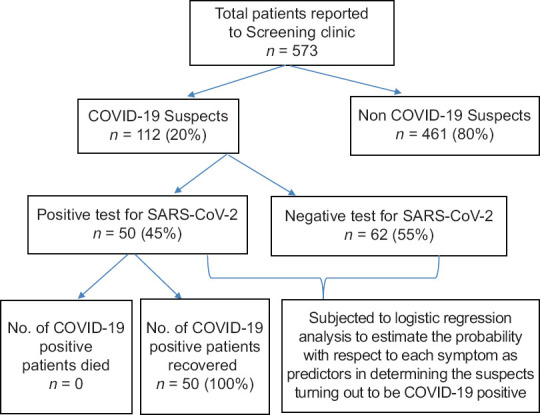
Flowchart demonstrating the proportion of COVID-19 suspects and COVID-19-positive cases among the patients who reported to the screening clinic in the dedicated COVID-19 hospital in Chandigarh, 2020
Among the suspects (112), 76.8% of the patients were from the general public and the remaining 23.2% of patients were health care workers. Around 36.6% of patients had a history of contact with a positive case. Around 90.3% of patients had no history of travel. The majority of the patients presented with complaints of cough (61.6%), fever (42.9%), sore throat (24.1%), running nose (8%), headache (3.6%), breathing difficulty (3.6%), diarrhea (1.8%), and vomiting (0.9%); 12 (10.7%) patients were asymptomatic.
Among the 112 patients suspected to have COVID-19, 50 (45%) patients were found to be positive for COVID-19. Among patients who tested positive for COVID-19, the majority of the patients (72%) had exposure with a confirmed positive case.
COVID-19-positive patients presented with complaints of cough (72%), fever (30%), sore throat (14%), running nose (10%), headache (6%), and breathing difficulty with SpO2 <95% (4%). Very few patients (8%) were asymptomatic. All the COVID-19-positive patients recovered. The case recovery rate was 100% with a nil case fatality rate.
A significant association was found with cough, history of fever, sore throat, temperature >38°C, and history of contact with a COVID-19 positive case among the two groups of COVID-19 suspects and COVID-19 positive patients [Table 2].
Table 2.
Symptom profile of COVID-19 suspects reported to the screening clinic of the dedicated COVID-19 hospital in Chandigarh, 2020 (n=112)
| Variables | Suspects (n=112) | Negative (%) (n=62) | Positive (%) (n=50) | P |
|---|---|---|---|---|
| Cough | ||||
| Yes | 69 (61.6) | 33 (53.2) | 36 (72) | 0.042* |
| No | 43 (38.4) | 29 (46.8) | 14 (28) | |
| Fever | ||||
| Yes | 48 (42.9) | 33 (53.2) | 15 (30) | 0.014* |
| No | 64 (57.1) | 29 (46.8) | 35 (70) | |
| Sore throat | ||||
| Yes | 27 (24.1) | 20 (32.3) | 7 (14) | 0.025* |
| No | 85 (75.9) | 42 (67.7) | 43 (86) | |
| Running Nose | ||||
| Yes | 9 (8) | 4 (6.5) | 5 (10) | 0.492 |
| No | 103 (92) | 58 (93.5) | 45 (90) | |
| Breathing Difficulty | ||||
| Yes | 4 (3.6) | 2 (3.2) | 2 (4) | 0.826 |
| No | 108 (96.4) | 60 (96.8) | 48 (96) | |
| Diarrhoea | ||||
| Yes | 2 (1.8) | 2 (3.2) | 0 (0) | 0.200 |
| No | 110 (98.2) | 60 (96.8) | 50 (100) | |
| Vomiting | ||||
| Yes | 1 (0.9) | 1 (1.6) | 0 (0) | 0.367 |
| No | 111 (99.1) | 61 (98.4) | 50 (100) | |
| Headache | ||||
| Yes | 4 (3.6) | 1 (1.6) | 3 (6) | 0.214 |
| No | 108 (96.4) | 61 (98.4) | 47 (94) | |
| SpO2 <95% | ||||
| Yes | 2 (1.8) | 0 (0) | 2 (4) | 0.112 |
| No | 110 (98.2) | 62 (100) | 48 (96) | |
| Temperature | ||||
| >38°C | 47 (42) | 32 (51.6) | 15 (30) | 0.021* |
| ≤38°C | 65 (58) | 30 (48.4) | 35 (70) | |
| Asymptomatic | ||||
| Yes | 12 (10.7) | 8 (12.9) | 4 (8) | 0.404 |
| No | 100 (89.3) | 54 (87.1) | 46 (92) | |
| Contact with COVID-19 positive case | ||||
| Yes | 41 (36.6) | 5 (8.1) | 36 (72) | <0.001* |
| No | 71 (63.4) | 57 (91.9) | 14 (28) |
*P<0.05 - Significant
The results of stepwise backward binary logistic regression predicted significant odds of the suspects turning out to be COVID-19-positive among the patients who presented with complaints of running nose (OR = 7.951) and history of contact with a COVID-19-positive case (OR = 169.9) at each of the four steps of the logistic regression model results, thereby confirming that patients with running nose and COVID-19 contact history are the most significant predictors resulting in an increased probability of a patient turning out to be COVID positive. The value of Nagelkerke pseudo R2 value ranged between 0.616 and 0.611 from step 1 to step 4, which further indicates that the logistic regression model explains approximately 60% of the results and has a reasonable predictive accuracy [Table 3].
Table 3.
Estimates of binary logistic regression where each screening variable serves as predictors in determining the suspects turning out to be COVID-19 positive
| Step No. | Variable | Coef. | Odds ratio | P | Goodness of Fit (Nagelkerke R2) |
|---|---|---|---|---|---|
| Step 1 | Cough | −1.172 | 0.310 | 0.125 | |
| Fever with temperature >38°C | 1.309 | 3.701 | 0.086 | 0.616 | |
| Sore throat | −0.321 | 0.726 | 0.669 | ||
| Running nose | 2.073 | 7.951 | 0.022* | ||
| Diarrhoea | −19.186 | 0 | 0.999 | ||
| Vomiting | −19.049 | 0 | 1.000 | ||
| Headache | 2.889 | 17.973 | 0.079 | ||
| Contact with COVID-19 positive case | 5.135 | 169.855 | <0.001* | ||
| Constant | −2.154 | 0.116 | 0.004 | ||
| Step 2 | Cough | −1.093 | 0.335 | 0.139 | |
| Fever with temperature>38° C | 1.256 | 3.512 | 0.092 | 0.615 | |
| Running nose | 2.061 | 7.851 | 0.025* | ||
| Diarrhoea | −19.114 | 0 | 0.999 | ||
| Vomittng | −18.951 | 0 | 1.000 | ||
| Headache | 2.770 | 15.959 | 0.079 | ||
| Contact with COVID-19 positive case | 5.157 | 173.642 | <0.001* | ||
| Constant | −2.252 | 0.105 | 0.002 | ||
| Step 3 | Cough | −1.079 | 0.340 | 0.144 | |
| Fever with temperature>38° C | 1.293 | 3.645 | 0.082 | 0.613 | |
| Running nose | 2.092 | 8.097 | 0.023* | ||
| Diarrhoea | −19.118 | 0 | 0.999 | ||
| Headache | 2.783 | 16.172 | 0.079 | ||
| Contact with COVID-19 positive case | 5.190 | 179.442 | <0.001* | ||
| Constant | −2.299 | 0.100 | 0.001 | ||
| Step 4a | Cough | −1.153 | 0.316 | 0.118 | |
| Fever with temperature>38C | 1.272 | 3.568 | 0.088 | 0.611 | |
| Running nose | 2.105 | 8.204 | 0.022* | ||
| Headache | 2.856 | 17.389 | 0.071 | ||
| Contact with COVID-19 positive case | 5.254 | 191.284 | <0.001* | ||
| Constant | −2.291 | 0.101 | 0.001 |
*P<0.05 - Significant
Discussion
The current study described the demographic and clinical characteristics of patients attending the COVID-19 screening clinic, the proportion of COVID-19 suspects, rate of COVID-19 positivity, and probability of each symptom as a predictor in determining the suspect turning out to be positive. These will be pertinent to the practice of primary care physicians who deal with patients at the first point of care.
Among all, 20% of the patients attending the screening clinic were COVID-19 suspects. Cough, fever, temperature >38°C, and sore throat were the significant symptoms complained by the participants. We also found that 45% of COVID 19 suspects tested positive for COVID-19. The binary logistic regression found that patients who reported symptoms of running nose and history of contact with COVID-positive patients had a higher probability of turning to be COVID-19 Positive.
The majority of the attendees were between in the age group of 16–30 years (42%) and 31–45 years (35%). Our finding of age groups is consistent with the findings reported by Sahu et al.[10] in Odisha, India and Maechler et al.,[11] in Germany. Due to state-wise curfews and later on nation-wide lockdowns, schools, colleges and workplaces were shut down and hence the people of those active age group of 16-45 years had shown more attendance in the hospital as compared to other groups. Moreover, routine OPDs were suspended during the COVID-19 pandemic due to which the elderly population, which usually suffers from chronic diseases, did not visit the hospital.
The majority of the participants (92%) belonged to urban areas. The geographic location of the dedicated COVID-19 hospital makes it more accessible to urban people. Most of the people during the initial period of the COVID-19 pandemic from rural areas were not able to reach a dedicated COVID-19 hospital due to interstate curfews/lockdowns.[12] Urban areas have a high-density population as compared to rural areas, which leads to overcrowding, making people more susceptible to contracting the COVID-19 infection.
Our study found that cough, fever, and sore throat were the significant symptoms associated with COVID-19-positive patients. The symptoms reported in our study were similar to those described by WHO for the COVID-19 infection.[5] This finding of our study is consistent with the findings of studies by Sahu et al.[10] and Gupta et al.[13] in India, Mizrahi et al.[14] in Israel, and Liang Li et al.[15] in China.
Our study found running nose as a significant predictor for COVID-19 infection, which is inconsistent with the findings of the studies conducted by La Torre et al.,[16] Roland et al.,[17] Haehner et al.,[18] and Trubner F et al.,[19] where anosmia and ageusia were the predictors of positivity. Our study results were inconsistent with the study done by Lan et al.,[20] where fever and myalgia were significant predictors of COVID-19 positivity. A review of the literature by El-Anwar et al.[21] found that running nose was reported very less among COVID-19-positive patients. The symptom per se is not grievous and may not urge the patient to report to a health facility; this leads to less testing and less reporting of COVID-19. This in turn can lead to the iceberg phenomenon for the disease.
Our study also found that patients reported with a history of contact with the COVID-19-positive patients had more predicted probabilities of testing positive for COVID-19, which is consistent with the study conducted by Zoabi et al.[22] As many asymptomatic cases were found to be COVID-19 positive and in the absence of symptoms, it cannot be determined whether their contacts were COVID-19 carriers. 6 Asymptomatic carriers are the people of great concern as they can act as super spreaders and transmit the infection to a large number of people.
Among the patients, 72% of patients reported on their own to the screening OPD, which shows increased awareness about the symptoms of COVID-19 and increased attitude of approaching health care. In our study, 45% of patients were positive for COVID-19 among the suspects, which was found to be inconsistent (higher) with other studies.[11,23,24] The higher proportion of COVID-19 suspects who tested positive for COVID-19 provide confidence in the ICMR guidelines[9] applied for identifying the epidemiological and clinical features that distinguish COVID-19-positive from COVID-19-negative patients.
The case recovery rate was 100% with no fatality. This finding of our study is not consistent with the findings of studies done by Mohan A et al.[25] and De Souza et al.[26] Zero fatality in our study may be because we collected data from only the OPD screening center and not from the emergency screening clinic; this might have added reporting bias. Further, the deaths that happened outside the hospital were not recorded.
One of the limitations of the study is that follow-up was not done for the patients who attended the screening clinic and were labeled as non-suspects for COVID-19. Among the two screening clinics functioning in the dedicated COVID-19 hospital, only the data pertaining to the screening clinic of the OPD block were included and not from the emergency screening clinic. As it is a record-based study, only the information available on records was extracted and no further information was available.
Conclusion
Among the patients who presented to the screening clinic and tested positive, the majority of them had complaints of cough, fever with a temperature of >38°C, and sore throat. Patients who reported with complaints of running nose and a history of contact with COVID-positive patients had significantly more predicted probabilities for turning out to be COVID-19 positive.
Recommendation
This study shows that for controlling the pandemic, contact tracing of confirmed cases and isolation of contacts followed by testing is crucial. Usage of protective measures and safe distancing is essential as there were a high number of asymptomatic carriers. The public should be informed and motivated to report to the health facility for COVID-19 testing irrespective of the severity of URI symptoms such as cough, fever, sore throat, running nose, headache, and loss of taste/smell. All patients with any of the complaints of URI symptoms must be tested for COVID-19 for early identification and isolation to break the chain of transmission.
Financial support and sponsorship
Nil.
Conflicts of interest
There are no conflicts of interest.
References
- 1.Shereen MA, Khan S, Kazmi A, Bashir N, Siddique R. COVID-19 infection:Origin, transmission, and characteristics of human coronaviruses. J Adv Res. 2020;24:91–8. doi: 10.1016/j.jare.2020.03.005. [DOI] [PMC free article] [PubMed] [Google Scholar]
- 2.World Health Organization (WHO) Timeline of WHO's response to COVID-19. 2020. [Last accessed on 2021 Jul 15]. Available from: https://www.who.int/news/item/29-06-2020-covidtimeline .
- 3.WHO Director-General. Media briefing on COVID-19. World Health Organization; [Last accessed on 2021 Jun 05]. Available from: https://www.who.int/director-general/speeches/detail/who-director-general-s-opening-remarks-at-the-media-briefing-on-covid-19---11-march-2020 . [Google Scholar]
- 4.GardaWorld. India:First confirmed case of 2019-nCoV announced January 30. [Last accessed on 2020 Aug 28]. Available from: https://www.garda.com/crisis24/news-alerts/309806/india-first-confirmed-case-of-2019-ncov-announced-january-30 .
- 5.World Health Organization (WHO). Coronavirus disease (COVID-19). 2020. [Last accessed on 2020 Aug 28]. Available from: https://www.who.int/health-topics/coronavirus#tab=tab_1 .
- 6.Lee S, Kim T, Lee E, Lee C, Kim H, Rhee H, et al. Clinical course and molecular viral shedding among asymptomatic and symptomatic patients with SARS-CoV-2 infection in a community treatment center in the Republic of Korea. JAMA Intern Med. 2020;180:1447–52. doi: 10.1001/jamainternmed.2020.3862. [DOI] [PMC free article] [PubMed] [Google Scholar]
- 7.World Health Organization (WHO) Contact tracing in the context of COVID-19. 2021. [Last accessed on 2020 Aug 28]. p. 11. Available from: https://apps.who.int/iris/handle/10665/339128 .
- 8.Chandigarh Administration. Administrator reviews arrangement in the city. Department of public relations, Chandigarh. [Last accessed on 2021 Apr 02]. Available from: http://chandigarh.gov.in/pdf/dpr20-press-reviewm3.pdf .
- 9.Indian Council of Medical Research. [Last accessed on 2020 Aug 28];Strategy for COVID-19 testing in India. 2020 1 Available from: https://www.icmr.gov.in/pdf/covid/strategy/Testing_Strategy_v5_18052020.pdf . [Google Scholar]
- 10.Sahu DP, Pradhan SK, Sahoo DP, Patra S, Singh AK, Patro BK. Fear and anxiety among COVID-19 screening clinic beneficiaries of a tertiary care hospital of Eastern India. Asian J Psychiatr. 2020;57:102543. doi: 10.1016/j.ajp.2020.102543. [DOI] [PMC free article] [PubMed] [Google Scholar]
- 11.Maechler F, Gertler M, Hermes J, van Loon W, Schwab F, Piening B, et al. Epidemiological and clinical characteristics of SARS-CoV-2 infections at a testing site in Berlin, Germany, March and April 2020—A cross-sectional study. Clin Microbiol Infect. 2020;26:1685e7. doi: 10.1016/j.cmi.2020.08.017. [DOI] [PMC free article] [PubMed] [Google Scholar]
- 12.The New York Times. Coronavirus in India:Modi orders total lockdown of 21 days. [Last accessed on 2020 Aug 28];2020 1 Available from: https://www.nytimes.com/2020/03/24/world/asia/india-coronavirus-lockdown.html . [Google Scholar]
- 13.Gupta N, Agrawal S, Ish P, Mishra S, Gaind R, Usha G, et al. Clinical and epidemiologic profile of the initial COVID-19 patients at a tertiary care centre in India. Monaldi Arch Chest Dis. 2020;90:193–6. doi: 10.4081/monaldi.2020.1294. [DOI] [PubMed] [Google Scholar]
- 14.Mizrahi B, Shilo S, Rossman H, Kalkstein H, Marcus K, Barer Y, et al. Longitudinal symptom dynamics of COVID-19 infection. Nat Commun. 2020;11:1–10. doi: 10.1038/s41467-020-20053-y. [DOI] [PMC free article] [PubMed] [Google Scholar]
- 15.Li L, Sun W, Han M, Ying Y, Wang Q. A study on the predictors of disease severity of COVID-19. Med Sci Monit. 2020;26:e927167–1. doi: 10.12659/MSM.927167. [DOI] [PMC free article] [PubMed] [Google Scholar]
- 16.La Torre G, Massetti AP, Antonelli G, Fimiani C, Fantini M, Marte M, et al. Anosmia and ageusia as predictive signs of covid-19 in healthcare workers in Italy:A prospective case-control study. J Clin Med. 2020;9:2870. doi: 10.3390/jcm9092870. [DOI] [PMC free article] [PubMed] [Google Scholar]
- 17.Roland LT, Gurrola JG, Loftus PA, Cheung SW, Chang JL. Smell and taste symptom-based predictive model for COVID-19 diagnosis. Int Forum Allergy Rhinol. 2020;10:832–8. doi: 10.1002/alr.22602. [DOI] [PMC free article] [PubMed] [Google Scholar]
- 18.Haehner A, Draf J, Dräger S, With K, Hummel T. Predictive value of sudden olfactory loss in the diagnosis of COVID-19. Orl. 2020;82:175–80. doi: 10.1159/000509143. [DOI] [PMC free article] [PubMed] [Google Scholar]
- 19.Trubner F, Steigert L, Echterdiek F, Jung N, Hellerau KS, Zoller WG, et al. Predictors of COVID-19 in an outpatient fever clinic. PLoS One. 2021;16:1–12. doi: 10.1371/journal.pone.0254990. [DOI] [PMC free article] [PubMed] [Google Scholar]
- 20.Lan FY, Filler R, Mathew S, Buley J, Iliaki E, Bruno-Murtha LA, et al. COVID-19 symptoms predictive of healthcare workers'SARS-CoV-2 PCR results. PLoS One. 2020;15:e0235460. doi: 10.1371/journal.pone.0235460. [DOI] [PMC free article] [PubMed] [Google Scholar]
- 21.El-Anwar MW, Elzayat S, Ahmed Y. ENT manifestation in COVID-19 patients. Auris Nasus Larynx. 2020;47:559–64. doi: 10.1016/j.anl.2020.06.003. [DOI] [PMC free article] [PubMed] [Google Scholar]
- 22.Zoabi Y, Deri-Rozov S, Shomron N. Machine learning-based prediction of COVID-19 diagnosis based on symptoms. NPJ Digit Med. 2021;4:3. doi: 10.1038/s41746-020-00372-6. [DOI] [PMC free article] [PubMed] [Google Scholar]
- 23.O'Reilly GM, Mitchell RD, Rajiv P, Wu J, Brennecke H, Brichko L, et al. Epidemiology and clinical features of emergency department patients with suspected COVID-19:Initial results from the COVID-19 Emergency Department Quality Improvement Project (COVED-1) Emerg Med Australas. 2020;32:638–45. doi: 10.1111/1742-6723.13540. [DOI] [PubMed] [Google Scholar]
- 24.Halalau A, Ditkoff J, Hamilton J, Sharrak A, Vanood A, Abbas A, et al. Emergency center curbside screening during the Covid-19 pandemic:Retrospective cohort study. JMIR Public Heal Surveill. 2020;6:e20040. doi: 10.2196/20040. [DOI] [PMC free article] [PubMed] [Google Scholar]
- 25.Mohan A, Tiwari P, Bhatnagar S, Patel A, Maurya A, Dar L, et al. Clinico-demographic profile &hospital outcomes of COVID-19 patients admitted at a tertiary care centre in North India. Indian J Med Res. 2020;152:61–9. doi: 10.4103/ijmr.IJMR_1788_20. [DOI] [PMC free article] [PubMed] [Google Scholar]
- 26.De Souza R, Mhatre S, Qayyumi B, Chitkara G, Madke T, Joshi M, et al. Clinical course and outcome of patients with COVID-19 in Mumbai City:An observational study. BMJ Open. 2021;11:e042943. doi: 10.1136/bmjopen-2020-042943. [DOI] [PMC free article] [PubMed] [Google Scholar]