


Abstract
This study assesses trends in the percentage of adolescents with an unsuccessful cigarette quit attempt and compares quit attempts of combustible cigarettes and e-cigarettes in 2020.
Nicotine use usually starts and is established during adolescence.1 The prevalence of lifetime adolescent cigarette use has declined from 57% in 19972 (the year before the Master Settlement Agreement of 19983 that prohibited marketing of cigarettes to children) to 16% in 2020. However, e-cigarette use among adolescents may have countered some of this decline in nicotine use and its potential effects on health.
An unsuccessful attempt to stop using nicotine is a central measure of nicotine addiction because it indicates loss of autonomy, a defining characteristic of addiction to any substance,4 and is also a risk factor for long-term chronic substance use trajectories, distress, and impairment.5 e-Cigarette and combustible cigarette users may be similarly likely to experience an unsuccessful quit attempt because both products deliver similar levels of nicotine with similar addiction potential.6
This study assessed trends in the percentage of adolescents with an unsuccessful cigarette quit attempt between 1997 and 2020 and compares quit attempts for cigarettes and e-cigarettes in 2020.
Methods
Respondents were from the 1997-2020 Monitoring the Future study, which each year surveyed nationally representative samples of 8th-, 10th-, and 12th-grade students in person at their schools during school hours. The University of Michigan institutional review board approved the study. Informed consent (active or passive per school policy) was obtained from parents and students. The student response rate averaged 86% over all years.
Analyses centered on the questions “Have you ever tried to stop smoking cigarettes and found that you could not?” among ever smokers (asked between 1997-2020) and “Have you ever tried to stop vaping nicotine and found that you could not?” among ever e-cigarette users (asked in 2020 only). Response categories were “yes” or “no.” Based on responses to these 2 survey questions, a variable was coded identifying a failed quit attempt for either combustible cigarettes or e-cigarettes.
The analyses combined respondent grades and used probability weights and adjusted SEs to take into account clustering within geographic strata and within schools using Stata version 17.0 (StataCorp). The analyses present prevalence levels and 95% CIs using linearized SEs and adjusted Wald tests to test for differences in these levels across years. A 2-sided P < .05 was considered statistically significant.
Results
The analysis pool consisted of 815 690 respondents, including 9065 in 2020. Lifetime cigarette use was reported by 249 663 respondents and lifetime e-cigarette use by 3050 (in 2020 only). Among lifetime users, at least 1 unsuccessful quit attempt was reported by 35 191 respondents for cigarettes and by 365 respondents for e-cigarettes (in 2020 only).
The percentage of all adolescents who reported an unsuccessful quit attempt for cigarettes declined from 9.82% (95% CI, 9.15%-10.53%) in 1997 to 2.23% (95% CI, 1.53%-3.22%) in 2020 (P < .001) (Table and Figure). For e-cigarettes, the percentage of all adolescents who reported an unsuccessful quit attempt was 4.12% (95% CI, 3.25%-5.20%) in 2020. For either type of nicotine use (combustible cigarettes or e-cigarettes), the percentage of all adolescents who reported an unsuccessful quit attempt was 5.74% (95% CI, 4.66%-7.05%) in 2020. Compared with this estimate of 5.74% in 2020, the percentage unsuccessfully attempting to quit cigarettes was significantly higher during each year from 1997 to 2001, was not significantly different from 2002 and 2006, and was significantly lower during each year from 2007 to 2020.
Table. Prevalence of Lifetime Combustible Cigarette and e-Cigarette Use and Proportion of Users Reporting an Unsuccessful Quit Attempt, 1997-2020 (N = 815 690)a.
| Prevalence of lifetime use (95% CI) | ≥1 Unsuccessful quit attempt, % (95% CI) | ||
|---|---|---|---|
| Among ever users | Among all adolescentsb | ||
| Smoked combustible cigarettes | |||
| 1997 | 56.15 (54.73-57.56) | 17.48 (16.51-18.50) | 9.82 (9.15-10.53) |
| 1998 | 54.13 (52.54-55.72) | 17.10 (16.17-18.08) | 9.26 (8.61-9.95) |
| 1999 | 52.64 (51.02-54.26) | 17.35 (16.43-18.31) | 9.13 (8.51-9.80) |
| 2000 | 49.49 (47.77-51.21) | 17.24 (16.32-18.21) | 8.53 (7.94-9.17) |
| 2001 | 46.95 (45.22-48.69) | 15.91 (14.98-16.88) | 7.47 (6.90-8.07) |
| 2002 | 42.55 (40.93-44.19) | 15.54 (14.66-16.46) | 6.61 (6.11-7.15) |
| 2003 | 39.39 (37.71-41.09) | 14.60 (13.63-15.63) | 5.75 (5.26-6.29) |
| 2004 | 38.08 (36.42-39.78) | 15.11 (14.09-16.19) | 5.75 (5.25-6.30) |
| 2005 | 35.88 (34.34-37.44) | 14.18 (13.23-15.20) | 5.09 (4.65-5.57) |
| 2006 | 33.66 (32.17-35.19) | 14.45 (13.56-15.39) | 4.86 (4.48-5.27) |
| 2007 | 32.11 (30.61-33.64) | 12.34 (11.48-13.25) | 3.96 (3.64-4.31) |
| 2008 | 30.20 (28.69-31.75) | 12.75 (11.78-13.79) | 3.85 (3.48-4.26) |
| 2009 | 29.98 (28.51-31.49) | 12.51 (11.49-13.60) | 3.75 (3.38-4.16) |
| 2010 | 30.13 (28.61-31.70) | 13.36 (12.42-14.37) | 4.03 (3.66-4.43) |
| 2011 | 28.11 (26.69-29.57) | 12.62 (11.57-13.75) | 3.55 (3.18-3.95) |
| 2012 | 26.23 (24.70-27.82) | 12.82 (11.80-13.90) | 3.36 (3.01-3.76) |
| 2013 | 24.22 (22.71-25.80) | 12.33 (11.26-13.47) | 2.99 (2.65-3.36) |
| 2014 | 21.56 (20.25-22.92) | 11.02 (10.00-12.12) | 2.37 (2.11-2.67) |
| 2015 | 19.82 (18.60-21.11) | 10.29 (9.30-11.37) | 2.04 (1.82-2.29) |
| 2016 | 16.54 (15.42-17.72) | 9.19 (8.15-10.35) | 1.52 (1.33-1.74) |
| 2017 | 15.72 (14.63-16.88) | 8.89 (7.80-10.11) | 1.40 (1.21-1.61) |
| 2018 | 15.42 (14.23-16.68) | 10.05 (8.84-11.40) | 1.55 (1.33-1.81) |
| 2019 | 10.19 (9.14-11.36) | 12.49 (11.02-14.12) | 1.27 (1.07-1.51) |
| 2020 | 15.35 (13.28-17.69) | 14.50 (10.82-19.17) | 2.23 (1.53-3.22) |
| Lifetime use of e-cigarettes in 2020 | 35.41 (31.78-39.22) | 11.62 (9.54-14.09) | 4.12 (3.25-5.20) |
| Lifetime use of combustible or e-cigarettes in 2020 | 37.95 (34.28-41.75) | 15.13 (12.78-17.82) | 5.74 (4.66-7.05) |
Some adolescents used both combustible cigarettes and e-cigarettes by the time of the survey and may also have had unsuccessful quit attempts with both. Consequently, the overall prevalence and the prevalence of unsuccessful quit attempts is less than the addition of their independent prevalence levels.
Column estimate is equal to the multiple of the preceding 2 columns divided by 100; rounding accounts for any differences between this calculation and the column estimate.
Figure. Prevalence of Lifetime Cigarette and e-Cigarette Use and Proportion Reporting an Unsuccessful Quit Attempt, 1997-2020.
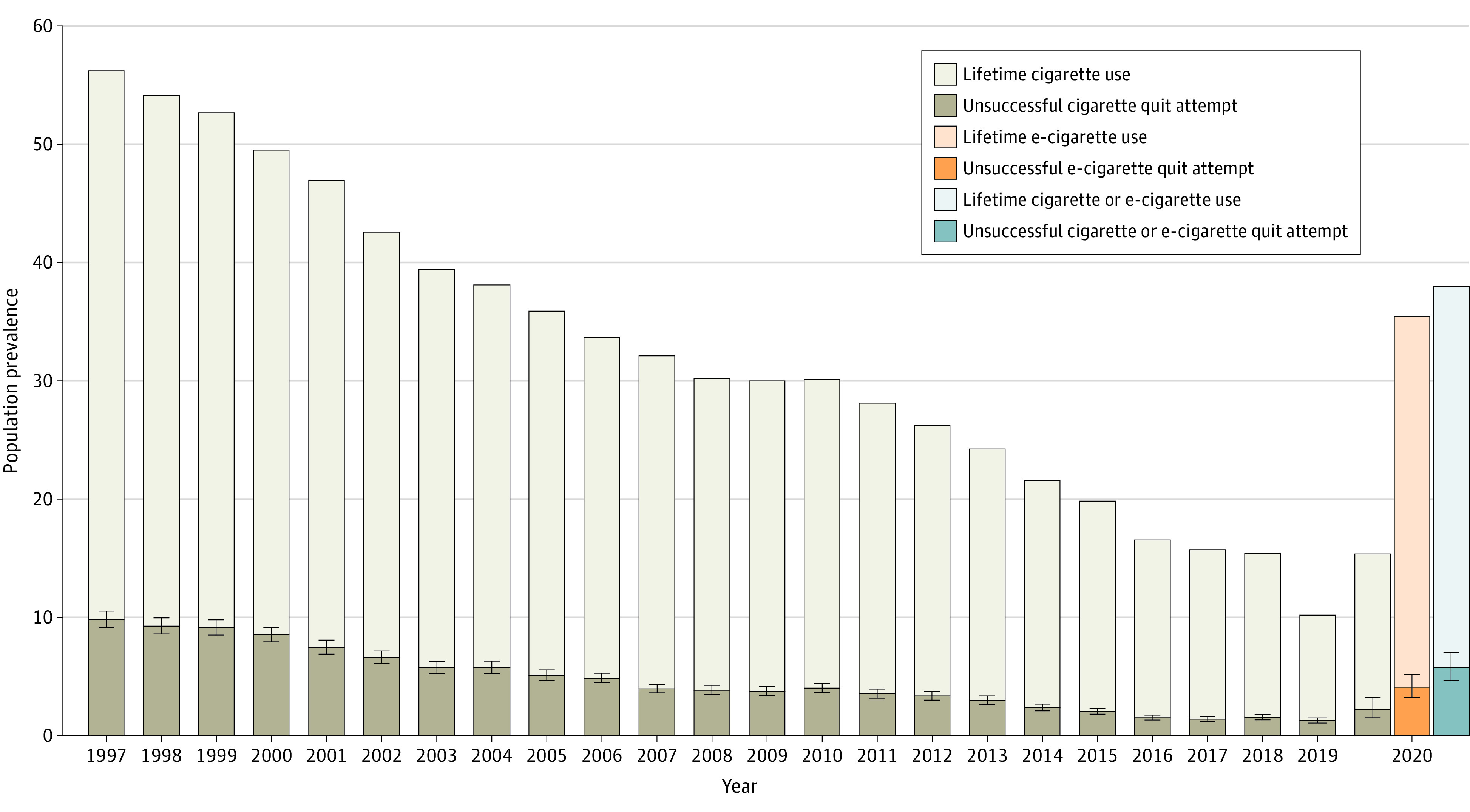
The detailed estimates used for this Figure appear in the Table.
Discussion
Among adolescents, reported prevalence of an unsuccessful cigarette quit attempt declined between 1997 and 2020. In 2020, the prevalence of unsuccessful quit attempts among adolescents who had used either e-cigarettes or cigarettes was higher than the prevalence of unsuccessful cigarette quit attempts in each of the previous 13 years.
Limitations of this study include absence of high school dropouts, a reliance on self-reported data, only 1 year of information on reported e-cigarette quit attempts, and no analysis of quit attempts among users of low-prevalence tobacco products such as cigars and hookahs.
The contribution of e-cigarettes to unsuccessful nicotine quit attempts among adolescents is substantial and warrants consideration as the US formulates policies to regulate e-cigarettes.
Section Editors: Jody W. Zylke, MD, Deputy Editor; Kristin Walter, MD, Associate Editor.
References
- 1.US Department of Health and Human Services . The Health Consequences of Smoking—50 Years of Progress: A Report of the Surgeon General. Office of the Surgeon General; 2014. [Google Scholar]
- 2.Miech RA, Johnston LD, O’Malley PM, Bachman JG, Schulenberg JE, Patrick ME. Monitoring the Future: national survey results on drug use, 1975-2020: volume I: secondary school students. Published June 2021. Accessed January 17, 2022. http://monitoringthefuture.org/pubs/monographs/mtf-vol1_2020.pdf
- 3.Jones WJ, Silvestri GA. The Master Settlement Agreement and its impact on tobacco use 10 years later: lessons for physicians about health policy making. Chest. 2010;137(3):692-700. doi: 10.1378/chest.09-0982 [DOI] [PMC free article] [PubMed] [Google Scholar]
- 4.Rounsaville BJ, Spitzer RL, Williams JB. Proposed changes in DSM-III substance use disorders: description and rationale. Am J Psychiatry. 1986;143(4):463-468. doi: 10.1176/ajp.143.4.463 [DOI] [PubMed] [Google Scholar]
- 5.Lüscher C, Robbins TW, Everitt BJ. The transition to compulsion in addiction. Nat Rev Neurosci. 2020;21(5):247-263. doi: 10.1038/s41583-020-0289-z [DOI] [PMC free article] [PubMed] [Google Scholar]
- 6.Kechter A, Cho J, Miech RA, Barrington-Trimis JL, Leventhal AM. Nicotine dependence symptoms in US youth who use JUUL e-cigarettes. Drug Alcohol Depend. 2021;227:108941. doi: 10.1016/j.drugalcdep.2021.108941 [DOI] [PMC free article] [PubMed] [Google Scholar]
