



Abstract
Background:
Despite the known negative consequences of exercise addiction and preliminary evidence suggesting that it may co-occur with other health risk behaviors, no studies to date have examined exercise addiction among college students in conjunction with disordered eating behaviors and alcohol use. The aim of this study was to describe which college students are most at-risk for co-occurring health risk behaviors to enhance the efficiency of health risk prevention efforts.
Method:
Guided by multidimensional theories of impulsivity and substance use models of comorbidity, this study used latent profile analysis to examine whether separate, conceptually meaningful profiles of risk for exercise addiction, disordered eating behaviors, and alcohol use would emerge among 503 college students from a large public university
Results:
The best-fitting model supported three profiles. MANOVA results revealed significant profile differences based on exercise addiction, binge eating, purging, laxative/pill/diuretic use, exercising longer than 60 minutes, negative urgency, and problematic alcohol use. Profile 3 students (n = 29), labeled the Affect Driven Health Risk-Takers, demonstrated the highest levels of impulsivity (i.e., negative urgency, lack of premeditation, lack of perseverance, and sensation seeking) and the most risk behaviors compared to the other two profiles. Profile membership was associated with distinct levels of negative urgency, exercise addiction, disordered eating behaviors, and problematic alcohol use. A small proportion of undergraduates demonstrated co-occurring exercise addiction, disordered eating behaviors, and problematic alcohol use. Profile membership also predicted the health outcomes of clinically significant exercise addiction and hazardous alcohol use.
Conclusions:
Findings illuminated how patterns of risk behavior engagement were associated with clinically significant exercise addiction and hazardous alcohol use and will inform prevention efforts and clinical interventions with at-risk college students.
Keywords: Exercise addiction, alcohol use, disordered eating behaviors, college students, impulsivity
Introduction
Exercise and physical activity are consistently linked with positive health outcomes and well-being (Penedo & Dahn, 2005). However, exercising excessively can lead to serious negative consequences (Berczik et al., 2012). Although not a diagnosable disorder, excessive exercise has been referred to in the literature as exercise dependence, obligatory exercising, exercise abuse, compulsive exercise, and exercise addiction (Berczik et al., 2012; Szabo et al., 2015). Griffiths (2002) defined exercise addiction using the six components of behavioral addictions: salience (i.e., exercise as the most important activity in the person’s life); mood modification (i.e., “high,” “escape,” “numbing” from exercise); tolerance (i.e., the person needs an increasing amount of the activity); withdrawal (i.e., unpleasant symptoms like moodiness, irritability, or shakes when the activity is stopped); interpersonal and intrapersonal conflicts with others as a result of the exercise behaviors; and relapse. Griffiths (2005) found that approximately 3% of college students are affected by exercise addiction, as defined by these components. While the proportion of affected students may be small, the impact can be quite large.
Exercise addiction can lead to significant negative consequences among college students. Some individuals with exercise addiction continue to exercise at a high intensity despite pain and injury (Berczik et al., 2012). Further, exercise addiction is related to poor mental health outcomes (e.g., anxiety, depression; Li et al., 2015). As individuals place more importance on exercise than their interpersonal relationships, social impairment is also a common negative consequence (Lichtenstein et al., 2017).
Two disorders that occur in the same person, either simultaneously or sequentially, constitute a comorbidity (NIDA, 2020). Co-occurring health risk behaviors can confer cumulative risks to well-being (Hunt & Forbush, 2016; Piran & Robinson, 2006), the consequences of which are significant, destructive, and costly (Rasberry et al., 2017). Given that exercise dependence or addiction may commonly co-occur with other health risk behaviors (e.g., disordered eating and alcohol use) at particularly high rates (Zmijewski & Howard, 2003), a greater understanding of exercise addiction in relation to other risk behaviors within the college population is warranted (Martin et al., 2008).
Excessive exercise can be a common compensatory behavior for binge eating episodes (Zmijewski & Howard, 2003). Individuals with eating disorders are 3.5 times as likely to demonstrate exercise addiction than individuals without eating disorders (Trott et al., 2021). As such, some cases of exercise addiction appear to be a high-severity manifestation of a common eating disorder symptom.
Further, emerging research links excessive exercise and disordered eating behaviors with alcohol (Barry & Piazza-Gardner, 2012), hypothesizing that highly active college students are more likely to binge drink and control their weight through disordered eating behaviors than their peers. Preliminary findings demonstrated associations between alcohol use, exercise, and dietary restriction. This group of “weight-conscious drinkers” engage in compensatory behaviors (e.g., caloric restriction, purging, laxative use, and/or excessive exercise) to offset alcohol-related calories (Barry & Piazza-Gardner, 2012). In a nationally representative sample of college students, exercise and unhealthy weight management strategies (e.g., use of laxatives and diet pills to lose weight) significantly predicted binge drinking (Barry et al., 2013).
Scholars have put forth models of comorbidity that posit that a common basis is shared between co-occurring disorders (e.g., Di Nicola et al., 2015). The shared vulnerability model of comorbidity theorizes that comorbidity occurs through shared individual and environmental risks that lead to simultaneous substance misuse and psychological distress (Haller & Chassin, 2014). One such individual risk factor is trait impulsivity (Verdejo-Garcia & Albein-Urios, 2021).
Impulsivity may be best understood as a multidimensional construct comprised of multiple facets. Whiteside and Lynam (2001) advanced a multidimensional theory of impulsivity comprised of four facets of impulsivity: negative urgency, or the tendency to act rashly in response to distress; lack of premeditation, or the tendency to act without thinking; lack of perseverance, or the inability to remain focused on a task; and sensation seeking, or the tendency to seek out novel and thrilling experiences (Cyders & Smith, 2008). Impulsivity has been found to play a prominent role in the understanding and diagnosis of various forms of psychopathology (Whiteside & Lynam, 2001) and may underlie an array of health risk behaviors, including exercise addiction (Kotbagi et al., 2017), disordered eating behaviors (Berg et al., 2015), and alcohol use (Cyders et al., 2009).
Impulsivity has been found to moderate the positive association between physical activity and alcohol consumption among college students (Leasure & Neighbors, 2014). In the few available studies on exercise addiction, negative urgency and sensation seeking were associated with increased exercise addiction (Kotbagi et al., 2017). In a study examining both exercise and alcohol use, the link between exercise motivated by weight loss and alcohol use was stronger for men with higher negative urgency (Reilly et al., 2016). Lack of premeditation and perseverance has not been significantly linked with exercise addiction in past research (Kotbagi et al., 2017).
In terms of disordered eating behaviors, negative urgency (Fischer et al., 2013) and sensation seeking (Fischer et al., 2008) have been linked with binge eating and purging, whereas lack of perseverance has been associated with binge eating but not purging (Peterson & Fischer, 2012). Lack of premeditation and sensation seeking have been found to be unrelated to binge eating and purging (Davis et al., 2020; Peterson & Fischer, 2012). No studies to date have specifically examined laxative/pill/diuretic use or compensatory exercise in relation to these four facets of impulsivity. The present study represents a first examination of these associations among college students.
Trait impulsivity is a well-established risk factor for alcohol use (Adams et al., 2012; Coskunpinar et al., 2013) and consistently found across college student samples, a group at particular risk for heavy drinking and associated consequences (Balodis et al., 2009). In disaggregating impulsivity into its distinct facets, differential associations have been found (Curcio & George, 2011; Shin et al., 2012). In a meta-analysis of 96 studies, Coskunpinar and colleagues (2013) found support for differential associations based on each distinct facet. While all facets were equal predictors of drinking frequency, lack of perseverance was the strongest predictor of drinking quantity, negative urgency was the strongest predictor of alcohol-related problems, and negative urgency and lack of premeditation were both significantly associated with alcohol dependence (Coskunpinar et al., 2013). Among college students, facets of negative urgency and sensation seeking have been most consistently linked to alcohol use (LaBrie et al., 2014; Shin et al., 2012).
The present study
Despite the known negative consequences of exercise addiction and preliminary evidence suggesting that it may co-occur with other health risk behaviors, no studies to date have examined exercise addiction among college students in conjunction with disordered eating behaviors and alcohol use. This study will contribute to the literature by examining four facets of impulsivity (i.e., negative urgency, lack of premeditation, lack of perseverance, and sensation seeking) in relation to exercise addiction, problematic alcohol use, and disordered eating behaviors (i.e., binge eating, purging, laxative/pill/diuretic use, exercising longer than 60 minutes to lose weight) to assess how impulsivity may increase health risk behaviors among college students. Guided by the shared vulnerability model of comorbidity (e.g., Haller & Chassin, 2014) and multidimensional theories of impulsivity (Whiteside & Lynam, 2001), this study responds to calls for more nuanced examinations of impulsivity in relation to college student health risk behaviors and is in line with evidence that suggests impulsivity may underlie an array of health risk behaviors (Cyders et al., 2009), including exercise addiction (Kotbagi et al., 2017), disordered eating behaviors (Berg et al., 2015), and alcohol use (Coskunpinar et al., 2013). Additionally, we compared data-driven profiles based on variables that have been associated with health risk behaviors among college students in prior research, including race/ethnicity (Velazquez et al., 2011), age (Costa et al., 2013), sex (Dumitru et al., 2018), Greek Life involvement (Scott-Sheldon et al., 2012), and sexual orientation (Matthews-Ewald et al., 2014).
Using latent profile analysis (LPA), an analytic technique that allows researchers to identify and describe meaningful profiles of participants, we examined whether separate, conceptually and clinically meaningful risk profiles would emerge among college students. We aimed to use LPA to help describe who is most at-risk for co-occurring health risk behaviors, which may enhance the efficiency of prevention efforts by allowing for the targeting of particular traits to reduce engagement in multiple health risk behaviors (Collins & Lanza, 2010). LPA is largely an exploratory analysis, so specific hypotheses were not developed. However, we did expect that one profile of individuals would report engaging in the most co-occurring health risk behaviors (i.e., more exercise addiction, binge eating, purging, use of laxatives/pills/diuretics, exercising longer than 60 minutes to lose weight, and alcohol use than other profiles) and would report the highest levels of all four facets of impulsivity, given the theoretical and developing empirical literature that has found greater impulsivity to be linked with increased health risk behaviors (Berg et al., 2015; Coskunpinar et al., 2013; Kotbagi et al., 2017; Whiteside & Lynam, 2001). We expected a second profile would show moderate engagement in alcohol use, one of the most common risk behaviors among college students, and moderate endorsement of the four facets of impulsivity; and a third profile would demonstrate low endorsement of all risk behaviors and all four facets of impulsivity. We also expected that these distinct profiles would predict clinically significant exercise addiction and hazardous alcohol use.
Materials and methods
Participants
The sample consisted of 503 college student males (27.4%; n = 138) and females (71.8%; n = 361) ages 18–26 (M = 19.9; SD = 1.5) who identified as White (58.1%; n = 292), Black/African American (14.7%; n = 74), Hispanic/Latina/o (14.5%; n = 73), Asian/Asian American (6.2%; n = 31), Biracial/Multiracial (4.2%; n = 21), and Other (2.2%; n = 11). The majority of participants self-identified as heterosexual (87.9%; n = 442), whereas the remainder self-identified as bisexual (5.2%; n = 26), gay/lesbian (3.0%; n = 15), and queer (0.2%; n = 1). Participants included first years (23.3%; n = 117), second years (28.0%; n = 141), third years (27.4%; n = 138), and fourth years (20.7%; n = 104). Only a small proportion of students were involved in Greek Life (13.1%; n = 66).
Procedures
Data collection took place at a large Northeastern university with the approval of the institutional review board. Research assistants recruited undergraduate students by posting flyers throughout the university in addition to classroom announcements in a variety of departments and courses. Interested students were emailed with the link to the informed consent and online questionnaire. Upon completion, participants were provided with the option to enter a raffle to win one of two $50 gift cards. All identifying information was kept separate from the questionnaire to ensure confidentiality.
Measures
Exercise addiction
Exercise addiction was measured using the 6-item Exercise Addiction Inventory-Short Form (EAI-SF; Terry et al., 2004). Items are rated on a 5-point Likert-type scale ranging from 1 (Strongly disagree) to 5 (Strongly agree) based on the past 6 months. Sample items include: “Exercise is the most important thing in my life” and “Conflicts have arisen between me and/or my partner about the amount of exercise I do.” A total score is calculated, with a threshold of 24 being considered “at risk” for exercise addiction (Terry et al., 2004). Reliability in the present study was α = .84.
Disordered eating
Disordered eating behaviors were measured with the four behavioral items from the Eating Attitude Test-26 (EAT-26; Garner et al., 1982), which measure binge eating (“Gone on eating binges where you feel that you may not be able to stop?”), purging (“Ever made yourself sick (vomited) to control your weight or shape?”), use of laxatives/pills/diuretics (“Ever used laxatives, diet pills, or diuretics (water pills) to control your weight or shape?”), and exercising longer than 60 minutes to lose weight (“Exercised more than 60 minutes a day to lose or to control your weight?”). Items are rated based on the past 6 months using a Likert scale ranging from 1 (Never) to 6 (Once a day or more). Higher scores indicate increased disordered eating behaviors, and any endorsement indicates recommendation for an evaluation from a mental health professional. All four items were entered separately into the LPA in order to explore how these separate indices of disordered eating behaviors might differently associate with impulsivity and other factors.
Problematic alcohol use
The 3-item Alcohol Use Disorders Identification Consumption (AUDIT-C) was used to examine problematic alcohol use (Bush et al., 1998) due to its brevity, ease of use, and support for reliability and validity in college student samples (Barry et al., 2015). Each item has 5 response options ranging from 0 (Never) to 4 (Four or more times a week), with total scores ranging from 0 to 12 (e.g., “How often do you have six or more drinks on one occasion?”). Higher scores indicate more alcohol use over the past 3 months, with sum scores ≥ 4 for men and ≥ 3 for women representing problematic alcohol use, and scores ≥ 8 representing hazardous use for both men and women. The measure demonstrated good internal consistency (α = .83).
Impulsivity
Four distinct facets of personality traits that lead to impulsive behaviors were assessed using the 45-item Urgency, (lack of) Premeditation, (lack of) Perseverance, Sensation Seeking Impulsive Behavior Scale (UPPS; Whiteside & Lynam, 2001). Respondents rate each item based on the past 6 months using a Likert scale ranging from 1 (Strongly agree) to 4 (Strongly disagree). Sample items include, “I’ll try anything once” (sensation seeking subscale), and “I often get involved in things I later wish I could get out of” (negative urgency subscale). A total score is calculated for each subscale, with higher values indicating greater negative urgency (range 12–48), greater lack of premeditation (range 11–44), greater lack of perseverance (range 10–40), and greater sensation seeking (range 12–48). Each of the four subscales demonstrated adequate internal consistency: negative urgency (α = .87), (lack of) premeditation (α = .83), (lack of) perseverance (α = .84), and sensation seeking (α = .85).
Sociodemographic covariates
Covariates assessed included race/ethnicity, age, sex, Greek Life involvement, and sexual orientation.
Data analytic plan
Prior to conducting analyses, data were analyzed for missingness and patterned occurrences. All study variables had fewer than 10% of data missing, ranging from 0.8% (n = 4) missing (i.e., two of the behavioral items on the EAT-26 that measure binge eating and exercising longer than 60 minutes) to 9.1% missing (n = 46; lack of premeditation subscale of the UPPS). Little’s Missing Completely at Random (Little, 1988) test revealed nonsignificant findings, which suggest that data were missing completely at random, χ2(86) = 191.91, p = .37. All continuous variables were also analyzed for violations of assumptions of normality. Absolute cutoff values of 3.0 for skewness and 8.0 for kurtosis were utilized (Kline, 2010). These cutoff values were not surpassed by any study predictors except for the behavioral item of the EAT-26 that assesses purging (e.g., skewness = 4.10; kurtosis = 18.33). Purging is commonly non-normally distributed in non-clinical college student samples (Ty & Francis, 2013). The purging item was retained in analyses despite being positively skewed and leptokurtic given that (a) mixture modeling is designed to capture non-normal outcomes; (b) transforming data before conducting LPA may lead to critical information loss on substantially important latent classes; and (c) the estimator used, maximum likelihood estimation with robust standard errors (MLR), effectively accounts for both non-normality and missingness (Asparouhov & Muthén, 2016; Muthén & Asparouhov, 2002). Thus, we proceeded with the analysis as planned.
Descriptive statistics and bivariate correlations were calculated for all study variables (see Table 1). Pearson product-moment coefficients between all continuous variables were assessed for discriminant validity and multicollinearity. To avoid multicollinearity, correlation coefficients of less than .70 between predictors are recommended (Tabachnick & Fidell, 2013), a threshold which all study variables were well below.
Table 1.
Correlations among study variables for all participants.
| Variable | M | SD | 1 | 2 | 3 | 4 | 5 | 6 | 7 | 8 | 9 | 10 | 11 | 12 | 13 | 14 |
|---|---|---|---|---|---|---|---|---|---|---|---|---|---|---|---|---|
| 1. Exercise addiction | 15.8 | 5.3 | 1 | |||||||||||||
| 2. Binge eating | 1.6 | 1.0 | .09* | 1 | ||||||||||||
| 3. Purging | 1.2 | 0.7 | .10* | .32*** | 1 | |||||||||||
| 4. Laxative/Pill/ Diuretic use | 1.3 | 0.8 | .19*** | .30*** | .46*** | 1 | ||||||||||
| 5. Exercise > 60 minutes | 2.1 | 1.6 | .46*** | .17*** | .27*** | .36*** | 1 | |||||||||
| 6. Problematic alcohol use | 4.3 | 2.7 | .10* | .04 | .10* | 05 | .06 | 1 | ||||||||
| 7. Negative urgency | 28.6 | 6.9 | .11* | .24*** | .29*** | .20*** | .20*** | .10* | 1 | |||||||
| 8. Lack of premeditation | 20.9 | 5.2 | −.08 | .20*** | .06 | .10* | .10* | −.05 | .30*** | 1 | ||||||
| 9. Lack of perseverance | 19.7 | 4.8 | −.12* | .16** | .13** | .12* | .11* | −.00 | .39*** | .51*** | 1 | |||||
| 10. Sensation seeking | 33.5 | 6.8 | .16** | .21*** | .00 | .03 | .078 | .08 | .09 | .14** | −.16** | 1 | ||||
| 11. Age | 19.9 | 1.5 | −.03 | −.15** | .04 | .04 | .02 | −.02 | −.02 | −.05 | .00 | −.05 | 1 | |||
| 12. Greek life | – | – | .00 | .15** | .11* | .13** | .15** | .07 | .13** | .01 | –.01 | .03 | .08 | 1 | ||
| 13. Sexual orientation | – | – | .08 | .08 | −.07 | .00 | .02 | −.01 | −.04 | −.05 | −.10* | −.00 | −.01 | −.05 | 1 | |
| 14. Sex | – | – | .09 | .25*** | −.18*** | −.04 | −.14* | −.06 | −.03 | −.02 | −.01 | .13** | −.13** | −.08 | .07 | 1 |
Note. Greek Life (1 = Involved in Greek Life, 0 = Uninvolved in Greek Life); Sexual Orientation (1 = Heterosexual, 0 = Non-heterosexual); Sex (1 = Male, 0 = Female).
p < .05
p < .01
p < .001.
In conducting the main study analyses, three major steps were undertaken. First, latent profiles were specified using Mplus 8.0 statistical software (Muthén & Muthén, 2017) based on the facets of impulsivity (i.e., negative urgency, sensation seeking, lack of premeditation, lack of perseverance) hypothesized to be related to co-occurring health risk behaviors among college students (i.e., exercise addiction, binge eating, purging, use of laxatives/pills/diuretics, exercising longer than 60 minutes to lose weight, and problematic alcohol use). LPA uses an iterative process to determine how many profiles are indicated by the data, which compares model fit with fewer profiles to model fit with more profiles using the Vuong-Lo-Mendell-Rubin (VLMR) test (Lo et al., 2001). The VLMR test compares model fit of two nested models differing by one profile. A significant p value indicates that the complex model fits significantly better than the more parsimonious (i.e., simpler) model. A nonsignificant p value indicates that the model fit is not statistically different, meaning that the more parsimonious model is desired. Beyond VLMR test significance, other model fit criteria were examined, including values for the Akaike Information Criterion (AIC), Bayesian Information Criterion (BIC), and Entropy. Lower AIC and BIC values indicate better fit, whereas higher Entropy values suggest greater accuracy of classifying participants in profiles (Collins & Lanza, 2010).
Once the LPA was conducted, a multivariate analysis of variance (MANOVA) and a logistic regression were conducted. The MANOVA compared the resulting profiles based on all four of the facets of impulsivity and the health risk behaviors under investigation (i.e., exercise addiction, binge eating, purging, laxative/pill/diuretic use, exercising longer than 60 minutes to lose weight, problematic alcohol use), given that the LPA does not indicate if differences by profile are statistically significant or not. Significant MANOVA findings were further probed using Bonferroni pairwise comparisons. The logistic regression examined the odds of membership in a particular profile by sociodemographic characteristics and in terms of the dichotomous outcomes of exercise addiction and alcohol use beyond recommended clinical thresholds (i.e., clinically significant exercise addiction and hazardous alcohol use) to provide valuable information on the clinical severity of health risks reported by participants.
Results
Latent profile analysis
The LPA tested various profiles of participants endorsing distinct facets of trait impulsivity (i.e., negative urgency, lack of premeditation, lack of perseverance, and sensation seeking) and engagement in health risk behaviors (i.e., exercise addiction; disordered eating behaviors of binge eating, purging, laxative/pill/diuretic use, and exercising longer than 60 minutes to lose weight; and problematic alcohol use). Models with one, two, three, four, and five profiles were compared to examine which was the best fit to the data using the Vuong-Lo-Mendell-Rubin (VLMR) test. The best-fitting model supported three separate profiles. This three-profile model demonstrated excellent fit (AIC = 21,487.82, BIC = 21,665.09, aBIC = 21,531.77, VLMR = 408.15, p = .04, Entropy = 0.96). See Table 2 for a comparison of fit indices for each of the five models.
Table 2.
Model fit indices for one- to five-profile solutions.
| Module | AIC | BIC | aBIC | VLMR p | Entropy |
|---|---|---|---|---|---|
| One-profile solution | 22,714.59 | 22,799.00 | 22,735.52 | – | – |
| Two-profile solution | 21,873.97 | 22,004.81 | 21,906.41 | .05 | .99 |
| Three-profile solution | 21,487.82 | 21,665.09 | 21,531.77 | .04 | .96 |
| Four-profile solution | 21,298.84 | 21,522.53 | 21,354.31 | .17 | .99 |
| Five-profile solution | 21,127.09 | 21,397.21 | 21,194.07 | .18 | .85 |
Note. In bold is the best-fitting model, which was retained.
In addition to evaluation based on model fit indices, a qualitative assessment of the interpretability and meaningfulness of different profiles was compared. Researchers recommend that profiles with less than 5% of the sample (equivalent to less than 25 cases in this study) be rejected (Spurk et al., 2020). The four-profile (i.e., Profile 1 n = 24, 4.77%; 2 n = 430, 85.49%; 3 n = 21, 4.18%; 4 n = 28, 5.57%) and five-profile solutions (i.e., Profile 1 n = 23, 4.57%; 2 n = 166, 33.00%; 3 n = 265, 52.68%; 4 n = 21, 4.18%; 5 n = 28, 5.57%) both included two profiles with less than 25 cases. All profiles generated in the one-profile (i.e., Profile 1 n = 503, 100%), two-profile (i.e., Profile 1 n = 474, 94.22%; 2 n = 29, 5.77%), and three-profile (i.e., Profile 1 n = 380, 75.55%; 2 n = 94, 18.69%; 3 n = 29, 5.77%) solutions contained more than 25 cases. The two-profile solution simply sorted participants into low-risk (Profile 1) and high-risk (Profile 2) based on scores of their indicators, which (similar to the one-profile solution) did not provide as much nuance in risk behavior engagement compared to the three-profile solution. Thus, based on parsimony and conceptual interpretability, in addition to model fit, the three-profile solution was advantageous compared to all others and was retained.
Descriptions of profiles in the three-profile solution
Profile 1: Healthier behaviors profile (n = 380; 75.55%)
Profile 1 was characterized by the lowest levels of exercise addiction, disordered eating behaviors (i.e., binge eating, purging, laxative/pill/diuretic use, and exercising longer than 60 minutes to lose weight), and problematic alcohol use. Profile 1 participants also demonstrated the lowest levels of negative urgency and sensation seeking. Participants categorized in this profile reported engaging in less health risk behaviors compared to the other two profiles and thus represent the Healthier Behaviors Profile.
Profile 2: Exercise-dependent dieters profile (n = 94; 18.69%)
Profile 2 was characterized by the highest levels of exercise addiction and the disordered eating behavior of exercising longer than 60 minutes to lose weight. These participants also demonstrated the lowest levels of lack of premeditation and lack of perseverance. Participants represented individuals who were likelier to demonstrate excessive exercise in attempts to lose weight and thus named the Exercise-Dependent Dieters Profile.
Profile 3: Affect-driven health risk-takers profile (n = 29; 5.77%)
Profile 3 was characterized by the highest levels of binge eating, purging, laxative/pill/diuretic use, and problematic alcohol use. Participants in Profile 3 also reported the highest levels of negative urgency, lack of premeditation, lack of perseverance, and sensation seeking. Profile 3 was termed the Affect-Driven Health Risk-Takers based on participants’ notable engagement in health risk behaviors. See Figure 1 for a complete depiction of standardized scores across profiles.
Figure 1.
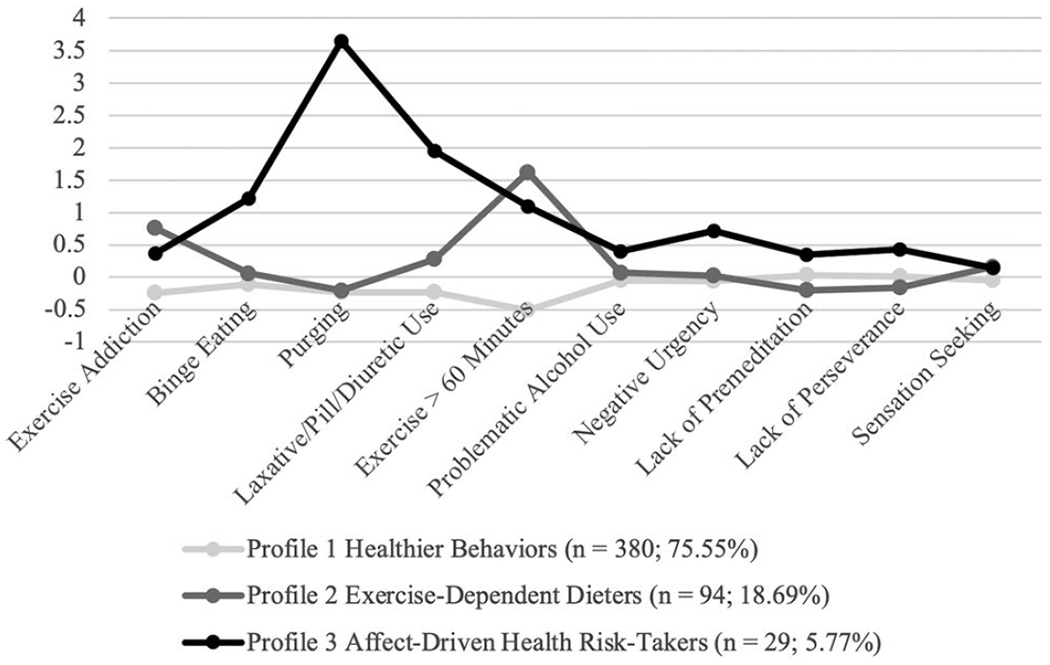
Latent profiles of college students based on facets of impulsivity, exercise addiction, alcohol use, and disordered eating behaviors with standardized scores.
Significant profile differences in facets of impulsivity and health risk behavior engagement
Impulsivity
Results of the MANOVA revealed that the Healthier Behaviors Profile and the Exercise-Dependent Dieters Profile demonstrated similarly low levels of negative urgency. Both profiles reported significantly lower negative urgency when compared to participants in the Affect-Driven Health Risk-Takers Profile, who demonstrated the highest levels of negative urgency. No other differences in facets of impulsivity were significant (e.g., lack of premeditation, lack of perseverance, sensation seeking).
Exercise addiction
Participants in the Healthier Behaviors Profile reported significantly lower levels of exercise addiction compared to the Exercise-Dependent Dieters Profile and the Affect-Driven Health Risk-Takers Profile. Participants in the Exercise-Dependent Dieters Profile and the Affect-Driven Health Risk-Takers Profile demonstrated similarly high levels of exercise addiction.
Disordered eating behaviors
The Healthier Behaviors Profile demonstrated the lowest levels of use of laxatives/pills/diuretics and exercising longer than 60 minutes to control weight compared to the Exercise-Dependent Dieters and Affect-Driven Health Risk-Takers Profiles. Participants in the Exercise-Dependent Dieters Profile demonstrated significantly more use of laxatives/pills/diuretics than the Healthier Behaviors Profile, but significantly less than the Affect-Driven Health Risk-Takers Profile. The Exercise-Dependent Dieters reported the highest levels of exercising longer than 60 minutes to control weight than the other two profiles. The Healthier Behaviors Profile and Exercise-Dependent Dieters Profile demonstrated similarly low levels of binge eating and purging, and both profiles reported significantly lower levels of binge eating and purging compared to the Affect-Driven Health Risk-Takers Profile.
Alcohol use
The Healthier Behaviors Profile demonstrated significantly lower problematic alcohol use than the Affect-Driven Health Risk-Takers Profiles. Alcohol use among the Exercise-Dependent Dieters did not differ significantly from the Healthier Behaviors Profile nor the Affect-Driven Health Risk-Takers Profile. See Table 3 for significant differences based on main study variables.
Table 3.
Means, standard errors, and proportions of profiles on study variables.
| Variables | Profile 1 (n = 380) | Profile 2 (n = 94) | Profile 3 (n = 29) | Profile differences | F statistic and value | |
|---|---|---|---|---|---|---|
| Age | 19.9(0.1) | 19.9(0.2) | 19.8(0.3) | F(22,714) | 0.12 | |
| Exercise addiction | 14.6(0.3) | 19.8(0.6) | 18.1(1.1) | 1 < 2, 3 | F(22,714) | 32.54*** |
| Disordered eating behaviors | F(22,714) | |||||
| Binge eating | 1.5(0.1) | 1.7(0.1) | 3.0(0.2) | 1, 2 < 3 | 22.25*** | |
| Purging | 1.0(0.0) | 1.0(0.0) | 3.7(0.1) | 1, 2 < 3 | 861.27*** | |
| Laxative/Pill/Diuretic Use | 1.1(0.0) | 1.6(0.1) | 2.8(0.2) | 1 < 2, 2 < 3 | 62.21*** | |
| Exercise > 60 minutes | 1.4(0.0) | 4.7(0.1) | 3.9(0.2) | 1 < 3, 3 < 2 | 572.87*** | |
| Problematic alcohol use | 4.2(0.2) | 4.7(0.3) | 6.2(0.6) | 1 < 3 | F(22,714) | 6.20** |
| UPPS | F(22,714) | |||||
| Lack of premeditation | 21.0(0.3) | 20.7(0.6) | 21.8(1.1) | 0.41 | ||
| Negative urgency | 28.1(0.4) | 28.9(0.8) | 33.1(1.5) | 1, 2 < 3 | 5.61** | |
| Sensation seeking | 33.2(0.4) | 34.3(0.8) | 34.1(1.5) | 0.73 | ||
| Lack of perseverance | 19.5(0.3) | 19.4(0.6) | 21.8(1.1) | 2.19 | ||
Note. N = 503. Standard errors are reported in parentheses.
p < .05;
p < .01;
p = < .001.
Profile differences in sociodemographic characteristics
Results of the logistic regression indicated that no sociodemographic covariates were significantly associated with profile membership (see Table 4).
Table 4.
Proportions of profiles based on categorical sociodemographic variables, exercise addiction beyond a clinical threshold, and hazardous alcohol use.
| Sociodemographic variables | Profile 1 (n = 380) | Profile 2 (n = 94) | Profile 3 (n = 29) | Profile 2 Odds Exp(B) | 95% C.I. | Profile 3 Odds Exp(B) | 95% C.I. |
|---|---|---|---|---|---|---|---|
|
| |||||||
| Sex1 | 72.5% Female | 69.6% Female | 79.3% Female | 0.86 | [0.47, 1.55] | 2.54 | [0.86, 7.53] |
| Greek involvement2 | 12.4% Greek | 12.8% Greek | 24.1% Greek | 0.89 | [0.41, 1.92] | 1.79 | [0.67, 4.78] |
| Sexual orientation3 | 87.9% Heterosexual | 85.1% Heterosexual | 96.6% Heterosexual | 0.98 | [0.45, 2.13] | 3.44 | [0.44, 26.72] |
| Race | |||||||
| Asian/Asian American | 6.1% | 5.3% | 10.3% | 0.42 | [0.09, 1.91] | 0.92 | [0.14, 6.17] |
| Black/African American | 15.0% | 13.8% | 13.8% | 0.40 | [0.13, 1.23] | 0.31 | [0.06, 1.77] |
| White/Caucasian | 59.1% | 55.3% | 55.2% | 0.54 | [0.21, 1.37] | 0.41 | [0.11, 1.61] |
| Hispanic/Latinx | 14.2% | 17.0% | 10.3% | 0.62 | [0.21, 1.82] | 0.27 | [0.05, 1.55] |
| Biracial/Multiracial | 4.0% | 3.2% | 10.3% | – | – | – | – |
| clinical outcome variables | Profile 1 (n = 380) | Profile 2 (n = 94) | Profile 3 (n = 29) | Profile 2 Odds Exp(B) | 95% C.I. | Profile 3 Odds Exp(B) | 95% C.I. |
| Clinical exercise addiction | 2.2% | 20.7% | 13.8% | 12.91*** | [5.02, 33.19] | 7.83** | [1.95, 31.42] |
| Hazardous alcohol use | 13.2% | 10.1% | 32.1% | 0.74 | [0.32, 1.73] | 3.72** | [1.40, 9.89] |
Note. N = 503.
Odds ratios represent likelihood of membership in a given profile, with Profile 1 as the reference group. Reference groups were as follows: females1 compared to males, Greek Life members2 compared to nonmembers, and heterosexual3 compared to non-heterosexual participants.
p < .05;
p < .01;
p = < .001.
Profile differences in clinically significant exercise addiction and hazardous alcohol use
Approximately 6.5% (n = 31) of the entire college student sample in the present study met the threshold for clinical risk of exercise addiction based on the severity of symptoms reported (i.e., score of ≥24 on the EAI; Terry et al., 2004), representing approximately 2.2% of Healthier Behaviors Profile (n = 8), 20.7% of the Exercise-Dependent Dieters (n = 19), and 13.8% of the Affect-Driven Health Risk-Takers (n = 4). Results of the logistic regression revealed that profile membership was associated with clinically significant exercise addiction, such that students with exercise addiction were significantly overrepresented among the Exercise-Dependent Dieters and Affect-Driven Health Risk-Takers Profiles compared to the Healthier Behaviors Profile. Participants in the Exercise-Dependent Dieters Profile were 12.91 times as likely to demonstrate clinically significant exercise addiction than participants in the Healthier Behaviors Profile, and participants in the Affect-Driven Health Risk-Takers Profile were 7.83 times more likely compared to the Healthier Behaviors Profile.
Approximately 13.8% (n = 63) of the entire sample met criteria for hazardous alcohol use based on the AUDIT-C (i.e., score of ≥ 8 on the AUDIT-C; Bush et al., 1998). The logistic regression indicated that the three profiles predicted hazardous alcohol use; nearly one-third (32.1%) of the Affect-Driven Health Risk-Takers reported drinking at hazardous levels, who were 3.72 times as likely compared to the participants in the Healthier Behaviors Profile (13.2%). Approximately 10.1% of the Exercise-Dependent Dieters reported hazardous use, which was not significantly different than the Healthier Behaviors Profile. See Table 4 for complete logistic regression results.
Discussion
This study aimed to examine how health risk behaviors may co-occur in relation to four distinct facets of trait impulsivity among college students to inform prevention efforts for this population. To this end, the present study examined if separate, conceptually meaningful profiles of college students would emerge and provide insight into facets of impulsivity as risk factors associated with exercise addiction, binge eating, purging, laxative/pill/diuretic use, exercising longer than 60 minutes to lose weight, and problematic alcohol use among college students. Results supported three distinct profiles that described characteristics of students who may be more or less likely to engage in these health risk behaviors.
The Affect-Driven Health Risk-Takers of Profile 3 reported high engagement in health risk behaviors that differentiated them from the Healthier Behaviors Profile and the Exercise-Dependent Dieters Profile: The Affect-Driven Health Risk-Takers endorsed significantly more negative urgency, binge eating, purging, and laxative/pill/diuretic use compared to both other profiles. The Affect-Driven Health Risk-Takers also demonstrated more problematic alcohol use and were more likely to report hazardous alcohol use than the Healthier Behaviors Profile. Nearly one-third of Profile 3 reported drinking at hazardous levels, which is in the severe risk category for alcohol-related consequences and health problems. In sum, although they represent a small proportion of the overall sample (n = 29), students in the Affect-Driven Health Risk-Takers demonstrated the greatest levels of co-occurring health risk behaviors that cumulatively confer serious risks to their health and well-being.
Of note, both the Affect-Driven Health Risk-Takers and the Exercise-Dependent Dieters were more likely to demonstrate clinically significant exercise addiction than the Healthier Behaviors Profile, although the Exercise-Dependent Dieters reported more exercise longer than 60 minutes to lose weight than both other profiles. The majority of participants who endorsed clinically significant exercise addiction in this study were sorted into the Exercise-Dependent Dieters Profile (n = 19 of 31), whereas only 4 were sorted into the Affect-Driven Health Risk-Takers (and 8 in the Healthier Behaviors Profile). This suggests that some college students endorsing clinically significant exercise addiction may be at high risk for multiple co-occurring health risk behaviors (i.e., Affect-Driven Health Risk-Takers); others may be at moderate risk and engage in co-occurring behaviors like laxative/pill/diuretic use and exercising longer than 60 minutes expressly to lose weight but not endorse notable impulsive traits; and still others may not endorse health risk behaviors or notable impulsive traits (i.e., Healthier Behaviors). Differentiating the high and moderate-risk students from the low-risk students is of utmost importance for promoting health and preventing both physical injury and psychopathology; findings suggest that negative urgency and laxative/pill/diuretic use may be key differentiating factors for these groups.
Findings of the present study support multidimensional theories of impulsivity (Cyders & Smith, 2008; Whiteside & Lynam, 2001). We found nuance in impulsivity as a broad construct comprised of the four facets, with only negative urgency being linked with profile membership defined by health risk behaviors. Results suggest that negative urgency is a major risk factor for co-occurring health risk behaviors for college students, in line with previous research linking negative urgency and disordered eating behaviors (Berg et al., 2015; Fischer et al., 2013), problematic alcohol use (Dir et al., 2013) and exercise addiction (Kotbagi et al., 2017). These associations among the Affect-Driven Health Risk-Takers replicate past research and extend our understanding of the clinical picture of the small proportion of the most at-risk students (Leasure & Neighbors, 2014).
Although some significant correlations were found between lack of premeditation, lack of perseverance, and sensation seeking in relation to the health risk behaviors under study, it was notable that only negative urgency differentiated profiles. This contrasts with what could be expected based on prior research that demonstrated links between sensation seeking in relation to exercise addiction (Kotbagi et al., 2017), binge eating, and purging (Fischer et al., 2008), as well as lack of premeditation, lack of perseverance, and sensation seeking in relation to alcohol use (Coskunpinar et al., 2013; LaBrie et al., 2014; Shin et al., 2012). Although it is unclear why these three facets of impulsivity failed to differentiate between profiles, prior research on sensation seeking has found that sensation seeking was endorsed to a greater extent by men compared to women (Kotbagi et al., 2017). It is possible that this sample of mostly women led to smaller associations between sensation seeking and health risk behaviors, which may have led to a lack of profile differentiation. Because previous research found that lack of premeditation and perseverance were less consistently linked to alcohol use than the other facets (LaBrie et al., 2014; Shin et al., 2012), it is less surprising that these associations failed to differentiate across profiles. Overall, our findings align with prior research that found negative urgency to be the facet of impulsivity most strongly and consistently highly linked with various forms of psychopathology (Berg et al., 2015).
With a total number of 31 students (6.5%) in this sample of 503 endorsing exercise addiction above the clinical threshold, this study sheds light on rates of exercise addiction in a non-clinical sample of college students. Exercise addiction is far less prevalent among college students than disordered eating and alcohol use. Previous research on exercise addiction has primarily studied samples from athletic settings (Lichtenstein et al., 2014; Lichtenstein & Jensen, 2016), with few studies focusing on a general college population of men and women (Jee & Eun, 2018). The one available study documenting the prevalence of exercise addiction among general college students found that exercise addiction affects 3% of students (Griffiths, 2005), which is less than half of the number found in the present study.
Students in the Exercise-Dependent Dieters Profile demonstrated more use of laxatives/pills/diuretics than the Healthier Behaviors Profile (yet less than the Affect-Driven Health Risk-Takers), as well as the highest levels of compensatory exercise (i.e., exercise longer than 60 minutes to lose weight). Thus, the Exercise-Dependent Dieters represent a group of active students who want to lose weight and are engaging in potentially health-compromising behaviors in order to do so. However, the Exercise-Dependent Dieters Profile differs in clinical presentation from students in the Affect-Driven Health Risk-Takers, who are engaging in several other co-occurring risk behaviors (e.g., binge eating, purging, problematic and hazardous alcohol use). Future research should investigate what other personality or other underlying factors may discern which college students report clinically significant exercise addiction with and without co-occurring health risk behaviors, given that the Exercise-Dependent Dieters Profile included the highest percentage of students with clinically significant exercise addiction, yet they did not demonstrate the highest levels of any impulsive traits.
Findings should be interpreted considering limitations. We used the UPPS to assess facets of impulsivity (Whiteside & Lynam, 2001), but recent research has suggested that the multidimensional model of impulsivity should also contain a fifth facet of positive urgency, which was unfortunately not included in the present study. Additionally, due to space limitations in the survey, disordered eating behaviors were assessed using the four behavioral items of the EAT-26 (Garner et al., 1982) rather than the full scale. These one-item measures of binge eating, purging, use of laxatives and diuretics, and exercising for longer than 60 minutes were analyzed separately in the LPA in this study. Future research should examine specific disordered eating behaviors separately with more comprehensive measures. Researchers may also consider examining alcohol-related consequences in addition to consumption. This study did not assess participants’ living situation. It would be helpful to compare engagement in risk behaviors based on whether students lived with or without family. Future studies may benefit from a targeted sample that is representative of students reporting higher levels of exercise addiction to further assess common and distinct factors among students demonstrating severe co-occurring risk behaviors. Finally, these findings may lack generalizability to college students nationally, as participants were not randomly selected.
Clinical implications and conclusion
This investigation into the co-occurrence of health risk behaviors and impulsive traits as they present in a general college population using LPA is the first of its kind. This person-centered approach was useful to identify three profiles of students who differed in terms of risk for co-occurring health risk behaviors. Findings illuminated how a small proportion of undergraduates engaged in multiple health risk behaviors and how patterns of traits and behaviors predicted negative urgency, exercise addiction, disordered eating behaviors, and problematic alcohol use. Results delineated negative urgency as a risk factor that can inform the development of prevention efforts and enhance the efficiency of intervention efforts to address particular traits and meet the unique needs of students at greatest risk for numerous co-occurring, health-compromising behaviors. For example, if a student presents for mandatory substance use counseling, the counselor might inquire about acting impulsively based on negative affect and may assess for disordered eating and exercise addiction, given the prevalence of comorbidity. Greater screening for negative urgency at college counseling centers may help uncover students at highest risk for engagement in risk behaviors. Implementing prevention programs that include skills-based distress tolerance techniques may reduce the negative health consequences associated with negative urgency.
Funding
This work was supported by Award Number T32 MH019139 (Principal Investigator, Theodorus Sandfort, Ph.D.). from the National Institute of Mental Health. The content is solely the responsibility of the authors and does not necessarily represent the official views of National Institute of Mental Health or the National Institutes of Health.
Footnotes
Declaration of interest
The authors report no conflicts of interest.
References
- Adams ZW, Kaiser AJ, Lynam DR, Charnigo RJ, & Milich R (2012). Drinking motives as mediators of the impulsivity-substance use relation: Pathways for negative urgency, lack of premeditation, and sensation seeking. Addictive Behaviors, 37(7), 848–855. 10.1016/j.addbeh.2012.03.016 [DOI] [PMC free article] [PubMed] [Google Scholar]
- Asparouhov T, & Muthén B (2016). Structural equation models and mixture models with continuous nonnormal skewed distributions. Structural Equation Modeling: A Multidisciplinary Journal, 23(1), 1–19. 10.1080/10705511.2014.947375 [DOI] [Google Scholar]
- Balodis IM, Potenza MN, & Olmstead MC (2009). Binge drinking in undergraduates: Relationships with sex, drinking behaviors, impulsivity, and the perceived effects of alcohol. Behavioural Pharmacology, 20(5–6), 518–526. https://dx.doi.org/10.1097%2FFBP.0b013e328330c779 https://doi.org/10.1097/FBP.0b013e328330c779 [DOI] [PMC free article] [PubMed] [Google Scholar]
- Barry AE, Chaney BH, Stellefson ML, & Dodd V (2015). Evaluating the psychometric properties of the AUDIT-C among college students. Journal of Substance Use, 20(1), 1–5. 10.3109/14659891.2013.856479 [DOI] [Google Scholar]
- Barry AE, & Piazza-Gardner AK (2012). Drunkorexia: Understanding the co-occurrence of alcohol consumption and eating/exercise weight management behaviors. Journal of American College Health, 60(3), 236–243. 10.1080/07448481.2011.587487 [DOI] [PubMed] [Google Scholar]
- Barry AE, Whiteman S, Piazza-Gardner AK, & Jensen AC (2013). Gender differences in the associations among body mass index, weight loss, exercise, and drinking among college students. Journal of American College Health, 61(7), 407–413. 10.1080/07448481.2013.823973 [DOI] [PubMed] [Google Scholar]
- Berczik K, Szabó A, Griffiths MD, Kurimay T, Kun B, Urbán R, & Demetrovics Z (2012). Exercise addiction: Symptoms, diagnosis, epidemiology, and etiology. Substance Use & Misuse, 47(4), 403–417. 10.3109/10826084.2011.639120 [DOI] [PubMed] [Google Scholar]
- Berg JM, Latzman RD, Bliwise NG, & Lilienfeld SO (2015). Parsing the heterogeneity of impulsivity: A meta-analytic review of the behavioral implications of the UPPS for psychopathology. Psychological Assessment, 27(4), 1129–1146. 10.1037/pas0000111 [DOI] [PubMed] [Google Scholar]
- Bush K, Kivlahan DR, McDonell MB, Fihn SD, & Bradley KA (1998). The AUDIT alcohol consumption questions (AUDIT-C). An effective brief screening test for problem drinking. Archives of Internal Medicine, 158(16), 1789–1795. 10.1001/archinte.158.16.1789 [DOI] [PubMed] [Google Scholar]
- Collins LM, & Lanza ST (2010). Latent class and latent transition analysis: With applications in the social, behavioral, and health sciences. Wiley. 10.1002/9780470567333 [DOI] [Google Scholar]
- Coskunpinar A, Dir AL, & Cyders MA (2013). Multidimensionality in impulsivity and alcohol use: A meta-analysis using the UPPS model of impulsivity. Alcoholism, Clinical and Experimental Research, 37(9), 1441–1450. 10.1111/acer.12131 [DOI] [PMC free article] [PubMed] [Google Scholar]
- Costa S, Hausenblas HA, Oliva P, Cuzzocrea F, & Larcan R (2013). The role of age, gender, mood states and exercise frequency on exercise dependence. Journal of Behavioral Addictions, 2(4), 216–223. 10.1556/JBA.2.2013.014 [DOI] [PMC free article] [PubMed] [Google Scholar]
- Curcio AL, & George AM (2011). Selected impulsivity facets with alcohol use/problems: The mediating role of drinking motives. Addictive Behaviors, 36(10), 959–964. 10.1016/j.addbeh.2011.05.007 [DOI] [PubMed] [Google Scholar]
- Cyders MA, Flory K, Rainer S, & Smith GT (2009). The role of personality dispositions to risky behavior in predicting first-year college drinking. Addiction (Abingdon, England), 104(2), 193–202. 10.1111/j.1360-0443.2008.02434.x [DOI] [PMC free article] [PubMed] [Google Scholar]
- Cyders MA, & Smith GT (2008). Emotion-based dispositions to rash action: Positive and negative urgency. Psychological Bulletin, 134(6), 807–828. 10.1037/a0013341 [DOI] [PMC free article] [PubMed] [Google Scholar]
- Davis HA, Smith GT, & Keel PK (2020). An examination of negative urgency and other impulsigenic traits in purging disorder. Eating Behaviors, 36, 101365. 10.1016/j.eatbeh.2020.101365 [DOI] [PMC free article] [PubMed] [Google Scholar]
- Dir AL, Karyadi K, & Cyders MA (2013). The uniqueness of negative urgency as a common risk factor for self-harm behaviors, alcohol consumption, and eating problems. Addictive Behaviors, 38(5), 2158–2162. 10.1016/j.addbeh.2013.01.025 [DOI] [PubMed] [Google Scholar]
- Di Nicola M, Tedeschi D, De Risio L, Pettorruso M,Martinotti G,Ruggeri F, & Janiri L (2015). Cooccurrence of alcohol use disorder and behavioral addictions: relevance of impulsivity and craving. Drug and alcohol dependence, 148 118–125. 10.1016/j.drugalcdep.2014.12.028 [DOI] [PubMed] [Google Scholar]
- Dumitru DC, Dumitru T, & Maher AJ (2018). A systematic review of exercise addiction: Examining gender differences. Journal of Physical Education and Sport, 18(3), 1738–1747. 10.7752/jpes.2018.03253 [DOI] [Google Scholar]
- Fischer S, Peterson CM, & McCarthy D (2013). A prospective test of the influence of negative urgency and expectancies on binge eating and purging. Psychology of Addictive Behaviors, 27(1), 294–300. 10.1037/a0029323 [DOI] [PubMed] [Google Scholar]
- Fischer S, Smith G, & Cyders M (2008). Another look at impulsivity: A meta-analytic review comparing specific dispositions to rash action in their relationship to bulimic symptoms. Clinical Psychology Review, 28(8), 1413–1425. 10.1016/j.cpr.2008.09.001 [DOI] [PMC free article] [PubMed] [Google Scholar]
- Garner DM, Olmsted MP, Bohr Y, & Garfinkel PE (1982). The eating attitudes test: Psychometric features and clinical correlates. Psychological Medicine, 12(4), 871–878. 10.1017/S0033291700049163 [DOI] [PubMed] [Google Scholar]
- Griffiths M (2005). A ‘components’ model of addiction within a biopsychosocial framework. Journal of Substance Use, 10(4), 191–197. 10.1080/14659890500114359 [DOI] [Google Scholar]
- Griffiths MD (2002). Gambling and gaming addictions in adolescence. Wiley. [Google Scholar]
- Haller M, & Chassin L (2014). Risk pathways among traumatic stress, posttraumatic stress disorder symptoms, and alcohol and drug problems: A test of four hypotheses. Psychology of Addictive Behaviors, 28(3), 841–851. 10.1037/a0035878 [DOI] [PMC free article] [PubMed] [Google Scholar]
- Hunt TK, & Forbush KT (2016). Is “drunkorexia” an eating disorder, substance use disorder, or both? Eating Behaviors, 22, 40–45. 10.1016/j.eatbeh.2016.03.034 [DOI] [PubMed] [Google Scholar]
- Jee YS, & Eun D (2018). Exercise addiction and psychophysiological health in Korean collegiate students. International Journal of Mental Health and Addiction, 16(2), 451–465. 10.1007/s11469-017-9802-7 [DOI] [Google Scholar]
- Kline RB (2010). Principles and practice of structural equation modeling (3rd ed.). Guilford. 10.15353/cgjsc-rcessc.v1i1.25 [DOI] [Google Scholar]
- Kotbagi G, Morvan Y, Romo L, & Kern L (2017). Which dimensions of impulsivity are related to problematic practice of physical exercise? Journal of Behavioral Addictions, 6(2), 221–228. 10.1556/2006.6.2017.024 [DOI] [PMC free article] [PubMed] [Google Scholar]
- LaBrie JW, Kenney SR, Napper LE, & Miller K (2014). Impulsivity and alcohol-related risk among college students: Examining urgency, sensation seeking and the moderating influence of beliefs about alcohol’s role in the college experience. Addictive Behaviors, 39(1), 159–164. 10.1016/j.addbeh.2013.09.018 [DOI] [PMC free article] [PubMed] [Google Scholar]
- Leasure JL, & Neighbors C (2014). Impulsivity moderates the association between physical activity and alcohol consumption. Alcohol (Fayetteville, N.Y.), 48(4), 361–366. 10.1016/j.alcohol.2013.12.003 [DOI] [PMC free article] [PubMed] [Google Scholar]
- Li M, Nie J, & Ren Y (2015). Effects of exercise dependence on psychological health of Chinese college students. Psychiatria Danubina, 27(4), 413–419. [PubMed] [Google Scholar]
- Lichtenstein MB, Christiansen E, Elklit A, Bilenberg N, & Støving RK (2014). Exercise addiction: A study of eating disorder symptoms, quality of life, personality traits and attachment styles. Psychiatry Research, 215(2), 410–416. 10.1016/j.psychres.2013.11.010 [DOI] [PubMed] [Google Scholar]
- Lichtenstein MB, Hinze CJ, Emborg B, Thomsen F, & Hemmingsen SD (2017). Compulsive exercise: Links, risks and challenges faced. Psychology Research and Behavior Management, 10, 85–95. 10.2147/PRBM.S113093 [DOI] [PMC free article] [PubMed] [Google Scholar]
- Lichtenstein MB, & Jensen TT (2016). Exercise addiction in CrossFit: Prevalence and psychometric properties of the Exercise Addiction Inventory. Addictive Behaviors Reports, 3, 33–37. 10.1016/j.abrep.2016.02.002 [DOI] [PMC free article] [PubMed] [Google Scholar]
- Little RJ (1988). A test of missing completely at random for multivariate data with missing values. Journal of the American Statistical Association, 83(404), 1198–1202. 10.1080/01621459.1988.10478722 [DOI] [Google Scholar]
- Lo Y, Mendell NR, & Rubin DB (2001). Testing the number of components in a normal mixture. Biometrika, 88(3), 767–778. 10.1093/biomet/88.3.767 [DOI] [Google Scholar]
- Martin JL, Martens MP, Serrao HF, & Rocha TL (2008). Alcohol use and exercise dependence: Co-occurring behaviors among college students? Journal of Clinical Sport Psychology, 2(4), 381–392. 10.1123/jcsp.2.4.381 [DOI] [Google Scholar]
- Matthews-Ewald MR, Zullig KJ, & Ward RM (2014). Sexual orientation and disordered eating behaviors among self-identified male and female college students. Eating Behaviors, 15(3), 441–444. 10.1016/j.eatbeh.2014.05.002 [DOI] [PubMed] [Google Scholar]
- Muthén B, & Asparouhov T (2002). Using Mplus Monte Carlo simulations in practice: A note on non-normal missing data in latent variable models. Mplus Web Notes, 2, 1–6. https://www.statmodel.com/download/webnotes/mc2.pdf [Google Scholar]
- Muthén LK, & Muthén BO (2017). Mplus user’s guide (8th ed.). Muthén & Muthén. [Google Scholar]
- National Institute on Drug Abuse. (2020). Common comorbidities with substance use disorders research report. https://www.drugabuse.gov/download/1155/common-comorbidities-substance-use-disorders-research-report.pdf?v=5d6a5983e0e9353d46d01767fb20354b [PubMed]
- Penedo FJ, & Dahn JR (2005). Exercise and well-being: A review of mental and physical health benefits associated with physical activity. Current Opinion in Psychiatry, 8(2), 189–193. 10.1097/00001504-200503000-00013 [DOI] [PubMed] [Google Scholar]
- Peterson CM, & Fischer S (2012). A prospective study of the influence of the UPPS model of impulsivity on the co-occurrence of bulimic symptoms and non-suicidal self-injury. Eating Behaviors, 13(4), 335–341. 10.1016/j.eatbeh.2012.05.007 [DOI] [PubMed] [Google Scholar]
- Piran N, & Robinson SR (2006). Associations between disordered eating behaviors and licit and illicit substance use and abuse in a university sample. Addictive Behaviors, 31(10), 1761–1775. 10.1016/j.addbeh.2005.12.021 [DOI] [PubMed] [Google Scholar]
- Rasberry CN, Tiu GF, Kann L, McManus T, Michael SL, Merlo CL, Lee SM, Bohm MK, Annor F, & Ethier KA (2017). Health-related behaviors and academic achievement among high school Students - United States, 2015. MMWR. Morbidity and Mortality Weekly Report, 66(35), 921–927. 10.15585/mmwr.mm6635a1 [DOI] [PMC free article] [PubMed] [Google Scholar]
- Reilly EE, Dmochowski S, Schaumberg K, Earleywine M, & Anderson D (2016). Gender-moderated links between urgency, binge drinking, and excessive exercise. Journal of American College Health, 64(2), 104–111. 10.1080/07448481.2015.1085056 [DOI] [PubMed] [Google Scholar]
- Scott-Sheldon LA, Terry DL, Carey KB, Garey L, & Carey MP (2012). Efficacy of expectancy challenge interventions to reduce college student drinking: A meta-analytic review. Psychology of Addictive Behaviors, 26(3), 393–405. 10.1037/a0027565 [DOI] [PMC free article] [PubMed] [Google Scholar]
- Shin SH, Hong HG, & Jeon SM (2012). Personality and alcohol use: The role of impulsivity. Addictive Behaviors, 37(1), 102–107. 10.1016/j.addbeh.2011.09.006 [DOI] [PMC free article] [PubMed] [Google Scholar]
- Spurk D, Hirschi A, Wang M, Valero D, & Kauffeld S (2020). Latent profile analysis: A review and “how to” guide of its application within vocational behavior research. Journal of Vocational Behavior, 120, 103445. 10.1016/j.jvb.2020.103445 [DOI] [Google Scholar]
- Szabo A, Griffiths MD, Marcos RD, Mervó B, & Demetrovics Z (2015). Methodological and conceptual limitations in exercise addiction research. The Yale Journal of Biology and Medicine, 88(3), 303–308. https://www.ncbi.nlm.nih.gov/pmc/articles/PMC4553651/ [PMC free article] [PubMed] [Google Scholar]
- Tabachnick BG, & Fidell LS (2013). Using multivariate statistics (6th ed.). Allyn and Bacon. [Google Scholar]
- Terry A, Szabo A, & Griffiths M (2004). The exercise addiction inventory: A new brief screening tool. Addiction Research & Theory, 12(5), 489–499. 10.1080/16066350310001637363 [DOI] [Google Scholar]
- Trott M, Jackson SE, Firth J, Jacob L, Grabovac I, Mistry A, Stubbs B, & Smith L (2021). A comparative meta-analysis of the prevalence of exercise addiction in adults with and without indicated eating disorders. Eating and Weight Disorders - Studies on Anorexia, Bulimia and Obesity, 26(1), 37–46. 10.1007/s40519-019-00842-1 [DOI] [PubMed] [Google Scholar]
- Ty M, & Francis AJ (2013). Insecure attachment and disordered eating in women: The mediating processes of social comparison and emotion dysregulation. Eating Disorders, 21(2), 154–174. 10.1080/10640266.2013.761089 [DOI] [PubMed] [Google Scholar]
- Velazquez CE, Pasch KE, Laska MN, Lust K, Story M, & Ehlinger EP (2011). Differential prevalence of alcohol use among 2-year and 4-year college students. Addictive Behaviors, 36(12), 1353–1356. 10.1016/j.addbeh.2011.07.037 [DOI] [PMC free article] [PubMed] [Google Scholar]
- Verdejo-Garcia A, & Albein-Urios N (2021). Special issue on vulnerabilities to substance abuse impulsivity traits and neurocognitive mechanisms conferring vulnerability to substance use disorders. Neuropharmacology, 183, 108402. 10.1016/j.neuropharm.2020.108402 [DOI] [PubMed] [Google Scholar]
- Whiteside SP, & Lynam DR (2001). The Five Factor Model and impulsivity: Using a structural model of personality to understand impulsivity. Personality and Individual Differences, 30(4), 669–689. 10.1016/S0191-8869(00)00064-7 [DOI] [Google Scholar]
- Zmijewski CF, & Howard MO (2003). Exercise dependence and attitudes toward eating among young adults. Eating Behaviors, 4(2), 181–195. 10.1016/S1471-0153(03)00022-9 [DOI] [PubMed] [Google Scholar]