


Abstract
Background:
Older veterans in urban settings rely less on Department of Veterans Affairs (VA) health care, suggesting deficits of access and services for aging veterans. We aimed to identify reasons for VA and non-VA use across health status of older, urban-dwelling veterans.
Methods:
We examined open-ended responses from 177 veterans who were enrolled in primary care at the Bronx VA Medical Center, used non-VA care in prior 2 years, and completed baseline interviews in a care coordination trial from March 2016 to August 2017. Using content analysis, we coded and categorized key terms and concepts into an established access framework. This framework included five categories: acceptability (relationship, second opinion), accessibility (distance, travel); affordability; availability (supply, specialty care); and accommodation (organization, wait-time). Self-reported health status was stratified by excellent/very good, good, and fair/poor.
Results:
We were able to categorize the responses of 166 veterans, who were of older age (≥75 years, 61%), minority race and ethnicity (77%), and low income (<$25,000/year, 51%). Veterans mentioned acceptability (42%) and accessibility (37%) the most, followed by affordability (33%), availability (25%), and accommodation (11%). With worse self-reported health status, accessibility intensified (Excellent/very good, 24%; Fair/Poor, 46%; p=0.031) particularly among minority veterans, while acceptability remained prominent (Excellent/very good, 49%; Fair/Poor, 37%; p=0.25). Other categories were mentioned less with no significant difference across health status.
Conclusions:
Even in an urban environment, proximity was a leading issue with worse health. Addressing urban accessibility and coordination for older, sicker veterans may enhance care for a growing vulnerable VA population.
Keywords: Geriatrics, Veterans, Access to Care, Primary Care
INTRODUCTION
Older adults with declining health face increasing challenges in health system navigation and access. The Department of Veterans Affairs (VA) health care system is the largest integrated health system in the United States, caring for over seven million patients with nearly half over the age of 65 years. Over 90% of veterans enrolled in VA older than 65 are also covered by Medicare.1 Prior evidence suggest that veterans shift care to non-VA sources as they age, develop greater medical complexity, acquire disability, must travel greater distances, and reside in urban environments with competing sources of care.2–4 While this dual use of VA and non-VA health care may enhance access, the unintended consequences of fragmentation5 and lack of continuity may lead to adverse events and outcomes.6–10 Understanding why older veterans choose VA or non-VA care could inform ways to maintain and improve the quality of care for an aging and particularly vulnerable veteran population.
Recent evidence suggests that older veterans are increasingly relying on the VA than private sector alternatives to fill their health care needs.11 The VA delivers high quality care, meeting and exceeding the private sector12 by using multidisciplinary care teams dedicated to providing comprehensive and coordinated primary13,14 and geriatric care.15 However, adequate access to and availability of VA services remains a concern. Only 42% of veterans over the age of 65 years who are enrolled in VA report that the VA fulfills most or all their needs.1 To address this issue, veterans who face wait times exceeding 20 days and 28 days or travel times exceeding 30 minutes and 60 minutes for primary care and specialty services, respectively, qualify to use non-VA services without the need for Medicare or private sector insurance coverage.16 Nearly 30% of all VA care is provided by non-VA providers through this benefit.17 The MISSION Act16 aims to further enhance access to non-VA services for urgent and specialty care. For younger, less complex patients, enhanced access to care outside the VA may result in timely treatment and outcomes;18 however, for the socioeconomically disadvantaged and more complex veteran population who typically relies on VA for all services,12,19 the benefits of enhanced timeliness to care may be superseded by the unintended consequences of care fragmentation.5,8
This analysis examines survey responses of veterans over the age of 65 years who get primary care at the James J Peters VA Medical Center in the Bronx, NY (Bronx VAMC) and have previously used non-VA services (dual system use). We examined the reasons for dual system use across levels of self-reported health. As the VA aims to expand choice and access, the number of veterans obtaining care from non-VA sources is likely to increase. This study aims to further elucidate reasons for dual non-VA and VA use for older veterans with poorer self-reported health.
METHODS
Study Design and Population.
Researchers analyzed responses to a baseline survey from an ongoing coach-delivered care transitions trial, which leverages Health Information Exchange to enhance care coordination and transitions.20 The study population included veterans who were over 65 years of age, enrolled and assigned a primary care provider at the James J Peters VA Medical Center (Bronx VAMC) in the Bronx, NY, and have previously used non-VA services in the Bronx in the prior 2 years. Non-VA utilization was identified within the Bronx Region Health Information Organization, a health information exchange that contains health care information from the major health systems in the Bronx designed to facilitate care coordination and patient safety.21 This study includes responses from the baseline survey of the first 177 patients enrolled from March of 2016 to August 2017. This study, along with informed consent documents, questionnaires, and data collection templates, were approved by the Institutional Review Board of the Bronx VAMC (Protocol BOO-15–035).
Data source.
A single research assistant delivered the survey face-to-face or by phone at the time of enrollment to veterans who agreed to participate in the study. The survey included 7 sections and 50 questions: Patient and Residence characteristics (n=15), care provider and access information (n=7), insurance coverage and income information (n = 4), activities of daily living (n=6), Instrumental activities of daily living (n=7), and Short Portable Mental Status Questionnaire (SPMSQ) (n=11). Duration of the survey took less than 1 hour to complete. All participants received $25.00 in direct deposit to bank account or in coupons to the hospital store.
In the survey’s second section of care provider and access, the research assistant asked participants the opened-ended question: “What are the reasons for using both non-VA and VA care?” The same researcher recorded the answers verbatim. The question was repeated if the patient did not respond or understand; however, probing on depth and context was limited. The survey also asked participants to rate their health (excellent, very good, good, fair, poor) and other characteristics of patient’s demographics, residence, access, and health (Table). If patients were unable to answer (n=6, 3.4%), we included responses provided by caretaker as access and health care use encompasses perceptions of patient or caretaker.22
Table:
Population characteristics of respondents to survey from March 2016 to August 2017, stratified by Self-Reported Health Status
| Self-Reported Health | |||||
|---|---|---|---|---|---|
| All | Excellent or Very Good | Good | Fair or Poor | P value | |
| N = | 166 | 41 | 71 | 54 | |
| %N | 24.7 | 42.8 | 32.5 | ||
| Age Categories (%) | |||||
| 65 to 74 yrs. | 38.6 | 41.5 | 33.8 | 42.6 | 0.094 |
| 75 to 84 yrs. | 39.2 | 48.8 | 42.3 | 27.8 | |
| 85 yrs. and older | 22.3 | 9.8 | 23.9 | 29.6 | |
| Race & Ethnicity (%) | |||||
| NH White | 32.5 | 26.8 | 45.1 | 20.4 | 0.008 |
| NH Black | 34.9 | 34.1 | 36.6 | 33.3 | |
| Hispanic | 27.1 | 31.7 | 12.7 | 42.6 | |
| NH Other | 5.4 | 7.3 | 5.6 | 3.7 | |
| Language spoken at home (%) | |||||
| English only | 78.2 | 75.0 | 90.1 | 64.8 | 0.003 |
| Educational Achievement (%) | |||||
| <High School (HS) | 16.3 | 19.5 | 18.3 | 11.1 | 0.825 |
| HS graduate/GED | 36.7 | 31.7 | 35.2 | 42.6 | |
| Some college | 33.1 | 31.7 | 32.4 | 35.2 | |
| 4-yr. degree or more | 13.9 | 17.1 | 14.1 | 11.1 | |
| Health Literacy, Inadequate | 34.3 | 26.8 | 29.6 | 46.3 | 0.076 |
| Income (%) | |||||
| <$25,000 | 51.2 | 51.2 | 54.9 | 46.3 | 0.594 |
| $25,001–50,000 | 22.9 | 26.8 | 15.5 | 29.6 | |
| >$50,000 | 18.1 | 14.6 | 19.7 | 18.5 | |
| Income, unknown | 7.8 | 7.3 | 9.9 | 5.6 | |
| Married (%) | 41.0 | 48.8 | 33.8 | 44.4 | 0.245 |
| Household size, mean (SD) | 1.9 (0.9) | 1.8 (0.7) | 1.9 (0.9) | 2.0 (1.1) | 0.494 |
| Cognitive Status | |||||
| Any impairment | 4.9 | 2.4 | 4.2 | 7.6 | 0.494 |
| Functional Impairment (%) | |||||
| ADL Impairment | 23.5 | 14.6 | 21.1 | 33.3 | 0.085 |
| IADL impairment | 40.4 | 24.4 | 36.6 | 57.4 | 0.004 |
| Assistance Device use (%) | |||||
| Independent, inside | 71.1 | 78.0 | 69.0 | 68.5 | 0.525 |
| Independent, outside | 45.8 | 63.4 | 39.4 | 40.7 | 0.033 |
| Insurance (%) | |||||
| Medicare | 88.0 | 87.8 | 91.5 | 83.3 | 0.376 |
| Medicaid | 19.3 | 26.8 | 19.7 | 13.0 | 0.235 |
| Other Insurance | 54.2 | 48.8 | 59.2 | 51.9 | 0.520 |
| Source(s) of Care (%) | |||||
| Non-VA provider | 62.0 | 65.9 | 63.4 | 57.4 | 0.670 |
| Most of Care | |||||
| VA | 78.3 | 85.4 | 73.2 | 79.6 | 0.207 |
| non-VA | 21.1 | 12.2 | 26.8 | 20.4 | |
| Unknown | 0.6 | 2.4 | 0.0 | 0.0 | |
| Travel to clinic | |||||
| Drive (%) | 53.0 | 51.2 | 52.1 | 55.6 | 0.898 |
| Travel time, min (SD) | 33.3 (21.3) | 37.4 (15.0) | 33.9 (24.3) | 29.5 (17.4) | 0.328 |
Non-Hispanic (NH); Activities of Daily Living (ADL); Independent Activities of Daily Living (IADL)
Analysis.
We used qualitative content analysis to “provide knowledge and understanding of the phenomenon under study.”23 A core team of three researchers and a trained research assistant, who delivered and recorded the surveys, analyzed responses in a multi-step process. First, using an inductive, conventional approach,23,24 the research assistant reviewed all 177 participant responses and, with open coding,25 identified key terms and concepts of reasons for using both VA and non-VA care. The larger study team reviewed the initial findings and discerned that the terms and concepts aligned with Penchanksy and Thomas’s framework of access, consisting of five relevant categories.26 To validate the categorization the previously identified terms and concepts and increase trustworthiness of the analysis,27 all responses were independently reviewed again by the research assistant and physician researcher. Consistent with deductive, directed content analysis,23,24 all responses were classified into none, one, or more of the five categories of the framework.26 Coders were blinded to other participant information during this process. Inter-rater reliability between coders was 91 percent. Researchers met independently and with the larger study team to resolve discrepancies of categorization by consensus.
In the final step, researchers examined the prevalence of each response category for salience28 and meaning, independently and across self-reported health status: “excellent / very good,” “good,” and “fair / poor.” Self-reported health status serves as a proximal and relevant factor in health care use.29 Researchers assessed how the prevalence of each category mapped onto self-reported health to better understand if and how health status may explain reasons for VA and non-VA use.
Given the evidence that veterans of minority race and ethnicity face unique access barriers30,31 and prevalence among our study population, we performed a post-hoc analysis of participants who identified as Hispanic or of a non-White race to evaluate if the concepts and categories for VA and non-VA use differed among this subpopulation.
RESULTS
Population characteristics.
A total of 177 patients who used services at the Bronx VAMC and were identified as using non-VA healthcare within the Bronx took the survey. One participant did not answer the question and 10 responses were unable to be categorized due to limited context and depth.
Of the 166 respondents, the majority were over 75 years (75–84 years: 39.2%; 85 or older: 22.3%) with nearly half with functional mobility deficits: 23.5% reported at least 1 impairment of activities of daily living (ADL), 40.4% reported at least 1 impairment with instrumental activities of daily living (IADL), and 54.2% reporting using an assistive device outside the home. Only 4.9% were identified to have any cognitive impairment: 5 respondents with mild, 2 with moderate, and 1 with severe cognitive impairment. Nearly half (47%) did not drive to clinic. The average reported travel time to the Bronx VAMC was 33.4 (SD 21.3; median 30, IQR 20–45) minutes. Racial and ethnic (NH White, 32.5%; NH Black, 34.9%; Hispanic, 27.1%) and socioeconomic diversity was consistent with the Bronx VAMC population. Twenty-two percent spoke an additional language to English at home. Half reported an income less than $25,000. Over one in three of the respondents (34.3%) screened positive for inadequate health literacy. Although 88.4% reported having Medicare, 78.7% reported getting most of their care at the VA (Table).
Self-reported health.
When asked about health status, 24.7% reported their health as excellent or very good; 42.8%, good; and 32.5%, fair or poor. Across groups, patients reporting their health as fair or poor were more likely to be Hispanic, speak non-English language at home, more likely to have IADL impairment, and use an assistive device outside their home (Table).
Reasons for VA and non-VA health care utilization.
We synthesized survey responses into common terms and concepts and identified alignment with Penchansky and Thomas’ five categories of access: acceptability, accessibility, affordability, availability, and accommodation.26
Acceptability, defined as the patient’s perceptions about the personal and practice characteristics of the provider and providing system, was the most mentioned category by 44% of respondents and encompassed concepts of satisfaction, quality, continuity of care, and seeking second opinions. Respondents described the importance of relationships and maintaining care with the provider they know or who cared for them within or outside the VA, notably if the relationship was established during a time of crisis. This is captured in one response: “The ambulance took me to [non-VA hospital] because I had a heart attack and [I] stayed with that doctor who took care of me there. She is very efficient and took me out of that situation. I stayed with her care. She kept me under control.” Others listed the duration of relationship with providers, captured by a participant who said: “I’ve had non-VA [primary care provider] for at least 20 years and I like him.” A few participants also cited the desire for a second opinion for treatment.
Accessibility, defined as the proximity and ease of travel to care, was mentioned by 37% of participants, particularly in the context of urgent or emergency care. As one patient stated, and echoed by several others, “It’s convenient for me to go to non-VA for emergencies; it’s closer.”
Affordability, defined as the relationship between the price of care and the ability of patients to pay in the context of insurance and other benefits, was mentioned by 33% of respondents. Participants cited out-of-pocket costs for medications, copayments for visits, and benefits within the VA related to their service-connected disability, and choosing location based upon costs and coverage. A participant stated, “There are no payments here […] on the outside it costs me. My medications are free here.” Others commented on condition- and cost-specific choices based upon conditions being service connected and the degree of outside insurance coverage. One respondent said, “Anything connected to that disability gets covered here but my insurance has more coverage at non-VA.”
The least frequently mentioned dimensions were availability (25%) and accommodation (11%). When availability was mentioned, defined as the number and type of services available to address the needs of the patients, respondents described seeking out specialty and subspecialty care outside the VA, such as cardiology and pulmonology services and cancer treatment. Accommodation is defined as the way services are organized and delivered to accommodate patient preferences, such as telephone availability, hours of operation, and wait-times for care, and encompassed concepts of timeliness and service alignment. Respondents mentioned the timeliness of same-day access to outside services and longer wait-times for procedures or tests within the VA. Other respondents mentioned the preference of the “one stop shop” of the VA.
Differences in categories of access across self-reported health status.
Within each of the 5 categories, content and tone of quotes did not consistently differ across self-reported health status (Supplemental Table S1). However, the prevalence of the five categories of access differed across and between levels of self-reported health status (Figure).
Figure: Percentage of patients mentioning the categories of Acceptability, Accessibility, Affordability, Availability and Accommodation as reasons for using VA and non-VA services across self-reported health status.
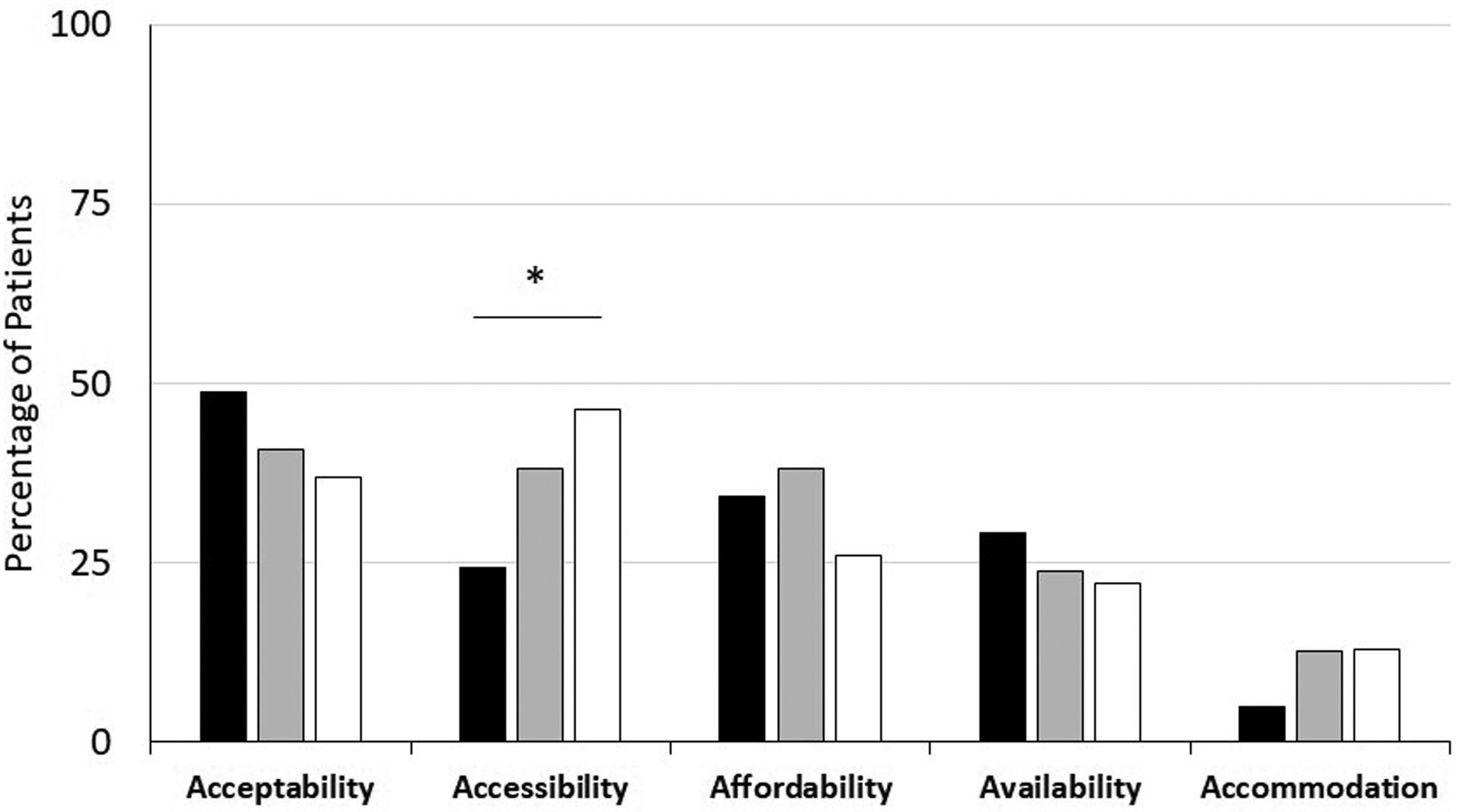
Self-reported health status categorized as excellent/very good (black bars), good (gray bars), and fair/poor (white bars). *p<0.05
Accessibility was mentioned more among respondents with poor self-reported health status. While themes of accessibility were mentioned by only 24% of respondents with excellent or very good health, 46% of patients with fair or poor health mentioned accessibility (p=0.031), making it the most prevalent category among this group (Figure). One respondent, who reported poor health, cited the burden of travel, saying “Traveling is the main reason, I can’t handle it anymore.” Notably, more participants with poor health status mentioned the theme of proximity in regard to emergency services. Acceptability remained prominent and did not differ by self-reported health status (Excellent/Very good, 49%; Good, 41%; Fair/Poor, 44%; p=0.45). Respondents consistently cited the importance of relationships and continuity of care after treatment across levels of health status (Supplemental Table S1). Affordability, availability, and accommodation did not differ statistically or qualitatively across self-reported health status (Figure, Supplemental Table S1).
Respondents of minority race and ethnicity.
Participants of minority race and ethnicity were younger (mean, 77.0 vs. NH White 80.3 years, p=0.018), more likely to speak a language other than English at home (29.7 vs. 5.6, p<0.001), less likely to have a non-VA provider (55.4 vs. 75.9, p=0.011), and more likely to rely on the VA for most of their care (84.8 vs. 64.8, p=0.011). Further, respondents of minority race and ethnicity were more likely to be covered with Medicaid (24.1 vs. 9.3, p=0.23) and less likely to report Medicare coverage (83.9 vs. 96.3, p=0.022) (Supplemental Tables S2–3).
When examining the categories of reasons for VA and non-VA use, respondents of minority race and ethnicity were less likely to mention acceptability (34.8% vs. NH White, 55.6%, p=0.011), particularly among patients with poor or fair health (28% vs. NH White, 73%; p=0.006). There was also a trend of increased mention of accessibility across health status by respondents of minority race and ethnicity (excellent or very good health 13% vs. fair or poor health 49%, p=0.005); a trend that did not occur in NH White respondents (Supplemental Tables S4).
DISCUSSION
We analyzed open-ended responses from veterans over 65 years from the Bronx VAMC who have used both VA and non-VA health care services to understand the reasons for dual system utilization among older, urban-dwelling veterans across levels of self-reported health status. Among five categories of access, acceptability remained prominent with no difference across health status, signifying the persistent importance of patient-provider relationships, continuity, and trust. Accessibility increased and became the most prominent category among participants with lower self-reported health status, which was driven by respondents of minority race and ethnicity. This highlights the burden of distance and travel to care as health declines, a potential contributor ongoing in health inequities. These findings build upon prior research of dual system use by veterans and offer insight into how the VA may reduce the consequences of care fragmentation and enhance care coordination for older vulnerable veteran populations.
In discrete choice experiments testing the preferences of timeliness, flexible appointments, continuity, and costs, older adults valued informational and relational continuity of care, especially for new and worrisome conditions, over other options.32–34 Through the implementation of the Patient-Aligned Care Team (PACT) and geriatric-specific care (Geri-PACT), the VA has enhanced provider and team continuity.14,15,35 In addition, the VA delivers effective home-based primary care with the continuity of multidisciplinary care team for qualified older adults.36,37 These efforts and their benefits may add to reasons why more veterans are relying upon the VA for primary and specialty care services.11–13,38 Veterans, who experience higher provider continuity, also experience improved outcomes, lower ED visits and hospitalizations.7,39 Similarly, greater continuity of the core primary care team of physicians, nurses, and medical assistants has been associated with improved performance, lower ED visits, particularly with medically complex patients.35
Distance has been a known factor influencing veteran reliance on VA care.4,18 VA policy has focused on distance with the CHOICE Act18 and recently adopted drive time (MISSION Act)40 on whether non-VA services could be covered by the VA. This focus is aimed to enhance access for rural veterans who may have closer non-VA compared with VA options. While disparities in access to care among rural veterans have been well documented,41 our findings highlight that distances in urban settings, though much shorter than rural settings, bears a significant burden, particularly as health status declines. Nearly 50% of our respondents did not drive, relying on other modalities to get care, including taxi and public transportation. Despite the extensive public transportation options within New York City and the Bronx, like other metropolitan cities, these transportation systems are geared toward travel in and out of economic hubs, which do not always align with health facilities’ locations.42–44 The VA provides benefits through the Veterans Transportation Services (VTS) for door-to-door transportation via hired taxi or para-transport services for qualifying Veterans; however, the availability, capacity, and responsiveness of these local programs may not overcome the barriers to accessing care among patients with declining health.
We observed the prominence of accessibility not only among vulnerable population of older adults with worse self-reported health, but also during vulnerable times of emergent care. As a result, the use of closer non-VA care in settings of emergency may precipitate care fragmentation, disrupting the continuity that patients desire and may provide greater benefit.7,8 Additionally, as we observed, the use of closer non-VA care in times of emergency for new illnesses may encourage older veterans who value continuity to make and then maintain their specialty care with non-VA providers. While the VA has implemented enhanced coordination and continuity within the VA system, the enhancement of VA and non-VA care coordination and communication needs improvement45,46 and may help facilitate better care or return to the VA.14
The less frequently mentioned domains of availability, affordability, and accommodation are consistent with higher prioritization of continuity and thoroughness of care.32,33 Further, the increased reliance on VA for specialty care,11 low out-of-pocket costs due to copayment exemption or service-connected disability,4,19 and improved VA wait-times47 signify a closing gap between VA and the private sector,11,12 and decreasing significance when choosing care.
Taken together, our findings should be interpreted in context of our patient population and the VA policies aiming to enhance access and care. This urban, minority population cited distance (accessibility) and relationships (acceptability) as primarily shaping where they choose to receive care. Nationally, over 3 million people who are older, lower socioeconomic status, and from an ethnic minority group experience transportation barriers to care.48 The veterans relying on the VA are more likely to be socioeconomically disadvantaged and more medically complex with worse self-reported health.12 Implementation of PACT and other VA efforts to enhance continuity may improve the care for this socioeconomically and medically complex population. However, as patients’ health diminish and medical events occur, patients prefer to use more proximal (potentially non-VA) facilities, particularly for urgent, emergency, specialty, and surgical care.11,49 VA policies enacted as a result of CHOICE and MISSION Act legislation adopted objective measures of drive times and wait-times, which may not account for the burden of travel experienced by veterans in urban environments, especially as their health declines and needs increase.
The call to transition from measures of travel time and distance to individual clinical needs and preferences with greater integration and coordination with non-VA providers merits consideration.50 Real-time health information exchange and care coordination between VA and non-VA health systems may facilitate greater continuity and reduction in adverse events.17,51,52
The recent expansion of telehealth may reduce the need and burden of travel for in-person evaluation.53 Alternatively, the VA may improve transportation options to maintain VA continuity. These options include improved logistical collaboration with municipal-sponsored or private transportation options48,54 and enhanced access to Veteran Transportation Services55 for older patients with declining health. These options are available and feasible in urban settings and variably implemented across VA Medical Centers. Evaluation and sharing of best practices are needed. Expansion of these services should be weighed against care fragmentation, outcomes, and costs of the VA covering closer non-VA services.
Limitations.
First, these responses come from a single institution and geographic region which may limit generalizability. Second, the researcher recording the survey responses was VA-based; despite an emphasis on anonymity and neutrality, respondents may have been apprehensive to make negative comments towards the VA, limiting our ability to understand some dimensions of their care-seeking decisions. Third, responses were manually rather than audio-recorded, which may have reduced accuracy; however, the same researcher recorded all the responses so there was consistency across the sample. Fourth, there was limited probing which may have elucidated further reasoning and confirmed the reference (VA or non-VA) of responses; however, the researcher recorded the responses in real-time, and captured the full response with the terms used by the respondents.
Conclusion.
By examining the reasons why older, veterans in an urban environment choose VA and non-VA care, we identified that acceptability, embodied in the patient-provider relationship which may be forged during urgent or emergent care, remains constant, while accessibility intensifies as self-reported health declines. Reducing transportation barriers for older veterans to get to the providers that they trust within or outside the VA and enhancing integration and coordination, may serve to improve outcomes and satisfaction and reduce inequities for a growing vulnerable population within the VA.
Supplementary Material
Funding Statement:
This research was funded by supported by Merit Review Award Number I01 HX001563 from the U.S. Department of Veterans Affairs (VA) Health Services Research & Development Service of the VA Office of Research and Development.
Footnotes
Conflicts of Interest: All authors report none.
REFERENCES
- 1.Z Joan Wang PD, Melissa Cidade PD, Michael Larsen PD, Pearman G, Schimpf M, Pavan Dhanireddy PD. 2018. Survey of Veteran Enrollees’ Health and Use of Health Care Data Findings Report. Rockville, MD: Strategic Analysis Service, Office of Strategic Planning and Analysis; 2019:1–202. [Google Scholar]
- 2.Wong ES, Liu C-F, Hernandez SE, et al. Longer wait times affect future use of VHA primary care. Healthc (Amst). 2018;6(3):180–185. doi: 10.1016/j.hjdsi.2017.07.003. [DOI] [PubMed] [Google Scholar]
- 3.Zhu CW, Penrod JD, Ross JS, Dellenbaugh C, Sano M. Use of Medicare and Department of Veterans Affairs health care by veterans with dementia: a longitudinal analysis. J Am Geriatr Soc. 2009;57(10):1908–1914. doi: 10.1111/j.1532-5415.2009.02405.x. [DOI] [PMC free article] [PubMed] [Google Scholar]
- 4.Hynes DM, Koelling K, Stroupe K, et al. Veterans’ access to and use of Medicare and Veterans Affairs health care. Med Care. 2007;45(3):214–223. doi: 10.1097/01.mlr.0000244657.90074.b7. [DOI] [PubMed] [Google Scholar]
- 5.Pizer SD, Gardner JA. Is fragmented financing bad for your health? Inquiry. 2011;48(2):109–122. doi: 10.5034/inquiryjrnl_48.02.02. [DOI] [PubMed] [Google Scholar]
- 6.Chaiyachati KH, Gordon K, Long T, et al. Continuity in a VA patient-centered medical home reduces emergency department visits. PLoS ONE. 2014;9(5):e96356. doi: 10.1371/journal.pone.0096356. [DOI] [PMC free article] [PubMed] [Google Scholar]
- 7.Katz DA, McCoy KD, Vaughan-Sarrazin MS. Does Greater Continuity of Veterans Administration Primary Care Reduce Emergency Department Visits and Hospitalization in Older Veterans? In: Vol 63. 2015:2510–2518. doi: 10.1111/jgs.13841. [DOI] [PMC free article] [PubMed] [Google Scholar]
- 8.Kern LM, Seirup JK, Rajan M, Jawahar R, Stuard SS. Fragmented ambulatory care and subsequent healthcare utilization among Medicare beneficiaries. Am J Manag Care. 2018;24(9):e278–e284. [PubMed] [Google Scholar]
- 9.Nyweide DJ, Anthony DL, Bynum JPW, et al. Continuity of care and the risk of preventable hospitalization in older adults. JAMA Intern Med. 2013;173(20):1879–1885. doi: 10.1001/jamainternmed.2013.10059. [DOI] [PMC free article] [PubMed] [Google Scholar]
- 10.Thorpe JM, Thorpe CT, Schleiden L, et al. Association Between Dual Use of Department of Veterans Affairs and Medicare Part D Drug Benefits and Potentially Unsafe Prescribing. JAMA Intern Med. July 2019. doi: 10.1001/jamainternmed.2019.2788. [DOI] [PMC free article] [PubMed] [Google Scholar]
- 11.Liu C-F, Batten A, Wong ES, Fihn SD, Hebert PL. Fee-for-Service Medicare-Enrolled Elderly Veterans Are Increasingly Voting with Their Feet to Use More VA and Less Medicare, 2003–2014. Health Serv Res. 2018;53 Suppl 3:5140–5158. doi: 10.1111/1475-6773.13029. [DOI] [PMC free article] [PubMed] [Google Scholar]
- 12.Hebert PL, Batten AS, Gunnink E, et al. Reliance on Medicare Providers by Veterans after Becoming Age-Eligible for Medicare is Associated with the Use of More Outpatient Services. Health Serv Res. 2018;53 Suppl 3:5159–5180. doi: 10.1111/1475-6773.13033. [DOI] [PMC free article] [PubMed] [Google Scholar]
- 13.Nelson KM, Helfrich C, Sun H, et al. Implementation of the patient-centered medical home in the Veterans Health Administration: associations with patient satisfaction, quality of care, staff burnout, and hospital and emergency department use. JAMA Intern Med. 2014;174(8):1350–1358. doi: 10.1001/jamainternmed.2014.2488. [DOI] [PubMed] [Google Scholar]
- 14.Rosland A-M, Nelson K, Sun H, et al. The patient-centered medical home in the Veterans Health Administration. Am J Manag Care. 2013;19(7):e263–e272. doi: 10.1016/j.hjdsi.2014.07.004. [DOI] [PubMed] [Google Scholar]
- 15.Sullivan JL, Eisenstein R, Price T, Solimeo S, Shay K. Implementation of the Geriatric Patient-Aligned Care Team Model in the Veterans Health Administration (VA). The Journal of the American Board of Family Medicine. 2018;31(3):456–465. doi: 10.3122/jabfm.2018.03.170272. [DOI] [PubMed] [Google Scholar]
- 16.Kullgren JT, Fagerlin A, Kerr EA. Completing the MISSION: a Blueprint for Helping Veterans Make the Most of New Choices. J Gen Intern Med. 2019;170(6):426–4. doi: 10.1007/s11606-019-05404-w. [DOI] [PMC free article] [PubMed] [Google Scholar]
- 17.Mattocks KM, Cunningham K, Elwy AR, et al. Recommendations for the Evaluation of Cross-System Care Coordination from the VA State-of-the-art Working Group on VA/Non-VA Care. J Gen Intern Med. 2019;34(Suppl 1):18–23. doi: 10.1007/s11606-019-04972-1. [DOI] [PMC free article] [PubMed] [Google Scholar]
- 18.Stroupe KT, Martinez R, Hogan TP, et al. Experiences with the Veterans’ Choice Program. J Gen Intern Med. 2019;34(10):2141–2149. doi: 10.1007/s11606-019-05224-y. [DOI] [PMC free article] [PubMed] [Google Scholar]
- 19.Wong ES, Maciejewski ML, Hebert PL, Reddy A, Liu C-F. Predicting Primary Care Use Among Patients in a Large Integrated Health System: The Role of Patient Experience Measures. Med Care. 2019;57(8):608–614. doi: 10.1097/MLR.0000000000001155. [DOI] [PubMed] [Google Scholar]
- 20.Dixon BE, Schwartzkopf AL, Guerrero VM, et al. Regional data exchange to improve care for veterans after non-VA hospitalization: a randomized controlled trial. BMC Med Inform Decis Mak. 2019;19(1):125–13. doi: 10.1186/s12911-019-0849-1. [DOI] [PMC free article] [PubMed] [Google Scholar]
- 21.Bronx Regional Health Information Organization. Bronx RHIO: Connecting for Better Health. Bronx, NY; 2019. https://www.bronxrhio.org. [Google Scholar]
- 22.Qualls SH. Caregiving families within the long-term services and support system for older adults. American Psychologist. 2016;71(4):283–293. doi: 10.1037/a0040252. [DOI] [PubMed] [Google Scholar]
- 23.Hsieh H-F, Shannon SE. Three approaches to qualitative content analysis. Qual Health Res. 2005;15(9):1277–1288. doi: 10.1177/1049732305276687. [DOI] [PubMed] [Google Scholar]
- 24.Elo S, Kyngäs H. The qualitative content analysis process. J Adv Nurs. 2008;62(1):107–115. doi: 10.1111/j.1365-2648.2007.04569.x. [DOI] [PubMed] [Google Scholar]
- 25.Saldana J The Coding Manual for Qualitative Researchers. Third Edition. Los Angeles: SAGE; 2015. [Google Scholar]
- 26.Penchansky R, Thomas JW. The concept of access: definition and relationship to consumer satisfaction. Med Care. 1981;19(2):127–140. [DOI] [PubMed] [Google Scholar]
- 27.Elo S, Kääriäinen M, Kanste O, Polkki T, Utriainen K, Kyngäs H. Qualitative content analysis: A focus on trustworthiness. SAGE Open. January 2014:1–10. doi: 10.1177/2158244014522633. [DOI] [Google Scholar]
- 28.Buetow S Thematic analysis and its reconceptualization as ‘saliency analysis’. J Health Serv Res Policy. 2010;15(2):123–125. doi: 10.1258/jhsrp.2009.009081. [DOI] [PubMed] [Google Scholar]
- 29.Rosenstock IM, Strecher VJ, Becker MH. Social learning theory and the Health Belief Model. Health Educ Q. 1988;15(2):175–183. [DOI] [PubMed] [Google Scholar]
- 30.Augustine MR, Nelson KM, Fihn SD, Wong ES. How Are Patients Accessing Primary Care Within the Patient-Centered Medical Home? Results From the Veterans Health Administration. J Ambul Care Manage. 2018;41(3):194–203. doi: 10.1097/JAC.0000000000000241. [DOI] [PubMed] [Google Scholar]
- 31.Jones AL, Mor MK, Cashy JP, et al. Racial/Ethnic Differences in Primary Care Experiences in Patient-Centered Medical Homes among Veterans with Mental Health and Substance Use Disorders. J Gen Intern Med. 2016;31(12):1435–1443. doi: 10.1007/s11606-016-3776-1. [DOI] [PMC free article] [PubMed] [Google Scholar]
- 32.Cheraghi-Sohi S, Hole AR, Mead N, et al. What patients want from primary care consultations: a discrete choice experiment to identify patients’ priorities. Ann Fam Med. 2008;6(2):107–115. doi: 10.1370/afm.816. [DOI] [PMC free article] [PubMed] [Google Scholar]
- 33.Rubin G, Bate A, George A, Shackley P, Hall N. Preferences for access to the GP: a discrete choice experiment. Br J Gen Pract. 2006;56(531):743–748. [PMC free article] [PubMed] [Google Scholar]
- 34.Turner D, Tarrant C, Windridge K, et al. Do patients value continuity of care in general practice? An investigation using stated preference discrete choice experiments. J Health Serv Res Policy. 2007;12(3):132–137. doi: 10.1258/135581907781543021. [DOI] [PubMed] [Google Scholar]
- 35.Crawford ER, Reeves CJ, Stewart GL, Astrove SL. To link or not to link? Multiple team membership and unit performance. J Appl Psychol. 2019;104(3):341–356. doi: 10.1037/apl0000381. [DOI] [PubMed] [Google Scholar]
- 36.Gillespie SM, Manheim C, Gilman C, et al. Interdisciplinary Team Perspectives on Mental Health Care in VA Home-Based Primary Care: A Qualitative Study. Am J Geriatr Psychiatry. 2019;27(2):128–137. doi: 10.1016/j.jagp.2018.10.006. [DOI] [PubMed] [Google Scholar]
- 37.Edwards ST, Prentice JC, Simon SR, Pizer SD. Home-based primary care and the risk of ambulatory care-sensitive condition hospitalization among older veterans with diabetes mellitus. JAMA Intern Med. 2014;174(11):1796–1803. doi: 10.1001/jamainternmed.2014.4327. [DOI] [PubMed] [Google Scholar]
- 38.Schuttner L, Reddy A, Rosland A-M, Nelson K, Wong ES. Association of the Implementation of the Patient-Centered Medical Home with Quality of Life in Patients with Multimorbidity. October 2019:1–7. doi: 10.1007/s11606-019-05429-1. [DOI] [PMC free article] [PubMed] [Google Scholar]
- 39.Reddy A, Wong E, Canamucio A, et al. Association between Continuity and Team-Based Care and Health Care Utilization: An Observational Study of Medicare-Eligible Veterans in VA Patient Aligned Care Team. Health Serv Res. 2018;62(2):116–118. doi: 10.1111/1475-6773.13042. [DOI] [PMC free article] [PubMed] [Google Scholar]
- 40.U.S. Department of Veterans Affairs. VA launches new health care options under MISSION Act. www.va.gov. https://www.va.gov/opa/pressrel/pressrelease.cfm?id=5264. Published June 6, 2019. Accessed February 5, 2020.
- 41.Kondo K, Low A, Everson T, et al. Health Disparities in Veterans: A Map of the Evidence. Med Care. 2017;55 Suppl 9 Suppl 2:S9–S15. doi: 10.1097/MLR.0000000000000756. [DOI] [PubMed] [Google Scholar]
- 42.Silver D, Blustein J, Weitzman BC. Transportation to clinic: findings from a pilot clinic-based survey of low-income suburbanites. J Immigrant Minority Health. 2012;14(2):350–355. doi: 10.1007/s10903-010-9410-0. [DOI] [PubMed] [Google Scholar]
- 43.National Academies of Sciences, Engineering, and Medicine, Transportation Research Board, Health and Medicine Division, Board on Population Health and Public Health Practice. Exploring Data and Metrics of Value at the Intersection of Health Care and Transportation: Proceedings of a Workshop. Wizemann T, Baciu A, eds. November 2016. doi: 10.17226/23638. [DOI] [PubMed] [Google Scholar]
- 44.Locatelli SM, Sharp LK, Syed ST, Bhansari S, Gerber BS. Measuring Health-related Transportation Barriers in Urban Settings. J Appl Meas. 2017;18(2):178–193. doi: 10.1007/BF02293919. [DOI] [PMC free article] [PubMed] [Google Scholar]
- 45.Schlosser J, Kollisch D, Johnson D, Perkins T, Olson A. VA-Community Dual Care: Veteran and Clinician Perspectives. J Community Health. 2020;45(4):795–802. doi: 10.1007/s10900-020-00795-y. [DOI] [PMC free article] [PubMed] [Google Scholar]
- 46.Nevedal AL, Wagner TH, Ellerbe LS, Asch SM, Koenig CJ. A Qualitative Study of Primary Care Providers’ Experiences with the Veterans Choice Program. J Gen Intern Med. 2019;34(4):598–603. doi: 10.1007/s11606-018-4810-2. [DOI] [PMC free article] [PubMed] [Google Scholar]
- 47.Penn M, Bhatnagar S, Kuy S, et al. Comparison of Wait Times for New Patients Between the Private Sector and United States Department of Veterans Affairs Medical Centers. JAMA Netw Open. 2019;2(1):e187096. doi: 10.1001/jamanetworkopen.2018.7096. [DOI] [PMC free article] [PubMed] [Google Scholar]
- 48.Syed ST, Gerber BS, Sharp LK. Traveling towards disease: transportation barriers to health care access. J Community Health. 2013;38(5):976–993. doi: 10.1007/s10900-013-9681-1. [DOI] [PMC free article] [PubMed] [Google Scholar]
- 49.Yoon J, Vanneman ME, Dally SK, Trivedi AN, Phibbs CS. Veterans’ Reliance on VA Care by Type of Service and Distance to VA for Nonelderly VA-Medicaid Dual Enrollees. Med Care. January 2019. doi: 10.1097/MLR.0000000000001066. [DOI] [PMC free article] [PubMed] [Google Scholar]
- 50.Shulkin D Implications for Veterans’ Health Care: The Danger Becomes Clearer. JAMA Intern Med. July 2019. doi: 10.1001/jamainternmed.2019.2996. [DOI] [PubMed] [Google Scholar]
- 51.Dixon BE, Haggstrom DA, Weiner M. Implications for informatics given expanding access to care for Veterans and other populations. J Am Med Inform Assoc. 2015;22(4):917–920. doi: 10.1093/jamia/ocv019. [DOI] [PMC free article] [PubMed] [Google Scholar]
- 52.Unruh MA, Jung H-Y, Kaushal R, Vest JR. Hospitalization event notifications and reductions in readmissions of Medicare fee-for-service beneficiaries in the Bronx, New York. J Am Med Inform Assoc. 2016;2:ocw139–7. doi: 10.1093/jamia/ocw139. [DOI] [PMC free article] [PubMed] [Google Scholar]
- 53.Baum A, Kaboli PJ, Schwartz MD. Reduced In-Person and Increased Telehealth Outpatient Visits During the COVID-19 Pandemic. Ann Intern Med. August 2020:M20–M3026. doi: 10.7326/M20-3026. [DOI] [PMC free article] [PubMed] [Google Scholar]
- 54.Powers BW, Rinefort S, Jain SH. Nonemergency Medical Transportation: Delivering Care in the Era of Lyft and Uber. JAMA. 2016;316(9):921–922. doi: 10.1001/jama.2016.9970. [DOI] [PubMed] [Google Scholar]
- 55.Department of Veterans Affairs. Veterans Transportation Service. Final rule. Fed Regist. 2016;81(40). [PubMed] [Google Scholar]
Associated Data
This section collects any data citations, data availability statements, or supplementary materials included in this article.