



Abstract
Utilizing the vortex beams, we investigate the entanglement between the triple-quantum dot molecule and its spontaneous emission field. We present the spatially dependent quantum dot-photon entanglement created by Laguerre-Gaussian (LG) fields. The degree of position-dependent entanglement (DEM) is controlled by the angular momentum of the LG light and the quantum tunneling effect created by the gate voltage. Various spatial-dependent entanglement distribution is reached just by the magnitude and the sign of the orbital angular momentum (OAM) of the optical vortex beam.
Subject terms: Information theory and computation, Quantum physics
Introduction
Intrinsic quantum correlation between different parts of a system leads to a quantum phenomenon called entanglement1. Entanglement is a foundation of quantum information processing and quantum computing2, quantum transport3–5, quantum dense coding6, and quantum cryptography7,8. Among many proposals in the entanglement between particles of a quantum system, the generation of atom-photon entanglement has reached a great deal of attention in the last two decades. It is well known that atom-photon entanglement has essential applications in quantum information theory, such as quantum repeaters and quantum networks9, that is widely investigated both experimentally and theoretically10–12. Coherent control of spontaneous emission leads to the creation of the controllable entanglement between the atom and its spontaneous emission field in 13, and V-type14 atomic systems. Maximally atom-photon entanglement has also been reached by the rate of an incoherent pump field and the quantum interference created by spontaneous emission and an incoherent pump field15. The effect of the surrounding environment such as photonic crystal on spontaneous emission and consequently dynamical behavior of the atom-photon entanglement is proposed16. In another proposal, the entanglement between the quantum dot molecule and its spontaneous emission field is also discussed at the rate of an incoherent pump field17. In all the above proposals, the entanglement between the atom (or quantum dot molecule) and its spontaneous emission field is coherently controlled by the laser fields or even by the incoherent pump field. It is interesting to generate a spatially dependent entanglement between the atom and its spontaneous emission. In this article, using an optical vortex beam, we produce spatially dependent quantum dot-photon entanglement. An optical vortex beam is a nonzero orbital angular momentum (OAM) beam with a helical wavefront and phase term as that is a function of azimuthal coordinate18,19. The interaction of an atom with a vortex beam has widely been proposed. Light-induced torque on moving atoms by the vortex beam20, slow light by the vortex beam21, and transfer and storage of the vortex state in light and matter waves22 are also discussed. OAM-based four-wave mixing23, spatially dependent optical transparency24,25, and entanglement of OAM states of photon pairs26 are the other potential applications of the vortex beam. Vortex slow light27 provides another issue for manipulating the optical information during slow light storage and retrieval28. The freedom action of the phase rotation in the vortex beam, which manifests itself in orbital angular momentum, leads to an increase in the system capacity and the spectral efficiency of wireless communication in millimeter waves29. A vortex beam was utilized to obtain images with a spatial resolution higher than the natural diffraction limit, i.e., stimulated emission depletion microscopy30. LG beam is a form of vortex beam with a helical phase structure and a doughnut-like intensity profile. This beam has recently been employed to narrow the Doppler line-shapes31, atom localization32, and spatially dependent atom-photon entanglement33. Such a beam was also exercised for generating entanglement of the orbital angular momentum states of photons34, quantum cryptography35, and a free-space quantum key distribution mechanism36. Further, orbital angular momentum can be considered as a suitable degree of freedom to increase the communication capacity of open space37, and the transmission and processing of quantum information38.
In this paper, we propose the entanglement between the triple quantum dot molecule and its spontaneous emission field using optical vortex beams. We present the spatially dependent quantum dot-photon entanglement created by LG fields. The effect of controlling parameters such as field intensity and tunneling effect on the entanglement of quantum dot molecule and its spontaneous emission field is then discussed. We prove that the DEM completely depends on the position of space points, magnitude, and the sign of orbital angular momentum (OAM) of the optical vortex beam.
In Sect. 2, we present the quantum dot molecule and the related equations to propose the degree of entanglement. We discuss the theoretical results and their physical mechanism in Sect. 3. The paper concludes in Sect. 4.
Model and equations
Consider a quantum dot molecule with three dots and various band structures, i.e. QD1, QD2, and QD3 as shown in Fig. 1. The three dots are coupled to each other via electron tunneling, where the intra-dot tunneling between “QD 1- QD 2” and “QD 2- QD 3” are denoted by tunneling rates and , respectively17.
Figure 1.
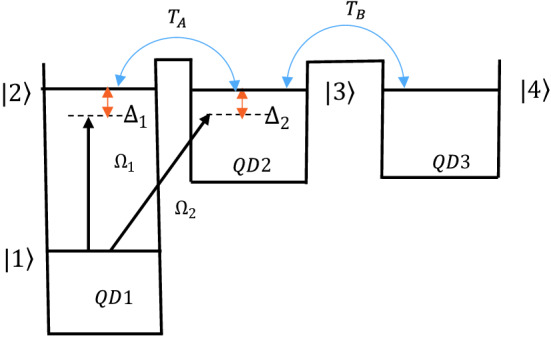
A four-level quantum dot molecule's band diagram. A triple quantum dot molecule is made up of three dots (“QD 1,” “QD 2,” and “QD 3”) with different tunneling rates and . The corresponding energy level structure is denoted by levels , and .
This quantum dot molecule is similar to a four-level atomic system as depicted in Fig. 1. The lower and higher conducting band levels of the left quantum dot are displayed by and , whereas the excited conducting band levels of the second and third quantum dots are denoted by and , respectively. The energy difference between the three upper levels and the lowest level is so large, thus their tunneling couplings are neglected. Levels and become close to the level if a gate voltage is applied, while level still has a large energy difference with the upper levels. A gate electrode placed between nearby quantum dots can adjust the tunnel barrier in triple quantum dots. When two laser fields resonantly couple the lower level to upper levels and in QD1 and QD2, an electron excites from level to the superposition of the upper levels and . For electron transition from level to level , the thin barrier thickness of QD1 and QD2 is required. In addition, tunneling allows an electron also to be transformed from QD1 to QD2 and from QD2 to QD3 by tunneling rates and . As an experimental example, a GaAs/AlGaAs heterostructure with a two-dimensional electron gas situated 470 Å below the surface and a sheet density of 3.7 × 1011 cm−2 and mobility 5 × 105 cm2/Vs at 10 K, and phase coherence length > 20 μm for can be used to create triple quantum dot samples39.
In the following discussion, we consider an ensemble of such four-level quantum dot molecules, and investigate the spatial-dependent degree of entanglement (DEM) as depicted in Ref.33 for atomic vapors. Thus, position dependent entanglement is presented via using various modes of the LG beam. The proposed coordinates x and y define as a point on the plane x–y perpendicular to the propagation direction of the LG beam.
Now, we present the Hamiltonian for the quantum-dot molecule described in Fig. 1. The Hamiltonian in Shrodinger picture is described as
| 1 |
Here, denotes the free energy part, while is the interaction Hamiltonian of the QD system with the LG fields. The term denotes the electron tunneling processes. Then tunneling effect may transfer the electron from QD1 to QD2 and QD3. Perturbation theory can be used to describe electron tunneling in a barrier, as demonstrated by Bardeen's technique40. The tunneling rate between two quantum dots can be controlled by the applied current, voltage, and thickness of the potential barrier. We assume that the coupling LG field of frequency is applied in the transition , while another LG field of frequency drives transition . To examine the position-dependent quantum-dot photon entanglement, we define the LG field with angular frequency , and Rabi-frequency and . Here, denote the amplitude of the beams that define as
| 2 |
where are cylindrical coordinates. The parameters l and p are LG beam mode parameters, which represent the azimuthal mode index and the radial index, respectively. The value of is set to be identical constant value. Here, and are the Riley length and the phase displacement. In addition, and are beam waist in distance , and radial cylindrical, respectively. Here is beam waist in The parameter represents the generalized Laguerre polynomial, is a required normalization constant, and shows the Gouy phase at position z. The radius curvature of the wavefront R(z) in the spherical approximation is expressed as
| 3 |
At point , the amplitude of the LG beam converts to
| 4 |
and the transverse view of LG beam intensity is
| 5 |
Here is the normalized intensity of the LG beam. Now the detailed form of Eq. (1) is given by
| 6 |
Here is the energy of level , and represent the Rabi-frequency between levels .
The density matrix elements in an arbitrary multilevel QDs system can be obtained using the Liouville equation as
| 7 |
where represents the relaxation mechanisms such as spontaneous emission and pure dephasing terms that are added to the density matrix through where 44. Here, and represent the radiative decay and pure dephasing rates, respectively. In addition denote the transition operates. Thus, all the incoherent processes that appeared in the density matrix element are imported through the parameters defined in Eq. (7).
Substituting Eqs. (6) in Eq. (7) provides the density matrix elements as
| 8 |
where we applied the rotating frame transformation as , , , and . Here, are the coherence term, and represent the population. Detuning parameters defined by the and where the frequency difference between two applied fields is . The terms declare as the frequency of the transitions . The total decay rates, , are given by , , which are determined by electron–electron interface roughness, phonon scattering processes, and are the dephasing rate of quantum coherence in pathway. The spontaneous emission from level to level is also denoted by
Now, we will determine the entanglement between the quantum dot molecule and its spontaneous emission field via the quantum entropy. Von-Neumann entropy utilizes for determining the DEM as
| 9 |
where is the reduced density matrix operator. Here and stand for quantum dot molecule and photon. The total entropy of the quantum-dot molecule and the spontaneous emission field is also determined by41
| 10 |
To measure the degree of entanglement of a pure state we only need the quantum dot molecule entropy , given in Eq. (9). The quantum-dot molecule entropy can also be represented according to the term of eigenvalues of the reduced density operator as a DEM. The degree of quantum dot-photon entanglement is then given by
| 11 |
where denotes the eigenvalues of the reduced density matrix operator.
Note that Von Neumann entropy can be interpreted as a measure of the unpredictability of a quantum state measurement. For calculating the DEM of subsystem, the reduced density matrix should be calculated, where the reduced density matrix is the entropy of studied subsystem. The entropy is defined as a measure of the system's disorder. The higher entropy of quantum system, the higher unpredictability or entanglement. So, the von-Neumann entropy of the reduced density matrix in the studied QDM is sufficient to quantify the degree of entanglement.
Note that in a realistic case the whole combined system is including QDM, photonic subsystem, i.e. free field modes due to spontaneous emission, and pure dephasing due to incoherent processes such as phonon scattering. So the whole state should be in a mixed state. This may destroy the coherence mechanisms in a realistic case even at low temperature, however slightly different choice of the pure dephasing model following Ref.42,43 does not qualitatively change our results.
Here, in order to obtain a quantum pure state, we consider the whole combined system of interest includes QDM and free fields created by spontaneous emission. Thus, we consider all the quantum dots initially in their ground states. In this case the total entropy of this pure system is time independent due to the unitary time evolution of the reduced density operators and . Then, by calculating the total entropy of the system, it is impossible to investigate the entanglement of quantum dots and its spontaneous emission. However, the reduced entropies, and , are time dependent and they can evaluate from a pure state to a mixed or maximally mixed state. Consequently, the total pure state becomes entangled and cannot be written as a tensor product of the two subsystems. Therefore, we utilize the reduced quantum entropy as a measure of the degree of entanglement between the quantum dots and its spontaneous emission field15,44.
Results and discussion
Now, we analyze the position-dependent entanglement between the quantum dot molecule and its spontaneous emission using the LG beam. For a paraxial beam such as the Laguerre Gaussian wave, the angular momentum can be divided into two categories: spin angular momentum relates to polarization and orbital angular momentum which is due to the spatial distribution of the wavefront45. The entanglement of the quantum dot-photon system depends on the intensity profile and the orbital angular momentum of the applied LG field. So different angular momentum implies various entanglement designs depending on spatial locations. Density matrix Eqs. (8) along with Eqs. (2) and (11) are numerically solved to reach the optimal . We chose the typical decay rate , and all the parameters are scaled in a unit of 46. Thus, the total decay and the spontaneous emission rates are , and , respectively47. Note that the maximum value of the entanglement for the N-level quantum system is . For the proposed four-level quantum dot molecule, the maximum value of the expected entanglement must be . We first examine the effect of quantum tunneling effect on quantum dot-photon entanglement to obtain the optimum values of and . Thus, the three-dimensional entanglement diagram as a function of tunneling effects is plotted in Fig. 2a. We observe that for and the maximum entanglement reaches DEM . These tunneling effects can be controlled by the applied voltage to the quantum dot molecule48. Therefore, the applied voltage can directly control quantum dot-photon entanglement. Physically this is an important mechanism, where the quantum coherence is produced just by the tunneling effect that is controlled by the gate voltage.
Figure 2.

(a) DEM plots as a function of and . Parameters are , and (b) DEM plots as a function of and for , and (c) Evolution of the population distribution a function of normalized time for , , and Other parameters are and .
We also propose the optimum value of and in Fig. 2b. It is observed that for and , the DEM will be maximized for and
This is due to the fact that the maximum entanglement can be reached by evenly population distribution in four-level of the proposed quantum dot system (Fig. 2c). Then, this leads to maximum quantum dot-photon entanglement, as can be viewed in Fig. 2a,b. Note that amount of entanglement is limited by where represents the dimension of the Hilbert space H. Thus, for the maximally mixed state with , where denote an identity matrix49, the DEM will be maximized.
Now, we are interested in studying the spatial distribution of the DEM in the x–y plane for different intensities of the applied LG fields. We consider LG modes for the applied fields and investigate the steady-state behavior of DEM at various points. The intensity profiles of LG modes for the first field (with ) and second field (with ) are displayed in Fig. 3a and b.
Figure 3.

Intensity profiles of applied LG fields (a) and (b). DEM density plots as a function of x–y (c), and population distribution as a function of x (y = 0) (d). Parameters are , and , , and . The parameter y represents the population distribution in presented levels.
The corresponding density plot of DEM is also displayed in Fig. 3c. From Fig. 3c, we observe that for x = 2.9 mm and y = − 0.01 mm, the maximum DEM = 1.93 is obtained. These points coincide with optimum values of and as can be viewed by Fig. 2b. For other parameters of and , the DEM will be decreased. As an example for x = − 6.91 mm and y = − 0.01 mm, the DEM is approaching zero, and at this point, the quantum dot-photon will be disentangled. These results are justified by the population distribution of four proposed levels as depicted in Fig. 3d. For x = 2.9 mm, a quarter of the population is approximately populated in each of the four-level, i.e. P = 0.238.
Figure 4 shows the spatial distribution of DEM for various modes of LG beams, i.e. . For a certain mode, the maximum DEM depends on the intensity profile of the LG modes. It is different for various presented modes. The corresponding population distribution is also displayed in Fig. 5, where the population is equally distributed in four-level, DEM reaches its maximum. However, for unequal distribution of population, the quantum dot and its spontaneous emission photon is will be disentangled.
Figure 4.

DEM density plots as a function of x and y for different modes for . Parameters are .
Figure 5.

Steady-state behavior of population versus x (y = 0) for l2 = 2 and l1 = − 1 (a), l2 = 1 and l1 = 1 (b) and l2 = − 2 and l1 = − 1 (c). Parameters are
For further discussion of the tunneling rate between neighbor quantum dots on quantum dot-photon entanglement, we show the DEM density plot for various tunneling rates in Fig. 6. For and at x = 2.78 mm and y = − 0.01 mm, and x = − 2.32 mm and y = − 0.01 mm, the population of the four presented levels are equally distributed (Fig. 6a), and the DEM at these points are maximum (Fig. 6b). So, the quantum dot and its spontaneous emission photon are entangled. In fact, a large tunneling effect between QD2 and QD3 populates level leading to the equality population distribution in four presented levels. This may also lead to strong quantum dot-photon entanglement as can be expected by where .
Figure 6.

Steady-state population distribution as a function of x (y = 0) (a, c), and DEM density plots as a function of x and y (b, d) for (a, b) and . Other parameters are .
However, for and and at the same points, the population are not equally distributed in four proposed levels as can be viewed in Fig. 6c. It is clear that the two strong coupling LG fields along with the tunneling rate lead to population trapping in three levels , , ; thus the population in level 4 tends to zero. This may lead to disentanglement between the quantum dot and its spontaneous emission photon (Fig. 6d). These results show that the tunneling rates have a direct effect on population distribution and also on the spatial distribution of the quantum dot-photon entanglement.
Conclusion
The entanglement between the triple quantum dot molecule and its spontaneous emission field is theoretically investigated by the LG fields. It is observed that the degree of entanglement and its position-dependent distribution are affected by the angular momentum of the LG lights. Thus, the position-dependent distribution of the DEM for various angular momentums of the LG fields is demonstrated. It is also shown that the spatial distribution of entanglement can be controlled by the tunneling rates between the two neighboring quantum dots. The presented results can be utilized in optical communications and information storage via preparing high-dimensional Hilbert space.
Author contributions
M.S. proposed the idea, supervised, wrote the manuscript, and analyzed the results. Y.D. wrote manuscript, performed simulation, and analysed the results. All of the authors participated in critical analysis and preparation of the manuscript.
Data availability
There is no supplementary data for manuscript. Correspondance and requests for materials should be addressed to Y.D.
Competing interests
The authors declare no competing interests.
Footnotes
Publisher's note
Springer Nature remains neutral with regard to jurisdictional claims in published maps and institutional affiliations.
References
- 1.Einstein A, Podolsky B, Rosen N. Can quantum-mechanical description of physical reality be considered complete? Phys. Rev. 1935;47:777. doi: 10.1103/PhysRev.47.777. [DOI] [Google Scholar]
- 2.O’Brien JL. Optical quantum computing. Science (80-.). 2007;318:1567. doi: 10.1126/science.1142892. [DOI] [PubMed] [Google Scholar]
- 3.Bennett CH, Brassard G, Crépeau C, Jozsa R, Peres A, Wootters WK. Teleporting an unknown quantum state via dual classical and Einstein-Podolsky-Rosen channels. Phys. Rev. Lett. 1993;70:1895. doi: 10.1103/PhysRevLett.70.1895. [DOI] [PubMed] [Google Scholar]
- 4.Boschi D, Branca S, De Martini F, Hardy L, Popescu S. Experimental realization of teleporting an unknown pure Quantum state via dual classical and Einstein-Podolsky-Rosen channels. Phys. Rev. Lett. 1998;80:1121. doi: 10.1103/PhysRevLett.80.1121. [DOI] [Google Scholar]
- 5.Ursin R, Zeilinger A, Lindenthal M, Aspelmeyer M, Jennewein T, Walther P, Kaltenbaek R. Communications quantum teleportation across the danube. Nature. 2004;430:849. doi: 10.1038/430849a. [DOI] [PubMed] [Google Scholar]
- 6.Li X, Pan Q, Jing J, Zhang J, Xie C, Peng K. Quantum dense coding exploiting a bright einstein-podolsky-rosen beam. Phys. Rev. Lett. 2002;88:047904. doi: 10.1103/PhysRevLett.88.047904. [DOI] [PubMed] [Google Scholar]
- 7.Ekert AK. Quantum cryptography based on Bell’s theorem. Phys. Rev. Lett. 1991;67:661. doi: 10.1103/PhysRevLett.67.661. [DOI] [PubMed] [Google Scholar]
- 8.Jennewein T, Simon C, Weihs G, Weinfurter H, Zeilinger A. Quantum cryptography with entangled photons. Phys. Rev. Lett. 2000;84:4729. doi: 10.1103/PhysRevLett.84.4729. [DOI] [PubMed] [Google Scholar]
- 9.Briegel H-J, Dür W, Cirac JI, Zoller P. Quantum repeaters: The role of imperfect local operations in quantum communication. Phys. Rev. Lett. 1998;81:5932. doi: 10.1103/PhysRevLett.81.5932. [DOI] [Google Scholar]
- 10.Blinov BB, Moehring DL, Duan L-M, Monroe C. Observation of entanglement between a single trapped atom and a single photon. Nature. 2004;428:153. doi: 10.1038/nature02377. [DOI] [PubMed] [Google Scholar]
- 11.Phoenix SJD, Knight PL. Establishment of an entangled atom-field state in the Jaynes-Cummings model. Phys. Rev. A. 1991;44:6023. doi: 10.1103/PhysRevA.44.6023. [DOI] [PubMed] [Google Scholar]
- 12.Volz J, Weber M, Schlenk D, Rosenfeld W, Vrana J, Saucke K, Kurtsiefer C, Weinfurter H. Observation of entanglement of a single photon with a trapped atom. Phys. Rev. Lett. 2006;96:030404. doi: 10.1103/PhysRevLett.96.030404. [DOI] [PubMed] [Google Scholar]
- 13.Fang M-F, Zhu S-Y. Entanglement between a -type three-level atom and its spontaneous emission fields. Phys. A Stat. Mech. Its Appl. 2006;369:475. doi: 10.1016/j.physa.2005.12.066. [DOI] [Google Scholar]
- 14.Abazari M, Mortezapour A, Mahmoudi M, Sahrai M. Phase-controlled atom-photon entanglement in a three-level v-type atomic system via spontaneously generated coherence. Entropy. 2011;13:150. doi: 10.3390/e13091541. [DOI] [Google Scholar]
- 15.Sangshekan B, Saghavaz NE, Gharamaleki AH, Sahrai M. Maximal atom-photon entanglement by the incoherent pumping fields. Eur. Phys. J. Plus. 2019;134:274. doi: 10.1140/epjp/i2019-12577-2. [DOI] [Google Scholar]
- 16.Sahrai M, Boroojerdi VTA. Dynamical behavior of atom-photon entanglement for a four-level atom near the band edge of a 3D-anisotropic photonic crystal. Quant. Inf. Process. 2017;16:145. doi: 10.1007/s11128-017-1590-2. [DOI] [Google Scholar]
- 17.Sahrai M, Arzhang B, Taherkhani D, Boroojerdi VTA. Control of the entanglement between triple quantum dot molecule and its spontaneous emission fields via quantum entropy. Phys. E Low-Dimens. Syst. Nanostruct. 2015;67:121. doi: 10.1016/j.physe.2014.11.005. [DOI] [Google Scholar]
- 18.Allen L, Beijersbergen MW, Spreeuw RJC, Woerdman JP. Orbital angular momentum of light and the transformation of laguerre-gaussian laser modes. Phys. Rev. A. 1992;45:8185. doi: 10.1103/PhysRevA.45.8185. [DOI] [PubMed] [Google Scholar]
- 19.Yao AM, Padgett MJ. Orbital angular momentum: Origins, behavior and applications. Adv. Opt. Photon. 2011;3:161. doi: 10.1364/AOP.3.000161. [DOI] [Google Scholar]
- 20.Babiker M, Power WL, Allen L. Light-induced torque on moving atoms. Phys. Rev. Lett. 1994;73:1239. doi: 10.1103/PhysRevLett.73.1239. [DOI] [PubMed] [Google Scholar]
- 21.Ruseckas J, Mekys A, Juzeliūnas G. Optical vortices of slow light using a tripod scheme. J. Opt. 2011;13:064013. doi: 10.1088/2040-8978/13/6/064013. [DOI] [Google Scholar]
- 22.Dutton Z, Ruostekoski J. Transfer and storage of vortex states in light and matter waves. Phys. Rev. Lett. 2004;93:193602. doi: 10.1103/PhysRevLett.93.193602. [DOI] [PubMed] [Google Scholar]
- 23.Walker G, Arnold AS, Franke-Arnold S. Trans-spectral orbital angular momentum transfer via four-wave mixing in Rb vapor. Phys. Rev. Lett. 2012;108:243601. doi: 10.1103/PhysRevLett.108.243601. [DOI] [PubMed] [Google Scholar]
- 24.Hamedi HR, Kudriašov V, Ruseckas J, Juzeliūnas G. Azimuthal modulation of electromagnetically induced transparency using structured light. Opt. Express. 2018;26:28249. doi: 10.1364/OE.26.028249. [DOI] [PubMed] [Google Scholar]
- 25.Radwell N, Clark TW, Piccirillo B, Barnett SM, Franke-Arnold S. Spatially dependent electromagnetically induced transparency. Phys. Rev. Lett. 2015;114:123603. doi: 10.1103/PhysRevLett.114.123603. [DOI] [PubMed] [Google Scholar]
- 26.Chen Q-F, Shi B-S, Zhang Y-S, Guo G-C. Entanglement of the orbital angular momentum states of the photon pairs generated in a hot atomic ensemble. Phys. Rev. A. 2008;78:053810. doi: 10.1103/PhysRevA.78.053810. [DOI] [Google Scholar]
- 27.Ruseckas J, Kudriašov V, Yu IA, Juzeliūnas G. Transfer of orbital angular momentum of light using two-component slow light. Phys. Rev. A. 2013;87:053840. doi: 10.1103/PhysRevA.87.053840. [DOI] [Google Scholar]
- 28.Moretti D, Felinto D, Tabosa JWR. Collapses and revivals of stored orbital angular momentum of light in a cold-atom ensemble. Phys. Rev. A. 2009;79:023825. doi: 10.1103/PhysRevA.79.023825. [DOI] [Google Scholar]
- 29.Yan Y, Xie G, Lavery MPJ, Huang H, Ahmed N, Bao C, Ren Y, Cao Y, Li L, Zhao Z, Molisch AF, Tur M, Padgett MJ, Willner AE. High-capacity millimetre-wave communications with orbital angular momentum multiplexing. Nat. Commun. 2014;5:4876. doi: 10.1038/ncomms5876. [DOI] [PMC free article] [PubMed] [Google Scholar]
- 30.Yan L, Gregg P, Karimi E, Rubano A, Marrucci L, Boyd R, Ramachandran S. Q-plate enabled spectrally diverse orbital-angular-momentum conversion for stimulated emission depletion microscopy. Optica. 2015;2:900. doi: 10.1364/OPTICA.2.000900. [DOI] [Google Scholar]
- 31.Das BC, Bhattacharyya D, De S. Narrowing of doppler and hyperfine line shapes of Rb–D2 transition using a vortex beam. Chem. Phys. Lett. 2016;644:212. doi: 10.1016/j.cplett.2015.12.004. [DOI] [Google Scholar]
- 32.Kazemi SH, Veisi M, Mahmoudi M. Atom localization using laguerre-gaussian beams. J. Opt. 2019;21:025401. doi: 10.1088/2040-8986/aafe61. [DOI] [Google Scholar]
- 33.Sabegh ZA, Amiri R, Mahmoudi M. Spatially dependent atom-photon entanglement. Sci. Rep. 2018;8:13840. doi: 10.1038/s41598-018-32051-8. [DOI] [PMC free article] [PubMed] [Google Scholar]
- 34.Mair A, Vaziri A, Weihs G, Zeilinger A. Entanglement of the orbital angular momentum states of photons. Nature. 2001;412:313. doi: 10.1038/35085529. [DOI] [PubMed] [Google Scholar]
- 35.Wang QK, Wang FX, Liu J, Chen W, Han ZF, Forbes A, Wang J. High-dimensional quantum cryptography with hybrid orbital-angular-momentum states through 25 Km of ring-core fiber: A proof-of-concept demonstration. Phys. Rev. Appl. 2021;15:1. [Google Scholar]
- 36.Goyal SK, Ibrahim AH, Roux FS, Konrad T, Forbes A. The effect of turbulence on entanglement-based free-space quantum key distribution with photonic orbital angular momentum. J. Opt. 2016;18:064002. doi: 10.1088/2040-8978/18/6/064002. [DOI] [Google Scholar]
- 37.Morgan KS, Miller JK, Cochenour BM, Li W, Li Y, Watkins RJ, Johnson EG. Free space propagation of concentric vortices through underwater turbid environments. J. Opt. 2016;18:104004. doi: 10.1088/2040-8978/18/10/104004. [DOI] [Google Scholar]
- 38.Peacock AC, Steel MJ. The time is right for multiphoton entangled states. Science (80-.). 2016;351:1152. doi: 10.1126/science.aaf2919. [DOI] [PubMed] [Google Scholar]
- 39.Waugh FR, Berry MJ, Mar DJ, Westervelt RM, Campman KL, Gossard AC. Single-electron charging in double and triple quantum dots with tunable coupling. Phys. Rev. Lett. 1995;75:705. doi: 10.1103/PhysRevLett.75.705. [DOI] [PubMed] [Google Scholar]
- 40.Reittu HJ. Fermi’s golden rule and Bardeen’s Tunneling theory. Am. J. Phys. 1995;63:940. doi: 10.1119/1.18037. [DOI] [Google Scholar]
- 41.Araki H, Lieb EH. Entropy Inequalities, in Inequalities. Springer; 2002. pp. 47–57. [Google Scholar]
- 42.Troiani F, Perea JI, Tejedor C. Cavity-Assisted Generation of Entangled Photon Pairs by a Quantum-Dot Cascade Decay. Springer; 2006. [Google Scholar]
- 43.Schumacher S, Jens F, Zrenner A, Gies C, Gartner P, Jahnke F. Cavity-assisted emission of polarization-entangled photons from biexcitons in quantum dots with fine-structure splitting abstract. Opt. Commun. 2012;20:217. doi: 10.1364/OE.20.005335. [DOI] [PubMed] [Google Scholar]
- 44.Ma YH, Mu QX, Zhou L. Entangled photons produced by a three-level atom in free-space. Opt. Commun. 2008;281:2695. doi: 10.1016/j.optcom.2007.12.070. [DOI] [Google Scholar]
- 45.Beth RA. Mechanical detection and measurement of the angular momentum of light. Phys. Rev. 1936;50:115. doi: 10.1103/PhysRev.50.115. [DOI] [Google Scholar]
- 46.Luo X-Q, Li Z-Z, Li T-F, Xiong W, You JQ. Tunable self-focusing and self-defocusing effects in a triple quantum dot via the tunnel-enhanced cross-Kerr nonlinearity. Opt. Express. 2018;26:32585. doi: 10.1364/OE.26.032585. [DOI] [PubMed] [Google Scholar]
- 47.Mehmannavaz MR. Electrical and optical control of entanglement entropy in a coupled triple quantum dot system. J. Mod. Opt. 2015;62:1391. doi: 10.1080/09500340.2015.1039946. [DOI] [Google Scholar]
- 48.Vafafard A, Sahrai M, Hamedi HR, Asadpour SH. Tunneling induced two-dimensional phase grating in a quantum well nanostructure via third and fifth orders of susceptibility. Sci. Rep. 2020;10:1. doi: 10.1038/s41598-019-56847-4. [DOI] [PMC free article] [PubMed] [Google Scholar]
- 49.Rehman J, Shin H. Purity-based continuity bounds for von Neumann entropy. Sci. Rep. 2019;9:13912. doi: 10.1038/s41598-019-50309-7. [DOI] [PMC free article] [PubMed] [Google Scholar]
Associated Data
This section collects any data citations, data availability statements, or supplementary materials included in this article.
Data Availability Statement
There is no supplementary data for manuscript. Correspondance and requests for materials should be addressed to Y.D.